ASC

ASC 325-30

Investments in Insurance Contracts

325 Investments—Other

Source downloaded: .Record version 7c6731527870. Effective date must be checked in the source.

ASC 325-30 governs investments in life insurance contracts held by entities that are the owner or beneficiary (e.g., corporate-owned or bank-owned life insurance), and, in separate Subsections, investments in life settlement contracts purchased from policy owners. The general rule is that a life insurance policy is reported as an asset measured at "the amount that could be realized under the insurance contract" at the balance sheet date, determined policy-by-policy (or certificate-by-certificate) and reflecting probable contractual limitations. For life settlement contracts, an investor makes an irrevocable, instrument-by-instrument election between the investment method (cost plus capitalized premiums and direct external costs, subject to impairment) and the fair value method (remeasured each period through earnings).

Key points (7)
  • An investment in a life insurance contract is reported as an asset (325-30-25-1) and measured subsequently at the amount that could be realized under the contract at the balance sheet date; death benefits may not be accrued on an actuarially expected or projected basis and are realized only on actual death (325-30-35-1).
  • The realizable amount is determined assuming surrender of each individual-life policy or certificate separately, including any amount realized on surrender of the final policy/certificate (325-30-35-5); if only group surrender is permitted, the amount is determined on a group basis (325-30-35-7).
  • Probable contractual limitations reduce the realizable amount, and amounts recoverable only at the insurer's discretion are excluded (325-30-35-3); amounts recoverable more than one year after surrender are discounted under Topic 835 (325-30-35-4), and the cash surrender value component is not discounted for surrender restrictions so long as the holder still participates in cash surrender value changes (325-30-35-6).
  • The change in cash surrender or contract value during the period is an adjustment of premiums paid in determining expense or income for the period (325-30-35-2), and contractual restrictions on the ability to surrender must be disclosed (325-30-50-1).
  • For life settlement contracts, the investor makes an irrevocable, instrument-by-instrument election of the investment method or the fair value method, supported by concurrent documentation or a preexisting automatic-election policy (325-30-25-2).
  • Investment method: initial measurement at transaction price plus initial direct external costs (325-30-30-1C), continuing premiums and direct external costs are capitalized (325-30-35-8), no gain is recognized until the insured dies (325-30-35-9), and impairment is tested when new information indicates expected undiscounted proceeds are less than carrying amount plus anticipated undiscounted future premiums and costs, with write-down to fair value (325-30-35-10 through 35-11).
  • Fair value method: initial measurement at transaction price (325-30-30-2) with remeasurement to fair value each reporting period and changes recognized in earnings (325-30-35-12); on death, the difference between carrying amount and insurance proceeds is recognized in earnings (325-30-40-1A), and fair value method amounts must be presented separately on the face of the balance sheet and income statement (325-30-45-1, 45-3).

For students. Exam traps: the asset is the amount realizable on assumed surrender policy-by-policy (so a surrender charge waived only on a full group surrender is NOT added back — see Example 1 at 325-30-55-4), and death benefits can never be accrued before death. Also remember the life settlement election is irrevocable and made instrument-by-instrument, which drives very different measurement, presentation, and disclosure outcomes.

Machine-generated study aid for ASC 325-30. Check the source paragraphs below.

325-30-00Status

Source downloaded: .Record version b3fd06769f14. Effective date must be checked in the source.

325-30-00-1
The following table identifies the changes made to this Subtopic.
Paragraph Action Accounting Standards Update Date
325-30-30-1AA Added Maintenance Update 2018-02 (PDF) 02/02/2018
325-30-30-1B Superseded Maintenance Update 2018-02 (PDF) 02/02/2018
325-30-50-3 Amended Maintenance Update 2014-07 (PDF) 03/17/2014

325-30-05Overview and Background

Source downloaded: .Record version c3a3a50f8446. Effective date must be checked in the source.

325-30-05-1
This Subtopic presents guidance in the following Subsections:
  1. a
    General
  2. b
    Life Settlement Contracts.
325-30-05-2
The General Subsections provide guidance on accounting for investments in life insurance contracts generally, including the calculation of the amount that could be realized under the life insurance contract.
325-30-05-3
A premium paid by a purchaser of life insurance serves a variety of purposes. A portion of the premium pays the insurer for assumption of mortality risk and provides for recovery of the insurer's contract acquisition, initiation, and maintenance costs. Another portion of the premium contributes to the accumulation of contract values. The relative amounts of premium payment credited to various contract attributes change over time as the age of the insured party increases and as earnings are credited to previously established contract values.
325-30-05-4
A life insurance contract is significantly different from most investment agreements. The various attributes of the policy could be obtained separately through term insurance and purchase of investment. The combination of benefits and contract values could not, however, typically be acquired absent the insurance contract. Continued protection from mortality risk and realization of scheduled increases in contract accumulation usually requires payment of future premiums.
325-30-05-5
The payment of insurance premiums may take a number of different forms. The insurance contract may be purchased through payment of a single premium, as opposed to the typical series of future premiums. Alternatively, the premium payments may be made through loans from the insurance entity that are secured by policy cash surrender values. The pattern of premium payments is a decision that does not alter the underlying nature of the insurance contract.
325-30-05-6
Life insurance policies are purchased by entities for a variety of purposes, including funding the cost of providing employee benefits and protecting against the loss of key persons. These types of policies have generally been known as corporate-owned life insurance or bank-owned life insurance. One of the primary benefits to using an insurance policy as a funding mechanism is the ability for an entity to receive the death benefits tax-free. Investment income is accumulated tax-free through the internal build-up of the cash surrender value. In the event that a policy is surrendered early, the policyholder will be responsible for paying the tax on the previously unrecognized investment income. The tax on the cash surrender value can be significant if the policies have been held for a number of years. Corporate-owned and bank-owned life insurance arrangements are established using several different insurance products, including all of the following:
  1. a
    Universal-life policies
  2. b
    Variable-life policies
  3. c
    Whole-life policies.
325-30-05-7
There are a few basic structures currently used as a framework for most policies in the marketplace. However, these structures can be combined and modified in many different ways and, therefore, can be quite complex. All of the following life insurance policy structures are considered in this guidance:
  1. a
    Individual-life policy. The individual-life policy generally has one contract value component and, in some cases, a surrender charge. The amount that could be realized for this policy upon surrender is the amount reported by the insurance entity to the policyholder as the cash surrender value.
  2. b
    Multiple individual-life policies. Many entities purchase separate individual-life policies for each employee. Similar to the individual-life policy, each policy has only one contract value component and in some cases a surrender charge. If one or more, but not all, policies are surrendered, the policyholder will incur the surrender charges on those policies surrendered. This will result in a permanent loss of asset value to the extent of the surrender charge. However, a rider (or a contractual stipulation) can be obtained for the insurance policy that will waive the surrender charges on each individual policy if all of the policies are surrendered at the same time. The cost of the rider will vary depending on the individual facts and circumstances.
  3. c
    Group-life policy. The group-life policy constitutes the legal contract with the insurance entity that covers individual-life insurance for multiple employees. Each individual in the group policy is issued a certificate. If the group policy is cancelled, each of the individual certificates is terminated. While certificates are issued pursuant to the policy and form part of the policy, the group-life policy contract is the controlling document. Under the group-life policy, individual-life insurance certificates can be surrendered separately and the cash surrender value for the certificate is received by the policyholder for the full surrender amount of that certificate.
325-30-05-8
Additionally, a number of policies include certain provisions that can make them more attractive to the policyholder (for example, a provision allowing for the recovery of certain costs). However, many provisions limit the amount that is realized and may necessitate the meeting of certain criteria to recover any of those amounts. Some of the more typical examples of limitations that exist include all of the following:
  1. a
    The prohibition against having a change of control or a restructuring occurring within the last 24 months
  2. b
    A planned restructuring within the next 12 months
  3. c
    The extent to which the policyholder is in a net operating loss carryforward position.
The amount associated with the termination of the policy may be received over an extended period of time after the surrender of the life insurance policy or certificate.
325-30-05-9
Other attributes include any of the following:
  1. a
    Multiple individual policies with a separate, group-level rider agreement
  2. b
    Multiple individual policies with a contractual stipulation in each individual policy referencing the other policies as a group
  3. c
    A group-life policy that has multiple certificates (individual life insurance for multiple employees).
These contracts may provide the policyholder with an amount that upon surrender is greater if all individual policies are surrendered at the same time rather than if the individual policies are surrendered over a period of time. The amount that can be realized under the insurance contract (that is, converted into cash) is dependent on how the contract is assumed to be hypothetically settled and, if surrendered, whether the insurance policies are surrendered at the individual or group level.

Exchange of Mutual Membership Interests for Stock in a Demutualization

325-30-05-9A
To effect a demutualization, an entity may be required to issue consideration, often in the form of stock, to existing participating policyholders in exchange for their current membership interests. The receipt of such stock has no direct effect on the policyholders' contractual interests of their insurance policies (for example, it does not alter the cash surrender value of their life insurance policies). However, the governance of the mutual insurance entity and, in particular, the participating policyholders' interest in that governance are modified.

Life Settlement Contracts

325-30-05-10
The Life Settlement Contracts Subsections provide guidance on accounting for an investment in a life settlement contract.

325-30-15Scope and Scope Exceptions

Source downloaded: .Record version 3d083d342aff. Effective date must be checked in the source.

Entities

325-30-15-1
The guidance in this Subtopic applies to all entities.

Transactions

325-30-15-2
The guidance in this Subtopic applies to all transactions for entities purchasing life insurance in which the entity is either the owner or beneficiary of the contract, without regard to the funding objective of the purchase (other than life settlement contracts). Such purchases would typically include those intended to meet loan covenants or to fund deferred compensation agreements, buy-sell agreements, or postemployment death benefits.
325-30-15-3
Purchases of life insurance by retirement plans that are subject to Topic 960 are not within the scope of this Subtopic.
325-30-15-4
Internal Revenue Code Section 1035 exchanges do not constitute a cash surrender.

Life Settlement Contracts

Entities

325-30-15-5
The guidance in the Life Settlement Contracts Subsections applies to all entities.

Transactions

325-30-15-6
The guidance in the Life Settlement Contracts Subsections applies to both transactions in which a broker facilitates settlement transactions between the policy owner and the investor, and transactions that do not involve a broker.

325-30-25Recognition

Source downloaded: .Record version 7a539a02489d. Effective date must be checked in the source.

325-30-25-1
An investment in a life insurance contract shall be reported as an asset.

Exchange of Mutual Membership Interests for Stock in a Demutualization

325-30-25-1A
An entity shall recognize stock received from a demutualization and subsequently follow the guidance in Subtopics 320-10 or 323-10 as applicable.

Life Settlement Contracts

325-30-25-2
An investor shall elect to account for its investments in life settlement contracts using either the investment method or the fair value method. The election shall be made on an instrument-by-instrument basis and is irrevocable. The election shall be supported by concurrent documentation or a preexisting documented policy for automatic election.

325-30-30Initial Measurement

Source downloaded: .Record version dc2c07c6cb51. Effective date must be checked in the source.

325-30-30-1
A policyholder shall consider any additional amounts included in the contractual terms of the policy in determining the amount that could be realized under the life insurance contract.
325-30-30-1A
An entity also shall apply the measurement guidance in paragraphs at initial measurement.

Exchange of Mutual Membership Interests for Stock in a Demutualization

325-30-30-1AA
Stock received from a demutualization shall be measured initially at fair value.

Life Settlement Contracts

Investment Method

325-30-30-1C
Under the investment method, an investor shall measure its investment in a life settlement contract initially at the transaction price plus all initial direct external costs.

Fair Value Method

325-30-30-2
Under the fair value method, an investor shall measure its investment in a life settlement contract initially at the transaction price.

325-30-35Subsequent Measurement

Source downloaded: .Record version c299e3f6626a. Effective date must be checked in the source.

325-30-35-1
An asset representing an investment in a life insurance contract shall be measured subsequently at the amount that could be realized under the insurance contract as of the date of the statement of financial position. It is not appropriate for the purchaser of life insurance to recognize income from death benefits on an actuarially expected basis. The death benefit shall not be realized before the actual death of the insured, and recognizing death benefits on a projected basis is not an appropriate measure of the asset.
325-30-35-2
The change in cash surrender or contract value during the period is an adjustment of premiums paid in determining the expense or income to be recognized under the contract for the period.
325-30-35-3
Paragraph 325-30-30-1 states that a policyholder shall consider any additional amounts included in the contractual terms of the policy in determining the amount that could be realized under the life insurance contract. When it is probable that contractual terms would limit the amount that could be realized under the life insurance contract, these contractual limitations shall be considered when determining the realizable amounts. Those amounts that are recoverable by the policyholder at the discretion of the insurance entity shall be excluded from the amount that could be realized under the life insurance contract.
325-30-35-4
Amounts that are recoverable by the policyholder in periods beyond one year from the surrender of the policy shall be discounted in accordance with Topic 835.
325-30-35-5
A policyholder shall determine the amount that could be realized under the life insurance contract assuming the surrender of an individual-life by individual-life policy (or certificate by certificate in a group policy). Any amount that ultimately would be realized by the policyholder upon the assumed surrender of the final policy (or final certificate in a group policy) shall be included in the amount that could be realized under the insurance contract. See Example 1 (paragraph 325-30-55-1) for an illustration of this guidance.
325-30-35-6
A policyholder shall not discount the cash surrender value component of the amount that could be realized under the insurance contract when contractual restrictions on the ability to surrender a policy exist, as long as the holder of the policy continues to participate in the changes in the cash surrender value as it had done before the surrender request. If, however, the contractual restrictions prevent the policyholder from participating in changes to the cash surrender value component, then the amount that could be realized under the insurance contract at a future date shall be discounted in accordance with Topic 835.
325-30-35-6A
Paragraph 325-30-30-1A states that an entity also shall apply the measurement guidance in paragraphs at initial measurement.
325-30-35-7
If a group of individual-life policies or a group policy only allows for the surrender of all of the individual-life policies or certificates as a group, then the policyholder shall determine the amount that could be realized under the insurance contract on a group basis.

Life Settlement Contracts

Investment Method

325-30-35-8
Continuing costs (policy premiums and direct external costs, if any) to keep the policy in force shall be capitalized.
325-30-35-9
The investor shall not recognize a gain until the insured dies (see paragraph 325-30-40-1A).
325-30-35-10
An investor shall test an investment in a life settlement contract for impairment if the investor becomes aware of new or updated information that indicates that the expected proceeds from the insurance policy will not be sufficient to recover the carrying amount of the investment plus anticipated undiscounted future premiums and capitalizable direct external costs, if any, when the insured dies. Factors include, but are not limited to, a change in expected mortality and a change in the creditworthiness of the issuer of the underlying insurance policy. A change in interest rates would not of itself require an investment in a life settlement contract to be tested for impairment.
325-30-35-11
An investor shall recognize an impairment loss if the expected undiscounted cash inflows (typically, the insurance proceeds) are less than the carrying amount of the investment plus anticipated undiscounted future premiums and capitalizable direct external costs, if any. If an impairment loss is recognized, the investment shall be written down to fair value. The fair value measurement shall consider current interest rates.

Fair Value Method

325-30-35-12
In subsequent periods, the investor shall remeasure the investment in a life settlement contract at fair value in its entirety at each reporting period and shall recognize changes in fair value in earnings (or other performance indicators for entities that do not report earnings) in the period in which the changes occur.

325-30-40Derecognition

Source downloaded: .Record version 52b81e59efe8. Effective date must be checked in the source.

Life Settlement Contracts

Exchange of Mutual Membership Interests for Stock in a Demutualization

325-30-40-1
Any gain on an exchange of mutual membership interests for stock in a demutualization shall be recognized in income from continuing operations.

Investment Method

325-30-40-1A
Upon the death of the insured, the investor shall recognize in earnings (or other performance indicators for entities that do not report earnings) the difference between the carrying amount of a life settlement contract and the life insurance proceeds of the underlying life insurance policy.

325-30-45Other Presentation Matters

Source downloaded: .Record version 4f5e83c7685d. Effective date must be checked in the source.

Life Settlement Contracts

Statement of Financial Position

325-30-45-1
An investor shall report its investments that are remeasured at fair value on the face of the statement of financial position separately from those accounted for under the investment method. To accomplish that separate reporting, an investor shall do either of the following:
  1. a
    Display separate line items on the statement of financial position for the fair value method and investment method carrying amounts
  2. b
    Present the aggregate of those fair value method and investment method carrying amounts and parenthetically disclose the amount of those investments accounted for under the fair value method included in the aggregate amount.

Income Statement

325-30-45-2
The investor shall classify the amount recognized upon the death of the insured in accordance with paragraph 325-30-35-9 in earnings (or other performance indicators for entities that do not report earnings).
325-30-45-3
An investor shall report the investment income from its investments in life settlement contracts that are remeasured at fair value on the face of the income statement separately from the investment income from those accounted for under the investment method. To accomplish that separate reporting, an investor shall do either of the following:
  1. a
    Display separate line items on the income statement for the investment income from the investments in life settlement contracts that are accounted for under the fair value method and investment method
  2. b
    Present the aggregate of the investment income in life settlement contracts and parenthetically disclose the investment income from those investments accounted for under the fair value method that are included in the aggregate amount.
325-30-45-4
An investor applying the fair value method shall account for premiums paid and life insurance proceeds received on the same financial reporting line as the changes in fair value are reported.

Statement of Cash Flows

325-30-45-5
An investor shall classify cash receipts and cash payments related to life settlement contracts in accordance with Topic 230, based on the nature and purpose for which the life settlements were acquired.

325-30-50Disclosure

Source downloaded: .Record version 8179c833ee88. Effective date must be checked in the source.

325-30-50-1
A policyholder shall disclose contractual restrictions on the ability to surrender a policy.

Life Settlement Contracts

325-30-50-2
An investor shall disclose its accounting policy for life settlement contracts, including the classification of cash receipts and cash disbursements, in the statement of cash flows.
325-30-50-3
The disclosure requirements in this Subsection do not eliminate disclosure requirements included in other Topics, including other disclosure requirements on the use of fair value.

Investment Method

325-30-50-4
An investor shall disclose all of the following for life settlement contracts accounted for under the investment method based on the remaining life expectancy for each of the first five succeeding years from the date of the statement of financial position and thereafter, as well as in the aggregate:
  1. a
    The number of life settlement contracts
  2. b
    The carrying value of the life settlement contracts
  3. c
    The face value (death benefits) of the life insurance policies underlying the contracts.
325-30-50-5
An investor shall disclose the life insurance premiums anticipated to be paid for each of the five succeeding fiscal years to keep the life settlement contracts in force as of the date of the most recent statement of financial position presented.
325-30-50-6
If the investor becomes aware of new or updated information that causes it to change its expectations on the timing of the realization of proceeds from the investments in life settlement contracts, the investor shall disclose the nature of the information and the related effect on the timing of the realization of proceeds from the life settlement contracts. This includes disclosing significant changes to the amounts disclosed in accordance with paragraph 325-30-50-4. However, an investor shall not be required to actively seek out new or updated information to update the assumptions used in determining the remaining life expectancy of the life settlement contracts.

Fair Value Method

325-30-50-7
An investor shall disclose the method(s) and significant assumptions used to estimate the fair value of investments in life settlement contracts, including any mortality assumptions.
325-30-50-8
An investor shall disclose all of the following for life settlement contracts accounted for under the fair value method based on remaining life expectancy for each of the first five succeeding years from the date of the statement of financial position and thereafter, as well as in the aggregate:
  1. a
    The number of life settlement contracts
  2. b
    The carrying value of the life settlement contracts
  3. c
    The face value (death benefits) of the life insurance policies underlying the contracts.
325-30-50-9
The investor shall disclose the reasons for changes in its expectation of the timing of the realization of the investments in life settlement contracts. This includes disclosing significant changes to the amounts disclosed in accordance with paragraph 325-30-50-8.
325-30-50-10
An investor shall disclose both of the following for each reporting period presented in the income statement:
  1. a
    The gains or losses recognized during the period on investments sold during the period
  2. b
    The unrealized gains or losses recognized during the period on investments that are still held at the date of the statement of financial position.

325-30-55Implementation Guidance and Illustrations

Source downloaded: .Record version ba5ba9ff4b74. Effective date must be checked in the source.

Illustrations

325-30-55-1
This Example illustrates the application of the guidance in the General Subsections of this Subtopic to life insurance contracts other than life settlement contracts.
325-30-55-2
On January 1, 19X7, Entity TKO purchases a group variable-life policy on 20 executives of Entity TKO. The insurance entity issued an individual certificate for each executive when the policy was purchased. The entire policy was funded with an initial single premium of $10,000,000. Entity TKO will be paid the stated death benefit of the certificate when the insured dies. The policy contains a surrender charge of $50,000 per certificate if a certificate is surrendered. If all of the certificates are surrendered at once (that is, if the group policy is surrendered) the surrender charge is waived. The policy includes a claims stabilization reserve account and a provision that allows for the recovery of the upfront deferred acquisition costs tax over 11 years on a certificate-by-certificate basis even when an individual certificate is surrendered. The remaining balance in the claims stabilization reserve is paid out in cash to Entity TKO upon surrender of the final certificate. At December 31, 20X5, the individual components of Entity TKO's policy have the following values:
  1. a
    Policy account balance = $9,700,000
  2. b
    Cash surrender value = $8,700,000
  3. c
    Claims stabilization reserve = $500,000
  4. d
    Deferred acquisition costs tax (on a discounted basis) = $250,000.
325-30-55-3
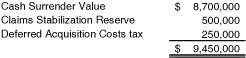
The following is an illustration of the amounts to be included in Entity TKO's financial statements at December 31, 20X5, under this Subtopic.
  • Cash Surrender Value " $8,700,000 " Claims Stabilization Reserve " 500,000 " Deferred Acquisition Costs tax " 250,000 " " $9,450,000 "
325-30-55-4
In evaluating the circumstances to determine the amount that could be realized under the insurance contract, Entity TKO considers the cash surrender value (policy account balance of $9,700,000 less surrender charge of $1,000,000), the claims stabilization reserve, and the deferred acquisition costs tax as each of these amounts is realizable based on the contractual terms and is not dependent on surrendering all of the policies at once. The claims stabilization reserve is included in the amount that could be realized because the claims stabilization reserve will be recovered when the final policy is surrendered and is not dependent on the surrender of all of the policies at once. The surrender charge of $1,000,000 (20 certificates at $50,000 per certificate) is not assumed to be waived because the waiver of those charges requires the surrender of all of the certificates at once.

Related subtopics