ASC

ASC 605-944

Financial Services—Insurance

605 Revenue Recognition

Source downloaded: .Record version 132ac680bb06. Effective date must be checked in the source.

ASC 944-605 governs when and how insurance entities recognize premium revenue, split into short-duration, long-duration, reinsurance, and financial guarantee subsections. Short-duration premiums are earned over the contract (or risk) period in proportion to insurance protection provided; long-duration premiums are recognized when due from policyholders; universal life-type contract revenue is limited to amounts assessed against policyholders, with front-end fees deferred as unearned revenue. Reinsurance sections address prepaid reinsurance premiums, deferral and amortization of retroactive reinsurance gains, and the open year versus periodic method for foreign reinsurance.

Key points (7)
  • Short-duration premiums are recognized as revenue over the contract period (or period of risk if significantly different) in proportion to the insurance protection provided, generally evenly (944-605-25-1); if the ultimate premium is not reasonably estimable, the cost recovery or deposit method may be used (944-605-25-2).
  • Long-duration contract premiums are recognized as revenue over the premium-paying period when due from policyholders (944-605-25-3), and gross premium in excess of net premium on limited-payment contracts is deferred as a deferred profit liability (944-605-25-4A) recognized in constant relationship to insurance in force or expected future benefit payments (944-605-35-1 through 35-1C).
  • Premiums collected on universal life-type contracts are not revenue; revenue is the amounts assessed against policyholders in the period assessed, with assessments for future services and front-end/initiation fees recorded as unearned revenue (944-605-25-5 through 25-7) and amortized using the same assumptions used for deferred acquisition costs (944-605-35-2).
  • Title insurance premiums are recognized on the effective date of the contract (or binder date if the entity is legally or contractually entitled to the premium) (944-605-25-12), and agent-issued contracts are recognized when agents are entitled to premiums if reasonably estimable (944-605-25-13).
  • Prospective reinsurance amounts paid are reported as prepaid reinsurance premiums amortized over the remaining contract period in proportion to protection provided (944-605-25-20; 944-605-35-8); retroactive reinsurance gains (liabilities exceeding amounts paid) are deferred and amortized by the interest or recovery method (944-605-25-22; 944-605-35-9), while excess of amounts paid over liabilities is charged to earnings immediately (944-605-25-23).
  • Foreign reinsurance must use the periodic method unless the foreign ceding entity cannot supply information to estimate ultimate premiums and periods under U.S. GAAP, in which case the open year method defers premiums, claims, commissions, and direct taxes in an open underwriting balance until earned premiums are reasonably estimable (944-605-25-17 through 25-19; 944-605-35-5 through 35-7).
  • For financial guarantee insurance contracts, an unearned premium revenue liability (the stand-ready obligation) is recognized at inception measured at the premium received or the present value of premiums due/expected (944-605-25-25; 944-605-30-5 through 30-7) and released to revenue using a constant rate applied to insured principal amounts outstanding (944-605-25-27 through 25-29); on a refunding, remaining nonrefundable unearned premium and deferred acquisition costs are recognized immediately (944-605-25-32 through 25-33).

For students. Insurance revenue recognition is largely carved out of ASC 606, so know that "premium collected" is not automatically "revenue"—for universal life-type contracts only assessments are revenue, and for retroactive reinsurance a day-one gain must be deferred (losses, by contrast, hit earnings immediately). The most common error is applying general revenue models or netting reinsurance recoverables against gross liabilities when no right of setoff exists.

Machine-generated study aid for ASC 605-944. Check the source paragraphs below.

605-944-00Status

Source downloaded: .Record version 168222492945. Effective date must be checked in the source.

605-944-00-1
The following table identifies the changes made to this Subtopic.
Paragraph Action Accounting Standards Update Date
Acquisition Costs Amended Accounting Standards Update No. 2010-26 10/13/2010
Contract Period Amended Accounting Standards Update No. 2016-19 12/14/2016
Liability for Future Policy Benefits Added Accounting Standards Update No. 2018-12 08/15/2018
Net Premiums Amended Accounting Standards Update No. 2018-12 08/15/2018
Reinsurance Receivable Superseded Accounting Standards Update No. 2016-19 12/14/2016
Reinsurance Recoverable Added Accounting Standards Update No. 2016-19 12/14/2016
944-605-05-1 Amended Accounting Standards Update No. 2016-19 12/14/2016
944-605-05-7 Amended Accounting Standards Update No. 2009-02 07/01/2009
944-605-05-8 Amended Accounting Standards Update No. 2009-02 07/01/2009
944-605-25-8 Superseded Accounting Standards Update No. 2018-12 08/15/2018
944-605-25-11 Superseded Accounting Standards Update No. 2018-12 08/15/2018
944-605-25-21 Amended Accounting Standards Update No. 2016-01 01/05/2016
944-605-25-22 Amended Accounting Standards Update No. 2016-19 12/14/2016
944-605-25-23 Amended Accounting Standards Update No. 2016-19 12/14/2016
944-605-25-24 Amended Accounting Standards Update No. 2009-02 07/01/2009
944-605-30-1 Amended Accounting Standards Update No. 2018-12 08/15/2018
944-605-30-2 Amended Accounting Standards Update No. 2018-12 08/15/2018
944-605-30-2A Added Accounting Standards Update No. 2018-12 08/15/2018
944-605-35-1 Amended Accounting Standards Update No. 2018-12 08/15/2018
944-605-35-1A Amended Accounting Standards Update No. 2018-12 08/15/2018
944-605-35-1B Added Accounting Standards Update No. 2018-12 08/15/2018
944-605-35-1C Added Accounting Standards Update No. 2018-12 08/15/2018
944-605-35-8 Amended Accounting Standards Update No. 2012-04 10/01/2012
944-605-35-9 Amended Accounting Standards Update No. 2012-04 10/01/2012
944-605-35-12 Amended Accounting Standards Update No. 2016-19 12/14/2016
944-605-45-1 Amended Maintenance Update 2016-11 (PDF) 06/27/2016
944-605-55-1 Amended Accounting Standards Update No. 2016-19 12/14/2016
944-605-55-11 Amended Accounting Standards Update No. 2016-19 12/14/2016
944-605-55-12 Amended Accounting Standards Update No. 2016-19 12/14/2016
944-605-55-14 Amended Accounting Standards Update No. 2016-19 12/14/2016
944-605-55-15 Amended Accounting Standards Update No. 2016-19 12/14/2016

605-944-05Overview and Background

Source downloaded: .Record version 3f3fe40daa53. Effective date must be checked in the source.

605-944-05-1
This Subtopic provides guidance to insurance entities on accounting for and financial reporting of revenue from insurance contracts. The guidance in this Subtopic is presented in the following five Subsections:
  1. a
    General
  2. b
    Short-Duration Contracts
  3. c
    Long-Duration Contracts
  4. d
    Reinsurance Contracts
  5. e
    Financial Guarantee Insurance Contracts.

Short-Duration Contracts

605-944-05-2
The Short-Duration Contracts Subsections of this Subtopic provide guidance to insurance entities on accounting for and financial reporting of revenue from short-duration insurance contracts.

Long-Duration Contracts

605-944-05-3
The Long-Duration Contracts Subsections of this Subtopic provide guidance to insurance entities on accounting for and financial reporting of revenue from long-duration insurance contracts.

Reinsurance Contracts

605-944-05-4
The Reinsurance Contracts Subsections of this Subtopic provide guidance to insurance entities on accounting for and financial reporting of revenue from reinsurance contracts.

All Reinsurance Contracts

605-944-05-5
Reinsurers assuming business from domestic entities historically have had sufficient information to monitor and account for contract results. In contrast, some reinsurers assuming business from foreign entities do not receive such information, because in some foreign jurisdictions, insurance entities' accounting and reporting practices concerning periodic recognition of revenue and incurred claims are substantially different from U.S. practices. Therefore, reinsurers assuming business from foreign ceding entities cannot always obtain sufficient information to periodically estimate earned premiums for the business assumed from the foreign ceding entities.
605-944-05-6
A significant amount of reinsurance is transacted through syndicates organized by Lloyd's of London. Lloyd's syndicates report the amounts of premiums, claims, and expenses recorded in an underwriting account for a particular year to the assuming entities that participate in the syndicates. The syndicates generally keep accounts open for three years. Traditionally, three years have been necessary to report substantially all premiums associated with an underwriting year and to report most related claims, although claims may remain unsettled after the account is closed. A Lloyd's syndicate typically closes an underwriting account by reinsuring outstanding claims on that account with a syndicate for the next underwriting year. The ceding syndicate pays the assuming syndicate an amount based on the unearned premiums and outstanding claims in the underwriting account at the date of the assumption and distributes the remaining balance to its participants.

Financial Guarantee Insurance Contracts

605-944-05-9
The Financial Guarantee Insurance Contracts Subsections of this Subtopic provide guidance to insurance entities on accounting for and financial reporting of revenue from financial guarantee insurance contracts.

Early Retirement and Replacement of an Insured Financial Obligation

605-944-05-10
In some cases, the issuer of an insured financial obligation will retire an insured financial obligation before its maturity and replace it with a new financial obligation. That situation, referred to as a refunding, often occurs when interest rates decrease and the insured financial obligation is replaced with a new financial obligation at a lower interest rate.

605-944-15Scope and Scope Exceptions

Source downloaded: .Record version 3f55e9491662. Effective date must be checked in the source.

Overall Guidance

605-944-15-1
This Subtopic follows the same Scope and Scope Exceptions as outlined in the Overall Subtopic, see Section 944-10-15, with specific entity exceptions noted below.

Entities

605-944-15-2
The guidance in this Subtopic does not apply to mortgage guaranty insurance entities.

Short-Duration Contracts

Overall Guidance

605-944-15-3
The Short-Duration Contracts Subsections of this Subtopic follow the same Scope and Scope Exceptions as outlined in the General Subsection of this Section, with specific instrument exceptions noted below.

Instruments

605-944-15-4
The guidance in the Short-Duration Contracts Subsections of this Subtopic applies only to short-duration contracts. See the Short-Duration Contracts Subsection of Section 944-20-15 for a discussion of what constitutes a short-duration contract.

Long-Duration Contracts

Overall Guidance

605-944-15-5
The Long-Duration Contracts Subsections of this Subtopic follow the same Scope and Scope Exceptions as outlined in the General Subsection of this Section, with specific instrument exceptions noted below.

Instruments

605-944-15-6
The guidance in the Long-Duration Contracts Subsections of this Subtopic applies only to long-duration contracts. See the Long-Duration Contracts Subsection of Section 944-20-15 for a discussion of what constitutes a long-duration contract.

Reinsurance Contracts

Overall Guidance

605-944-15-7
The Reinsurance Contracts Subsections of this Subtopic follow the same Scope and Scope Exceptions as outlined in the General Subsection of this Section, with specific instrument exceptions noted below.

Instruments

605-944-15-8
The guidance in the Reinsurance Contracts Subsections of this Subtopic applies only to reinsurance contracts. See the Reinsurance Contracts Subsection of Section 944-20-15 for a discussion of what constitutes a reinsurance contract.

Financial Guarantee Insurance Contracts

605-944-15-9
The guidance in the Financial Guarantee Insurance Contracts Subsections of this Subtopic applies only to financial guarantee insurance contracts (which include financial guarantee reinsurance contracts).

605-944-25Recognition

Source downloaded: .Record version 2edc9c88c410. Effective date must be checked in the source.

Short-Duration Contracts

605-944-25-1
Premiums from short-duration contracts shall be recognized as revenue over the period of the contract in proportion to the amount of insurance protection provided. For those few types of contracts for which the period of risk differs significantly from the contract period, premiums shall be recognized as revenue over the period of risk in proportion to the amount of insurance protection provided. That generally results in premiums being recognized as revenue evenly over the contract period (or the period of risk, if different), except for those few cases in which the amount of insurance protection declines according to a predetermined schedule.
605-944-25-2
If premiums are subject to adjustment (for example, retrospectively rated or other experience-rated insurance contracts for which the premium is determined after the period of the contract based on claim experience or reporting-form contracts for which the premium is adjusted after the period of the contract based on the value of insured property), premium revenue shall be recognized as follows:
  1. a
    If the ultimate premium is reasonably estimable, the estimated ultimate premium shall be recognized as revenue over the period of the contract. The estimated ultimate premium shall be revised to reflect current experience.
  2. b
    If the ultimate premium cannot be reasonably estimated, the cost recovery method or the deposit method may be used until the ultimate premium becomes reasonably estimable.

Long-Duration Contracts

Traditional Long-Duration Contracts

605-944-25-3
Because no single function or service is predominant over the periods of most types of long-duration contracts, premiums shall be recognized as revenue over the premium-paying periods of the contracts when due from policyholders. This includes premiums from whole-life contracts, guaranteed renewable term life contracts, title insurance contracts, and participating life insurance contracts that meet the criteria in paragraph 944-20-15-3.
605-944-25-4
Premium revenue from long-duration contracts generally exceeds expected policy benefits in the early years of the contracts and it is necessary to accrue, as premium revenue is recognized, a liability for costs that are expected to be paid in the later years of the contracts. See Subtopic 944-40 for specific guidance.

Limited-Payment Contracts

605-944-25-4A
Because the collection of premium under a limited-payment contract does not represent the completion of an earnings process, any gross premium received in excess of the net premium shall be deferred.

Universal Life-Type Contracts

605-944-25-5
Premiums collected on universal life-type contracts shall not be reported as revenue in the statement of earnings of the insurance entity. Revenue from those contracts shall represent amounts assessed against policyholders and shall be reported in the period that the amounts are assessed unless evidence indicates that the amounts are designed to compensate the insurer for services to be provided over more than one period.
605-944-25-6
Amounts assessed that represent compensation to the insurance entity for services to be provided in future periods are not earned in the period assessed. Such amounts shall be recognized as unearned revenue.
605-944-25-7
Amounts that are assessed against the policyholder balance as consideration for origination of the contract, often referred to as initiation or front-end fees, shall be recognized as unearned revenues.
605-944-25-9
An insurance entity shall not record a liability for unearned revenue if the purpose is an attempt to inappropriately level the contract's gross profit over the life of the contract or the accrual would serve to produce a level gross profit from the mortality benefit over the life of the contract.
605-944-25-10
This Subtopic does not limit the accrual of unearned revenue for insurance benefit features of universal life-type contracts to situations where profits are expected to be followed by losses; that is, the facts and circumstances of each situation must be considered in determining the need for accruing unearned revenue.

Title Insurance Contracts

605-944-25-12
Except as noted in the next sentence, premiums from title insurance contracts shall be considered due from policyholders and, accordingly, recognized as revenue on the effective date of the insurance contract because most of the services associated with the contract have been rendered by that time. However, the binder date is appropriate if the insurance entity is legally or contractually entitled to the premium on the binder date.
605-944-25-13
If reasonably estimable, premium revenue and costs relating to title insurance contracts issued by agents shall be recognized when the agents are legally or contractually entitled to the premiums, using estimates based on past experience and other sources. If not reasonably estimable, premium revenue and costs shall be recognized when agents report the issuance of title insurance contracts.

Retrospective and Contingent Commission Arrangements

605-944-25-14
If retrospective commission or experience refund arrangements exist under experience-rated insurance contracts, a separate liability shall be accrued for those amounts. Income in any period shall not include any amounts that are expected to be paid to agents or others in the form of experience refunds or additional commissions. Contingent commissions receivable or payable shall be accrued over the period in which related income is recognized.

Reinsurance Contracts

Foreign Property and Liability Reinsurance

605-944-25-16
The periodic method and open year method are not interchangeable in the same circumstances. The periodic method and open year method are not alternative accounting principles as discussed in Topic 250. Rather, one or the other is to be used depending on the circumstances. As such, changes between these methods are not accounting changes. In addition, changes from the periodic method to the open year method would be seldom.
605-944-25-17
The periodic method of accounting for reinsurance provides for current recognition of profits and losses. Premiums are recognized as revenue over the policy term, and claims, including an estimate of claims incurred but not reported, are recognized as they occur. The periodic method shall be used to account for foreign reinsurance except in the circumstance described in the following paragraph. Only if reasonable estimates cannot be made currently, for the reason discussed in the following paragraph, shall the open year method be used.
605-944-25-18
If, due to local revenue recognition policies, the foreign ceding entity cannot provide the information required by the assuming entity to estimate both the ultimate premiums and the appropriate periods of recognition in accordance with U.S. generally accepted accounting principles (GAAP), then the open year method shall be used. If the foreign ceding entity maintains supplementary records that are sufficient to reasonably estimate earned premiums currently, then the U.S. assuming entity shall obtain the necessary information and use the periodic method to account for the foreign reinsurance. The presence of uncertainties that may be inherent in estimating earned premiums is not an acceptable basis for using the open year method.
605-944-25-19
Under the open year method, premiums, claims, commissions, and related direct taxes shall not be reported currently as income; instead, paragraph 944-605-35-5 requires that they be included in the open underwriting balance to which they pertain. The underwriting balances shall be aggregated and each underwriting balance shall be kept open until, as discussed in paragraph 944-605-35-6, sufficient information becomes available to record a reasonable estimate of earned premiums.

Reinsurance of Short-Duration Contracts

605-944-25-20
Amounts paid for prospective reinsurance of short-duration contracts that meet the conditions for reinsurance accounting shall be reported as prepaid reinsurance premiums.
605-944-25-21
If practicable, prospective and retroactive provisions included within a single contract shall be accounted for separately. The Reinsurance Contracts Subsections of this Subtopic do not require any specific method for allocating reinsurance premiums to the prospective and retroactive portions of a contract. However, separate accounting for the prospective and retroactive portions of a contract may take place only when an allocation is practicable. Practicability requires a reasonable basis for allocating the reinsurance premiums to the risks covered by the prospective and retroactive portions of the contract, considering all amounts paid or deemed to have been paid regardless of the timing of payment. If separate accounting for prospective and retroactive provisions included within a single contract is impracticable, the contract shall be accounted for as a retroactive contract provided the conditions for reinsurance accounting are met. Impracticable is used to mean that the prospective and retroactive provisions cannot be accounted for separately without incurring excessive costs. Practicability is a dynamic concept: what is practicable for one entity might not be for another; what is not practicable in one year might be in another.
605-944-25-22
Amounts paid for retroactive reinsurance of short-duration contracts that meets the conditions for reinsurance accounting shall be reported as reinsurance recoverables to the extent those amounts do not exceed the recorded liabilities relating to the underlying reinsured contracts. If the recorded liabilities exceed the amounts paid, reinsurance recoverables shall be increased to reflect the difference and the resulting gain deferred.
605-944-25-23
If the amounts paid for retroactive reinsurance for short-duration contracts exceed the recorded liabilities relating to the underlying reinsured short-duration contracts, the ceding entity shall increase the related liabilities or reduce the reinsurance recoverable or both at the time the reinsurance contract is entered into, so that the excess is charged to earnings.

Financial Guarantee Insurance Contracts

605-944-25-25
An insurance entity shall recognize a liability for the unearned premium revenue at the inception of a financial guarantee insurance contract. The unearned premium revenue represents the insurance entity's stand-ready obligation under a financial guarantee insurance contract at initial recognition.
605-944-25-26
An insurance entity shall recognize the premium from a financial guarantee insurance contract as revenue over the period of the contract in proportion to the amount of insurance protection provided with a corresponding adjustment (decrease) in the unearned premium revenue.
605-944-25-27
The amount of insurance protection provided is assumed to be a function of the insured principal amount outstanding. Therefore, the proportionate share of premium revenue to be recognized in a given reporting period shall be a constant rate calculated based on the relationship between the following:
  1. a
    The insured principal amount outstanding in a given reporting period
  2. b
    The sum of each of the insured principal amounts outstanding for all periods.
605-944-25-28
Accordingly, the premium revenue for each reporting period shall be determined by multiplying the insured principal amount outstanding for that period by the ratio of (a) to (b):
  1. a
    The total present value of the premium due or expected to be collected over the period of the contract
  2. b
    The sum of all insured principal amounts outstanding during each reporting period over the period of the contract (either contract period or expected period).
Example 2 (see paragraph 944-605-55-17) illustrates the application of this guidance.
605-944-25-29
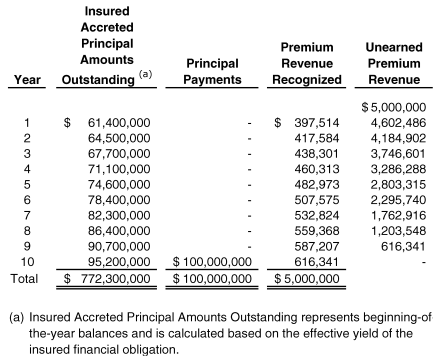
If an insured financial obligation accretes to the principal amount over its life and has a single principal payment at maturity, the sum of all insured accreted principal amounts outstanding during each reporting period shall be used as the denominator of the ratio and the insured principal amount outstanding is the accreted principal amount outstanding. Example 3 (see paragraph 944-605-55-19) illustrates the application of this guidance.
605-944-25-30
The guidance in the following paragraph applies if both of the following conditions exist:
  1. a
    An expected period is used as discussed in paragraph 944-310-30-3
  2. b
    The expected period changes due to changes in prepayment assumptions.
605-944-25-31
If the conditions in the preceding paragraph are met, the insurance entity shall recalculate the constant rate based on the new prepayment assumptions (and current risk-free rate) and apply that new constant rate to the principal amounts outstanding for the remaining expected period of the contract. Example 1 in Section 944-310-55 (see paragraph 944-310-55-1) illustrates the application of this guidance.

Early Retirement and Replacement of an Insured Financial Obligation

605-944-25-32
In a refunding, the financial guarantee insurance contract on the retired financial obligation is extinguished—that is, the financial guarantee insurance contract must be extinguished to be considered a refunding for purposes of this paragraph. The insurance entity shall immediately recognize any nonrefundable unearned premium revenue related to that contract as premium revenue and any associated acquisition costs previously deferred under Subtopic 944-30 as an expense.
605-944-25-33
If the insurance entity insures the new financial obligation, the insurance entity shall recognize the unearned premium revenue on the new financial obligation that is commensurate with the premium it would charge to insure a similar financial obligation in a separate (standalone) transaction. If that premium differs from the premium actually charged, the difference shall be recognized in current earnings. Example 4 (see paragraph 944-605-55-22) illustrates the application of this guidance.

605-944-30Initial Measurement

Source downloaded: .Record version 8a97ae5f311f. Effective date must be checked in the source.

Long-Duration Contracts

Universal Life-Type Contracts with Death or Other Insurance Benefit Features

605-944-30-1
A liability for unearned revenue to be recognized under paragraphs and shall be measured initially as the portion of such assessments that compensates the insurance entity for benefits to be provided in future periods.
605-944-30-2
For contracts in which assessments are collected over a period significantly shorter than the period for which the contract is subject to mortality and morbidity risks, the assessment would be considered a front-end fee and accounted for under paragraphs . The amounts amortized into income shall be considered assessments for purposes of this paragraph.

Limited-Payment Contracts

605-944-30-2A
Assumptions used in measuring any gross premium deferred in accordance with paragraph 944-605-25-4A (that is, the deferred profit liability) shall be consistent with those used in estimating the liability for future policy benefits as described in paragraph 944-40-30-7.

Retrospective and Contingent Commission Arrangements

605-944-30-3
The liability recognized under paragraph 944-605-25-14 shall be based on experience and the provisions of the contract.

Reinsurance Contracts

Reinsurance of Long-Duration Contracts

605-944-30-4
The difference, if any, between amounts paid for a reinsurance contract and the amount of the liabilities for policy benefits relating to the underlying reinsured contracts is part of the estimated cost to be amortized.

Financial Guarantee Insurance Contracts

605-944-30-5
Initial measurement of the unearned premium revenue recognized under paragraph 944-605-25-25 shall be equal to the present value of either of the following:
  1. a
    If the criteria in paragraph 944-310-30-3 are met and used, the premiums expected to be collected over the period of the financial guarantee insurance contract
  2. b
    If the criteria in paragraph 944-310-30-3 are not met, the premiums due.
605-944-30-6
If the premium is a single premium received at the inception of the financial guarantee insurance contract, the insurance entity shall initially measure the unearned premium revenue at the amount received.
605-944-30-7
If the premiums are received as payments over the period of the financial guarantee insurance contract, the insurance entity shall initially measure the unearned premium revenue at an amount equal to the present value of the premiums due or expected to be collected over the period of the financial guarantee insurance contract. Example 1 (see paragraph 944-605-55-16) illustrates the application of this paragraph. Paragraph 944-310-30-2 provides guidance on the discount rate and the period used.

605-944-35Subsequent Measurement

Source downloaded: .Record version 25ab330c177b. Effective date must be checked in the source.

Long-Duration Contracts

Limited-Payment Contracts

605-944-35-1
Any gross premium deferred in accordance with paragraph 944-605-25-4A(that is, the deferred profit liability) shall be recognized in income in a constant relationship with insurance in force (if accounting for life insurance contracts) or with the amount of expected future benefit payments (if accounting for annuity contracts).
605-944-35-1A
The deferred profit liability shall be amortized in relation to the discounted amount of the insurance in force or expected future benefit payments, discounted as described in paragraph 944-40-30-9, and interest shall accrue to the unamortized balance. The use of interest in the amortization is consistent with the determination of the deferred profit using discounting.
605-944-35-1B
Assumptions shall be updated in subsequent accounting periods to determine changes in the deferred profit liability, contemporaneously with the updating of assumptions for the corresponding liability for future policy benefits (see paragraph 944-40-35-5). Cash flow assumptions shall be reviewed—and if there is a change, updated—on an annual basis, at the same time every year. Cash flow assumptions shall be updated in interim reporting periods if evidence suggests that earlier cash flow assumptions should be revised. The interest accretion rate shall remain the original discount rate used at contract issue date.
605-944-35-1C
A related charge or credit to net income for the current reporting period as a result of updating cash flow assumptions at the level of aggregation at which reserves are calculated shall be determined as follows:
  1. a
    Cash flow assumptions used to calculate the deferred profit liability at contract issuance shall be updated in subsequent periods using actual historical experience and updated future cash flow assumptions.
  2. b
    The recalculated deferred profit liability as of the contract issue date shall be subsequently amortized in accordance with paragraph 944-605-35-1A to derive the revised deferred profit liability estimate as of the beginning of the current reporting period.
  3. c
    The revised deferred profit liability estimate calculated in (b) shall be compared with the carrying amount of the deferred profit liability as of the beginning of the current reporting period to determine the change in estimate adjustment to be recognized in net income for the current reporting period (see paragraph 944-40-45-4).

Universal Life-Type Contracts

605-944-35-2
Amounts recognized as unearned revenue under paragraph 944-605-25-6 shall be recognized in income over the period benefited using the same assumptions and factors used to amortize capitalized acquisition costs under the Long-Duration Contracts Subsection of Section 944-30-35.

Reinsurance Contracts

Foreign Property and Liability Reinsurance—Open Year Method

605-944-35-4
Paragraph 944-605-25-17 explains that only if reasonable estimates cannot be made currently for the reason discussed in paragraph 944-605-25-18, shall the open year method be used.
605-944-35-5
Under the open year method, underwriting results of foreign reinsurance shall not be included in the income statement until sufficient information becomes available to provide reasonable estimates of earned premiums. Instead, premiums, claims, commissions, and related direct taxes shall be included in the open underwriting balance to which they pertain. The underwriting balances shall be aggregated and each underwriting balance shall be kept open until sufficient information becomes available to record a reasonable estimate of earned premiums.
605-944-35-6
The underwriting balance aggregated under the preceding paragraph shall be disaggregated and reported in the income statement as premiums, claims, commissions, and related direct taxes when earned premiums are reasonably determinable.
605-944-35-7
If it becomes probable that a loss has been incurred before an underwriting balance is closed, a provision for the loss shall be recorded. Examples of situations in which a provision may need to be recorded before an underwriting balance is closed include catastrophic losses, higher-than-expected claim frequency, significant unanticipated adverse events, or a negative open year account.

Reinsurance of Short-Duration Contracts

605-944-35-8
Prepaid reinsurance premiums recognized under paragraph 944-605-25-20 shall be amortized over the remaining contract period in proportion to the amount of insurance protection provided. If the amounts paid are subject to adjustment and can be reasonably estimated, the basis for amortization shall be the estimated ultimate amount to be paid.
605-944-35-9
Any gain deferred under paragraph 944-605-25-22 shall be amortized over the estimated remaining settlement period. If the amounts and timing of the reinsurance recoveries can be reasonably estimated, the deferred gain shall be amortized using the effective interest rate inherent in the amount paid to the reinsurer and the estimated timing and amounts of recoveries from the reinsurer; that is, the interest method. Otherwise, the proportion of actual recoveries to total estimated recoveries (the recovery method) shall determine the amount of amortization.
605-944-35-10
Amortization of deferred amounts arising from retroactive reinsurance under both the interest method and the recovery method is based on the ceding entity's estimates of the expected timing and total amount of cash flows. The timing of changes in those estimates shall not alter the recognition of the revenues and costs of reinsurance. Therefore, changes in estimates of the amount recoverable from the reinsurer shall be accounted for consistently both at the inception of and after the reinsurance transaction.
605-944-35-11
Changes in the estimated amount of the liabilities relating to the underlying reinsured contracts shall be recognized in earnings in the period of the change.
605-944-35-12
Reinsurance recoverables shall reflect the related change in the amount recoverable from the reinsurer, and a gain to be deferred and amortized, as described in paragraph 944-605-25-22, shall be adjusted or established as a result. Decreases in the estimated amount of the liabilities shall reduce the related amount recoverable from the reinsurer and accordingly reduce previously deferred gains.
605-944-35-13
When changes in the estimated amount recoverable from the reinsurer or in the timing of receipts related to that amount occur, a cumulative amortization adjustment shall be recognized in earnings in the period of the change so that the deferred gain reflects the balance that would have existed had the revised estimate been available at the inception of the reinsurance transaction. However, if the revised estimate of the liabilities is less than the amounts paid to the reinsurer, a loss shall not be deferred. The resulting difference shall be recognized in earnings immediately, as described in paragraph 944-605-25-23.

Reinsurance of Long-Duration Contracts

605-944-35-14
Amortization of the estimated cost of reinsurance of long-duration contracts that meets the conditions for reinsurance accounting depends on whether the reinsurance contract is long-duration or short-duration. The cost shall be amortized over the remaining life of the underlying reinsured contracts if the reinsurance contract is long-duration, or over the contract period of the reinsurance if the reinsurance contract is short-duration.
605-944-35-15
The assumptions used in accounting for reinsurance costs shall be consistent with those used for the reinsured contracts.

Financial Guarantee Insurance Contracts

605-944-35-16
In instances where a contract period is used as the period of the financial guarantee insurance contract to measure the unearned premium revenue an insurance entity shall adjust the unearned premium revenue to reflect early principal payments as they occur. The adjustment to the unearned premium revenue shall equal the adjustment to the premium receivable.

605-944-45Other Presentation Matters

Source downloaded: .Record version 8640e36eb338. Effective date must be checked in the source.

Reinsurance Contracts

All Reinsurance Contracts

605-944-45-1
The amounts of earned premiums ceded and recoveries recognized under reinsurance contracts shall either be:
  1. a
    Reported in the statement of earnings, as separate line items or parenthetically
  2. b
    Disclosed in the notes to financial statements under paragraph 944-605-50-1.

605-944-50Disclosure

Source downloaded: .Record version 4d5ac361fc8f. Effective date must be checked in the source.

Reinsurance Contracts

All Reinsurance Contracts

605-944-50-1
All insurance entities shall disclose all of the following in their financial statements:
  1. a
    For all reinsurance contracts, both of the following:
    1. 1
      Methods used for income recognition on reinsurance contracts
    2. 2
      If not reported under paragraph 944-605-45-1 in the statement of earnings, as separate line items or parenthetically, the amounts of earned premiums ceded and recoveries recognized under reinsurance contracts.
  2. b
    For short-duration contracts, all of the following on both a written basis and an earned basis:
    1. 1
      Premiums from direct business
    2. 2
      Reinsurance assumed
    3. 3
      Reinsurance ceded.
  3. c
    For long-duration contracts, all of the following:
    1. 1
      Premiums and amounts assessed against policyholders from direct business
    2. 2
      Reinsurance assumed and ceded
    3. 3
      Premiums and amounts earned.
  4. d
    For foreign reinsurance accounted for by the open year method, all of the following shall be disclosed for each period for which an income statement is presented:
    1. 1
      The amounts of premiums, claims, and expenses recognized as income on closing underwriting balances
    2. 2
      The additions to underwriting balances for the year for reported premiums, claims, and expenses.
  5. e
    The amounts of premiums, claims, and expenses in the underwriting account for each balance sheet presented.
605-944-50-2
Appropriate disclosure of both of the following items is encouraged:
  1. a
    The extent to which reinsurance contracts indemnify the ceding entity against loss or liability relating to insurance risk
  2. b
    Indemnification policies as part of the required disclosure in the preceding paragraph about the nature and effect of reinsurance transactions.
605-944-50-3
Disclosure in the financial statements of an insurance entity's accounting policies under Topic 250 shall include a description of the methods used to account for foreign reinsurance.

Financial Guarantee Insurance Contracts

605-944-50-4
To meet the disclosure objective in paragraph 944-20-50-7, an insurance entity shall disclose all of the following information for each annual period and interim period:
  1. a
    For premium revenue recognition that has been accelerated, the amount and reasons for acceleration
  2. b
    A schedule of the future expected premium revenue as of the latest date of the statement of financial position detailing both of the following:
    1. 1
      The four quarters of the subsequent annual period and each of the next four annual periods
    2. 2
      The remaining periods aggregated in five-year increments.

605-944-55Implementation Guidance and Illustrations

Source downloaded: .Record version ff651245d2e9. Effective date must be checked in the source.

Reinsurance Contracts

Implementation Guidance

605-944-55-1
If a reinsurance contract provides the ceding entity's policyholders and claimants with the right to recover their claims directly from the reinsurer (a cut-through provision), the ceding entity shall not net the recoverable due from the reinsurer against the gross loss obligations on the underlying insurance contracts. As stated in paragraphs , reinsurance contracts in which a ceding entity is not relieved of its legal liability to its policyholder do not result in removal of the related assets and liabilities from the ceding entity's financial statements. Amounts recoverable and payable between the ceding entity and a reinsurer may be offset only if a right of setoff exists, as defined in Subtopic 210-20.
605-944-55-2
Similarly, if the circumstances discussed in the preceding paragraph involved retroactive reinsurance of short-duration insurance policies that resulted in a gain to the ceding entity, the gain shall not be recognized in income immediately. Paragraph 944-40-25-33 states that reinsurance contracts do not result in immediate recognition of gains unless the reinsurance contract is a legal replacement of one insurer by another and thereby extinguishes the ceding entity's liability to the policyholder.
605-944-55-3
Under the definition of settlement period, if the ceding entity does not expect to receive any recoveries because the reinsurer has agreed to reimburse claimants under the reinsured contracts directly, the settlement period shall not be considered to have ended on the effective date of the contract. Unless the reinsurance contract results in legal replacement of one reinsurer by another, a gain shall not be recognized at the inception of the contract. In the circumstances discussed in paragraph 944-605-55-1 the reinsurer is substantively acting as disbursing agent for the ceding entity. Therefore, the ceding entity cannot be said to have recovered amounts due from the reinsurer before payment is made to the claimant.
605-944-55-4
This implementation guidance addresses circumstances in which a ceding entity enters into a retroactive contract to reinsure short-duration insurance policies that gives rise to a deferred gain. Specifically, it addresses whether, if the reinsurer prepays its obligation under the contract, the ceding entity may recognize its deferred gain at the time the prepayment is received.
605-944-55-5
The amortization period (the settlement period) is based on the period over which the reinsurer settles its obligations to the ceding entity, and it may be appropriate to recognize the gain over the expected prepayment period. However, all of the facts and circumstances shall be considered to determine whether the reinsurer has substantively settled its obligation to the ceding entity. For example, if the ceding entity agrees to compensate the reinsurer for the prepayment, such as by crediting the reinsurer with investment income on prepaid amounts or balances held, the reinsurer has not, in substance, settled its obligation but rather has made a deposit with the ceding entity that shall be accounted for accordingly.

Illustrations

605-944-55-6
The following Cases illustrate how the requirement in paragraphs that gains arising from retroactive reinsurance be deferred and losses be charged to expense immediately is affected by the requirements in paragraphs for a catch-up adjustment to reflect changes in estimates of amounts recoverable from reinsurers:
  1. a
    Adverse development occurs (Case A)
  2. b
    Favorable development occurs (Case B).
605-944-55-7
Cases A and B share all of the following assumptions:
  1. a
    Entity A pays $100 of premium in 1993 for $150 limit of retroactive reinsurance.
  2. b
    Entity A has recorded related liabilities of $110.
  3. c
    There is a 5-year settlement period.
  4. d
    At inception, Entity A recorded a reinsurance recoverable of $110 and a deferred gain of $10.
605-944-55-8
If an adverse development of $30 occurred in the first year, paragraphs require an adjustment to bring the balance of the deferred gain to the balance that would have existed had the revised estimate been available at inception, less cumulative amortization. The balance that would have existed at inception is $40 ($140 reserves less $100 premium) and cumulative amortization to date is $8 ($40/5 years). Therefore, a net $32 deferred gain balance is required. Entity A would defer $30 of additional gain ($40 less the $10 already recorded) and credit income for $8 amortization. Straight-line amortization is used for simplicity of illustration rather than the interest method or recovery method as required by paragraph 944-605-35-9.
605-944-55-9
If a favorable development of $15 occurred in the first year, the amount of ceded premiums ($100) would exceed the related revised liabilities ($95). Paragraphs state that decreases in the estimated amount of the liabilities reduce the related amount recoverable and reduce previously deferred gains. Further, if the revised estimate of the liabilities is less than the amounts paid to the reinsurer, the difference shall be charged to earnings. Entity A would therefore reduce the reinsurance recoverable by $15, reduce the $10 deferred gain to zero, and charge $5 to earnings.
605-944-55-10
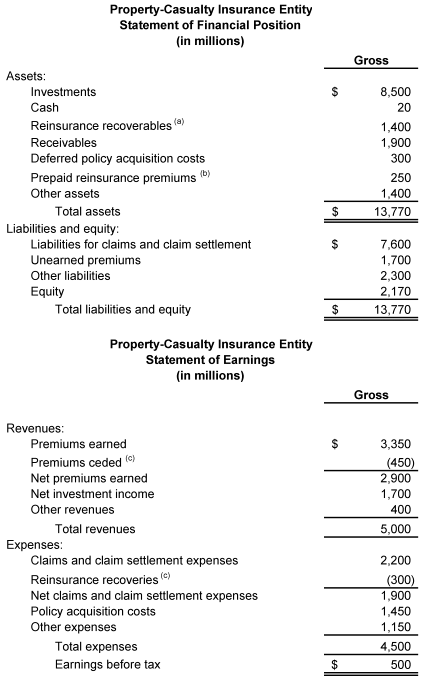
This Example illustrates the application of the requirements in the Reinsurance Contracts Subsections of this Subtopic to a property-casualty insurance entity (Property-Casualty Insurance Entity) that issues short-duration contracts.
605-944-55-11
Property-Casualty Insurance Entity's statement of financial position follows.
  • Property-Casualty Insurance Entity Statement of Financial Position (in millions) Gross Assets: Investments " $8,500 " Cash 20 Reinsurance recoverables (a) " 1,400 " Receivables " 1,900 " Deferred policy acquisition costs 300 Prepaid reinsurance premiums (b) 250 Other assets " 1,400 " Total assets " $13,770 " Liabilities and equity: Liabilities for claims and claim settlement expenses " $7,600 " Unearned premiums " 1,700 " Other liabilities " 2,300 " Equity " 2,170 " Total liabilities and equity " $13,770 " Property-Casualty Insurance Entity Statement of Earnings (in millions) Gross Revenues: Premiums earned " $3,350 " Premiums ceded (c) (450) Net premiums earned " 2,900 " Net investment income " 1,700 " Other revenues 400 Total revenues " 5,000 " Expenses: Claims and claim settlement expenses " 2,200 " Reinsurance recoveries (c) (300) Net claims and claim settlement expenses " 1,900 " Policy acquisition costs " 1,450 " Other expenses " 1,150 " Total expenses " 4,500 " Earnings before tax $500 $500
  1. a
    The Reinsurance Contracts Subsections of this Subtopic require that estimated amounts recoverable from reinsurers include amounts related to paid and unpaid claims and claims incurred but not reported. Details of the amounts comprising reinsurance recoverables may be presented separately.
  2. b
    Prepaid reinsurance premiums include amounts paid to reinsurers relating to the unexpired portion of reinsured policies, often referred to as ceded unearned premiums.
  3. c
    Alternatively, the effect of reinsurance on premiums earned and claim costs may be shown parenthetically or may be disclosed. An illustration of a parenthetical presentation follows.

  • Premiums earned (net of premiums ceded totaling $450) " $2,900 " Claims and claim settlement expenses (net of reinsurance recoveries totaling $300) " $1,900 "
605-944-55-12
Property-Casualty Insurance Entity's related notes to financial statements follow.
  • Property-Casualty Insurance Entity— Notes to Financial Statements
    • Summary of Significant Accounting Policies
      • In the normal course of business, the Entity seeks to reduce the loss that may arise from catastrophes or other events that cause unfavorable underwriting results by reinsuring certain levels of risk in various areas of exposure with other insurance entities or reinsurers.
      • Amounts recoverable from reinsurers are estimated in a manner consistent with the claim liability associated with the reinsured policy. The amount by which the liabilities associated with the reinsured policies exceed the amounts paid for retroactive reinsurance contracts is amortized in income over the estimated remaining settlement period using the interest method. The effects of subsequent changes in estimated or actual cash flows are accounted for by adjusting the previously deferred amount to the balance that would have existed had the revised estimate been available at the inception of the reinsurance transactions, with a corresponding charge or credit to income.
    • Reinsurance
      • Reinsurance contracts do not relieve the Entity from its obligations to policyholders. Failure of reinsurers to honor their obligations could result in losses to the Entity; consequently, allowances are established for amounts deemed uncollectible. The Entity evaluates the financial condition of its reinsurers and monitors concentrations of credit risk arising from similar geographic regions, activities, or economic characteristics of the reinsurers to minimize its exposure to significant losses from reinsurer insolvencies. At December 31, 19X3, reinsurance recoverables with a carrying value of $260 million and prepaid reinsurance premiums of $45 million were associated with a single reinsurer. The Entity holds collateral under related reinsurance agreements in the form of letters of credit totaling $150 million that can be drawn on for amounts that remain unpaid for more than 120 days.
      • The effect of reinsurance on premiums written and earned is as follows (in millions).
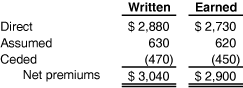
        • Written Earned Direct " $2,880 " " $2,730 " Assumed 630 620 Ceded (470) (450) Net premiums " $3,040 " " $2,900 "
605-944-55-13
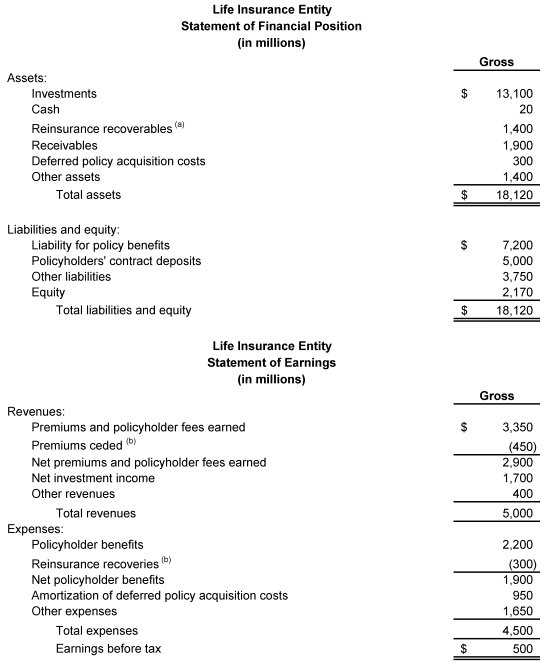
This Example illustrates the application of the requirements in the Reinsurance Contracts Subsections of this Subtopic to a life insurance entity (Life Insurance Entity) that issues long-duration contracts.
605-944-55-14
Life Insurance Entity's statement of financial position follows.
  • Life Insurance Entity Statement of Financial Position (in millions) Gross Assets: Investments " $13,100 " Cash 20 Receivables: Reinsurance (a) " 1,400 " Other " 1,900 " Deferred policy acquisition costs 300 Other assets " 1,400 " Total assets " $18,120 " Liabilities and equity: Liability for policy benefits " $7,200 " Policyholders' contract deposits " 5,000 " Other liabilities " 3,750 " Equity " 2,170 " Total liabilities and equity " $18,120 " Life Insurance Entity Statement of Earnings (in millions) Gross Revenues: Premiums and policyholder fees earned " $3,350 " Premiums ceded (b) (450) Net premiums and policyholder fees earned " 2,900 " Net investment income " 1,700 " Other revenues 400 Total revenues " 5,000 " Expenses: Policyholder benefits " 2,200 " Reinsurance recoveries (b) (300) Net policyholder benefits " 1,900 " Amortization of deferred policy acquisition costs 950 Other expenses " 1,650 " Total expenses " 4,500 " Earnings before tax $500
    1. a
      The Reinsurance Contracts Subsections of this Subtopic require that estimated amounts recoverable from reinsurers include amounts related to paid and unpaid benefits, including amounts related to liabilities recognized for future policy benefits. Details of the amounts comprising reinsurance recoverables may be presented separately.
    2. b
      Alternatively, the effect of reinsurance on premiums earned and benefit costs may be shown parenthetically or may be disclosed. An illustration of a parenthetical presentation follows.

    • Premiums and policyholder fees earned (net of premiums ceded totaling $450) " $2,900 " Benefits (net of reinsurance recoveries totaling $300) " $1,900 "
605-944-55-15
Life Insurance Entity's related notes to financial statements follow.
  • Life Insurance Entity—Notes to Financial Statements
    • Summary of Significant Accounting Policies
      • In the normal course of business, the Entity seeks to limit its exposure to loss on any single insured and to recover a portion of benefits paid by ceding reinsurance to other insurance entities or reinsurers under excess coverage and coinsurance contracts. The Entity retains a maximum of $500,000 of coverage per individual life.
      • Amounts paid or deemed to have been paid for reinsurance contracts are recorded as reinsurance recoverables. The cost of reinsurance related to long-duration contracts is accounted for over the life of the underlying reinsured policies using assumptions consistent with those used to account for the underlying policies.
    • Reinsurance
      • Reinsurance contracts do not relieve the Entity from its obligations to policyholders. Failure of reinsurers to honor their obligations could result in losses to the Entity; consequently, allowances are established for amounts deemed uncollectible. The Entity evaluates the financial condition of its reinsurers and monitors concentrations of credit risk arising from similar geographic regions, activities, or economic characteristics of the reinsurers to minimize its exposure to significant losses from reinsurer insolvencies. At December 31, 19X3, reinsurance recoverables with a carrying value of $260 million were associated with a single reinsurer. The Entity holds collateral under related reinsurance agreements in the form of letters of credit totaling $150 million that can be drawn on for amounts that remain unpaid for more than 120 days.
      • The effect of reinsurance on premiums and amounts earned is as follows (in millions).
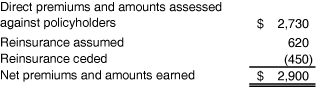
        • Direct premiums and amounts assessed against policyholders " $2,730 " Reinsurance assumed 620 Reinsurance ceded (450) Net premiums and amounts earned " $2,900 "

Financial Guarantee Insurance Contracts

605-944-55-16
This example illustrates the application of paragraph 944-605-30-7, which states that if the premiums are received as payments over the period of the financial guarantee insurance contract, the insurance entity shall initially measure the unearned premium revenue at an amount equal to the present value of the premiums due or expected to be collected over the period of the financial guarantee insurance contract. For example, if the insurance entity expects to receive total premiums due over the period of the financial guarantee insurance contract of $28 million and the present value of that amount is $24.3 million, both the unearned premium revenue and the premium receivable initially shall be recognized at $24.3 million.
605-944-55-17
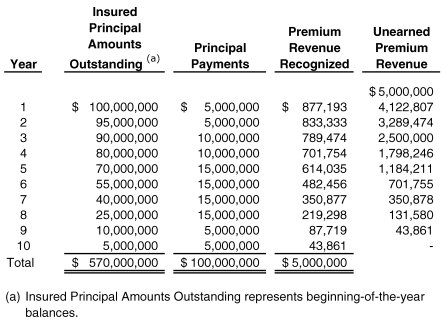
This Example illustrates the application of paragraphs to insured principal payments made over the period of a contract. On January 1, 20X0, an insurance entity issues a single-premium financial guarantee insurance contract for a financial obligation (municipal bond) with a contract period of 10 years. The premium amount is $5 million. Insured principal payments of $100 million will be made by the issuer of the bond over the period of the contract. The contractual schedule of expected insured principal payments follows.
  • Year "Insured Principal Amounts Outstanding (a)" "Principal Payments" "Premium Revenue Recognized" "Unearned Premium Revenue" " $5,000,000 " 1 " $100,000,000 " " $5,000,000 " " $877,193 " " 4,122,807 " 2 " 95,000,000 " " 5,000,000 " " 833,333 " " 3,289,474 " 3 " 90,000,000 " " 10,000,000 " " 789,474 " " 2,500,000 " 4 " 80,000,000 " " 10,000,000 " " 701,754 " " 1,798,246 " 5 " 70,000,000 " " 15,000,000 " " 614,035 " " 1,184,211 " 6 " 55,000,000 " " 15,000,000 " " 482,456 " " 701,755 " 7 " 40,000,000 " " 15,000,000 " " 350,877 " " 350,878 " 8 " 25,000,000 " " 15,000,000 " " 219,298 " " 131,580 " 9 " 10,000,000 " " 5,000,000 " " 87,719 " " 43,861 " 10 " 5,000,000 " " 5,000,000 " " 43,861 " - Total " $570,000,000 " " $100,000,000 " " $5,000,000 " (a) Insured Principal Amounts Outstanding represents beginning-of-the-year balances.
605-944-55-18
The ratio of the premium to the sum of all contractual insured principal amounts outstanding during each reporting period (the constant rate) is 0.00877193 (calculated as $5 million divided by $570 million). Accordingly, the insurance entity would recognize $877,193 of premium revenue (calculated as $100 million of insured principal amount outstanding multiplied by 0.00877193) in the first year of the contract. In the second year of the contract, the insurance entity would recognize $833,333 (calculated as $95 million multiplied by 0.00877193) of premium revenue. Thus, premium revenue is recognized based on the insurance protection being provided (represented by the constant rate and the insured principal amounts outstanding).
605-944-55-19
The Example illustrates the application of paragraph 944-605-25-29 to an insured principal payment made at the end of period of a contract. Assume all of the following:
  1. a
    On January 1, 200X, an insurance entity issues a single-premium financial guarantee insurance contract for a financial obligation (a zero-coupon municipal bond).
  2. b
    The insured financial obligation was issued at $61.4 million, resulting in an effective yield of 5 percent.
  3. c
    The premium amount is $5 million.
  4. d
    The insured principal payment of $100 million will be made by the issuer of the bond in total at the end of the 10-year period of the contract.
605-944-55-20
In this Example, the insured accreted principal amount outstanding represents the obligation of the insurance entity. The schedule of the insured accreted principal amounts outstanding during each reporting period follows.
  • Year "Insured Accreted Principal Amounts Outstanding (a)" "Principal Payments" "Premium Revenue Recognized" "Unearned Premium Revenue" " $5,000,000 " 1 " $61,400,000 " - " $397,514 " " 4,602,486 " 2 " 64,500,000 " - " 417,584 " " 4,184,902 " 3 " 67,700,000 " - " 438,301 " " 3,746,601 " 4 " 71,100,000 " - " 460,313 " " 3,286,288 " 5 " 74,600,000 " - " 482,973 " " 2,803,315 " 6 " 78,400,000 " - " 507,575 " " 2,295,740 " 7 " 82,300,000 " - " 532,824 " " 1,762,916 " 8 " 86,400,000 " - " 559,368 " " 1,203,548 " 9 " 90,700,000 " - " 587,207 " " 616,341 " 10 " 95,200,000 " " $100,000,000 " " 616,341 " - Total " $772,300,000 " " $100,000,000 " " $5,000,000 " (a) Insured Accreted Principal Amounts Outstanding represents beginning-of-the-year balances and is calculated based on the effective yield of the insured financial obligation.
605-944-55-21
The ratio of the premium to the sum of the insured accreted principal amounts outstanding (the constant rate) is 0.006474168 (calculated as $5 million divided by $772.3 million). Accordingly, the insurance entity would recognize $397,514 of premium revenue (calculated as $61.4 million of insured accreted principal amount outstanding multiplied by 0.006474168) in the first year of the contract. In accordance with the Financial Guarantee Insurance Contracts Subsection of Section 944-605-25, premium revenue is recognized based on the insurance protection being provided (represented by the constant rate and the insured accreted principal amount outstanding).
605-944-55-22
This Example illustrates the application of paragraphs to the early retirement and replacement of an insured financial obligation if the same insurance entity insured the new financial obligation. This Example makes all of the following assumptions:
  1. a
    On January 1, 20X0, an insurance entity issues a nonrefundable, single premium financial guarantee insurance contract for a 30-year financial obligation (municipal bond).
  2. b
    The premium amount is $5 million.
  3. c
    On the municipal bond's 10th anniversary, the issuer of the insured financial obligation retires the municipal bond.
  4. d
    Premium recognized by the insurance entity for the financial guarantee insurance contract over the first 10 years was $2 million.
605-944-55-23
At early retirement on the 10th anniversary, the insurance entity would recognize as premium revenue the remaining unearned premium revenue ($3 million) because the risk to the insurance entity is extinguished. In addition, any remaining associated deferred acquisition costs are expensed.
605-944-55-24
This Example makes all of the following further assumptions:
  1. a
    The issuer of the financial obligation facilitated the early retirement of the municipal bond by issuing a new municipal bond at a lower interest rate.
  2. b
    The same insurance entity insures the new municipal bond.
  3. c
    The premium amount for the financial guarantee insurance contract for the new financial obligation is $3 million.
  4. d
    The amount of premium charged to insure a similar financial obligation in a separate standalone transaction is $4 million.
605-944-55-25
The insurance entity would recognize unearned premium revenue of $4 million. It also would recognize a debit to earnings in the amount of $1 million. This represents the difference between the amount of premium charged ($3 million) and the amount of premium that would be charged for a similar financial obligation in a separate standalone transaction.

Related subtopics