ASC 340-30
Insurance Contracts That Do Not Transfer Insurance Risk
340 Other Assets and Deferred Costs
Source downloaded: .Record version df8046fcc671. Effective date must be checked in the source.
ASC 340-30 tells you how to apply the deposit method of accounting to insurance and reinsurance contracts that fail to transfer insurance risk (which requires transfer of both timing risk and underwriting risk). At inception a deposit asset or liability is recognized at consideration paid or received less explicitly identified premiums or fees retained (340-30-25-1; 340-30-30-1). Subsequent measurement depends on which of four risk categories the contract falls into: effective-yield/interest-method accretion for timing-risk-only or no-risk contracts, unexpired-coverage plus present value of expected recoveries for underwriting-risk-only contracts, and the open-year method for indeterminate-risk contracts.
Key points (7)
- Insurance risk transfer requires both timing risk and underwriting risk, producing four deposit categories: timing risk only, underwriting risk only, neither, or indeterminate risk (340-30-05-2).
- A deposit asset or liability is recognized at inception and measured at the consideration paid or received less any explicitly identified premiums or fees retained by the insurer or reinsurer, irrespective of contract experience (340-30-25-1; 340-30-30-1).
- For contracts transferring only significant timing risk or neither risk, the deposit is adjusted each reporting date using the effective yield on estimated cash flows (interest method, consistent with 310-20 and 835-30), with a corresponding credit or charge to interest income or expense (340-30-35-1 through 35-3; 340-30-45-2).
- If cash flow estimates change, the effective yield is recalculated retrospectively and the deposit is adjusted to the amount that would have existed had the new yield applied since inception (340-30-35-3); a significant change may signal that significant underwriting risk exists, requiring conversion to that model (340-30-35-4).
- For contracts transferring only significant underwriting risk, the deposit equals the unexpired portion of coverage until a reimbursable loss is incurred, then the present value of expected future cash flows plus remaining unexpired coverage (340-30-35-5), discounted at the current rate on U.S. government obligations with similar cash-flow characteristics (adjusted for default risk only by the insured/ceding entity), locked in at each loss date (340-30-35-6).
- Contracts with indeterminate risk follow the open-year method: effects are excluded from net income and aggregated on the balance sheet until premiums can be reasonably estimated and allocated, but the method cannot defer losses recognizable under Subtopic 450-20 (340-30-25-3 through 25-5); reclassification is a change in accounting estimate under Topic 250 (340-30-25-6 through 25-7).
- Deposit assets and liabilities are reported gross unless a right of offset exists under Subtopic 210-20, and entities must disclose a description of the contracts plus separate totals of deposit assets and deposit liabilities (340-30-45-1; 340-30-50-1).
For students. This is the "failed reinsurance" bucket: if a contract does not shift both timing and underwriting risk, no premium/loss accounting is allowed and the arrangement is booked like a financing (deposit) with interest. The common mistake is assuming one accounting model applies to all deposits — the measurement rule differs sharply between timing-risk-only contracts (effective yield) and underwriting-risk-only contracts (unexpired coverage plus discounted expected recoveries).
Machine-generated study aid for ASC 340-30. Check the source paragraphs below.
340-30-00Status
Source downloaded: .Record version 7dabf92dd9c7. Effective date must be checked in the source.
| Paragraph | Action | Accounting Standards Update | Date |
| Reinsurance | Added | Accounting Standards Update No. 2016-19 | 12/14/2016 |
| 340-30-15-2 | Amended | Accounting Standards Update No. 2016-19 | 12/14/2016 |
| 340-30-25-1 | Amended | Accounting Standards Update No. 2016-19 | 12/14/2016 |
| 340-30-35-1 | Amended | Accounting Standards Update No. 2016-19 | 12/14/2016 |
| 340-30-45-3 | Amended | Accounting Standards Update No. 2016-19 | 12/14/2016 |
| 340-30-50-2 | Amended | Accounting Standards Update No. 2024-03 | 11/04/2024 |
| 340-30-50-2 | Amended | Accounting Standards Update No. 2016-19 | 12/14/2016 |
| 340-30-55-2 | Amended | Accounting Standards Update No. 2016-19 | 12/14/2016 |
340-30-05Overview and Background
Source downloaded: .Record version ce695ac0fe9c. Effective date must be checked in the source.
- aAn insurance or reinsurance contract that transfers only significant timing risk.
- bAn insurance or reinsurance contract that transfers only significant underwriting risk.
- cAn insurance or reinsurance contract that transfers neither significant timing nor significant underwriting risk.
- dAn insurance or reinsurance contract with an indeterminate risk.
An Insurance or Reinsurance Contract that Transfers Only Significant Timing Risk
An Insurance or Reinsurance Contract that Transfers Only Significant Underwriting Risk
An Insurance or Reinsurance Contract that Transfers Neither Significant Timing nor Significant Underwriting Risk
An Insurance or Reinsurance Contract with an Indeterminate Risk
340-30-15Scope and Scope Exceptions
Source downloaded: .Record version 2c1ff41de222. Effective date must be checked in the source.
Overall Guidance
Entities
- aThe insured and the insurer in an insurance contract
- bThe ceding and assuming entity in a reinsurance contract.
Transactions
- aShort-duration insurance and reinsurance contracts that do not transfer insurance risk as described in paragraph 720-20-25-1 and, for reinsurance contracts, as described in Section 944-20-15
- bMultiple-year insurance and reinsurance contracts that do not transfer insurance risk or for which insurance risk transfer is not determinable.
- aLong-duration life and health insurance contracts that do not indemnify against mortality or morbidity risk shall be accounted for as investment contracts under Topic 944. Therefore, such contracts are not covered by this Subtopic.
340-30-25Recognition
Source downloaded: .Record version b20d616f7e2c. Effective date must be checked in the source.
Deposit Asset or Liability Relating to Insurance and Reinsurance Contracts Accounted for Under Deposit Accounting
- aOnly significant timing risk
- bNeither significant timing nor significant underwriting risk
- cOnly significant underwriting risk.
Insurance and Reinsurance Contracts with Indeterminate Risk
- a Transfers that have neither significant timing nor significant underwriting risk
- b Transfers that have only significant timing risk
- c Transfers that have only significant underwriting risk.
Short-Duration Reinsurance Contracts
340-30-30Initial Measurement
Source downloaded: .Record version 7c926440a5a0. Effective date must be checked in the source.
Deposit Asset or Liability Related to Insurance and Reinsurance Contracts Accounted for Under Deposit Accounting
340-30-35Subsequent Measurement
Source downloaded: .Record version 737c9d6f4448. Effective date must be checked in the source.
Insurance and Reinsurance Contracts that Transfer Only Significant Timing Risk and Insurance and Reinsurance Contracts that Transfer Neither Significant Timing nor Significant Underwriting Risk
Insurance and Reinsurance Contracts that Transfer Only Significant Underwriting Risk
Insurance and Reinsurance Contracts that Transfer Only Significant Underwriting Risk—Discount Rate
340-30-45Other Presentation Matters
Source downloaded: .Record version a52d0f75aba0. Effective date must be checked in the source.
Deposit Asset and Liability
Insurance and Reinsurance Contracts that Transfer Only Significant Timing Risk and Insurance and Reinsurance Contracts that Transfer Neither Timing nor Significant Underwriting Risk
Insurance and Reinsurance Contracts that Transfer Only Significant Underwriting Risk
340-30-50Disclosure
Source downloaded: .Record version 5f867f8f9543. Effective date must be checked in the source.
Deposit Asset or Liability
Insurance and Reinsurance Contracts that Transfer Only Underwriting Risk
- aThe present values of initial expected recoveries that will be reimbursed under the insurance or reinsurance contracts that have been recorded as an adjustment to incurred losses
- bAny adjustment of amounts initially recognized for expected recoveries. The individual components of the adjustment (meaning, interest accrual, the present value of additional expected recoveries, and the present value of reductions in expected recoveries) shall be disclosed separately.
- cThe amortization expense attributable to the expiration of coverage provided under the contract.
- aThe present values of initial expected recoveries that will be reimbursed under the insurance or reinsurance contracts that have been recorded as an adjustment to incurred losses
- bAny adjustment of amounts initially recognized for expected recoveries. The individual components of the adjustment (meaning, interest accrual, the present value of additional expected recoveries, and the present value of reductions in expected recoveries) shall be disclosed separately.
- cThe amortization expense attributable to the expiration of coverage provided under the contract.
340-30-55Implementation Guidance and Illustrations
Source downloaded: .Record version fec48753bb22. Effective date must be checked in the source.
Illustrations
-
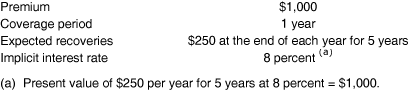 Premium "$1,000 " Coverage period 1 year Expected recoveries $250 at the end of each year for 5 years Implicit interest rate 8 percent (a) (a) "Present value of $250 per year for 5 years at 8 percent = $1,000."
-
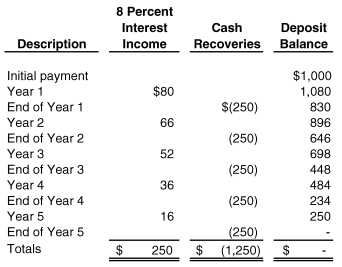 Description 8 Percent Interest Income Cash Recoveries Deposit Balance Initial payment " $1,000 " Year 1 $80 " 1,080 " End of Year 1 $(250) 830 Year 2 66 896 End of Year 2 (250) 646 Year 3 52 698 End of Year 3 (250) 448 Year 4 36 484 End of Year 4 (250) 234 Year 5 16 250 End of Year 5 (250) - Totals $250 " $(1,250)" $-
-
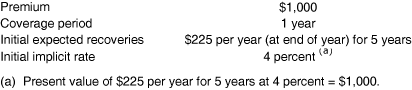 Premium "$1,000 " Coverage period 1 year Initial expected recoveries $225 per year (at end of year) for 5 years Initial implicit rate 4 percent (a) (a) "Present value of $225 per year for 5 years at 4 percent = $1,000."
-
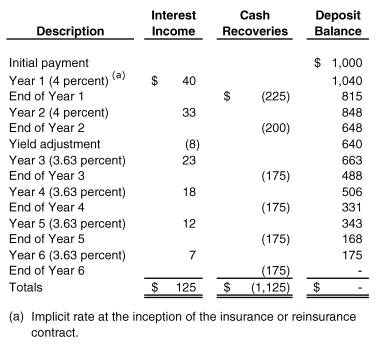 Description Interest Income Cash Recoveries Deposit Balance Initial payment " $1,000 " Year 1 (4 percent) (a) $40 " 1,040 " End of Year 1 $(225) 815 Year 2 (4 percent) 33 848 End of Year 2 (200) 648 Yield adjustment (8) 640 Year 3 (3.63 percent) 23 663 End of Year 3 (175) 488 Year 4 (3.63 percent) 18 506 End of Year 4 (175) 331 Year 5 (3.63 percent) 12 343 End of Year 5 (175) 168 Year 6 (3.63 percent) 7 175 End of Year 6 (175) - Totals $125 " $(1,125)" $- (a) Implicit rate at the inception of the insurance or reinsurance contract.
-
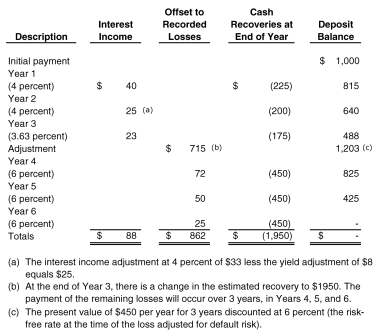 Description Interest Income Offset to Recorded Losses Cash Recoveries at End of Year Deposit Balance Initial payment " $1,000 " Year 1 (4 percent) $40 $(225) 815 Year 2 (4 percent) 25 (a) (200) 640 Year 3 (3.63 percent) 23 (175) 488 Adjustment $715 (b) " 1,203 " (c) Year 4 (6 percent) 72 (450) 825 Year 5 (6 percent) 50 (450) 425 Year 6 (6 percent) 25 (450) - Totals $88 $862 " $(1,950)" $- (a) The interest income adjustment at 4 percent of $33 less the yield adjustment of $8 equals $25. (b) "At the end of Year 3, there is a change in the estimated recovery to $1950. The payment of the remaining losses will occur over 3 years, in Years 4, 5, and 6." (c) The present value of $450 per year for 3 years discounted at 6 percent (the risk-free rate at the time of the loss adjusted for default risk).
-
 Initial premium "$1,000 " Coverage period 1 year Expected recoveries "Could aggregate up to $10,000 with none paid prior to Year 8 regardless of when the insured incurs or pays a loss"
-
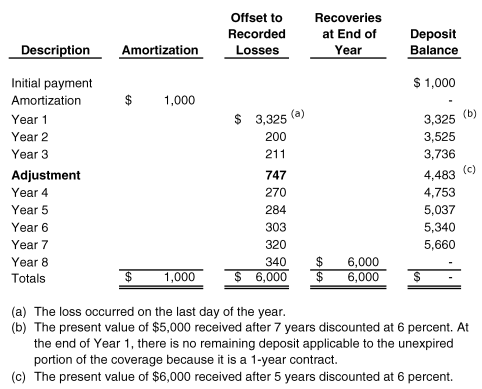 Description Amortization Offset to Recorded Losses Cash Recoveries at End of Year Deposit Balance Initial payment " $1,000 " Amortization " $1,000 " - Year 1 " $3,325 " (a) " 3,325 " (b) Year 2 200 " 3,525 " Year 3 211 " 3,736 " Adjustment 747 " 4,483 " (c) Year 4 270 " 4,753 " Year 5 284 " 5,037 " Year 6 303 " 5,340 " Year 7 320 " 5,660 " Year 8 340 " $6,000 " - Totals " $1,000 " " $6,000 " " $6,000 " $- (a) The loss occurred on the last day of the year. (b) "The present value of $5,000 received after 7 years discounted at 6 percent. At the end of Year 1, there is no remaining deposit applicable to the unexpired portion of the coverage because it is a 1-year contract." (c) "The present value of $6,000 received after 5 years discounted at 6 percent."
Related subtopics
- 605-944 Financial Services—InsuranceRevenue Recognition
- 944-40 Claim Costs and Liabilities for Future Policy BenefitsFinancial Services—Insurance
- 310-944 Financial Services—InsuranceReceivables
- 815-944 Financial Services—InsuranceDerivatives and Hedging
- 944-20 Insurance ActivitiesFinancial Services—Insurance
- 944-30 Acquisition CostsFinancial Services—Insurance