ASC

ASC 944-30

Acquisition Costs

944 Financial Services—Insurance

Source downloaded: .Record version eb9d31a4aba1. Effective date must be checked in the source.

ASC 944-30 governs how insurance entities capitalize, amortize, present, and disclose acquisition costs (DAC) for short-duration contracts, long-duration contracts, investment contracts, and reinsurance, plus deferred sales inducements. Only costs "related directly to the successful acquisition" of new or renewal contracts may be capitalized (944-30-25-1A) — incremental direct costs, directly related compensation/fringe benefits for underwriting, policy issuance and processing, medical and inspection, and sales force contract selling, plus certain other direct costs and qualifying direct-response advertising. Post-ASU 2018-12, long-duration DAC is amortized on a constant level basis over the expected contract term (944-30-35-3A), and the Internal Replacement Transactions Subsections determine whether a modified/replaced contract is "substantially unchanged" (continuation, DAC carried forward) or "substantially changed" (extinguishment, DAC written off).

Key points (7)
  • Only costs directly related to the successful acquisition of new or renewal contracts may be capitalized: incremental direct costs, the portion of employee compensation and payroll-related fringe benefits for time spent on underwriting, policy issuance and processing, medical and inspection, and sales force contract selling, and other directly related costs that would not have been incurred but for the acquisition (944-30-25-1A); unsuccessful efforts, idle time, market research, training, general overhead, and dedicated software are expensed as incurred (944-30-55-1B; 944-30-55-1F).
  • Direct-response advertising costs are capitalized only if the primary purpose is to elicit sales to customers documented as responding specifically to the advertising and the advertising results in probable future benefits based on verifiable historical patterns for the entity (944-30-25-1AA through 25-1I); probable future benefits include only primary revenues (944-30-25-1P), and costs not capitalized may not be retroactively capitalized (944-30-25-1I).
  • Acquisition costs that vary in a constant relationship to premiums or insurance in force, are recurring, or are incurred in level amounts (e.g., recurring premium taxes, ultimate level commissions) are maintenance and other period costs expensed as incurred (944-30-25-4 through 25-5).
  • Short-duration DAC is charged to expense in proportion to premium revenue recognized under Subtopic 944-605 (944-30-35-1A; 944-30-35-2), while long-duration DAC is charged to expense on a constant level basis — straight-line for individual contracts, or a constant-level basis approximating individual straight-line for grouped contracts — over the expected contract term, not as a function of revenue or profit emergence, with no interest accrual (944-30-35-3A; 944-30-35-3C).
  • The long-duration DAC balance is reduced for actual experience in excess of expected (unexpected terminations), and changes in future estimates are recognized prospectively as revisions of future amortization amounts (944-30-35-3B).
  • Sales inducements that are incremental to amounts credited on similar contracts, exceed expected ongoing crediting rates, are recognized as part of the liability under 944-40-25-12, and are explicitly identified in the contract at inception are deferred as an asset and amortized like DAC, with amortization in benefit expense (944-30-25-6 through 25-7; 944-30-35-18; 944-30-45-2).
  • An internal replacement is 'substantially unchanged' only if all six conditions in 944-30-35-37 are met (no change in insured event/risk/period of coverage, investment return rights, no additional deposit, no net account value reduction, no change in participation/dividend features, no change in amortization method or revenue classification); continuation carries DAC, unearned revenue liabilities, and deferred sales inducements forward on a prospective basis (944-30-35-38 through 35-40, 35-46), while a substantially changed contract is accounted for as an extinguishment with those balances not deferred (944-30-40-1 through 40-4).

For students. DAC is the signature insurance-accounting asset, and ASU 2018-12 fundamentally changed it: long-duration DAC is now amortized on a constant level basis over the expected term with no interest accrual and no unlocking/retrospective catch-up, and it is no longer subject to the old EGP/gross-profit amortization or to DAC recoverability testing. The most common error is assuming all costs of writing business are deferrable — only costs directly related to *successful* acquisition qualify, so unsuccessful underwriting effort, idle time, marketing, training, and overhead must be expensed as incurred.

Machine-generated study aid for ASC 944-30. Check the source paragraphs below.

944-30-00Status

Source downloaded: .Record version cf4cb6f44053. Effective date must be checked in the source.

944-30-00-1
The following table identifies the changes made to this Subtopic.
ParagraphActionAccounting Standards UpdateDate
Acquisition CostsAmendedAccounting Standards Update No. 2010-2610/13/2010
Annual Policyholder DividendsSupersededAccounting Standards Update No. 2018-1208/15/2018
Annuitization PhaseSupersededAccounting Standards Update No. 2014-0603/14/2014
Benefit PeriodSupersededAccounting Standards Update No. 2018-1208/15/2018
Contract RateSupersededAccounting Standards Update No. 2018-1208/15/2018
Enhanced-Crediting-Rate BonusAddedAccounting Standards Update No. 2014-0603/14/2014
Enhanced-Yield BonusSupersededAccounting Standards Update No. 2014-0603/14/2014
Guaranteed Minimum Income BenefitAmendedAccounting Standards Update No. 2018-1208/15/2018
Gross PremiumSupersededAccounting Standards Update No. 2018-1208/15/2018
Incremental Direct Cost of Contract AcquisitionAddedAccounting Standards Update No. 2010-2610/13/2010
Investment YieldSupersededAccounting Standards Update No. 2018-1208/15/2018
Involuntary TerminationSupersededAccounting Standards Update No. 2014-0603/14/2014
Market Risk BenefitAddedAccounting Standards Update No. 2018-1208/15/2018
Net Level Premium ReserveSupersededAccounting Standards Update No. 2018-1208/15/2018
Net PremiumsAmendedAccounting Standards Update No. 2018-1208/15/2018
Payout PhaseAmendedAccounting Standards Update No. 2014-0603/14/2014
Sales InducementsAmendedAccounting Standards Update No. 2014-0603/14/2014
TerminationAmendedAccounting Standards Update No. 2014-0603/14/2014
Voluntary TerminationSupersededAccounting Standards Update No. 2014-0603/14/2014
944-30-05-1AmendedAccounting Standards Update No. 2016-1912/14/2016
944-30-15-6AmendedAccounting Standards Update No. 2018-1208/15/2018
944-30-25-1SupersededAccounting Standards Update No. 2010-2610/13/2010
944-30-25-1AAmendedAccounting Standards Update No. 2018-0907/16/2018
944-30-25-1AAmendedAccounting Standards Update No. 2014-0905/28/2014
944-30-25-1AAddedAccounting Standards Update No. 2010-2610/13/2010
944-30-25-1AAAddedAccounting Standards Update No. 2014-0905/28/2014
944-30-25-1BAmendedAccounting Standards Update No. 2018-1208/15/2018
944-30-25-1BAddedAccounting Standards Update No. 2010-2610/13/2010
AddedAccounting Standards Update No. 2014-0905/28/2014
944-30-25-1DDAddedAccounting Standards Update No. 2018-0907/16/2018
944-30-25-2AmendedAccounting Standards Update No. 2010-2610/13/2010
944-30-25-3AmendedAccounting Standards Update No. 2018-1208/15/2018
944-30-25-6AmendedAccounting Standards Update No. 2018-1208/15/2018
944-30-25-8AmendedAccounting Standards Update No. 2018-1208/15/2018
944-30-25-8AmendedAccounting Standards Update No. 2015-1006/12/2015
944-30-25-9AmendedAccounting Standards Update No. 2018-1208/15/2018
944-30-25-10SupersededAccounting Standards Update No. 2018-1208/15/2018
944-30-25-14AmendedAccounting Standards Update No. 2012-0410/01/2012
944-30-30-2AmendedAccounting Standards Update No. 2018-1208/15/2018
944-30-35-1AAmendedAccounting Standards Update No. 2012-0410/01/2012
944-30-35-3AmendedAccounting Standards Update No. 2018-1208/15/2018
944-30-35-3AAmendedAccounting Standards Update No. 2018-1208/15/2018
944-30-35-3AAddedAccounting Standards Update No. 2012-0410/01/2012
944-30-35-3BAddedAccounting Standards Update No. 2018-1208/15/2018
944-30-35-3CAddedAccounting Standards Update No. 2018-1208/15/2018
SupersededAccounting Standards Update No. 2018-1208/15/2018
944-30-35-10AmendedAccounting Standards Update No. 2014-0603/14/2014
AmendedAccounting Standards Update No. 2018-1208/15/2018
944-30-35-18AmendedAccounting Standards Update No. 2014-0603/14/2014
944-30-35-19AmendedAccounting Standards Update No. 2012-0410/01/2012
944-30-35-20AmendedAccounting Standards Update No. 2012-0410/01/2012
944-30-35-21SupersededAccounting Standards Update No. 2018-1208/15/2018
944-30-35-22SupersededAccounting Standards Update No. 2018-1208/15/2018
944-30-35-22AmendedAccounting Standards Update No. 2012-0410/01/2012
944-30-35-28AmendedAccounting Standards Update No. 2014-0603/14/2014
944-30-35-36AmendedAccounting Standards Update No. 2018-1208/15/2018
944-30-35-38AmendedAccounting Standards Update No. 2014-0603/14/2014
SupersededAccounting Standards Update No. 2018-1208/15/2018
AmendedAccounting Standards Update No. 2018-1208/15/2018
944-30-35-53AmendedAccounting Standards Update No. 2012-0410/01/2012
944-30-35-61AmendedAccounting Standards Update No. 2018-1208/15/2018
944-30-35-62SupersededAccounting Standards Update No. 2018-1208/15/2018
944-30-35-63AmendedAccounting Standards Update No. 2018-1208/15/2018
944-30-35-64AmendedAccounting Standards Update No. 2018-1208/15/2018
944-30-40-3AmendedAccounting Standards Update No. 2018-1208/15/2018
944-30-50-1AmendedAccounting Standards Update No. 2024-0311/04/2024
944-30-50-1AmendedAccounting Standards Update No. 2010-2610/13/2010
944-30-50-2SupersededAccounting Standards Update No. 2018-1208/15/2018
944-30-50-2AAmendedAccounting Standards Update No. 2025-1112/08/2025
944-30-50-2AAddedAccounting Standards Update No. 2018-1208/15/2018
944-30-50-2BAddedAccounting Standards Update No. 2018-1208/15/2018
944-30-50-3SupersededAccounting Standards Update No. 2018-1208/15/2018
944-30-50-4AmendedAccounting Standards Update No. 2018-1208/15/2018
944-30-55-1AmendedAccounting Standards Update No. 2010-2610/13/2010
AddedAccounting Standards Update No. 2010-2610/13/2010
944-30-55-1FAmendedAccounting Standards Update No. 2014-0905/28/2014
944-30-55-2AmendedAccounting Standards Update No. 2018-1208/15/2018
SupersededAccounting Standards Update No. 2018-1208/15/2018
944-30-55-7AmendedAccounting Standards Update No. 2018-1208/15/2018
944-30-55-7AAddedAccounting Standards Update No. 2018-1208/15/2018
944-30-55-7BAddedAccounting Standards Update No. 2018-1208/15/2018
SupersededAccounting Standards Update No. 2018-1208/15/2018
AmendedAccounting Standards Update No. 2018-1208/15/2018
SupersededAccounting Standards Update No. 2018-1208/15/2018
944-30-55-36AmendedAccounting Standards Update No. 2018-1208/15/2018
944-30-55-39AmendedAccounting Standards Update No. 2018-1208/15/2018
944-30-55-40AmendedAccounting Standards Update No. 2018-1208/15/2018
944-30-55-56AmendedAccounting Standards Update No. 2018-1208/15/2018
944-30-55-58AmendedAccounting Standards Update No. 2018-1208/15/2018
944-30-55-65AmendedAccounting Standards Update No. 2018-1208/15/2018
944-30-55-66AmendedAccounting Standards Update No. 2018-1208/15/2018
944-30-55-76AmendedAccounting Standards Update No. 2018-1208/15/2018

944-30-05Overview and Background

Source downloaded: .Record version 2c024772be79. Effective date must be checked in the source.

944-30-05-1
This Subtopic provides guidance to insurance entities on accounting for and financial reporting of acquisition costs including related considerations for internal replacement transactions. The guidance in this Subtopic is presented in the following five Subsections:
  1. a
    General
  2. b
    Short-Duration Contracts
  3. c
    Long-Duration Contracts
  4. d
    Internal Replacement Transactions
  5. e
    Reinsurance Contracts.

Short-Duration Contracts

944-30-05-2
The Short-Duration Contracts Subsections of this Subtopic provide insurance entities guidance on accounting for and financial reporting of acquisition costs involving short-duration contracts.

Long-Duration Contracts

944-30-05-3
The Long-Duration Contracts Subsections of this Subtopic provide insurance entities guidance on accounting for and financial reporting of acquisition costs involving long-duration contracts.

Internal Replacement Transactions

944-30-05-4
The Internal Replacement Transactions Subsections of this Subtopic provide guidance to insurance entities on accounting for and financial reporting of unamortized acquisition costs in the event of an internal replacement transaction.
944-30-05-5
Policyholders often purchase universal life-type contracts as replacements for other insurance contracts issued by the same entity (sometimes referred to as internal replacement transactions). In those cases, the policyholder often uses the cash surrender value of the previous contract to pay an initial lump-sum premium for the new contract.

Reinsurance Contracts

944-30-05-6
The Reinsurance Contracts Subsections of this Subtopic provide insurance entities guidance on accounting for and financial reporting of acquisition costs involving reinsurance contracts.

944-30-15Scope and Scope Exceptions

Source downloaded: .Record version 4e0473b97162. Effective date must be checked in the source.

Overall Guidance

944-30-15-1
This Subtopic follows the same Scope and Scope Exceptions as outlined in the Overall Subtopic, see Section 944-10-15, with specific entity qualifications noted below.

Entities

944-30-15-2
The guidance in this Subtopic does not apply to mortgage guaranty insurance entities.

Short-Duration Contracts

Overall Guidance

944-30-15-3
The Short-Duration Contracts Subsections of this Subtopic follow the same Scope and Scope Exceptions as outlined in the General Subsection of this Section, with specific instrument qualifications noted below.

Instruments

944-30-15-4
The guidance in the Short-Duration Contracts Subsections of this Subtopic applies only to short-duration insurance contracts. For guidance on identifying a short-duration insurance contract, see the Short-Duration Contracts Subsection of Section 944-20-15.

Long-Duration Contracts

Overall Guidance

944-30-15-5
The Long-Duration Contracts Subsections of this Subtopic follow the same Scope and Scope Exceptions as outlined in the General Subsection of this Section, with specific instrument qualifications noted below.

Instruments

944-30-15-6
The guidance in the Long-Duration Contracts Subsections of this Subtopic applies only to long-duration contracts. For guidance on identifying a long-duration contract, see the Long-Duration Contracts Subsection of Section 944-20-15.

Internal Replacement Transactions

Overall Guidance

944-30-15-7
The Internal Replacement Transactions Subsections follow the same Scope and Scope Exceptions as outlined in the General Subsection of this Section, with specific instrument qualifications and other considerations noted below.

Instruments

944-30-15-8
The guidance in the Internal Replacement Transactions Subsections applies to modifications and replacements made to short-duration contracts and long-duration contracts (including those contracts defined as investment contracts).

Other Considerations

944-30-15-9
For guidance on modifications and exchanges of debt issued by insurance entities, see Subtopic 470-50.

Reinsurance Contracts

Overall Guidance

944-30-15-10
The Reinsurance Contracts Subsections of this Subtopic follow the same Scope and Scope Exceptions as outlined in the General Subsection of this Section, with specific instrument qualifications noted below.

Instruments

944-30-15-11
The guidance in the Reinsurance Contracts Subsections of this Subtopic applies only to reinsurance contracts. For guidance on identifying a reinsurance contract, see the Reinsurance Contracts Subsection of Section 944-20-15.

944-30-25Recognition

Source downloaded: .Record version 7c9491759e5d. Effective date must be checked in the source.

944-30-25-1A
An insurance entity shall capitalize only the following as acquisition costs related directly to the successful acquisition of new or renewal insurance contracts:
  1. a
  2. b
    The portion of the employee's total compensation (excluding any compensation that is capitalized as incremental direct costs of contract acquisition) and payroll-related fringe benefits related directly to time spent performing any of the following acquisition activities for a contract that actually has been acquired:
    1. 1
      Underwriting
    2. 2
      Policy issuance and processing
    3. 3
      Medical and inspection
    4. 4
      Sales force contract selling.
  3. c
    Other costs related directly to the insurer's acquisition activities in (b) that would not have been incurred by the insurance entity had the acquisition contract transaction(s) not occurred.
  4. d
  • If the application of the guidance in this paragraph results in the capitalization of acquisition costs that had not previously been capitalized by the insurance entity before fiscal years beginning after December 15, 2011, the insurance entity may elect to not capitalize those types of costs. This election shall be made before fiscal years beginning after December 15, 2011.
  • [Editor's Note: This accounting policy election was a one-time election upon the adoption of the amendments in Update 2010-26.]
944-30-25-1AA
The costs of direct-response advertising shall be capitalized if both of the following conditions are met:
  1. a
    The primary purpose of the advertising is to elicit sales to customers who could be shown to have responded specifically to the advertising. Paragraph 944-30-25-1D discusses the conditions that must exist in order to conclude that the advertising's purpose is to elicit sales to customers who could be shown to have responded specifically to the advertising.
  2. b
    The direct-response advertising results in probable future benefits. Paragraph 944-30-25-1G discusses the conditions that must exist in order to conclude that direct-response advertising results in probable future benefits.
944-30-25-1B
To associate acquisition costs with related premium revenue, for acquisition costs that are charged to expense in proportion to premium revenue recognized under Subtopic 944-605, capitalized acquisition costs shall be allocated by groupings of insurance contracts consistent with the entity's manner of acquiring, servicing, and measuring the profitability of its insurance contracts.

Primary Purpose to Elicit Sales to Customers Responding to the Advertising

944-30-25-1C
As noted in paragraph 944-30-25-1AA(a), the first condition for capitalizing direct-response advertising is that the primary purpose of the advertising is to elicit sales to customers who could be shown to have responded specifically to the advertising.
944-30-25-1D
In order to conclude that advertising elicits sales to customers who could be shown to have responded specifically to the advertising, there must be a means of documenting that response, including a record that can identify the name of the customer and the advertising that elicited the direct response. Examples of such documentation include the following:
  1. a
    Files indicating the customer names and the related direct-response advertisement
  2. b
    A coded order form, coupon, or response card, included with an advertisement, indicating the customer name
  3. c
    A log of customers who have made phone calls to a number appearing in an advertisement, linking those calls to the advertisement.
944-30-25-1DD
Direct-response advertising activities exclude advertising that, though related to the direct-response advertising, is directed to an audience that could not be shown to have responded specifically to the direct-response advertising. For example, a television commercial announcing that order forms (that are direct-response advertising) soon will be distributed directly to some people in the viewing area would not be a direct-response advertising activity because the television commercial is directed to a broad audience, not all of which could be shown to have responded specifically to the direct-response advertising.

Probable Future Benefits of Direct-Response Advertising

944-30-25-1E
As noted in paragraph 944-30-25-1AA(b), the second condition for capitalizing direct-response advertising is that the direct-response advertising results in probable future benefits.
944-30-25-1F
The probable future benefits of direct-response advertising activities are probable future revenues arising from that advertising in excess of future costs to be incurred in realizing those revenues.
944-30-25-1G
Demonstrating that direct-response advertising will result in future benefits requires persuasive evidence that its effects will be similar to the effects of responses to past direct-response advertising activities of the entity that resulted in future benefits. Such evidence shall include verifiable historical patterns of results for the entity. Attributes to consider in determining whether the responses will be similar include the following:
  1. a
    The demographics of the audience
  2. b
    The method of advertising
  3. c
    The product
  4. d
    The economic conditions.
944-30-25-1H
Industry statistics would not be considered objective evidence that direct-response advertising will result in future benefits in the absence of the specific entity's operating history. If the entity does not have an operating history for a particular product or service but does have operating histories for other new products or services, statistics for the other products or services may be used if it can be demonstrated that the statistics for the other products or services are likely to be highly correlated to the statistics of the particular product or service being evaluated. For example, test market results for a new product or service may be used to support the view that the results of advertising for current new products or services are likely to be highly correlated with the results of advertising for new products or services previously sold by the entity. In the absence of the expectation of a high degree of correlation, a success rate based on historical ratios of successful products or services to total products or services introduced to the marketplace would not be a sufficient basis for reporting a portion of the costs of current-period advertising as resulting in assets.

Direct-Response Advertising That Does Not Result in Probable Future Benefits

944-30-25-1I
Direct-response advertising costs that are not capitalized because it cannot be demonstrated that the direct-response advertising will result in future benefits shall not be retroactively capitalized in subsequent periods if historical evidence in those subsequent periods indicates that the advertising did in fact result in future benefits.

Basis of Measurement

944-30-25-1J
Based on the potential customers and the probable customer response rates, direct-response advertising that is expected to produce future revenues generally is undertaken before the customers' identity is known. Such advertising is undertaken with the expectation that not all targets of the direct-response advertising will provide benefits but that the benefits created by the customers who do respond to the advertising will justify the total advertising costs. Accordingly, the cost of the direct-response advertising directed to all prospective customers, not only the cost related to the portion of the potential customers that are expected to respond to the advertising, shall be used to measure the amounts of such reported assets.

Period and Extent of Expected Future Benefits

944-30-25-1K
There is no overriding guidance that would either permit or prohibit reporting the costs of direct-response advertising as assets based on the inclusion of future revenues from renewals or repeat sales. Reporting entities with an established operating history, such as certain entities in subscription businesses, may be able to measure such amounts with the required degree of reliability and, if so, shall report assets based on renewal amounts. The reporting entity must exercise judgment about both of the following:
  1. a
    The existence of the degree of reliability required to determine the probability of renewals
  2. b
    Whether those renewals result from the direct-response advertising being accounted for.
In order to conclude that the renewals result from the direct-response advertising being accounted for, the renewals must not result from significant direct-response advertising that took place subsequent to the direct-response advertising being accounted for.
944-30-25-1L
Each significant advertising effort establishes a separate standalone cost pool. Examples of situations in which that required degree of reliability may exist, without significant direct-response advertising subsequent to the direct-response advertising being accounted for, include the following:
  1. a
    The sale of subscriptions may be offered only through direct-response advertising. The entity may have objective evidence that, historically, a quantifiable percentage of subscriptions is renewed at the end of each subscription period without a significant advertising effort. After the subscription is purchased, in what is deemed to be an insignificant advertising effort, renewal subscriptions are offered for sale by mailing a renewal card to those who have subscriptions that will lapse soon. The amount of direct-response advertising reported as assets and amortized in future periods ordinarily would be based on the expected total revenue to be realized over both the initial and the renewal subscription periods.
  2. b
    A series of products, such as pieces in a chess set, may be offered for sale only through direct-response advertising. After the first piece is purchased, the remaining pieces are offered for sale by mailing a response card to those who purchased the first piece in what is deemed to be an insignificant advertising effort. The entity may have objective evidence that, historically, each customer who buys the first piece will buy a quantifiable percentage of the remaining pieces. If each of the pieces is bought separately, the amount of direct-response advertising reported as assets and amortized in future periods ordinarily would be based on total revenue from all sales, including estimated future sales.
If significant marketing efforts are required to generate subsequent revenues through renewal or repeat sales, those subsequent revenues would not qualify as revenues resulting from the direct-response advertising that resulted in the initial sale and initial standalone cost pool. For instance, in the chess set example in (b), if a pamphlet describing the chess set, its monetary and aesthetic value, and the history of the game of chess is sent to those who purchased the first piece, the amount of direct-response advertising reported as assets and amortized in future periods would be based on sales of the first piece rather than on the total of all sales including estimated future sales. However, subsequent direct-response advertising may result in the capitalization of the costs of that subsequent advertising, with its costs accumulated in a standalone cost pool, if the conditions for capitalization in this Subtopic are met.

Acquisition Costs of Assets

944-30-25-1M
The costs of materials bought from a supplier in the production of advertising materials shall be reported as costs of assets from direct-response advertising if those materials can be directly attributed to specific direct-response advertising. An example of such costs and activities is the cost of paper bought from a third party used to produce catalogues.

Tangible Assets Used for Several Advertising Campaigns

944-30-25-1N
Tangible assets, such as blimps or billboards, may be used for several advertising campaigns. The costs of such assets shall be capitalized.

Revenues to Consider When Evaluating Future Benefits

944-30-25-1O
For purposes of considering the probable future benefits of direct-response advertising, revenues associated with such advertising are as follows:
  1. a
    Primary: Revenues from sales to customers receiving and responding to the direct-response advertising
  2. b
    Secondary: Revenues that are not from sales to customers receiving and responding to the direct-response advertising.
For example, most publishers receive revenue from customers that subscribe to the publications; these subscription revenues are primary revenues. Publishers also receive secondary revenues such as advertisements in the publications (referred to as placement fees). Placement fee revenues are affected by several factors, including the total number of subscribers to the publication and the selling efforts devoted to obtaining the placement fees.
944-30-25-1P
When determining probable future revenues, those revenues shall be limited to revenues from sales to customers receiving and responding to the direct-response advertising (primary revenues). When evaluating whether the direct-response advertising results in probable future benefits (see paragraph 944-30-25-1AA(b)), probable future benefits shall include only primary revenues.
944-30-25-2
Paragraph 944-720-25-2 requires that an insurance entity charge to expense as incurred certain other costs.

Long-Duration Contracts

944-30-25-3
This guidance does not define the costs to be included in acquisition costs but does describe those that are not eligible to be capitalized.
944-30-25-4
Acquisition costs that have any of the following characteristics shall be considered maintenance and other period costs and be charged to expense in the period incurred:
  1. a
    Acquisition costs that vary in a constant relationship to premiums or insurance in force
  2. b
    Acquisition costs that are recurring in nature
  3. c
    Acquisition costs that tend to be incurred in a level amount from period to period.
944-30-25-5
Costs such as recurring premium taxes and ultimate level commissions, which vary with premium revenue, shall be charged to expense in the periods incurred.

Sales Inducements

944-30-25-6
Paragraph 944-30-25-7 addresses sales inducements that may be deferrable if the insurance entity can demonstrate that the sales inducement amounts have both of the following characteristics:
  1. a
    The amounts are incremental to amounts the entity credits on similar contracts without sales inducements.
  2. b
    The amounts are higher than the contract's expected ongoing crediting rates for periods after the inducement, as applicable; that is, the crediting rate excluding the inducement should be consistent with assumptions used in contract illustrations and interest-crediting strategies.
Due to the nature of day-one bonuses and persistency bonuses, the criteria in items (a) and (b) generally are met for such sales inducements.
944-30-25-7
Amounts specified in the preceding paragraph shall be deferred and amortized using the same methodology and assumptions used to amortize capitalized acquisition costs if the sales inducements have both of the following characteristics:
  1. a
    The sales inducements are recognized as part of the liability under paragraph 944-40-25-12.
  2. b
    The sales inducements are explicitly identified in the contract at inception.

Limited-Payment Contracts

944-30-25-8
Costs related to the acquisition of new and renewal business that are not capitalized (because they do not meet the criteria for capitalization in paragraphs 944-30-25-1A through 25-1AA) and costs that are required to be charged to expense as incurred, such as those relating to investments, general administration, policy maintenance costs, product development, market research, and general overhead (see paragraphs 944-40-30-15 and 944-720-25-2) are period costs that shall be recognized when incurred. Such costs shall not be included in the calculation of net premium used in determining the profit to be deferred on limited-payment contractsbecause the inclusion of such costs in the calculation of net premium would result in their deferral.
944-30-25-9
Costs that would be included in the determination of net premium under this Subtopic are policy-related costs that are not primarily related to the acquisition of business (such as termination or settlement costs; see paragraph 944-40-30-15).

Internal Replacement Transactions

944-30-25-11
The guidance applies only to replacements of traditional life insurance contracts by universal life type contracts. If surrender of a life insurance contract is associated with an internal replacement by a universal life-type contract, the entity shall not defer either of the following in connection with the replacement contract:
  1. a
    Unamortized acquisition costs associated with the replaced contract
  2. b
    Any difference between the cash surrender value and the previously recorded liability.
944-30-25-12
The accounting for other internal replacements shall be based on the circumstances of the transaction.

Reinsurance Contracts

944-30-25-13
The net cost to the assuming entity shall be accounted for as an acquisition cost.
944-30-25-14
Paragraphs provide guidance on recognition of acquisition costs.

944-30-30Initial Measurement

Source downloaded: .Record version 71886c5eff2a. Effective date must be checked in the source.

Short-Duration Contracts

944-30-30-1
Paragraph 944-30-35-2 states that, if acquisition costs for short-duration contracts are determined based on a percentage relationship of costs incurred to premiums from contracts issued or renewed for a specified period, the percentage relationship and the period used, once determined, shall be applied to applicable unearned premiums throughout the period of the contracts.

Long-Duration Contracts

944-30-30-2
Incurred acquisition costs for long-duration contracts shall be used in determining acquisition costs to be capitalized. Acquisition costs, including future contract renewal costs, shall not be capitalized or amortized before the incurrence of those costs.

944-30-35Subsequent Measurement

Source downloaded: .Record version a08064a457c7. Effective date must be checked in the source.

944-30-35-1
The Subsections in this Section address acquisition costs and other costs.

Short-Duration Contracts

944-30-35-1A
Acquisition costs capitalized under paragraphs shall be charged to expense in proportion to premium revenue recognized under Subtopic 944-605.
944-30-35-2
If acquisition costs for short-duration contracts are determined based on a percentage relationship of costs incurred to premiums from contracts issued or renewed for a specified period, the percentage relationship and the period used, once determined, shall be applied to applicable unearned premiums throughout the period of the contracts.

Long-Duration Contracts

Insurance Contracts

944-30-35-3
Capitalized acquisition costs shall be charged to expense using assumptions consistent with those used in estimating the liability for future policy benefits(or any other related balance) for the corresponding contracts (see Subtopic 944-40), as applicable (for example, terminations). For contracts with accumulation and payout phases, the payout phase shall be viewed as a separate contract under this Topic and shall not be combined with the accumulation phase for amortization of capitalized acquisition costs.
944-30-35-3A
Acquisition costs capitalized under paragraphs 944-30-25-1A through 25-1AA shall be charged to expense on a constant level basis—either on an individual contract basis or on a grouped contract basis—over the expected term of the related contract(s) as follows:
  1. a
    Individual contracts. Capitalized acquisition costs shall be charged to expense on a straight-line basis.
  2. b
    Grouped contracts. Capitalized acquisition costs shall be charged to expense on a constant-level basis that approximates straight-line amortization on an individual contract basis. Contracts shall be grouped consistent with the grouping used in estimating the liability for future policy benefits (or any other related balance) for the corresponding contracts.
The resulting amortization amount shall not be a function of revenue or profit emergence. The amortization method shall be applied consistently over the expected term of the related contract(s).
944-30-35-3B
The balance of capitalized acquisition costs shall be reduced for actual experience in excess of expected experience (that is, as a result of unexpected contract terminations). The effect of changes in future estimates (for example, revisions of mortality or lapse assumptions as required in paragraph 944-40-35-5(a)) shall be recognized over the remaining expected contract term as a revision of the future amortization amounts.
944-30-35-3C
No interest shall accrue on the unamortized balance of capitalized acquisition costs. In determining amortization expense, future deferrable costs shall not be included before the incurrence and capitalization of those costs.

Sales Inducements

944-30-35-18
Sales inducementsdeferred under paragraph 944-30-25-7 shall be amortized using the same methodology and assumptions used to amortize capitalized acquisition costs. No interest shall accrue to the unamortized balance of deferred sales inducements. In determining the amortization expense, future deferrable sales inducements shall not be included before the incurrence and capitalization of those sales inducements. The payout phase is viewed as a separate contract under this Topic and shall not be combined with the accumulation phase for amortization of deferred sales inducements.

Investment Contracts

944-30-35-19
The amortization method described in paragraphs 944-30-35-3 through 35-3C shall be used to amortize acquisition costs deferred under paragraphs 944-30-25-1A through 25-1AA for investment contracts that include significant surrender charges or that yield significant revenues from sources other than the investment of contract holders' funds.
944-30-35-20
Acquisition costs deferred under paragraphs 944-30-25-1A through 25-1AA for other investment contracts shall be amortized using an accounting method that recognizes costs as expenses at a constant rate applied to net policy liabilities and that is consistent with the interest method under Subtopic 310-20. The incidence of surrenders (if they are probable and can be reasonably estimated) can be anticipated for purposes of determining the amortization period. The rate of amortization shall be adjusted for changes in the incidence of surrenders to be consistent with the handling of principal prepayments under Subtopic 310-20.
944-30-35-23
Under some methods, the contract liabilities may be calculated net of deferred acquisition costs. In that event, the amounts of deferred acquisition costs and contract liabilities have to be determined separately.

Internal Replacement Transactions

Overall

944-30-35-24
If an internal replacement (as described in this Subsection) occurs and the rights and obligations of the parties to the contract are substantially unchanged (based on an evaluation of the conditions specified in paragraph 944-30-35-37) from those under the replaced contract, the replacement contract shall be accounted for as a continuation of the replaced contract in accordance with the guidance beginning in paragraph 944-30-35-38.
944-30-35-25
If the internal replacement occurs and results in a replacement contract that is substantially changed from the replaced contract, the replaced contract shall be accounted for as extinguished in accordance with the guidance in paragraphs .
944-30-35-26
Modifications (other than partial withdrawals, surrenders, or reductions in coverage [see paragraph 944-30-35-29]) that result from the election by the contract holder of a benefit, feature, right, or coverage that was within the original contract are not internal replacements subject to this guidance as long as all of the following conditions are met:
  1. a
    The election is made in accordance with terms fixed or specified within narrow ranges in the original contract.
  2. b
    The election of the benefit, feature, right, or coverage is not subject to any underwriting.
  3. c
    The insurance entity cannot decline to provide the coverage or adjust the pricing of the benefit, feature, right, or coverage.
  4. d
    The benefit, feature, right, or coverage had been accounted for since the inception of the contract.
944-30-35-27
Examples of (d) in the preceding paragraph include both of the following:
  1. a
    The option to elect the feature is an embedded option within the contract that is required to be accounted for under Subtopic 815-15.
  2. b
    The existence of the option to elect a feature was assessed in the classification of and accounting for the contract, such as the classification of the contract as an insurance contract under Section 944-30-15.
944-30-35-28
The payout phase of a contract is separate and distinct from and shall not be accounted for as a continuation of the accumulation phase, even if annuitization is in accordance with terms fixed in the original contract.
944-30-35-29
Partial withdrawals, surrenders, or reductions in coverage (for example, reduced face amount on a life insurance contract or higher deductibles on a property casualty contract), as allowed by terms that are fixed and specified at contract inception either in the contract or other information available to the contract holder or, if required by state law or regulation, at terms in effect when the reduction is made for that benefit, feature, right, or coverage, whether or not surrender charges or other termination charges are assessed, are not internal replacements subject to this guidance, as long as there are no reunderwriting or other modifications to the contract, at that time, that would require evaluation under paragraph 944-30-35-37.

Integrated and Nonintegrated Contract Features

944-30-35-30
For long-duration contracts, integrated contract features are those for which the benefits provided by the feature can be determined only in conjunction with the account value or other contract holder balances related to the base contract, and nonintegrated contract features are those for which the determination of benefits provided by the feature is not related to or dependent on the account value or other contract holder balances of the base contract. Underwriting and pricing for nonintegrated contract features typically are executed separately from other components of the contract, and it is inherent in this concept that the premium charged is not in excess of an amount that is commensurate with the incremental insurance coverage provided.
944-30-35-31
For short-duration contracts, nonintegrated contract features are those that provide coverage that is underwritten and priced only for that incremental insurance coverage, and do not result in the explicit or implicit reunderwriting or repricing of other components of the contract. It is inherent in this concept that the premium charged is not in excess of an amount that is commensurate with the incremental insurance coverage provided. Additional coverage provided by a nonintegrated contract feature would be considered nonintegrated even though the entire coverage provided by the short-duration contract may be subject to only one deductible or limit in the event of an insured loss. For short-duration contracts, integrated contract features are those where there is explicit or implicit reunderwriting or repricing of existing components of the base contract.

Contract Modifications Involving Nonintegrated Contract Features

944-30-35-32
If a contract feature or coverage is nonintegrated, the addition or election of that feature or coverage, in and of itself, does not change the existing base contract and, as a result, further evaluation of the base contract under paragraph 944-30-35-37 is not required.
944-30-35-33
The nonintegrated contract feature or coverage shall be accounted for in a manner similar to a separately issued contract.
944-30-35-34
Subsequent modifications made only to the nonintegrated contract feature or coverage shall be evaluated under paragraphs separately from the base contract, and any deferred acquisition costs related to the nonintegrated contract feature or coverage accounted for accordingly.
944-30-35-35
Subsequent termination of a nonintegrated contract feature or coverage shall be accounted for as an extinguishment of only the balances related to the nonintegrated contract feature or coverage.

Contract Modifications Involving Integrated Contract Features

944-30-35-36
For contract modifications involving integrated contract features or coverages (other than those contract modifications described in paragraphs ) the insurance entity shall review the conditions set forth in paragraph 944-30-35-37 to determine whether the contract has changed substantially as a result of the modification. As a result of that review, either of the following actions shall be taken:
  1. a
    Continuation. A contract modification meeting all of the conditions in paragraph 944-30-35-37 results in a replacement contract that is substantially unchanged from the replaced contract, and shall be accounted for as a continuation of the replaced contract in accordance with paragraphs and .
  2. b
    Extinguishment. A contract modification that fails any of the conditions in paragraph 944-30-35-37 results in a replacement contract that is substantially changed from the replaced contract, and shall be accounted for as an extinguishment of the replaced contract in accordance with paragraphs .
944-30-35-37
An internal replacement (other than those described in paragraphs ) is determined to involve contracts that are substantially unchanged only if all the following conditions exist:
  1. a
    The insured event, risk, or period of coverage of the contract has not changed, as noted by no significant changes in the kind and degree of mortality risk, morbidity risk, or other insurance risk, if any.
  2. b
    The nature of the investment return rights (for example, whether amounts are determined by formulas specified by the contract, pass through of actual performance of referenced investments, or at the discretion of the insurer), if any, between the insurance entity and the contract holder has not changed.
  3. c
    No additional deposit, premium, or charge relating to the original benefit or coverage, in excess of amounts specified or allowed in the original contract, is required to effect the transaction; or if there is a reduction in the original benefit or coverage, the deposit, premiums, or charges are reduced by an amount at least equal to the corresponding reduction in benefits or coverage.
  4. d
    Other than distributions to the contract holder or contract designee or charges related to newly purchased or elected benefits or coverages, there is no net reduction in the contract holder's account value or, for contracts not having an explicit or implicit account value, the cash surrender value, if any.
  5. e
    There is no change in the participation or dividend features of the contract, if any.
  6. f
    There is no change to the amortization method or revenue classification of the contract.
If any of the conditions are not met, an internal replacement is determined to involve a replacement contract that is substantially changed from the replaced contract. Example 2 (see paragraph 944-30-55-33) illustrates the application of this guidance.
944-30-35-38
An internal replacement that is determined to result in a replacement contract that is substantially unchanged from the replaced contract shall be accounted for as a continuation of the replaced contract. However, even if both accumulation and payout phase contracts are investment contracts involving no life contingencies, the payout phase of a contract is separate and distinct from and cannot be accounted for as a continuation of the accumulation phase of the contract. For a short-duration contract, renewal results in a separate and distinct contract that cannot be accounted for as a continuation of the previous contract. Example 1 (see paragraph 944-30-55-12) illustrates the application of this guidance.
944-30-35-39
Unamortized deferred acquisition costs, unearned revenue liabilities, and deferred sales inducement assets associated with the replaced contract shall continue to be deferred and amortized or earned in connection with the replacement contract. If the replaced contract was acquired in a business combination, any present value of future profits shall be accounted for in a similar manner.
944-30-35-40
Other balances associated with the replaced contract, such as any liability for minimum guaranteed death benefits or guaranteed minimum income benefits, shall be accounted for in a similar manner, that is, as if the replacement contract is a continuation of the replaced contract.
944-30-35-46
For long-duration contracts other than investment contracts described in paragraph 944-30-35-48, a replacement contract that is substantially unchanged shall be viewed as a prospective revision of the replaced contract with future amortization of unamortized deferred acquisition costs adjusted, accordingly, on a prospective basis. Under the prospective revision methodology for long-duration contracts other than certain investment contracts, the unamortized deferred acquisition costs balance at the time of replacement is unchanged.
944-30-35-47
If it is not reasonably practicable for an insurance entity to account for a contract exchange that has resulted in a replacement contract that is substantially unchanged from the replaced contract, the insurance entity shall determine the balance of unamortized deferred acquisition costs related to the replaced contract to carry forward to the replacement contract and determine future amortization on a prospective basis. The total balance of unamortized deferred acquisition costs before the internal replacement shall be allocated between replaced contracts and contracts remaining in the original book of business based on a reasonable and systematic allocation process.
944-30-35-48
For contracts to which the interest method amortization methodology discussed in Subtopic 310-20 is applied, the replacement contract represents revisions to the cash flows of the replaced contract, and unamortized deferred acquisition costs and deferred sales inducement assets are adjusted accordingly.
944-30-35-49
The balance of unamortized deferred acquisition costs and other contract-related balances shall be updated based on the most current assumptions at the time of the internal replacement.
944-30-35-50
Any related liability for future policy benefits or market risk benefits for a substantially unchanged contract shall be updated as described in Subtopic 944-40 on claim costs and liabilities for future policy benefits.
944-30-35-51
Other balances that are determined based on activity over the life of the contract, such as an additional liability for death or other insurance benefits (which, under this Subtopic, is determined based on assessments and benefit costs) shall be calculated considering the entire revised life of the contract, including activity during the term of the replaced contract.
944-30-35-52
A revision to a short-duration contract is viewed as a prospective revision with future recognition of unearned premium and amortization of unamortized deferred acquisition costs adjusted, accordingly, on a prospective basis.
944-30-35-53
Consistent with the guidance in paragraphs 944-30-35-1A and 944-605-25-1, unearned premium is recognized as revenue over the period of the contract in proportion to the amount of insurance protection provided, amortization of deferred acquisition costs continues to be recognized in proportion to the premium recognized, and the revised amortization ratio is used prospectively.
944-30-35-54
If the modification is a reduction in benefits with a directly proportionate reduction in premiums, the modification shall result in an immediate proportionate reduction in unamortized deferred acquisition costs rather than a prospective revision.
944-30-35-55
Costs incurred in connection with an internal replacement that results in a replacement contract that is substantially unchanged from the replaced contract shall be accounted for as policy maintenance costs and charged to expense as incurred.
944-30-35-56
The portion of renewal commissions paid on the replacement contract that meets the criteria for deferral under this Subtopic, limited to the amount of the future deferrable renewal commissions on the replaced contract that would have met the deferral criteria, continues to be deferrable under those provisions.
944-30-35-57
If an insurance entity assesses a surrender charge on the replaced contract that is offset by an immediate sales inducement to a contract holder on the replacement contract, the insurance entity shall offset any surrender charges assessed against the contract holder's account balance under the replaced contract against any stated immediate sales inducement to determine whether there has been a net reduction in the contract holder's account value in accordance with paragraph 944-30-35-37.
944-30-35-58
The liability for a sales inducement to a contract holder offered in conjunction with an internal replacement of a long-duration contract that is determined to result in a replacement contract that is substantially unchanged from the replaced contract shall be accounted for from the date of its addition to the replacement contract in accordance with the guidance in paragraph 944-40-25-12.
944-30-35-59
Sales inducements provided to the contract holder, whether for investment or universal life-type contracts, shall be recognized as part of the liability for policy benefits over the period in which the contract must remain in force for the contract holder to qualify for the inducement or at the crediting date, if earlier, in accordance with paragraphs . No adjustments shall be made to reduce the liability related to the sales inducements for anticipated surrender charges, persistency, or early withdrawal contractual features.
944-30-35-60
The criteria in paragraphs for recognition of a related sales inducement asset cannot be satisfied in these circumstances because the sales inducement was not specifically identified in the original contract.

Contract Assessments

944-30-35-61
Front-end fees assessed in connection with an internal replacement of a long-duration contract shall be evaluated for deferral in accordance with the guidance in Subtopic 944-605 on revenue recognition.

Recoverability

944-30-35-63
Unamortized deferred acquisition costs for short-duration contracts and the present value of future profits continue to be subject to premium deficiency testing in accordance with the provisions of Subtopic 944-60.

Reinsurance Contracts

944-30-35-64
Proceeds from reinsurance transactions that represent recovery of acquisition costs shall reduce applicable unamortized acquisition costs in such a manner that net acquisition costs are capitalized and charged to expense in accordance with the amortization guidance in this Section that applies to those unamortized acquisition costs.

944-30-40Derecognition

Source downloaded: .Record version 4787f82031e0. Effective date must be checked in the source.

Internal Replacement Transactions

Contracts That Are Substantially Changed

944-30-40-1
An internal replacement that is determined under paragraph 944-30-35-37 to result in a replacement contract that is substantially changed from the replaced contract shall be accounted for as an extinguishment of the replaced contract.
944-30-40-2
Unamortized deferred acquisition costs, unearned revenue liabilities, and deferred sales inducement assets from the replaced contract in an internal replacement transaction that results in a substantially changed contract shall not be deferred in connection with the replacement contract. If the replaced contract was acquired in a purchase business combination, any present value of future profits shall be accounted for in a similar manner.
944-30-40-3
Other balances associated with the replaced contract, such as any liability for future policy benefits or market risk benefits, shall be accounted for based on an extinguishment of the replaced contract and issuance of a new contract.
944-30-40-4
Acquisition costs related to the replacement contract shall be evaluated for deferral in accordance with Section 944-30-25.

944-30-45Other Presentation Matters

Source downloaded: .Record version 978b45324e5e. Effective date must be checked in the source.

944-30-45-1
Unamortized acquisition costs shall be classified as an asset.

Long-Duration Contracts

Deferred Sales Inducement Asset

944-30-45-2
The amount deferred under paragraph 944-30-25-7 shall be recognized on the statement of financial position as an asset and amortization shall be recognized as a component of benefit expense.
944-30-45-3
Paragraph 944-825-45-1 states that deferred acquisition costs related to investment contracts shall be reported as an asset to be consistent with the guidance in the preceding paragraph.

944-30-50Disclosure

Source downloaded: .Record version d71db0ab772e. Effective date must be checked in the source.

944-30-50-1
Insurance entities shall disclose all of the following in their financial statements:
  1. a
    The nature and type of acquisition costs capitalized
  2. b
    The method of amortizing capitalized acquisition costs
  3. c
    The amount of acquisition costs amortized for the period.
Transition date:(P) December 16, 2026; (N) December 16, 2026Transition guidance:
220-40-65-1Insurance entities shall disclose all of the following in their financial statements:
  1. a
    The nature and type of acquisition costs capitalized
  2. b
    The method of amortizing capitalized acquisition costs
  3. c
    The amount of acquisition costs amortized for the period. See paragraphs for additional disclosure requirements.

Long-Duration Contracts

944-30-50-2A
For annual reporting periods, and to the extent required by Topic 270 on interim reporting, an insurance entity shall disclose the following information about deferred acquisition costs and sales inducements:
  1. a
    The nature of the costs deferred
  2. b
    Information about the inputs, judgments, assumptions, and methods used to determine amortization amounts and changes in those inputs, judgments, and assumptions.
Transition date:(P) December 16, 2027; (N) December 16, 2028Transition guidance:
270-10-65-1For interim and annual reporting periods, an insurance entity shall disclose the following information about deferred acquisition costs and sales inducements:
  1. a
    The nature of the costs deferred
  2. b
    Information about the inputs, judgments, assumptions, and methods used to determine amortization amounts and changes in those inputs, judgments, and assumptions.
944-30-50-2B
For annual and interim reporting periods, an insurance entity shall disclose the following:
  1. a
    A year-to-date disaggregated tabular rollforward of the beginning to the ending balance of unamortized deferred costs—and balances amortized on a basis consistent with deferred acquisition costs, to the extent that such balances are not included in the tabular rollforwards required in Section 944-40-50—disaggregated in a manner that is consistent with the disaggregation of the related liability disclosures
  2. b
    A reconciliation of the disaggregated rollforwards to the aggregate ending carrying amount in the statement of financial position.

Internal Replacement Transactions

944-30-50-4
The notes to financial statements shall describe the accounting policy applied to internal replacements, including whether or not the entity has availed itself of the alternative application guidance outlined in paragraphs 944-30-35-47 and 944-30-35-49 and, if so, for which types of internal replacement transactions.

944-30-55Implementation Guidance and Illustrations

Source downloaded: .Record version 934e5851f586. Effective date must be checked in the source.

Implementation Guidance

944-30-55-1
Paragraph 944-30-25-1A(a) requires that an insurance entity capitalize incremental direct costs of contract acquisition. Such costs include the following:
  1. a
    An agent or broker commission or bonus for successful contract acquisition or acquisitions.
  2. b
  3. c
    Medical and inspection fees for successful contract acquisition or acquisitions.
944-30-55-1A
Examples of other costs related directly to the insurer's acquisition activities in paragraph 944-30-25-1A(b) that would not have been incurred by the insurance entity had the acquisition contract transaction(s) not occurred include all of the following:
  1. a
    Reimbursement of costs for air travel, hotel accommodations, automobile mileage, and similar costs incurred by personnel relating to the specified activities
  2. b
    Costs of itemized long-distance telephone calls related to contract underwriting
  3. c
    Reimbursement for mileage and tolls to personnel involved in on-site reviews of individuals before the contract is executed.
944-30-55-1B
Costs for software dedicated to contract acquisition are not eligible for deferral as deferred acquisition costs under the definition of that term. Such costs are not other costs related to those activities that would not have been incurred but for that contract under the definition of that term.
944-30-55-1C
Payroll-related fringe benefits include any costs incurred for employees as part of the total compensation and benefits program. Examples of such benefits include all of the following:
  1. a
    Payroll taxes
  2. b
    Dental and medical insurance
  3. c
    Group life insurance
  4. d
    Retirement plans
  5. e
    401(k) plans
  6. f
    Stock compensation plans, such as stock options and stock appreciation rights
  7. g
    Overtime meal allowances.
944-30-55-1D
This Subtopic does not specify how costs are to be determined but rather what costs must be deferred. In many instances, standard costing may be used to estimate the costs to be deferred in accordance with this Subtopic. For certain contracts, the cost of acquisition may be similar and standard costing may be appropriate for those contracts, while other contracts may be of such a nature that costs must be identified separately. Insurers may use any one or a combination of methods that will provide adequate information to report financial results in accordance with this Subtopic. Development of a standard costing system will require periodic analysis of variances and, if necessary, adjustment of standard costing estimates. Possible standard costing methods that may be used to measure costs applicable to transactions that have occurred include standard costs, actual costs, job process costs (for example, homogeneous policies), or job order costs (for example, specific contracts).
944-30-55-1E
The successful-efforts accounting notion utilized at an entity-wide level may result in a standard costing system that does not accurately reflect the amount of costs that may be deferred and amortized under this Subtopic. Successful acquisition efforts can be determined as a percentage of each function (for example, application, underwriting, and medical and inspection) and may be based on the percentage, adjusted for idle time and time spent on activities for which the related costs cannot be deferred, of successful and unsuccessful efforts determined for each function.
944-30-55-1F
All other contract acquisition-related costs, including costs related to activities performed by the insurer for soliciting potential customers (except direct-response advertising capitalized in accordance with paragraph 944-30-25-1AA), market research, training, and administration, should be charged to expense as incurred. Employees' compensation and fringe benefits related to those activities, unsuccessful contract acquisition efforts, and idle time should be charged to expense as incurred. Administrative costs, rent, depreciation, and all other occupancy and equipment costs are considered indirect costs and should be charged to expense as incurred.
944-30-55-1G
The portion of total compensation of executive employees that relates directly to the time spent approving successful contracts may be deferred as acquisition costs under the definition of that term. For example, the amount of compensation allocable to time spent by members of a contract approval committee is a component of acquisition costs.

Long-Duration Contracts

Illustrations

944-30-55-2
This Example illustrates the tabular rollforward that an insurance entity should disclose in its financial statements to meet the requirements of paragraph 944-30-50-2B(a).
  1. a
  2. b
  • Note X: Deferred Acquisition Costs
  • The balances of and changes in deferred acquisition costs as of and for the years ended December 31, 20X2, and December 31, 20X1, respectively, follow.
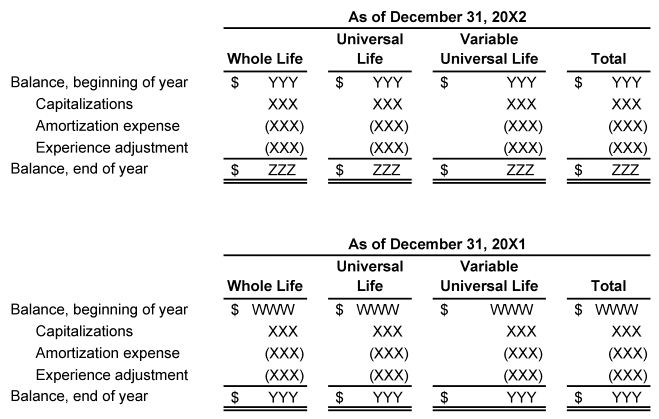
    • "As of December 31, 20X2" Whole Life Universal Life Fixed Annuity Variable Annuity Variable Universal Life Total "Balance, beginning of year" $YYY $YYY $YYY $YYY $YYY $YYY Capitalizations XXX XXX XXX XXX XXX XXX Amortization expense (XXX) (XXX) (XXX) (XXX) (XXX) (XXX) Experience adjustment (XXX) (XXX) (XXX) (XXX) (XXX) (XXX) "Balance, end of year" $ZZZ $ZZZ $ZZZ $ZZZ $ZZZ $ZZZ "As of December 31, 20X1" Whole Life Universal Life Fixed Annuity Variable Annuity Variable Universal Life Total "Balance, beginning of year" $WWW $WWW $WWW $WWW $WWW $WWW Capitalizations XXX XXX XXX XXX XXX XXX Amortization expense (XXX) (XXX) (XXX) (XXX) (XXX) (XXX) Experience adjustment (XXX) (XXX) (XXX) (XXX) (XXX) (XXX) "Balance, end of year" $YYY $YYY $YYY $YYY $YYY $YYY
944-30-55-7
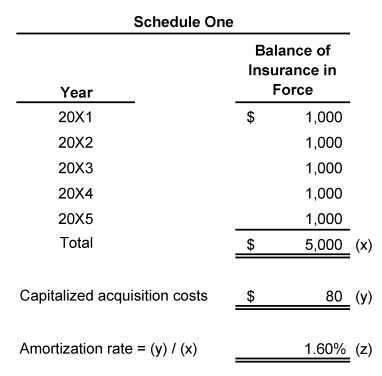
This Example illustrates the computation of amortization on a constant level basis. In this Example, a block of long-duration guaranteed-renewable five-year term life insurance contracts are grouped and amortized in proportion to the amount of insurance in force to derive an approximate level amortization amount on an individual contract basis. In 20X1, the insurance entity defers costs totaling $80 and projects the balance of insurance in force over 5 years. The insurance entity would need to include mortality and lapse assumptions to project the balance of insurance in force; however, for ease of illustration, no mortality or lapses are assumed (see paragraph 944-30-55-7B for subsequent changes to the mortality and lapse assumptions).
  • Schedule One Year Balance of Insurance in Force 20X1 " $1,000 " 20X2 " 1,000 " 20X3 " 1,000 " 20X4 " 1,000 " 20X5 " 1,000 " Total " $5,000 " (x) Capitalized acquisition costs $80 (y) Amortization rate = (y) / (x) 1.60% (z)
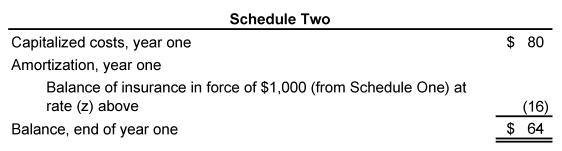
  • Schedule Two "Capitalized costs, year one" $80 "Amortization, year one" "Balance of insurance in force of $1,000 (from Schedule One) at rate (z) above" (16) "Balance, end of year one" $64
944-30-55-7A
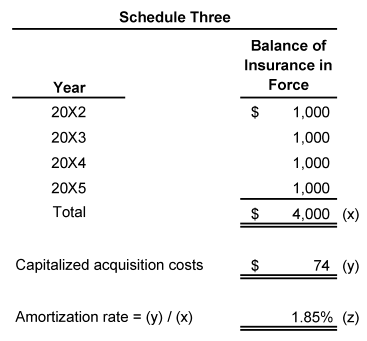
At the beginning of 20X2, the entity incurs an additional $10 of deferrable acquisition costs and computes the amortization rate and expense for 20X2 as follows.
  • Schedule Three Year Balance of Insurance in Force 20X2 " $1,000 " 20X3 " 1,000 " 20X4 " 1,000 " 20X5 " 1,000 " Total " $4,000 " (x) Capitalized acquisition costs $74 (y) Amortization rate = (y) / (x) 1.85% (z)
944-30-55-7B
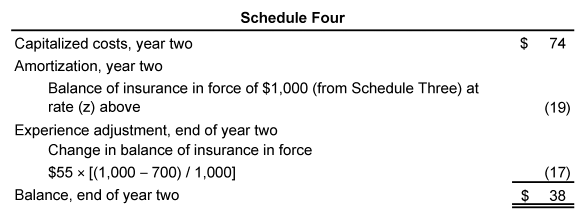
At the end of 20X2, the entity experienced unexpected contract terminations that resulted in the writeoff of deferred acquisition costs at the end of the reporting period. In addition, the entity updated the expected balance of insurance in force for the remaining periods.
  • Schedule Four "Capitalized costs, year two" $74 "Amortization, year two" "Balance of insurance in force of $1,000 (from Schedule Three) at rate (z) above" (19) "Experience adjustment, end of year two" Change in balance of insurance in force "$55 × [(1,000 - 700) / 1,000]" (17) "Balance, end of year two" $38
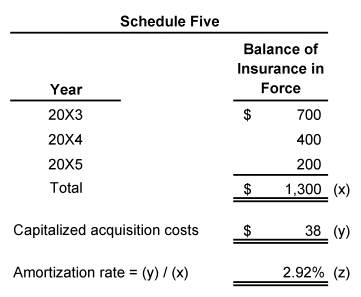
  • Schedule Five Year Balance of Insurance in Force 20X3 $700 20X4 400 20X5 200 Total " $1,300 " (x) Capitalized acquisition costs $38 (y) Amortization rate = (y) / (x) 2.92% (z)
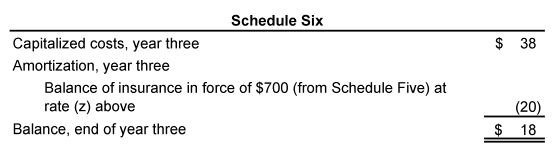
  • Schedule Six "Capitalized costs, year three" $38 "Amortization, year three" Balance of insurance in force of $700 (from Schedule Five) at rate (z) above (20) "Balance, end of year three" $18
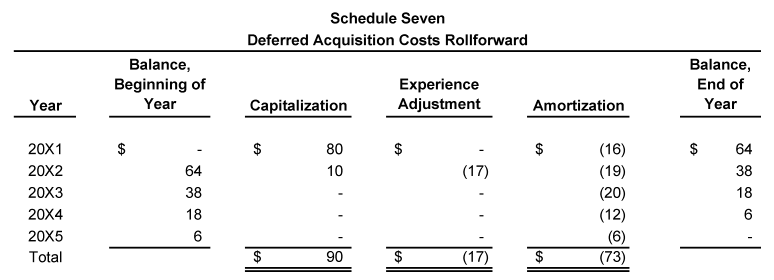
  • Schedule Seven Deferred Acquisition Costs Rollforward Year "Balance, Beginning of Year" Capitalization Experience Adjustment Amortization "Balance, End of Year" 20X1 $- $80 $- $(16) $64 20X2 64 10 (17) (19) 38 20X3 38 - - (20) 18 20X4 18 - - (12) 6 20X5 6 - - (6) - Total $90 $(17) $(73)

Internal Replacement Transactions

Implementation Guidance
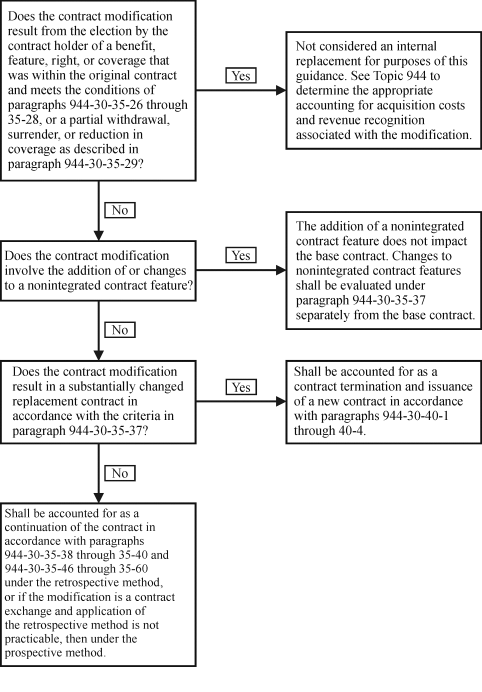
944-30-55-11
A flowchart summarizing the accounting model set out in the Internal Replacement Transactions Subsections of this Subtopic follows.

Illustrations

944-30-55-12
The following Example illustrates the application of the guidance in the Internal Replacement Transactions Subsections of this Subtopic to an internal replacement transaction that results in a substantially unchanged contract.
  1. a
  2. b
944-30-55-13
This Example assumes the following:
  1. a
    An insurance entity is offering to replace its general account single premium deferred annuity contracts with newer general account single premium deferred annuity contracts.
  2. b
    The insurance entity assumes that 50 percent of the existing contract holders choose the internal replacement at the end of Year 5.
  3. c
    No surrender charges from the original contract will be imposed on contract holders who elect to have their contracts replaced.
  4. d
    The contract holder who elects the new contract will receive a higher interest crediting rate than under the older contract but must accept a new surrender charge period.
  5. e
    The insurance entity expects that persistency rates will improve under the replacement contracts as a result of the new surrender charge period and the higher credited interest.
944-30-55-14
The exchange of the single premium deferred annuity contract for a newer single premium deferred annuity contract in this Example results in the replacement contract being substantially unchanged from the replaced contract, due to the following:
  1. a
    The insured event or risk, type, or period of coverage of the contract has not changed, as noted by no significant changes in the kind and degree of mortality risk, morbidity risk, or other insurance risk, if any.
  2. b
    The nature of the investment return rights, if any, have not changed.
  3. c
    No additional deposit, premium, or charge relating to the original benefit, in excess of amounts contemplated in the original contract, is required to effect the transaction.
  4. d
    Other than distributions to the contract holder or contract designee, there is no net reduction in the contract holder's account value or, for contracts not having an explicit or implicit account value, the cash surrender value, if any.
  5. e
    There is no change in the participation or dividend features of the contract, if any.
  6. f
    There is no change to the revenue classification of the contract.
944-30-55-33
The following represents implementation guidance for contract modifications and the application of the guidance in Section 944-30-35 for evaluating whether the internal replacements are substantially changed from the replaced contracts. The guidance is based on the specific facts and circumstances; the same conclusions may not be reached for other modifications because of differing facts or circumstances. The following cases represent contract modifications.
944-30-55-34
There are several ways in which a contract holder can increase death benefit coverage on a traditional whole life insurance contract.
944-30-55-35
An option to purchase additional insurance rider gives the contract holder the right to purchase additional insurance coverage with no additional underwriting. That is, the contract holder can increase the face value of the policy for the same type of insurance coverage and in the same form as that provided by the original contract. The additional premium charged is not in excess of an amount that would be commensurate with the additional insurance coverage obtained. The rider could be included in the original contract or added subsequently to its issuance. This is an example of a nonintegrated contract feature. Once purchased, the benefit under the option to purchase additional insurance rider generally is accounted for as a separate contract.
944-30-55-36
The contract holder obtains a second life insurance policy for an incremental face amount, with underwriting required on the new policy only. The original contract remains in force without change. This transaction does not fall within the definition of an internal replacement in Section 944-30-35. The accounting for the original contract remains unchanged and the new contract is accounted for independently of the original contract. Any deferrable acquisition costs associated with the new contract are deferred and amortized in accordance with the guidance in Section 944-30-35, as applicable.
944-30-55-37
The increased face amount (death benefit) of a traditional life insurance contract effectuated through an amendment or rider to the original contract is considered a nonintegrated feature that should be accounted for separately from the existing life insurance contract, provided that the additional premium charged for that incremental insurance coverage is not in excess of an amount that is commensurate with the incremental insurance coverage and does not result in the explicit or implicit reunderwriting or repricing of other components of the contract.
944-30-55-38
Universal life-type contracts are long-duration contracts that can provide either death or annuity benefits and are characterized by one of the following features:
  1. a
    One or more of the amounts assessed by the insurer against the policyholder are not fixed and guaranteed by the terms of the contract.
  2. b
    Amounts that accrue to the benefit of the policyholder are not fixed and guaranteed by the terms of the contract.
  3. c
    Premiums may be varied by the policyholder within contract limits without the consent of the insurer.
944-30-55-39
The increase in face amount of a universal life-type contract through an amendment to the original contract is considered an integrated feature as the death benefit under a universal life-type contract is equal to the excess of face amount over contract account value. In this example, only the additional face amount has been underwritten during the contract amendment and the additional premium charged is not in excess of an amount that would be commensurate with the additional insurance coverage obtained. This contract amendment to increase the face amount of a universal life-type contract results in the replacement contract being substantially unchanged from the replaced contract due to the following:
  1. a
    The modification does not result in a change in the insured event, as there is no significant change in the kind and degree of mortality risk. Although the face amount of the contract has increased, it is appropriate in this example to analyze the change in degree of mortality risk by comparing the relationship of the expected cost of the benefit to charges assessed for that benefit, and there was no significant change in this relationship.
  2. b
    There is no change in the nature of the investment return rights from the replaced contract.
  3. c
    There are no changes in the charges related to the original benefits; also, the additional cost of insurance is not in excess of an amount commensurate with the additional insurance coverage obtained.
  4. d
    There is no net decrease in the balance available to the contract holder, except to pay the cost of insurance charge for the increased coverage.
  5. e
    There is no change in the participation or dividend feature of the replaced contract.
  6. f
    The modification does not result in a change to either the amortization method or revenue classification of the contract.
944-30-55-40
A universal-life type contract may contain a no-lapse guarantee feature that provides for continuing coverage of the contract even if the account value drops to a level that cannot cover the contract charges. The contract exchange of a universal life-type contract for a universal life-type contract that contains a no-lapse guarantee results in the replacement contract being substantially changed from the replaced contract because the addition of the no-lapse guarantee changes both the period of coverage of the contract as well as introduces a combination of mortality and investment risk. The analysis would be the same if the change had been achieved through the addition of a no-lapse guarantee rider, as it would be considered an integrated benefit (the benefit is a function of the contract account value) and would need to meet the conditions of paragraph 944-30-35-37. If, however, the contract holder had elected to add a no-lapse guarantee feature that was included in the original contract (and met the specifications of paragraphs ), the modification would not be considered an internal replacement.
944-30-55-41
A second-to-die feature incorporates multiple mortality events within a single contract, as payment to the beneficiary is made, assuming the contract remains in force, only after both insured individuals die. The contract exchange of a universal life-type contract for a universal life-type contract that contains a second-to-die provision results in the replacement contract being substantially changed from the replaced contract because the addition of the second-to-die feature changes the insured event, as now two mortality events must occur for the beneficiary to obtain the proceeds. If the modification were achieved through amendment, endorsement, or rider rather than through a contract exchange, the analysis and conclusion would be the same as for the contract exchange because the second-to-die provision is an integrated feature.
944-30-55-42
An automobile insurance contract is a short-duration contract that generally provides coverage for personal injury and automobile damage sustained by the insured and liability to third parties for losses caused by the insured. A newly purchased car being added to an existing automobile policy with no change in the other vehicles covered or the premium related to the other vehicles under the contract results in additional nonintegrated contract coverage that should be accounted for separately from the existing automobile contract coverage, assuming the underwriting and price for coverage of the new car is determined separately and there is no change, explicit or implicit, in the pricing of the base contract.
944-30-55-43
If one of the existing automobiles under the contract described in paragraph 944-30-55-42 above is removed from the automobile contract, it is considered the extinguishment of nonintegrated contract coverage and should be accounted for as an extinguishment of only the balances related to that nonintegrated coverage. The amount refunded to the contract holder from the change in the coverage is determined in accordance with terms that are fixed in the contract or applicable state law or regulation, and no reunderwriting is required for other coverage. The amount refunded to the contract holder reduces the related unearned revenue liability, and unamortized deferred acquisition costs related to the extinguished nonintegrated contract coverage are eliminated.
944-30-55-44
Assume the automobile insurance contract described in paragraph 944-30-55-42 contains one car and one driver, the existing car is sold and replaced with another car, and coverage is changed through a contract endorsement. For accounting purposes, the original automobile contract is extinguished and coverage for a new automobile contract is established for the driver and the new car. The modification is not a reduction in coverage under paragraph 944-30-35-29, as it is a termination of all coverage in the contract, not a partial termination of coverage as described in paragraph 944-30-35-29. It is common practice to net settle the premium and commission adjustments resulting from this contract modification. For accounting purposes, there are in substance two transactions: the extinguishment of one contract, which is accounted for as a contract extinguishment under paragraphs , and establishment of a new contract.
944-30-55-45
The addition of a new driver to an existing automobile contract with no other changes in the contract results in additional nonintegrated contract coverage that should be accounted for separately from the existing automobile contract coverage, as the underwriting and price for coverage for the new driver is determined separately.
944-30-55-46
If one of the existing drivers under the contract described in paragraph 944-30-55-44 is removed from the automobile contract, it is the extinguishment of nonintegrated contract coverage and should be accounted for as an extinguishment of only the balances related to that nonintegrated coverage. The amount refunded to the contract holder from the change in the coverage is determined in accordance with terms that are fixed in the contract or applicable state law or regulation, and no reunderwriting is required for other coverage. The amount refunded to the contract holder reduces the related unearned revenue liability, and the balance of the unamortized deferred acquisition costs related to the extinguished nonintegrated contract coverage is eliminated.
944-30-55-47
An increase in the collision deductible of an automobile contract is, in effect, a reduction in the coverage provided. It is not an internal replacement, but a reduction in coverage under paragraph 944-30-35-29, providing that all the terms that determine the amount refunded from the change in coverage are fixed in the original contract or by applicable state law or regulation and no reunderwriting is required for the continuing coverage. Contractual provisions that allow the contract holder to elect to decrease existing coverage at then-current rates (other than when required by state law or regulation), subject to a stated minimum and maximum, generally are not specific enough to satisfy this requirement.
944-30-55-48
A decrease in the collision deductible of an automobile contract is, in effect, an increase in the coverage provided. It is not an internal replacement, but an election by the contract holder of coverage that was within the original contract as noted in paragraphs , providing that all the terms that determine the amount of the premium related to the additional coverage are fixed in the original contract or by applicable state law or regulation and no reunderwriting is required of the original coverage. Contractual provisions that allow the contract holder to elect to add future coverage at then-current rates (other than when required by state law or regulation), subject to a stated minimum and maximum, generally are not specific enough to satisfy this requirement.
944-30-55-49
A homeowner's contract is a short-duration contract that generally provides coverage for loss or damage of property and personal injury occurring on the insured's property. A personal articles floater provides coverage for losses on personal property not covered under the terms of the homeowner's contract. If multiple pieces of jewelry are added to a personal articles floater, each separately identified and priced item constitutes a nonintegrated contract feature. Thus, the addition of a personal articles floater providing coverage for several new pieces of jewelry to an existing homeowner's contract, with no other changes in the contract, results in additional nonintegrated contract coverage that should be accounted for separately from the existing homeowner's contract, as the underwriting and price for coverage for the jewelry is determined separately from the homeowner's contract and does not result in the reunderwriting of the existing coverages provided by the contracts. This is true even though the items covered by the personal articles floater and the homeowner's contract share a deductible and limit in the event of a common loss. The sharing of a common deductible and limit in the event of loss does not determine whether the contract feature or coverage is integrated, as the deductible is a definition of the terms of coverage resulting from a single loss event.
944-30-55-50
A contract holder increases the coverage of a homeowner's contract, which insures a house valued at $350,000 with $300,000 of insurance coverage, to $400,000 to include a recently completed addition to the house worth $100,000. The additional layer of coverage results in a nonintegrated contract feature that should be accounted for separately from the existing homeowner's contract, provided that the additional premium charged for that incremental insurance coverage is not in excess of an amount that is commensurate with the incremental insurance coverage and does not result in the explicit or implicit reunderwriting or repricing of other components of the contract. If, however, there was substantive underwriting of the entire contract, including the original coverage, the contract would be considered to be substantially changed because substantive reunderwriting of existing contract coverage is an indicator that the insurance risk has changed significantly, and would probably also result in the repricing of the entire contract, which would result in failure to satisfy the criteria in paragraph 944-30-35-37. Additional coverage provided by a nonintegrated contract feature is considered nonintegrated even though the entire coverage provided by the contract is subject to a common deductible and limit in the event of an insured loss.
944-30-55-51
A contract holder currently has an umbrella contract from the same insurance entity as his or her homeowner's contract that provides for liability coverage with a limit of $1 million. The contract holder requests to increase the limit on the umbrella contract to $2 million. This additional layer of coverage results in additional nonintegrated contract coverage that should be accounted for separately from the existing umbrella contract, as the additional premium charged is not in excess of an amount that would be commensurate with the additional insurance coverage obtained ($1 million in excess of $1 million with no additional deductible), and there was no reunderwriting of the original coverage. If, however, there was substantive underwriting of the entire contract, including the original coverage, the contract would be considered to be substantially changed because substantive reunderwriting of existing contract coverage is an indicator that the insurance risk has changed significantly.
944-30-55-52
A long-term care product provides for a specified payment while the insured qualifies for benefits under the contract; for example, while in a long-term care facility or when receiving care at home. If the long-term care product had an authorized rate increase, the insurance entity may offer the contract holder the option of reducing coverage instead of paying additional premiums (i.e., maintain the current premium rate). For example, if the original contract provided benefit coverage of $100 a day for a $2,000 annual premium and there was an authorized increase of premiums to $2,500, the contract holder could elect to pay the increased premium or, if allowed by the insurance contract, retain annual premiums of $2,000 with reduced benefit coverage of $80 a day. In this example, the increase in premiums from $2,000 to $2,500 is related to a change in the cost of the insurance that is within ranges outlined in the contract and approved by the insurance regulator, and by itself the premium increase is not considered a modification to the contract. The contract holder election of a reduction in benefits is not an internal replacement, but rather a reduction in coverage under paragraph 944-30-35-29, if all the terms for a change in coverage are fixed in the original contract or by applicable state law or regulation and no reunderwriting of the continuing coverage is required.
944-30-55-53
If the contract holder elected a reduction in benefits under which the terms related to a change in coverage were not fixed in the original contract, the contract modification results in the replacement contract being substantially unchanged from the replaced contract as a result of the following:
  1. a
    The insured event has not changed from the replaced contract.
  2. b
    The exchange does not change the nature of the contract holder's investment return rights.
  3. c
    No additional deposit or premium is required and there are no changes in the charges related to the original benefits in excess of the amounts specified or allowed in the original contract, as the reduction in benefits is not in excess of the corresponding reduction in premiums. (The original contract provided for benefits of $100 a day for $2,000 annual premium, the reduction in benefits to $80 a day is commensurate with the 20-percent reduction in premiums from the increased rate of $2,500 to $2,000.)
  4. d
    There is no net decrease in the balance available to the contract holder.
  5. e
    There is no change in the participation or dividend features of the replaced contract.
  6. f
    There is no change in the amortization method or revenue classification of the replaced contract.
944-30-55-54
A single premium deferred annuity typically is classified as an investment contract as addressed in paragraphs .
944-30-55-55
The current interest rate guarantee period of a market value annuity typically does not encompass substantially all of the expected life of the contract. At the end of an interest rate declaration period, a new crediting rate is declared by the insurance entity and may vary above the minimum guaranteed rate. The length of the initial and subsequent interest rate guarantee periods generally is selected by the contract holder. Market value annuities typically are classified as investment contracts.
944-30-55-56
In this guidance, there is no significant difference in the declared interest crediting rate (further, the change in interest rates is consistent with the change in declaration period), no change in the guaranteed minimum interest rate, no additional deposit or premium is required, and there are no surrender charges or front-end fees associated with the internal replacement. The contract exchange of a single premium deferred annuity contract for a market value annuity contract results in the replacement contract being substantially unchanged from the replaced contract as a result of the following:
  1. a
    The insured event has not changed from the replaced contract.
  2. b
    The exchange does not change the nature of the contract holder's investment return rights (crediting rate declared by insurance entity, subject to guaranteed minimum crediting rate). The single premium deferred annuity and the market value annuity are both contracts for which the interest rate is periodically reset by the insurance entity subject to a minimum interest rate guaranteed by the contract and, in this example, the current declared interest period does not represent substantially all of the expected life of the contract. The difference between the single premium deferred annuity and the market value annuity results from the manner in which the amount available to the contract holder is determined in the event the contract is terminated prematurely, not the contractual rights and provisions for the determination of the contract holder's investment return in the absence of a premature termination of the contract.
  3. c
    No additional deposit or premium is required, and there are no changes in the charges related to the original benefits.
  4. d
    There is no net decrease in the balance available to the contract holder.
  5. e
    There is no change in the participation or dividend features of the replaced contract.
  6. f
    There is no change in the amortization method or revenue classification of the replaced contract.
944-30-55-57
The single premium deferred annuity and the market value annuity are both contracts for which the interest rate is periodically reset by the insurer subject to a minimum interest rate guaranteed by the contract; the only significant substantive difference between these two contracts is the manner in which amounts are determined in the event of a premature surrender. If the declared interest rate period of the market value annuity constituted substantially all of the expected life of the contract, the change from a contract for which interest is set at the discretion of the insurer to one for which the rate is set by contract would result in a substantially changed contract.
944-30-55-58
A single premium deferred annuity has a crediting rate that is set at the discretion of the insurance entity. An equity-indexed annuity is a deferred fixed annuity contract with a guaranteed minimum crediting rate plus a contingent return based on a contractually specified internal or external equity index. Equity-indexed annuities typically are classified as investment contracts with embedded derivatives that are required to be bifurcated from the contract and accounted for separately under Topic 815 (see paragraphs ). Generally, the equity index feature represents a periodic crediting rate mechanism that affects the amounts credited to the contract holder's account balance, rather than representing a benefit in addition to the account balance that protects the contract holder from other-than-nominal capital market risk and exposes the insurance entity to other-than-nominal capital market risk. Periodic crediting rate mechanisms are required to be evaluated for possible bifurcation under Topic 815. However, an equity-indexed annuity also may contain one or more market risk benefits (see paragraphs ).
944-30-55-59
The contract exchange of a single premium deferred annuity contract for an equity-indexed annuity results in the replacement contract being substantially changed from the replaced contract because the nature of the contract holder's investment return rights differs significantly between the two contracts. The crediting rate of the single premium deferred annuity contract is declared at the discretion of the insurance entity, while the crediting rate on the equity-indexed annuity is contractually determined by reference to a pool of assets, an index, or other specified formula.
944-30-55-60
A single premium deferred annuity has a crediting rate that is set at the discretion of the insurance entity. A multi-bucket annuity is a general account deferred annuity for which, subject to a contractually specified minimum crediting rate, the interest rate to be credited on the contract holder's account balance is determined based on the returns achieved on a specified category of investments or investment strategy selected by the contract holder. The contract specifies the rights and provisions for the determination of investment return to the contract holder.
944-30-55-61
The contract exchange of a single premium deferred annuity contract for a multi-bucket annuity results in the replacement contract being substantially changed from the replaced contract because the nature of the investment return rights are different between the two contracts. In the case of the typical single premium deferred annuity, the interest rate is declared at the discretion of the insurance entity whereas, in the case of the multi-bucket annuity, the interest rate is determined by reference to a specific category of assets or investment strategy selected by the contract holder as defined in the contract.
944-30-55-62
A fixed-interest rate guaranteed investment contract has a stated fixed crediting rate guaranteed for a specified period. An example of a variable-interest rate guaranteed investment contract is a contract with a credited interest rate defined as London Inter Bank Offered Rate (LIBOR) plus a specified spread. Both types of guaranteed investment contracts are classified investment contracts under paragraphs .
944-30-55-63
The contract exchange of a fixed-rate guaranteed investment contract for a variable-rate guaranteed investment contract results in the replacement contract being substantially changed from the replaced contract because the investment return rights for the determination of the contract holder's investment return are different between the two contracts. In the case of the fixed-rate guaranteed investment contract, the interest rate is fixed and guaranteed whereas, in the case of the variable-interest rate guaranteed investment contract, the investment return to the contract holder is contractually specified to be determined based on the returns achieved on a specified category of investments or tied to a specific index.
944-30-55-64
A variable annuity is a product offered by an insurance entity in which the contract holder's payments are used to purchase units of a separate account. The contract holder directs the allocation of the account value among various investment allocation alternatives and bears the investment risk. The units may be surrendered for their current value in cash (often less a surrender charge) or applied to purchase annuity income contracts. The insurance entity periodically deducts mortality and expense charges from the account. A common feature in variable annuities is a minimum guaranteed death benefit, with some minimum guaranteed death benefit designs providing more extensive benefits than others.
944-30-55-65
The contract exchange of a variable annuity with a return of premium death benefit guarantee, that in this example is determined to have a minimal degree of mortality risk (although sufficient to result in classification as an insurance contract), for a variable annuity that contains a ratchet death benefit guarantee, that in this example is determined to be a "rich" death benefit, results in the replacement contract being substantially changed from the replaced contract as the change in death benefits substantively changes the degree of mortality risk. The nature of a minimum guaranteed death benefit provision is essentially a combination of mortality and investment events. Although the actual mortality event itself is the same in the return of premium and ratchet guaranteed minimum death benefits (death of the contract holder), the risk has changed because of the combined effects of mortality and investment events. In this instance, the preparer analyzed and concluded that a significant change in the actuarially determined expected mortality costs was indicative of a significant change in the degree of mortality risk. It should be noted that other methods and approaches could have been used to evaluate the change in degree of mortality.
944-30-55-66
In this guidance, it is assumed that both the variable annuity with the rollup death benefit guarantee and the variable annuity with the ratchet death benefit guarantee offered as an internal replacement are determined to have similar degrees of mortality risk. In this instance, the preparer compared actuarially determined expected mortality costs, and since the costs were similar, it was indicative that the degree of mortality risk was also similar. It should be noted that other methods and approaches could have been used to evaluate the change in degree of mortality. It is also assumed that there is no reunderwriting required for the transaction, no additional deposit required to effect the transaction, and no net decrease in the balance available to the contract holder prior to surrender charges. In this guidance, the replacement results in additional mortality and expense charges due to the enhanced death benefit guarantee not in excess of an amount commensurate with the added benefit. A contract exchange of a variable annuity contract that contains a minimum guaranteed death benefit that is determined to have significant mortality risk with a variable annuity contract that contains another kind of minimum guaranteed death benefit that is determined to have a comparable degree of mortality risk, results in the replacement contract being substantially unchanged from the replaced contract as a result of the following:
  1. a
    The exchange does not result in a significant change in the kind and degree of mortality risk.
  2. b
    The exchange does not change the nature of the contract holder's investment return rights.
  3. c
    No additional deposit or premium is required relating to the variable annuity (the original benefit), and the additional charges for the ratchet death benefit guarantee are not in excess of an amount commensurate with the benefit.
  4. d
    There is no net decrease in the balance available to the contract holder.
  5. e
    There is no change in the participation or dividend features of the contracts.
  6. f
    There is no change to the revenue classification of the replaced contract.
944-30-55-67
If the modification were achieved through amendment, endorsement, or rider rather than through a contract exchange, the analysis and conclusion would be the same as for the contract exchange because the minimum guaranteed death benefit is an integrated feature.
944-30-55-68
A long-term care rider provides that in the event the insured enters a covered facility, the feature will provide a specified fixed payment while the insured is being treated at a covered facility.
944-30-55-69
In this guidance, the contract holder exchanges the original variable annuity contract for a new variable annuity contract that contains an long-term care rider. This is a contract exchange in which the replacement contract contains a nonintegrated contract feature, as the long-term care rider is not related to the provisions of the replacement variable annuity contract. This contract exchange results in the base annuity contract being substantially unchanged from the replaced contract as a result of the following:
  1. a
    The modification does not result in a change in the insured event, as there is no significant change in the kind and degree of mortality risk from the replaced contract.
  2. b
    There is no change in the nature of the investment return rights from the replaced contract.
  3. c
    There are no changes in the charges related to the variable annuity (the original benefit), and the additional premium for the long-term care benefit is not in excess of an amount commensurate with the additional insurance coverage obtained.
  4. d
    There is no net decrease in the balance available to the contract holder.
  5. e
    There is no change in the participation or dividend features of the replaced contract.
  6. f
    The modification does not result in a change to either the amortization method or revenue classification of the contract.
944-30-55-70
The long-term care rider should be accounted for as a separate contract, as it is a nonintegrated contract feature. This accounting would be the same if the modification had been achieved through the addition of a long-term care rider to the original annuity contract rather than through an exchange.
944-30-55-71
Variable annuities generally have a number of investment allocation alternatives from which the contract holder may select. In the normal course of business, companies modify these elections for a number of reasons, including competition and changes in investment management and distribution relationships. Throughout the life of the contract, the contract holder has the option to select new allocations for the investment of his or her annuity account balance. Generally, the addition of new investment allocation alternatives to variable life insurance or annuity contracts does not result in a substantive change to the original contract because the contractual rights and provisions for the determination of the contract holder's investment return have not changed.
944-30-55-72
It is possible that one of the investment allocation alternatives added or elected could be a fixed return option. As long as the contract remains a variable annuity contract and the contract holder retains the right to reallocate amounts to other investment alternatives, neither the addition of the investment alternative nor the contract holder's utilization of that investment alternative would constitute an internal replacement that results in a substantially changed contract. If, however, the contract holder's election of a fixed allocation alternative results in a conversion or partial conversion to a fixed annuity contract or the contract remains a variable annuity contract but the transfer is effectively a conversion or partial conversion because there are substantive restrictions on the contract holder's ability to reallocate amounts to other investment alternatives, the modification would result in a substantially changed contract to the extent of the conversion or substantially restricted balance.
944-30-55-73
A variable annuity contract is replaced with a variable annuity contract that also provides a guaranteed minimum accumulation benefit, in this example, a 5-percent annual rollup of contract value in 10 years. The contract exchange of a variable annuity for a variable annuity that contains a guaranteed minimum accumulation benefit results in the replacement contract being substantially changed from the replaced contract because the addition of a guaranteed minimum accumulation benefit, an integrated benefit feature, changes the investment return rights of the contract holder by providing a minimum investment return guarantee. The analysis would be the same if the change had been achieved through the addition of a guaranteed minimum accumulation benefit rider. If, however, the contract holder had elected to add a guaranteed minimum accumulation benefit feature that was included in the original contract (and met the specifications in paragraphs ), the modification would not be considered an internal replacement.
944-30-55-74
A variable annuity contract is replaced with a variable annuity contract that also provides a guaranteed minimum income benefit, in this guidance, a 5-percent annual rollup of contract value. A guaranteed minimum income benefit, an integrated contract feature, specifies a manner in which an annuitization benefit is determined if the contract holder elects to annuitize. The guaranteed minimum income benefit cannot be withdrawn or net settled. The contract exchange of a variable annuity for a variable annuity that contains a guaranteed minimum income benefit results in the replacement contract being substantially changed from the replaced contract because the addition of a guaranteed minimum income benefit changes the investment return rights of the contract holder, as a minimum investment return provision, via the guaranteed amount for annuitization, has been added to the variable annuity. The analysis would be the same if the change had been achieved through the addition of a guaranteed minimum income benefit rider. If, however, the contract holder had elected to add a guaranteed minimum income benefit feature that was included in the original contract (and met the specifications in paragraphs ), the modification would not be considered an internal replacement.
944-30-55-75
The insurance entity either replaces deferred annuity contracts with annuity contracts that contain the guaranteed minimum withdrawal benefit feature or the insurance entity adds a guaranteed minimum withdrawal benefit rider to existing inforce business (that is, deferred annuity contracts).
944-30-55-76
A variable annuity with a guaranteed minimum withdrawal benefit is classified as an investment contract with a market risk benefit. The contract exchange of a variable annuity for a variable annuity that contains a guaranteed minimum withdrawal benefit results in the replacement contract being substantially changed from the replaced contract because the addition of a guaranteed minimum withdrawal benefit, an integrated contract feature, changes the investment return rights of the contract holder, as a minimum investment return provision, via the guaranteed withdrawal amount, to the variable annuity. The analysis would be the same if the change had been achieved through the addition of a guaranteed minimum withdrawal benefit rider. If, however, the contract holder had elected to add a guaranteed minimum withdrawal benefit feature that was included in the original contract (and met the specifications in paragraph 944-30-35-26), the modification would not be considered an internal replacement.

Related subtopics