ASC 720-20
Insurance Costs
720 Other Expenses
Source downloaded: .Record version 7ade7bff5a15. Effective date must be checked in the source.
ASC 720-20 tells a policyholder (a noninsurance entity, or an insurer buying coverage outside its core operations) how to account for insurance it purchases, covering three contract types: retroactive contracts, claims-made contracts, and multiple-year retrospectively rated contracts. If a contract does not actually transfer insurance risk, the premium (less amounts retained by the insurer) is accounted for as a deposit under Subtopic 340-30 (720-20-25-1). For retroactive coverage of already-incurred liabilities, the premium is expensed immediately, a receivable is recorded for expected recoveries, and any excess of receivable over premium is a deferred gain amortized over the recovery period (720-20-25-3 through 25-4; 720-20-35-2).
Key points (7)
- If, regardless of form, an insurance contract does not indemnify the insured against loss or liability, the premium paid less the amount retained by the insurer is accounted for as a deposit under Subtopic 340-30 (720-20-25-1; 720-20-25-2).
- Purchased retroactive insurance is accounted for like retroactive reinsurance under Subtopic 944-605: the premium is expensed immediately and a receivable is established for expected recoveries related to the insured event (720-20-25-3).
- Any excess of the receivable over the amount paid is a deferred gain—immediate gain recognition and derecognition of the liability are prohibited because the liability is not extinguished and offsetting is not permitted under 210-20-45-1 (720-20-25-4); the deferred gain is amortized using the interest method, or on a recoveries-to-total-recoveries basis if amounts and timing cannot be reasonably estimated (720-20-35-2).
- A claims-made policy that covers specific known claims reportable before the policy period (asserted claims, known unasserted claims, or known events that might result in a claim) contains a retroactive provision; the retroactive and prospective provisions must be accounted for separately if practicable, and if not practicable the entire policy is accounted for as retroactive (720-20-25-6 through 25-8), with indicators of a purely prospective policy listed in 720-20-25-10.
- Prospective claims-made policies are accounted for by recognizing the premium as prepaid expense and estimating an annual expense equal to premium plus the change in the incurred-but-not-reported liability and the change in the related insurance recoverable, allocated to interim periods, with unusual claims recognized discretely when incurred (720-20-35-3 through 35-5; 720-20-35-9 through 35-10).
- Insured entities must still accrue a liability for probable and reasonably estimable incurred but not reported claims under 450-20-25-2 (720-20-25-14), and prepaid insurance and insurance receivables may not be offset against those liabilities unless 210-20-45-1 is met (720-20-45-1).
- For a multiple-year retrospectively rated contract accounted for as insurance, the insured recognizes a liability (or asset) for consideration payable to (or by) the insurer that would not exist absent experience under the contract, measured using a with-and-without method excluding future experience (720-20-25-15; 720-20-30-3; termination alternatives in 720-20-30-4).
For students. This is the policyholder's side of insurance accounting—easy to confuse with Topic 944, which governs insurers. The classic trap is assuming that buying insurance for an already-recognized liability lets you write off the liability and book a gain; instead you expense the premium, record a receivable, defer any gain, and keep the gross liability on the balance sheet.
Machine-generated study aid for ASC 720-20. Check the source paragraphs below.
720-20-00Status
Source downloaded: .Record version ffda97179e02. Effective date must be checked in the source.
| Paragraph | Action | Accounting Standards Update | Date |
| Reinsurance | Added | Accounting Standards Update No. 2016-19 | 12/14/2016 |
| 720-20-05-3 | Amended | Accounting Standards Update No. 2016-19 | 12/14/2016 |
| 720-20-05-5 | Amended | Maintenance Update 2020-18 (PDF) | 11/25/2020 |
| 720-20-15-6 | Amended | Accounting Standards Update No. 2016-19 | 12/14/2016 |
| 720-20-15-8 | Amended | Accounting Standards Update No. 2016-19 | 12/14/2016 |
| 720-20-25-1 | Amended | Accounting Standards Update No. 2016-19 | 12/14/2016 |
| 720-20-30-2 | Amended | Maintenance Update 2020-18 (PDF) | 11/25/2020 |
720-20-05Overview and Background
Source downloaded: .Record version ba7f18a3047d. Effective date must be checked in the source.
- aRetroactive contracts
- bClaims-made contracts
- cMultiple-year retrospectively rated contracts.
Retroactive Contracts
Claims-Made Contracts
Multiple-Year Retrospectively Rated Contracts
- aChanges in the amount or timing of future contractual cash flows, including premium adjustments, settlement adjustments, or refunds to the noninsurance entity
- bChanges in the contract's future coverage.
720-20-15Scope and Scope Exceptions
Source downloaded: .Record version bc61da2cecd9. Effective date must be checked in the source.
Overall Guidance
Entities
Retroactive Contracts
Overall Guidance
Entities
Transactions
- aThose that meet the indemnification against loss or liability conditions of Section 720-20-25-1
- bThose that provide indemnification against loss or liability relating to liabilities that have been incurred as a result of a past event, for example, environmental remediation liabilities (see Subtopic 410-30).
- aThose that legally extinguish the entity's liability
- bReinsurance transactions (see Subtopic 944-20 for guidance on the accounting by insurance entities for reinsurance contracts).
Claims-Made Contracts
Overall Guidance
Transactions
Multiple-Year Retrospectively Rated Contracts
Overall Guidance
Transactions
- aA retrospectively rated insurance contract that is not a multiple-year contract or that could be cancelled by either party without further obligation.
720-20-25Recognition
Source downloaded: .Record version eb70b47ccbe1. Effective date must be checked in the source.
Retroactive Contracts
Purchase of a Retroactive Insurance Policy
Claims-Made Contracts
Claims-Made Insurance Policies That Represent Purchased Retroactive Insurance Contracts
- a Asserted claims
- b Known unasserted claims
- c Any known previous event or circumstance that might result in a specific claim (whether asserted or unasserted).
- a The insured consistently purchases claims-made insurance policies as part of its risk management program for the specific type of risk being insured, and tail coverage for both prior periods and prior policies is readily available and not excessively priced as compared to tail coverage offered to similar entities that do not contain retroactive provisions.
- b The claims-made insurance policy is responsive to unknown risks for a finite or limited period of time, as evidenced by the fact that all of the following conditions exist:
- 1 The type of risk being insured is inherently short-tailed (that is, the claims are incurred during the policy period and paid out in their entirety shortly after the end of the policy period).
- 2 The policy term is for a limited period of time (for example, one-year coverage).
- 3 Claims-made coverage is the most readily available coverage for this type of insurance risk.
- 4 The occurrence date of the type of risk covered by the policy is unclear (that is, the causal event that gives rise to an insured claim is difficult to determine). Such a lack of identification creates difficulty in assessing risk for an entity considering whether to self-insure its insurance risk (for example, a manufacturing entity may be completely unaware of the potential health hazards attributable to its core products and may want to protect itself in case a by-product of its production process becomes the next asbestos).
- 1
- c The claims-made insurance policy contains an unambiguous trigger indicating that a claim is covered by the policy. That contract trigger should not be subject to interpretation, negotiation, or manipulation. An example of an unambiguous trigger that indicates that a claim is covered by a claims-made insurance policy would include both of the following provisions:
- 1 The insured notifies the insurance carrier during the policy term that a claim has been asserted or that an incident has occurred.
- 2 The insured must represent that it was not aware of any such incident when the claims-made policy was purchased.
- 1
- d The premium charged for the claims-made insurance policy is not significantly in excess of the premium that would be charged for a claims-made insurance policy that could be purchased by a similar entity with similar insurance risks and no knowledge of any circumstances or events that would result in any claims, excluding any anticipated amounts for a typical number of claims for which the insured is not aware to have specifically occurred but that it expects would be reported (incurred but not reported).
- e The insurer may base the premium for the claims-made insurance policy on estimates and predictions that are based on the past experience of the insured but the premium is not based on settlement estimates of specific, known events that are expected to be recovered under the policy.
- f The premium charged for the policy in the current year is not significantly in excess of that charged in previous years, other than for increases in the amount or type of coverage. An anticipated increase in premiums that is expected to occur because the insured entity is advancing toward the mature stage of premiums for claims-made insurance would not be considered in making that determination.
- g The claims-made insurance policy is primarily intended to cover insurance risk and is not a financing arrangement. Claims-made insurance policies that are intended to cover insurance risk typically include features such as:
- 1 An absence of adjustment features based on experience
- 2 Coverage of the ultimate loss from the claim, once made, regardless of period of settlement.
- 1
- h If the claims-made insurance policy has a specified retroactive date prior to the inception of the claims-made relationship with the insurer, the period from that specified retroactive date to the inception of the claims-made relationship with that insurer is either short or covered by other insurance policies.
Recognizing a Liability for Incurred but Not Reported Claims
Multiple-Year Retrospectively Rated Contracts
- aAs indicated in paragraph 944-20-25-2, a liability to the extent that the insured has an obligation to pay cash (or other consideration) to the insurer that would not have been required absent experience under the contract
- bAs indicated in paragraph 944-20-25-2, an asset to the extent that any cash (or other consideration) would be payable by the insurer to the insured based on experience to date under the contract.
720-20-30Initial Measurement
Source downloaded: .Record version 9863f1c53eca. Effective date must be checked in the source.
Claims-Made Contracts
Liability for Incurred but Not Reported Claims Based on the Cost of Tail Coverage
Multiple-Year Retrospectively Rated Contracts
- aIf a decision to terminate has been made, the measurement shall be based on an assumption of termination and on experience to date.
- bOtherwise, the measurement shall be based on the lesser of the following:
- 1The total incremental amount that would be paid based on the with-and-without calculation assuming experience to date and assuming termination (that is, excluding the effects of future losses and future premiums that would have been paid regardless of experience to date)
- 2The total incremental amount that would be paid based on the with-and-without calculation assuming experience to date and assuming no termination (that is, excluding the effects of future losses and future premiums that would have been paid regardless of experience to date).
- 1
720-20-35Subsequent Measurement
Source downloaded: .Record version 3cff17b9ea0c. Effective date must be checked in the source.
Retroactive Contracts
Deferred Gain Amortization
Claims-Made Contracts
Interim Financial Reporting—Entity's Fiscal Year and Policy Year Coincide
- a Accruing the incurred but not reported liability
- b Accruing any expected increase in insurance recoverables
- c Amortizing the insurance premium on a pro rata basis over the year.
- a The premium paid at the beginning of the fiscal year for the new claims-made insurance policy shall be recognized as a prepaid expense.
- b At the beginning of the fiscal year, the entity shall estimate its incurred but not reported liability as of the end of the fiscal year. That estimate involves estimating the claims and incidents that will be incurred prior to year-end but will not be reportable until after year-end. Presumably the estimated year-end incurred but not reported liability would approximate the beginning incurred but not reported liability adjusted for relevant historical patterns unless the entity has identified new factors (such as a major change in products, manufacturing processes, or risk management systems) that warrant further adjustment of the ending incurred but not reported liability.
- c The entity shall compute an estimated annual expense as the sum of all of the following:
- 1 The premium paid for the claims-made policy
- 2 The difference between the beginning incurred but not reported liability and the estimated year-end incurred but not reported liability
- 3 The difference between the beginning insurance recoverable related to the incurred but not reported liability and the estimated ending amount.
That estimated annual expense shall be recognized in interim periods based on the methodology that best reflects the manner in which the benefits of the insurance coverage are consumed and the incurred but not reported liability is incurred. In addition, liabilities for specific claims incurred during the year that are not included in the incurred but not reported estimate shall be recognized as expense in the interim period in which they are incurred. The method selected shall be appropriate in light of the relevant facts and circumstances and consistently applied. - 1
- d The estimated year-end incurred but not reported liability shall be reviewed whenever interim financial statements are prepared. Routine adjustments to the estimated liability shall be recognized ratably in each of the remaining interim periods. However, if events and circumstances in that interim period indicate that unusual claims and incidents have been incurred prior to the end of the interim period, the entity shall recognize in that interim period any related significant adjustments of the estimated year-end incurred but not reported liability.
- e For any insurance recoverable recognized, either related to the incurred but not reported liability or to a specific incurred claim, the entity shall evaluate those assets and adjust them, if necessary, based on changes in circumstances. See paragraphs for further guidance on the recognition of a receivable for expected insurance recoveries.
- f Any unusual claims and incidents that have been incurred prior to the end of an interim period but will probably be reported prior to year-end should not affect net income if they will be covered (insured) under the existing claims-made insurance policy. However, both the asset (under the insurance claim) and the liability (for the incident) shall be reflected on the balance sheet.
Interim Financial Reporting—Entity's Fiscal Year and Policy Year Do Not Coincide
- a An incurred but not reported liability related to the entity's obligation for claims and incidents that have been incurred prior to year-end but will be reportable after year-end
- b An insurance recoverable for any outstanding claims that are reimbursable under the existing claims-made policy
- c An asset for prepaid insurance premiums related to the coverage for claims and incidents that will be incurred after year-end but reported prior to the expiration of the existing claims-made policy.
- a At the beginning of the fiscal year the entity shall make an estimate of its future premium cost of the new claims-made policy that is expected to be purchased during the fiscal year. The entity shall also estimate the portion of that future premium cost that would relate to coverage for claims and incidents that will be incurred after the end of the fiscal year but reported prior to the expiration of that new claims-made policy; that portion represents the estimated prepaid asset at the end of the fiscal year. The estimate of the future premium cost involves estimating the effect of past claims and incidents that are expected to affect the premium level, as well as the effect of historical patterns and any new factors (such as a major change in products, manufacturing processes, or risk management systems) that are relevant.
- b At the beginning of the fiscal year the entity shall make an estimate of its incurred but not reported liability as of the end of the fiscal year. That estimate involves estimating the claims and incidents that will be incurred prior to year-end but will not be reportable until after the year-end. Presumably the estimated year-end incurred but not reported liability would closely approximate the beginning incurred but not reported liability adjusted for relevant historical patterns unless the entity has identified new factors (such as a major change in products, manufacturing processes, or risk management systems) that warrant further adjustment of the ending incurred but not reported liability.
- c The entity shall compute an estimated annual expense as the sum of all of the following:
- 1 The balance of the premium cost for the claims-made policy expiring during the year
- 2 The estimated future premium cost for the new claims-made policy
- 3 The difference between the beginning incurred but not reported liability and the estimated year-end incurred but not reported liability
- 4 The difference between the beginning and estimated ending insurance receivable related to incurred but not reported liability.
That estimated annual expense should be recognized ratably in interim periods based on the methodology that best reflects the manner in which the benefits of the insurance premiums are consumed and the incurred but not reported liability is incurred. As indicated in paragraph 720-20-35-5(c), the method selected should be appropriate in light of the relevant facts and circumstances and consistently applied. In addition, liabilities for specific claims incurred during the year that are not included in the incurred but not reported estimate shall be recognized as expense in the period in which they are incurred. - 1
- d The estimated year-end incurred but not reported liability should be reviewed whenever interim financial statements are prepared. Routine adjustments in the estimated liability (such as adjusting the estimated future premium cost to reflect actual) would be recognized ratably in each of the remaining interim periods. However, if events and circumstances in that interim period indicate that unusual claims and incidents have been incurred prior to the end of the interim period, the entity shall recognize in that interim period any related significant adjustments of the estimated year-end incurred but not reported liability.
- e For any insurance recoverable recognized, either related to the incurred but not reported liability or to a specific incurred claim, the entity should evaluate those assets and adjust them, if necessary, based on changes in circumstances. Paragraphs provide further guidance on the recognition of a receivable for expected insurance recoveries.
- f Any unusual claims and incidents that have been incurred prior to the end of an interim period and that will probably be reported prior to expiration of the new claims-made insurance policy should not affect net income if they will be covered by insurance. However, both the asset (under the insurance claim) and the liability (for the incident) shall be reflected on the balance sheet.
Multiple-Year Retrospectively Rated Contracts
720-20-45Other Presentation Matters
Source downloaded: .Record version c4a2bfe8f21d. Effective date must be checked in the source.
Claims-Made Contracts
720-20-50Disclosure
Source downloaded: .Record version 6f9df67821fc. Effective date must be checked in the source.
Claims-Made Contracts
720-20-55Implementation Guidance and Illustrations
Source downloaded: .Record version a974c1e17cad. Effective date must be checked in the source.
Claims-Made Contracts
Illustrations
- aA policy without a retroactive provision (Case A)
- bA policy with a retroactive provision (Case B).
- a Entity A typically uses a claims-made policy to manage its insurance risk and plans to continue purchasing a claims-made insurance policy annually.
- b Tail coverage is readily available.
- c The premium charged for the claims-made policy is not significantly in excess of premiums charged to other similar entities with similar insurance profiles.
- d The claims-made policy contains an unambiguous contract trigger to determine when claims are covered.
- e Because Entity A has no knowledge of any asserted claims or events that would result in a claim, the claims-made policy is primarily expected to cover insurance risk related to future claims.
- a The claims-made policy was taken out in part in response to a known incident that was reported to the insurer.
- b The premium charged by the insurer includes an estimate of the expected settlement costs for the unasserted claim.
- c The premium charged primarily represents a financing of the unasserted claim.
- a The claims-made policy was purchased specifically to cover known claims for which a liability had been recognized.
- b The claims-made policy effectively represented a financing of the liability previously recognized by Entity A.
- c The premium charged was primarily based on expected payouts for an event that had already occurred.
- a There are no known asserted or unasserted claims that are expected to be covered by the policy. The liability recognized for incurred but not reported claims would not preclude HealthCo from concluding that its claims-made insurance policy is prospective as HealthCo represented that it did not know of any asserted claims.
- b Tail coverage is readily available.
- c The premium charged for the claims-made policy is not significantly in excess of premiums charged for similar policies with no retroactive dates.
- d There is a clear and unambiguous contract coverage trigger.
- aCalculations are made using assumed facts (Case A).
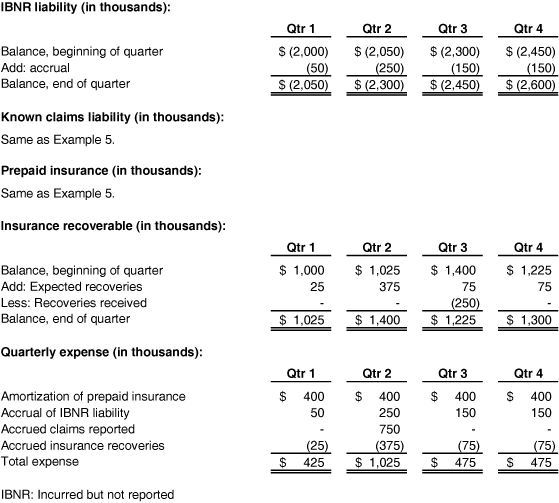
- bThe entity revises its incurred but not reported estimate (Case B).
- cThe entity discovers a defect in the manufacturing process (Case C).
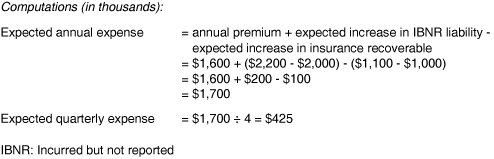
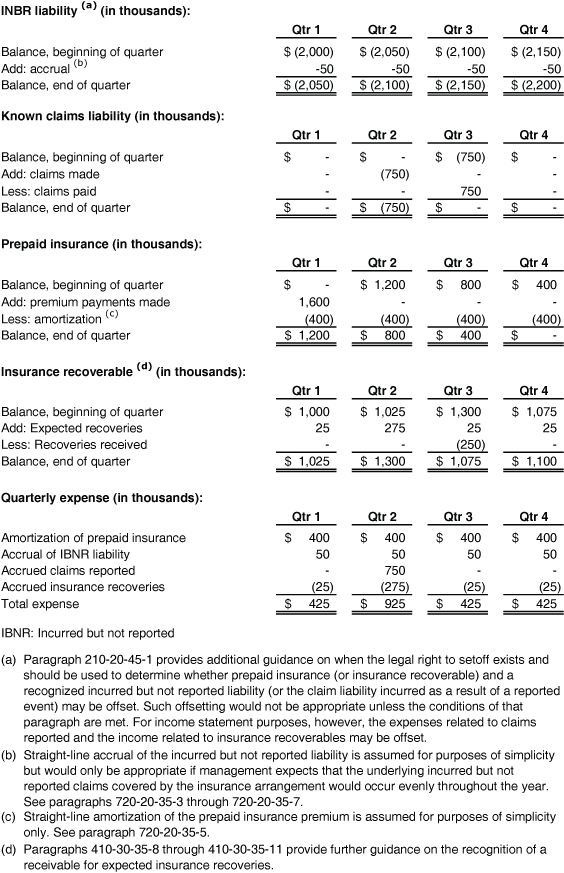
- aEntity A purchases claims-made policies every year for its insurable risk. The insurance arrangement meets the criteria for prospective treatment as described in paragraphs . The policy has a $500,000 per incident deductible and a $2 million per incident maximum with a policy limit of $15 million. When calculating the insurance recoverable related to incurred but not reported incidents, Entity A assumes that approximately 50 percent of the gross claim value will be recovered because of the deductible. Entity A does not anticipate incurring any losses in excess of the policy's maximums.
- bAccrued incurred but not reported liability at 12/31/X0: $2 million.
- cReceivable for insurance recoverable at 12/31/X0: $1 million.
- dEstimated incurred but not reported liability at 12/31/X1: $2.2 million.
- eEstimated receivable for insurance recoverable at 12/31/X1: $1.1 million.
- fPremium for claims-made policy for year ending 12/31/X1, payable 1/1/X1: $1.6 million.
- gValue of claim for an incident reported during the second quarter (the claim is covered by the insurance policy subject to a $500,000 deductible and was both paid to the claimant and recovered from the carrier during the third quarter): $750,000.
 Computations (in thousands): Expected annual expense = annual premium + expected increase in IBNR liability - expected increase in insurance recoverable = "$1,600 + ($2,200 - $2,000) - ($1,100 - $1,000)" = "$1,600 + $200 - $100" = "$1,700 " Expected quarterly expense = "$1,700 ÷ 4 = $425" IBNR: Incurred but not reported
 INBR liability (a) (in thousands): Qtr 1 Qtr 2 Qtr 3 Qtr 4 "Balance, beginning of quarter" " $(2,000)" " $(2,050)" " $(2,100)" " $(2,150)" Add: accrual (b) -50 -50 -50 -50 "Balance, end of quarter" " $(2,050)" " $(2,100)" " $(2,150)" " $(2,200)" Known claims liability (in thousands): Qtr 1 Qtr 2 Qtr 3 Qtr 4 "Balance, beginning of quarter" $- $- $(750) $- Add: claims made - (750) - - Less: claims paid - - 750 - "Balance, end of quarter" $- $(750) $- $- Prepaid insurance (in thousands): Qtr 1 Qtr 2 Qtr 3 Qtr 4 "Balance, beginning of quarter" $- " $1,200 " $800 $400 Add: premium payments made " 1,600 " - - - Less: amortization (c) (400) (400) (400) (400) "Balance, end of quarter" " $1,200 " $800 $400 $- Insurance recoverable (d) (in thousands): Qtr 1 Qtr 2 Qtr 3 Qtr 4 "Balance, beginning of quarter" " $1,000 " " $1,025 " " $1,300 " " $1,075 " Add: Expected recoveries 25 275 25 25 Less: Recoveries received - - (250) - "Balance, end of quarter" " $1,025 " " $1,300 " " $1,075 " " $1,100 " Quarterly expense (in thousands): Qtr 1 Qtr 2 Qtr 3 Qtr 4 Amortization of prepaid insurance $400 $400 $400 $400 Accrual of IBNR liability 50 50 50 50 Accrued claims reported - 750 - - Accrued insurance recoveries (25) (275) (25) (25) Total expense $425 $925 $425 $425 IBNR: Incurred but not reported (a) "Paragraph 210-20-45-1 provides additional guidance on when the legal right to setoff exists and should be used to determine whether prepaid insurance (or insurance recoverable) and a recognized incurred but not reported liability (or the claim liability incurred as a result of a reported event) may be offset. Such offsetting would not be appropriate unless the conditions of that paragraph are met. For income statement purposes, however, the expenses related to claims reported and the income related to insurance recoverables may be offset." (b) Straight-line accrual of the incurred but not reported liability is assumed for purposes of simplicity but would only be appropriate if management expects that the underlying incurred but not reported claims covered by the insurance arrangement would occur evenly throughout the year. See paragraphs 720-20-35-3 through 720-20-35-7. (c) Straight-line amortization of the prepaid insurance premium is assumed for purposes of simplicity only. See paragraph 720-20-35-5. (d) Paragraphs 410-30-35-8 through 410-30-35-11 provide further guidance on the recognition of a receivable for expected insurance recoveries.
 IBNR liability (in thousands): Qtr 1 Qtr 2 Qtr 3 Qtr 4 "Balance, beginning of quarter" " $(2,000)" " $(2,050)" " $(2,300)" " $(2,450)" Add: accrual (50) (250) (150) (150) "Balance, end of quarter" " $(2,050)" " $(2,300)" " $(2,450)" " $(2,600)" Known claims liability (in thousands): Same as Example 5. Prepaid insurance (in thousands): Same as Example 5. Insurance recoverable (in thousands): Qtr 1 Qtr 2 Qtr 3 Qtr 4 "Balance, beginning of quarter" " $1,000 " " $1,025 " " $1,400 " " $1,225 " Add: Expected recoveries 25 375 75 75 Less: Recoveries received - - (250) - "Balance, end of quarter" " $1,025 " " $1,400 " " $1,225 " " $1,300 " Quarterly expense (in thousands): Qtr 1 Qtr 2 Qtr 3 Qtr 4 Amortization of prepaid insurance $400 $400 $400 $400 Accrual of IBNR liability 50 250 150 150 Accrued claims reported - 750 - - Accrued insurance recoveries (25) (375) (75) (75) Total expense $425 " $1,025 " $475 $475 IBNR: Incurred but not reported
 IBNR liability (in thousands): Qtr 1 Qtr 2 Qtr 3 Qtr 4 "Balance, beginning of quarter" " $(2,000)" " $(2,050)" " $(2,300)" " $(2,450)" Add: accrual (50) (250) (150) (150) "Balance, end of quarter" " $(2,050)" " $(2,300)" " $(2,450)" " $(2,600)" Known claims liability (in thousands): Same as Example 5. Prepaid insurance (in thousands): Same as Example 5. Insurance recoverable (in thousands): Qtr 1 Qtr 2 Qtr 3 Qtr 4 "Balance, beginning of quarter" " $1,000 " " $1,025 " " $1,400 " " $1,225 " Add: Expected recoveries 25 375 75 75 Less: Recoveries received - - (250) - "Balance, end of quarter" " $1,025 " " $1,400 " " $1,225 " " $1,300 " Quarterly expense (in thousands): Qtr 1 Qtr 2 Qtr 3 Qtr 4 Amortization of prepaid insurance $400 $400 $400 $400 Accrual of IBNR liability 50 250 150 150 Accrued claims reported - 750 - - Accrued insurance recoveries (25) (375) (75) (75) Total expense $425 " $1,025 " $475 $475 IBNR: Incurred but not reported
- aEntity A purchases claims-made policies every year for its insurable risk. The insurance arrangement meets the criteria for prospective treatment as described in paragraphs . The policy has a $500,000 per incident deductible and a $2 million per incident maximum with a policy limit of $15 million. When calculating the insurance recoverable related to incurred but not reported incidents, Entity A assumes that approximately 50 percent of the gross claim value will be recovered because of the deductible. Entity A does not anticipate incurring any losses in excess of the policy's maximums.
- bThe policy period runs from May 1 to April 30, and uses a December 31 year-end for financial reporting purposes.
- cAccrued incurred but not reported liability at 12/31/X0: $2 million.
- dReceivable for insurance recoverable at 12/31/X0: $1 million.
- eEstimated incurred but not reported liability at 12/31/X1: $2.2 million.
- fEstimated receivable for insurance recoverable at 12/31/X1: $1.1 million.
- gPremium for one year claims-made policy expiring 4/30/X1: $1.2 million.
- hEstimated premium for one-year claims-made policy commencing 5/1/X1: $1.8 million.
- iValue of claim for an incident reported during the second quarter (the claim is covered by the insurance policy subject to a $500,000 deductible and was both paid to the claimant and recovered from the carrier during the third quarter): $750,000.
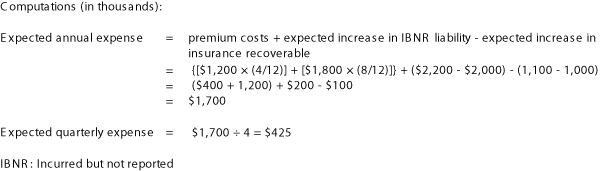 Computations (in thousands): Expected annual expense = premium costs + expected increase in IBNR liability - expected increase in insurance recoverable = " {[$1,200 × (4/12)] + [$1,800 × (8/12)]} + ($2,200 - $2,000) - (1,100 - 1,000) " = " ($400 + 1,200) + $200 - $100 " = "$1,700 " Expected quarterly expense = " $1,700 ÷ 4 = $425 " IBNR: Incurred but not reported
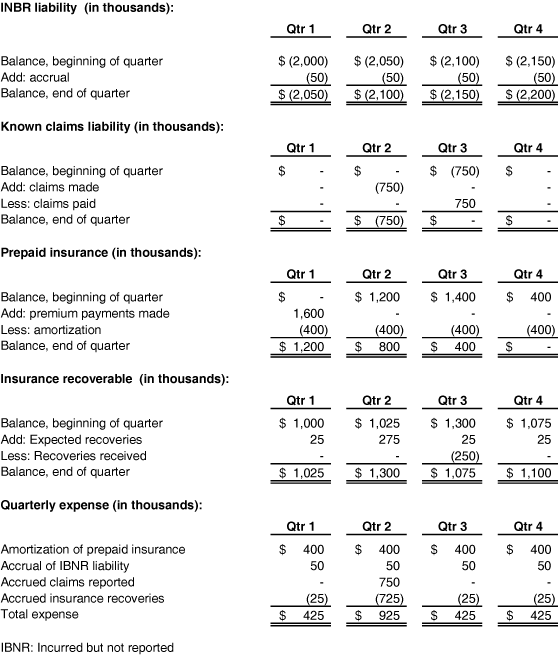 INBR liability (in thousands): Qtr 1 Qtr 2 Qtr 3 Qtr 4 "Balance, beginning of quarter" " $(2,000)" " $(2,050)" " $(2,100)" " $(2,150)" Add: accrual (50) (50) (50) (50) "Balance, end of quarter" " $(2,050)" " $(2,100)" " $(2,150)" " $(2,200)" Known claims liability (in thousands): Qtr 1 Qtr 2 Qtr 3 Qtr 4 "Balance, beginning of quarter" $- $- $(750) $- Add: claims made - (750) - - Less: claims paid - - 750 - "Balance, end of quarter" $- $(750) $- $- Prepaid insurance (in thousands): Qtr 1 Qtr 2 Qtr 3 Qtr 4 "Balance, beginning of quarter" $- " $1,200 " " $1,400 " $400 Add: premium payments made " 1,600 " - - - Less: amortization (400) (400) (400) (400) "Balance, end of quarter" " $1,200 " $800 $400 $- Insurance recoverable (in thousands): Qtr 1 Qtr 2 Qtr 3 Qtr 4 "Balance, beginning of quarter" " $1,000 " " $1,025 " " $1,300 " " $1,075 " Add: Expected recoveries 25 275 25 25 Less: Recoveries received - - (250) - "Balance, end of quarter" " $1,025 " " $1,300 " " $1,075 " " $1,100 " Quarterly expense (in thousands): Qtr 1 Qtr 2 Qtr 3 Qtr 4 Amortization of prepaid insurance $400 $400 $400 $400 Accrual of IBNR liability 50 50 50 50 Accrued claims reported - 750 - - Accrued insurance recoveries (25) (725) (25) (25) Total expense $425 $925 $425 $425 IBNR: Incurred but not reported
720-20-60Relationships
Source downloaded: .Record version 69034ca22beb. Effective date must be checked in the source.
Claims-Made Contracts
Health Care Entities
Related subtopics
- 720-954 Health Care EntitiesOther Expenses
- 405-30 Insurance-Related AssessmentsLiabilities
- 605-944 Financial Services—InsuranceRevenue Recognition
- 340-30 Insurance Contracts That Do Not Transfer Insurance RiskOther Assets and Deferred Costs
- 944-40 Claim Costs and Liabilities for Future Policy BenefitsFinancial Services—Insurance
- 325-30 Investments in Insurance ContractsInvestments—Other