ASC 410-30
Environmental Obligations
410 Asset Retirement and Environmental Obligations
Source downloaded: .Record version fe8f6e9f6dcd. Effective date must be checked in the source.
ASC 410-30 governs accounting for environmental remediation liabilities — obligations to clean up pollution arising from past acts under Superfund (CERCLA), RCRA corrective-action provisions, or analogous state/non-U.S. laws. Applied site by site, it uses the loss contingency model of ASC 450-20: accrue when it is probable a liability has been incurred (litigation/claim asserted or probably will be, and an unfavorable outcome probable) and the amount (or a minimum in a range) is reasonably estimable, measured as the entity's allocable share of the joint and several liability plus amounts other PRPs won't pay. Remediation costs are generally expensed as a component of operating income, with narrow capitalization exceptions and separate recognition of probable third-party recoveries as assets.
Key points (7)
- Accrual follows 450-20-25-2: probable that a liability has been incurred and reasonably estimable; in the remediation context probability has two elements — litigation/claim/assessment commenced or probable commencement, and probable unfavorable outcome (410-30-25-4), with a presumption of unfavorable outcome if the entity is associated with the site (410-30-25-6).
- Inability to estimate the total liability does not defer recognition: components that can be reasonably estimated serve as a surrogate for the minimum of the overall range, and the best estimate (or minimum of a range) must be recognized and refined as events occur (410-30-25-10 through 25-13).
- Recognition benchmarks — PRP identification, receipt of a unilateral administrative order, participation in the remedial investigation-feasibility study, completion of the feasibility study, record of decision, and remedial design through operation and maintenance — must be evaluated, but may not be used to delay recognition beyond the point the 450-20 criteria are met (410-30-25-14 through 25-15).
- Measurement is the entity's estimated allocable share of the joint and several liability plus its share of amounts that will not be paid by other PRPs or the government, with a rebuttable presumption that costs are allocated only among participating PRPs (410-30-30-1, 30-4, 30-7, 30-8).
- Included costs are incremental direct costs of the remediation effort and compensation/benefits of employees devoting significant time to it, based on enacted laws and adopted regulations, estimated at the cost when the work is expected to be performed; discounting is permitted only if the amount and timing of payments are fixed or reliably determinable (410-30-30-10, 30-15, 30-17, 410-30-35-12).
- Remediation costs are generally charged to expense and reported in operating income, with recovery credits in the same line item; capitalization is allowed only if costs are recoverable and they improve the property versus its original condition, prevent future contamination, or ready property held for sale (410-30-25-16, 25-18, 410-30-45-4).
- A recovery asset is recognized only when realization of the claim is probable, measured independently of the liability, with a rebuttable presumption that realization is not probable if the claim is in litigation; disclosure must state whether the accrual is discounted, and if so the undiscounted amount and discount rate (410-30-35-8, 35-9, 410-30-50-4, 50-7).
For students. This is the classic overlay of ASC 450-20 loss contingency mechanics on Superfund/CERCLA facts, so exam questions test when accrual is triggered and how much. The most common mistake is waiting for total site costs (or the final PRP allocation) to be known — GAAP requires accruing the reasonably estimable components or minimum of the range now and refining later; also don't confuse 410-30 (past contamination, remediation) with 410-20 asset retirement obligations arising from normal operation of a long-lived asset.
Machine-generated study aid for ASC 410-30. Check the source paragraphs below.
410-30-00Status
Source downloaded: .Record version de3199c006a6. Effective date must be checked in the source.
410-30-05Overview and Background
Source downloaded: .Record version 0edc0595583a. Effective date must be checked in the source.
- aEnvironmental remediation liability laws
- bLaws intended to control or prevent pollution
- cOther federal statutes
- dPotentially responsible parties
- eStrict liability
- fJoint and several liability
- gMitigation of strict, joint and several, and retroactive liability
- hCosts associated with remediation
- iEnvironmental loss contingencies.
Environmental Remediation Liability Laws
Laws Intended to Control or Prevent Pollution
Other Federal Statutes
Potentially Responsible Parties
- a Current owners or operators of sites at which hazardous substances have been disposed of or abandoned
- b Previous owners or operators of sites at the time of disposal of hazardous substances
- c Parties that "arranged for disposal" of hazardous substances found at the sites
- d Parties that transported hazardous substances to a site, having selected the site for treatment or disposal.
Strict Liability
Joint and Several Liability
Costs Associated with Remediation
Environmental Loss Contingencies
410-30-10Objectives
Source downloaded: .Record version d24e1ed219ca. Effective date must be checked in the source.
410-30-15Scope and Scope Exceptions
Source downloaded: .Record version e8e6b834ba68. Effective date must be checked in the source.
Entities
Transactions
- aEnvironmental contamination incurred in the normal operation of a long-lived asset (see Subtopic 410-20 for guidance that will apply if the entity is legally obligated to treat the contamination). Paragraph 410-20-15-3(b) explains that the obligation to clean up the spillage resulting from the normal operation of the fuel storage facility is within the scope of Subtopic 410-20. Additionally, that Subtopic applies if a legal obligation to treat environmental contamination is incurred or assumed as a result of the acquisition, construction, or development of a long-lived asset.
- bPollution control costs with respect to current operations or on accounting for costs of future site restoration or closure that are required upon the cessation of operations or sale of facilities, as such current and future costs and obligations represent a class of accounting issues different from environmental remediation liabilities.
- cEnvironmental remediation actions that are undertaken at the sole discretion of management and that are not induced by the threat, by governments or other parties, of litigation or of assertion of a claim or an assessment.
- dRecognizing liabilities of insurance entities for unpaid claims.
- eNatural resource damages and toxic torts (see paragraphs ).
- fAsset impairment issues.
410-30-25Recognition
Source downloaded: .Record version 6c8c8adb4c85. Effective date must be checked in the source.
Overall Approach
- aInformation available before the financial statements are issued or are available to be issued (as discussed in Section 855-10-25) indicates that it is probable that an asset has been impaired or a liability has been incurred at the date of the financial statements.
- bThe amount of the loss can be reasonably estimated.
Probability That a Liability Has Been Incurred
- aLitigation has commenced or a claim or an assessment has been asserted, or, based on available information, commencement of litigation or assertion of a claim or an assessment is probable. In other words, it has been asserted (or it is probable that it will be asserted) that the entity is responsible for participating in a remediation process because of a past event.
- bBased on available information, it is probable that the outcome of such litigation, claim, or assessment will be unfavorable. In other words, an entity will be held responsible for participating in a remediation process because of the past event.
- aLitigation has commenced or a claim or an assessment has been asserted, or commencement of litigation or assertion of a claim or assessment is probable.
- bThe reporting entity is associated with the site—that is, it in fact arranged for the disposal of hazardous substances found at a site or transported hazardous substances to the site or is the current or previous owner or operator of the site.
Ability to Reasonably Estimate the Liability
- aThe extent and types of hazardous substances at a site
- bThe range of technologies that can be used for remediation
- cEvolving standards of what constitutes acceptable remediation
- dThe number and financial condition of other potentially responsible parties and the extent of their responsibility for the remediation (that is, the extent and types of hazardous substances they contributed to the site).
Benchmarks
- aIdentification and verification of an entity as a potentially responsible party. The Resource Conservation and Recovery Act analogue is subjection to facility permit requirements. Receipt of notification or otherwise becoming aware that an entity may be a potentially responsible party compels the entity to action. The entity must examine its records to determine whether it is associated with the site. If, based on a review and evaluation of its records and all other available information, the entity determines that it is associated with the site, it is probable that a liability has been incurred. If all or a portion of the liability is reasonably estimable, the liability shall be recognized. In some cases, an entity will be able to reasonably estimate a range of its liability very early in the process because the site situation is common or similar to situations at other sites with which the entity has been associated (for example, the remediation involves only the removal of underground storage tanks in accordance with the underground storage tank program). In such cases, the criteria for recognition would be met and the liability shall be recognized. In other cases, however, the entity may have insufficient information to reasonably estimate the minimum amount in the range of its liability. In these cases, the criteria for recognition would not be met at this time.
- bReceipt of unilateral administrative order. The Resource Conservation and Recovery Act analogue is, generally, interim corrective measures. An entity may receive a unilateral administrative order compelling it to take a response action at a site or risk penalties of up to four times the cost of the response action. Such response actions may be relatively limited actions, such as the performance of a remedial investigation and feasibility study or performance of a removal action, or they may be broad actions such as remediating a site. Under section 106 of Superfund, the Environmental Protection Agency must find that an "imminent and substantial endangerment" exists at the site before such an order may be issued. No preenforcement review by a court is authorized under Superfund if an entity elects to challenge a unilateral administrative order. The ability to estimate costs resulting from unilateral administrative orders varies with factors such as site complexity and the nature and extent of the work to be performed. The benchmarks that follow should be considered in evaluating the ability to estimate such costs insofar as the actions required by the unilateral administrative order involve these benchmarks. The cost of performing the requisite work generally is estimable within a range, and recognition of an environmental remediation liability for costs of removal actions generally should not be delayed beyond this point.
- cParticipation, as a potentially responsible party, in the remedial investigation-feasibility study. The Resource Conservation and Recovery Act analogue is Resource Conservation and Recovery Act facility investigation. At this stage, the entity and possibly others have been identified as potentially responsible parties and have agreed to pay the costs of a study that will investigate the extent of the environmental impact of the release or threatened release of hazardous substances and identify site-remediation alternatives. Further, the total cost of the remedial investigation-feasibility study generally is estimable within a reasonable range. In addition, the identification of other potentially responsible parties and their agreement to participate in funding the remedial investigation-feasibility study typically provides a reasonable basis for determining the entity's allocable share of the cost of the remedial investigation-feasibility study. At this stage, additional information may be available regarding the extent of environmental impact and possible remediation alternatives. This additional information, however, may or may not be sufficient to provide a basis for reasonable estimation of the total remediation liability. At a minimum, the entity should recognize its share of the estimated total cost of the remedial investigation-feasibility study. As the remedial investigation-feasibility study proceeds, the entity's estimate of its share of the total cost of the remedial investigation-feasibility study can be refined. Further, additional information may become available based on which the entity can refine its estimates of other components of the liability or begin to estimate other components. For example, an entity may be able to estimate the extent of environmental impact at a site and to identify existing alternative remediation technologies. An entity may also be able to identify better the extent of its involvement at the site relative to other potentially responsible parties; the universe of potentially responsible parties may be identified; negotiations among potentially responsible parties and with federal and state Environmental Protection Agency representatives may occur; and information may be obtained that materially affects the agreed-upon method of remediation.
- dCompletion of feasibility study. The Resource Conservation and Recovery Act analogue is corrective measures study. At substantial completion of the feasibility study, both a minimum remediation liability and the entity's allocated share generally will be reasonably estimable. The feasibility study should be considered substantially complete no later than the point at which the potentially responsible parties recommend a proposed course of action to the Environmental Protection Agency. If the entity had not previously concluded that it could reasonably estimate the remediation liability (the best estimate or, if no amount within an estimated range of loss was a better estimate than any other amount in the range, the minimum amount in the range), recognition should not be delayed beyond this point, even if uncertainties, for example, about allocations to individual potentially responsible parties and potential recoveries from third parties, remain.
- eIssuance of record of decision. The Resource Conservation and Recovery Act analogue is approval of corrective measures study. At this point, the Environmental Protection Agency has issued its determination specifying a preferred remedy. Normally, the entity and other potentially responsible parties have begun, or perhaps completed, negotiations, litigation (see paragraphs ), or both for their allocated share of the remediation liability. Accordingly, the entity's estimate normally can be refined based on the specified preferred remedy and a preliminary allocation of the total remediation costs.
- fRemedial design through operation and maintenance, including postremediation monitoring. The Resource Conservation and Recovery Act analogue is corrective measures implementation. During the design phase of the remediation, engineers develop a better sense of the work to be done and are able to provide more precise estimates of the total remediation cost. Further information likely will become available at various points until the site is delisted, subject only to postremediation monitoring. The entity should continue to refine and recognize its best estimate of its final obligation as this additional information becomes available.
Criteria to Capitalize Environmental Treatment Costs
- aThe costs extend the life, increase the capacity, or improve the safety or efficiency of property owned by the entity. For purposes of this criterion, the condition of that property after the costs are incurred must be improved as compared with the condition of that property when originally constructed or acquired, if later.
- bThe costs mitigate or prevent environmental contamination that has yet to occur and that otherwise may result from future operations or activities. In addition, the costs improve the property compared with its condition when constructed or acquired, if later.
- cThe costs are incurred in preparing for sale that property currently held for sale.
Remediation Liabilities in Property Acquisitions
Unasserted Claims
410-30-30Initial Measurement
Source downloaded: .Record version d81de75cbd1c. Effective date must be checked in the source.
Allocation of Liability Among Potentially Responsible Parties
- a Identify the potentially responsible parties for the site
- b Assess the likelihood that other potentially responsible parties will pay their full allocable share of the joint and several remediation liability
- c Determine the percentage of the liability that will be allocated to the entity.
- a
- b
- c
- d
- e
- a The potentially responsible parties have agreed to (whether that agreement applies to the entire remediation effort or to the costs incurred in the current phase of the remediation process)
- b Have been assigned by a consultant
- c Have been determined by the Environmental Protection Agency.
- a Existing data about the kinds and quantities of waste at the site
- b Experience with allocation approaches in comparable situations
- c Reports of environmental specialists (internal or external)
- d Internal data refuting Environmental Protection Agency allegations about the entity's contribution of waste (kind, volume, and so forth) to the site.
Costs to Be Included in Remediation Liability
- a Allocable share of the liability for a specific site
- b Share of amounts related to the site that will not be paid by other potentially responsible parties or the government.
- a Costs that should be included in the measurement
- b Whether the measurement should consider the effects of expected future events or developments, including discounting considerations
- c How the measurement should be affected by the existence of other potentially responsible parties
- d How the measurement should be affected by potential recoveries.
- a Incremental direct costs of the remediation effort (see paragraph 410-30-55-1)
- b Costs of compensation and benefits for those employees who are expected to devote a significant amount of time directly to the remediation effort, to the extent of the time expected to be spent directly on the remediation effort.
- a Precleanup activities, such as the performance of a remedial investigation, risk assessment, or feasibility study and the preparation of a remedial action plan and remedial designs for a Superfund site, or the performance of a Resource Conservation and Recovery Act of 1976 facility assessment, facility investigation, or corrective measures studies
- b Performance of remedial actions under Superfund, corrective actions under the Resource Conservation and Recovery Act of 1976, and analogous actions under state and non-U.S. laws
- c Government oversight and enforcement-related activities
- d Operation and maintenance of the remedy, including required postremediation monitoring.
- a The extent of remedial actions that are required
- b The type of remedial actions to be used
- c The allocation of costs among potentially responsible parties.
- a The liability is not discounted.
- b The timing of the recovery is dependent on the timing of the payment of the liability.
410-30-35Subsequent Measurement
Source downloaded: .Record version 5f9a00ac62df. Effective date must be checked in the source.
Changes in Estimates
Effects of Expected Future Events and Developments
Impairment Tests
Impact of Potential Recoveries
Tangible Assets Acquired to Treat Environmental Contamination
410-30-45Other Presentation Matters
Source downloaded: .Record version fecd9e87be66. Effective date must be checked in the source.
- aReceivables from other potentially responsible parties that are not providing initial funding
- bAnticipated recoveries from insurers
- cAnticipated recoveries from prior owners as a result of indemnification agreements.
410-30-50Disclosure
Source downloaded: .Record version fad8d223328f. Effective date must be checked in the source.
- a Accounting principles
- b Environmental remediation loss contingencies
- c Environmental remediation costs recognized currently
- d Conclusions on loss contingencies and other matters.
- a Disclosures that are required
- b Disclosures that are encouraged, but not required.
Disclosures that Are Required
Disclosures that Are Encouraged but Not Required
- a The estimated time frame of disbursements for recorded amounts if expenditures are expected to continue over the long term
- b The estimated time frame for realization of recognized probable recoveries, if realization is not expected in the near term
- c If an estimate of the probable or reasonably possible loss or range of loss cannot be made, the reasons why it cannot be made
- d If information about the reasonably possible loss or the recognized and additional reasonably possible loss for an environmental remediation obligation related to an individual site is relevant to an understanding of the financial position, cash flows, or results of operations of the entity, the following with respect to the site:
- 1 The total amount accrued for the site
- 2 The nature of any reasonably possible loss contingency or additional loss, and an estimate of the possible loss or the fact that an estimate cannot be made and the reasons why it cannot be made
- 3 Whether other potentially responsible parties are involved and the entity's estimated share of the obligation
- 4 The status of regulatory proceedings
- 5 The estimated time frame for resolution of the contingency.
- 1
- a The amount recognized for environmental remediation loss contingencies in each period
- b The amount of any recovery from third parties that is credited to environmental remediation costs in each period
- c The income statement caption in which environmental remediation costs and credits are included.
Disclosure Related to Loss Contingencies
410-30-55Implementation Guidance and Illustrations
Source downloaded: .Record version 137bd075e233. Effective date must be checked in the source.
Implementation Guidance
- a Fees to outside law firms for work related to determining the extent of remedial actions that are required, the type of remedial actions to be used, or the allocation of costs among potentially responsible parties
- b Costs related to completing the remedial investigation-feasibility study
- c Fees to outside engineering and consulting firms for site investigations and the development of remedial action plans and remedial designs
- d Costs of contractors performing remedial actions
- e Governmental oversight costs and past costs; usually this is based on the cost incurred by the Environmental Protection Agency or other governmental authority dealing with the site
- f The cost of machinery and equipment that is dedicated to the remedial actions and that does not have an alternative use
- g Assessments by a potentially responsible party group covering costs incurred by the group in dealing with a site
- h Costs of operation and maintenance of the remedial action, including the costs of postremediation monitoring required by the remedial action plan.
- a The internal legal staff that is involved with the determination of the extent of remedial actions that are required, the type of remedial action to be used, and the allocation of costs among potentially responsible parties
- b Technical employees who are involved with the remediation effort.
- a Elements of fair share. Examples are the amount of waste based on volume; the amount of waste based on mass, type of waste, toxicity of waste; the length of time the site was used.
- b Classification of potentially responsible party. Examples are site owner, site operator, transporter of waste, generator of waste.
- c Limitations on payments. This characteristic includes any statutory or regulatory limitations on contributions that may be applicable to a potentially responsible party. For example, in the reauthorization of the Comprehensive Environmental Response, Compensation, and Liability Act, it has been proposed that the statute limit the contribution of a municipality to 10 percent of the total remediation liability, irrespective of the municipality's allocable share.
- d Degree of care. This refers to the degree of care exercised in selecting the site or in selecting a transporter.
Illustrations
- The entity will begin a project to decontaminate the soil at its Anytown, Anystate facility in the coming year. The entity estimates the cost of decontamination to total at least $1 million and has accrued that amount as an operating expense in the current year. The ultimate cost, however, will depend on the extent of contamination found as the project progresses and may be as much as $3 million. The entity expects decontamination to be substantially completed within one year.
- Environmental Remediation Costs—[Entity A accrues for losses associated with environmental remediation obligations when such losses are probable and reasonably estimable. Accruals for estimated losses from environmental remediation obligations generally are recognized no later than completion of the remedial feasibility study. Such accruals are adjusted as further information develops or circumstances change.] Costs of future expenditures for environmental remediation obligations are not discounted to their present value. [Recoveries of environmental remediation costs from other parties are recorded as assets when their receipt is deemed probable.]
- a An entity is involved in a single environmental site at which a number of potential outcomes may occur.
- b There is a probable, reasonably estimable recovery from a third party.
- c The entity has accrued for the most likely outcome within a range of possible outcomes for each component.
- d The nature of the amounts accrued for remediation and the related probable recovery are necessary to be disclosed in order for the financial statements not to be misleading.
- e There is a reasonably possible loss exposure in excess of the amount accrued that is material and it is reasonably possible that a change in estimate that would be material to the financial statements will occur in the near term.
- Entity A has been notified by the Environmental Protection Agency that it is a potentially responsible party under Superfund legislation [with respect to XYZ site in Sometown, USA, a disposal site previously used in its chemical-fertilizer business. The Environmental Protection Agency has also identified 10 other potentially responsible parties for XYZ. A remedial investigation and feasibility study has been completed, and the results of that study have been forwarded to the Environmental Protection Agency. The study indicates a range of viable remedial approaches, but agreement has not yet been reached with the Environmental Protection Agency on the final remediation approach. The potentially responsible party group has preliminarily agreed to an allocation that sets Entity A's share of the cost of remediating XYZ site at 6 percent.] Entity A has accrued its best estimate of its obligation with respect to the site at December 31, 199X, [which is $10 million and which is included in long-term liabilities and is expected to be disbursed over the next 10 years. If certain of the potentially responsible parties are ultimately not able to fund their allocated shares or the Environmental Protection Agency insists on a more expensive remediation approach,] Entity A could incur additional obligations of up to $7 million. It is reasonably possible that Entity A's recorded estimate of its obligation may change in the near term.
- With respect to the environmental obligation discussed above, the site was acquired in 1982, and, in connection with that acquisition, the former owner partially indemnified Entity A for environmental impacts occurring before the acquisition. [Based on existing documentation indicating the years in which the business shipped wastes to XYZ and the terms of the indemnification in the acquisition agreement,] Entity A [believes it is probable that it will recover from the prior owners 50 percent of its allocated remediation costs for XYZ and, accordingly,] has recorded a receivable of $5 million at December 31, 199X.
- Entity A has been notified by the Environmental Protection Agency that it is a potentially responsible party with respect to environmental impacts [identified at the XYZ site in Sometown, USA. Several meetings have been held with the Environmental Protection Agency and the other identified potentially responsible parties, and a remedial investigation has recently commenced]. Although a loss is probable, it is not possible at this time to reasonably estimate the amount of any obligation for remediation [of XYZ site] that would be material to Entity A's financial statements [because the extent of environmental impact, allocation among the potentially responsible parties, remediation alternatives (which could involve no or minimal efforts), and concurrence of the regulatory authorities have not yet advanced to the stage where a reasonable estimate of any loss that would be material to the entity can be made]. [A reasonable estimate of a material obligation, if any, is expected to be possible in 199X.]
- aTanker oil spill (Case A)
- bRusty chemical storage tank (Case B)
- cAir pollution caused by manufacturing activities (Case C)
- dLead pipes in office building that contaminate drinking water (Case D)
- eSoil contamination caused by an operating garbage dump (Case E)
- fWater well contamination (Case F)
- gUnderground gasoline storage tank leak (Case G)
- hAir in office building contaminated with asbestos fibers (Case H).
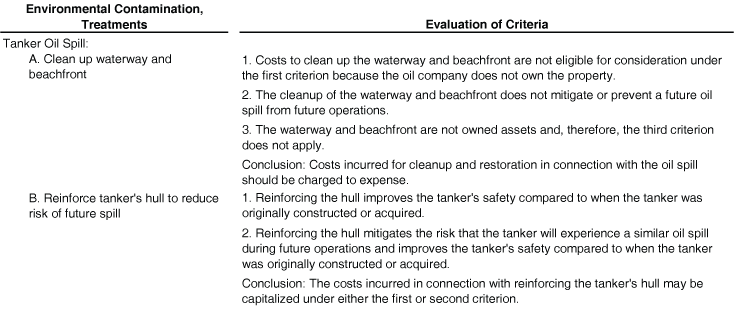 "Environmental Contamination, Treatments" Evaluation of Criteria Tanker Oil Spill: A. Clean up waterway and beachfront 1. Costs to clean up the waterway and beachfront are not eligible for consideration under the first criterion because the oil company does not own the property. 2. The cleanup of the waterway and beachfront does not mitigate or prevent a future oil spill from future operations. "3. The waterway and beachfront are not owned assets and, therefore, the third criterion does not apply." Conclusion: Costs incurred for cleanup and restoration in connection with the oil spill should be charged to expense. B. Reinforce tanker's hull to reduce risk of future spill 1. Reinforcing the hull improves the tanker's safety compared to when the tanker was originally constructed or acquired. 2. Reinforcing the hull mitigates the risk that the tanker will experience a similar oil spill during future operations and improves the tanker's safety compared to when the tanker was originally constructed or acquired. Conclusion: The costs incurred in connection with reinforcing the tanker's hull may be capitalized under either the first or second criterion.
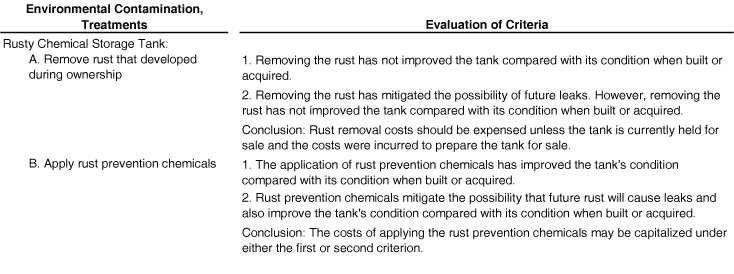 "Environmental Contamination, Treatments" Evaluation of Criteria Rusty Chemical Storage Tank: A. Remove rust that developed during ownership 1. Removing the rust has not improved the tank compared with its condition when built or acquired. "2. Removing the rust has mitigated the possibility of future leaks. However, removing the rust has not improved the tank compared with its condition when built or acquired." Conclusion: Rust removal costs should be expensed unless the tank is currently held for sale and the costs were incurred to prepare the tank for sale. B. Apply rust prevention chemicals 1. The application of rust prevention chemicals has improved the tank's condition compared with its condition when built or acquired. 2. Rust prevention chemicals mitigate the possibility that future rust will cause leaks and also improve the tank's condition compared with its condition when built or acquired. Conclusion: The costs of applying the rust prevention chemicals may be capitalized under either the first or second criterion.
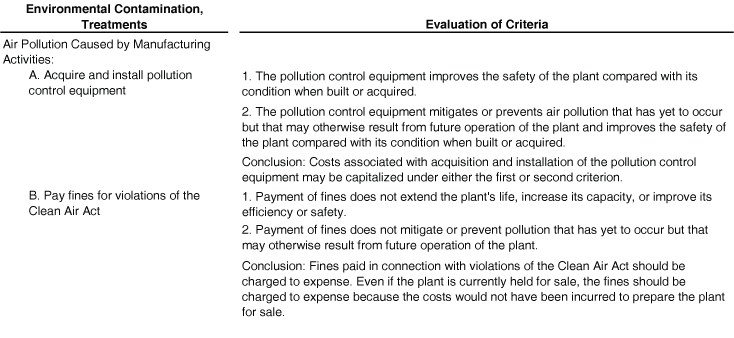 "Environmental Contamination, Treatments" Evaluation of Criteria Air Pollution Caused by Manufacturing Activities: A. Acquire and install pollution control equipment 1. The pollution control equipment improves the safety of the plant compared with its condition when built or acquired. 2. The pollution control equipment mitigates or prevents air pollution that has yet to occur but that may otherwise result from future operation of the plant and improves the safety of the plant compared with its condition when built or acquired. Conclusion: Costs associated with acquisition and installation of the pollution control equipment may be capitalized under either the first or second criterion. B. Pay fines for violations of the Clean Air Act "1. Payment of fines does not extend the plant's life, increase its capacity, or improve its efficiency or safety." 2. Payment of fines does not mitigate or prevent pollution that has yet to occur but that may otherwise result from future operation of the plant. "Conclusion: Fines paid in connection with violations of the Clean Air Act should be charged to expense. Even if the plant is currently held for sale, the fines should be charged to expense because the costs would not have been incurred to prepare the plant for sale."
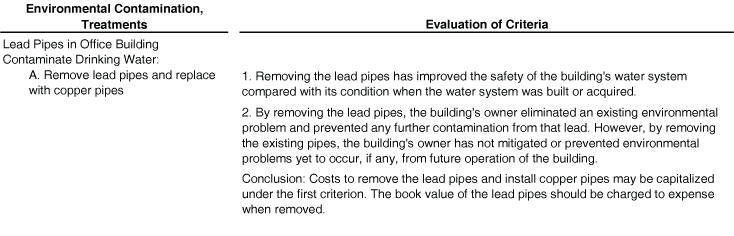 "Environmental Contamination, Treatments" Evaluation of Criteria Lead Pipes in Office Building Contaminate Drinking Water: A. Remove lead pipes and replace with copper pipes 1. Removing the lead pipes has improved the safety of the building's water system compared with its condition when the water system was built or acquired. "2. By removing the lead pipes, the building's owner eliminated an existing environmental problem and prevented any further contamination from that lead. However, by removing the existing pipes, the building's owner has not mitigated or prevented environmental problems yet to occur, if any, from future operation of the building." Conclusion: Costs to remove the lead pipes and install copper pipes may be capitalized under the first criterion. The book value of the lead pipes should be charged to expense when removed.
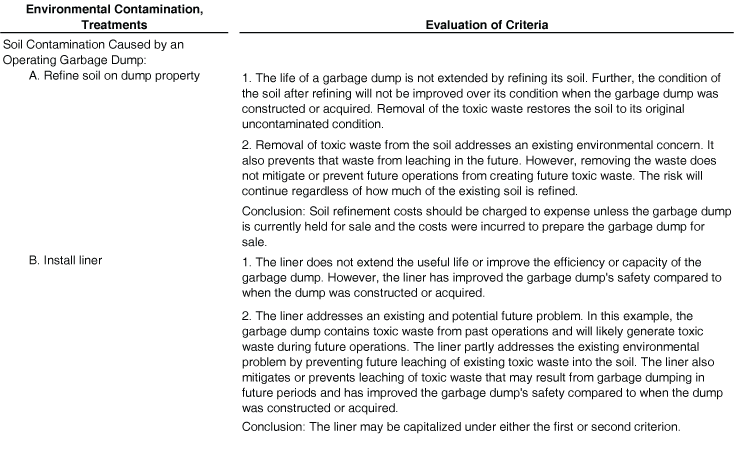 "Environmental Contamination, Treatments" Evaluation of Criteria Soil Contamination Caused by an Operating Garbage Dump: A. Refine soil on dump property "1. The life of a garbage dump is not extended by refining its soil. Further, the condition of the soil after refining will not be improved over its condition when the garbage dump was constructed or acquired. Removal of the toxic waste restores the soil to its original uncontaminated condition." "2. Removal of toxic waste from the soil addresses an existing environmental concern. It also prevents that waste from leaching in the future. However, removing the waste does not mitigate or prevent future operations from creating future toxic waste. The risk will continue regardless of how much of the existing soil is refined." Conclusion: Soil refinement costs should be charged to expense unless the garbage dump is currently held for sale and the costs were incurred to prepare the garbage dump for sale. B. Install liner "1. The liner does not extend the useful life or improve the efficiency or capacity of the garbage dump. However, the liner has improved the garbage dump's safety compared to when the dump was constructed or acquired." "2. The liner addresses an existing and potential future problem. In this example, the garbage dump contains toxic waste from past operations and will likely generate toxic waste during future operations. The liner partly addresses the existing environmental problem by preventing future leaching of existing toxic waste into the soil. The liner also mitigates or prevents leaching of toxic waste that may result from garbage dumping in future periods and has improved the garbage dump's safety compared to when the dump was constructed or acquired." Conclusion: The liner may be capitalized under either the first or second criterion.
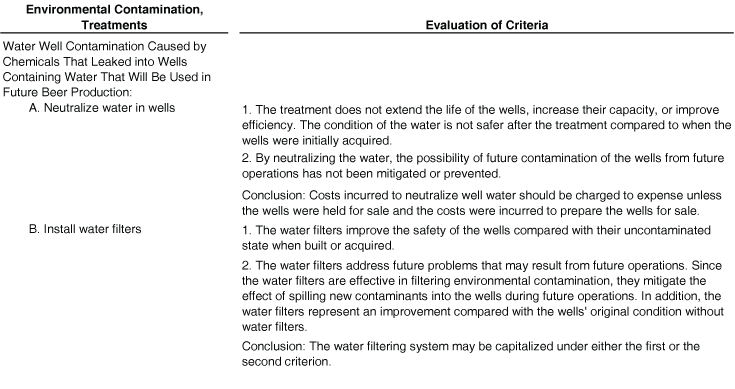 "Environmental Contamination, Treatments" Evaluation of Criteria Water Well Contamination Caused by Chemicals That Leaked into Wells Containing Water That Will Be Used in Future Beer Production: A. Neutralize water in wells "1. The treatment does not extend the life of the wells, increase their capacity, or improve efficiency. The condition of the water is not safer after the treatment compared to when the wells were initially acquired." "2. By neutralizing the water, the possibility of future contamination of the wells from future operations has not been mitigated or prevented." Conclusion: Costs incurred to neutralize well water should be charged to expense unless the wells were held for sale and the costs were incurred to prepare the wells for sale. B. Install water filters 1. The water filters improve the safety of the wells compared with their uncontaminated state when built or acquired. "2. The water filters address future problems that may result from future operations. Since the water filters are effective in filtering environmental contamination, they mitigate the effect of spilling new contaminants into the wells during future operations. In addition, the water filters represent an improvement compared with the wells' original condition without water filters." Conclusion: The water filtering system may be capitalized under either the first or the second criterion.
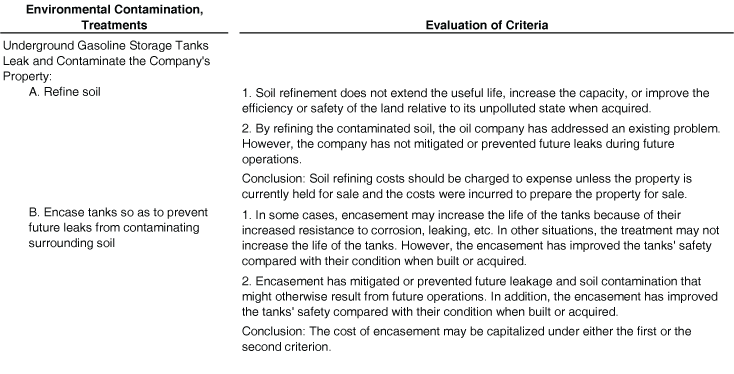 "Environmental Contamination, Treatments" Evaluation of Criteria Underground Gasoline Storage Tanks Leak and Contaminate the Company's Property: A. Refine soil "1. Soil refinement does not extend the useful life, increase the capacity, or improve the efficiency or safety of the land relative to its unpolluted state when acquired." "2. By refining the contaminated soil, the oil company has addressed an existing problem. However, the company has not mitigated or prevented future leaks during future operations." Conclusion: Soil refining costs should be charged to expense unless the property is currently held for sale and the costs were incurred to prepare the property for sale. B. Encase tanks so as to prevent future leaks from contaminating surrounding soil "1. In some cases, encasement may increase the life of the tanks because of their increased resistance to corrosion, leaking, etc. In other situations, the treatment may not increase the life of the tanks. However, the encasement has improved the tanks' safety compared with their condition when built or acquired." "2. Encasement has mitigated or prevented future leakage and soil contamination that might otherwise result from future operations. In addition, the encasement has improved the tanks' safety compared with their condition when built or acquired." Conclusion: The cost of encasement may be capitalized under either the first or the second criterion.
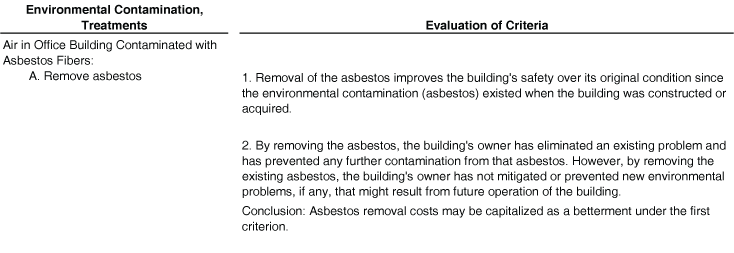 "Environmental Contamination, Treatments" Evaluation of Criteria Air in Office Building Contaminated with Asbestos Fibers: A. Remove asbestos 1. Removal of the asbestos improves the building's safety over its original condition since the environmental contamination (asbestos) existed when the building was constructed or acquired. "2. By removing the asbestos, the building's owner has eliminated an existing problem and has prevented any further contamination from that asbestos. However, by removing the existing asbestos, the building's owner has not mitigated or prevented new environmental problems, if any, that might result from future operation of the building." Conclusion: Asbestos removal costs may be capitalized as a betterment under the first criterion.
- a To implement the requirements of the unilateral administrative order in the most cost-effective and scientifically valid way
- b To raise money and allocate costs among the potentially responsible parties willing to perform the work based on the types and relative quantities of wastes shipped to the site or another agreed-upon formula
- c To recover costs from nonparticipating potentially responsible parties, if possible.
-
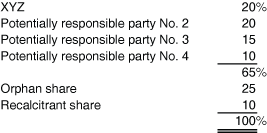 XYZ 20% Potentially responsible party No. 2 20 Potentially responsible party No. 3 15 Potentially responsible party No. 4 10 65% Orphan share 25 Recalcitrant share 10 100%
-
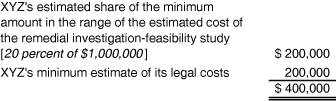 "XYZ's estimated share of the minimum amount in the range of the estimated cost of the remedial investigation-feasibility study [20 percent of $1,000,000]" " $200,000 " XYZ's minimum estimate of its legal costs " 200,000 " " $400,000 "
-
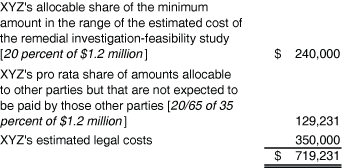 XYZ's allocable share of the minimum amount in the range of the estimated cost of the remedial investigation-feasibility study [20 percent of $1.2 million] " $240,000 " XYZ's pro rata share of amounts allocable to other parties but that are not expected to be paid by those other parties [20/65 of 35 percent of $1.2 million] " 129,231 " XYZ's estimated legal costs " 350,000 " " $719,231 "
-
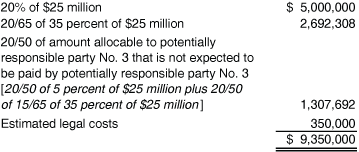 20% of $25 million " $5,000,000 " 20/65 of 35 percent of $25 million " 2,692,308 " 20/50 of amount allocable to potentially responsible party No. 3 that is not expected to be paid by potentially responsible party No. 3 [20/50 of 5 percent of $25 million plus 20/50 of 15/65 of 35 percent of $25 million] " 1,307,692 " Estimated legal costs " 350,000 " " $9,350,000 "
410-30-S00StatusSEC
Source downloaded: .Record version 64a0adc4af6f. Effective date must be checked in the source.
| Paragraph | Action | Accounting Standards Update | Date |
| 410-30-S35-1 | Added | Accounting Standards Update No. 2009-07 | 09/15/2009 |
410-30-S30Initial MeasurementSEC
Source downloaded: .Record version 5bd3512b7e9c. Effective date must be checked in the source.
Appropriate Discount Rate to Be Applied to a Product or Environmental Remediation Liability
410-30-S35Subsequent MeasurementSEC
Source downloaded: .Record version bf95c8077bf7. Effective date must be checked in the source.
Appropriate Discount Rate to Be Applied to a Product or Environmental Remediation Liability
410-30-S50DisclosureSEC
Source downloaded: .Record version 68ff935db4c0. Effective date must be checked in the source.
Disclosures Related to Discounting an Environmental Liability
Disclosure Related to Loss Contingencies
Disclosures Related to Remediation Costs
Related subtopics
- 410-980 Regulated OperationsAsset Retirement and Environmental Obligations
- 410-20 Asset Retirement ObligationsAsset Retirement and Environmental Obligations
- 818-30 Environmental Credit ObligationsEnvironmental Credits and Environmental Credit Obligations
- 450-20 Loss ContingenciesContingencies
- 405-980 Regulated OperationsLiabilities
- 405-30 Insurance-Related AssessmentsLiabilities