ASC 405-30
Insurance-Related Assessments
405 Liabilities
Source downloaded: .Record version ba259c1644f0. Effective date must be checked in the source.
ASC 405-30 governs when and how entities—insurers and self-insurers alike—accrue liabilities for statutory or regulatory insurance-related assessments such as state guaranty-fund assessments, insurance department administrative assessments, and workers' compensation second-injury fund assessments. A liability is recognized only when an assessment is probable, the obligating event has occurred by the balance sheet date, and the amount is reasonably estimable (405-30-25-1); the obligating event differs by assessment mechanism (retrospective vs. prospective vs. prefunded premium-based, and loss-based). Related recoveries via premium tax offsets or policy surcharges are recognized as assets when probable (405-30-25-8), but recoveries expected only through future premium rate structures are not (405-30-25-10).
Key points (7)
- A liability is accrued only when all three conditions are met: probability of assessment, occurrence of the obligating event on or before the financial statement date, and ability to reasonably estimate the amount (405-30-25-1).
- Premium-based guaranty-fund assessments (other than prefunded) are presumed probable upon a formal determination of insolvency and presumed not probable before it; prefunded and premium-based administrative assessments are probable when the underlying premiums are written, and loss-based assessments when the losses are incurred (405-30-25-2 through 25-3).
- The obligating event for premium-based assessments is generally writing (or becoming obligated to write or renew) the premiums, but is the insolvency itself where state law or regulatory practice means the entity cannot avoid the assessment by ceasing to write premiums; for loss-based assessments it is incurring the losses (405-30-25-4).
- For retrospective-premium-based assessments the entire estimated future assessment for an insolvency is accrued upon formal determination of insolvency, because the obligating premium has already been written (405-30-25-6(a)); prospective-premium-based assessments are accrued as premiums are written unless unavoidable (405-30-25-6(b)).
- If the estimate is a range with no better estimate within it, the minimum amount is accrued; if a best estimate exists, that amount is recorded (405-30-25-5; 405-30-30-8).
- An asset for premium tax offsets or policy surcharges is recognized when probable, measured on current laws and in-force policies (excluding expected renewals of short-duration contracts but reflecting persistency for long-duration contracts), subject to a valuation allowance; no asset is recorded for recovery through future premium rate structures (405-30-25-8 through 25-10; 405-30-30-11; 405-30-35-1).
- Discounting of the liability (and asset) is optional where the amount and timing of cash flows are fixed or reliably determinable; disclosure of discounted vs. undiscounted amounts, discount rate, and expected payment/realization periods is required (405-30-30-9 through 30-12; 405-30-50-1).
For students. The exam trap is conflating the event that makes an assessment probable (usually the insolvency) with the event that obligates the entity (usually writing the premium)—for prospective-premium-based assessments an insurer that can stop writing business accrues only for premiums already written, whereas a retrospective assessment is accrued in full at insolvency. Also remember the recovery asymmetry: premium tax offsets and policy surcharges can be assets, but expected recovery through future premium rate structures cannot.
Machine-generated study aid for ASC 405-30. Check the source paragraphs below.
405-30-00Status
Source downloaded: .Record version 37c2636d34d0. Effective date must be checked in the source.
| Paragraph | Action | Accounting Standards Update | Date |
| Reinsurance | Added | Accounting Standards Update No. 2016-19 | 12/14/2016 |
| 405-30-05-1 | Amended | Accounting Standards Update No. 2011-06 | 07/21/2011 |
| 405-30-15-3 | Amended | Accounting Standards Update No. 2016-19 | 12/14/2016 |
| 405-30-15-3 | Amended | Accounting Standards Update No. 2011-06 | 07/21/2011 |
| 405-30-30-7 | Amended | Accounting Standards Update No. 2016-19 | 12/14/2016 |
405-30-05Overview and Background
Source downloaded: .Record version 3d3815466f5e. Effective date must be checked in the source.
State Guaranty Funds
- aRetrospective-premium-based assessments. Guaranty funds covering benefit payments of insolvent life, annuity, and health insurance entities typically assess entities based on premiums written or received in one or more years before the year of insolvency. Assessments in any year are generally limited to an established percentage of an entity's average premiums for the three years preceding the insolvency. Assessments for a given insolvency may take place over several years.
- bProspective-premium-based assessments. Guaranty funds covering claims of insolvent property and casualty insurance entities typically assess entities based on premiums written in one or more years after the insolvency. Assessments in any year are generally limited to an established percentage of an entity's premiums written or received for the year preceding the assessment. Assessments for a given insolvency may take place over several years.
- cPrefunded-premium-based assessments. At least one state uses this kind of assessment to cover claims of insolvent property and casualty insurance entities. This kind of assessment is intended to prefund the costs of future insolvencies. Assessments are imposed before any particular insolvency and are based on the current level of written premiums. Rates to be applied to future premiums are adjusted as necessary.
- dAdministrative-type assessments. These assessments are typically a flat (annual) amount per entity to fund operations of the guaranty association, regardless of the existence of an insolvency.
Other Insurance-Related Assessments
- aTo fund operating expenses of state insurance regulatory bodies (for example, the state insurance department or workers' compensation board)
- bTo fund second-injury funds, which provide reimbursement to insurance carriers or employers for workers' compensation claims when the cost of a second injury combined with a prior accident or disability is greater than what the second accident alone would have produced. The employer of an injured or handicapped worker is responsible only for the workers' compensation benefit for the most recent injury; the second-injury fund would cover the cost of any additional benefits for aggravation of a prior condition or injury. The intent of the fund is to help insure that employers are not made to suffer a greater monetary loss or increased insurance costs because of hiring previously injured or handicapped employees.
- aPremium-based. The assessing entity imposes the assessment based on the entity's written premiums. The assessing entity may be at the state, county, municipality, or other such level. The base year of premiums is generally either the current year or the year preceding the assessment.
- bLoss-based. The assessing entity imposes the assessment based on the entity's incurred losses or paid losses in relation to that amount for all entities subject to that assessment in the particular jurisdiction.
405-30-10Objectives
Source downloaded: .Record version 16cbe4b0b6cc. Effective date must be checked in the source.
405-30-15Scope and Scope Exceptions
Source downloaded: .Record version a1ba8bf5f08c. Effective date must be checked in the source.
Entities
Transactions
- aAmounts payable or paid as a result of reinsurance contracts or arrangements that are in substance reinsurance, including assumed reinsurance activities and certain involuntary pools that are covered by Topic 944.
- bAssessments of depository institutions related to bank insurance and similar funds.
- cThe annual fee imposed on health insurers by the Patient Protection and Affordable Care Act as amended by the Health Care and Education Reconciliation Act (the Acts). The accounting for the Acts' fee is addressed in Subtopic 720-50.
405-30-25Recognition
Source downloaded: .Record version 35a21475052a. Effective date must be checked in the source.
Reporting Liabilities
- a Probability of assessment. An assessment has been imposed or information available before the financial statements are issued or are available to be issued (as discussed in Section 855-10-25) indicates it is probable that an assessment will be imposed.
- b Obligating event. The event obligating an entity to pay (underlying cause of) an imposed or probable assessment has occurred on or before the date of the financial statements.
- c Ability to reasonably estimate. The amount of the assessment can be reasonably estimated.
- a For premium-based assessments, the event that obligates the entity is generally writing the premiums or becoming obligated to write or renew (such as multiple-year, noncancelable policies) the premiums on which the assessments are expected to be based. Some states, through law or regulatory practice, provide that an insurance entity cannot avoid paying a particular assessment even if that insurance entity reduces its premium writing in the future. In such circumstances, the event that obligates the entity is a formal determination of insolvency or similar triggering event. For example, in certain states, an insurance entity may remain liable for assessments even though the insurance entity discontinues the writing of premiums. In this circumstance, the underlying cause of the liability is not the writing of the premium, but the insolvency. Regulatory practice would be determined based on the stated intentions or prior history of the insurance regulators.
- b For loss-based assessments, the event that obligates an entity is an entity's incurring the losses on which the assessments are expected to be based.
Applying the Recognition Criteria
- a Retrospective-premium-based guaranty-fund assessments. An assessment is probable of being imposed when a formal determination of insolvency occurs. At that time, the premium that obligates the entity for the assessment liability has already been written. Accordingly, an entity that has the ability to reasonably estimate the amount of the assessment shall recognize a liability for the entire amount of future assessments related to a particular insolvency when a formal determination of insolvency is rendered.
- b Prospective-premium-based guaranty-fund assessments. The event that obligates the entity for the assessment liability generally is the writing of, or becoming obligated to write or renew, the premiums on which the expected future assessments are to be based (for example, multiple-year contracts under which an insurance entity has no discretion to avoid writing future premiums). Therefore, the event that obligates the entity generally will not have occurred at the time of the insolvency. Law or regulatory practice affects the event that obligates the entity in either of the following ways:
- 1 In states that, through law or regulatory practice, provide that an entity cannot avoid paying a particular assessment in the future (even if the entity reduces premium writings in the future), the event that obligates the entity is a formal determination of insolvency or a similar event. An entity that has the ability to reasonably estimate the amount of the assessment shall recognize a liability for the entire amount of future assessments that cannot be avoided related to a particular insolvency when a formal determination of insolvency occurs.
- 2 In states without such a law or regulatory practice, the event that obligates the entity is the writing of, or becoming obligated to write, the premiums on which the expected future assessments are to be based. An entity that has the ability to reasonably estimate the amount of the assessments shall recognize a liability when the related premiums are written or when the entity becomes obligated to write the premiums.
- 1
- c Prefunded-premium-based guaranty-fund assessments. A liability for an assessment arises when premiums are written. Accordingly, an entity that has the ability to reasonably estimate the amount of the assessment shall recognize a liability as the related premiums are written.
- d Other premium-based assessments. Other premium-based assessments, as described in paragraph 405-30-05-5, would be accounted for in the same manner as prefunded-premium-based guaranty-fund assessments.
- e Loss-based assessments. An assessment is probable of being asserted when the loss occurs. The obligating event of the assessment also has occurred when the loss occurs. Accordingly, an entity that has the ability to reasonably estimate the amount of the assessment shall recognize a liability as the related loss is incurred.
Asset for Premium Tax Offsets and Policy Surcharges
405-30-30Initial Measurement
Source downloaded: .Record version 4c411d998530. Effective date must be checked in the source.
Estimating the Liability
- aThe ratio of the entity's prior period paid workers' compensation claims to aggregate workers' compensation claims in the state that was used as a basis for previous assessments
- bTotal fund assessments in prior periods
- cKnown changes in the current period to either the number of employees self-insured by the entity or the number of workers who are the subject of recoveries from the second-injury fund that might alter total fund assessments and the entity's proportion of the total fund assessments.
- aLimitations, as provided by statute, on the amount of individual contract liabilities that the guaranty fund will assume, that cause the guaranty fund associations' liability to be less than the amount by which the entity is insolvent
- bContract provisions (for example, credited rates) that may be modified at the time of the insolvency or alternative payout options that may be offered to contract holders that affect the level and payout of the guaranty fund's liability
- cThe extent and timing of available reinsurance recoveries, which may be subject to significant uncertainties
- dAlternative strategies for the liquidation of assets of the insolvent entity that affect the timing and level of assessments
- eCertain liabilities of the insolvent insurer that may be particularly difficult to estimate (for example, asbestos or environmental liabilities).
Present Value Measurement of the Obligation
Asset for Premium Tax Offsets and Policy Surcharges
405-30-35Subsequent Measurement
Source downloaded: .Record version 19656d9ed34b. Effective date must be checked in the source.
Asset for Premium Tax Offsets and Policy Surcharges
405-30-50Disclosure
Source downloaded: .Record version a9c9316aed50. Effective date must be checked in the source.
405-30-55Implementation Guidance and Illustrations
Source downloaded: .Record version d562420c8e6a. Effective date must be checked in the source.
Illustrations
-
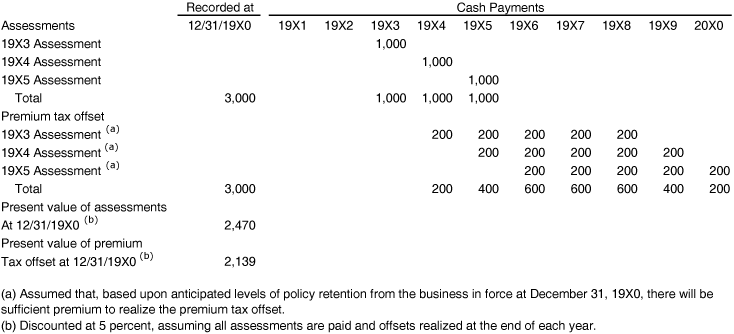 Recorded at Cash Payments Assessments 12/31/19X0 19X1 19X2 19X3 19X4 19X5 19X6 19X7 19X8 19X9 20X0 19X3 Assessment " 1,000 " 19X4 Assessment " 1,000 " 19X5 Assessment " 1,000 " Total " 3,000 " " 1,000 " " 1,000 " " 1,000 " Premium tax offset 19X3 Assessment (a) 200 200 200 200 200 19X4 Assessment (a) 200 200 200 200 200 19X5 Assessment (a) 200 200 200 200 200 Total " 3,000 " 200 400 600 600 600 400 200 Present value of assessments At 12/31/19X0 (b) " 2,470 " Present value of premium Tax offset at 12/31/19X0 (b) " 2,139 " "(a) Assumed that, based upon anticipated levels of policy retention from the business in force at December 31, 19X0, there will be sufficient premium to realize the premium tax offset." "(b) Discounted at 5 percent, assuming all assessments are paid and offsets realized at the end of each year."
Related subtopics
- 944-40 Claim Costs and Liabilities for Future Policy BenefitsFinancial Services—Insurance
- 605-944 Financial Services—InsuranceRevenue Recognition
- 720-20 Insurance CostsOther Expenses
- 450-20 Loss ContingenciesContingencies
- 805-944 Financial Services—InsuranceBusiness Combinations
- 944-60 Premium Deficiency and Loss RecognitionFinancial Services—Insurance