ASC

ASC 720-958

Not-for-Profit Entities

720 Other Expenses

Source downloaded: .Record version 40a7cc616233. Effective date must be checked in the source.

ASC 720-958 (cross-referenced as 958-720) governs how not-for-profit entities report expenses: by functional classification (program services and supporting activities such as management and general, fundraising, and membership development) and by natural classification, with a required analysis linking the two. It also sets the purpose/audience/content criteria that must all be met before joint costs of an activity that includes fundraising may be allocated to program or management and general rather than charged entirely to fundraising, and requires a recipient NFP to recognize services received from personnel of an affiliate that the affiliate does not charge for.

Key points (7)
  • An NFP must report information about all expenses in one location—on the face of the statement of activities, in a note schedule, or in a separate statement—in an analysis that disaggregates functional expense classifications by natural classifications such as salaries, rent, interest, and depreciation (958-720-45-15).
  • Costs of fundraising activities, including special fundraising events and direct-response solicitations that will generate future contributions, are expensed as incurred (958-720-25-4); fundraising by NFPs is not advertising (958-720-25-5).
  • Costs representing direct conduct or direct supervision of program or other supporting activities must be allocated out of management and general, and shared costs such as information technology are allocated among the functions receiving direct benefit (958-720-45-2A; 958-720-45-8).
  • For joint activities, if the purpose, audience, and content criteria are all met, identifiable costs are charged to their function and joint costs are allocated between fundraising and program or management and general; if any criterion fails, all costs are charged to fundraising except costs of goods or services provided in exchange transactions such as direct donor benefits (958-720-45-29).
  • The purpose criterion requires a call for specific action by the audience that helps accomplish the mission (educating the public about causes or asking for contributions is not enough) and is tested in order: compensation or fees test, separate and similar activities test, then other evidence test (958-720-45-33 through 45-47).
  • A rebuttable presumption exists that the audience criterion is not met if the audience includes prior donors or is selected based on ability or likelihood to contribute; it is overcome only if the audience is also selected for the reasons in 958-720-45-49 (958-720-45-48).
  • Services received from personnel of an affiliate that the affiliate does not charge for must be recognized and measured at the affiliate's cost (including direct personnel costs), with an election to use fair value if cost would significantly over- or understate the service, and may not be presented as a contra-expense or contra-asset (958-720-25-9; 30-2; 30-3; 45-56).

For students. Exam questions almost always hinge on the joint-cost allocation gate: all three criteria (purpose, audience, content) must be met or 100% of the activity's cost is charged to fundraising. The most common misunderstanding is thinking "educating the public about causes" counts as a program call to action—it does not; the message must ask the audience to take a specific mission-advancing action, and disclosure of allocated joint costs is mandatory.

Machine-generated study aid for ASC 720-958. Check the source paragraphs below.

720-958-00Status

Source downloaded: .Record version ca1d7d414937. Effective date must be checked in the source.

720-958-00-1
The following table identifies the changes made to this Subtopic.
ParagraphActionAccounting Standards UpdateDate
AffiliateAmendedMaintenance Update 2018-12 (PDF)09/10/2018
AffiliateAddedAccounting Standards Update No. 2013-0604/19/2013
Conditional ContributionAddedAccounting Standards Update No. 2018-0806/21/2018
ContributionAmendedAccounting Standards Update No. 2018-0806/21/2018
ContributionAmendedAccounting Standards Update No. 2010-0701/28/2010
Donor-Imposed ConditionAddedAccounting Standards Update No. 2018-0806/21/2018
Functional ClassificationSupersededAccounting Standards Update No. 2016-1408/18/2016
Functional Expense ClassificationAddedAccounting Standards Update No. 2016-1408/18/2016
Management and General ActivitiesAmendedAccounting Standards Update No. 2016-1408/18/2016
Natural Expense ClassificationAmendedAccounting Standards Update No. 2024-0311/04/2024
Natural Expense ClassificationAmendedAccounting Standards Update No. 2016-1408/18/2016
Natural Expense ClassificationAddedAccounting Standards Update No. 2014-0603/14/2014
Unconditional Promise to GiveSupersededAccounting Standards Update No. 2018-0806/21/2018
958-720-05-1AmendedAccounting Standards Update No. 2013-0604/19/2013
958-720-05-7AddedAccounting Standards Update No. 2013-0604/19/2013
AddedAccounting Standards Update No. 2013-0604/19/2013
958-720-25-1AmendedAccounting Standards Update No. 2018-0806/21/2018
958-720-25-2SupersededAccounting Standards Update No. 2018-0806/21/2018
958-720-25-5AmendedAccounting Standards Update No. 2014-0905/28/2014
958-720-25-6SupersededAccounting Standards Update No. 2014-0905/28/2014
958-720-25-8SupersededAccounting Standards Update No. 2014-0905/28/2014
958-720-25-9AddedAccounting Standards Update No. 2013-0604/19/2013
958-720-30-1AmendedAccounting Standards Update No. 2018-0806/21/2018
958-720-30-2AddedAccounting Standards Update No. 2013-0604/19/2013
958-720-30-3AddedAccounting Standards Update No. 2013-0604/19/2013
AmendedAccounting Standards Update No. 2016-1408/18/2016
958-720-45-2AmendedMaintenance Update 2020-18 (PDF)11/25/2020
958-720-45-2AmendedMaintenance Update 2015-11 (PDF)06/19/2015
958-720-45-2AAddedAccounting Standards Update No. 2016-1408/18/2016
958-720-45-7AmendedAccounting Standards Update No. 2016-1408/18/2016
958-720-45-7AmendedAccounting Standards Update No. 2012-0410/01/2012
958-720-45-8AmendedAccounting Standards Update No. 2016-1408/18/2016
958-720-45-13AmendedAccounting Standards Update No. 2012-0410/01/2012
958-720-45-14AmendedAccounting Standards Update No. 2012-0410/01/2012
958-720-45-15AmendedAccounting Standards Update No. 2018-0907/16/2018
958-720-45-15AmendedAccounting Standards Update No. 2016-1408/18/2016
958-720-45-15AmendedAccounting Standards Update No. 2014-0603/14/2014
958-720-45-16SupersededAccounting Standards Update No. 2016-1408/18/2016
958-720-45-16AmendedAccounting Standards Update No. 2014-0603/14/2014
958-720-45-23AmendedMaintenance Update 2018-12 (PDF)09/10/2018
958-720-45-56AmendedAccounting Standards Update No. 2020-1010/29/2020
958-720-45-56AddedAccounting Standards Update No. 2013-0604/19/2013
958-720-50-1AmendedAccounting Standards Update No. 2016-1408/18/2016
958-720-50-3AddedAccounting Standards Update No. 2013-0604/19/2013
958-720-55-1SupersededAccounting Standards Update No. 2018-0806/21/2018
958-720-55-1AAddedAccounting Standards Update No. 2018-0806/21/2018
958-720-55-1BAddedAccounting Standards Update No. 2018-0806/21/2018
958-720-55-166AmendedAccounting Standards Update No. 2016-1408/18/2016
958-720-55-169AmendedAccounting Standards Update No. 2016-1408/18/2016
AddedAccounting Standards Update No. 2016-1408/18/2016
958-720-65-1AddedAccounting Standards Update No. 2013-0604/19/2013

720-958-05Overview and Background

Source downloaded: .Record version 7a88cb4352b4. Effective date must be checked in the source.

720-958-05-1
This Subtopic provides guidance on reporting expenses for not-for-profit entities (NFPs). The guidance in this Subtopic is presented in the following three Subsections:
  1. a
    General
  2. b
    Accounting for Costs of Activities that Include Fundraising
  3. c
    Services Received from Personnel of an Affiliate.
720-958-05-2
The General Subsections provide incremental guidance on the following subjects:
  1. a
    The functional classification of expenses
  2. b
    The natural classification of expenses
  3. c
  4. d
    Fundraising costs
  5. e
    Premium costs
  6. f
    Advertising costs
  7. g
    Reductions in amounts charged for goods and services (discounts)
  8. h
    Cost of sales
  9. i
    Costs of occupancy and maintenance
  10. j
    Interest costs
  11. k
    Payments to affiliated NFPs
  12. l
    Expenses of federated fundraising organizations.
720-958-05-3
For additional information about the presentation of expenses in a statement of activities, see Section 958-220-45.
720-958-05-4
An NFP produces and distributes goods and services by using resources. It obtains some of the resources it uses by paying cash, some by incurring liabilities, and some by contribution. Some of its resources (assets) are used up in providing services at the time they are received, others are used up at a later date, and still others are used up gradually over time. Using up assets in providing services (or otherwise) has a cost whether those assets have been acquired in prior periods or in the current period and whether acquired by paying cash, incurring liabilities, or by contribution. To help explain the relationships of an NFP's ongoing major or central operations and activities, a statement of activities shall report the gross amounts of revenues and expenses pursuant to paragraph 958-220-45-14. To help donors, creditors, and others in assessing an NFP's service efforts, including the costs of its services and how it uses resources, a statement of activities or notes to financial statements shall provide information about expenses reported by their functional classification such as major classes of program services and supporting activities.

Accounting for Costs of Activities that Include Fundraising

720-958-05-5
The Accounting for Costs of Activities that Include Fundraising Subsections provide guidance for reporting costs as program or management and general in circumstances in which those activities are combined with fundraising activities. Some not-for-profit entities (NFPs) solicit support through a variety of fundraising activities, including the following:
  1. a
    Direct mail
  2. b
    Telephone solicitation
  3. c
    Door-to-door canvassing
  4. d
    Telethons
  5. e
    Special events
  6. f
    Others.
Sometimes fundraising activities are conducted with activities related to other functions, such as program activities or supporting services, such as management and general activities. Sometimes fundraising activities include components that would otherwise be associated with program or supporting services, but in fact support fundraising. The Accounting for Costs of Activities that Include Fundraising Subsections establish financial accounting standards for accounting for costs of those joint activities and require financial statement disclosures about the nature of the activities for which joint costs have been allocated and the amounts of joint costs.
720-958-05-6
The functional classifications of fundraising, program, and management and general are discussed throughout the Accounting for Costs of Activities that Include Fundraising Subsections for purposes of illustrating how the guidance in these Subsections would be applied by NFPs that use those functional classifications. Some entities have a functional structure that does not include fundraising, program, or management and general, or that includes other functional classifications, such as membership development. Use of those functional classifications is not intended to require reporting the functional classifications of fundraising, program, and management and general.

Services Received from Personnel of an Affiliate

720-958-05-7
The Services Received from Personnel of an Affiliate Subsections provide guidance for reporting services received by a not-for-profit entity (NFP) from personnel of an affiliate that directly benefit the recipient NFP and for which the affiliate does not charge the recipient NFP. Charging the recipient NFP means requiring payment from the recipient NFP at least for the approximate amount of the direct personnel costs (for example, compensation and any payroll-related fringe benefits) incurred by the affiliate in providing a service to the recipient NFP or the approximate fair value of that service.

720-958-15Scope and Scope Exceptions

Source downloaded: .Record version 77492de3c92b. Effective date must be checked in the source.

Overall Guidance

720-958-15-1
This Subtopic follows the same Scope and Scope Exceptions as outlined in the Overall Subtopic, see Section 958-10-15.
720-958-15-2
The General Subsection of this Section establishes the pervasive scope for this Subtopic, with specific exceptions noted in the other Subsections of this Section.

Accounting for Costs of Activities that Include Fundraising

720-958-15-3
The Accounting for Costs of Activities that Include Fundraising Subsections follow the same Scope and Scope Exceptions as outlined in the General Subsection of this Subtopic, see paragraph 958-720-15-1, with specific exceptions noted below.

Entities

720-958-15-4
The guidance in the Accounting for Costs of Activities that Include Fundraising Subsections applies to all not-for-profit entities (NFPs) that solicit contributions.

Transactions

720-958-15-5
The guidance in the Accounting for Costs of Activities that Include Fundraising Subsections applies only to costs of joint activities. The guidance does not address allocations of costs in other circumstances.

Services Received from Personnel of an Affiliate

Overall Guidance

720-958-15-6
The Services Received from Personnel of an Affiliate Subsections follow the same Scope and Scope Exceptions as outlined in the General Subsections of this Subtopic, see paragraph 958-720-15-1, with specific exceptions noted below.

Entities

720-958-15-7
The guidance in the Services Received from Personnel of an Affiliate Subsections applies to all not-for-profit entities (NFPs) that receive services from personnel of an affiliate that directly benefit the recipient NFP and for which the affiliate does not charge the recipient NFP.

Transactions

720-958-15-8
The guidance in the Services Received from Personnel of an Affiliate Subsections applies to services received from personnel of an affiliate that directly benefit the recipient NFP and for which the affiliate does not charge the recipient NFP. Charging the recipient NFP means requiring payment from the recipient NFP at least for the approximate amount of the direct personnel costs (for example, compensation and any payroll-related fringe benefits) incurred by the affiliate in providing a service to the recipient NFP or the approximate fair value of that service. The guidance does not address transactions between affiliates for which the affiliate charges the recipient NFP at least for the approximate amount of direct personnel costs or the approximate fair value of the services provided.

720-958-25Recognition

Source downloaded: .Record version 8457f605a1c3. Effective date must be checked in the source.

Contributions Made

720-958-25-1
A not-for-profit entity (NFP) shall comply with the applicable guidance in Subtopic 720-25, as well as the following guidance. For guidance on promises to give, see Subtopic 958-405 on not-for-profit entities—liabilities.
720-958-25-3
If an NFP makes contributions or awards grants to other NFPs upon specific requests of others, the NFP may be acting as an agent, trustee, or intermediary in a transfer between the donor and the beneficiary specified by the donor (agency transaction) (see paragraph 958-605-25-24).

Fundraising Costs

720-958-25-4
Costs of fundraising activities, including the cost of special fundraising events, shall be expensed as incurred. Costs are incurred when the item or service has been received. Fundraising costs incurred in one period, such as those made to obtain bequests, compile a mailing list of prospective contributors, or solicit contributions in a direct-response activity, may result in contributions that will be received in future periods. Those costs also shall be expensed as incurred.

Advertising Costs

720-958-25-5
An NFP shall comply with the guidance in Subtopic 720-35 applicable to its advertising activities. Fundraising by NFPs is not considered advertising and is not within the scope of that Subtopic.

Reductions in Amounts Charged for Goods or Services

720-958-25-7
Reductions in amounts charged for goods or services provided by an NFP shall be reported as expenses if such reductions are given in exchange for goods or services provided to the NFP, such as part of a compensation package.

Services Received from Personnel of an Affiliate

720-958-25-9
A not-for-profit entity (NFP) shall recognize all services received from personnel of an affiliate that directly benefit the recipient NFP (that is, are similar to personnel directly engaged by the recipient NFP). For example, that would include services performed by personnel of an affiliate for and under the direction of the recipient NFP and shared services. Shared services generally refers to services provided by a centralized function of one or more individuals within the affiliate group that the recipient NFP would otherwise typically need to purchase or have donated, if not provided by those personnel.

720-958-30Initial Measurement

Source downloaded: .Record version 53ae16cdf720. Effective date must be checked in the source.

Contributions Made

720-958-30-1
A liability and an expense recognized under paragraph 958-720-25-1 shall be measured initially at fair value.

Services Received from Personnel of an Affiliate

720-958-30-2
Services received from personnel of an affiliate that directly benefit the recipient not-for-profit entity (NFP) and for which the affiliate does not charge the recipient NFP shall be measured by the recipient NFP at the cost recognized by the affiliate in providing those services, except as provided in the following paragraph. Although the components of cost would depend on the nature and type of services provided and could vary from entity to entity, cost should include the direct personnel costs (for example, compensation and any payroll-related fringe benefits) incurred by the affiliate in providing the services to the recipient NFP.
720-958-30-3
If recording a service received from personnel of an affiliate at the cost recognized by the affiliate for the personnel providing that service will significantly overstate or understate the value of the service received, the recipient NFP may elect to recognize that service at either of the following:
  1. a
    The cost recognized by the affiliate for the personnel providing that service
  2. b
    The fair value of that service.

720-958-45Other Presentation Matters

Source downloaded: .Record version ee89d5b74825. Effective date must be checked in the source.

720-958-45-1
This Subsection provides guidance on the reporting of expenses incurred by not-for-profit entities (NFPs) as follows:
  1. a
    Functional classification of expenses
  2. b
    Analysis of expenses by their nature and function
  3. c
    Classification of particular costs.
For additional guidance on reporting under these classifications see Section 958-205-45.

Functional Classification of Expenses

720-958-45-2
To help donors, creditors, and others in assessing an NFP's service efforts, including the costs of its services and how it uses resources, a statement of activities or notes to financial statements shall provide information about expenses reported by their functional expense classification, such as major classes of program services and supporting activities, for example:
  1. a
    Program services
  2. b
    Supporting activities, which often include one or more of the following:
    1. 1
    2. 2
    3. 3
720-958-45-2A
Activities that represent direct conduct or direct supervision of program or other supporting activities require allocation from management and general activities. Additionally, certain costs benefit more than one function and, therefore, shall be allocated. For example, information technology generally can be identified as benefiting various functions, such as management and general (for example, accounting and financial reporting and human resources), fundraising, and program delivery. Therefore, information technology costs generally would be allocated among the functions receiving direct benefit.
720-958-45-3
Program services are the activities that result in goods and services being distributed to beneficiaries, customers, or members that fulfill the purposes or mission for which the NFP exists. Those services are the major purpose for and the major output of the NFP and often relate to several major programs. For example, a large university may have programs for student instruction, research, and patient care, among others. Similarly, a health and welfare entity may have programs for health or family services, research, disaster relief, and public education, among others. A federated fundraising entity's programs may include making contributions to NFPs supported by the federated fundraising entity. Paragraphs , although not required of NFPs, may be helpful in determining what constitutes major classes of programs and supporting activities.
720-958-45-4
Information about an NFP's major programs (or segments) can be enhanced by reporting the interrelationships of program expenses and program revenues. For example, a university might report expenses for its instruction and other academic services with related revenues from student tuition and expenses for its housing and food services with related revenues from room and board fees. Related nonmonetary information about program inputs, outputs, and results also is helpful; for example, information about applications, acceptances, admissions, enrollment and occupancy rates, and degrees granted. Generally, reporting that kind of information is feasible only in supplementary information or management explanations or by other methods of financial reporting.
720-958-45-5
The components of total program expenses shall be evident from the details provided on the face of the statement of activities, unless the notes to financial statements provide the information in paragraph 958-720-50-1(b).
720-958-45-6
Supporting activities are all activities of an NFP other than program services. Generally, supporting activities include the following activities:
  1. a
  2. b
  3. c
720-958-45-7
Management and general activities include the following:
  1. a
    Oversight
  2. b
    Business management
  3. c
    General recordkeeping and payroll
  4. d
    Budgeting
  5. e
    Financing, including unallocated interest costs pursuant to paragraph 958-720-45-24
  6. f
    Soliciting funds other than contributions and membership dues, for example, the costs associated with:
    1. 1
      Promoting the sale of goods or services to customers, including advertising costs
    2. 2
      Responding to government, foundation, and other requests for proposals for customer-sponsored contracts for goods and services
  7. ff
    Administering government, foundation, and similar customer-sponsored contracts, including billing and collecting fees and grant and contract financial reporting
  8. g
    Disseminating information to inform the public of the NFP's stewardship of contributed funds
  9. h
    Making announcements concerning appointments
  10. i
    Producing and disseminating the annual report
  11. j
  12. jj
    Employee benefits management and oversight (human resources)
  13. k
    All other management and administration except for direct conduct of program services (see paragraphs ), fundraising activities (see paragraphs ), or membership development activities (see paragraphs ). See paragraphs for examples on which activities would constitute direct conduct or supervision of program or support functions and an example footnote disclosure on the cost allocation method used to allocate costs among functions.
720-958-45-8
The costs of oversight and management usually include the salaries and expenses of the governing board, the chief executive officer of the NFP, and the supporting staff. If such staff spend a portion of their time directly conducting or supervising program services or categories of other supporting services, however, their salaries and expenses shall be allocated among those functions (see paragraph 958-720-45-2A). See paragraphs for examples on which activities would constitute direct conduct or supervision of program or support functions and an example note disclosure on the method used to allocate costs among functions.
720-958-45-9
Fundraising activities include the following:
  1. a
    Publicizing and conducting fundraising campaigns
  2. b
    Maintaining donor mailing lists
  3. c
    Conducting special fundraising events
  4. d
    Preparing and distributing fundraising manuals, instructions, and other materials
  5. e
    Conducting other activities involved with soliciting contributions from individuals, foundations, government agencies, and others.
720-958-45-10
Fundraising activities include soliciting contributions of services from individuals, regardless of whether those services meet the recognition criteria for contributions in the Contributions Received Subsection of Section 958-605-25.
720-958-45-11
Membership development activities include the following:
  1. a
    Soliciting for prospective members and membership dues
  2. b
    Membership relations
  3. c
    Similar activities.
720-958-45-12
If there are no significant benefits or duties connected with membership, however, the substance of membership development activities may, in fact, be fundraising, and the related costs shall be reported as fundraising costs. (See paragraphs for indicators useful in determining the contribution and exchange portions of membership dues.)
720-958-45-13
Membership development activities may be conducted in conjunction with other activities. In circumstances in which membership development is in part soliciting membership dues and in part soliciting contributions, the activity is a joint activity, as discussed in the Accounting for Costs of Activities that Include Fundraising Subsections of this Subtopic beginning with paragraph 958-720-45-28.
720-958-45-14
In circumstances in which membership development is conducted in conjunction with other activities but does not include soliciting contributions, the activity is not a joint activity, and the costs shall be allocated to membership development and one or more other functions. For example, if an activity involves costs to solicit new members (membership development) and direct costs of providing goods or services to existing members, in accordance with paragraph 958-720-45-3, an appropriate part of the costs of soliciting members shall be allocated to the membership development function and a part to program services.

Analysis of Expenses by Their Nature and Function

720-958-45-15
All NFPs shall report information about all expenses in one location on the face of the statement of activities, as a schedule in the notes to financial statements, or in a separate financial statement, as discussed in paragraph 958-205-45-6. The relationship between functional classification and natural classification for all expenses shall be presented in an analysis that disaggregates functional expense classifications, such as major classes of program services and supporting activities, by their natural expense classifications, such as salaries, rent, electricity, interest expense, supplies, depreciation, awards and grants to others, and professional fees. To the extent that expenses are reported by other than their natural classification (such as salaries included in cost of goods sold or facility rental costs of special events reported as direct benefits to donors), they shall be reported by their natural classification in the analysis of expenses by nature and function. For example, salaries, wages, and fringe benefits that are included as part of the cost of goods sold on the statement of activities shall be included with other salaries, wages, and fringe benefits in the analysis of expenses by nature and function. External and direct internal investment expenses that have been netted against investment return shall not be included in the analysis of expenses by nature and function. Certain items that are typically excluded from net income and that are included in other comprehensive income of business entities such as those items listed in paragraph 220-10-45-10A, are considered gains or losses and, like other gains and losses, shall not be included in the analysis of expenses by nature and function. See Note F in paragraph 958-205-55-21 for an example of how to report expenses by nature and function.

Classification of Particular Costs

720-958-45-17
This Subsection provides classification guidance for the following specific costs:
  1. a
    Cost of premiums
  2. b
    Cost of sales
  3. c
    Reductions in amounts charged for goods and services
  4. d
    Interest costs
  5. e
    Cost of occupancy and maintenance
  6. f
    Payments to affiliated NFPs
  7. g
    Expenses of federated fundraising organizations.
720-958-45-18
The cost of premiums (such as postcards or calendars) given to potential donors as part of mass fundraising appeals is a fundraising expense, and the classification of the donations received from the appeal as contributions is unaffected by the fact that premiums were given to potential donors. The premiums are not provided to potential donors in exchange for the assets contributed; they can be kept by all those from whom funds are solicited, regardless of whether a contribution is made.
720-958-45-19
The cost of premiums (such as coffee mugs) that are given to resource providers to acknowledge receipt of a contribution shall also be reported as fundraising expenses if those costs are nominal in value compared with the value of the goods or services donated by the resource provider. For example, an NFP may provide a coffee mug to people making a contribution of $50 or more; the mug costs the NFP $1. The NFP shall recognize contributions for the total amount contributed and fundraising expense of $1 for each mug provided to donors. The cost of premiums that are greater than nominal in value shall be reported as cost of sales. If premiums are greater than nominal in value, transactions shall be reported as part exchange transaction and part contribution.
720-958-45-20
The way that costs related to sales of goods and services are displayed depends on whether the sales constitute a major or central activity of the NFP or a peripheral or incidental activity.
720-958-45-21
For example, a not-for-profit museum that has a store that is a major or central activity shall report and display separately the revenues from the store's sales and the related cost of sales. Cost of sales is permitted to be reported immediately after revenues from sale of merchandise, and may be followed by a descriptive subtotal, or cost of sales may be reported with other expenses. If the store sells merchandise that is related to the museum's program, the store would be a program service and the cost of the store's sales would be reported as a program expense. In other circumstances, cost of sales could be reported as a separate supporting service. For example, if operating a cafeteria is a major or central activity but is not related to the NFP's programs, the cafeteria's cost of sales would be reported as supporting services.
720-958-45-22
In contrast, a not-for-profit church that occasionally produces and sells a cookbook (considered to be a peripheral or incidental activity) has gains (or losses) from those sales, and the receipts and related costs are permitted to be offset and only the net gains (or losses) are reported.
720-958-45-23
If a reduction in the amount charged for goods and services is reported as an expense in accordance with paragraph 958-720-25-7, the expense shall be reported in the same functional classification in which the cost of the goods or services provided to the NFP are reported.
720-958-45-24
Interest costs, including interest on a building's mortgage, shall be allocated to specific programs or supporting services to the extent possible. Interest costs that cannot be allocated shall be reported as part of the management and general function.
720-958-45-25
Occupying and maintaining a building is not a separate supporting service.
720-958-45-26
Payments to related local and national NFPs shall be reported by their functional classification to the extent that it is practicable and reasonable to do so and the necessary information is available, even if it is impossible to allocate the entire amount of such payments to functions. Payments to those entities that cannot be allocated to functions shall be treated as a separate supporting service, reported on a statement of activities as a separate line item, and labeled unallocated payments to local (or national) organizations.
720-958-45-27
Federated fundraising entities solicit and receive designated and undesignated contributions and make grants and awards to other NFPs. The fundraising activities of federated fundraising entities, including activities related to fundraising on behalf of others, shall be reported as fundraising expenses.

Accounting for Costs of Activities that Include Fundraising

720-958-45-28
This Subsection provides guidance on the following:
  1. a
    Classification of the costs of a joint activity
  2. b
    Allocation methods
  3. c
    Incidental activities.

Classification of the Costs of a Joint Activity

720-958-45-29
If the criteria of purpose, audience, and content are met, the costs of a joint activity shall be classified as follows:
  1. a
    The costs that are identifiable with a particular function shall be charged to that function.
  2. b
    Joint costs shall be allocated between fundraising and the appropriate program or management and general function.
If any of the criteria are not met, all costs of the joint activity shall be reported as fundraising costs, including costs that otherwise might be considered program or management and general costs if they had been incurred in a different activity, subject to the exception in the following sentence. Costs of goods or services provided in exchange transactions that are part of joint activities, such as costs of direct donor benefits of a special event (for example, a meal), shall not be reported as fundraising.
720-958-45-30
In circumstances in which a not-for-profit entity (NFP) that conducts joint activities has a functional structure that includes functional classifications other than fundraising, program, and management and general (see paragraph 958-720-05-6), all costs of those joint activities shall be charged to fundraising (or the category in which fundraising is reported), unless the purpose, audience, and content of those joint activities are appropriate for achieving those other functions.
720-958-45-31
Classification of costs incurred by an NFP for joint activities is based on the following criteria:
  1. a
    The purpose criterion
  2. b
    The audience criterion
  3. c
    The content criterion.
720-958-45-32
Examples 1 through 16 (see paragraphs ) provide illustrations of the tests and analysis that are used to determine whether the criteria listed in the preceding paragraph are met.
720-958-45-33
The purpose criterion is met if the purpose of the joint activity includes accomplishing program or management and general functions.
720-958-45-34
Paragraphs provide guidance that shall be considered in determining whether the purpose criterion is met, specifically:
  1. a
    If program functions are combined with fundraising activities, paragraphs provide guidance pertaining to program functions only.
  2. b
    If program functions, management and general functions, or both are combined with fundraising activities, paragraph 958-720-45-38 provides guidance pertaining to both program and management and general functions.
720-958-45-35
To accomplish program functions, the activity shall call for specific action by the audience that will help accomplish the NFP's mission. Actions that help accomplish the NFP's mission are actions that do either of the following:
  1. a
    Benefit the recipient (such as by improving the recipient's physical, mental, emotional, or spiritual health and well-being)
  2. b
    Benefit society (by addressing societal problems).
720-958-45-36
See paragraphs , which provide implementation guidance for determining whether an activity includes a call for a specific action. If the activity calls for specific action by the audience that will help accomplish the NFP's mission, the guidance in paragraph 958-720-45-38 shall also be considered in determining whether the purpose criterion is met.
720-958-45-37
In circumstances in which joint activities are conducted, a presumption exists that expenses shall be reported as fundraising rather than as program or management and general. The following circumstances are insufficient to overcome that presumption:
  1. a
    The purpose of the activity includes educating the public about causes.
  2. b
    The audience has a need or reasonable potential for use of any educational component of the activity pertaining to causes.
  3. c
    The audience has the ability to assist the NFP in meeting the goals of the program component of the activity by becoming educated about causes.
To conclude that the criteria of purpose, audience, and content are met, program activities shall call for specific action by the recipient (other than becoming educated about causes) that will help accomplish the NFP's mission.
720-958-45-38
The following factors shall be considered, in the order in which they are listed, to determine whether the purpose criterion is met:
  1. a
    The compensation or fees test
  2. b
    The separate and similar activities test
  3. c
    The other evidence test.
720-958-45-39
See Examples 1 through 16 (paragraphs ), which provide implementation guidance for these three tests.
720-958-45-40
The purpose criterion is not met if a majority of compensation or fees for any party's performance of any component of the discrete joint activity varies based on contributions raised for that discrete joint activity.
720-958-45-41
Some compensation contracts provide that compensation for performing the activity is based on a factor other than contributions raised, but not to exceed a specified portion of contributions raised. For example, a contract may provide that compensation for performing the activity is $10 per contact hour, but not to exceed 60 percent of contributions raised. In such circumstances, compensation is not considered based on amounts raised, unless the stated maximum percentage is met. In circumstances in which it is not yet known whether the stated maximum percentage is met, compensation is not considered based on amounts raised, unless it is probable that the stated maximum percentage will be met.
720-958-45-42
The compensation or fees test is a negative test in that it either:
  1. a
    Results in failing the purpose criterion
  2. b
    Is not determinative of whether the purpose criterion is met.
720-958-45-43
In considering the guidance in paragraph 958-720-45-38, compensation or fees test is the preeminent guidance. Therefore, if the activity fails the compensation or fees test, the activity fails the purpose criterion and the separate and similar activities test shall not be considered.
720-958-45-44
If the purpose criterion is not failed based on the compensation or fees test, this factor is not determinative of whether the purpose criterion is met, and the factor in the following paragraph and paragraph 958-720-45-46 (the separate and similar activities test) shall be considered.
720-958-45-45
The purpose criterion is met if a similar program or management and general activity is conducted separately and on a similar or greater scale. That is, the purpose criterion is met if either of the following conditions is met:
  1. a
    The first condition is met if both of the following are true:
    1. 1
      The program component of the joint activity calls for specific action by the recipient that will help accomplish the NFP's mission (see paragraphs ).
    2. 2
      A similar program component is conducted without the fundraising component using the same medium and on a scale that is similar to or greater than the scale on which it is conducted with the fundraising. Determining the scale on which an activity is conducted may be subjective. Factors to consider in determining the scale on which an activity is conducted may include dollars spent, the size of the audience reached, and the degree to which the characteristics of the audience are similar to the characteristics of the audience of the activity being evaluated.
  2. b
    The second condition is met if a management and general activity that is similar to the management and general component of the joint activity being accounted for is conducted without the fundraising component using the same medium and on a scale that is similar to or greater than the scale on which it is conducted with the fundraising.
720-958-45-46
If the purpose criterion is met based on the separate and similar activities test, the other evidence test shall not be considered. If the separate and similar activities test is not determinative, the other evidence test shall be considered.
720-958-45-47
The compensation or fees test and the separate and similar activities test may not always be determinative because the attributes that they consider may not be present. If the factors in paragraphs or do not determine whether the purpose criterion is met, other evidence may determine whether the criterion is met. All available evidence, both positive and negative, shall be considered to determine whether, based on the weight of that evidence, the purpose criterion is met. See paragraphs , which provide implementation guidance for applying the other evidence test.
720-958-45-48
A rebuttable presumption exists that the audience criterion is not met if the audience includes prior donors or is otherwise selected based on its ability or likelihood to contribute to the NFP. That presumption can be overcome if the audience is also selected for any of the reasons in the following paragraph. In determining whether that presumption is overcome, an NFP shall consider the extent to which the audience is selected based on its ability or likelihood to contribute to the NFP and contrast that with the extent to which it is selected for one or more of the reasons in the following paragraph. For example, if the audience's ability or likelihood to contribute is a significant factor in its selection and it has a need for the action related to the program component of the joint activity, but having that need is an insignificant factor in its selection, the presumption would not be overcome.
720-958-45-49
In circumstances in which the audience includes no prior donors and is not otherwise selected based on its ability or likelihood to contribute to the NFP, the audience criterion is met if the audience is selected for any of the following reasons:
  1. a
    The audience's need to use or reasonable potential for use of the specific action called for by the program component of the joint activity
  2. b
    The audience's ability to take specific action to assist the NFP in meeting the goals of the program component of the joint activity
  3. c
    The NFP is required to direct the management and general component of the joint activity to the particular audience or the audience has reasonable potential for use of the management and general component.
720-958-45-50
The content criterion is met if the joint activity supports program or management and general functions, as follows:
  1. a
    Program. The joint activity calls for specific action by the recipient that will help accomplish the NFP's mission (see paragraph 958-720-45-35). If the need for and benefits of the action are not clearly evident, information describing the action and explaining the need for and benefits of the action is provided.
  2. b
    Management and general. The joint activity fulfills one or more of the NFP's management and general responsibilities through a component of the joint activity.
720-958-45-51
Information identifying and describing the NFP, its causes, or how the contributions provided will be used is considered in support of fundraising.
720-958-45-52
Activities that are undertaken as a result of receiving contributions are management and general activities. For example, activities conducted to comply with requirements of regulatory bodies concerning contributions that have been received are management and general activities.
720-958-45-53
Activities that are undertaken in order to solicit contributions are fundraising activities. For example, activities conducted to comply with requirements of regulatory bodies concerning soliciting contributions, such as the requirement by some states or other regulatory bodies that certain disclosures be included when soliciting contributions, are fundraising activities. For purposes of applying this guidance, communications that include such required disclosures are considered fundraising activities and are not considered management and general activities.

Allocation Methods

720-958-45-54
The cost allocation methodology used shall be rational and systematic, it shall result in an allocation of joint costs that is reasonable, and it shall be applied consistently given similar facts and circumstances. See paragraphs , which provide explanations and illustrations of some acceptable allocation methods. The allocation of joint costs shall be based on the degree to which costs were incurred for the functions to which the costs are allocated (that is, program, management and general, or fundraising). For purposes of determining whether the allocation methodology for a particular joint activity is consistent with methodologies used for other particular joint activities, facts and circumstances that may be considered include factors related to the content and relative costs of the components of the activity. The audience shall not be considered in determining whether the facts and circumstances are similar for purposes of determining whether the allocation methodology for a particular joint activity is consistent with methodologies used for other particular joint activities. A change in cost allocation methodology shall be evaluated in accordance with Topic 250 to determine if it is a change in accounting principle.

Incidental Activities

720-958-45-55
Some fundraising activities conducted in conjunction with program or management and general activities are incidental to such program or management and general activities. In circumstances in which a fundraising, program, or management and general activity is conducted in conjunction with another activity and is incidental to that other activity, and the criteria in paragraph 958-720-45-29 for allocation are met, joint costs are permitted but not required to be allocated and may therefore be charged to the functional classification related to the activity that is not the incidental activity. However, in circumstances in which the program or management and general activities are incidental to the fundraising activities, it is unlikely that the criteria in that paragraph to permit allocation of joint costs would be met. See paragraphs 958-720-55-161, 958-720-55-163, and 958-720-55-165 for implementation guidance for incidental activities.

Services Received from Personnel of an Affiliate

720-958-45-56
The increase in net assets associated with services received from personnel of an affiliate that directly benefit the recipient not-for-profit entity (NFP) and for which the affiliate does not charge the recipient NFP shall not be presented as a contra-expense or a contra-asset. The corresponding decrease in net assets or the creation or enhancement of an asset resulting from the use of services received from personnel of an affiliate that directly benefit the recipient NFP and for which the affiliate does not charge the recipient NFP shall be presented similar to how other such expenses or assets are presented. See paragraph 958-220-45-21 for presentation guidance on services received from personnel of an affiliate.

720-958-50Disclosure

Source downloaded: .Record version 5a6d8ddb8247. Effective date must be checked in the source.

720-958-50-1
The financial statements of a not-for-profit entity (NFP) shall disclose the following information:
  1. a
    Total fundraising expenses.
  2. b
    Total program expenses and information about why total program expenses disclosed in the notes do not articulate with the statement of activities. Pursuant to paragraph 958-720-45-5, this disclosure is only required if the components of total program expenses are not evident from the details provided on the face of the statement of activities (for example, if cost of sales is not identified as either program or supporting services).
  3. bb
    The relationship between functional classification and natural classification for all expenses in an analysis that disaggregates functional expense classifications by their natural expense classifications in accordance with paragraph 958-720-45-15.
  4. c
    The amount of income tax expense and the nature of the activities that generated the taxes, which is only required if the NFP incurs income tax expense.
  5. d
    A description of the methods used to allocate costs among program and support functions. See paragraph 958-720-55-176 or Note F in paragraph 958-205-55-21 for examples of note disclosures on the cost allocation methods used.

Accounting for Costs of Activities that Include Fundraising

720-958-50-2
A not-for-profit entity (NFP) that allocates joint costs shall disclose all of the following in the notes to its financial statements:
  1. a
    The types of activities for which joint costs have been incurred
  2. b
    A statement that such costs have been allocated
  3. c
    The total amount allocated during the period and the portion allocated to each functional expense category.
An NFP is also encouraged, but not required, to disclose the amount of joint costs for each kind of joint activity, if practical. See Example 20 (paragraph 958-720-55-166) for illustrative disclosures.

Services Received from Personnel of an Affiliate

720-958-50-3
The disclosures in Subtopic 850-10 shall be provided for services received by a not-for-profit entity (NFP) from personnel of an affiliate.

720-958-55Implementation Guidance and Illustrations

Source downloaded: .Record version cbaf34fc9399. Effective date must be checked in the source.

Implementation Guidance
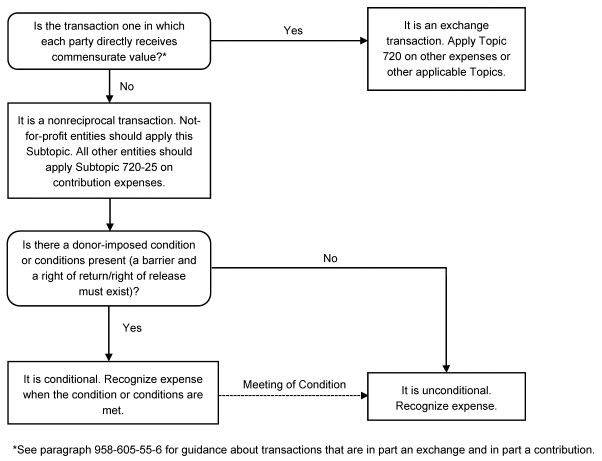
720-958-55-1A
The following diagram illustrates the process for determining whether a transfer of assets to a recipient is a contribution or an exchange transaction and how to determine whether a contribution is conditional. Further guidance on what is an exchange transaction or a contribution as well as guidance on what is a conditional contribution can be found in Subtopic 958-605 on not-for-profit entities—revenue recognition.
  • Is the transaction one in which each party directly receives commensurate value? It is an exchange transaction. Apply Topic 720 on other expenses or other applicable Topics. It is a nonreciprocal transaction. Not-for-profit entities should apply this Subtopic. All other entities should apply Subtopic 720-25 on contribution expenses. Is there a donor-imposed condition or conditions present (a barrier and a right of return/right of release must exist)? It is conditional. Recognize expense when the condition or conditions are met. Meeting of Condition. It is unconditional. Recognize expense. See paragraph 958-605-55-6 for guidance about transactions that are in part an exchange and in part a contribution.

Accounting for Costs of Activities That Include Fundraising

Implementation Guidance
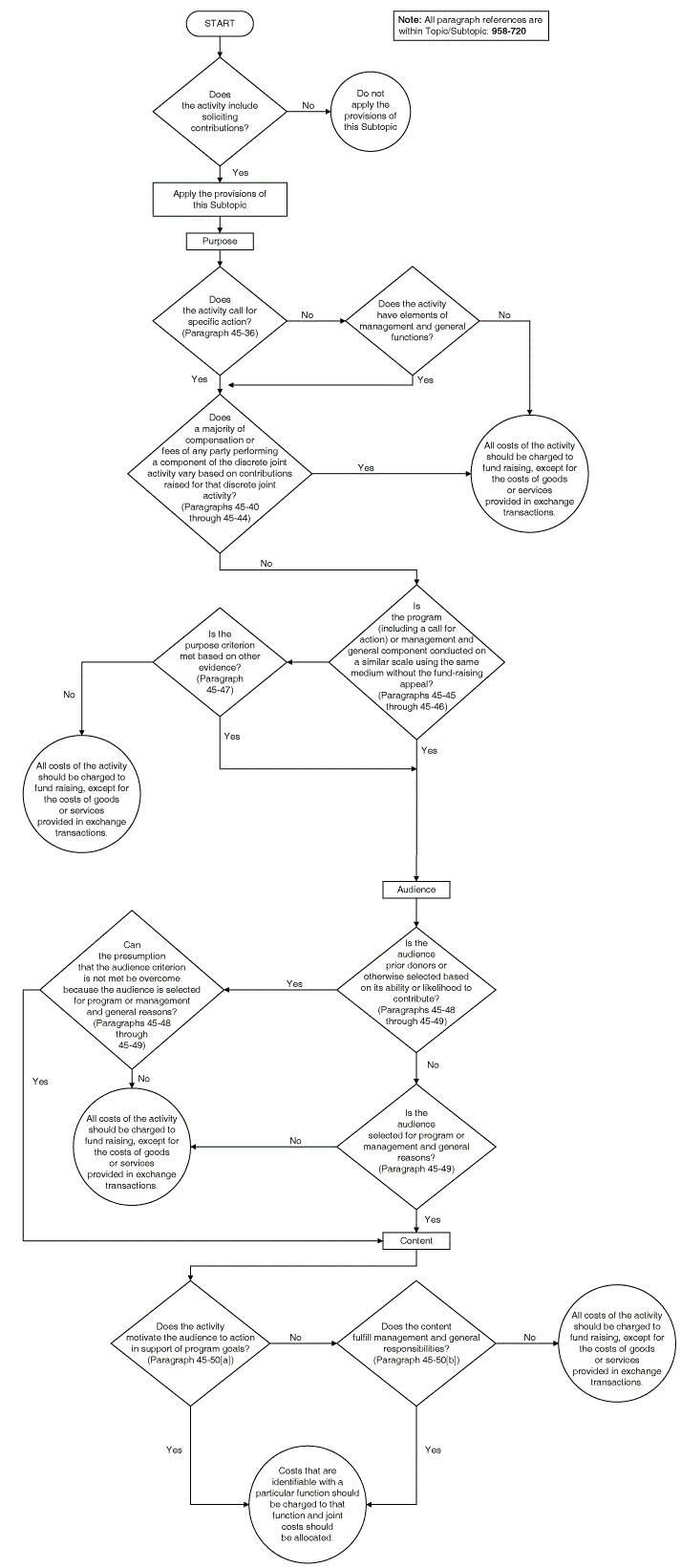
720-958-55-1B
This Subsection, which is an integral part of the requirements of the Accounting for Costs of Activities That Include Fundraising Subsections of this Subtopic, provides general guidance to be used in the classification and allocation of costs incurred in activities that include fundraising.
720-958-55-2
The following flowchart summarizes the guidance in paragraphs and is not intended as a substitute for the guidance therein.
720-958-55-3
The following provides implementation guidance related to paragraph 958-720-45-35.
720-958-55-4
The following are examples of activities that call for specific action by the audience that will help accomplish the not-for-profit entity's (NFP's) mission:
  1. a
    An NFP's mission includes improving individuals' physical health. For that NFP, motivating the audience to take specific action that will improve their physical health is a call for specific action by the audience that will help accomplish the NFP's mission. An example of an activity that motivates the audience to take specific action that will improve their physical health is sending the audience a brochure that urges them to stop smoking and suggests specific methods, instructions, references, and resources that may be used to stop smoking.
  2. b
    An NFP's mission includes educating individuals in areas other than the causes, conditions, needs, or concerns that the NFP's programs are designed to address (referred to as causes). For that NFP, educating the audience in areas other than causes or motivating the audience to otherwise engage in specific activities that will educate them in areas other than causes is a call for specific action by the audience that will help accomplish the NFP's mission. Examples of NFPs whose mission includes educating individuals in areas other than causes are universities and possibly other NFPs. An example of an activity motivating individuals to engage in education in areas other than causes is a university inviting individuals to attend a lecture or class in which the individuals will learn about the solar system.
  3. c
    Some educational activities that might otherwise be considered as educating the audience about causes may implicitly call for specific action by the audience that will help accomplish the NFP's mission. For example, activities that educate the audience about environmental problems caused by not recycling implicitly call for that audience to increase recycling. If the need for and benefits of the specific action are clearly evident from the educational message, the message is considered to include an implicit call for specific action by the audience that will help accomplish the NFP's mission.
720-958-55-5
The following are examples of activities that fail to call for a specific action by the audience that will help accomplish the NFP's mission:
  1. a
    Educating the audience about causes or motivating the audience to otherwise engage in specific activities that will educate them about causes is not a call for specific action by the audience that will help accomplish the NFP's mission. Such activities are considered in support of fundraising.
  2. b
    Asking the audience to make contributions is not a call for specific action by the audience that will help accomplish the NFP's mission.
720-958-55-6
The following provides implementation guidance related to paragraph 958-720-45-47.
720-958-55-7
The following are examples of indicators that provide evidence that the purpose criterion may be met:
  1. a
    Measuring program results and accomplishments of the activity. The facts may indicate that the purpose criterion is met if the NFP measures program results and accomplishments of the activity (other than measuring the extent to which the public was educated about causes).
  2. b
    Medium. The facts may indicate that the purpose criterion is met if the program component of the joint activity calls for specific action by the recipient that will help accomplish the NFP's mission and if the NFP conducts the program component without a significant fundraising component in a different medium. Also, the facts may indicate that the purpose criterion is met if the NFP conducts the management and general component of the joint activity without a significant fundraising component in a different medium.
720-958-55-8
The following are examples of indicators that provide evidence that the purpose criterion may not be met:
  1. a
    Evaluation. The facts may indicate that the purpose criterion is not met if the evaluation of any party's performance of any component of the discrete joint activity varies based on contributions raised for that discrete joint activity.
  2. b
    Compensation. The facts may indicate that the purpose criterion is not met if some, but less than a majority, of compensation or fees for any party's performance of any component of the discrete joint activity varies based on contributions raised for that discrete joint activity.
720-958-55-9
The following are examples of indicators that provide evidence that the purpose criterion may be either met or not met:
  1. a
    Evaluation of measured results of the activity. The NFP may have a process to evaluate measured program results and accomplishments of the activity (other than measuring the extent to which the public was educated about causes). If the NFP has such a process, in evaluating the effectiveness of the joint activity, the NFP may place significantly greater weight on the activity's effectiveness in accomplishing program goals or may place significantly greater weight on the activity's effectiveness in raising contributions. The former may indicate that the purpose criterion is met. The latter may indicate that the purpose criterion is not met.
  2. b
    Qualifications. The following qualifications and duties of those performing the joint activity should be considered:
    1. 1
      If a third party, such as a consultant or contractor, performs part or all of the joint activity, such as producing brochures or making telephone calls, the third party's experience and the range of services provided to the NFP should be considered in determining whether the third party is performing fundraising, program (other than educating the public about causes), or management and general activities on behalf of the NFP.
    2. 2
      If the NFP's employees perform part or all of the joint activity, the full range of their job duties should be considered in determining whether those employees are performing fundraising, program (other than educating the public about causes), or management and general activities on behalf of the NFP. For example, employees who are not members of the fundraising department and employees who are members of the fundraising department but who perform non-fundraising activities are more likely to perform activities that include program or management and general functions than are employees who otherwise devote significant time to fundraising.
  3. c
    Tangible evidence of intent. Tangible evidence indicating the intended purpose of the joint activity should be considered. Examples of such tangible evidence include the following:
    1. 1
      The NFP's written mission statement, as stated in its fundraising activities, bylaws, or annual report
    2. 2
      Minutes of board of directors, committee, or other meetings
    3. 3
      Restrictions imposed by donors (who are not related parties) on gifts intended to fund the joint activity
    4. 4
      Long-range plans or operating policies
    5. 5
      Written instructions to other entities, such as script writers, consultants, or list brokers, concerning the purpose of the joint activity, audience to be targeted, or method of conducting the joint activity
    6. 6
      Internal management memoranda.
720-958-55-10
The following provides implementation guidance related to paragraphs .
720-958-55-11
Some NFPs conduct joint activities that are special events, such as symposia, dinners, dances, and theater parties, in which the attendee receives a direct benefit (for example, a meal or theater ticket) and for which the admission price includes a contribution. For example, it may cost $500 to attend a dinner with a fair value of $50. In that case, the audience is required to make a $450 contribution in order to attend.
720-958-55-12
In circumstances in which the audience is required to make a contribution to participate in a joint activity, such as attending a special event, the audience's ability or likelihood to contribute is a significant factor in its selection. Therefore, in circumstances in which the audience is required to make a contribution to participate in a joint activity, the extent to which the audience is selected for the program or management and general reasons in paragraph 958-720-45-49 must be overwhelmingly significant in order to rebut the presumption that the audience criterion is not met.
720-958-55-13
The source of the names and the characteristics of the audience should be considered in determining the reason for selecting the audience. Some NFPs use lists compiled by others to reach new audiences. The source of such lists may indicate the purpose or purposes for which they were selected. For example, lists acquired from entities with similar or related programs are more likely to meet the audience criterion than are lists acquired from entities with dissimilar or unrelated programs. Also, the characteristics of those on the lists may indicate the purpose or purposes for which they were selected. For example, a list based on a consumer profile of those who buy environmentally friendly products may be useful to an NFP whose mission addresses environmental concerns and could therefore indicate that the audience was selected for its ability to take action to assist the NFP in meeting program goals. However, a list based on net worth would indicate that the audience was selected based on its ability or likelihood to contribute, unless there was a correlation between net worth and the program or management and general components of the activity.
720-958-55-14
Some audiences may be selected because they have an interest in or affinity to the program. For example, homeowners may have an interest in the homeless because they are sympathetic to the plight of the homeless. Nevertheless, including homeowners in the audience of a program activity to provide services to the homeless would not meet the audience criterion, because they do not have a need or reasonable potential for use of services to the homeless.
720-958-55-15
Paragraph 958-720-45-49(c) provides that the audience criterion is met if the NFP is required to direct the management and general component of the joint activity to the particular audience or the audience has reasonable potential for use of the management and general component. An example of a joint activity in which the audience is selected because the NFP is required to direct the management and general component of the joint activity to the particular audience is an activity in which the NFP sends a written acknowledgment or other information to comply with requirements of the Internal Revenue Service (IRS) to prior donors and includes a request for contributions. An example of a joint activity in which the audience is selected because the audience has reasonable potential for use of the management and general component is an activity in which the NFP sends its annual report to prior donors and includes a request for contributions.
720-958-55-16
The following provides implementation guidance related to paragraphs .
720-958-55-17
Paragraph 958-720-45-50(a) provides that, to meet the content criterion, program activities should call for specific action by the recipient that will help accomplish the NFP's mission. As discussed in paragraph 958-720-45-35, the action should benefit the recipient or society. Examples of actions that benefit the recipient (such as by improving the recipient's physical, mental, emotional, or spiritual health and well-being) or society (such as by addressing societal problems) include the following:
  1. a
    Actions that benefit the recipient include the following:
    1. 1
      Stop smoking. Specific methods, instructions, references, and resources should be suggested.
    2. 2
      Do not use alcohol or drugs. Specific methods, instructions, references, and resources should be suggested.
  2. b
    Actions that benefit society include the following:
    1. 1
      Write or call. The party to communicate with and the subject matter to be communicated should be specified.
    2. 2
      Complete and return the enclosed questionnaire. The results of the questionnaire should help the NFP achieve its mission. For example, if the NFP discards the questionnaire, it does not help the NFP achieve its mission.
    3. 3
      Boycott. The particular product or entity to be boycotted should be specified.
720-958-55-18
Paragraph 958-720-45-50(b) provides that to meet the content criterion, management and general functions are required to fulfill one or more of the NFP's management and general responsibilities through a component of the joint activity. Some states or other regulatory bodies require that certain disclosures be included when soliciting contributions. Paragraph 958-720-45-53 provides that for purposes of applying this guidance, communications that include such required disclosures are considered fundraising activities and are not considered management and general activities. Some examples of such disclosures include the following:
  • Information filed with the attorney general concerning this charitable solicitation may be obtained from the attorney general of [the state] by calling 123-4567. Registration with the attorney general does not imply endorsement.
  • A copy of the registration and financial information may be obtained from the Division of Consumer Services by calling toll-free, within [the state], 1-800-123-4567. Registration does not imply endorsement, approval, or recommendation by [the state].
  • Information about the cost of postage and copying, and other information required to be filed under [the state] law, can be obtained by calling 123-4567.
  • The entity's latest annual report can be obtained by calling 123-4567.
720-958-55-19
NFPs that do not use the functional classifications of fundraising, program, and management and general shall apply the guidance in the Accounting for Costs of Activities that Include Fundraising Subsections of this Subtopic, for purposes of accounting for joint activities, using their reporting model.
720-958-55-20
Some NFPs may conduct membership development activities. If there are no significant benefits or duties connected with membership, the substance of the membership development activities may, in fact, be fundraising. In such circumstances, the costs of those activities shall be charged to fundraising. To the extent that member benefits are received, membership is an exchange transaction.
720-958-55-21
In circumstances in which membership development is in part soliciting revenues from exchange transactions and in part soliciting contributions and the purpose, audience, and content of the activity are appropriate for achieving membership development, joint costs should be allocated between fundraising and the exchange transaction.
720-958-55-22
Most transactions in which a student attends a lecture or class are exchange transactions and are not joint activities. Such transactions are joint activities only if the activity includes fundraising.
720-958-55-23
Some NFPs have missions that include educating the public (students) in areas other than causes. Paragraph 958-720-55-4 provides that, for those entities, educating the audience in areas other than causes or motivating the audience to engage in specific activities, such as attending a lecture or class, that will educate them in areas other than causes is considered a call for specific action by the recipients that will help accomplish the NFP's mission. Educating the audience about causes or motivating the audience to engage in specific activities that will educate them about causes without educating them in other subjects is not considered a call for specific action by the audience that will help accomplish the NFP's mission.
720-958-55-24
An example of a lecture or class that will educate students in an area other than causes is a lecture on the nesting habits of the bald eagle, given by the Save the Bald Eagle Society, an NFP whose mission is to save the bald eagle from extinction and educate the public about the bald eagle. An example of a lecture or class that will address particular causes is a lecture by the Bald Eagle Society on the potential extinction of bald eagles and the need to raise contributions to prevent their extinction. For purposes of applying this guidance, motivating the audience to attend a lecture on the nesting habits of the bald eagle is a call for specific action that will help accomplish the NFP's mission. If the lecture merely addresses the potential extinction of bald eagles and the need to raise contributions to prevent their extinction, without addressing the nesting habits of the bald eagle, motivating the audience to attend the lecture is not considered a call for specific action by the recipient that will help accomplish the NFP's mission.
720-958-55-25
Paragraphs provide some commonly used cost allocation methods.
720-958-55-26
Joint costs are allocated to materials and activities in proportion to the number of units of output that can be attributed to each of the materials and activities. Examples of units of output are lines, square inches, and physical content measures. This method assumes that the benefits received by the fundraising, program, or management and general component of the materials or activity from the joint costs incurred are directly proportional to the lines, square inches, or other physical output measures attributed to each component of the activity. This method may result in an unreasonable allocation of joint costs if the units of output (for example, line counts) do not reflect the degree to which costs are incurred for the joint activity. Use of the physical units method may also result in an unreasonable allocation if the physical units cannot be clearly ascribed to fundraising, program, or management and general. For example, direct mail and telephone solicitations sometimes include content that is not identifiable with fundraising, program, or management and general; or the physical units of such content are inseparable.
720-958-55-27
For example, assume a direct mail campaign is used to conduct programs of the NFP and to solicit contributions to support the NFP and its programs. Further, assume that the appeal meets the criteria for allocation of joint costs to more than one function. The letter and reply card include a total of 100 lines; 45 lines pertain to program because they include a call for action by the recipient that will help accomplish the NFP's mission, while 55 lines pertain to the fundraising appeal. Accordingly, 45 percent of the costs are allocated to program and 55 percent to fundraising.
720-958-55-28
Joint costs are allocated to each of the components on the basis of their respective direct costs. Direct costs are those costs that are incurred in connection with the multipurpose materials or activity and that are specifically identifiable with a function (program, fundraising, or management and general). This method may result in an unreasonable allocation of joint costs if the joint costs of the materials and activity are not incurred in approximately the same proportion and for the same reasons as the direct costs of the materials and activity. For example, if a relatively costly booklet informing the reader about the NFP's mission (including a call for action by the recipient that will help accomplish the NFP's mission) is included with a relatively inexpensive fundraising letter, the allocation of joint costs based on the cost of these pieces may be unreasonable, particularly if the booklet and letter weigh approximately the same and therefore contribute equally to the postage costs.
720-958-55-29
For example, the costs of a direct mail campaign that can be specifically identified with program services are the costs of separate program materials and a postcard that calls for specific action by the recipient that will help accomplish the NFP's mission. They total $20,000. The direct costs of the fundraising component of the direct mail campaign consist of the costs to develop and produce the fundraising letter. They total $80,000. Joint costs associated with the direct mail campaign total $40,000 and would be allocated as follows under the relative direct cost method:
  1. a
    Program services: $20,000/$100,000 x $40,000 = $8,000
  2. b
    Fundraising: $80,000/$100,000 x $40,000 = $32,000.
720-958-55-30
Joint costs are allocated to each component of the activity based on a ratio that uses estimates of costs of items included in joint costs that would have been incurred had the components been conducted independently. The numerator of the ratio is the cost (of items included in joint costs) of conducting a single component independently. The denominator is the cost (of items included in joint costs) of conducting all components independently. This method assumes that efforts for each component in the standalone situation are proportionate to the efforts actually undertaken in the joint cost situation. This method may result in an unreasonable allocation because it ignores the effect of each function, which is performed jointly with other functions, on other such functions. For example, the programmatic impact of a direct mail campaign or a telemarketing phone message may be significantly lessened when performed in conjunction with a fundraising appeal.
720-958-55-31
For example, assume that the joint costs associated with a direct mail campaign including both program and fundraising components are the costs of stationery, postage, and envelopes at a total of $100,000. The costs of stationery, postage, and envelopes to produce and distribute each component separately would have been $90,000 for the program component and $70,000 for the fundraising component. Under the standalone joint cost allocation method, the $100,000 in joint costs would be allocated as follows:
  1. a
    Program services: $90,000/$160,000 x $100,000 = $56,250
  2. b
    Fundraising: $70,000/$160,000 x $100,000 = $43,750.
720-958-55-32
Some costs, such as utilities, rent, and insurance, commonly referred to as indirect costs, may be joint costs. For example, the telephone bill for a department that, among other things, prepares materials that include both fundraising and program components may commonly be referred to as an indirect cost. Such telephone bills may also be joint costs.
720-958-55-33
However, for some NFPs, it is impracticable to measure and allocate the portion of the costs that are joint costs. Considerations about which joint costs should be measured and allocated, such as considerations about materiality and the costs and benefits of developing and providing the information, are the same as considerations about cost allocations in other circumstances.
720-958-55-34
The purpose for which costs other than joint costs are incurred may be fundraising, program, or management and general, depending on the context in which they are used in the activity undertaken. For example, a program-related pamphlet may be sent to an audience in need of the program. In that context, the pamphlet is used for program purposes. However, in order to demonstrate to potential donors that the NFP's programs are worthwhile, that same pamphlet may be sent to an audience that is likely to contribute, but that has no need or reasonable potential for use of the program. In that context, the pamphlet is used for fundraising. The classification of the cost of the pamphlets depends upon the use of the pamphlets and the application of the criteria in paragraph 958-720-45-29, as follows:
  1. a
    If some program-related pamphlets are used in program activities that include no fundraising, the cost of the pamphlets used in those separate program activities that include no fundraising should be charged to program.
  2. b
    If some pamphlets are included in a joint activity and the criteria in paragraph 958-720-45-29 are met, the costs of materials that accomplish program goals and that are unrelated to fundraising, including the costs of the program-related pamphlet, should be charged to program, while joint costs, such as postage, should be allocated between fundraising and program.
  3. c
    If the program-related pamphlet is used in fundraising packets and the criteria in paragraph 958-720-45-29 are not met, the costs of the pamphlets used in the fundraising packets, as well as the joint costs, should be charged to fundraising.

Illustrations

720-958-55-35
Paragraph 958-720-45-29 provides that all costs of joint activities, except for costs of goods or services provided in exchange transactions that are part of joint activities, such as costs of direct donor benefits of a special event (for example, a meal), shall be charged to fundraising if any of the criteria of purpose, audience, or content are not met. Accordingly, if one or more criteria are not met, the other criteria need not be considered. The following Examples provide conclusions about whether each of the criteria would be met in circumstances in which one or more criteria are not met in order to provide further guidance.
720-958-55-36
This Example illustrates the guidance in paragraphs and .
720-958-55-37
Not-for-Profit Entity A's (NFP A's) mission is to prevent drug abuse. NFP A's annual report states that one of its objectives in fulfilling that mission is to assist parents in preventing their children from abusing drugs.
720-958-55-38
NFP A mails informational materials to the parents of all junior high school students explaining the prevalence and dangers of drug abuse. The materials encourage parents to counsel children about the dangers of drug abuse and inform them about how to detect drug abuse. The mailing includes a request for contributions. NFP A conducts other activities informing the public about the dangers of drug abuse and encouraging parents to counsel their children about drug abuse that do not include requests for contributions and that are conducted in different media. NFP A's executive director is involved in the development of the informational materials as well as the request for contributions. The executive director's annual compensation includes a significant bonus if total annual contributions exceed a predetermined amount.
720-958-55-39
The purpose, audience, and content criteria are met, and the joint costs should be allocated.
720-958-55-40
The activity calls for specific action by the recipient (encouraging parents to counsel children about the dangers of drug abuse and informing them about how to detect drug abuse) that will help accomplish the NFP's mission. Therefore, the guidance in paragraph 958-720-45-38 should be considered. Neither the factors in paragraphs nor those in paragraphs are determinative of whether the purpose criterion is met. (Although NFP A's executive director's annual compensation varies based on annual contributions, the executive director's compensation does not vary based on contributions raised for this discrete joint activity.) Therefore, other evidence, such as the indicators in paragraphs , should be considered.
720-958-55-41
The purpose criterion is met based on the other evidence, because:
  1. a
    The program component of this activity calls for specific action by the recipient (encouraging parents to counsel children about the dangers of drug abuse) that will help accomplish the NFP's mission, and it otherwise conducts the program activity in this Example without a request for contributions.
  2. b
    Performing such programs helps accomplish NFP A's mission. (Note that had NFP A conducted the activity using the same medium on a scale that is similar to or greater than the scale on which it is conducted with the request for contributions, the purpose criterion would have been met under paragraphs .)
720-958-55-42
The audience criterion is met because the audience (parents of junior high school students) is selected based on its need to use or reasonable potential for use of the action called for by the program component.
720-958-55-43
The content criterion is met because the activity calls for specific action by the recipient (encouraging parents to counsel children about the dangers of drug abuse and informing them about how to detect drug abuse) that will help accomplish the NFP's mission (assisting parents in preventing their children from abusing drugs), and it explains the need for and benefits of the action (the prevalence and dangers of drug abuse).
720-958-55-44
This Example illustrates the guidance in paragraphs and .
720-958-55-45
Not-for-Profit Entity B's (NFP B's) mission is to reduce the incidence of illness from ABC disease, which afflicts a broad segment of the population. One of NFP B's objectives in fulfilling that mission is to inform the public about the effects and early warning signs of the disease and specific action that should be taken to prevent the disease.
720-958-55-46
NFP B maintains a list of its prior donors and sends them donor renewal mailings. The mailings include messages about the effects and early warning signs of the disease and specific action that should be taken to prevent it. That information is also sent to a similar-sized audience but without the request for contributions. Also, NFP B believes that recent donors are more likely to contribute than nondonors or donors who have not contributed recently. Prior donors are deleted from the mailing list if they have not contributed to NFP B recently, and new donors are added to the list. There is no evidence of a correlation between recent contributions and participation in the program component of the activity. Also, the prior donors' need to use or reasonable potential for use of the messages about the effects and early warning signs of the disease and specific action that should be taken to prevent it is an insignificant factor in their selection.
720-958-55-47
The purpose and content criteria are met. The audience criterion is not met. All costs, including those that might otherwise be considered program or management and general costs if they had been incurred in a different activity, should be charged to fundraising.
720-958-55-48
The activity calls for specific action by the recipient (action that should be taken to prevent ABC disease) that will help accomplish the NFP's mission. Therefore, the guidance in paragraph 958-720-45-38 should be considered.
720-958-55-49
The purpose criterion is met because:
  1. a
    The program component of the activity calls for specific action by the recipient that will help accomplish the NFP's mission (to reduce the incidence of illness from the disease).
  2. b
    The program is also conducted using the same medium on a scale that is similar to or greater than the scale on which it is conducted with the request for contributions (a similar mailing is done without the request for contributions, to a similar-sized audience).
720-958-55-50
The audience criterion is not met. The rebuttable presumption that the audience criterion is not met because the audience includes prior donors is not overcome in this Example. Although the audience has a need to use or reasonable potential for use of the program component, that was an insignificant factor in its selection.
720-958-55-51
The content criterion is met because the activity calls for specific action by the recipient (actions to prevent ABC disease) that will help accomplish the NFP's mission (to reduce the incidence of ABC disease), and it explains the need for and benefits of the action (to prevent ABC disease).
720-958-55-52
This Example illustrates the guidance in paragraphs and .
720-958-55-53
Not-for-Profit Entity C's (NFP C's) mission is to reduce the incidence of illness from ABC disease, which afflicts a broad segment of the population. One of NFP C's objectives in fulfilling that mission is to increase governmental funding for research about ABC disease.
720-958-55-54
NFP C maintains a list of its prior donors and its employees call them on the telephone reminding them of the effects of ABC disease, asking for contributions, and encouraging them to contact their elected officials to urge increased governmental funding for research about ABC disease. The callers are educated about ABC, do not otherwise perform fundraising functions, and are not compensated or evaluated based on contributions raised. NFP C's research indicates that recent donors are likely to contact their elected officials about such funding while nonrecent donors are not. Prior donors are deleted from the calling list if they have not contributed to NFP C recently, and new donors are added to the list.
720-958-55-55
The purpose, audience, and content criteria are met, and the joint costs should be allocated.
720-958-55-56
The activity calls for specific action by the recipient (contacting elected officials concerning funding for research about ABC disease) that will help accomplish the NFP's mission. Therefore, the guidance in paragraph 958-720-45-38 should be considered. Neither the factors in paragraphs nor those in paragraphs are determinative of whether the purpose criterion is met. Therefore, other evidence, such as the indicators in paragraphs , should be considered.
720-958-55-57
The purpose criterion is met based on the other evidence, because:
  1. a
    The qualifications and duties of the personnel performing the activity indicate that it is a program activity (the callers are educated about ABC and do not otherwise perform fundraising functions).
  2. b
    The method of compensation for performing the activity does not indicate that it is a fundraising activity (the employees are not compensated or evaluated based on contributions raised).
  3. c
    Performing such programs helps accomplish NFP C's mission.
720-958-55-58
The audience criterion is met because the audience (recent donors) is selected based on its ability to assist NFP C in meeting the goals of the program component of the activity (recent donors are likely to contact their elected officials about such funding while nonrecent donors are not).
720-958-55-59
The content criterion is met because the activity calls for specific action by the recipient (contacting elected officials concerning funding for research about ABC disease) that will help accomplish the NFP's mission (to reduce the incidence of ABC disease), and it explains the need for and benefits of the action (to prevent ABC disease).
720-958-55-60
The following Cases illustrate the guidance in paragraphs and :
  1. a
    The purpose criterion is met (Case A).
  2. b
    The purpose criterion is not met (Case B).
720-958-55-61
Cases A and B have the following assumptions.
720-958-55-62
Not-for-Profit Entity D's (NFP D's) mission is to improve the quality of life for senior citizens. One of NFP D's objectives included in that mission is to increase the physical activity of senior citizens. One of NFP D's programs to attain that objective is to send representatives to speak to groups about the importance of exercise and to conduct exercise classes.
720-958-55-63
NFP D mails a brochure on the importance of exercise that encourages exercise in later years to residents over the age of 65 in 3 ZIP code areas. The last two pages of the four-page brochure include a perforated contribution remittance form on which NFP D explains its program and makes an appeal for contributions. The content of the first two pages of the brochure is primarily educational; it explains how seniors can undertake a self-supervised exercise program and encourages them to undertake such a program. In addition, NFP D includes a second brochure on various exercise techniques that can be used by those undertaking an exercise program.
720-958-55-64
The brochures are distributed to educate people in this age group about the importance of exercising, to help them exercise properly, and to raise contributions for NFP D. These objectives are documented in a letter to the public relations firm that developed the brochures. The audience is selected based on age, without regard to ability to contribute. NFP D believes that most of the recipients would benefit from the information about exercise.
720-958-55-65
The purpose, audience, and content criteria are met, and the joint costs should be allocated. (Note that the costs of the second brochure should be charged to program because all the costs of the brochure are identifiable with the program function.)
720-958-55-66
The activity calls for specific action by the recipient (exercising) that will help accomplish the NFP's mission. Therefore, the guidance in paragraph 958-720-45-38 should be considered. Neither the factors in paragraphs nor those in paragraphs are determinative of whether the purpose criterion is met. Therefore, other evidence, such as the indicators in paragraphs , should be considered.
720-958-55-67
The purpose criterion is met based on the other evidence, because:
  1. a
    Performing such programs helps accomplish Entity D's mission.
  2. b
    The objectives of the program are documented in a letter to the public relations firm that developed the brochure.
720-958-55-68
The audience criterion is met because the audience (residents over 65 in certain ZIP codes) is selected based on its need to use or reasonable potential for use of the action called for by the program component.
720-958-55-69
The content criterion is met because the activity calls for specific action by the recipient (exercising) that will help accomplish the NFP's mission (increasing the physical activity of senior citizens), and the need for and benefits of the action are clearly evident (explains the importance of exercising).
720-958-55-70
In this Case, NFP D employs a fundraising consultant to develop the first brochure and pays that consultant 30 percent of contributions raised.
720-958-55-71
The content and audience criteria are met.
720-958-55-72
The purpose criterion is not met, however, because a majority of compensation or fees for the fundraising consultant varies based on contributions raised for this discrete joint activity (the fundraising consultant is paid 30 percent of contributions raised). All costs should be charged to fundraising, including the costs of the second brochure and any other costs that otherwise might be considered program or management and general costs if they had been incurred in a different activity.
720-958-55-73
This Example illustrates the guidance in paragraphs and .
720-958-55-74
Not-for-Profit Entity E's (NFP E's) mission is to protect the environment. One of NFP E's objectives included in that mission is to take action that will increase the portion of waste recycled by the public.
720-958-55-75
NFP E conducts a door-to-door canvass of a community that recycles a low portion of its waste. The purpose of the activity is to help increase recycling by educating the community about environmental problems created by not recycling, and to raise contributions. Based on the information communicated by the canvassers, the need for and benefits of the action are clearly evident. The ability or likelihood of the residents to contribute is not a basis for communities selected, and all neighborhoods in the geographic area are covered if their recycling falls below a predetermined rate. The canvassers are selected from individuals who are well-informed about NFP E's environmental concerns and programs and who previously participated as volunteers in program activities such as answering environmental questions directed to NFP E and developing program activities designed to influence legislators to take actions addressing those concerns. The canvassers have not previously participated in fundraising activities.
720-958-55-76
The purpose, audience, and content criteria are met, and the joint costs should be allocated.
720-958-55-77
The activity calls for specific action by the recipient (implicitly—to help increase recycling) that will help accomplish the entity's mission. Therefore, the guidance in paragraph 958-720-45-38 should be considered. Neither the factors in paragraphs nor those in paragraphs are determinative of whether the purpose criterion is met. Therefore, other evidence, such as the indicators in paragraphs , should be considered.
720-958-55-78
The purpose criterion is met based on the other evidence, because:
  1. a
    The qualifications and duties of the personnel performing the activity indicate that it is a program activity (the canvassers are selected from individuals who are well-informed about NFP E's environmental concerns and programs and who previously participated as volunteers in program activities such as answering environmental questions directed to NFP E and developing program activities designed to influence legislators to take actions addressing those concerns).
  2. b
    Performing such programs helps accomplish NFP E's mission (to protect the environment).
720-958-55-79
The audience criterion is met because the audience (neighborhoods whose recycling falls below a predetermined rate) is selected based on its need to use or reasonable potential for use of the action called for by the program component.
720-958-55-80
The content criterion is met because the activity calls for specific action by the recipient (implicitly—to help increase recycling) that will help accomplish the NFP's mission (to protect the environment), and the need for and benefits of the action are clearly evident (increased recycling will help alleviate environmental problems).
720-958-55-81
This Example illustrates the guidance in paragraphs and .
720-958-55-82
Not-for-Profit Entity F's (NFP F's) mission is to provide summer camps for economically disadvantaged youths. Educating the families of ineligible youths about the camps is not one of the program objectives included in that mission.
720-958-55-83
NFP F conducts a door-to-door solicitation campaign for its camp programs. In the campaign, volunteers with canisters visit homes in middle-class neighborhoods to collect contributions. NFP F believes that people in those neighborhoods would not need the camp's programs but may contribute. The volunteers explain the camp's programs, including why the disadvantaged children benefit from the program, and distribute leaflets to the residents regardless of whether they contribute to the camp. The leaflets describe the camp, its activities, who can attend, and the benefits to attendees. Requests for contributions are not included in the leaflets.
720-958-55-84
The purpose, audience, and content criteria are not met. All costs should be charged to fundraising.
720-958-55-85
The activity does not include a call for specific action because it only educates the audience about causes (describing the camp, its activities, who can attend, and the benefits to attendees). Therefore, the purpose criterion is not met.
720-958-55-86
The audience criterion is not met, because the audience is selected based on its ability or likelihood to contribute, rather than based on its need to use or reasonable potential for use of the action called for by the program component, or its ability to take action to assist the NFP in meeting the goals of the program component of the activity. (NFP F believes that people in those neighborhoods would not need the camp's programs but may contribute.)
720-958-55-87
The content criterion is not met because the activity does not call for specific action by the recipient. (The content educates the audience about causes that the program is designed to address without calling for specific action.)
720-958-55-88
This Example illustrates the guidance in paragraphs and .
720-958-55-89
Not-for-Profit Entity G's (NFP G's) mission is to educate the public about lifesaving techniques in order to increase the number of lives saved. One of NFP G's objectives in fulfilling that mission, as stated in the minutes of the board's meetings, is to produce and show television broadcasts including information about lifesaving techniques.
720-958-55-90
NFP G conducts an annual national telethon to raise contributions and to reach the American public with lifesaving educational messages, such as summary instructions concerning dealing with certain life-threatening situations. Based on the information communicated by the messages, the need for and benefits of the action are clearly evident. The broadcast includes segments describing NFP G's services. NFP G broadcasts the telethon to the entire country, not merely to areas selected on the basis of giving potential or prior fundraising results. Also, NFP G uses national television broadcasts devoted entirely to lifesaving educational messages to conduct program activities without fundraising.
720-958-55-91
The purpose, audience, and content criteria are met, and the joint costs should be allocated.
720-958-55-92
The activity calls for specific action by the recipient (implicitly—to save lives) that will help accomplish the NFP's mission. Therefore, the guidance in paragraph 958-720-45-38 should be considered.
720-958-55-93
The purpose criterion is met because:
  1. a
    The program component of the activity calls for specific action by the recipient that will help accomplish NFP G's mission (to save lives by educating the public).
  2. b
    A similar program activity is conducted without the fundraising using the same medium and on a scale that is similar to or greater than the scale on which it is conducted with the appeal (NFP G uses national television broadcasts devoted entirely to lifesaving educational messages to conduct program activities without fundraising).
720-958-55-94
The audience criterion is met because the audience (a broad segment of the population) is selected based on its need to use or reasonable potential for use of the action called for by the program activity.
720-958-55-95
The content criterion is met because the activity calls for specific action by the recipient (implicitly—to save lives) that will help accomplish the NFP's mission (to save lives by educating the public), and the need for and benefits of the action are clearly evident (saving lives is desirable).
720-958-55-96
This Example illustrates the guidance in paragraphs and .
720-958-55-97
Not-for-Profit Entity H's (NFP H's) mission is to provide food, clothing, and medical care to children in developing countries.
720-958-55-98
NFP H conducts television broadcasts in the United States that describe its programs, show the needy children, and end with appeals for contributions. NFP H's operating policies and internal management memoranda state that these programs are designed to educate the public about the needs of children in developing countries and to raise contributions. The employees producing the programs are trained in audiovisual production and are familiar with NFP H's programs. Also, the executive producer is paid $25,000 for this activity, with a $5,000 bonus if the activity raises over $1,000,000.
720-958-55-99
The purpose, audience, and content criteria are not met. All costs should be charged to fundraising.
720-958-55-100
The activity does not include a call for specific action because it only educates the audience about causes (describing its programs and showing the needy children). Therefore, the purpose criterion is not met. Also, note that if the factors in paragraphs were considered, it would not be determinative of whether the purpose criterion is met. Although the executive producer will be paid $5,000 if the activity raises over $1,000,000, that amount would not be a majority of the executive producer's total compensation for this activity, because $5,000 would not be a majority of the executive producer's total compensation of $30,000 for this activity. Also, note that if other evidence, such as the indicators in paragraphs , were considered, the purpose criterion would not be met based on the other evidence. Although the qualifications and duties of the personnel performing the activity indicate that the employees producing the program are familiar with NFP H's programs, the facts that some, but less than a majority, of the executive producer's compensation varies based on contributions raised, and that the operating policies and internal management memoranda state that these programs are designed to educate the public about the needs of children in developing countries (with no call for specific action by recipients) and to raise contributions, indicate that the purpose is fundraising.
720-958-55-101
The audience criterion is not met because the audience is selected based on its ability or likelihood to contribute, rather than based on its need to use or reasonable potential for use of the action called for by the program component, or its ability to take action to assist the NFP in meeting the goals of the program component of the activity. (The audience is a broad segment of the population of a country that is not in need of or has no reasonable potential for use of the program activity.)
720-958-55-102
The content criterion is not met because the activity does not call for specific action by the recipient that will help accomplish the NFP's mission. (The content educates the audience about the causes without calling for specific action.)
720-958-55-103
This Example illustrates the guidance in paragraphs and .
720-958-55-104
Not-for-Profit Entity I (NFP I) is a university that distributes its annual report, which includes reports on mission accomplishments, to those who have made significant contributions over the previous year, its board of trustees, and its employees. The annual report is primarily prepared by management and general personnel, such as the accounting department and executive staff. The activity is coordinated by the public relations department. Internal management memoranda indicate that the purpose of the annual report is to report on how management discharged its stewardship responsibilities, including the university's overall performance, goals, financial position, cash flows, and results of operations. Included in the package containing the annual report are requests for contributions and donor reply cards.
720-958-55-105
The purpose, audience, and content criteria are met, and the joint costs should be allocated.
720-958-55-106
The activity has elements of management and general functions. Therefore, no call for specific action is required. Neither the factors in paragraphs nor those in paragraphs are determinative of whether the purpose criterion is met. Therefore, other evidence, such as the indicators in paragraphs , should be considered.
720-958-55-107
The purpose criterion is met based on the other evidence, because:
  1. a
    The employees performing the activity are not members of the fundraising department and perform other nonfundraising activities.
  2. b
    Internal management memoranda indicate that the purpose of the annual report is to fulfill one of the university's management and general responsibilities.
720-958-55-108
The audience criterion is met because the audience is selected based on its reasonable potential for use of the management and general component. Although the activity is directed primarily at those who have previously made significant contributions, the audience was selected based on its presumed interest in NFP I's annual report (prior donors who have made significant contributions are likely to have an interest in matters discussed in the annual report).
720-958-55-109
The content criterion is met because the activity (distributing annual reports) fulfills one of the NFP's management and general responsibilities (reporting concerning management's fulfillment of its stewardship function).
720-958-55-110
This Example illustrates the guidance in paragraphs and .
720-958-55-111
In accordance with internal management memoranda documenting its policies requiring it to comply with IRS regulations, Not-for-Profit Entity J (NFP J) mails prior donors the contribution substantiation documentation required by the IRS. The documentation is included on a perforated piece of paper. The information above the perforation line pertains to the documentation required by the IRS. The information below the perforation line includes a request for contributions and may be used as a donor reply card.
720-958-55-112
The purpose, audience, and content criteria are met, and the joint costs should be allocated. (Note that the costs of the information below the perforation line are identifiable with fundraising and therefore should be charged to fundraising.)
720-958-55-113
The activity has elements of management and general functions. Therefore, no call for specific action is required. Neither the factors in paragraphs nor those in paragraphs are determinative of whether the purpose criterion is met. Therefore, other evidence, such as the indicators in paragraphs , should be considered.
720-958-55-114
The purpose criterion is met based on the other evidence, because internal management memoranda indicate that the purpose of the activity is to fulfill one of NFP J's management and general responsibilities.
720-958-55-115
The audience criterion is met because the NFP is required to direct the management and general component of the activity to the particular audience. Although the activity is directed at those who have previously contributed, the audience was selected based on its need for the documentation.
720-958-55-116
The content criterion is met because the activity (sending documentation required by the IRS) fulfills one of the NFP's management and general responsibilities (complying with IRS regulations).
720-958-55-117
This Example illustrates the guidance in paragraphs and .
720-958-55-118
Not-for-Profit Entity K is an animal rights organization. It mails a package of material to individuals included in lists rented from various environmental and other NFPs that support causes that NFP K believes are congruent with its own. In addition to donor response cards and return envelopes, the package includes materials urging recipients to contact their legislators and urge the legislators to support legislation to protect those rights, and postcards addressed to legislators urging support for legislation restricting the use of animal testing for cosmetic products. The mail campaign is part of an overall strategy that includes magazine advertisements and the distribution of similar materials at various community events, some of which are undertaken without fundraising appeals. The advertising and community events reach audiences similar in size and demographics to the audience reached by the mailing.
720-958-55-119
The purpose, audience, and content criteria are met, and the joint costs should be allocated.
720-958-55-120
The activity calls for specific action by the recipient (mailing postcards to legislators urging support for legislation restricting the use of animal testing for cosmetic products) that will help accomplish the NFP's mission. Therefore, the guidance in paragraph 958-720-45-38 should be considered. Neither the factors in paragraphs nor those in paragraphs are determinative of whether the purpose criterion is met. Therefore, other evidence, such as the indicators in paragraphs should be considered.
720-958-55-121
The purpose criterion is met based on the other evidence, because:
  1. a
    The program component of this activity calls for specific action by the recipient that will help accomplish the NFP's mission, and it otherwise conducts the program activity in this Example without a request for contributions.
  2. b
    Performing such programs helps accomplish NFP K's mission.
720-958-55-122
The audience criterion is met because the audience (individuals included in lists rented from various environmental and other NFPs that support causes that NFP K believes are congruent with its own) is selected based on its ability to take action to assist the NFP in meeting the goals of the program component of the activity.
720-958-55-123
The content criterion is met because the activity calls for specific action by the recipient (mailing postcards to legislators urging support for legislation restricting the use of animal testing for cosmetic products) that will help accomplish the NFP's mission (to protect animal rights), and the need for and benefits of the action are clearly evident (to protect animal rights).
720-958-55-124
This Example illustrates the guidance in paragraphs and .
720-958-55-125
Not-for-Profit Entity L is a performing arts organization whose mission is to make the arts available to residents in its area. NFP L charges a fee for attending performances and sends advertisements, including subscription forms, for the performances to residents in its area. These advertisements include a return envelope with a request for contributions. NFP L evaluates the effectiveness of the advertising based on the number of subscriptions sold as well as contributions received. In performing that evaluation, NFP L places more weight on the number of subscriptions sold than on the contributions received. Also, NFP L advertises the performances on local television and radio without a request for contributions but on a smaller scale than the mail advertising.
720-958-55-126
The purpose, audience, and content criteria are met, and the joint costs should be allocated.
720-958-55-127
The activity calls for specific action by the recipient (attending the performances) that will help accomplish the NFP's mission. Therefore, the guidance in paragraph 958-720-45-38 should be considered. Neither the factors in paragraphs nor those in paragraphs are determinative of whether the purpose criterion is met. Therefore, other evidence, such as the indicators in paragraphs , should be considered.
720-958-55-128
The purpose criterion is met based on the other evidence, because:
  1. a
    NFP L measures program results and accomplishments of the joint activity and in evaluating the effectiveness of the activity, the NFP places significantly greater weight on the activity's effectiveness in accomplishing program goals than on the activity's effectiveness in raising contributions (NFP L evaluates the effectiveness of the advertising based on the number of subscriptions sold as well as contributions received and places more weight on the number of subscriptions sold than on the contributions received).
  2. b
    It otherwise conducts the program activity without a request for contributions.
  3. c
    Performing such programs helps accomplish NFP L's mission (to make the arts available to residents in its area).
720-958-55-129
The audience criterion is met because the audience (a broad segment of the population in NFP L's area) is selected based on its need to use or reasonable potential for use of the action called for by the program component.
720-958-55-130
The content criterion is met because the activity calls for specific action by the recipient (attending the performances) that will help accomplish the NFP's mission (making the arts available to area residents), and the need for and benefits of the action are clearly evident (attending the performance is a positive cultural experience). (Note that the purchase of subscriptions is an exchange transaction and, therefore, is not a contribution.)
720-958-55-131
This Example illustrates the guidance in paragraphs and .
720-958-55-132
Not-for-Profit Entity M (NFP M) is a university whose mission is to educate the public (students) in various academic pursuits. NFP M's political science department holds a special lecture series in which prominent world leaders speak about current events. The speakers command relatively high fees and, in order to cover costs and make a modest profit, the university sets a relatively expensive fee to attend. However, the tickets are priced at the fair value of the lecture and no portion of the ticket purchase price is a contribution. NFP M advertises the lectures by sending invitations to prior attendees and to prior donors who have contributed significant amounts, and by placing advertisements in local newspapers read by the general public. At some of the lectures, including the lecture being considered in this Example, deans and other faculty members of NFP M solicit significant contributions from attendees. Other lectures in the series are conducted on a scale similar to the scale of the lecture in this Example without requesting contributions. NFP M's records indicate that historically 75 percent of the attendees have attended prior lectures. Of the 75 percent who have attended prior lectures, 15 percent have made prior contributions to NFP M. Of the 15 percent who have made prior contributions to NFP M, 5 percent have made contributions in response to solicitations made at the events. (Therefore, one-half of 1 percent of attendees make contributions in response to solicitations made at the events. However, those contributions are significant.) Overall, the audience's ability or likelihood to contribute is an insignificant factor in its selection. NFP M evaluates the effectiveness of the activity based on the number of tickets sold, as well as contributions received. In performing that evaluation, NFP M places more weight on the number of tickets sold than on the contributions received.
720-958-55-133
The purpose, audience, and content criteria are met, and the joint costs should be allocated. The purchase of the tickets is an exchange transaction and, therefore, is not a contribution. As discussed in paragraph 958-720-45-29, costs of goods or services provided in exchange transactions that are part of joint activities, such as costs of direct donor benefits of a special event, should not be reported as fundraising. Paragraph 958-220-45-19 provides guidance concerning reporting special events.
720-958-55-134
The activity calls for specific action by the recipient (attending the lecture) that will help accomplish the NFP's mission. Therefore, the guidance in paragraph 958-720-45-38 should be considered.
720-958-55-135
The purpose criterion is met because:
  1. a
    The program component of the activity calls for specific action by the recipient that will help accomplish the NFP's mission (educating the public [students] in various academic pursuits).
  2. b
    The program is also conducted using the same medium on a scale that is similar to or greater than the scale on which it is conducted with the request for contributions (other lectures in the series are conducted on a scale similar to the scale of the lecture in this Example without requesting contributions).
720-958-55-136
The audience criterion is met. The rebuttable presumption that the audience criterion is not met because the audience includes prior donors is overcome in this Example because the audience (those who have shown prior interest in the lecture series, prior donors, a broad segment of the population in NFP M's area, and those attending the lecture) is also selected for its reasonable potential for use of the program component (attending the lecture). Although the audience may make significant contributions, that was an insignificant factor in its selection.
720-958-55-137
The content criterion is met because the activity calls for specific action by the recipient (attending the lecture) that will help accomplish the NFP's mission (educating the public [students] in various academic pursuits), and the need for and benefits of the action are clearly evident (attending the lecture is a positive educational experience).
720-958-55-138
This Example illustrates the guidance in paragraphs and .
720-958-55-139
Not-for-Profit Entity N (NFP N) is a university whose mission is to educate the public (students) in various academic pursuits. NFP N's political science department holds a special lecture series in which prominent world leaders speak about current events. Admission is priced at $250, which is above the $50 fair value of the lecture and, therefore, $200 of the admission price is a contribution. Therefore, the audience's likelihood to contribute to the NFP is a significant factor in its selection. NFP N advertises the lectures by sending invitations to prior attendees and to prior donors who have contributed significant amounts, and by placing advertisements in local newspapers read by the general public. NFP N presents similar lectures that are priced at the fair value of those lectures.
720-958-55-140
The purpose and content criteria are met. The audience criterion is not met. All costs, including those that might otherwise be considered program or management and general costs if they had been incurred in a different activity, except for the costs of the direct donor benefit (the lecture), should be charged to fundraising. The purchase of the tickets is an exchange transaction and, therefore, is not a contribution. As discussed in paragraph 958-720-45-29, costs of goods or services provided in exchange transactions that are part of joint activities, such as costs of direct donor benefits of a special event, shall not be reported as fundraising. Paragraph 958-720-45-17 provides guidance concerning reporting special events.
720-958-55-141
The activity calls for specific action by the recipient (attending the lecture) that will help accomplish the NFP's mission. Therefore, the guidance in paragraph 958-720-45-38 should be considered.
720-958-55-142
The purpose criterion is met because:
  1. a
    The program component of the activity calls for specific action by the recipient that will help accomplish the NFP's mission (educating the public [students] in various academic pursuits).
  2. b
    The program is also conducted using the same medium on a scale that is similar to or greater than the scale on which it is conducted with the request for contributions (other lectures in the series are conducted on a scale similar to the scale of the lecture in this Example without including a contribution in the admission price).
720-958-55-143
The audience criterion is not met. The rebuttable presumption that the audience criterion is not met because the audience is selected based on its likelihood to contribute to the NFP is not overcome in this Example. The fact that the $250 admission price includes a $200 contribution leads to the conclusion that the audience's ability or likelihood to contribute is an overwhelmingly significant factor in its selection, whereas there is no evidence that the extent to which the audience is selected for its need to use or reasonable potential for use of the action called for by the program component (attending the lecture) is overwhelmingly significant.
720-958-55-144
The content criterion is met because the activity calls for specific action by the recipient (attending the lecture) that will help accomplish the NFP's mission (educating the public [students] in various academic pursuits), and the need for and benefits of the action are clearly evident (attending the lecture is a positive educational experience).
720-958-55-145
This Example illustrates the guidance in paragraphs and .
720-958-55-146
Not-for-Profit Entity O's (NFP O's) mission is to reduce the incidence of illness from ABC disease, which primarily afflicts people over 65 years of age. One of NFP O's objectives in fulfilling that mission is to have all persons over 65 screened for ABC disease.
720-958-55-147
NFP O rents space at events attended primarily by people over 65 years of age and conducts free screening for ABC disease. NFP O's employees, who are educated about ABC disease and screening procedures and do not otherwise perform fundraising functions, educate interested parties about the effects of ABC disease and the ease and benefits of screening for it. NFP O also solicits contributions at the events. The effectiveness of the activity is evaluated primarily based on how many screening tests are performed, and only minimally based on contributions raised. The employees are not compensated or evaluated based on contributions raised.
720-958-55-148
The purpose, audience, and content criteria are met, and the joint costs should be allocated.
720-958-55-149
The activity calls for specific action by the recipient (being screened for ABC disease) that will help accomplish the NFP's mission. Therefore, the guidance in paragraph 958-720-45-38 should be considered. Neither of the factors in paragraphs nor those in paragraphs are determinative of whether the purpose criterion is met. Therefore, other evidence, such as the indicators in paragraphs , should be considered.
720-958-55-150
The purpose criterion is met based on the other evidence, because:
  1. a
    A process exists to evaluate measured program results and accomplishments and in evaluating the effectiveness of the joint activity, the NFP places significantly greater weight on the activity's effectiveness in accomplishing program goals than on the activity's effectiveness in raising contributions (NFP O evaluates the effectiveness of the activity based on the number of screening tests conducted as well as contributions received and places more weight on the number of tests conducted than on the contributions received).
  2. b
    The qualifications and duties of the personnel performing the activity indicate that it is a program activity (the employees are educated about ABC disease and the testing procedures and do not otherwise perform fundraising functions).
  3. c
    The method of compensation for performing the activity does not indicate that it is a fundraising activity (the employees are not compensated or evaluated based on contributions raised).
  4. d
    Performing such programs helps accomplish NFP O's mission (to prevent ABC disease).
720-958-55-151
The audience criterion is met because the audience (people over 65 years of age) is selected based on its need to use or reasonable potential for use of the action called for by the program component.
720-958-55-152
The content criterion is met because the activity calls for specific action by the recipient (being screened for ABC disease) that will help accomplish the NFP's mission (to reduce the incidence of ABC disease), and it explains the need for and benefits of the action (to prevent ABC disease).
720-958-55-153
This Example illustrates the guidance in paragraphs and .
720-958-55-154
Not-for-Profit Entity P's (NFP P's) mission is to provide cultural and educational television programming to residents in its area. NFP P owns a public television station and holds a membership drive in which it solicits new members. The drive is conducted by station employees and consists of solicitations that are shown during long breaks between the station's regularly scheduled programs. NFP P's internal management memoranda state that these drives are designed to raise contributions. NFP P evaluates the effectiveness of the activity based on the amount of contributions received. NFP P shows the programs on a similar scale, without the request for contributions. The audience is members of the general public who watch the programs shown during the drive. Station member benefits are given to those who contribute and consist of tokens of appreciation with a nominal value.
720-958-55-155
The purpose, audience, and content criteria are met, and the joint costs should be allocated. (Note that there would be few, if any, joint costs. Costs associated with the fundraising activities, such as costs of airtime, would be separately identifiable from costs of the program activities, such as licensing costs for a particular television program. Also, note that because no significant benefits or duties are associated with membership, member dues are contributions. Therefore, the substance of the membership-development activities is, in fact, fundraising.)
720-958-55-156
The activity calls for specific action by the recipient (watching the television program) that will help accomplish the NFP's mission. Therefore, the guidance in paragraph 958-720-45-38 should be considered.
720-958-55-157
The purpose criterion is met because:
  1. a
    The program component of the activity calls for specific action by the recipient that will help accomplish the NFP's mission.
  2. b
    The program is also conducted using the same medium on a scale that is similar to or greater than the scale on which it is conducted with the request for contributions (NFP P shows the television programs on a similar scale, without the request for contributions).
720-958-55-158
The audience criterion is met. The rebuttable presumption that the audience criterion is not met because the audience is selected based on its likelihood to contribute is overcome in this Example because the audience (members of the general public who watch the television programs shown during the drive) is also selected for its reasonable potential for use of the program component (watching the television programs). Although the audience may make contributions, that was an insignificant factor in its selection.
720-958-55-159
The content criterion is met because the activity calls for specific action by the recipient (watching the television programs) that will help accomplish the NFP's mission (providing cultural and educational television programming to residents in its area), and the need for and benefits of the action are clearly evident (watching the programs is a positive cultural and educational experience).
720-958-55-160
This Example provides an illustration of incidental activities covered in paragraph 958-720-45-55.
720-958-55-161
Not-for-Profit Entity Q (NFP Q) conducts a fundraising activity by including a generic message, "Contributions to NFP Q may be sent to [address]" on a small area of a message that would otherwise be considered a program or management and general activity based on its purpose, audience, and content. That fundraising activity likely would be considered incidental to the program or management and general activity being conducted.
720-958-55-162
This Example provides an illustration of incidental activities covered in paragraph 958-720-45-55.
720-958-55-163
Not-for-Profit Entity R conducts a program activity by including a generic program message such as "Continue to pray for [a particular cause]" on a small area of a message that would otherwise be considered fundraising based on its purpose, audience, and content. That program activity would likely be considered incidental to the fundraising activity being conducted.
720-958-55-164
This Example provides an illustration of incidental activities covered in paragraph 958-720-45-55.
720-958-55-165
Not-for-Profit Entity S conducts a management and general activity by including a brief management and general message—"We recently changed our phone number. Our new number is 123-4567"—on a small area of a message that would otherwise be considered a program or fundraising activity based on its purpose, audience, and content. That management and general activity would likely be considered incidental to the program or fundraising activity being conducted.
720-958-55-166
The disclosures discussed in paragraph 958-720-50-2 are illustrated in the following Cases:
  1. a
    Narrative format (Case A)
  2. b
    Tabular format (Case B).
720-958-55-167
The following shows the required and encouraged information in narrative format.
  • Note X. Allocation of Joint Costs
  • In 19XX, Not-for-Profit Entity T conducted activities that included requests for contributions, as well as program and management and general components. Those activities included direct mail campaigns, special events, and a telethon. The costs of conducting those activities included a total of $310,000 of joint costs, which are not specifically attributable to particular components of the activities (joint costs). [Joint costs for each kind of activity were $50,000, $150,000, and $110,000 respectively.] These joint costs were allocated as follows.
    • Fund raising " $180,000 " Program A " 80,000 " Program B " 40,000 " Management and general " 10,000 " Total " $310,000 "
720-958-55-168
Note that the bracketed sentence is a disclosure that is encouraged but not required.
720-958-55-169
The following reports that information in tabular format, as well as information concerning joint costs incurred for each kind of activity by functional expense classification, which is neither required nor encouraged, but which is not prohibited.
  • Note X. Allocation of Joint Costs
  • In 19XX, Not-for-Profit Entity T conducted activities that included appeals for contributions and incurred joint costs of $310,000. These activities included direct mail campaigns, special events, and a telethon. Joint costs were allocated as follows.
    • Direct Mail Special Events Telethon Total Fund raising " $40,000 " " $50,000 " " $90,000 " " $180,000 " Program A " 10,000 " " 65,000 " " 5,000 " " 80,000 " Program B " 25,000 " " 15,000 " " 40,000 " Management and general " 10,000 " " 10,000 " Total " $50,000 " " $150,000 " " $110,000 " " $310,000 "
720-958-55-170
Note that shading is used to highlight information that is neither required nor encouraged, but which is not prohibited. However, NFPs may prefer to disclose it. Disclosing the total joint costs for each kind of activity ($50,000, $150,000, and $110,000) is encouraged but not required.
720-958-55-171
The following Cases represent certain activities to illustrate direct conduct and direct supervision of program or support activities and, therefore, should be allocated to the program or support function or functions that receive a benefit in accordance with paragraph 958-720-45-7(k).
720-958-55-172
The broad responsibilities of a chief executive officer generally include administrative and programmatic oversight. At Not-for-Profit Entity A (NFP A), the chief executive officer spends a portion of time directly overseeing the research program. Additionally, a portion of time is spent with current and potential donors on fundraising cultivation activities. A portion of the chief executive officer's compensation and benefits and other expenses would be allocated to the research program and to the fundraising function representing the portion of time spent on those activities because they reflect direct conduct or direct supervision. If the remainder of the chief executive officer's time is spent indirectly supervising the other areas of NFP A, including the administrative areas, those activities would not constitute direct conduct or direct supervision, and the ratable portion of compensation and benefit amounts would remain in management and general activities.
720-958-55-173
The chief financial officer at Not-for-Profit Entity B (NFP B) has primary responsibility for (a) accounting and reporting, (b) short-term budgeting and long-term financial planning, (c) cash management, and (d) direct oversight of NFP B's endowment. A portion of the chief financial officer's compensation and benefits and other expenses would be allocated to management and general activities for the accounting and reporting, the short-term budgeting and long-term financial planning, and cash management functions because they benefit the overall organization. A portion also would be allocated to investment expenses for management of the investment strategy of the endowment and would be netted against investment return. However, any portion of time spent supervising the accounting for investments or other fiduciary oversight would not be allocated to investment expenses because that time is related to an accounting and general management activity that benefits the overall organization and should be allocated to management and general activities.
720-958-55-174
The human resources department at Not-for-Profit Entity C (NFP C) generally is involved in the benefits administration for all personnel of NFP C. The human resources department's related costs would not be allocated to any specific program. Rather, those costs would remain a component of management and general activities because benefits administration is a supporting activity for the entire entity.
720-958-55-175
Not-for-Profit Entity D (NFP D) receives federal grants and employs an accountant who is responsible for grant accounting and reporting. In some cases, under the terms of the grant agreement, a fiscal report is required to be filed that details expenses incurred and charged against the grant. The fiscal report is not part of the direct conduct or direct supervision of the grant but rather is an accounting function. Therefore, the grant accountant's compensation and benefits would not be allocated to the programmatic area. However, a scientific report prepared by a principal investigator who is responsible for the research activity would be indicative of direct conduct and/or direct supervision of the grant activity, and the principal investigator's compensation and benefits would be allocated to the grant.
720-958-55-176
In accordance with the Cases presented in paragraphs , an NFP would be required to assess which activities constitute direct conduct or direct supervision of a program or support function and, therefore, would require allocation of costs. The information required to be disclosed by paragraph 958-720-50-1(d) would be the cost allocation method used to allocate costs of activities identifiable with one or more program, fundraising, or membership-development activities, an example of which is illustrated as follows.
  • Note X. Methods Used for Allocation of Expenses from Management and General Activities
  • The financial statements report certain categories of expenses that are attributable to one or more program or supporting functions of the Organization. Those expenses include depreciation and amortization, the president's office, communications department, and information technology department. Depreciation is allocated based on square footage, the president's office is allocated based on estimates of time and effort, certain costs of the communications department are allocated based on estimates of time and effort, and the information technology department is allocated based on estimates of time and costs of specific technology utilized.

720-958-60Relationships

Source downloaded: .Record version 4536841695cb. Effective date must be checked in the source.

Other Expenses

720-958-60-1
For activities that stimulate a desire to purchase a not-for-profit entity's (NFP's) products or use its services, see Subtopic 720-35.

Income Taxes

720-958-60-2
For accounting for income taxes that apply to the activities of an NFP, see Topic 740.

720-958-65Transition and Open Effective Date Information

Source downloaded: .Record version 74c78175491c. Effective date must be checked in the source.

720-958-65-1
Paragraph superseded on 01/05/2016 after the end of the transition period stated in Accounting Standards Update No. 2013-06, Not-for-Profit Entities (Topic 958): Services Received from Personnel of an Affiliate.

Related subtopics