ASC

ASC 360-958

Not-for-Profit Entities

360 Property, Plant, and Equipment

Source downloaded: .Record version 73accc3b191b. Effective date must be checked in the source.

This subtopic governs long-lived tangible assets held by not-for-profit entities, including contributed property, plant, and equipment and collection items. Its core rules are that all NFPs must recognize depreciation on long-lived tangible assets (360-958-35-1), that contributed PP&E is recognized under the Contributions Received Subsections of 958-605 with initial measurement including all costs to place the asset in use (360-958-30-1), and that an NFP holding a "collection" may elect one of three policies—full capitalization, prospective capitalization, or no capitalization—but capitalizing selected items is precluded (360-958-25-3).

Key points (7)
  • All NFPs shall recognize depreciation on long-lived tangible assets (360-958-35-1), and grant or reimbursement 'allowable cost' terms do not affect recognition or measurement of depreciation for financial reporting (360-958-35-7).
  • Works of art and historical treasures not part of a collection must be recognized as assets (360-958-25-2); contributed collection items need not be recognized, and the NFP must elect capitalization of all items, prospective capitalization, or no capitalization—selective capitalization is precluded (360-958-25-1 through 25-3).
  • Depreciation need not be recognized on an individual work of art or historical treasure only if verifiable evidence shows both perpetual cultural, aesthetic, or historical value worth preserving and the holder's technological and financial ability to preserve the service potential essentially undiminished, and is doing so (360-958-35-3 through 35-4).
  • Buildings, structures, landmarks, and monuments—and items comprising collections in the ordinary sense—are depreciated because wear, pollutants, and vibrations use up their service potential (360-958-35-5), and capitalized major preservation or restoration costs are depreciated until the next expected effort (360-958-35-6).
  • Purpose-restricted contributions of PP&E without a donor time stipulation, and cash restricted for acquiring or constructing PP&E, are reclassified in full to net assets without donor restrictions when the asset is placed in service (360-958-45-1A); an explicit donor time restriction instead releases over the specified period, an amount that may differ from depreciation (360-958-45-1).
  • An NFP that does not capitalize (or capitalizes prospectively) must show a statement of financial position line item referring to the collections disclosures, and report purchases, sale proceeds, and insurance recoveries of noncapitalized collection items on the face of the statement of activities separately from revenues, expenses, gains, and losses (360-958-45-3, 45-5).
  • Required disclosures include the capitalization and collection policies and basis of valuation (360-958-50-1), liquidity and limitations on use of PP&E such as liens and donor restrictions (360-958-50-3 through 50-4), and the policy on use of deaccession proceeds including the definition of 'direct care' (360-958-50-7).

For students. Exam questions focus on the three-way collection capitalization election (all, prospective, or none—never selective) and the narrow exception from depreciation for individual works of art, which requires BOTH perpetual value and demonstrated preservation ability. A common misunderstanding is releasing restrictions on donated PP&E over the asset's useful life; absent an explicit donor time stipulation, the entire amount is reclassified when the asset is placed in service.

Machine-generated study aid for ASC 360-958. Check the source paragraphs below.

360-958-00Status

Source downloaded: .Record version 65222098c50f. Effective date must be checked in the source.

360-958-00-1
The following table identifies the changes made to this Subtopic.
ParagraphActionAccounting Standards UpdateDate
CollectionsAmendedAccounting Standards Update No. 2019-0303/21/2019
Conditional ContributionAddedAccounting Standards Update No. 2018-0806/21/2018
ContributionAmendedAccounting Standards Update No. 2018-0806/21/2018
ContributionAmendedAccounting Standards Update No. 2010-0701/28/2010
Donor-Imposed ConditionAddedAccounting Standards Update No. 2018-0806/21/2018
Donor-Imposed RestrictionAmendedAccounting Standards Update No. 2016-1408/18/2016
Donor-Restricted SupportAddedAccounting Standards Update No. 2016-1408/18/2016
Net Assets with Donor RestrictionsAddedAccounting Standards Update No. 2016-1408/18/2016
Net Assets without Donor RestrictionsAddedAccounting Standards Update No. 2016-1408/18/2016
Promise to GiveAddedAccounting Standards Update No. 2018-0806/21/2018
ReclassificationSupersededAccounting Standards Update No. 2016-1408/18/2016
Reclassification of Net AssetsAddedAccounting Standards Update No. 2016-1408/18/2016
Restricted SupportSupersededAccounting Standards Update No. 2016-1408/18/2016
Temporarily Restricted Net AssetsSupersededAccounting Standards Update No. 2016-1408/18/2016
Unrestricted Net AssetsSupersededAccounting Standards Update No. 2016-1408/18/2016
Unrestricted SupportSupersededAccounting Standards Update No. 2016-1408/18/2016
958-360-35-8AmendedAccounting Standards Update No. 2016-1408/18/2016
958-360-40-1SupersededAccounting Standards Update No. 2016-1408/18/2016
958-360-45-1AmendedAccounting Standards Update No. 2016-1408/18/2016
958-360-45-1AAddedAccounting Standards Update No. 2016-1408/18/2016
958-360-45-2SupersededAccounting Standards Update No. 2016-1408/18/2016
958-360-45-6AmendedAccounting Standards Update No. 2016-1408/18/2016
958-360-45-7AddedAccounting Standards Update No. 2016-1408/18/2016
958-360-50-1AmendedAccounting Standards Update No. 2016-1408/18/2016
958-360-50-4AmendedAccounting Standards Update No. 2025-1212/17/2025
958-360-50-7AddedAccounting Standards Update No. 2019-0303/21/2019
958-360-55-2AmendedAccounting Standards Update No. 2016-1408/18/2016

360-958-05Overview and Background

Source downloaded: .Record version 1459defb32c9. Effective date must be checked in the source.

360-958-05-1
This Subtopic provides guidance about long-lived tangible assets held by not-for-profit entities (NFPs). It includes standards of financial accounting and reporting that require all NFPs to recognize the cost of using up long-lived tangible assets—depreciation—in financial statements.

360-958-15Scope and Scope Exceptions

Source downloaded: .Record version 7eb0722fc154. Effective date must be checked in the source.

Overall Guidance

360-958-15-1
This Subtopic follows the same Scope and Scope Exceptions as outlined in the Overall Subtopic, see Section 958-10-15.

360-958-25Recognition

Source downloaded: .Record version 268f2722f7e7. Effective date must be checked in the source.

360-958-25-1
Property, plant, and equipment acquired by contribution is recognized in accordance with the Contributions Received Subsections of Subtopic 958-605. However, a not-for-profit entity (NFP) need not recognize contributions of works of art, historical treasures, and similar assets if the donated items are added to collections (see the following paragraph and paragraph 958-360-25-3).

Works of Art, Historical Treasures, and Similar Items

360-958-25-2
Works of art, historical treasures, and similar items that are not part of a collection shall be recognized as assets in financial statements.
360-958-25-3
An NFP that holds works of art, historical treasures, and similar items that meet the definition of a collection has the following three alternative policies for reporting that collection:
  1. a
    Capitalization of all collection items
  2. b
    Capitalization of all collection items on a prospective basis (that is, all items acquired after a stated date)
  3. c
    No capitalization.
Capitalization of selected collections or items is precluded.

360-958-30Initial Measurement

Source downloaded: .Record version 594fe72f4707. Effective date must be checked in the source.

360-958-30-1
Similar to items acquired in exchange transactions, the amount initially recognized for contributed property, plant, and equipment shall include all the costs incurred by the entity to place those assets in use. Examples of such costs include the freight and installation costs of contributed equipment and cataloging costs for contributed library books.

360-958-35Subsequent Measurement

Source downloaded: .Record version 5b466d61dbf6. Effective date must be checked in the source.

Depreciation

360-958-35-1
A not-for-profit entity (NFP) shall recognize the cost of using up the future economic benefits or service potentials of its long-lived tangible assets—depreciation.
360-958-35-2
The process of using up the future economic benefit or service potential of land often takes place over a period so long that its occurrence is imperceptible—land used as a building site is perhaps the most common example. In contrast, however, that process also sometimes occurs much more rapidly—land used as a site for toxic waste, as a source of gravel or ore, or for farming under conditions in which fertility dissipates relatively quickly and cannot be restored economically are examples.
360-958-35-3
Consistent with the accepted practice for land used as a building site, depreciation need not be recognized on an individual work of art or historical treasure whose economic benefit or service potential is used up so slowly that its estimated useful life is extraordinarily long. A work of art or historical treasure shall be deemed to have that characteristic only if verifiable evidence exists demonstrating both of the following characteristics:
  1. a
    The asset individually has cultural, aesthetic, or historical value that is worth preserving perpetually.
  2. b
    The holder has the technological and financial ability to protect and preserve essentially undiminished the service potential of the asset and is doing that.
360-958-35-4
A recognized cultural, aesthetic, or historical value and, generally, an already long existence have established each work of art or historical treasure as a member of a group of rare works with that characteristic. Most of them are acquired by purchase, gift, or discovery with that characteristic already having been demonstrated, and the holder or acquirer usually takes steps to protect and preserve it, for example, by keeping a work of art in a protective environment and limiting its use solely to display. While that characteristic is not limited to assets with an already long existence, an asset that has come into existence relatively recently cannot be assumed to have it in the absence of the verifiable evidence described in the preceding paragraph. For example, to put a painting in a protective environment is not by itself evidence of cultural, aesthetic, or historical value that is worth preserving perpetually.
360-958-35-5
The future economic benefits or service potentials of individual items comprising collections (as that term is commonly used, not necessarily as defined within this Subtopic) and of buildings and other structures—including those designated as landmarks, monuments, cathedrals, or historical treasures—are used up not only by wear and tear in intended uses but also by the continuous destructive effects of pollutants, vibrations, and so forth. The cultural, aesthetic, or historical values of those assets can be preserved, if at all, only by periodic major efforts to protect, clean, and restore them, usually at significant cost. Thus, depreciation of those assets shall be recognized.
360-958-35-6
Depreciation shall be recognized on any capitalized costs of major preservation or restoration devices or efforts, which provide future economic benefits or service potentials until the next expected preservation or restoration, regardless of whether depreciation is recognized on the asset being protected or restored.
360-958-35-7
The terms of certain grants and reimbursements from other entities may specify whether depreciation or the entire cost of the asset in the year of acquisition should be included as a cost of activities associated with those grants or reimbursements for contractual purposes (sometimes referred to as allowable costs). Those terms shall not affect the recognition and measurement of depreciation for financial reporting purposes.

Impairment

360-958-35-8
When grouping assets for impairment testing as described in paragraphs , an NFP that relies in part on contributions to maintain its assets may need to consider those contributions in determining the appropriate cash flows to compare with the carrying amount of an asset. If future contributions without donor restrictions to the entity as a whole are not considered, the sum of the expected future cash flows may be negative or positive but less than the carrying amount of the asset. For example, the costs of administering a museum may exceed the admission fees charged, but the museum may fund the cash flow deficit with contributions without donor restrictions.

360-958-40Derecognition

Source downloaded: .Record version 40df6807a442. Effective date must be checked in the source.

Disposal of a Collection Item by Contribution

360-958-40-2
A contribution made by a not-for-profit entity (NFP) of a previously recognized collection item shall be reported as an expense and a decrease in assets in the period in which the contribution is made, and shall be measured at fair value. A gain or loss shall be recognized on that contribution made if the collection item's fair value differs from its carrying amount.
360-958-40-3
A contribution made by an NFP of a previously unrecognized collection item shall not be recognized on the face of the financial statements.

360-958-45Other Presentation Matters

Source downloaded: .Record version 3b41609a0221. Effective date must be checked in the source.

Reclassification upon Expiration of Donor-Imposed Restrictions

360-958-45-1
If the property, plant, and equipment item being depreciated was contributed to the not-for-profit entity (NFP) with an explicit donor-imposed restriction on the length of time of the item's use, net assets with donor restrictions shall be reclassified as net assets without donor restrictions in a statement of activities as those restrictions expire. (For how to report a reclassification of net assets, see paragraph 958-220-45-3.) The amount reclassified may or may not be equal to the amount of the related depreciation. The amount to be reclassified shall be based on the length of time indicated by the donor-imposed restrictions, if restrictions exist, while the amount of depreciation shall be based on the useful economic life of the asset. For example, a computer with an estimated useful economic life of five years may be contributed by a donor and restricted for a specific use by the NFP for three years. Absent donor stipulations specifying how long such donated assets or assets constructed or acquired with cash restricted for such acquisition or construction must be used, restrictions on long-lived assets, if any, expire when the assets are placed in service as required by paragraph 958-205-45-12.
360-958-45-1A
The following contributions shall be reclassified from net assets with donor restrictions to net assets without donor restrictions when the acquired or constructed property, plant, or equipment is placed in service:
  1. a
    Purpose-restricted contributions of property, plant, or equipment that are without donor-imposed stipulations specifying how long the donated asset must be used
  2. b
    Contributions of cash restricted for the acquisition or construction of property, plant, or equipment.
The entire amount of the contribution of property, plant, or equipment or cash shall be reclassified at the time the asset is placed in service. There may be circumstances in which a donor restriction might extend beyond the point at which the property, plant, or equipment is placed in service. For example, a donor might specify that a donation restricted for the acquisition of property, plant, or equipment must continue to be used for a specified period of time. In such circumstances, the restriction would expire over the period of time that the asset is to be used.

Works of Art, Historical Treasures, and Similar Assets

360-958-45-3
If an NFP does not recognize and capitalize its collections or capitalizes its collections prospectively, a line item shall be shown on the face of the statement of financial position that refers to the disclosures about collections required by paragraph 958-360-50-6. That line item shall be dated if collections are capitalized prospectively, for example, collections acquired since January 1, 20X1 (Note X). If an NFP adopts a policy of capitalizing collections, a statement of financial position shall include the total amount capitalized on a separate line item, entitled collections or collection items.
360-958-45-4
The amount capitalized for works of art, historical treasures, and similar assets that do not meet the definition of a collection shall be disclosed separately on the face of the statement of financial position or in the notes.
360-958-45-5
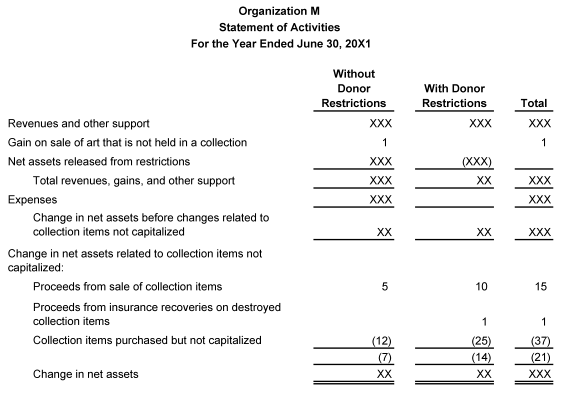
An NFP that does not recognize and capitalize its collections shall report all of the following on the face of its statement of activities, separately from revenues, expenses, gains, and losses:
  1. a
    Costs of collection items purchased as a decrease in the appropriate class of net assets
  2. b
    Proceeds from sale of collection items as an increase in the appropriate class of net assets
  3. c
    Proceeds from insurance recoveries of lost or destroyed collection items as an increase in the appropriate class of net assets.
Similarly, an entity that capitalizes its collections prospectively shall report proceeds from sales and insurance recoveries of items not previously capitalized separately from revenues, expenses, gains, and losses.
360-958-45-6
Example 1 (see paragraph 958-360-55-2) illustrates a statement of activities that satisfies the requirements in paragraph 958-360-45-5.
360-958-45-7
Purpose-restricted contributions of works of art, historical treasures, and similar assets and contributions of cash restricted for the acquisition or construction of such assets are reclassified when the restrictions are met in accordance with paragraph 958-360-45-1.

360-958-50Disclosure

Source downloaded: .Record version 3bde9363ec0a. Effective date must be checked in the source.

Accounting Policies

360-958-50-1
A not-for-profit entity (NFP) shall disclose the following accounting policies:
  1. a
    That the entity reports donor-restricted support whose restrictions are met in the same reporting period as support within net assets without donor restrictions pursuant to paragraph 958-605-45-4 if that policy is adopted
  2. b
  3. c
    The capitalization policy adopted
  4. d
    The capitalization policy for collections (capitalization, prospective capitalization, or no capitalization)
  5. e
    The basis of valuation of property, plant, and equipment—for example, cost for purchased items and fair value for contributed items.

Major Classes of Property, Plant, and Equipment

360-958-50-2
In the disclosures made in accordance with paragraph 360-10-50-1, separate disclosure shall be made of the following items:
  1. a
    Nondepreciable assets
  2. b
    Property and equipment not held for use in operations, for example, items held for sale or for investment purposes or construction in process
  3. c
    Improvements to leased facilities and equipment.

Liquidity and Use

360-958-50-3
The notes to financial statements shall include disclosures concerning the liquidity of property, plant, and equipment, including information about limitations on their use.
360-958-50-4
For example, the following information shall be provided:
  1. a
    Property, plant, and equipment pledged as collateral or otherwise subject to lien
  2. b
    Donor or legal limitations on the use of or proceeds from the disposal of plant, property, and equipment
  3. c
    Property, plant, and equipment acquired with restricted assets if title may revert to another party, such as a resource provider
  4. d
    The terms of exchange transactions (other than lease transactions), such as federal contracts, in which the resource provider retains legal title during the term of the arrangement but it is probable that the NFP will be permitted to keep the assets when the arrangement terminates.
Transition date:(P) December 16, 2026; (N) December 16, 2026Transition guidance:
105-10-65-10For example, the following information shall be provided:
  1. a
    Property, plant, and equipment pledged as collateral or otherwise subject to lien
  2. b
    Donor or legal limitations on the use of or proceeds from the disposal of plant, property, and equipment
  3. c
    Property, plant, and equipment acquired with restricted assets if title may revert to another party, such as a resource provider
  4. d

Works of Art, Historical Treasures, and Similar Assets

360-958-50-5
If not presented separately on the face of the statement of financial position pursuant to paragraph 958-360-45-4, the amount capitalized for works of art, historical treasures, and similar assets that do not meet the definition of a collection shall be disclosed.
360-958-50-6
An NFP that does not recognize and capitalize its collections or that capitalizes collections prospectively shall describe its collections, including their relative significance, and its stewardship policies for collections. If collection items not capitalized are deaccessed during the period, it also shall describe the items given away, damaged, destroyed, lost, or otherwise deaccessed during the period or disclose their fair value.
360-958-50-7
A collection-holding NFP shall disclose its organizational policy for the use of proceeds from deaccessioned collection items, including whether those proceeds could be used for acquisitions of new collection items, the direct care of existing collections, or both. If the collection-holding entity allows proceeds from deaccessioned collection items to be used for direct care, the entity shall disclose its definition of direct care.

360-958-55Implementation Guidance and Illustrations

Source downloaded: .Record version 01ca4ee83604. Effective date must be checked in the source.

360-958-55-1
This Section, which is an integral part of the requirements of this Subtopic, provides general guidance to be used by a not-for-profit entity (NFP) in reporting property, plant, and equipment.

Illustrations

360-958-55-2
Certain transactions involving collection items are required by paragraph 958-360-45-5 to be reported separately from items of revenues, gains, expenses, and losses. The following illustrates one possible format that may be used to satisfy those financial disclosure provisions. Additionally, paragraph 958-205-55-10 contains illustrations of several formats of statements of activities that might be adapted to comply with those provisions.
  • Organization M Statement of Activities " For the Year Ended June 30, 20X1" Without Donor Restrictions With Donor Restrictions Total Revenues and other support XXX XXX XXX Gain on sale of art that is not held in a collection 1 1 Net assets released from restrictions XXX (XXX) "Total revenues, gains, and other support" XXX XX XXX Expenses XXX XXX Change in net assets before changes related to collection items not capitalized XX XX XXX Change in net assets related to collection items not capitalized: Proceeds from sale of collection items 5 10 15 Proceeds from insurance recoveries on destroyed collection items 1 1 Collection items purchased but not capitalized (12) (25) (37) (7) (14) (21) Change in net assets XX XX XXX

Related subtopics