ASC 360-980
Regulated Operations
360 Property, Plant, and Equipment
Source downloaded: .Record version 56928678b44a. Effective date must be checked in the source.
This Subtopic tells regulated entities (utilities) how to account for property, plant, and equipment in three situations: plant abandonments, disallowances of costs of recently completed plants, and capitalization of an allowance for funds used during construction (AFUDC). When abandonment becomes probable, the asset's cost comes out of construction work-in-process or plant-in-service and a separate new asset is recorded — at full cost if a full return on investment is likely to be provided, or at the present value of expected future recovery revenues (discounted at the entity's incremental borrowing rate) if partial or no return is likely, with the shortfall and any probable, estimable disallowance recognized as a loss. When it becomes probable that part of the cost of a recently completed plant will be disallowed for rate-making purposes and the amount is reasonably estimable, that amount is deducted from the plant's reported cost and recognized as a loss.
Key points (7)
- AFUDC, including a designated cost of equity funds, may be capitalized as part of the asset's acquisition cost only if its subsequent inclusion in allowable costs for rate-making purposes is probable (360-980-25-1).
- When abandonment of an operating asset or asset under construction becomes probable, its cost must be removed from construction work-in-process or plant-in-service (360-980-35-1).
- If full return on investment is likely, any probable and reasonably estimable disallowance is a loss and the remaining cost is reported as a separate new asset; if partial or no return is likely, the new asset equals the present value of expected future recovery revenues (discounted at the incremental borrowing rate) and any excess cost is a loss (360-980-35-3).
- If the expected recovery period is a range, Section 450-20-55 applies: use the most likely period, or the minimum period if no point in the range is a better estimate (360-980-35-3(b)).
- Between recognition of the new asset and the start of recovery, a carrying charge accrues at the allowed overall cost of capital (full return case) or at the discount rate used for the present value (partial/no return case); during recovery the asset is amortized per rate-making methods or so as to produce a constant return equal to the discount rate (360-980-35-7; 35-8).
- Estimates of the new asset are updated as new information arises (the rate order is usually the confirming event), with adjustments recognized in income as a loss or gain, but the carrying amount is never adjusted for changes in the incremental borrowing rate (360-980-35-4; 35-6).
- A probable and reasonably estimable disallowance of part of a recently completed plant's cost — including an explicit but indirect disallowance, such as excluding part of the plant from rate base or an agreed cost cap — is deducted from reported plant cost and recognized as a loss (360-980-35-12; 35-13; 35-15).
For students. This is the classic utility-specific "regulatory asset" mechanic: economic value in regulated PP&E depends on what the regulator will let the utility recover, so losses are driven by rate orders rather than market value. The most common misunderstanding is skipping the full-return vs. partial/no-return branch — only in the partial/no-return case do you discount expected recovery revenues (at the incremental borrowing rate) and recognize the resulting shortfall as a loss.
Machine-generated study aid for ASC 360-980. Check the source paragraphs below.
360-980-05Overview and Background
Source downloaded: .Record version 15cecd20958b. Effective date must be checked in the source.
360-980-15Scope and Scope Exceptions
Source downloaded: .Record version 7290fa120081. Effective date must be checked in the source.
Overall Guidance
360-980-25Recognition
Source downloaded: .Record version 4a13e3bf1c8d. Effective date must be checked in the source.
Allowance for Funds Used During Construction
360-980-35Subsequent Measurement
Source downloaded: .Record version 7a74e3d1f982. Effective date must be checked in the source.
Abandonments
- aFull return on investment during the period from the time when abandonment becomes probable to the time when recovery is completed
- bPartial or no return on investment during that period.
- aFull return on investment is likely to be provided. Any disallowance of all or part of the cost of the abandoned plant that is both probable and reasonably estimable (as defined in Topic 450) shall be recognized as a loss, and the carrying basis of the recorded asset shall be correspondingly reduced. The remainder of the cost of the abandoned plant shall be reported as a separate new asset.
- bPartial or no return on investment is likely to be provided. Any disallowance of all or part of the cost of the abandoned plant that is both probable and reasonably estimable shall be recognized as a loss. The present value of the future revenues expected to be provided to recover the allowable cost of that abandoned plant and return on investment, if any, shall be reported as a separate new asset. Any excess of the remainder of the cost of the abandoned plant over that present value also shall be recognized as a loss. The discount rate used to compute the present value shall be the entity's incremental borrowing rate, that is, the rate that the entity would have to pay to borrow an equivalent amount for a period equal to the expected recovery period. In determining the present value of expected future revenues, the entity shall consider such matters as the following:
- 1The probable time period before such recovery is expected to begin
- 2The probable time period over which recovery is expected to be provided.
If the estimate of either period is a range, the guidance in Section 450-20-55 shall be applied to determine the loss to be recognized. Accordingly, the most likely period within that range shall be used to compute the present value. If no period within that range is a better estimate than any other, the present value shall be based on the minimum time period within that range. - 1
- aThe determination of whether full return on investment will be provided and, if not, the probable time period before recovery is expected to begin and the probable time period over which recovery is expected to be provided
- bThe amount of any probable and reasonably estimable disallowance of recorded costs of the abandoned plant.
- aIf full return on investment is likely to be provided, a rate equal to the allowed overall cost of capital in the jurisdiction in which recovery is expected to be provided shall be used.
- bIf partial or no return on investment is likely to be provided, the rate that was used to compute the present value shall be used.
- aIf full return on investment is likely to be provided, the asset shall be amortized in the same manner as that used for rate-making purposes.
- bIf partial or no return on investment is likely to be provided, the asset shall be amortized in a manner that will produce a constant return on the unamortized investment in the new asset equal to the rate at which the expected revenues were discounted.
- aDeferred income taxes are allocated to the assets that resulted in those deferred income taxes. Under that assumption, if certain assets are included in the rate base (that is, a return is allowed on those assets), the deferred income taxes allocated to those assets are deducted from the rate base in computing the investment on which a return will be allowed. Similarly, if certain assets are excluded from the rate base (that is, a return is not allowed on those assets), the deferred income taxes allocated to those assets are not deducted from the rate base in computing the investment on which a return will be allowed.
- bIncome taxes that result from recovery of the recorded cost of the abandoned plant will be treated as allowable costs when those income taxes become payable to the extent those income taxes do not represent repayment of an income tax benefit that has already accrued to the entity's shareholders.
Cost Disallowances
- aExample 2 (see paragraph 980-360-55-14) illustrates a disallowance of plant cost.
- bExample 3 (see paragraph 980-360-55-18) illustrates a disallowance of plant cost resulting from a cost cap.
- cExample 4 (see paragraph 980-360-55-26) illustrates an explicit, but indirect, disallowance.
360-980-55Implementation Guidance and Illustrations
Source downloaded: .Record version 15d79b726fe3. Effective date must be checked in the source.
Illustrations
- a Upon initial application of Subtopic 740-10, an entity that meets the criteria of paragraph 980-10-15-2 for application of this Topic will adjust its deferred income tax liabilities as required. This Example is presented as though the entity has already applied Subtopic 740-10 prior to the date of the abandonment. If an entity initially applies that Subtopic after a loss has been recognized on an abandonment and before the end of the recovery period for any recoverable costs, the amount of the previously recognized loss may change. The amount of that loss will change if the tax rate used in the initial net-of-tax discount rate under that Subtopic is different from that used by the entity previously. Once that Subtopic is initially applied, the accounting for the abandonment should follow the approach described in this Example.
- b This Example assumes a tax rate of 34 percent.
- c Utility A decides to abandon a plant that has been under construction for some time. Although the possibility of abandoning the plant has been under consideration, abandonment was not considered probable before the actual decision was made.
- d Immediately before the abandonment, the recorded assets for the plant and related deferred income tax liabilities are as follows.
-
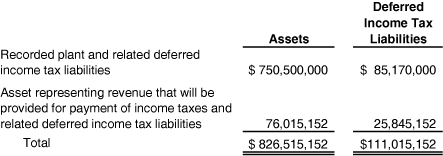 Assets Deferred Income Tax Liabilities Recorded plant and related deferred income tax liabilities " $750,500,000 " " $85,170,000 " Asset representing revenue that will be provided for payment of income taxes and related deferred income tax liabilities " 76,015,152 " " 25,845,152 " Total " $826,515,152 " " $111,015,152 "
-
- e For income tax purposes, the abandoned plant has a basis of $500 million at the date of the abandonment.
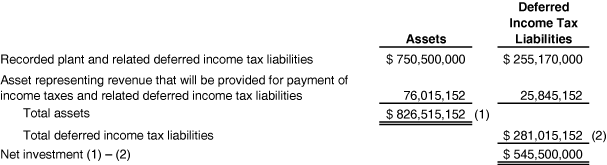
- f Utility A will deduct the remaining tax basis of the abandoned plant ($500,000,000) as an abandonment loss on its income tax return in the year of the abandonment and will receive a tax benefit of 34 percent of the tax basis of the plant ($170,000,000). Utility A operates in a state that has no state income taxes. The federal income tax rate is 34 percent.
- g Accounting pretax income before the loss on the abandonment and taxable income before any deduction for the loss on the abandonment are both $1,500,000,000. Utility A has no other temporary differences or tax credits.
- h Utility A operates solely in a single-state jurisdiction.
- i In the past, Utility A's regulator has permitted recovery of amounts prudently invested in abandoned plants over an extended period of time without a return on unrecovered investment during the recovery period.
- j The normal practice of Utility A's regulator is to allocate deferred income taxes to assets on which return on investment is disallowed. Deferred taxes allocated to assets excluded from the rate base are not deducted from the rate base for purposes of computing allowable return on investment.
- k Utility A's regulator normally treats income taxes that were not previously provided as allowable costs if they result from recovery of other allowable costs.
- l Utility A's incremental borrowing rate at the date of the decision to abandon the plant is 14 percent, interest payable monthly.
- m Utility A believes that it is probable that recovery of cost without return on investment during the recovery period will be granted over a period that will not be less than 5 years nor more than 10 years, but it has no basis for estimating the exact time period that the regulator will select.
- n At the date of the abandonment, Utility A believes that it will take approximately 18 months to obtain a rate order covering the abandoned plant.
- o No disallowance of recorded cost is expected.
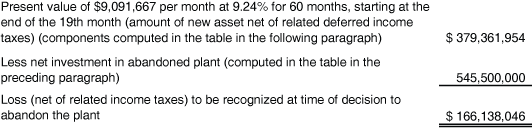
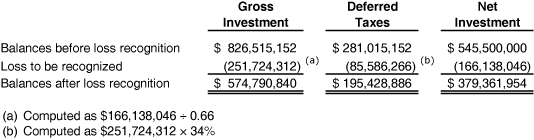
- p A rate order covering the abandoned plant is received in the 18th month following the abandonment. There is no disallowance of recorded costs of the abandoned plant. Those recorded costs are to be recovered over 60 months commencing in the 19th month after abandonment.
-
 Assets Deferred Income Tax Liabilities Recorded plant and related deferred income tax liabilities " $750,500,000 " " $255,170,000 " Asset representing revenue that will be provided for payment of income taxes and related deferred income tax liabilities " 76,015,152 " " 25,845,152 " Total assets " $826,515,152 " (1) Total deferred income tax liabilities " $281,015,152 " (2) Net investment (1) - (2) " $545,500,000 "
-
 "Present value of $9,091,667 per month at 9.24% for 60 months, starting at the end of the 19th month (amount of new asset net of related deferred income taxes) (components computed in the table in the following paragraph)" " $379,361,954 " Less net investment in abandoned plant (computed in the table in the preceding paragraph) " 545,500,000 " Loss (net of related income taxes) to be recognized at time of decision to abandon the plant " $166,138,046 "
-
 Gross Investment Deferred Taxes Net Investment Balances before loss recognition " $826,515,152 " " $281,015,152 " " $545,500,000 " Loss to be recognized " (251,724,312)" (a) " (85,586,266)" (b) " (166,138,046)" Balances after loss recognition " $574,790,840 " " $195,428,886 " " $379,361,954 " (a) "Computed as $166,138,046 ÷ 0.66" (b) "Computed as $251,724,312 × 34%"
-
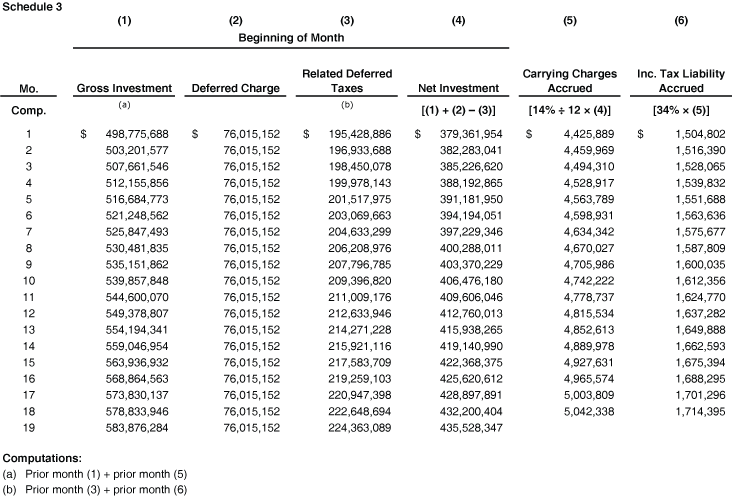 Schedule 3 (1) (2) (3) (4) (5) (6) Beginning of Month Mo. Gross Investment Deferred Charge Related Deferred Taxes Net Investment Carrying Charges Accrued Inc. Tax Liability Accrued Comp. (a) (b) [(1) + (2) - (3)] [14% ÷ 12 × (4)] [34% × (5)] 1 " $498,775,688 " " $76,015,152 " " $195,428,886 " " $379,361,954 " " $4,425,889 " " $1,504,802 " 2 " 503,201,577 " " 76,015,152 " " 196,933,688 " " 382,283,041 " " 4,459,969 " " 1,516,390 " 3 " 507,661,546 " " 76,015,152 " " 198,450,078 " " 385,226,620 " " 4,494,310 " " 1,528,065 " 4 " 512,155,856 " " 76,015,152 " " 199,978,143 " " 388,192,865 " " 4,528,917 " " 1,539,832 " 5 " 516,684,773 " " 76,015,152 " " 201,517,975 " " 391,181,950 " " 4,563,789 " " 1,551,688 " 6 " 521,248,562 " " 76,015,152 " " 203,069,663 " " 394,194,051 " " 4,598,931 " " 1,563,636 " 7 " 525,847,493 " " 76,015,152 " " 204,633,299 " " 397,229,346 " " 4,634,342 " " 1,575,677 " 8 " 530,481,835 " " 76,015,152 " " 206,208,976 " " 400,288,011 " " 4,670,027 " " 1,587,809 " 9 " 535,151,862 " " 76,015,152 " " 207,796,785 " " 403,370,229 " " 4,705,986 " " 1,600,035 " 10 " 539,857,848 " " 76,015,152 " " 209,396,820 " " 406,476,180 " " 4,742,222 " " 1,612,356 " 11 " 544,600,070 " " 76,015,152 " " 211,009,176 " " 409,606,046 " " 4,778,737 " " 1,624,770 " 12 " 549,378,807 " " 76,015,152 " " 212,633,946 " " 412,760,013 " " 4,815,534 " " 1,637,282 " 13 " 554,194,341 " " 76,015,152 " " 214,271,228 " " 415,938,265 " " 4,852,613 " " 1,649,888 " 14 " 559,046,954 " " 76,015,152 " " 215,921,116 " " 419,140,990 " " 4,889,978 " " 1,662,593 " 15 " 563,936,932 " " 76,015,152 " " 217,583,709 " " 422,368,375 " " 4,927,631 " " 1,675,394 " 16 " 568,864,563 " " 76,015,152 " " 219,259,103 " " 425,620,612 " " 4,965,574 " " 1,688,295 " 17 " 573,830,137 " " 76,015,152 " " 220,947,398 " " 428,897,891 " " 5,003,809 " " 1,701,296 " 18 " 578,833,946 " " 76,015,152 " " 222,648,694 " " 432,200,404 " " 5,042,338 " " 1,714,395 " 19 " 583,876,284 " " 76,015,152 " " 224,363,089 " " 435,528,347 " Computations: (a) Prior month (1) + prior month (5) (b) Prior month (3) + prior month (6)
-
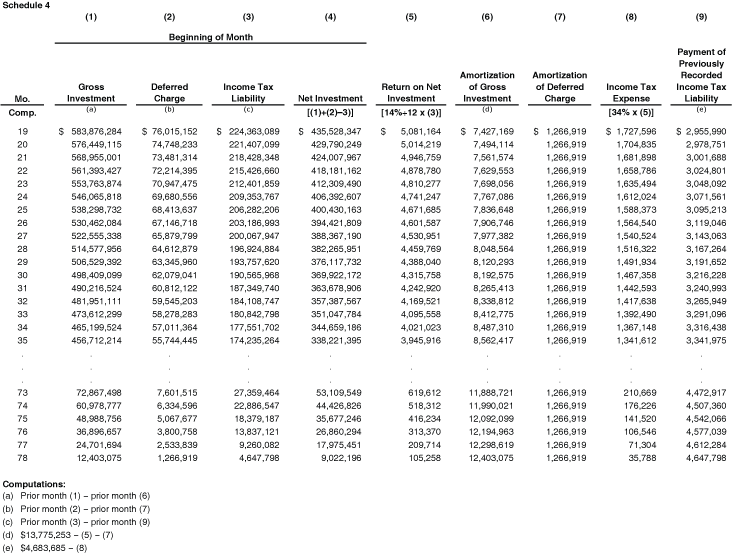 Schedule 4 (1) (2) (3) (4) (5) (6) (7) (8) (9) Beginning of Month Mo. Gross Investment Deferred Charge Income Tax Liability Net Investment Return on Net Investment Amortization of Gross Investment Amortization of Deferred Charge Income Tax Expense Payment of Previously Recorded Income Tax Liability Comp. (a) (b) (c) [(1)+(2)-3)] [14%÷12 x (3)] (d) [34% x (5)] (e) 19 " $583,876,284 " " $76,015,152 " " $224,363,089 " " $435,528,347 " " $5,081,164 " " $7,427,169 " " $1,266,919 " " $1,727,596 " " $2,955,990 " 20 " 576,449,115 " " 74,748,233 " " 221,407,099 " " 429,790,249 " " 5,014,219 " " 7,494,114 " " 1,266,919 " " 1,704,835 " " 2,978,751 " 21 " 568,955,001 " " 73,481,314 " " 218,428,348 " " 424,007,967 " " 4,946,759 " " 7,561,574 " " 1,266,919 " " 1,681,898 " " 3,001,688 " 22 " 561,393,427 " " 72,214,395 " " 215,426,660 " " 418,181,162 " " 4,878,780 " " 7,629,553 " " 1,266,919 " " 1,658,786 " " 3,024,801 " 23 " 553,763,874 " " 70,947,475 " " 212,401,859 " " 412,309,490 " " 4,810,277 " " 7,698,056 " " 1,266,919 " " 1,635,494 " " 3,048,092 " 24 " 546,065,818 " " 69,680,556 " " 209,353,767 " " 406,392,607 " " 4,741,247 " " 7,767,086 " " 1,266,919 " " 1,612,024 " " 3,071,561 " 25 " 538,298,732 " " 68,413,637 " " 206,282,206 " " 400,430,163 " " 4,671,685 " " 7,836,648 " " 1,266,919 " " 1,588,373 " " 3,095,213 " 26 " 530,462,084 " " 67,146,718 " " 203,186,993 " " 394,421,809 " " 4,601,587 " " 7,906,746 " " 1,266,919 " " 1,564,540 " " 3,119,046 " 27 " 522,555,338 " " 65,879,799 " " 200,067,947 " " 388,367,190 " " 4,530,951 " " 7,977,382 " " 1,266,919 " " 1,540,524 " " 3,143,063 " 28 " 514,577,956 " " 64,612,879 " " 196,924,884 " " 382,265,951 " " 4,459,769 " " 8,048,564 " " 1,266,919 " " 1,516,322 " " 3,167,264 " 29 " 506,529,392 " " 63,345,960 " " 193,757,620 " " 376,117,732 " " 4,388,040 " " 8,120,293 " " 1,266,919 " " 1,491,934 " " 3,191,652 " 30 " 498,409,099 " " 62,079,041 " " 190,565,968 " " 369,922,172 " " 4,315,758 " " 8,192,575 " " 1,266,919 " " 1,467,358 " " 3,216,228 " 31 " 490,216,524 " " 60,812,122 " " 187,349,740 " " 363,678,906 " " 4,242,920 " " 8,265,413 " " 1,266,919 " " 1,442,593 " " 3,240,993 " 32 " 481,951,111 " " 59,545,203 " " 184,108,747 " " 357,387,567 " " 4,169,521 " " 8,338,812 " " 1,266,919 " " 1,417,638 " " 3,265,949 " 33 " 473,612,299 " " 58,278,283 " " 180,842,798 " " 351,047,784 " " 4,095,558 " " 8,412,775 " " 1,266,919 " " 1,392,490 " " 3,291,096 " 34 " 465,199,524 " " 57,011,364 " " 177,551,702 " " 344,659,186 " " 4,021,023 " " 8,487,310 " " 1,266,919 " " 1,367,148 " " 3,316,438 " 35 " 456,712,214 " " 55,744,445 " " 174,235,264 " " 338,221,395 " " 3,945,916 " " 8,562,417 " " 1,266,919 " " 1,341,612 " " 3,341,975 " . . . . . . . . . . . . . . . . . . . . . . . . . . . . . . 73 " 72,867,498 " " 7,601,515 " " 27,359,464 " " 53,109,549 " " 619,612 " " 11,888,721 " " 1,266,919 " " 210,669 " " 4,472,917 " 74 " 60,978,777 " " 6,334,596 " " 22,886,547 " " 44,426,826 " " 518,312 " " 11,990,021 " " 1,266,919 " " 176,226 " " 4,507,360 " 75 " 48,988,756 " " 5,067,677 " " 18,379,187 " " 35,677,246 " " 416,234 " " 12,092,099 " " 1,266,919 " " 141,520 " " 4,542,066 " 76 " 36,896,657 " " 3,800,758 " " 13,837,121 " " 26,860,294 " " 313,370 " " 12,194,963 " " 1,266,919 " " 106,546 " " 4,577,039 " 77 " 24,701,694 " " 2,533,839 " " 9,260,082 " " 17,975,451 " " 209,714 " " 12,298,619 " " 1,266,919 " " 71,304 " " 4,612,284 " 78 " 12,403,075 " " 1,266,919 " " 4,647,798 " " 9,022,196 " " 105,258 " " 12,403,075 " " 1,266,919 " " 35,788 " " 4,647,798 " Computations: (a) Prior month (1) − prior month (6) (b) Prior month (2) − prior month (7) (c) Prior month (3) − prior month (9) (d) "$13,775,253 − (5) − (7)" (e) "$4,683,685 − (8)"
-
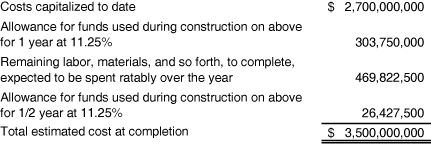 Costs capitalized to date " $2,700,000,000 " Allowance for funds used during construction on above for 1 year at 11.25% " 303,750,000 " "Remaining labor, materials, and so forth, to complete, expected to be spent ratably over the year" " 469,822,500 " Allowance for funds used during construction on above for 1/2 year at 11.25% " 26,427,500 " Total estimated cost at completion " $3,500,000,000 "
-
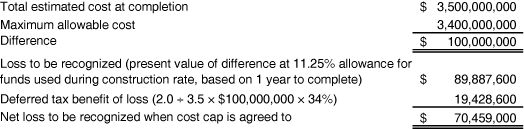 Total estimated cost at completion " $3,500,000,000 " Maximum allowable cost " 3,400,000,000 " Difference " $100,000,000 " "Loss to be recognized (present value of difference at 11.25% allowance for funds used during construction rate, based on 1 year to complete)" " $89,887,600 " "Deferred tax benefit of loss (2.0 ÷ 3.5 × $100,000,000 × 34%)" " 19,428,600 " Net loss to be recognized when cost cap is agreed to " $70,459,000 "
360-980-S00StatusSEC
Source downloaded: .Record version 8c84b07fe2f7. Effective date must be checked in the source.
360-980-S45Other Presentation MattersSEC
Source downloaded: .Record version acc1ce04156a. Effective date must be checked in the source.
Classification of Charges for Abandonment and Disallowances
360-980-S50DisclosureSEC
Source downloaded: .Record version 9762b809886e. Effective date must be checked in the source.
Tangible and Intangible Utility Plant
Jointly Owned Electric Utility Plants
360-980-S99SEC MaterialsSEC
Source downloaded: .Record version 057e0fb4900f. Effective date must be checked in the source.
SEC Staff Guidance
- Facts: Groups of electric utility companies have been building and operating utility plants under joint ownership agreements or arrangements which do not create legal entities for which separate financial statements are presented. FN1 Under these arrangements, a participating utility has an undivided interest in a utility plant and is responsible for its proportionate share of the costs of construction and operation and its entitled to its proportionate share of the energy produced.
- FN1 Before considering the guidance in this SAB Topic, registrants are reminded that the arrangement should be evaluated in accordance with the provisions of Interpretation 46 [Topic 810].
- During the construction period a participating utility finances its own share of a utility plant using its own financial resources and not the combined resources of the group. Allowance for funds used during construction is provided in the same manner and at the same rates as for plants constructed to be used entirely by the participant utility.
- When a joint-owned plant becomes operational, one of the participant utilities acts as operator and bills the other participants for their proportionate share of the direct expenses incurred. Each individual participant incurs other expenses related to transmission, distribution, supervision and control which cannot be related to the energy generated or received from any particular source. Many companies maintain depreciation records on a composite basis for each class of property so that neither the accumulated allowance for depreciation nor the periodic expense can be allocated to specific generating units whether jointly or wholly owned.
- Question: What disclosure should be made on the financial statements or in the notes concerning interests in jointly owned utility plants?
- Interpretive Response: A participating utility should include information concerning the extent of its interests in jointly owned plants in a note to its financial statements. The note should include a table showing separately for each interest in a jointly owned plant the amount of utility plant in service, the accumulated provision for depreciation (if available), the amount of plant under construction, and the proportionate share. The amounts presented for plant in service or plant under construction may be further subdivided to show amounts applicable to plant subcategories such as production, transmission, and distribution. The note should include statements that the dollar amounts represent the participating utility's share in each joint plant and that each participant must provide its own financing. Information concerning two or more generating plants on the same site may be combined if appropriate.
- The note should state that the participating utility's share of direct expenses of the joint plants is included in the corresponding operating expenses on its income statement (e. g., fuel, maintenance of plant, other operating expense). If the share of direct expenses is charged to purchased power then the note should disclose the amount so charged and the proportionate amounts charged to specific operating expenses on the records maintained for the joint plants.
- Facts: A public utility company abandons the construction of a plant and, under the provisions of Statement 90 [Topic 980], must charge a portion of the costs of the abandoned plant to expense. FN3 Also, the utility determines that it is probable that certain costs of a recently completed plant will be disallowed, and charges those costs to expense as required by Statement 90 [Topic 980].
- FN3 Paragraph 3 of Statement 90 [paragraph 980-360-35-3] requires that costs of abandoned plants in excess of the present value of the future revenues expected to be provided to recover any allowable costs be charged to expense in the period that the abandonment becomes probable. Also, paragraph 7 of Statement 90 [paragraph 980-360-35-12] requires that disallowed costs for recently completed plants be charged to expense when the disallowance becomes probable and can be reasonably estimated.
- Question: May such charges for abandonments and disallowances be reported as extraordinary items in the statement of income?
- Interpretive Response: No. The staff does not believe that such charges meet the requirements of APB Opinion 30 [Topic 225] that an item be both unusual and infrequent to be classified as an extraordinary item. Accordingly, the public utility was advised by the staff that such charges should be reported as a component of income from continuing operations, separately presented, if material. FN4
- FN4 Additionally, the registrant was reminded that paragraph 26 of APB Opinion 30 [paragraph 220-20-45-1] provides that items which are not reported as extraordinary should not be reported on the income statement net of income taxes or in any manner that implies that they are similar to extraordinary items.
- Paragraph 20 of APB Opinion 30 [paragraph 225-20-45-2] indicates that to be unusual, an item must "possess a high degree of abnormality and be of a type clearly unrelated to, or only incidentally related to, the ordinary and typical activities of the entity, taking into account the environment in which the entity operates." Similarly, that paragraph indicates that, to be infrequent, an event should "not reasonably be expected to recur in the foreseeable future."
- Electric utilities operate under a franchise that requires them to furnish adequate supplies of electricity for their service area. That undertaking requires utilities to continually forecast the future demand for electricity, and the costs to be incurred in constructing the plants necessary to meet that demand. Abandonments and disallowances result from the failure of demand to reach projected levels and/or plant construction costs that exceed anticipated amounts. Neither event qualifies as being both unusual and infrequent in the environment in which electric utilities operate.
- Accordingly, the staff believes that charges for abandonments and disallowances under Statement 90 should not be presented as extraordinary items. FN5
- FN5 The staff also notes that paragraphs 3 and 7 of Statement 90 [paragraphs 980-360-35-3 and 980-360-35-12], in requiring that such costs be "recognized as a loss," do not specify extraordinary item treatment. The staff believes that it generally has been the FASB's practice to affirmatively require extraordinary item treatment when it believes that it is appropriate for charges or credits to income specifically required by a provision of a statement.
Related subtopics
- 980-20 Discontinuation of Rate-Regulated AccountingRegulated Operations
- 980-10 OverallRegulated Operations
- 420-10 OverallExit or Disposal Cost Obligations
- 340-980 Regulated OperationsOther Assets and Deferred Costs
- 410-980 Regulated OperationsAsset Retirement and Environmental Obligations
- 330-10 OverallInventory