ASC

ASC 980-20

Discontinuation of Rate-Regulated Accounting

980 Regulated Operations

Source downloaded: .Record version a0c81f44bbe4. Effective date must be checked in the source.

ASC 980-20 governs what happens when an entity's operations (or a separable portion of them) stop meeting the criteria in 980-10-15-2 for rate-regulated accounting — because of deregulation, a shift away from cost-based rate-making, or competition/rate resistance. On discontinuation, the entity eliminates from its balance sheet all regulatory assets and liabilities that entities in general could not recognize, but does not adjust the carrying amounts of plant, equipment, and inventory unless impaired under Subtopic 360-10. The net adjustment goes to income of the period of discontinuation, classified separately within income from continuing operations as an unusual or infrequently occurring item.

Key points (7)
  • An entity must discontinue applying Topic 980 to operations in a regulatory jurisdiction (or to a separable portion, such as a customer class) that no longer meet the criteria of 980-10-15-2; discontinuation for a separable portion creates a rebuttable presumption that Topic 980 should be discontinued for all operations in that jurisdiction (980-20-40-1).
  • Upon discontinuation the entity eliminates the effects of regulator actions recognized as assets and liabilities that entities in general would not recognize, and the Impairment or Disposal of Long-Lived Assets Subsections of 360-10 apply except for the income statement reporting in 360-10-45-4 and 360-10-50-2 (980-20-40-2).
  • Carrying amounts of plant, equipment, and inventory are not adjusted unless impaired, judged in the same manner as for entities in general (980-20-35-2; 980-20-40-2; 980-20-40-4).
  • Amounts included in or netted against plant, equipment, or inventory that entities in general could not include — other than allowance for funds used during construction, intra-entity profit, and disallowances of recently completed plant costs (e.g., postconstruction operating costs capitalized under 980-340-25-1, or cumulative depreciation differences) — must be separated and accounted for as effects of regulator actions (980-20-35-3 through 35-5; 980-20-40-3).
  • The net effect of the required adjustments is included in income of the period of discontinuation and classified separately in income from continuing operations as an unusual or infrequently occurring item (980-20-40-4).
  • Under the source-of-cash-flow approach, regulatory assets and liabilities originating in the deregulated separable portion are not eliminated if deregulatory legislation or a rate order provides regulated cash flows from a still-regulated separable portion; they are carried in that other portion until recovered/settled, individually impaired or eliminated by the regulator, or that portion ceases to meet 980-10-15-2 (980-20-35-6 through 35-9).
  • Disclosure: the entity must disclose the reasons for discontinuation and identify the affected portion of operations (980-20-50-1), apply Subtopic 220-20 disclosures to the net adjustment (980-20-50-2), and segregate amounts relating to the deregulated separable portion by display or note (980-20-45-1).

For students. The classic exam trap is assuming discontinuation writes down everything: regulatory assets/liabilities are eliminated, but plant, equipment, and inventory keep their Topic 980 carrying amounts (including AFUDC) unless separately impaired under 360-10. Also remember the write-off is an unusual/infrequent item inside continuing operations, not an extraordinary item or a restatement.

Machine-generated study aid for ASC 980-20. Check the source paragraphs below.

980-20-00Status

Source downloaded: .Record version 0b85f030417e. Effective date must be checked in the source.

980-20-00-1
The following table identifies the changes made to this Subtopic.

980-20-05Overview and Background

Source downloaded: .Record version 1cbc1de6d814. Effective date must be checked in the source.

980-20-05-1
This Subtopic addresses the discontinuation of rate-regulated accounting when an entity no longer meets the criteria in paragraph 980-10-15-2.
980-20-05-2
Deregulation of certain industries and changes in the method of regulating others have caused several entities to discontinue application of this Topic for some or all of their operations.

980-20-15Scope and Scope Exceptions

Source downloaded: .Record version 0b716c0a6fc4. Effective date must be checked in the source.

Overall Guidance

980-20-15-1
This Subtopic follows the same Scope and Scope Exceptions as outlined in the Overall Subtopic, see Section 980-10-15, with specific exceptions as noted below, which provides further guidance on an entity's operations that no longer meet the criteria of regulated operations.

Entities

980-20-15-2
Failure of an entity's operations to continue to meet the criteria in paragraph 980-10-15-2 can result from different causes. Examples include the following:
  1. a
    Deregulation
  2. b
    A change in the regulator's approach to setting rates from cost-based rate-making to another form of regulation
  3. c
    Increasing competition that limits the entity's ability to sell utility services or products at rates that will recover costs (as used in paragraph 980-10-15-2)
  4. d
    Regulatory actions resulting from resistance to rate increases that limit the entity's ability to sell utility services or products at rates that will recover costs if the entity is unable to obtain (or chooses not to seek) relief from prior regulatory actions through appeals to the regulator or the courts.
980-20-15-3
Regardless of the reason for an entity's discontinuation of application of the Regulated Operations Topic, this Subtopic specifies how that discontinuation shall be reported in the entity's general-purpose external financial statements.

980-20-35Subsequent Measurement

Source downloaded: .Record version ee4f0f8bb1ab. Effective date must be checked in the source.

Discontinuation of Recognition Following Regulator Actions

980-20-35-1
An entity that discontinues application of the Regulated Operations Topic shall no longer recognize the effects of actions of a regulator as assets or liabilities unless the right to receive payment or the obligation to pay exists as a result of past events or transactions and regardless of future transactions.

Plant, Equipment, and Inventory

980-20-35-2
This Subtopic requires that upon the discontinuation of rate-regulated accounting, the carrying amounts of the plant, equipment, and inventory measured and recorded pursuant to this Topic shall not be adjusted unless those assets are impaired.
980-20-35-3
The carrying amounts of plant, equipment, and inventory for entities applying this Topic differ from those for entities in general only because of the allowance for funds used during construction, intra-entity profit, and disallowances of costs of recently completed plants. If any other amounts that would not be includable in the carrying amounts of plant, equipment, or inventory by entities in general are included in or netted against the carrying amounts of plant, equipment, and inventory, those amounts shall be separated from the carrying amounts of plant, equipment, and inventory and accounted for as prescribed in this Subtopic.
980-20-35-4
For example, postconstruction operating costs that were capitalized pursuant to paragraph 980-340-25-1 represent the effects of actions of a regulator regardless of their classification in the financial statements and shall be accounted for as this Subtopic prescribes for the effects of actions of a regulator.
980-20-35-5
Another example of the effect of actions of a regulator that would require adjustment is the cumulative difference, if any, between recorded depreciation and depreciation computed using a generally accepted method of depreciation.

Regulatory Assets and Liabilities Originating in a Separable Portion of the Entity

980-20-35-6
The regulatory assets and regulatory liabilities that originate in a separable portion of an entity to which this Subtopic is applied shall be evaluated on the basis of where (that is, the portion of the business in which) the regulated cash flows to realize and settle them, respectively, will be derived. Regulated cash flows are from rates that are charged to customers and intended by regulators to be for the recovery of the specified regulatory assets and the settlement of regulatory liabilities. They are derived from a levy on rate-regulated goods or services provided by another separable portion of the entity that meets the criteria of paragraph 980-10-15-2 for application of this Topic.
980-20-35-7
There is no elimination of the regulatory assets and regulatory liabilities that originate in the separable portion of the business to which this Subtopic is applied and for which the deregulatory legislation or rate order (whichever is necessary to effect change in the jurisdiction) specifies the collection of regulated cash flows until any of the following occur:
  1. a
    They are recovered by (in the case of assets) or settled through (in the case of liabilities) collection of regulated cash flows.
  2. b
    They are individually impaired (in the case of assets) or the regulator eliminates the obligation (in the case of liabilities) as specified by the provisions of this Topic.
  3. c
    The separable portion of the business from which the regulated cash flows are derived no longer meets the criteria of paragraph 980-10-15-2 for application of this Topic.
980-20-35-8
The source of the cash flow approach adopted in paragraphs shall be used for recoveries of all costs and settlements of all obligations (not just for regulatory assets and regulatory liabilities that are recorded at the date this Subtopic is applied) for which regulated cash flows are specifically provided in the deregulatory legislation or rate order (whichever is necessary to effect change in the jurisdiction).
980-20-35-9
A cost or an obligation is recognized as a regulatory asset or a regulatory liability within the separable portion of the entity from which the regulated cash flows for its recovery or settlement, respectively, are derived once it meets both of the following conditions:
  1. a
    Expensed or incurred after this Subtopic is applied to the portion of the business where it originated (such as the loss on the sale of an electricity generating plant or the loss on the buy-out of a purchased power contract that is recognized after this Subtopic is applied to the generation portion of the business)
  2. b
    Specified for recovery or settlement in the deregulatory legislation or a rate order (whichever is necessary to effect change in the jurisdiction) and is recovered or settled in the same manner (that is, via regulated cash flows) as the regulatory assets and regulatory liabilities described in paragraphs .
Those regulatory assets and regulatory liabilities shall be carried in this other separable portion of the business until they are collected or settled, until they are individually impaired (assets) or eliminated (liabilities), or until that separable portion of the business no longer meets the criteria of paragraph 980-10-15-2 for application of this Topic.

980-20-40Derecognition

Source downloaded: .Record version fcd672857e34. Effective date must be checked in the source.

Discontinuation of Regulatory Operations Guidance

980-20-40-1
When an entity determines that its operations in a regulatory jurisdiction no longer meet the criteria of paragraph 980-10-15-2 for application of the Regulated Operations Topic, that entity shall discontinue application of this Topic to its operations in that jurisdiction. If a separable portion of the entity's operations within a regulatory jurisdiction ceases to meet the criteria of that paragraph for application of this Topic, application of this Topic to that separable portion shall be discontinued. That situation creates a presumption that application of this Topic shall be discontinued for all of the entity's operations within that regulatory jurisdiction. That presumption can be overcome by establishing that the entity's other operations within that jurisdiction continue to meet the criteria of paragraph 980-10-15-2 for application of this Topic. The separable portion may be an entity's operations within a regulatory jurisdiction or a smaller portion (such as a customer class within a regulatory jurisdiction), either of which could require the allocation of system-wide assets and liabilities.
980-20-40-2
When an entity discontinues application of this Topic to all or part of its operations, that entity shall eliminate from its statement of financial position prepared for general-purpose external financial reporting the effects of any actions of regulators that had been recognized as assets and liabilities pursuant to this Topic but would not have been recognized as assets and liabilities by entities in general, and the Impairment or Disposal of Long-Lived Assets Subsections of Subtopic 360-10 shall apply, except for the provisions for income statement reporting in paragraphs 360-10-45-4 and 360-10-50-2. However, the carrying amounts of plant, equipment, and inventory measured and reported pursuant to this Topic shall not be adjusted unless those assets are impaired, in which case the carrying amounts of those assets shall be reduced to reflect that impairment.
980-20-40-3
The carrying amounts of plant, equipment, and inventory for entities applying this Topic differ from those for entities in general only because of the allowance for funds used during construction, intra-entity profit, and disallowances of costs of recently completed plants. If any other amounts that would not be includable in the carrying amounts of plant, equipment, or inventory by entities in general (such as postconstruction operating costs capitalized pursuant to paragraph 980-340-25-1) are included in or netted against the carrying amounts of plant, equipment, or inventory, those amounts shall be accounted for as this Subtopic prescribes for the effects of actions of a regulator.
980-20-40-4
Whether those assets have been impaired shall be judged in the same manner as for entities in general. The net effect of the adjustments required by this Subtopic shall be included in income of the period in which the discontinuation occurs and shall be classified separately in income from continuing operations as an unusual or infrequently occurring item.
980-20-40-5
Examples illustrating the discontinuation of regulatory operations guidance include the following:
  1. a
    Example 1 (see paragraph 980-20-55-1) illustrates assets recorded based solely on expected future revenue from the regulator.
  2. b
    Example 2 (see paragraph 980-20-55-6) illustrates liabilities recorded based solely on actions of the regulator.
  3. c
    Example 3 (see paragraph 980-20-55-10) illustrates assets recorded for deferred income taxes not previously recognized for rate-making purposes but expected to be in the future.

Deregulatory Legislation or Rate Order in a Separable Portion of the Entity

980-20-40-6
When deregulatory legislation is passed or when a rate order (whichever is necessary to effect change in the jurisdiction) that contains sufficient detail for the entity to reasonably determine how the transition plan will affect a separable portion of its business whose pricing is being deregulated is issued, the entity shall stop applying this Topic to that separable portion of its business. It has not been established whether an entity shall stop applying the accounting and reporting for regulatory operations as provided in the other Subtopics of this Topic to that separable portion of its business before the issuance of sufficiently detailed deregulatory legislation or a sufficiently detailed rate order.

980-20-45Other Presentation Matters

Source downloaded: .Record version 92dd4dab9757. Effective date must be checked in the source.

Separable Portion Following Discontinuation of Regulatory Operations Guidance

980-20-45-1
Once the Regulated Operations Topic is no longer applied to a separable portion of an entity's business, the financial statements shall segregate, via financial statement display or note disclosure, the amounts contained in the financial statements that relate to that separable portion.

980-20-50Disclosure

Source downloaded: .Record version efc3805cae6c. Effective date must be checked in the source.

980-20-50-1
For the period in which an entity reflects the discontinuation of application of the Regulated Operations Topic all or a separable portion of its operations, the entity shall disclose the reasons for the discontinuation and identify the portion of its operations to which the application of this Topic is being discontinued.
980-20-50-2
The disclosure requirements of Subtopic 220-20 for unusual or infrequently occurring items apply to the net adjustment reported in the statement of operations as a result of applying this Subtopic.

980-20-55Implementation Guidance and Illustrations

Source downloaded: .Record version b4d4447bbba3. Effective date must be checked in the source.

Illustrations

980-20-55-1
This Example illustrates the guidance in paragraphs .
980-20-55-2
Utility A operates solely in one regulatory jurisdiction. At December 31, 19X1, Utility A concludes, based on current market conditions, that it no longer meets the criteria of paragraph 980-10-15-2 for the application of the Regulated Operations Topic. Utility A's statement of financial position at December 31, 19X1, includes all of the following items:
  1. a
    Deferred purchased power costs (costs of power used for operations in prior periods that were expected to be recovered from customers as a result of an automatic adjustment clause)
  2. b
    Deferred costs of abandoned plant (costs for which recovery was being provided through rates)
  3. c
    Deferred costs of repairing storm damage.
980-20-55-3
Those items should be reported as follows as of December 31, 19X1.
980-20-55-4
All of those items should be eliminated from the entity's statement of financial position when it ceases to apply this Topic. The resulting charge to income should be reported as an unusual or infrequently occurring item in the period that includes December 31, 19X1. The entity should no longer defer those costs and report them as assets because they could not be reported as assets by entities in general. Entities in general would report a receivable for those items only if a right to receive payment exists as a result of past events or transactions and regardless of future transactions (such as future sales).
980-20-55-5
For example, a contract between a supplier and a customer for the sale of fuel oil may specify that next year's sales price will be adjusted based on the supplier's current-year cost of fuel oil. Even though it is probable that a future economic benefit (the ability to charge a higher price in the future) will result from the supplier's current-year cost of fuel oil, no asset exists at the end of the current year because the transactions (sales to the customer) that give the supplier control of the benefit are in the future. However, if the contract provides that the customer is obligated to pay additional amounts related to past purchases and regardless of future purchases, the supplier has an asset and it does not matter whether that payment is made in a single amount or when the customer will pay for next year's purchases.
980-20-55-6
This Example illustrates the guidance in paragraphs .
980-20-55-7
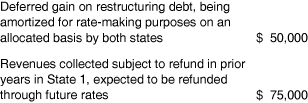
Utility B operates in two regulatory jurisdictions, State 1 and State 2; 40 percent of Utility B's operations are located in State 1 and 60 percent in State 2; system-wide assets, liabilities, and certain gains and losses are allocated 40 percent to State 1 and 60 percent to State 2. At December 31, 19X2, Utility B concludes, based on current and expected future market conditions in State 1, that it no longer meets the criteria of paragraph 980-10-15-2 for application of this Topic to its operations in State 1. No similar conditions exist in State 2, and actions of State 1's regulators are not expected to influence the decisions of regulators in State 2. Utility B's statement of financial position at December 31, 19X2, includes the following items.
  • "Deferred gain on restructuring debt, being amortized for rate-making purposes on an allocated basis by both states" " $50,000 " "Revenues collected subject to refund in prior years in State 1, expected to be refunded through future rates" " $75,000 "
980-20-55-8
Those items should be reported as follows as of December 31, 19X2.
980-20-55-9
The portion of the deferred gain allocable to State 1 (determined in this Example to be 40 percent of $50,000, or $20,000) should be eliminated from the entity's statement of financial position when it ceases to apply this Topic to its operations in State 1. No adjustment should be made for the deferred gain applicable to State 2. The regulatory-created accrual for revenues subject to refund in State 1 should be eliminated. Whether any liability related thereto exists should be determined under generally accepted accounting principles (GAAP) for entities in general. For example, amounts that were collected in the current or prior periods for which refunds will be made regardless of future sales should continue to be reported as liabilities after application of this Topic is discontinued. The credit to income resulting from the above adjustments should be reported as an unusual or infrequently occurring item in the period that includes December 31, 19X2.
980-20-55-10
This Example illustrates the guidance in paragraphs .
980-20-55-11
Utility C operates solely in one regulatory jurisdiction. At June 30, 19X3, Utility C concludes, based on new legislation, that it no longer meets the criteria of paragraph 980-10-15-2 for application of this Topic . Utility C had adopted Subtopic 740-10 in 19X2 and because of applying this Topic had recorded a regulatory-created asset of $650,000 for deferred taxes resulting from temporary differences that had not been recognized in the rate-making process but that were expected to be recovered in the future.
980-20-55-12
The following reporting is required for that regulatory-created asset.
980-20-55-13
Utility C should eliminate that regulatory-created asset from its statement of financial position when the entity ceases to apply this Topic. The charge to income should be reported as an unusual or infrequently occurring item in the period that includes June 30, 19X3.

Related subtopics