ASC 740-980
Regulated Operations
740 Income Taxes
Source downloaded: .Record version 43694f28914a. Effective date must be checked in the source.
This subtopic applies ASC 740 to entities whose rates are regulated and that meet the criteria in 980-10-15-2. It prohibits net-of-tax accounting, requires a deferred tax liability for tax benefits flowed through to customers and for the equity component of the allowance for funds used during construction (AFUDC), and requires deferred taxes to be adjusted for enacted changes in tax law or rates. When it is probable that a regulator will allow recovery from (or require refund to) customers of those future tax amounts, the entity recognizes a separate regulatory asset or liability, which is itself a temporary difference generating additional deferred tax.
Key points (7)
- For entities meeting paragraph 980-10-15-2, net-of-tax accounting and reporting is prohibited, a deferred tax liability must be recognized for tax benefits flowed through to customers when temporary differences originate and for the equity component of AFUDC, and deferred tax liabilities/assets must be adjusted for enacted changes in tax laws or rates (740-980-25-1).
- If regulator action makes it probable the future increase or decrease in taxes payable will be recovered from or returned to customers through future rates, a regulatory asset or liability is recognized under 980-340-25-1 and 980-405-25-1, and that asset or liability is itself a temporary difference requiring a deferred tax liability or asset (740-980-25-2).
- The regulatory asset and the related deferred tax liability are displayed separately and are not offset for general-purpose financial reporting (740-980-55-1).
- The regulatory asset is grossed up for the tax on the recovery itself: 34% x ($26,000 AFUDC equity + A) = A, giving A = $13,394 (740-980-55-9).
- Where the deferred tax liability represents amounts already collected from customers, no regulatory asset exists; a rate-rate decrease creates a probable refund liability grossed up as $4,000 + (30% x R) = R, so R = $5,714 (740-980-55-13).
- A regulated entity capitalizes an otherwise-expensed cost only if future revenue at least equal to the cost is probable from including it in allowable costs, and the evidence shows the revenue recovers the previously incurred cost rather than funding similar future costs (740-980-55-1).
- For an abandoned plant, the abandonment loss is deductible for federal tax purposes when abandonment occurs regardless of rate-making treatment, and deferred taxes on the remaining asset and related recovery asset are recorded under Subtopic 740-10 (740-980-55-4 through 55-6).
For students. Exam questions here hinge on the gross-up math: because the regulatory asset (or refund liability) is itself taxable/deductible, you must solve the circular equation rather than simply multiplying the tax rate by the AFUDC equity amount. A common misunderstanding is netting the regulatory asset against the deferred tax liability — the guidance requires separate display and forbids net-of-tax presentation.
Machine-generated study aid for ASC 740-980. Check the source paragraphs below.
740-980-05Overview and Background
Source downloaded: .Record version 9fdba3d05b2c. Effective date must be checked in the source.
740-980-15Scope and Scope Exceptions
Source downloaded: .Record version 8a4613109556. Effective date must be checked in the source.
Overall Guidance
740-980-25Recognition
Source downloaded: .Record version 49b01d59145f. Effective date must be checked in the source.
Income Taxes Applicable to Regulated Entities
- aProhibits net-of-tax accounting and reporting
- bRequires recognition of a deferred tax liability for tax benefits that are flowed through to customers when temporary differences originate and for the equity component of the allowance for funds used during construction
- cRequires adjustment of a deferred tax liability or asset for an enacted change in tax laws or rates.
740-980-55Implementation Guidance and Illustrations
Source downloaded: .Record version 9618d567e1b0. Effective date must be checked in the source.
Implementation Guidance
- a It is probable that future revenue in an amount at least equal to the capitalized cost will result from inclusion of that cost in allowable costs for rate-making purposes.
- b Based on available evidence, the future revenue will be provided to permit recovery of the previously incurred cost rather than to provide for expected levels of similar future costs.
- a Costs that will be deductible in the future, either as depreciation or (in the event that the plant is abandoned) as an abandonment loss
- b Costs that have been deducted in the past
- c Costs that are never deductible (the allowance for equity funds used during construction).
Illustrations
- aRecognition of an asset for the probable future revenue to recover future income taxes related to the deferred tax liability for the equity component of the allowance for funds used during construction (Case A)
- bA subsequent adjustment of deferred tax liability for an enacted change in tax rates (Case B).
- aDuring Year 1, the first year of operations, total construction costs for financial reporting and tax purposes are $400,000 (exclusive of the allowance for funds used during construction).
- bThe enacted tax rate is 34 percent for all future years.
- cAllowance for funds used during construction (consisting entirely of the equity component) is $26,000. The asset for probable future revenue to recover the related income taxes is calculated as follows:
- 34 percent of ($26,000 + A) = A (where A equals the asset for probable future revenue)
- dA = $13,394.
-
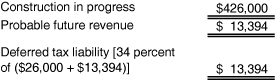 Construction in progress " $426,000 " Probable future revenue " $13,394 " "Deferred tax liability [34 percent of ($26,000 + $13,394)]" " $13,394 "
-
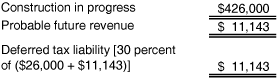 Construction in progress " $426,000 " Probable future revenue " $11,143 " "Deferred tax liability [30 percent of ($26,000 + $11,143)]" " $11,143 "
- a Amounts at the end of Year 1, the current year, are as follows.
-
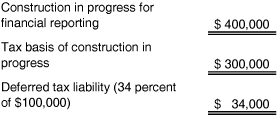 Construction in progress for financial reporting " $400,000 " Tax basis of construction in progress " $300,000 " "Deferred tax liability (34 percent of $100,000)" " $34,000 "
-
- b A change in the tax rate from 34 percent to 30 percent is enacted on the first day of Year 2. As a result of the reduction in tax rates, it is probable that $4,000 of the $34,000 (previously collected from customers for the future payment of income taxes) will be refunded to customers, together with the tax benefit of that refund, through a future rate reduction. The liability for the future rate reduction to refund a portion of the deferred taxes previously collected from customers is calculated as follows:
- $4,000 + (30 percent of R) = R (where R equals the probable future reduction in revenue)
-
- c R = $5,714.
-
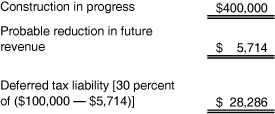 Construction in progress " $400,000 " Probable reduction in future revenue " $5,714 " "Deferred tax liability [30 percent of ($100,000 — $5,714)]" " $28,286 "
Related subtopics
- 740-10 OverallIncome Taxes
- 740-830 Foreign Currency MattersIncome Taxes
- 740-20 Intraperiod Tax AllocationIncome Taxes
- 740-30 Other Considerations or Special AreasIncome Taxes
- 410-980 Regulated OperationsAsset Retirement and Environmental Obligations
- 980-20 Discontinuation of Rate-Regulated AccountingRegulated Operations