ASC

ASC 740-805

Business Combinations

740 Income Taxes

Source downloaded: .Record version 1a88a3311c84. Effective date must be checked in the source.

ASC 740-805 (codified as 805-740) gives the income tax rules that apply when an acquirer accounts for a business combination or a not-for-profit acquisition. It requires recognizing deferred tax assets and liabilities (and valuation allowances) at the acquisition date for the differences between the tax bases and the recognized values of assets acquired and liabilities assumed, measured under Subtopic 740-10 with no discounting. It also specifies exceptions (nondeductible goodwill, leveraged leases) and how post-acquisition changes in valuation allowances and acquired tax positions are recognized — through goodwill only within the measurement period, otherwise in income tax expense.

Key points (7)
  • An acquirer recognizes a deferred tax asset or liability at the acquisition date for the acquiree's taxable and deductible temporary differences and operating loss/tax credit carryforwards, and assesses the need for a valuation allowance under Subtopic 740-10 (740-805-25-2 through 25-3).
  • Exceptions to recognition are the portion of goodwill whose amortization is not tax deductible, leveraged leases (Subtopic 842-50), and the acquired temporary differences in paragraph 740-10-25-3(a) (740-805-25-3, 25-4).
  • Deferred taxes acquired are measured under Subtopic 740-10 and discounting is prohibited (740-805-30-1).
  • Goodwill is split into two components: the first (lesser of book or tax-deductible goodwill) generates temporary differences and deferred taxes; an excess of tax goodwill over book goodwill generates a deferred tax asset (computed by the simultaneous equations method, 740-805-55-10 through 55-13), while an excess of book goodwill over tax goodwill produces no deferred taxes ever (740-805-25-8 through 25-9).
  • A change in the acquired entity's valuation allowance or an acquired tax position is recorded against goodwill only if it occurs within the measurement period and results from new information about acquisition-date facts (with a bargain purchase gain once goodwill is zero); all other changes go to income tax expense or contributed capital (740-805-45-2, 45-4).
  • A reduction in the acquirer's own valuation allowance caused by the combination is not part of the acquisition accounting; it is recognized as an income tax benefit or credited to contributed capital (740-805-30-3, 35-2 through 35-3).
  • For equity-classified replacement awards that ordinarily yield postcombination tax deductions, a deferred tax asset is recognized on the precombination portion included in consideration transferred; the excess or shortfall of the actual tax deduction versus the fair-value-based measure goes to income tax expense or benefit (740-805-25-10 through 25-11, 45-5).

For students. Exam favorites are the goodwill two-component rule (book goodwill in excess of tax goodwill never produces deferred taxes) and the post-2007 rule that valuation allowance releases outside the measurement period hit income tax expense, not goodwill. A common misunderstanding is treating any later reversal of an acquired valuation allowance as a goodwill adjustment — that only works within the measurement period and only for acquisition-date facts.

Machine-generated study aid for ASC 740-805. Check the source paragraphs below.

740-805-00Status

Source downloaded: .Record version 6b7b2cf461ca. Effective date must be checked in the source.

740-805-00-1
The following table identifies the changes made to this Subtopic.
ParagraphActionAccounting Standards UpdateDate
AcquireeAmendedAccounting Standards Update No. 2010-0701/28/2010
AcquirerAmendedAccounting Standards Update No. 2025-0305/12/2025
Acquisition by a Not-for-Profit EntityAddedAccounting Standards Update No. 2010-0701/28/2010
BusinessAmendedAccounting Standards Update No. 2017-0101/05/2017
Business CombinationAmendedAccounting Standards Update No. 2010-0701/28/2010
Commencement Date of the Lease (Commencement Date)AddedAccounting Standards Update No. 2016-0202/25/2016
ContractAddedAccounting Standards Update No. 2016-0202/25/2016
Excess Tax BenefitsSupersededAccounting Standards Update No. 2016-0903/30/2016
GoodwillAmendedAccounting Standards Update No. 2023-0508/23/2023
GoodwillAmendedAccounting Standards Update No. 2010-0701/28/2010
LeaseAddedAccounting Standards Update No. 2016-0202/25/2016
LesseeAddedAccounting Standards Update No. 2016-0202/25/2016
LessorAddedAccounting Standards Update No. 2016-0202/25/2016
Leveraged LeaseAddedAccounting Standards Update No. 2016-0202/25/2016
Temporary DifferenceAmendedAccounting Standards Update No. 2016-1610/24/2016
Underlying AssetAddedAccounting Standards Update No. 2016-0202/25/2016
Variable Interest EntitySupersededAccounting Standards Update No. 2025-0305/12/2025
805-740-05-1AmendedAccounting Standards Update No. 2010-0701/28/2010
805-740-05-2AmendedAccounting Standards Update No. 2010-0701/28/2010
805-740-25-4AmendedAccounting Standards Update No. 2016-0202/25/2016
805-740-25-10AmendedAccounting Standards Update No. 2018-0706/20/2018
805-740-25-11AmendedAccounting Standards Update No. 2018-0706/20/2018
805-740-25-12AmendedMaintenance Update 2017-06 (PDF)04/07/2017
805-740-25-13AmendedAccounting Standards Update No. 2018-0907/16/2018
805-740-30-1AmendedAccounting Standards Update No. 2016-0202/25/2016
805-740-45-5AmendedAccounting Standards Update No. 2016-0903/30/2016
805-740-45-6SupersededAccounting Standards Update No. 2016-0903/30/2016

740-805-05Overview and Background

Source downloaded: .Record version 21c4112a3e2f. Effective date must be checked in the source.

740-805-05-1
This Subtopic provides incremental guidance on accounting for income taxes related to business combinations and to acquisitions by not-for-profit entities. This Subtopic requires recognition of deferred tax liabilities and deferred tax assets (and related valuation allowances, if necessary) for the deferred tax consequences of differences between the tax bases and the recognized values of assets acquired and liabilities assumed in a business combination or in an acquisition by a not-for-profit entity.
740-805-05-2
The recognition and measurement requirements related to accounting for income taxes in this Subtopic are exceptions to the recognition and measurement principles that are otherwise required for business combinations and acquisitions by not-for-profit entities, as established in Sections 805-20-25 and 805-20-30.

740-805-15Scope and Scope Exceptions

Source downloaded: .Record version 6cf720521c5a. Effective date must be checked in the source.

Overall Guidance

740-805-15-1
This Subtopic follows the same Scope and Scope Exceptions as outlined in the Overall Subtopic, see Section 805-10-15.

740-805-25Recognition

Source downloaded: .Record version a4f2327ee309. Effective date must be checked in the source.

740-805-25-1
This Section provides general guidance on the recognition of deferred tax assets and liabilities in connection with a business combination. It also addresses certain business-combination-specific matters relating to goodwill, replacement awards, and the allocation of consolidated tax expense after an acquisition.
740-805-25-2
An acquirer shall recognize a deferred tax asset or deferred tax liability arising from the assets acquired and liabilities assumed in a business combination and shall account for the potential tax effects of temporary differences, carryforwards, and any income tax uncertainties of an acquiree that exist at the acquisition date, or that arise as a result of the acquisition, in accordance with the guidance in Subtopic 740-10 together with the incremental guidance provided in this Subtopic.
740-805-25-3
As of the acquisition date, a deferred tax liability or asset shall be recognized for an acquired entity's taxable or deductible temporary differences or operating loss or tax credit carryforwards except for differences relating to the portion of goodwill for which amortization is not deductible for tax purposes, leveraged leases, and the specific acquired temporary differences identified in paragraph 740-10-25-3(a). Taxable or deductible temporary differences arise from differences between the tax bases and the recognized values of assets acquired and liabilities assumed in a business combination. Example 1 (see paragraph 805-740-55-2) illustrates this guidance. An acquirer shall assess the need for a valuation allowance as of the acquisition date for an acquired entity's deferred tax asset in accordance with Subtopic 740-10.
740-805-25-4
Guidance on tax-related matters related to the portion of goodwill for which amortization is not deductible for tax purposes is in paragraphs ; guidance on accounting for the acquisition of leveraged leases in a business combination is in Subtopic 842-50; and guidance on the specific acquired temporary differences identified in paragraph 740-10-25-3(a) is referred to in that paragraph.
740-805-25-5
The tax bases used in the calculation of deferred tax assets and liabilities as well as amounts due to or receivable from taxing authorities related to prior tax positions at the date of a business combination shall be calculated in accordance with Subtopic 740-10.
740-805-25-6
In a taxable business combination, the consideration paid is assigned to the assets acquired and liabilities assumed for financial reporting and tax purposes. However, the amounts recognized for particular assets and liabilities may differ for financial reporting and tax purposes. As required by paragraph 805-740-25-3, deferred tax liabilities and assets are recognized for the deferred tax consequences of those temporary differences. For example, a portion of the amount of goodwill for financial reporting may be allocated to some other asset for tax purposes, and amortization of that other asset may be deductible for tax purposes. If a valuation allowance is recognized for that deferred tax asset at the acquisition date, recognized benefits for those tax deductions after the acquisition date shall be applied in accordance with paragraph 805-740-45-2.
740-805-25-7
See Examples 1 through 3 (paragraphs ) for illustrations of the recognition of deferred tax assets and related valuation allowances at the date of a nontaxable business combination.

Goodwill

740-805-25-8
Guidance on the financial accounting for goodwill is provided in Subtopic 350-20. For tax purposes, amortization of goodwill is deductible in some tax jurisdictions. In those tax jurisdictions, the reported amount of goodwill and the tax basis of goodwill are each separated into two components as of the acquisition date for purposes of deferred tax calculations. The first component of each equals the lesser of goodwill for financial reporting or tax-deductible goodwill. The second component of each equals the remainder of each, that is, the remainder, if any, of goodwill for financial reporting or the remainder, if any, of tax-deductible goodwill.
740-805-25-9
Any difference that arises between the book and tax basis of that first component of goodwill in future years is a temporary difference for which a deferred tax liability or asset is recognized based on the requirements of Subtopic 740-10. If that second component is an excess of tax-deductible goodwill over the reported amount of goodwill, the tax benefit for that excess is a temporary difference for which a deferred tax asset is recognized based on the requirements of that Subtopic (see Example 4 [paragraph 805-740-55-9]). However, if that second component is an excess of goodwill for financial reporting over the tax-deductible amount of goodwill, no deferred taxes are recognized either at the acquisition date or in future years.

Replacement Awards Classified as Equity

740-805-25-10
Paragraph 805-30-30-9 identifies the types of awards that are referred to as replacement awards in the Business Combinations Topic. For a replacement award classified as equity that ordinarily would result in postcombination tax deductions under current tax law, an acquirer shall recognize a deferred tax asset for the deductible temporary difference that relates to the portion of the fair-value-based measure attributed to a precombination exchange of goods or services and therefore included in consideration transferred in the business combination.
740-805-25-11
For a replacement award classified as equity that ordinarily would not result in tax deductions under current tax law, an acquirer shall recognize no deferred tax asset for the portion of the fair-value-based measure attributed to precombination vesting and thus included in consideration transferred in the business combination. A future event, such as an employee's disqualifying disposition of shares under a tax law, may give rise to a tax deduction for instruments that ordinarily do not result in a tax deduction. The tax effects of such an event shall be recognized only when it occurs.

Allocation of Consolidated Tax Expense to the Acquired Entity after an Acquisition

740-805-25-12
Paragraph 740-10-30-27 provides general guidance on the allocation of consolidated tax expense to the separate financial statements of members of a consolidated group. Under certain conditions, paragraphs permit an acquired entity to retain its preacquisition historical basis in separately issued financial statements after an acquisition.
740-805-25-13
If there is a continuation of the historical basis for financial reporting, for example, when pushdown accounting is not applied, at the same time as there is a tax basis step-up, the tax benefit from the tax basis step-up shall be credited to the acquired entity's additional paid-in capital consistent with paragraph 740-20-45-11(g).
  1. a
  2. b
  3. c
740-805-25-14
Paragraph 740-10-50-17 specifies the disclosure requirements for separately issued financial statements of an entity that is a member of a group that files a consolidated tax return.

740-805-30Initial Measurement

Source downloaded: .Record version a9210cb12974. Effective date must be checked in the source.

740-805-30-1
An acquirer shall measure a deferred tax asset or deferred tax liability arising from the assets acquired and liabilities assumed in a business combination in accordance with Subtopic 740-10. Discounting deferred tax assets or liabilities is prohibited for temporary differences (except for leveraged leases, see Subtopic 842-50) related to business combinations as it is for other temporary differences.
740-805-30-2
See Example 1 (paragraph 805-740-55-2) for an illustration of the measurement of deferred tax assets and a related valuation allowance at the date of a nontaxable business combination.
740-805-30-3
The tax law in some tax jurisdictions may permit the future use of either of the combining entities' deductible temporary differences or carryforwards to reduce taxable income or taxes payable attributable to the other entity after the business combination. If the combined entity expects to file a consolidated tax return, an acquirer may determine that as a result of the business combination its valuation for its deferred tax assets should be changed. For example, the acquirer may be able to utilize the benefit of its tax operating loss carryforwards against the future taxable profit of the acquiree. In such cases, the acquirer reduces its valuation allowance based on the weight of available evidence. However, that reduction does not enter into the accounting for the business combination but is recognized as an income tax benefit (or credited directly to contributed capital [see paragraph 740-10-45-20]).

740-805-35Subsequent Measurement

Source downloaded: .Record version afe52dd95c65. Effective date must be checked in the source.

740-805-35-1
An acquirer may have a valuation allowance for its own deferred tax assets at the time of a business combination. The guidance in this Section addresses measurement of that valuation allowance and the potential need to distinguish the separate pasts of the acquirer and the acquired entity in the measurement of valuation allowances together with expected future results of operations. Guidance on the subsequent measurement of deferred tax assets or liabilities arising from the assets acquired and liabilities assumed in a business combination, and any income tax uncertainties of an acquiree that exist at the acquisition date, or that arise as a result of the acquisition, is provided in Subtopic 740-10.
740-805-35-2
Changes in the acquirer's valuation allowance, if any, that result from the business combination shall reflect any provisions in the tax law that restrict the future use of either of the combining entities' deductible temporary differences or carryforwards to reduce taxable income or taxes payable attributable to the other entity after the business combination.
740-805-35-3
Any changes in the acquirer's valuation allowance shall be accounted for in accordance with paragraph 805-740-30-3. For example, the tax law may limit the use of the acquired entity's deductible temporary differences and carryforwards to subsequent taxable income of the acquired entity included in a consolidated tax return for the combined entity. In that circumstance, or if the acquired entity will file a separate tax return, the need for a valuation allowance for some portion or all of the acquired entity's deferred tax assets for deductible temporary differences and carryforwards is assessed based on the acquired entity's separate past and expected future results of operations.

740-805-45Other Presentation Matters

Source downloaded: .Record version 46faa113c67e. Effective date must be checked in the source.

740-805-45-1
This Section addresses how an acquirer recognizes changes in valuation allowances and tax positions related to an acquisition and the accounting for tax deductions for replacement awards.

Changes in Valuation Allowances

740-805-45-2
The effect of a change in a valuation allowance for an acquired entity's deferred tax asset shall be recognized as follows:
  1. a
    Changes within the measurement period that result from new information about facts and circumstances that existed at the acquisition date shall be recognized through a corresponding adjustment to goodwill. However, once goodwill is reduced to zero, an acquirer shall recognize any additional decrease in the valuation allowance as a bargain purchase in accordance with paragraphs . See paragraphs and for a discussion of the measurement period in the context of a business combination.
  2. b
    All other changes shall be reported as a reduction or increase to income tax expense (or a direct adjustment to contributed capital as required by paragraphs ).
740-805-45-3
Example 2 (see paragraph 805-740-55-4) illustrates this guidance relating to accounting for a change in an acquired entity's valuation allowance.

Changes in Tax Positions

740-805-45-4
The effect of a change to an acquired tax position, or those that arise as a result of the acquisition, shall be recognized as follows:
  1. a
    Changes within the measurement period that result from new information about facts and circumstances that existed as of the acquisition date shall be recognized through a corresponding adjustment to goodwill. However, once goodwill is reduced to zero, the remaining portion of that adjustment shall be recognized as a gain on a bargain purchase in accordance with paragraphs .
  2. b
    All other changes in acquired income tax positions shall be accounted for in accordance with the accounting requirements for tax positions established in Subtopic 740-10.

Tax Deductions for Replacement Awards

740-805-45-5
Paragraph 805-30-30-9 identifies the types of awards that are referred to as replacement awards in this Topic. After the acquisition date, the deduction reported on a tax return for a replacement award classified as equity may be different from the fair-value-based measure of the award. The tax effect of that difference shall be recognized as income tax expense or benefit in the income statement of the acquirer.

740-805-50Disclosure

Source downloaded: .Record version 68bb00aee82a. Effective date must be checked in the source.

Change in Acquirer's Valuation Allowance as a Result of a Business Combination

740-805-50-1
Paragraph 805-740-30-3 describes a situation where an acquirer reduces its valuation allowance for deferred tax assets as a result of a business combination. Paragraph 740-10-50-9(h) requires disclosure of adjustments of the beginning-of-the-year balance of a valuation allowance because of a change in circumstances that causes a change in judgment about the realizability of the related deferred tax asset in future years. That would include, for example, any acquisition-date income tax benefits or expenses recognized from changes in the acquirer's valuation allowance for its previously existing deferred tax assets as a result of a business combination.

740-805-55Implementation Guidance and Illustrations

Source downloaded: .Record version 0f7bb656cb72. Effective date must be checked in the source.

740-805-55-1
This Section is an integral part of the requirements of this Subtopic. This Section provides illustrations that address the application of accounting requirements to specific aspects of accounting for income taxes in connection with business combinations. The illustrations that follow make various assumptions about the tax law. These assumptions about the tax law are for illustrative purposes only.

Illustrations

740-805-55-2
This Example illustrates the guidance in paragraphs and 805-740-30-1 relating to the recognition and measurement of a deferred tax liability and deferred tax asset in a nontaxable business combination. The assumptions are as follows:
  1. a
    The enacted tax rate is 40 percent for all future years, and amortization of goodwill is not deductible for tax purposes.
  2. b
    A wholly owned entity is acquired for $20,000, and the entity has no leveraged leases.
  3. c
    The tax basis of the net assets acquired (other than goodwill) is $5,000, and the recognized value is $12,000. Future recovery of the assets and settlement of the liabilities at their assigned values will result in $20,000 of taxable amounts and $13,000 of deductible amounts that can be offset against each other. Therefore, no valuation allowance is necessary.

740-805-55-3
The amounts recorded to account for the business combination transaction are as follows.
  • Recognized value of the net assets (other than goodwill) acquired " $12,000 " "Deferred tax liability for $20,000 of taxable temporary differences" " (8,000)" "Deferred tax asset for $13,000 of deductible temporary differences" " 5,200 " Goodwill " 10,800 " Consideration paid for the acquiree " $20,000 "
740-805-55-4
This Example illustrates the guidance in paragraphs 805-740-25-3 and 805-740-45-2 relating to the recognition of a deferred tax asset and the related valuation allowance for acquired deductible temporary differences at the date of a nontaxable business combination and in subsequent periods when the tax law limits the use of an acquired entity's deductible temporary differences and carryforwards to subsequent taxable income of the acquired entity in a consolidated tax return. The assumptions are as follows:
  1. a
    The enacted tax rate is 40 percent for all future years.
  2. b
    The purchase price is $20,000, and the assigned value of the net assets acquired is also $20,000.
  3. c
    The tax basis of the net assets acquired is $60,000. The $40,000 ($60,000 - $20,000) of deductible temporary differences at the combination date is primarily attributable to an allowance for loan losses. Provisions in the tax law limit the use of those future tax deductions to subsequent taxable income of the acquired entity.
  4. d
    The acquired entity's actual pretax results for the two preceding years and the expected results for the year of the business combination are as follows.

    • Year 1 " $(15,000)" Year 2 " (10,000)" Year 3 to the combination date " (5,000)" Expected results for the remainder of Year 3 " (5,000)"
  5. e
    Based on assessments of all evidence available at the date of the business combination in Year 3 and at the end of Year 3, management concludes that a valuation allowance is needed at both dates for the entire amount of the deferred tax asset related to the acquired deductible temporary differences.
740-805-55-5
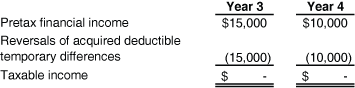
The acquired entity's pretax financial income and taxable income for Year 3 (after the business combination) and Year 4 are as follows.
  • Year 3 Year 4 Pretax financial income " $15,000 " " $10,000 " Reversals of acquired deductible temporary differences " (15,000)" " (10,000)" Taxable income $- $-
740-805-55-6
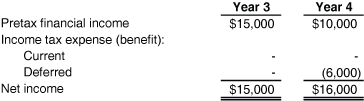
At the end of Year 4, the remaining balance of acquired deductible temporary differences is $15,000 ($40,000 − $25,000). The deferred tax asset is $6,000 ($15,000 at 40 percent). Based on an assessment of all available evidence at the end of Year 4, management concludes that no valuation allowance is needed for that $6,000 deferred tax asset. Elimination of the $6,000 valuation allowance results in a $6,000 deferred tax benefit that is reported as a reduction of deferred income tax expense because the reversal of the valuation allowance occurred after the measurement period (see paragraph 805-740-45-2). Tax benefits realized in Years 3 and 4 attributable to reversals of acquired deductible temporary differences are reported as a zero current income tax expense. The consolidated statement of earnings would include the following amounts attributable to the acquired entity for Year 3 (after the business combination) and Year 4.
  • Year 3 Year 4 Pretax financial income " $15,000 " " $10,000 " Income tax expense (benefit): Current - - Deferred - " (6,000)" Net income " $15,000 " " $16,000 "
740-805-55-7
This Example illustrates the guidance in paragraph 805-740-25-3 if there is an elimination of the need for a valuation allowance for the deferred tax asset for an acquired loss carryforward based on offset against taxable temporary differences of the acquiring entity in a nontaxable business combination. This Example assumes that the tax law permits use of an acquired entity's deductible temporary differences and carryforwards to reduce taxable income or taxes payable attributable to the acquiring entity in a consolidated tax return. The other assumptions are as follows:
  1. a
    The enacted tax rate is 40 percent for all future years.
  2. b
    The purchase price is $20,000. The tax basis of the identified net assets acquired is $5,000, and the assigned value is $12,000, that is, there are $7,000 of taxable temporary differences. The acquired entity also has a $16,000 operating loss carryforward, which, under the tax law, may be used by the acquiring entity in the consolidated tax return.
  3. c
    The acquiring entity has temporary differences that will result in $30,000 of net taxable amounts in future years.
  4. d
    All temporary differences of the acquired and acquiring entities will result in taxable amounts before the end of the acquired entity's loss carryforward period.
740-805-55-8
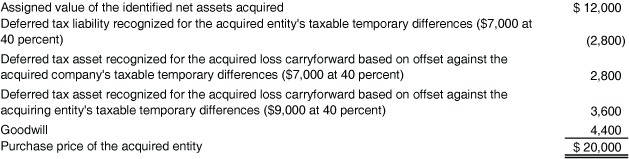
In assessing the need for a valuation allowance, future taxable income exclusive of reversing temporary differences and carryforwards (see paragraph 740-10-30-18(b)) need not be considered because the $16,000 operating loss carryforward will offset the acquired entity's $7,000 of taxable temporary differences and another $9,000 of the acquiring entity's taxable temporary differences. The amounts recorded to account for the purchase transaction are as follows.
  • Assigned value of the identified net assets acquired " $12,000 " "Deferred tax liability recognized for the acquired entity's taxable temporary differences ($7,000 at 40 percent)" " (2,800)" "Deferred tax asset recognized for the acquired loss carryforward based on offset against the acquired company's taxable temporary differences ($7,000 at 40 percent)" " 2,800 " "Deferred tax asset recognized for the acquired loss carryforward based on offset against the acquiring entity's taxable temporary differences ($9,000 at 40 percent)" " 3,600 " Goodwill " 4,400 " Purchase price of the acquired entity " $20,000 "
740-805-55-9
This Example illustrates the guidance in paragraphs on accounting for the tax consequences of goodwill when tax-deductible goodwill exceeds the goodwill recorded for financial reporting at the acquisition date. The assumptions are as follows:
  1. a
    At the acquisition date, the reported amount of goodwill for financial reporting purposes is $600 before taking into consideration the tax benefit associated with goodwill and the tax basis of goodwill is $900.
  2. b
    The tax rate is 40 percent for all years.
740-805-55-10
As of the acquisition date, the goodwill for financial reporting purposes is adjusted for the tax benefit associated with goodwill by using the following simultaneous equations method. In the following equation, the Preliminary Temporary Difference variable is the excess of tax goodwill over book goodwill, before taking into consideration the tax benefit associated with goodwill, and the Deferred Tax Asset variable is the resulting deferred tax asset.
  • (Tax Rate ÷ [1 − Tax Rate]) × Preliminary Temporary Difference = Deferred Tax Asset
740-805-55-11
In this Example, the following variables are known:
  • Tax rate = 40 percent
  • Preliminary Temporary Difference = $300 ($900 − $600)

740-805-55-12
The unknown variable (Deferred Tax Asset) equals $200, and the goodwill for financial reporting purposes would be adjusted with the following entry.
  • Deferred tax asset 200 Goodwill 200
740-805-55-13
Goodwill for financial reporting would be established at the acquisition date at $400 ($600 less the $200 credit adjustment).

Related subtopics