ASC 805-40
Reverse Acquisitions
805 Business Combinations
Source downloaded: .Record version 2e9a764c7529. Effective date must be checked in the source.
In brief
AdvancedBusiness combinationsConsolidationFinancial statement presentationEarnings per shareASC 805-40 explains how to apply the acquisition method when the legal acquirer (the entity that issues equity, often a public shell) is the accounting acquiree and the legal subsidiary is the accounting acquirer — a reverse acquisition. The accounting acquiree must be a business, and all recognition and measurement principles of 805-10, 805-20 and 805-30 (including goodwill) apply, but consideration transferred is imputed as the number of shares the legal subsidiary would have had to issue to give the legal parent's owners their resulting ownership percentage (805-40-30-2). The consolidated statements are issued in the legal parent's name yet are a continuation of the legal subsidiary's financial statements, with the subsidiary's legal capital retroactively restated to the parent's equity structure (805-40-45-1 through 45-2).
Key points (6)
- A transaction is accounted for as a reverse acquisition only if the accounting acquiree meets the definition of a business, and all recognition principles of 805-10, 805-20 and 805-30 — including recognizing goodwill — apply (805-40-25-1).
- The acquisition-date fair value of consideration transferred is based on the number of equity interests the legal subsidiary would hypothetically have had to issue to give the legal parent's owners the same percentage interest in the combined entity, measured using the most reliable measure of fair value (805-40-30-2; 805-40-55-10).
- The legal subsidiary's (accounting acquirer's) assets, liabilities, retained earnings and other equity are carried at precombination carrying amounts, while the legal parent's (accounting acquiree's) assets and liabilities are recognized and measured under the acquisition method (805-40-45-2(a)-(c)).
- Owners of the legal acquiree who do not exchange their shares become a noncontrolling interest, measured at their proportionate share of the legal subsidiary's precombination carrying amounts rather than fair value (805-40-25-2; 805-40-30-3; 805-40-45-2(e)).
- Issued equity in the consolidated balance sheet equals the accounting acquirer's precombination issued equity plus the fair value of consideration effectively transferred, but the number and type of shares reflect the legal parent's equity structure, with comparatives retroactively adjusted (805-40-45-1; 45-2(d); 45-3; illustrated at 805-40-55-14).
- For EPS, weighted-average shares before the acquisition date are the accounting acquirer's historical weighted-average shares multiplied by the exchange ratio, and actual legal acquirer shares thereafter; prior comparative-period EPS uses the accounting acquirer's income over its restated share count (805-40-45-4; 45-5).
For students. Reverse acquisitions are the standard accounting model for private companies going public via a shell or SPAC merger, so exam questions focus on identifying the accounting acquirer and computing imputed consideration and goodwill. The most common misunderstanding is thinking the noncontrolling interest is measured at fair value — here it is the NCI's share of the legal subsidiary's precombination carrying amounts (805-40-30-3).
Machine-generated study aid for ASC 805-40. Check the source paragraphs below.
805-40-00Status
Source downloaded: .Record version 62d6c821063f. Effective date must be checked in the source.
| Paragraph | Action | Accounting Standards Update | Date |
| Acquiree | Amended | Accounting Standards Update No. 2010-07 | 01/28/2010 |
| Acquirer | Amended | Accounting Standards Update No. 2025-03 | 05/12/2025 |
| Business | Amended | Accounting Standards Update No. 2017-01 | 01/05/2017 |
| Business Combination | Amended | Accounting Standards Update No. 2010-07 | 01/28/2010 |
| Goodwill | Amended | Accounting Standards Update No. 2023-05 | 08/23/2023 |
| Goodwill | Amended | Accounting Standards Update No. 2010-07 | 01/28/2010 |
| Variable Interest Entity | Superseded | Accounting Standards Update No. 2025-03 | 05/12/2025 |
| 805-40-55-19 | Amended | Accounting Standards Update No. 2010-08 | 02/02/2010 |
805-40-05Overview and Background
Source downloaded: .Record version 2c564c3bf5df. Effective date must be checked in the source.
805-40-15Scope and Scope Exceptions
Source downloaded: .Record version fe7f26435640. Effective date must be checked in the source.
Overall Guidance
Transactions
805-40-25Recognition
Source downloaded: .Record version 1a547dd08358. Effective date must be checked in the source.
Noncontrolling Interest
805-40-30Initial Measurement
Source downloaded: .Record version ea456696b429. Effective date must be checked in the source.
Measuring the Consideration Transferred
Noncontrolling Interest
Consolidated Financial Statements Following a Reverse Acquisition
805-40-45Other Presentation Matters
Source downloaded: .Record version 14a7c4430758. Effective date must be checked in the source.
Preparation and Presentation of Consolidated Financial Statements
- aThe assets and liabilities of the legal subsidiary (the accounting acquirer) recognized and measured at their precombination carrying amounts.
- bThe assets and liabilities of the legal parent (the accounting acquiree) recognized and measured in accordance with the guidance in this Topic applicable to business combinations.
- cThe retained earnings and other equity balances of the legal subsidiary (accounting acquirer) before the business combination.
- dThe amount recognized as issued equity interests in the consolidated financial statements determined by adding the issued equity interest of the legal subsidiary (the accounting acquirer) outstanding immediately before the business combination to the fair value of the legal parent (accounting acquiree) determined in accordance with the guidance in this Topic applicable to business combinations. However, the equity structure (that is, the number and type of equity interests issued) reflects the equity structure of the legal parent (the accounting acquiree), including the equity interests the legal parent issued to effect the combination. Accordingly, the equity structure of the legal subsidiary (the accounting acquirer) is restated using the exchange ratio established in the acquisition agreement to reflect the number of shares of the legal parent (the accounting acquiree) issued in the reverse acquisition.
- eThe noncontrolling interest's proportionate share of the legal subsidiary's (accounting acquirer's) precombination carrying amounts of retained earnings and other equity interests as discussed in paragraphs 805-40-25-2 and 805-40-30-3 and illustrated in Example 1, Case B (see paragraph 805-40-55-18).
EPS
- aThe number of common shares outstanding from the beginning of that period to the acquisition date shall be computed on the basis of the weighted-average number of common shares of the legal acquiree (accounting acquirer) outstanding during the period multiplied by the exchange ratio established in the merger agreement.
- bThe number of common shares outstanding from the acquisition date to the end of that period shall be the actual number of common shares of the legal acquirer (the accounting acquiree) outstanding during that period.
- aThe income of the legal acquiree attributable to common shareholders in each of those periods
- bThe legal acquiree's historical weighted-average number of common shares outstanding multiplied by the exchange ratio established in the acquisition agreement.
805-40-55Implementation Guidance and Illustrations
Source downloaded: .Record version e52b9599c120. Effective date must be checked in the source.
Illustrations
- aA reverse acquisition if all the shares of the legal subsidiary are exchanged (Case A)
- bA reverse acquisition if not all of the shares of the legal subsidiary are exchanged and a noncontrolling interest results (Case B).
-
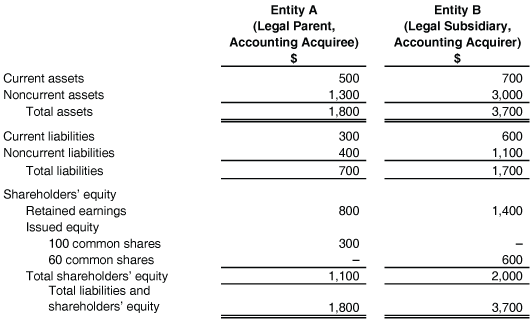 "Entity A (Legal Parent, Accounting Acquiree) $" "Entity B (Legal Subsidiary, Accounting Acquirer) $" Current assets 500 700 Noncurrent assets " 1,300 " " 3,000 " Total assets " 1,800 " " 3,700 " Current liabilities 300 600 Noncurrent liabilities 400 " 1,100 " Total liabilities 700 " 1,700 " Shareholders' equity Retained earnings 800 " 1,400 " Issued equity 100 common shares 300 - 60 common shares - 600 Total shareholders' equity " 1,100 " " 2,000 " "Total liabilities and shareholders' equity" " 1,800 " " 3,700 "
-
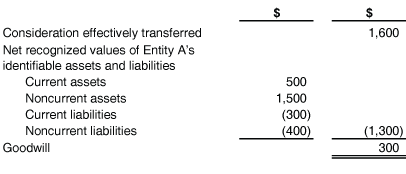 $ $ Consideration effectively transferred " 1,600 " Net recognized values of Entity A's identifiable assets and liabilities Current assets 500 Noncurrent assets " 1,500 " Current liabilities (300) Noncurrent liabilities (400) " (1,300)" Goodwill 300
-
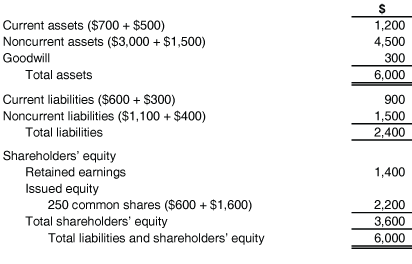 $ Current assets ($700 + $500) " 1,200 " "Noncurrent assets ($3,000 + $1,500)" " 4,500 " Goodwill 300 Total assets " 6,000 " Current liabilities ($600 + $300) 900 "Noncurrent liabilities ($1,100 + $400)" " 1,500 " Total liabilities " 2,400 " Shareholders' equity Retained earnings " 1,400 " Issued equity "250 common shares ($600 + $1,600)" " 2,200 " Total shareholders' equity " 3,600 " Total liabilities and shareholders' equity " 6,000 "
-
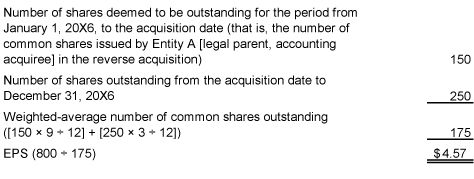 "Number of shares deemed to be outstanding for the period from January 1, 20X6, to the acquisition date (that is, the number of common shares issued by Entity A [legal parent, accounting acquiree] in the reverse acquisition)" 150 "Number of shares outstanding from the acquisition date to December 31, 20X6" 250 "Weighted-average number of common shares outstanding ([150 × 9 ÷ 12] + [250 × 3 ÷ 12])" 175 EPS (800 ÷ 175) $4.57
-
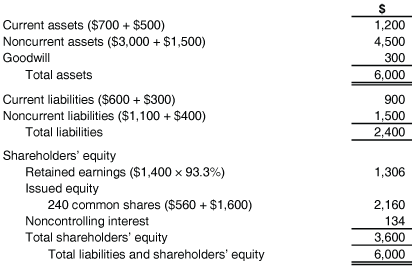 $ Current assets ($700 + $500) " 1,200 " "Noncurrent assets ($3,000 + $1,500)" " 4,500 " Goodwill 300 Total assets " 6,000 " Current liabilities ($600 + $300) 900 "Noncurrent liabilities ($1,100 + $400)" " 1,500 " Total liabilities " 2,400 " Shareholders' equity "Retained earnings ($1,400 × 93.3%)" " 1,306 " Issued equity "240 common shares ($560 + $1,600)" " 2,160 " Noncontrolling interest 134 Total shareholders' equity " 3,600 " Total liabilities and shareholders' equity " 6,000 "
Related subtopics
- 805-30 Goodwill or Gain from Bargain Purchase, Including Consideration TransferredBusiness Combinations
- 805-50 Related IssuesBusiness Combinations
- 740-805 Business CombinationsIncome Taxes
- 805-60 Joint Venture FormationsBusiness Combinations
- 610-20 Gains and Losses from the Derecognition of Nonfinancial AssetsOther Income
- 505-30 Treasury StockEquity