ASC 805-958
Not-for-Profit Entities
805 Business Combinations
Source downloaded: .Record version 433fa1910b9a. Effective date must be checked in the source.
ASC 958-805 (indexed here as 805-958) governs combinations in which a not-for-profit entity is the reporting entity and combines with other NFPs, businesses, or nonprofit activities. If the participating governing boards cede control to a new NFP, the transaction is a merger accounted for under the carryover method (combine GAAP carrying amounts, no fresh start, no new assets); if one entity obtains control of the other, it is an acquisition accounted for under the acquisition method with NFP-specific rules for identifying the acquirer, goodwill, and inherent contributions.
Key points (7)
- An NFP must classify the transaction by applying the definitions: ceding control to a new NFP is the sole definitive criterion for a merger, and one entity obtaining control of another is the sole definitive criterion for an acquisition (958-805-25-1; 958-805-55-1).
- Under the carryover method the new NFP combines the merging entities' GAAP carrying amounts as of the merger date, recognizes no additional assets such as internally developed intangibles, carries forward prior classifications and designations, conforms accounting policies, and eliminates intra-entity balances (958-805-25-4 through 25-9; 958-805-30-1 through 30-4).
- Because the carryover method is not a fresh-start measurement, a merger does not permit new elections (or reversals) of options restricted to initial acquisition or recognition, such as the fair value option (958-805-30-3).
- The new NFP is a new reporting entity whose initial period begins on the merger date; the merger is not reported as activity of that period, and combined amounts appear as opening balances (958-805-45-1 through 45-2).
- An NFP acquirer applies the acquisition method with modifications: the acquirer is identified using NFP/health care consolidation control guidance (958-805-25-15), acquired donor relationships are subsumed into goodwill (958-805-25-22), uncapitalized collection items are not recognized as assets (958-805-25-23), and conditional promises to give are recognized only if conditions are substantially met (958-805-25-26).
- If the acquiree's operations are expected to be predominantly supported by contributions and returns on investments, the acquirer recognizes an immediate separate charge in the statement of activities instead of goodwill; otherwise goodwill is recognized (958-805-25-28 through 25-30; 958-805-30-6; presented per 958-805-45-4).
- Instead of a bargain purchase gain, an excess of net identifiable assets acquired over consideration is recognized as an inherent contribution received, reported as a separate line item and classified according to donor restrictions without applying the 958-605-45-4A exception (958-805-25-31; 958-805-30-8; 958-805-45-5 through 45-6).
For students. Exams love the merger/acquisition fork: NFPs are the only reporting entities that may use the carryover method, and only when both boards cede control to a genuinely new governing body. The classic mistake is treating an excess of net assets acquired as a bargain purchase gain (it is an inherent contribution) or automatically recognizing goodwill when the acquiree is contribution-supported (that excess is charged immediately to the statement of activities).
Machine-generated study aid for ASC 805-958. Check the source paragraphs below.
805-958-00Status
Source downloaded: .Record version 2f1977978f87. Effective date must be checked in the source.
805-958-05Overview and Background
Source downloaded: .Record version 4f97fb6963ab. Effective date must be checked in the source.
- aGeneral
- bMerger of Not-for-Profit Entities
- cAcquisition by a Not-for-Profit Entity.
Merger of Not-for-Profit Entities
- aApplies the carryover method in accounting for a merger
- bDetermines what information to disclose to enable users of financial statements to evaluate the nature and financial effects of a merger.
Acquisition by a Not-for-Profit Entity
- aApplies the acquisition method in accounting for an acquisition, including determining which of the combining entities is the acquirer
- bDetermines what information to disclose to enable users of financial statements to evaluate the nature and financial effects of an acquisition.
805-958-10Objectives
Source downloaded: .Record version e3e01f6f2ea0. Effective date must be checked in the source.
805-958-15Scope and Scope Exceptions
Source downloaded: .Record version b9fe9ccf1263. Effective date must be checked in the source.
Overall Guidance
Transactions
- a
- b
- aThe formation of a joint venture
- bThe acquisition of an asset or a group of assets that does not constitute either a business or a nonprofit activity. (Subtopic 805-50 addresses the typical accounting for an asset acquisition.)
- cA combination between not-for-profit entities (NFPs), businesses, or nonprofit activities under common control. (Subtopic 805-50 addresses the typical accounting for a transfer of assets or an exchange of shares between entities under common control.)
- dA transaction or other event in which an NFP obtains control of another not-for-profit entity but does not consolidate that entity, as permitted or required by Section 958-810-25. Similarly, this Subtopic does not apply if an NFP that obtained control in a transaction or other event in which consolidation was permitted but not required decides in a subsequent annual reporting period to begin consolidating a controlled entity that it initially chose not to consolidate.
Merger of Not-for-Profit Entities
Overall Guidance
Transactions
Acquisition by a Not-for-Profit Entity
Overall Guidance
Transactions
805-958-25Recognition
Source downloaded: .Record version 30f7638be149. Effective date must be checked in the source.
Merger of Not-for-Profit Entities
Classifying or Designating Assets and Liabilities in a Merger
- a The merger results in a modification of a contract in a manner that would change those previous classifications or designations; for example, if the provisions of a lease are modified and the modification is not accounted for as a separate contract in accordance with paragraph 842-10-25-8
- b Reclassifications are necessary to conform accounting policies in accordance with paragraph 958-805-30-2.
Acquisition by a Not-for-Profit Entity
- aIdentifying the acquirer
- bIdentifying the acquisition date
- cRecognizing the identifiable assets acquired, the liabilities assumed, and any noncontrolling interest in the acquiree
- dRecognizing goodwill acquired or a contribution received, including consideration transferred
- eDetermining what is part of the acquisition transaction.
- aThe identification of the acquirer in accordance with paragraphs , instead of the guidance in paragraph 805-10-25-5
- bThe recognition and measurement of goodwill (or the immediate charge to the statement of activities) in accordance with paragraphs , instead of the guidance in paragraph 805-30-25-1 and paragraphs
- cThe recognition and measurement of an inherent contribution received in accordance with paragraph 958-805-25-31 and paragraphs , instead of the guidance for a gain from a bargain purchase in paragraphs and paragraphs .
Identifying the Acquirer
- aFor an NFP acquirer other than a health care entity within the scope of Topic 954, the guidance in Subtopic 958-810, including the guidance referenced in paragraph 958-810-15-4.
- bFor a not-for-profit health care acquirer within the scope of Topic 954 (see Section 954-10-15), the guidance referenced in paragraph 954-810-15-3.
- cControl of a for-profit business has the meaning of controlling financial interest in paragraphs 810-10-15-8 through 15-8A.
- d
Identifying the Acquisition Date
Recognizing the Identifiable Assets Acquired, the Liabilities Assumed, and Any Noncontrolling Interest in the Acquiree
- aRecognition conditions
- bClassifying or designating identifiable assets acquired and liabilities assumed
- cAdditional exceptions to the recognition principle.
- aDonor relationships
- b
- c
- aDonor relationships
- b
- c
- aRecognize the cost of the collection items purchased (either by the transfer of consideration or the assumption of liabilities in excess of assets acquired) as a decrease in the appropriate class of net assets in the statement of activities and as a cash outflow for investing activities
- bNot recognize the fair value of collection items contributed—either as an asset or as contribution revenue.
- aRecognize a conditional promise only if the conditions on which it depends are substantially met as of the acquisition date
- bRecognize a transfer of assets with a conditional promise to contribute them as a refundable advance unless the conditions have been substantially met as of the acquisition date.
Recognizing Goodwill Acquired or a Contribution Received, Including Consideration Transferred
- aGoodwill acquired, whether recognized as an asset or as an immediate charge to the statement of activities
- bA contribution received in an acquisition
- cConsideration transferred, including contingent consideration.
- aCash
- bOther assets
- cA business or a nonprofit activity of the acquirer
- dContingent consideration.
- aThe assets are transferred to the acquiree rather than to its former owners or are otherwise transferred to a recipient that is controlled by the acquirer. By virtue of its control over the recipient, the acquiring entity has the ability to revoke the transfer or to direct the use of the assets to itself or an affiliate.
- bThe asset transfer is otherwise revocable, repayable, or refundable.
- cThe assets are transferred with the stipulation that they be used on behalf of, or for the benefit of, the acquiree, the acquirer, the consolidated entity, or their affiliates. Example 3 (see paragraphs ) illustrates an asset transfer in which the NFP acquirer retains control over the future economic benefits after the acquisition.
Determining What Is Part of the Acquisition Transaction
805-958-30Initial Measurement
Source downloaded: .Record version ddb5a2d90622. Effective date must be checked in the source.
Merger of Not-for-Profit Entities
Acquisition by a Not-for-Profit Entity
- aGoodwill acquired, whether recognized as an asset or an immediate charge to the statement of activities
- bA contribution received in an acquisition
- cConsideration transferred, including contingent consideration.
- aGoodwill acquired, whether recognized as an asset or an immediate charge to the statement of activities
- bA contribution received in an acquisition
- cConsideration transferred, including contingent consideration.
Goodwill Acquired, Whether Recognized as an Asset or an Immediate Charge to the Statement of Activities
- aThe aggregate of the following:
- 1The consideration transferred measured at its acquisition-date fair value (see paragraphs )
- 2The fair value of any noncontrolling interest in the acquiree
- 3In an acquisition by a not-for-profit entity achieved in stages, the acquisition-date fair value of the acquirer's previously held equity interest in the acquiree.
- 1
- bThe net of the acquisition-date amounts of the identifiable assets acquired and the liabilities assumed measured in accordance with Subtopic 805-20 and this Subtopic.
- aNo consideration is transferred.
- bThere is no noncontrolling interest in an acquiree.
- cThe acquisition was not achieved in stages.
A Contribution Received in an Acquisition
- aThat acquisition is effected without the transfer of consideration.
- bThere is no noncontrolling interest in an acquiree.
- cThe acquisition was not achieved in stages.
Consideration Transferred, Including Contingent Consideration
805-958-35Subsequent Measurement
Source downloaded: .Record version d4f0e0e32f79. Effective date must be checked in the source.
Acquisition by a Not-for-Profit Entity
- aContingent consideration, including contingent consideration arrangements assumed by an acquirer
- bGoodwill acquired.
Contingent Consideration, Including Contingent Consideration Arrangements Assumed by an Acquirer
Goodwill Acquired
805-958-45Other Presentation Matters
Source downloaded: .Record version f2de7daea334. Effective date must be checked in the source.
Merger of Not-for-Profit Entities
- aInclude in the reported amounts as of the beginning of the period (the opening amounts), such as cash and cash equivalents at the beginning of the period, the combined amounts of the merging entities' assets, liabilities, and net assets (in total and by classes of net assets) as of the merger date. The following changes shall be reflected in the opening amounts:
- 1Accounting changes necessary to adjust a merging entity's financial statements to generally accepted accounting principles (GAAP) in accordance with paragraph 958-805-25-7
- 2Accounting changes to conform the individual accounting policies of the merging entities in accordance with paragraph 958-805-30-2
- 3Changes to eliminate intra-entity balances in accordance with paragraph 958-805-30-4.
- 1
- bReport activity from the merger date through the end of the reporting period.
Acquisition by a Not-for-Profit Entity
Statement of Activities
- a Include restrictions imposed on the net assets of the acquiree by a donor before the acquisition and those imposed by the donor of the business or nonprofit activity acquired, if any, in accordance with Section 958-605-45.
- b Report donor-restricted contributions as donor-restricted support even if the restrictions are met in the same reporting period in which the acquisition occurs. That is, the acquirer shall not apply the reporting exception in paragraph 958-605-45-4A to net assets with donor restrictions acquired in an acquisition.
Statement of Cash Flows
805-958-50Disclosure
Source downloaded: .Record version c5af3e8cfeb3. Effective date must be checked in the source.
Merger of Not-for-Profit Entities
- aThe name and a description of each merging entity
- bThe merger date
- cThe primary reasons for the merger
- dBoth of the following for each merging entity:
- 1The amounts recognized as of the merger date for each major class of assets and liabilities and each class of net assets
- 2The nature and amounts, if applicable, of any significant assets (for example, conditional promises receivable or collections) or liabilities (for example, conditional promises payable) not otherwise required to be recognized under generally accepted accounting principles (GAAP).
- 1
- eThe nature and amount of any significant adjustments made to conform the individual accounting policies of the merging entities or to eliminate intra-entity balances.
- aThe name and a description of each merging entity
- bThe merger date
- cThe primary reasons for the merger
- dBoth of the following for each merging entity:
- 1The amounts recognized as of the merger date for each major class of assets and liabilities and each class of net assets
- 2The nature and amounts, if applicable, of any significant assets (for example, conditional promises receivable or collections) or liabilities (for example, conditional promises payable) not otherwise required to be recognized under generally accepted accounting principles (GAAP).
- 1
- eThe nature and amount of any significant adjustments made to conform the individual accounting policies of the merging entities or to eliminate intra-entity balances.
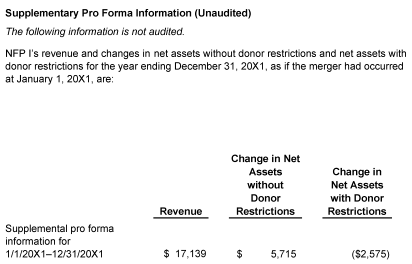
- aRevenue for the current reporting period as though the merger date had been the beginning of the annual reporting period
- bChanges in net assets without donor restrictions and changes in net assets with donor restrictions for the current reporting period as though the merger date had been the beginning of the annual reporting period.
- aRevenue for the current reporting period as though the merger date had been the beginning of the annual reporting period
- bChanges in net assets without donor restrictions and changes in net assets with donor restrictions for the current reporting period as though the merger date had been the beginning of the annual reporting period.
Acquisition by a Not-for-Profit Entity
- aRevenues attributable to the acquiree since the acquisition date that are included in the statement of activities for the reporting period
- bChanges in net assets without donor restrictions and changes in net assets with donor restrictions attributable to the acquiree since the acquisition date that are included in the statement of activities for the reporting period
- cThe revenues of the combined entity as though the acquisition date for all acquisitions that occurred during the current year had been at the beginning of the annual reporting period (supplemental pro forma information)
- dChanges in net assets without donor restrictions and changes in net assets with donor restrictions as though the acquisition date for all acquisitions that occurred during the current year had been at the beginning of the annual reporting period (supplemental pro forma information)
- eThe nature and amount of any material, nonrecurring pro forma adjustments directly attributable to the acquisition(s) included in the reported pro forma revenues and changes in net assets without donor restrictions and changes in net assets with donor restrictions (supplemental pro forma information).
- aRevenues attributable to the acquiree since the acquisition date that are included in the statement of activities for the reporting period
- bChanges in net assets without donor restrictions and changes in net assets with donor restrictions attributable to the acquiree since the acquisition date that are included in the statement of activities for the reporting period
- cThe revenues of the combined entity as though the acquisition date for all acquisitions that occurred during the current year had been at the beginning of the annual reporting period (supplemental pro forma information)
- dChanges in net assets without donor restrictions and changes in net assets with donor restrictions as though the acquisition date for all acquisitions that occurred during the current year had been at the beginning of the annual reporting period (supplemental pro forma information)
- eThe nature and amount of any material, nonrecurring pro forma adjustments directly attributable to the acquisition(s) included in the reported pro forma revenues and changes in net assets without donor restrictions and changes in net assets with donor restrictions (supplemental pro forma information).
- aA qualitative description of the factors, such as expected synergies from combining operations of the acquiree and the acquirer, intangible assets that do not qualify for separate recognition, or other factors, such as the nonrecognition of collections, that make up either of the following:
- 1The goodwill recognized
- 2The separate charge recognized in the statement of activities in accordance with paragraph 958-805-25-29.
- 1
- bThe acquisition-date fair value of the total consideration transferred (or if no consideration was transferred, that fact) and the acquisition-date fair value of each major class of consideration, such as:
- 1Cash
- 2Other tangible or intangible assets, including a business or subsidiary of the acquirer
- 3Liabilities incurred, for example, a liability for contingent consideration.
- 1
- cFor contingent consideration arrangements, all of the following:
- 1The amount recognized as of the acquisition date
- 2A description of the arrangement and the basis for determining the amount of the payment
- 3An estimate of the range of outcomes (undiscounted) or, if a range cannot be estimated, that fact and the reasons why a range cannot be estimated. If the maximum amount of the payment is unlimited, the acquirer shall disclose that fact.
- 1
- dThe total amount of goodwill that is expected to be deductible for tax purposes.
- eIf the acquisition results in an inherent contribution received, a description of the reasons why the transaction resulted in a contribution received (see paragraph 958-805-25-31).
- aA qualitative description of the factors, such as expected synergies from combining operations of the acquiree and the acquirer, intangible assets that do not qualify for separate recognition, or other factors, such as the nonrecognition of collections, that make up either of the following:
- 1The goodwill recognized
- 2The separate charge recognized in the statement of activities in accordance with paragraph 958-805-25-29.
- 1
- bThe acquisition-date fair value of the total consideration transferred (or if no consideration was transferred, that fact) and the acquisition-date fair value of each major class of consideration, such as:
- 1Cash
- 2Other tangible or intangible assets, including a business or subsidiary of the acquirer
- 3Liabilities incurred, for example, a liability for contingent consideration.
- 1
- cFor contingent consideration arrangements, all of the following:
- 1The amount recognized as of the acquisition date
- 2A description of the arrangement and the basis for determining the amount of the payment
- 3An estimate of the range of outcomes (undiscounted) or, if a range cannot be estimated, that fact and the reasons why a range cannot be estimated. If the maximum amount of the payment is unlimited, the acquirer shall disclose that fact.
- 1
- dThe total amount of goodwill that is expected to be deductible for tax purposes.
- eIf the acquisition results in an inherent contribution received, a description of the reasons why the transaction resulted in a contribution received (see paragraph 958-805-25-31).
- aThe amount of collection items acquired that are recognized in the statement of activities as a decrease in the acquirer's net assets in accordance with paragraph 958-805-25-23.
- bThe undiscounted amount of conditional promises to give acquired or assumed and a description and the amount of each group of promises with similar characteristics, such as amounts of promises conditioned on establishing new programs, completing a new building, or raising matching gifts by a specified date.
- aThe amount of collection items acquired that are recognized in the statement of activities as a decrease in the acquirer's net assets in accordance with paragraph 958-805-25-23.
- bThe undiscounted amount of conditional promises to give acquired or assumed and a description and the amount of each group of promises with similar characteristics, such as amounts of promises conditioned on establishing new programs, completing a new building, or raising matching gifts by a specified date.
- aAny changes in the recognized amounts, including any differences arising upon settlement
- bAny changes in the range of outcomes (undiscounted) and the reasons for those changes
- cThe disclosures required by Section 820-10-50.
- aAny changes in the recognized amounts, including any differences arising upon settlement
- bAny changes in the range of outcomes (undiscounted) and the reasons for those changes
- cThe disclosures required by Section 820-10-50.
805-958-55Implementation Guidance and Illustrations
Source downloaded: .Record version 88d4afa5cabd. Effective date must be checked in the source.
Implementation Guidance
- a The process leading to the combination
- b The participants to the combination
- c The combined entity.
- a Governance and related control powers
- b Financial capacity.
Illustrations
- aA combination that is a merger (Case A)
- bA combination that is neither a merger nor an acquisition (Case B).
- a A new NFP named Charity AB is to be formed.
- b The chief executive officer of Charity B will be offered the position of chief executive officer of Charity AB for a term of at least two years.
- c The initial Board of Charity AB will consist of 15 members. Charity A will appoint 9 of the initial members, preferably from the members of its existing 25-member board and its current chief executive officer. Charity B will appoint 6 of the initial members, preferably from its existing 50-member board.
- d The charter of Charity AB will provide for a maximum of 25 board members. The committee recommended that a search be undertaken to add 6 new members within a year, with each new member requiring approval by a minimum of 10 of the 15 initial members.
- e The headquarters of Charity A and its underlying lease (which has eight remaining years) will be retained.
- f A transition committee consisting of two members each from the current boards of Charity A and Charity B, under the authority of the chief executive officer of Charity AB, will be appointed to perform the following duties:
- 1 Submit a formal plan of merger to each of the governing boards and, if approved, seek approval from the appropriate state authorities.
- 2 Seek opportunities to sublease the headquarters space of Charity B for the remaining two-year lease term or to utilize that space for program activities.
- 3 Interview existing staff and other candidates for senior management positions.
- 4 Make recommendations about each of the following:
- i Eliminating program and operating redundancies, including severance packages for any terminated staff.
- ii Improving the current operating policies and practices of Charity A and Charity B.
- iii Revising employee benefit plans with the objective of adopting unified plans for Charity AB's employees without diminishing the overall benefits being offered to existing employees.
- i
- 1
- a The charities will create a new NFP named Charity E upon completing the due diligence process and obtaining approvals of the state authorities and Internal Revenue Service (IRS) qualification as a tax exempt public charity, which will be concluded no later than December 31, 20X5. Charity E incorporates Charity C's name into its own.
- b The bylaws of Charity E will establish a board of directors of up to 30 members.
- c The board of directors of Charity C will nominate 15 of the initial members of the board of Charity E. (All 15 nominees selected were current members of the board of directors of which 13 were also members of the executive committee.) The board of directors of Charity D will nominate five of the initial members.
- d Charity E will have four local community committees representing four geographic areas, one of which is County. Each committee will provide advice to the board of directors for local decision-making consistent with Charity E's mission and vision. At each election after the installation of the initial board, each local community committee may nominate up to four candidates for a one-year renewable term on the board of Charity E. The board will select a minimum of two members from each local community committee, for a total of eight additional members.
- e Amendments to the articles of incorporation or bylaws, significant transactions (a merger, reorganization, termination, or sale of substantially all assets), and reductions in the authority and responsibilities of local community committees will require an affirmative vote of at least 60 percent of the board of directors.
- f Each charity's board of directors will appoint five members to a joint transition committee, with the charge of and authority to implement the plan of consolidation.
- g Until the consolidation is complete, each charity's board of directors agrees to do the following:
- 1 Use reasonable efforts to conduct their activities consistent with their current mission allowing for changes consistent with moving to the business model, mission, and vision of Charity E.
- 2 Preserve their tax-exempt status and relationships with contributors and grantee agencies.
- 3 Not materially amend or modify their articles of incorporation or bylaws.
- 1
- h During the first three years after the combination, Charity E will do the following:
- 1 Use the business model (direct-services based) to increase its capacity for making sustained change to address key social needs.
- 2 Fund and maintain no less than four geographic sites, with one in County, to allow for community involvement in campaign, community impact programs, marketing, and public policy.
- 3 Fund and maintain the financial and program commitments of both of the consolidating charities to their respective grantee agencies, subject to available funding.
- 4 Strive to expand Brand Name program of Charity D and its strategies throughout Charity E's service area. Given the success of that program, its current staff will be given full opportunity and consideration to lead the Brand Name program for Charity E.
- 5 Not reduce significantly the current staff of the charities. It is understood that reassignments or realignments are probable. Any reductions of the staff of Charity D will be made in consultation with its former chief executive officer, who will become the vice president for program services and strategic development of Charity E.
- 1
- i The obligations of Charity D, which are outlined in the memorandum of understanding, are subject to approval by its board of directors. The obligations of Charity C, which also are outlined in the memorandum of understanding, are subject to approval by its executive committee.
-
 Charity C Charity D Financial—years ended 20X5 and 20X4: $ millions $ millions Revenues $45 $46 $30 $37 Expenses 42 42 37 38 Net excess (deficit) 3 4 (7) (1) Net assets—carrying amount 70 67 13 20 Employee head count 119 120 90 90 Joint operating agreements: Fund raising—net revenue sharing ratio 65% 35% "Information technology and marketing provided by Charity C" " receives nominal fee, pays all costs " " pays nominal fee " Governance: Members of board of directors 80 50 Members of executive committee 20 16 Staffing of Entity E: Senior officers of Entity E: President former chief executive officer Vice president strategic relations former chief executive officer Chief financial officer former chief financial officer "VP public policy (vacant, being recruited)"
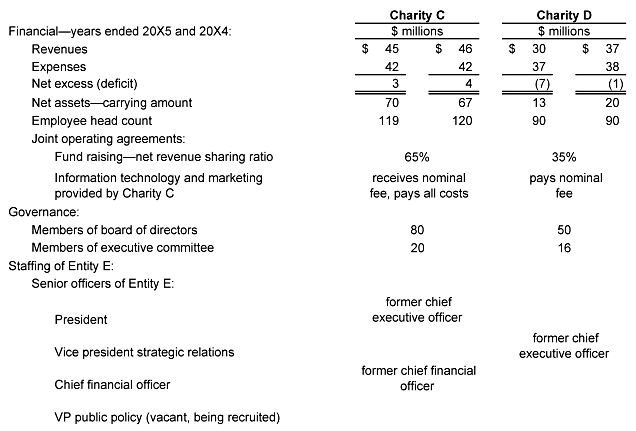
- a Charity C's dominance in the selection of 15 of the 20 members of the initial board of directors of Charity E. It also seems that the governing power center of Charity C—its executive committee—continues to control because 13 of its members continued as members of the initial 20-member board of Charity E and, together with the other 2 board members from that charity, would have a strong (if not dominating) voice in selecting at least 6 of the minimum of 8 members yet to be selected from the nominees of the 4 local community committees.
- b Charity C's dominance in the selection of the key senior officers. The table in paragraph 958-805-55-25 indicates that early on it was decided that the chief executive officer of Charity C would be retained as chief executive officer and president of Charity E, that the chief executive officer of Charity D of County would become one of Charity E's vice presidents, and that there was no need to open the chief executive officer search process to external parties.
- c Charity C's dominance in terms of financial capability and viability. Charity D has been experiencing financial difficulties and since 20X1 has been somewhat dependent on Charity C to provide back-office and information technology support for a below-cost fee.
- a Charity D's expertise in implementing new programs developed and promoted by the national entity
- b Charity D's existing donor relationships
- c Charity D's residual net assets.
Merger of Not-for-Profit Entities
- aDescription of the merger
- bSignificant asset not required to be recognized
- cConforming accounting policies
- dMajor classes of assets, liabilities, and net assets
- eRequired supplemental information.
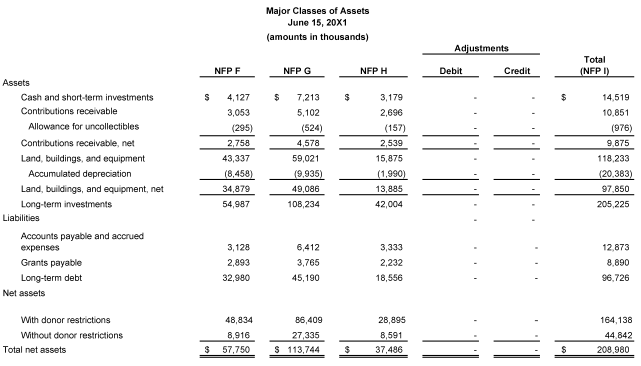
- NFP I was formed on June 15, 20X1, as the result of a merger of three local not-for-profit entities—NFP F, NFP G, and NFP H. All three entities shared the common mission of supporting youth education. Through their merger, the entities seek to further their common mission by substantially improving their after-school youth programs in the region and their capability to assist youth in need. They also seek to achieve economies of scale and other synergies through integrating their services.
- At June 15, 20X1, NFP F had a conditional promise receivable of $1.4 million from a donor to be used to construct a new after-school youth facility. The promise is conditioned upon NFP F raising an equivalent amount from others by the end of 20X4 to be used for construction of the facility. At the merger date, NFP F had raised $420,000. NFP I expects to successfully raise the remaining amount by the end of 20X4.
- NFP G and NFP H have a policy to report donor-restricted contributions whose restrictions are met in the same reporting period as support within net assets without donor restrictions. NFP F reports donor-restricted contributions whose restrictions are met in the same reporting period as donor-restricted support and subsequently releases the donor-restricted net assets when the restrictions are met. NFP I has conformed its policy to that of NFP G and NFP H. The accounting policy difference affects only the statement of activities; thus, no adjustment to the opening balance of NFP I's net asset classes is necessary.
 "Major Classes of Assets June 15, 20X1" (amounts in thousands) Adjustments NFP F NFP G NFP H Debit Credit Total (NFP I) Assets Cash and short-term investments " $4,127 " " $7,213 " " $3,179 " - - " $14,519 " Contributions receivable " 3,053 " " 5,102 " " 2,696 " - - " 10,851 " Allowance for uncollectibles (295) (524) (157) - - (976) "Contributions receivable, net" " 2,758 " " 4,578 " " 2,539 " - - " 9,875 " "Land, buildings, and equipment" " 43,337 " " 59,021 " " 15,875 " - - " 118,233 " "Accumulated depreciation" " (8,458)" " (9,935)" " (1,990)" - - " (20,383)" "Land, buildings, and equipment, net" " 34,879 " " 49,086 " " 13,885 " - - " 97,850 " "Long-term investments" " 54,987 " " 108,234 " " 42,004 " - - " 205,225 " Liabilities - - Accounts payable and accrued expenses " 3,128 " " 6,412 " " 3,333 " - - " 12,873 " Grants payable " 2,893 " " 3,765 " " 2,232 " - - " 8,890 " Long-term debt " 32,980 " " 45,190 " " 18,556 " - - " 96,726 " Net assets With donor restrictions "48,834" "86,409" "28,895" - - "164,138" Without donor restrictions " 8,916 " " 27,335 " " 8,591 " - - "44,842" Total net assets " $57,750 " " $113,744 " " $37,486 " - - " $208,980 "
-
 Supplementary Pro Forma Information (Unaudited) The following information is not audited. "NFP I's revenue and changes in net assets without donor restrictions and net assets with donor restrictions for the year ending December 31, 20X1, as if the merger had occurred at January 1, 20X1, are:" Revenue Change in Net Assets without Donor Restrictions Change in Net Assets with Donor Restrictions Supplemental pro forma information for 1/1/20X1-12/31/20X1 " $17,139 " " $5,715 " "($2,575)"
Acquisition by a Not-for-Profit Entity
Implementation Guidance
- aDefinition of a business and a nonprofit activity
- bIdentifying the acquirer
- cIntangible assets that are identifiable
- dTransactions between entities under common control.
- a If the combined entity's articles of incorporation or bylaws state that the members of the governing body are appointed, whether one of the entities has the right to appoint a voting majority of the governing body.
- b Both of the following factors, if the combined entity's governing body is self-perpetuating:
- 1 Whether one of the entities has the right to select a voting majority of the initial governing body of the entity as part of the acquisition agreement
- 2 Whether one of the entities has the ability to dominate the selection of a voting majority of the initial governing body of the entity through means other than negotiated selection rights, such as through disproportionate representation on the committee that selects nominees for that body.
- 1
- c If the initial governing body of the combined entity is selected by the governing members of the combining entities, whether one entity's members have the majority of the voting rights.
- d Any other rights to appoint or designate members of the combined entity's governing body either as of the acquisition date or in the near future (such as upon the expiration of the terms of some or all of the initial members).
- e If positions on the combined entity's governing body are designated positions, the effect of those designated positions on the ability of an entity to appoint a voting majority of the resulting entity's governing body.
- f The powers of any sponsoring entities or members of an NFP and the composition of those sponsors and members. If sponsors and corporate members have limited powers, the effect of those limited powers on the ability of one of the entities to control the combined entity.
- g If the combined entity's governing body delegates powers to committees, the nature of those delegated powers and the composition of the committees.
- h The effect of voting requirements (such as supermajority voting requirements) on the ability of one entity to appoint or dominate the selection of a supermajority of the governing body of the combined entity.
Illustrations
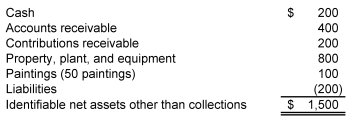
-
 Cash $200 Accounts receivable 400 Contributions receivable 200 "Property, plant, and equipment" 800 Paintings (50 paintings) 100 Liabilities (200) Identifiable net assets other than collections " $1,500 "
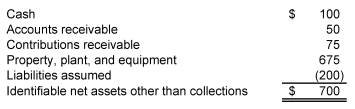 Cash $100 Accounts receivable 50 Contributions receivable 75 "Property, plant, and equipment" 675 Liabilities assumed (200) Identifiable net assets other than collections $700
-
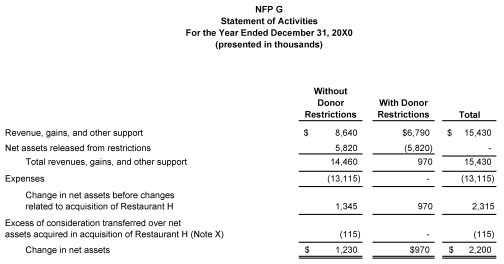 "NFP G Statement of Activities For the Year Ended December 31, 20X0 (presented in thousands)" Without Donor Restrictions With Donor Restrictions Total "Revenue, gains, and other support" " $8,640 " "$6,790 " " $15,430 " Net assets released from restrictions " 5,820 " " (5,820)" - "Total revenues, gains, and other support" " 14,460 " 970 " 15,430 " Expenses " (13,115)" - " (13,115)" "Change in net assets before changes related to acquisition of Restaurant H" " 1,345 " 970 "2,315" "Excess of consideration transferred over net assets acquired in acquisition of Restaurant H (Note X)" (115) - (115) Change in net assets " $1,230 " $970 " $2,200 "
- Note X: Acquisition of Restaurant H
- On February 10, 20X0, NFP G acquired Restaurant H, a local restaurant, which it converted into a soup kitchen. NFP G acquired Restaurant H as part of furthering its mission to care for the needy. The acquisition was effected by purchasing 100 percent of the ownership interests in Restaurant H.
- Because the operations of the soup kitchen are expected to be predominantly supported by contributions and returns on investments, NFP G has recognized the excess of the consideration transferred over the net assets acquired as a separate charge in its statement of activities rather than as goodwill. NFP G paid consideration of $525,000 for Restaurant H. On the acquisition date, the net identifiable assets of Restaurant H were $410,000. The excess of the amount paid over the net identifiable assets acquired represents the value of Restaurant H's assembled workforce, which is not recognized as a separate intangible asset, and the value of Restaurant H's earnings potential as a restaurant to other potential buyers.
- aThe inherent contribution is not subject to additional restrictions (Case A)
- bThe inherent contribution is subject to additional restrictions (Case B).
-
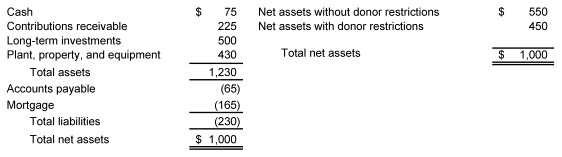 Cash $75 Net assets without donor restrictions $550 Contributions receivable 225 Net assets with donor restrictions 450 Long-term investments 500 "Plant, property, and equipment" 430 Total net assets " $1,000 " Total assets " 1,230 " Accounts payable (65) Mortgage (165) Total liabilities (230) Total net assets " $1,000 "
-
 Increase in net assets without donor restrictions: Contribution received in the acquisition of Charity J $550 Increase in net assets with donor restrictions: Contribution received in the acquisition of Charity J $450
-
 Increase in net assets without donor restrictions: Contribution received in the acquisition of Charity J $375 Increase in net assets with donor restrictions: Contribution received in the acquisition of Charity J $625
-
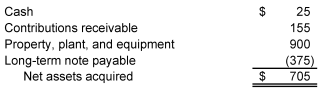 Cash $25 Contributions receivable 155 "Property, plant, and equipment" 900 Long-term note payable (375) Net assets acquired $705
-
 "Payment for acquisition of Entity S, net of cash acquired" $(275)
-
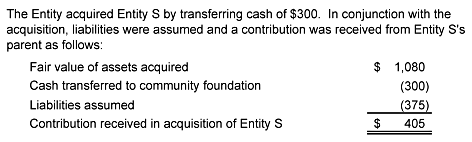 "The Entity acquired Entity S by transferring cash of $300. In conjunction with the acquisition, liabilities were assumed and a contribution was received from Entity S's parent as follows:" Fair value of assets acquired " $1,080 " Cash transferred to community foundation (300) Liabilities assumed (375) Contribution received in acquisition of Entity S $405
805-958-65Transition and Open Effective Date Information
Source downloaded: .Record version c7bb4d71c97f. Effective date must be checked in the source.
Related subtopics
- 805-954 Health Care EntitiesBusiness Combinations
- 805-20 Identifiable Assets and Liabilities, and Any Noncontrolling InterestBusiness Combinations
- 805-50 Related IssuesBusiness Combinations
- 740-805 Business CombinationsIncome Taxes
- 720-958 Not-for-Profit EntitiesOther Expenses
- 810-954 Health Care EntitiesConsolidation