ASC 842-10
Overall
842 Leases
Source downloaded: .Record version 0f96cb121a7c. Effective date must be checked in the source.
ASC 842-10 sets the scope and core mechanics common to all leases: how to decide whether a contract is or contains a lease, how to identify and separate lease and nonlease components and allocate consideration, how to classify the lease (finance/sales-type, direct financing, or operating), and how to determine lease term and lease payments. A contract contains a lease if it conveys the right to control the use of an identified item of property, plant, or equipment for a period of time in exchange for consideration — meaning the customer has both the right to obtain substantially all the economic benefits from use and the right to direct the use of that asset (842-10-15-3, 15-4). Classification is made once at the commencement date and is reassessed only on a modification not accounted for as a separate contract (or, for lessees, a change in lease term or purchase option assessment) (842-10-25-1).
Key points (7)
- The Topic applies to all leases, including subleases, but excludes leases of intangible assets, mineral/oil/gas exploration rights, biological assets including timber, inventory, and assets under construction (842-10-15-1).
- A contract is or contains a lease only if it conveys the right to control the use of an identified PP&E asset for a period of time for consideration; control requires both the right to obtain substantially all the economic benefits from use and the right to direct the use of the asset throughout the period of use (842-10-15-3; 15-4), and the assessment is revisited only if the contract's terms and conditions change (842-10-15-6).
- An asset is not 'identified' if the supplier has a substantive substitution right — practical ability to substitute throughout the period of use plus economic benefit from substituting; if the customer cannot readily determine this, the right is presumed not substantive (842-10-15-10; 15-15). A physically distinct capacity portion is an identified asset; a non-physically-distinct portion is not unless it is substantially all of the capacity (842-10-15-16).
- Separate lease components exist where the lessee can benefit from the right of use on its own or with readily available resources and the right of use is neither highly dependent on nor highly interrelated with other rights of use (842-10-15-28); land is generally separated (842-10-15-29), and administrative setup tasks and reimbursements of lessor costs are not components and receive no allocation (842-10-15-30).
- Lessees allocate consideration on a relative standalone price basis (842-10-15-33) but may elect by class of underlying asset not to separate nonlease components (842-10-15-37); lessors allocate using Topic 606 (842-10-15-38) and may elect to combine nonlease components with an operating lease component when the timing and pattern of transfer are the same (842-10-15-42A through 15-42B).
- A lessee classifies a lease as a finance lease and a lessor as a sales-type lease if any of the five criteria in 842-10-25-2 are met (ownership transfer, purchase option reasonably certain of exercise, major part of remaining economic life, PV of lease payments plus lessee residual value guarantee equals or exceeds substantially all of fair value, or specialized asset with no alternative use); otherwise a lessor has a direct financing lease only if the PV test (including third-party guarantees) is met and collection is probable, and an operating lease in all other cases (842-10-25-3). Reasonable benchmarks are 75% of economic life and 90% of fair value (842-10-55-2).
- Lease term is the noncancellable period plus optional periods the lessee is reasonably certain to exercise or not to terminate, and periods whose exercise the lessor controls (842-10-30-1); lease payments include fixed and in-substance fixed payments net of incentives, index/rate-based variable payments measured at commencement, reasonably certain purchase option prices, termination penalties, and (lessee only) amounts probable of being owed under residual value guarantees (842-10-30-5), excluding other variable payments (842-10-30-6). A modification is a separate contract only if it adds a right of use priced at its standalone price (842-10-25-8).
For students. 842-10 is the gateway subtopic: nearly every lease question starts with 'is there a lease?' and 'how is it classified?' Students commonly treat the old 90%/75% tests as bright lines — under 842 they are only 'one reasonable approach' (842-10-55-2) — and forget that lessors cannot reassess lease term or remeasure lease payments absent a modification (842-10-35-3; 35-6).
Machine-generated study aid for ASC 842-10. Check the source paragraphs below.
842-10-00Status
Source downloaded: .Record version c96f3b5f7a44. Effective date must be checked in the source.
842-10-05Overview and Background
Source downloaded: .Record version a0c7e5331629. Effective date must be checked in the source.
- a Overall
- b
- c
- d Sale and Leaseback Transactions
- e Leveraged Lease Arrangements
842-10-10Objectives
Source downloaded: .Record version 61cff63327b3. Effective date must be checked in the source.
842-10-15Scope and Scope Exceptions
Source downloaded: .Record version 97629ca1bff3. Effective date must be checked in the source.
- aLeases of intangible assets (see Topic 350, Intangibles—Goodwill and Other).
- bLeases to explore for or use minerals, oil, natural gas, and similar nonregenerative resources (see Topics 930, Extractive Activities—Mining, and 932, Extractive Activities—Oil and Gas). This includes the intangible right to explore for those natural resources and rights to use the land in which those natural resources are contained (that is, unless those rights of use include more than the right to explore for natural resources), but not equipment used to explore for the natural resources.
- cLeases of biological assets, including timber (see Topic 905, Agriculture).
- d
- eLeases of assets under construction (see Topic 360, Property, Plant, and Equipment).
Identifying a Lease
- aIf the arrangement was previously determined to be a lease and continues to be a lease, the entity shall classify and account for the lease on the basis of the enforceable terms and conditions. If the enforceable terms and conditions differ from the written terms and conditions previously used to apply paragraph 842-10-15-3A, the entity shall apply the modification requirements in paragraphs using the enforceable terms and conditions. If the enforceable terms and conditions are the same as the written terms and conditions previously used to apply paragraph 842-10-15-3A, the modification requirements in those paragraphs are not applicable.
- bIf the arrangement was previously not determined to be a lease and is determined to be a lease, the entity shall account for the arrangement as a new lease.
- cIf the arrangement was previously determined to be a lease and the lease ceases to exist:
- 1A lessee shall apply the derecognition requirements for fully terminated leases in paragraph 842-20-40-1.
- 2A lessor with a lease previously classified as a sales-type lease or a direct financing lease shall apply the derecognition requirements for terminated leases in paragraph 842-30-40-2.
- 3A lessor with a lease previously classified as an operating lease shall derecognize any amounts that would not exist if the arrangement was not accounted for as a lease and account for the arrangement in accordance with other generally accepted accounting principles (GAAP).
- 1
- aThe right to obtain substantially all of the economic benefits from use of the identified asset (see paragraphs )
- bThe right to direct the use of the identified asset (see paragraphs ).
- aThe supplier has the practical ability to substitute alternative assets throughout the period of use (for example, the customer cannot prevent the supplier from substituting an asset, and alternative assets are readily available to the supplier or could be sourced by the supplier within a reasonable period of time).
- bThe supplier would benefit economically from the exercise of its right to substitute the asset (that is, the economic benefits associated with substituting the asset are expected to exceed the costs associated with substituting the asset).
- aAn agreement by a future customer to pay an above-market rate for use of the asset
- bThe introduction of new technology that is not substantially developed at inception of the contract
- cA substantial difference between the customer's use of the asset, or the performance of the asset and the use or performance considered likely at inception of the contract
- dA substantial difference between the market price of the asset during the period of use and the market price considered likely at inception of the contract.
- aIf a contract limits the use of a motor vehicle to only one particular territory during the period of use, an entity shall consider only the economic benefits from use of the motor vehicle within that territory and not beyond.
- bIf a contract specifies that a customer can drive a motor vehicle only up to a particular number of miles during the period of use, an entity shall consider only the economic benefits from use of the motor vehicle for the permitted mileage and not beyond.
- aThe customer has the right to direct how and for what purpose the asset is used throughout the period of use (as described in paragraphs ).
- bThe relevant decisions about how and for what purpose the asset is used are predetermined (see paragraph 842-10-15-21) and at least one of the following conditions exists:
- 1The customer has the right to operate the asset (or to direct others to operate the asset in a manner that it determines) throughout the period of use without the supplier having the right to change those operating instructions.
- 2The customer designed the asset (or specific aspects of the asset) in a way that predetermines how and for what purpose the asset will be used throughout the period of use.
- 1
- aThe right to change the type of output that is produced by the asset (for example, deciding whether to use a shipping container to transport goods or for storage, or deciding on the mix of products sold from a retail unit)
- bThe right to change when the output is produced (for example, deciding when an item of machinery or a power plant will be used)
- cThe right to change where the output is produced (for example, deciding on the destination of a truck or a ship or deciding where a piece of equipment is used or deployed)
- dThe right to change whether the output is produced and the quantity of that output (for example, deciding whether to produce energy from a power plant and how much energy to produce from that power plant).
Separating Components of a Contract
- aThe lessee can benefit from the right of use either on its own or together with other resources that are readily available to the lessee. Readily available resources are goods or services that are sold or leased separately (by the lessor or other suppliers) or resources that the lessee already has obtained (from the lessor or from other transactions or events).
- bThe right of use is neither highly dependent on nor highly interrelated with the other right(s) to use underlying assets in the contract. A lessee's right to use an underlying asset is highly dependent on or highly interrelated with another right to use an underlying asset if each right of use significantly affects the other.
- aAdministrative tasks to set up a contract or initiate the lease that do not transfer a good or service to the lessee
- bReimbursement or payment of the lessor's costs. For example, a lessor may incur various costs in its role as a lessor or as owner of the underlying asset. A requirement for the lessee to pay those costs, whether directly to a third party or as a reimbursement to the lessor, does not transfer a good or service to the lessee separate from the right to use the underlying asset.
- aThe lessee shall determine the relative standalone price of the separate lease components and the nonlease components on the basis of their observable standalone prices. If observable standalone prices are not readily available, the lessee shall estimate the standalone prices, maximizing the use of observable information. A residual estimation approach may be appropriate if the standalone price for a component is highly variable or uncertain.
- bThe lessee shall allocate the consideration in the contract on a relative standalone price basis to the separate lease components and the nonlease components of the contract.
- aAny fixed payments (for example, monthly service charges) or in substance fixed payments, less any incentives paid or payable to the lessee, other than those included in paragraph 842-10-30-5
- bAny other variable payments that depend on an index or a rate, initially measured using the index or rate at the commencement date.
- aA remeasurement of the lease liability (for example, a remeasurement resulting from a change in the lease term or a change in the assessment of whether a lessee is or is not reasonably certain to exercise an option to purchase the underlying asset) (see paragraph 842-20-35-4)
- bThe effective date of a contract modification that is not accounted for as a separate contract (see paragraph 842-10-25-8).
- aThe lessor's efforts to transfer one or more goods or services that are not leases
- bAn outcome from transferring one or more goods or services that are not leases.
- aThe timing and pattern of transfer for the lease component and nonlease components associated with that lease component are the same.
- bThe lease component, if accounted for separately, would be classified as an operating lease in accordance with paragraphs 842-10-25-2 through 25-3A.
- aAs a single performance obligation entirely in accordance with Topic 606 if the nonlease component or components are the predominant component(s) of the combined component. In applying Topic 606, the entity shall do both of the following:
- 1Use the same measure of progress as used for applying paragraph 842-10-15-42A(a)
- 2Account for all variable payments related to any good or service, including the lease, that is part of the combined component in accordance with the guidance on variable consideration in Topic 606.
- 1
- bOtherwise, as an operating lease entirely in accordance with this Topic. In applying this Topic, the entity shall account for all variable payments related to any good or service that is part of the combined component as variable lease payments.
Other Considerations
842-10-25Recognition
Source downloaded: .Record version 66884183a995. Effective date must be checked in the source.
Lease Classification
- aThe lease transfers ownership of the underlying asset to the lessee by the end of the lease term.
- bThe lease grants the lessee an option to purchase the underlying asset that the lessee is reasonably certain to exercise.
- cThe lease term is for the major part of the remaining economic life of the underlying asset. However, if the commencement date falls at or near the end of the economic life of the underlying asset, this criterion shall not be used for purposes of classifying the lease.
- dThe present value of the sum of the lease payments and any residual value guaranteed by the lessee that is not already reflected in the lease payments in accordance with paragraph 842-10-30-5(f) equals or exceeds substantially all of the fair value of the underlying asset.
- eThe underlying asset is of such a specialized nature that it is expected to have no alternative use to the lessor at the end of the lease term.
- aA lessee shall classify the lease as an operating lease.
- bA lessor shall classify the lease as either a direct financing lease or an operating lease. A lessor shall classify the lease as an operating lease unless both of the following criteria are met, in which case the lessor shall classify the lease as a direct financing lease:
- 1The present value of the sum of the lease payments and any residual value guaranteed by the lessee that is not already reflected in the lease payments in accordance with paragraph 842-10-30-5(f) and/or any other third party unrelated to the lessor equals or exceeds substantially all of the fair value of the underlying asset.
- 2It is probable that the lessor will collect the lease payments plus any amount necessary to satisfy a residual value guarantee.
- 1
Lease Modifications
- a
- bThe lease payments increase commensurate with the standalone price for the additional right of use, adjusted for the circumstances of the particular contract. For example, the standalone price for the lease of one floor of an office building in which the lessee already leases other floors in that building may be different from the standalone price of a similar floor in a different office building, because it was not necessary for a lessor to incur costs that it would have incurred for a new lessee.
- aGrants the lessee an additional right of use not included in the original contract (and that modification is not accounted for as a separate contract in accordance with paragraph 842-10-25-8)
- bExtends or reduces the term of an existing lease (for example, changes the lease term from five to eight years or vice versa), other than through the exercise of a contractual option to extend or terminate the lease (as described in paragraph 842-20-35-5)
- cFully or partially terminates an existing lease (for example, reduces the assets subject to the lease)
- dChanges the consideration in the contract only.
- aIf the modified lease is classified as an operating lease, the lessor shall consider any prepaid or accrued lease rentals relating to the original lease as a part of the lease payments for the modified lease.
- bIf the modified lease is classified as a direct financing lease or a sales-type lease, the lessor shall derecognize any deferred rent liability or accrued rent asset and adjust the selling profit or selling loss accordingly.
- aIf the modified lease is classified as a direct financing lease, the lessor shall adjust the discount rate for the modified lease so that the initial net investment in the modified lease equals the carrying amount of the net investment in the original lease immediately before the effective date of the modification.
- bIf the modified lease is classified as a sales-type lease, the lessor shall account for the modified lease in accordance with the guidance applicable to sales-type leases in Subtopic 842-30, with the commencement date of the modified lease being the effective date of the modification. In calculating the selling profit or selling loss on the lease, the fair value of the underlying asset is its fair value at the effective date of the modification and its carrying amount is the carrying amount of the net investment in the original lease immediately before the effective date of the modification.
- cIf the modified lease is classified as an operating lease, the carrying amount of the underlying asset equals the net investment in the original lease immediately before the effective date of the modification.
- aIf the modified lease is classified as a sales-type or a direct financing lease, in the same manner as described in paragraph 842-10-25-16(a)
- bIf the modified lease is classified as an operating lease, in the same manner as described in paragraph 842-10-25-16(c).
Contract Combinations
- aThe contracts are negotiated as a package with the same commercial objective(s).
- bThe amount of consideration to be paid in one contract depends on the price or performance of the other contract.
- cThe rights to use underlying assets conveyed in the contracts (or some of the rights of use conveyed in the contracts) are a single lease component in accordance with paragraph 842-10-15-28.
842-10-30Initial Measurement
Source downloaded: .Record version 6de337244b8e. Effective date must be checked in the source.
Lease Term and Purchase Options
- aPeriods covered by an option to extend the lease if the lessee is reasonably certain to exercise that option
- bPeriods covered by an option to terminate the lease if the lessee is reasonably certain not to exercise that option
- cPeriods covered by an option to extend (or not to terminate) the lease in which exercise of the option is controlled by the lessor.
Initial Measurement of the Lease Payments
- aFixed payments, including in substance fixed payments, less any lease incentives paid or payable to the lessee (see paragraphs ).
- bVariable lease payments that depend on an index or a rate (such as the Consumer Price Index or a market interest rate), initially measured using the index or rate at the commencement date.
- cThe exercise price of an option to purchase the underlying asset if the lessee is reasonably certain to exercise that option (assessed considering the factors in paragraph 842-10-55-26).
- dPayments for penalties for terminating the lease if the lease term (as determined in accordance with paragraph 842-10-30-1) reflects the lessee exercising an option to terminate the lease.
- eFees paid by the lessee to the owners of a special-purpose entity for structuring the transaction. However, such fees shall not be included in the fair value of the underlying asset for purposes of applying paragraph 842-10-25-2(d).
- fFor a lessee only, amounts probable of being owed by the lessee under residual value guarantees (see paragraphs ).
- aVariable lease payments other than those in paragraph 842-10-30-5(b)
- bAny guarantee by the lessee of the lessor's debt
- cAmounts allocated to nonlease components in accordance with paragraphs
- dLeasehold improvements recognized by a lessee and accounted for in accordance with paragraph 842-20-35-12A.
- aCommissions
- bPayments made to an existing tenant to incentivize that tenant to terminate its lease.
- aGeneral overheads, including, for example, depreciation, occupancy and equipment costs, unsuccessful origination efforts, and idle time
- bCosts related to activities performed by the lessor for advertising, soliciting potential lessees, servicing existing leases, or other ancillary activities
- cCosts related to activities that occur before the lease is obtained, such as costs of obtaining tax or legal advice, negotiating lease terms and conditions, or evaluating a prospective lessee's financial condition.
842-10-35Subsequent Measurement
Source downloaded: .Record version fad716b912b1. Effective date must be checked in the source.
Lease Term and Purchase Options
- a There is a significant event or a significant change in circumstances that is within the control of the lessee that directly affects whether the lessee is reasonably certain to exercise or not to exercise an option to extend or terminate the lease or to purchase the underlying asset.
- b There is an event that is written into the contract that obliges the lessee to exercise (or not to exercise) an option to extend or terminate the lease.
- c The lessee elects to exercise an option even though the entity had previously determined that the lessee was not reasonably certain to do so.
- d The lessee elects not to exercise an option even though the entity had previously determined that the lessee was reasonably certain to do so.
Subsequent Measurement of the Lease Payments
- a The lease is modified, and that modification is not accounted for as a separate contract in accordance with paragraph 842-10-25-8.
- b A contingency upon which some or all of the variable lease payments that will be paid over the remainder of the lease term are based is resolved such that those payments now meet the definition of lease payments. For example, an event occurs that results in variable lease payments that were linked to the performance or use of the underlying asset becoming fixed payments for the remainder of the lease term. However, a change in a reference index or a rate upon which some or all of the variable lease payments in the contract are based does not constitute the resolution of a contingency subject to (b) (see paragraph 842-10-35-5 for guidance on the remeasurement of variable lease payments that depend on an index or a rate).
- c There is a change in any of the following:
- 1 The lease term, as described in paragraph 842-10-35-1. A lessee shall determine the revised lease payments on the basis of the revised lease term.
- 2 The assessment of whether the lessee is reasonably certain to exercise or not to exercise an option to purchase the underlying asset, as described in paragraph 842-10-35-1. A lessee shall determine the revised lease payments to reflect the change in the assessment of the purchase option.
- 3 Amounts probable of being owed by the lessee under residual value guarantees. A lessee shall determine the revised lease payments to reflect the change in amounts probable of being owed by the lessee under residual value guarantees.
- 1
842-10-55Implementation Guidance and Illustrations
Source downloaded: .Record version 06c44e78d121. Effective date must be checked in the source.
Implementation Guidance
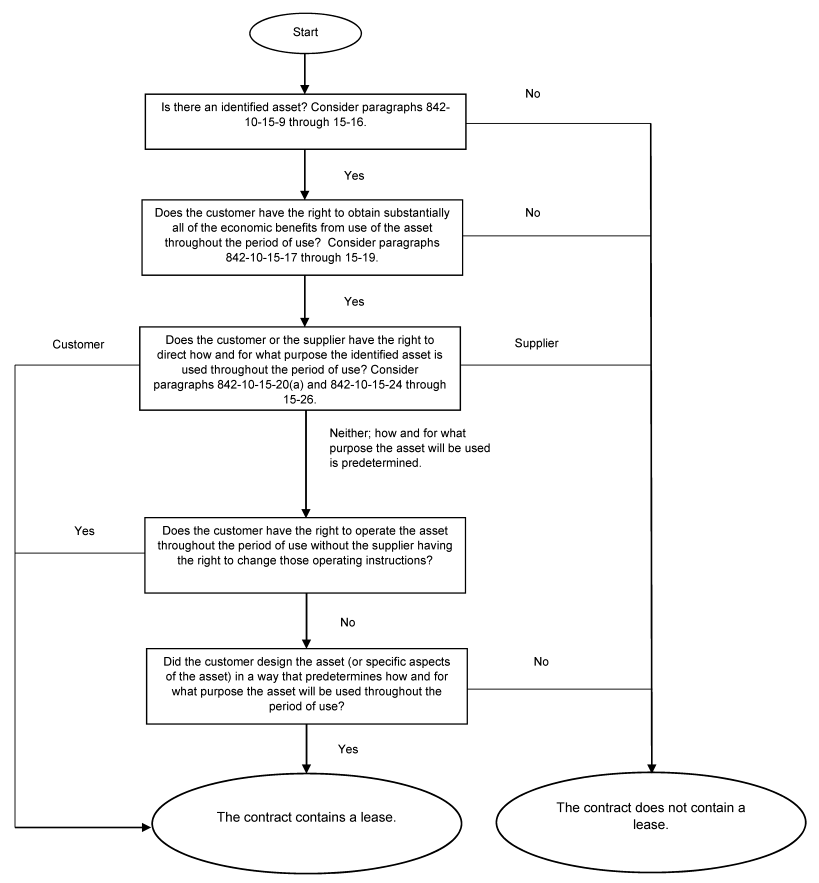 Start Is there an identified asset? Consider paragraphs 842-10-15-9 through 15-16. Does the customer have the right to obtain substantially all of the economic benefits from use of the asset throughout the period of use? Consider paragraphs 842-10-15-17 through 15-19. Does the customer or the supplier have the right to direct how and for what purpose the identified asset is used throughout the period of use? Consider paragraphs 842-10-15-20(a) and 842-10-15-24 through 15-26. Neither; how and for what purpose the asset will be used is predetermined. Does the customer have the right to operate the asset throughout the period of use without the supplier having the right to change those operating instructions? Did the customer design the asset (or specific aspects of the asset) in a way that predetermines how and for what purpose the asset will be used throughout the period of use? The contract contains a lease. The contract does not contain a lease.
- aSeventy-five percent or more of the remaining economic life of the underlying asset is a major part of the remaining economic life of that underlying asset.
- bA commencement date that falls at or near the end of the economic life of the underlying asset refers to a commencement date that falls within the last 25 percent of the total economic life of the underlying asset.
- cNinety percent or more of the fair value of the underlying asset amounts to substantially all the fair value of the underlying asset.
- aThe underlying asset is owned by a governmental unit or authority.
- bThe underlying asset is part of a larger facility, such as an airport, operated by or on behalf of the lessor.
- cThe underlying asset is a permanent structure or a part of a permanent structure, such as a building, that normally could not be moved to a new location.
- dThe lessor, or in some circumstances a higher governmental authority, has the explicit right under the lease agreement or existing statutes or regulations applicable to the underlying asset to terminate the lease at any time during the lease term, such as by closing the facility containing the underlying asset or by taking possession of the facility.
- eThe lease neither transfers ownership of the underlying asset to the lessee nor allows the lessee to purchase or otherwise acquire ownership of the underlying asset.
- fThe underlying asset or equivalent asset in the same service area cannot be purchased or leased from a nongovernmental unit or authority. An equivalent asset in the same service area is an asset that would allow continuation of essentially the same service or activity as afforded by the underlying asset without any appreciable difference in economic results to the lessee.
- aContractual terms and conditions for the optional periods compared with current market rates, such as:
- 1The amount of lease payments in any optional period
- 2The amount of any variable lease payments or other contingent payments, such as payments under termination penalties and residual value guarantees
- 3The terms and conditions of any options that are exercisable after initial optional periods (for example, the terms and conditions of a purchase option that is exercisable at the end of an extension period at a rate that is currently below market rates).
- 1
- bSignificant leasehold improvements that are expected to have significant economic value for the lessee when the option to extend or terminate the lease or to purchase the underlying asset becomes exercisable.
- cCosts relating to the termination of the lease and the signing of a new lease, such as negotiation costs, relocation costs, costs of identifying another underlying asset suitable for the lessee's operations, or costs associated with returning the underlying asset in a contractually specified condition or to a contractually specified location.
- dThe importance of that underlying asset to the lessee's operations, considering, for example, whether the underlying asset is a specialized asset and the location of the underlying asset.
- aConstructing significant leasehold improvements that are expected to have significant economic value for the lessee when the option becomes exercisable
- bMaking significant modifications or customizations to the underlying asset
- cMaking a business decision that is directly relevant to the lessee's ability to exercise or not to exercise an option (for example, extending the lease of a complementary asset or disposing of an alternative asset)
- dSubleasing the underlying asset for a period beyond the exercise date of the option.
- aPayments made to or on behalf of the lessee
- bLosses incurred by the lessor as a result of assuming a lessee's preexisting lease with a third party. In that circumstance, the lessor and the lessee should independently estimate any loss attributable to that assumption. For example, the lessee's estimate of the lease incentive could be based on a comparison of the new lease with the market rental rate available for similar underlying assets or the market rental rate from the same lessor without the lease assumption. The lessor should estimate any loss on the basis of the total remaining costs reduced by the expected benefits from the sublease for use of the assumed underlying asset.
- aPayments that do not create genuine variability (such as those that result from clauses that do not have economic substance)
- bThe lower of the payments to be made when a lessee has a choice about which set of payments it makes, although it must make at least one set of payments.
Illustrations
- aCustomer has the right to obtain substantially all of the economic benefits from use of the cars over the five-year period of use. Customer has exclusive use of the cars throughout the period of use, including when they are not being used to transport Customer's goods.
- bCustomer has the right to direct the use of the cars. The contractual restrictions on the cargo that can be transported by the cars are protective rights of Supplier and define the scope of Customer's right to use the cars. Within the scope of its right of use defined in the contract, Customer makes the relevant decisions about how and for what purpose the cars are used by being able to decide when and where the rail cars will be used and which goods are transported using the cars. Customer also determines whether and how the cars will be used when not being used to transport its goods (for example, whether and when they will be used for storage). Customer has the right to change these decisions during the five-year period of use.
- aSupplier has the practical ability to substitute each car and the engine throughout the period of use. Alternative cars and engines are readily available to Supplier, and Supplier can substitute each car and the engine without Customer's approval.
- bSupplier would benefit economically from substituting each car and the engine. There would be minimal, if any, cost associated with substituting each car or the engine because the cars and engines are stored at Supplier's premises and Supplier has a large pool of similar cars and engines. Supplier benefits from substituting each car or the engine in contracts of this nature because substitution allows Supplier to, for example, (1) use cars or an engine to fulfill a task for which the cars or engine are already positioned to perform (for example, a task at a rail yard close to the point of origin) or (2) use cars or an engine that would otherwise be sitting idle because they are not being used by a customer.
- aSupplier has the practical ability to change the space used by Customer throughout the period of use. There are many areas in the airport that meet the specifications for the space in the contract, and Supplier has the right to change the location of the space to other space that meets the specifications at any time without Customer's approval.
- bSupplier would benefit economically from substituting the space. There would be minimal cost associated with changing the space used by Customer because the kiosk can be moved easily. Supplier benefits from substituting the space in the airport because substitution allows Supplier to make the most effective use of the space at boarding areas in the airport to meet changing circumstances.
- aCustomer has the right to obtain substantially all of the economic benefits from use of the fibers over the 15-year period of use. Customer has exclusive use of the fibers throughout the period of use.
- bCustomer has the right to direct the use of the fibers. Customer makes the relevant decisions about how and for what purpose the fibers are used by deciding when and whether to light the fibers and when and how much output the fibers will produce (that is, what data and how much data those fibers will transport). Customer has the right to change these decisions during the 15-year period of use.
- aCustomer has the right to obtain substantially all of the economic benefits from use of Retail Unit A over the five-year period of use. Customer has exclusive use of Retail Unit A throughout the period of use. Although a portion of the cash flows derived from sales from Retail Unit A will flow from Customer to Supplier, this represents consideration that Customer pays Supplier for the right to use the retail unit. It does not prevent Customer from having the right to obtain substantially all of the economic benefits from use of Retail Unit A.
- bCustomer has the right to direct the use of Retail Unit A. The contractual restrictions on the goods that can be sold from Retail Unit A and when Retail Unit A is open define the scope of Customer's right to use Retail Unit A. Within the scope of its right of use defined in the contract, Customer makes the relevant decisions about how and for what purpose Retail Unit A is used by being able to decide, for example, the mix of products that will be sold in the retail unit and the sale price for those products. Customer has the right to change these decisions during the five-year period of use.
- aCustomer has the right to obtain substantially all of the economic benefits from the use of the truck over the period of use. Customer has exclusive use of the truck throughout the period of use.
- bCustomer has the right to direct the use of the truck. How and for what purpose the truck will be used (that is, the transport of specified cargo from New York to San Francisco within a specified time frame) are predetermined in the contract. Customer directs the use of the truck because it has the right to operate the truck (for example, speed, route, and rest stops) throughout the period of use. Customer makes all of the decisions about the use of the truck that can be made during the period of use through its control of the operations of the truck.
- aCustomer has the right to obtain substantially all of the economic benefits from use of the ship over the five-year period of use. Customer has exclusive use of the ship throughout the period of use.
- bCustomer has the right to direct the use of the ship. The contractual restrictions about where the ship can sail and the cargo to be transported by the ship define the scope of Customer's right to use the ship. They are protective rights that protect Supplier's investment in the ship and Supplier's personnel. Within the scope of its right of use, Customer makes the relevant decisions about how and for what purpose the ship is used throughout the five-year period of use because it decides whether, where, and when the ship sails, as well as the cargo it will transport. Customer has the right to change these decisions throughout the five-year period of use.
- aCustomer has the right to obtain substantially all of the economic benefits from use of the aircraft over the two-year period of use. Customer has exclusive use of the aircraft throughout the period of use.
- bCustomer has the right to direct the use of the aircraft. The restrictions on where the aircraft can fly define the scope of Customer's right to use the aircraft. Within the scope of its right of use, Customer makes the relevant decisions about how and for what purpose the aircraft is used throughout the two-year period of use because it decides whether, where, and when the aircraft travels as well as the passengers and cargo it will transport. Customer has the right to change these decisions throughout the two-year period of use.
- aCustomer has the right to obtain substantially all of the economic benefits from use of the solar farm over the 20-year period of use. Customer has exclusive use of the solar farm; it takes all of the electricity produced by the farm over the 20-year period of use as well as the renewable energy credits that are a by-product from use of the solar farm. Although Supplier will be receiving economic benefits from the solar farm in the form of tax credits, those economic benefits relate to the ownership of the solar farm rather than the use of the solar farm and, thus, are not considered in this assessment.
- bCustomer has the right to direct the use of the solar farm. Neither Customer nor Supplier decides how and for what purpose the solar farm is used during the period of use because those decisions are predetermined by the design of the asset (that is, the design of the solar farm has, in effect, programmed into the asset any relevant decision-making rights about how and for what purpose the solar farm is used throughout the period of use). Customer does not operate the solar farm; Supplier makes the decisions about the operation of the solar farm. However, Customer's design of the solar farm has given it the right to direct the use of the farm (as described in paragraph 842-10-15-20(b)(2)). Because the design of the solar farm has predetermined how and for what purpose the asset will be used throughout the period of use, Customer's control over that design is substantively no different from Customer controlling those decisions.
- aCustomer has the right to obtain substantially all of the economic benefits from use of the power plant over the 10-year period of use. Customer has exclusive use of the power plant; it has rights to all of the power produced by the power plant throughout the 10-year period of use.
- bCustomer has the right to direct the use of the power plant. Customer makes the relevant decisions about how and for what purpose the power plant is used because it has the right to determine whether, when, and how much power the plant will produce (that is, the timing and quantity, if any, of power produced) throughout the period of use. Because Supplier is prevented from using the power plant for another purpose, Customer's decision making about the timing and quantity of power produced, in effect, determines when and whether the plant produces output.
- aCustomer has the right to obtain substantially all of the economic benefits from use of the server over the three-year period of use. Customer has exclusive use of the server throughout the period of use.
- bCustomer has the right to direct the use of the server. Customer makes the relevant decisions about how and for what purpose the server is used because it has the right to decide which aspect of its operations the server is used to support and which data it stores on the server. Customer is the only party that can make decisions about the use of the server during the period of use.
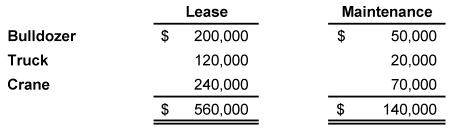
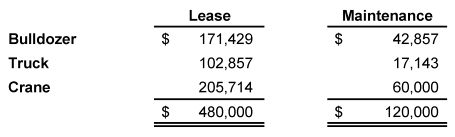
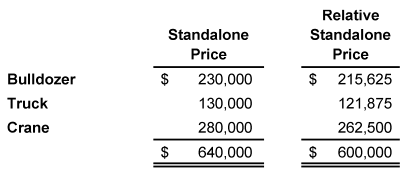
- aThe criterion in paragraph 842-10-15-28(a) is met because Lessee can benefit from each of the three pieces of equipment on its own or together with other readily available resources (for example, Lessee could readily lease or purchase an alternative truck or crane to use with the bulldozer).
- bThe criterion in paragraph 842-10-15-28(b) is met because, despite the fact that Lessee is leasing all three machines for one purpose (that is, to engage in construction operations), the machines are not highly dependent on or highly interrelated with each other. The machines are not, in effect, inputs to a combined single item for which Lessee is contracting. Lessor can fulfill each of its obligations to lease one of the underlying assets independently of its fulfillment of the other lease obligations, and Lessee's ability to derive benefit from the lease of each piece of equipment is not significantly affected by its decision to lease or not lease the other equipment from Lessor.
 Lease Maintenance Bulldozer " $200,000 " " $50,000 " Truck " 120,000 " " 20,000 " Crane " 240,000 " " 70,000 " " $560,000 " " $140,000 "
 Lease Maintenance Bulldozer " $171,429 " " $42,857 " Truck " 102,857 " " 17,143 " Crane " 205,714 " " 60,000 " " $480,000 " " $120,000 "
 "Standalone Price" "Relative Standalone Price" Bulldozer " $230,000 " " $215,625 " Truck " 130,000 " " 121,875 " Crane " 280,000 " " 262,500 " " $640,000 " " $600,000 "
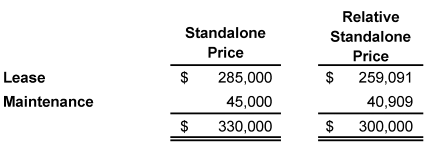 "Standalone Price" "Relative Standalone Price" Lease " $285,000 " " $259,091 " Maintenance " 45,000 " " 40,909 " " $330,000 " " $300,000 "
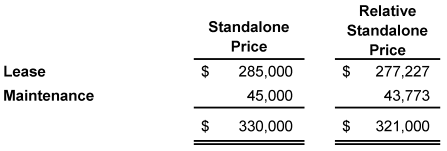 "Standalone Price" "Relative Standalone Price" Lease " $285,000 " " $277,227 " Maintenance " 45,000 " " 43,773 " " $330,000 " " $321,000 "
- aThe potential variable payments are $14,000 per year ($42,000 in total), and the annual fixed payments are $93,000 per year ($279,000 in total).
- bWhile Lessor's estimate of the variable payments to which it will be entitled is $42,000, Lessor concludes that it is not probable that including the full $42,000 in potential variable payments in the consideration in the contract will not result in a significant revenue reversal (that is, the entity applies the constraint on variable consideration in paragraph 606-10-32-11). Lessor concludes that only $28,000 is probable of not resulting in a significant revenue reversal. Therefore, the consideration in the contract is initially $307,000 ($279,000 + $28,000).
- aA remaining lease term of 5 years
- bAnnual allocated lease payments of $77,778 in Years 6 through 10 (see paragraph 842-10-55-173)
- cLessee's incremental borrowing rate at the effective date of the modification of 7 percent.
- aA lease term of 4 years
- bFour allocated annual payments of $72,222 ([allocated lease payments of $311,111 − $22,222 rent prepayment] ÷ 4 years)
- cLessee's incremental borrowing rate at the commencement date of the separate lease component for the additional office space of 7.5 percent.
- aThe lease term is 10 years, while the office building has a remaining economic life of 40 years.
- bThe fair value of the office space is estimated to be significantly in excess of the present value of the lease payments.
- cThe office space is expected to have an alternative use to Lessor at the end of the lease term.
- aA remaining lease term of 5 years
- bLease payments of $68,000 in the year of modification (Year 6), increasing by 5 percent each year thereafter
- cLessee's incremental borrowing rate at the effective date of the modification of 7 percent.
- aRemaining lease term of 5 years
- bPayments of $93,000 in Year 6, increasing by $1,000 each year for the remainder of the lease term
- cLessee's incremental borrowing rate at the effective date of the modification of 7 percent.
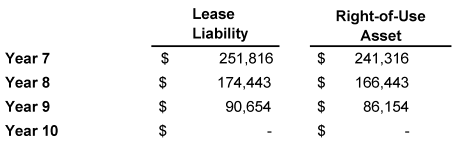 "Lease Liability" "Right-of-Use Asset" Year 7 " $251,816 " " $241,316 " Year 8 " $174,443 " " $166,443 " Year 9 " $90,654 " " $86,154 " Year 10 $ - $
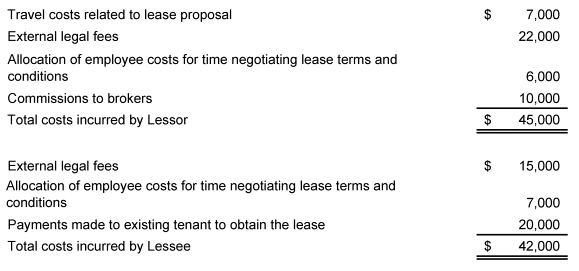 Travel costs related to lease proposal " $7,000 " External legal fees " 22,000 " "Allocation of employee costs for time negotiating lease terms and conditions " " 6,000 " Commissions to brokers " 10,000 " Total costs incurred by Lessor " $45,000 " External legal fees " $15,000 " " Allocation of employee costs for time negotiating lease terms and conditions " " 7,000 " Payments made to existing tenant to obtain the lease " 20,000 " Total costs incurred by Lessee " $42,000 "
842-10-65Transition and Open Effective Date Information
Source downloaded: .Record version fbda7266a519. Effective date must be checked in the source.
Transition Related to Accounting Standards Updates No. 2016-02, <em class="ph i">Leases (Topic 842)</em>, No. 2018-01, <em class="ph i">Leases (Topic 842): Land Easement Practical Expedient for Transition to Topic 842,</em> No. 2018-10, <em class="ph i">Codification Improvements to Topic 842, Leases,</em> No. 2018-11, <em class="ph i">Leases (Topic 842): Targeted Improvements,</em> No. 2018-20, <em class="ph i">Leases (Topic 842): Narrow-Scope Improvements for Lessors,</em> No. 2019-01, <em class="ph i">Leases (Topic 842): Codification Improvements</em>, No. 2019-10, <em class="ph i">Financial Instruments—Credit Losses (Topic 326), Derivatives and Hedging (Topic 815), Leases (Topic 842): Effective Dates</em>, No. 2020-05, <em class="ph i">Revenue from Contracts with Customers (Topic 606) and Leases (Topic 842): Effective Dates for Certain Entities</em>, No. 2021-05, <em class="ph i">Leases (Topic 842): Lessors—Certain Leases with Variable Lease Payments</em>, No. 2021-09, <em class="ph i">Leases (Topic 842): Discount Rate for Lessees That Are Not Public Business Entities</em>, and No. 2023-01, <em class="ph i">Leases (Topic 842): Common Control Arrangements</em>
- aA public business entity, a not-for-profit entity that has issued or is a conduit bond obligor for securities that are traded, listed, or quoted on an exchange or an over-the-counter market (with an exception for those entities that have not yet issued their financial statements or made financial statements available for issuance as described in the following sentence), and an employee benefit plan that files or furnishes financial statements with or to the U.S. Securities and Exchange Commission shall apply the pending content that links to this paragraph for financial statements issued for fiscal years beginning after December 15, 2018, and interim periods within those fiscal years. A not-for-profit entity that has issued or is a conduit bond obligor for securities that are traded, listed, or quoted on an exchange or an over-the-counter market that has not yet issued financial statements or made financial statements available for issuance as of June 3, 2020 shall apply the pending content that links to this paragraph for fiscal years beginning after December 15, 2019, and interim periods within those fiscal years. Earlier application is permitted.
- bAll other entities shall apply the pending content that links to this paragraph for financial statements issued for fiscal years beginning after December 15, 2021, and interim periods within fiscal years beginning after December 15, 2022. Earlier application is permitted.
- cIn the financial statements in which an entity first applies the pending content that links to this paragraph, the entity shall recognize and measure leases within the scope of the pending content that links to this paragraph that exist at the application date, as determined by the transition method that the entity elects. An entity shall apply the pending content that links to this paragraph using one of the following two methods:
- 1Retrospectively to each prior reporting period presented in the financial statements with the cumulative effect of initially applying the pending content that links to this paragraph recognized at the beginning of the earliest comparative period presented, subject to the guidance in (d) through (gg). Under this transition method, the application date shall be the later of the beginning of the earliest period presented in the financial statements and the commencement date of the lease.
- 2Retrospectively at the beginning of the period of adoption through a cumulative-effect adjustment, subject to the guidance in (d) through (gg). Under this transition method, the application date shall be the beginning of the reporting period in which the entity first applies the pending content that links to this paragraph.
- 1
- dAn entity shall adjust equity and, if the entity elects the transition method in (c)(1), the other comparative amounts disclosed for each prior period presented in the financial statements, as if the pending content that links to this paragraph had always been applied, subject to the requirements in (e) through (gg).
- eIf a lessee elects not to apply the recognition and measurement requirements in the pending content that links to this paragraph to short-term leases, the lessee shall not apply the approach described in (k) through (t) to short-term leases.
See Examples 28 through 29 (paragraphs ) for illustrations of the transition requirements for an entity that applies the pending content that links to this paragraph in accordance with (c)(1).Practical expedients- a
- fAn entity may elect the following practical expedients, which must be elected as a package and applied consistently by an entity to all of its leases (including those for which the entity is a lessee or a lessor), when applying the pending content that links to this paragraph to leases that commenced before the effective date:
- 1An entity need not reassess whether any expired or existing contracts are or contain leases.
- 2An entity need not reassess the lease classification for any expired or existing leases (for example, all existing leases that were classified as operating leases in accordance with Topic 840 will be classified as operating leases, and all existing leases that were classified as capital leases in accordance with Topic 840 will be classified as finance leases).
- 3An entity need not reassess initial direct costs for any existing leases.
- 1
- gAn entity also may elect a practical expedient, which must be applied consistently by an entity to all of its leases (including those for which the entity is a lessee or a lessor) to use hindsight in determining the lease term (that is, when considering lessee options to extend or terminate the lease and to purchase the underlying asset) and in assessing impairment of the entity's right-of-use assets. This practical expedient may be elected separately or in conjunction with either one or both of the practical expedients in (f) and (gg).
- ggAn entity also may elect a practical expedient to not assess whether existing or expired land easements that were not previously accounted for as leases under Topic 840 are or contain a lease under this Topic. For purposes of (gg), a land easement (also commonly referred to as a right of way) refers to a right to use, access, or cross another entity's land for a specified purpose. This practical expedient shall be applied consistently by an entity to all its existing and expired land easements that were not previously accounted for as leases under Topic 840. This practical expedient may be elected separately or in conjunction with either one or both of the practical expedients in (f) and (g). An entity that elects this practical expedient for existing or expired land easements shall apply the pending content that links to this paragraph to land easements entered into (or modified) on or after the date that the entity first applies the pending content that links to this paragraph as described in (a) and (b). An entity that previously accounted for existing or expired land easements as leases under Topic 840 shall not be eligible for this practical expedient for those land easements.
Amounts previously recognized in respect of business combinations- f
- hIf an entity has previously recognized an asset or a liability in accordance with Topic 805 on business combinations relating to favorable or unfavorable terms of an operating lease acquired as part of a business combination, the entity shall do all of the following:
- 1Derecognize that asset and liability (except for those arising from leases that are classified as operating leases in accordance with Topic 842 for which the entity is a lessor).
- 2Adjust the carrying amount of the right-of-use asset by a corresponding amount if the entity is a lessee.
- 3Make a corresponding adjustment to equity if assets or liabilities arise from leases that are classified as sales-type leases or direct financing leases in accordance with Topic 842 for which the entity is a lessor. Also see (w).
- 1
Disclosure- h
- iAn entity shall provide the transition disclosures required by Topic 250 on accounting changes and error corrections, except for the requirements in paragraph 250-10-50-1(b)(2)and paragraph 250-10-50-3. An entity that elects the transition method in (c)(2) shall provide the transition disclosures in paragraph 250-10-50-1(b)(3) as of the beginning of the period of adoption rather than at the beginning of the earliest period presented.
- Note: See paragraph 250-10-S99-6 on disclosure of the impact that recently issued accounting standards will have on the financial statements of a registrant.
- jIf an entity uses one or more of the practical expedients in (f), (g), and (gg), it shall disclose that fact.
- jj
LesseesLeases previously classified as operating leases under Topic 840- i
- kA lessee shall initially recognize a right-of-use asset and a lease liability at the application date as determined in (c).
- lUnless, on or after the effective date, the lease is modified (and that modification is not accounted for as a separate contract in accordance with paragraph 842-10-25-8) or the lease liability is required to be remeasured in accordance with paragraph 842-20-35-4, a lessee shall measure the lease liability at the present value of the sum of the following, using a discount rate for the lease (which, for entities that are not public business entities, can be a risk-free rate determined in accordance with paragraph 842-20-30-3) established at the application date as determined in (c):
- 1The remaining minimum rental payments (as defined under Topic 840).
- 2Any amounts probable of being owed by the lessee under a residual value guarantee.
- 1
- mFor each lease classified as an operating lease in accordance with paragraphs , a lessee shall initially measure the right-of-use asset at the initial measurement of the lease liability adjusted for both of the following:
- 1The items in paragraph 842-20-35-3(b), as applicable.
- 2The carrying amount of any liability recognized in accordance with Topic 420 on exit or disposal cost obligations for the lease.
- 1
- nFor each lease classified as an operating lease in accordance with paragraphs , a lessee shall subsequently measure the right-of-use asset throughout the remaining lease term in accordance with paragraph 842-20-35-3(b). If the initial measurement of the right-of-use asset in (m) is adjusted for the carrying amount of a liability recognized in accordance with Topic 420 on exit or disposal cost obligations for the lease, the lessee shall apply the recognition and subsequent measurement guidance in Sections 842-20-25 and 842-20-35, respectively, when the right-of-use asset has been impaired.
- oFor each lease classified as a finance lease in accordance with paragraph 842-10-25-2, a lessee shall measure the right-of-use asset as the applicable proportion of the lease liability at the commencement date, which can be imputed from the lease liability determined in accordance with (l). The applicable proportion is the remaining lease term at the application date as determined in (c) relative to the total lease term. A lessee shall adjust the right-of-use asset recognized by the carrying amount of any prepaid or accrued lease payments and the carrying amount of any liability recognized in accordance with Topic 420 for the lease.
- pIf a lessee does not elect the practical expedients described in (f), any unamortized initial direct costs that do not meet the definition of initial direct costs in this Topic shall be written off as an adjustment to equity unless the entity elects the transition method in (c)(1) and the costs were incurred after the beginning of the earliest period presented, in which case those costs shall be written off as an adjustment to earnings in the period the costs were incurred.
- qIf a modification to the contractual terms and conditions occurs on or after the effective date, and the modification does not result in a separate contract in accordance with paragraph 842-10-25-8, or the lessee is required to remeasure the lease liability for any reason (see paragraphs ), the lessee shall follow the requirements in this Topic from the effective date of the modification or the remeasurement date.
Leases previously classified as capital leases under Topic 840- k
- rFor each lease classified as a finance lease in accordance with this Topic, a lessee shall do all of the following:
- 1Recognize a right-of-use asset and a lease liability at the carrying amount of the lease asset and the capital lease obligation in accordance with Topic 840 at the application date as determined in (c).
- 2Include any unamortized initial direct costs that meet the definition of initial direct costs in this Topic in the measurement of the right-of-use asset established in (r)(1).
- 3If a lessee does not elect the practical expedients described in (f), write off any unamortized initial direct costs that do not meet the definition of initial direct costs in this Topic and that are not included in the measurement of the capital lease asset under Topic 840 as an adjustment to equity unless the entity elects the transition method in (c)(1) and the costs were incurred after the beginning of the earliest period presented, in which case those costs shall be written off as an adjustment to earnings in the period the costs were incurred.
- 4If an entity elects the transition method in (c)(1), subsequently measure the right-of-use asset and the lease liability in accordance with Section 840-30-35 before the effective date.
- 5Regardless of the transition method selected in (c), apply the subsequent measurement guidance in paragraphs and 842-20-35-8 after the effective date. However, when applying the pending content in paragraph 842-20-35-4, a lessee shall not remeasure the lease payments for amounts probable of being owed under residual value guarantees in accordance with paragraph 842-10-35-4(c)(3).
- 6Classify the assets and liabilities held under capital leases as right-of-use assets and lease liabilities arising from finance leases for the purposes of presentation and disclosure.
- 1
- sFor each lease classified as an operating lease in accordance with this Topic, a lessee shall do the following:
- 1Derecognize the carrying amount of any capital lease asset and capital lease obligation in accordance with Topic 840 at the application date as determined in (c). Any difference between the carrying amount of the capital lease asset and the capital lease obligation shall be accounted for in the same manner as prepaid or accrued rent.
- 2If an entity elects the transition method in (c)(1) and the lease commenced before the beginning of the earliest period presented in the financial statements or if the entity elects the transition method in (c)(2), recognize a right-of-use asset and a lease liability in accordance with paragraph 842-20-35-3at the application date as determined in (c).
- 3If an entity elects the transition method in (c)(1) and the lease commenced after the beginning of the earliest period presented in the financial statements, recognize a right-of-use asset and a lease liability in accordance with paragraph 842-20-30-1 at the commencement date of the lease.
- 4Account for the operating lease in accordance with the guidance in Subtopic 842-20 after initial recognition in accordance with (s)(2) or (s)(3).
- 5Write off any unamortized initial direct costs that do not meet the definition of initial direct costs in this Topic as an adjustment to equity unless the entity elects the transition method in (c)(1) and the costs were incurred after the beginning of the earliest period presented, in which case those costs shall be written off as an adjustment to earnings in the period the costs were incurred.
- 1
- tIf a modification to the contractual terms and conditions occurs on or after the effective date, and the modification does not result in a separate contract in accordance with paragraph 842-10-25-8, or the lessee is required to remeasure the lease liability in accordance with paragraph 842-20-35-4, the lessee shall subsequently account for the lease in accordance with the requirements in this Topic beginning on the effective date of the modification or the remeasurement date.
Build-to-suit lease arrangements- r
- uA lessee shall apply a modified retrospective transition approach for leases accounted for as build-to-suit arrangements under Topic 840 that are existing at, or entered into after, the beginning of the earliest comparative period presented in the financial statements (if an entity elects the transition method in (c)(1)) or that are existing at the beginning of the reporting period in which the entity first applies the pending content that links to this paragraph (if an entity elects the transition method in (c)(2)) as follows:
- 1If an entity has recognized assets and liabilities solely as a result of a transaction's build-to-suit designation in accordance with Topic 840, the entity shall do the following:
- iIf an entity elects the transition method in (c)(1), the entity shall derecognize those assets and liabilities at the later of the beginning of the earliest comparative period presented in the financial statements and the date that the lessee is determined to be the accounting owner of the asset in accordance with Topic 840.
- iiIf an entity elects the transition method in (c)(2), the entity shall derecognize those assets and liabilities at the beginning of the reporting period in which the entity first applies the pending content that links to this paragraph.
- iiiAny difference in (i) or (ii) shall be recorded as an adjustment to equity at the date that those assets and liabilities were derecognized in accordance with (u)(1)(i) or (ii).
- ivThe lessee shall apply the lessee transition requirements in (k) through (t) to the lease.
- i
- 2If the construction period of the build-to-suit lease concluded before the beginning of the earliest comparative period presented in the financial statements (if the entity elects the transition method in (c)(1)) or if it concluded before the beginning of the reporting period in which the entity first applies the pending content that links to this paragraph (if the entity elects the transition method in (c)(2)), and the transaction qualified as a sale and leaseback transaction in accordance with Subtopic 840-40 before that date, the entity shall follow the general lessee transition requirements for the lease.
- 1
LessorsLeases previously classified as operating leases under Topic 840- u
- vFor each lease classified as an operating lease in accordance with this Topic, a lessor shall do all of the following:
- 1Continue to recognize the carrying amount of the underlying asset and any lease assets or liabilities at the application date as determined in (c) as the same amounts recognized by the lessor immediately before that date in accordance with Topic 840.
- 2Account for previously recognized securitized receivables as secured borrowings in accordance with other Topics.
- 3If a lessor does not elect the practical expedients described in (f), write off any unamortized initial direct costs that do not meet the definition of initial direct costs in this Topic as an adjustment to equity unless the entity elects the transition method in (c)(1) and the costs were incurred after the beginning of the earliest period presented, in which case those costs shall be written off as an adjustment to earnings in the period the costs were incurred.
- 1
- wFor each lease classified as a direct financing or a sales-type lease in accordance with this Topic, the objective is to account for the lease, beginning on the application date as determined in (c) as if it had always been accounted for as a direct financing lease or a sales-type lease in accordance with this Topic. Consequently, a lessor shall do all of the following:
- 1Derecognize the carrying amount of the underlying asset at the application date as determined in (c).
- 2Recognize a net investment in the lease at the application date as determined in (c)as if the lease had been accounted for as a direct financing lease or a sales-type lease in accordance with Subtopic 842-30 since lease commencement.
- 3Record any difference between the amounts in (w)(1) and (w)(2) as follows:
- iIf an entity elects the transition method in (c)(1), as an adjustment to equity (if the commencement date of the lease was before the beginning of the earliest period presented or if the lease was acquired as part of a business combination; see also (h)(3)) or earnings (if the commencement date of the lease was on or after the beginning of the earliest period presented).
- iiIf an entity elects the transition method in (c)(2), as an adjustment to equity.
- i
- 4Account for the lease in accordance with this Topic after the application date as determined in (c).
- 1
Leases previously classified as direct financing or sales-type leases under Topic 840- v
- xFor each lease classified as a direct financing lease or a sales-type lease in accordance with this Topic, do all of the following:
- 1Continue to recognize a net investment in the lease at the application date as determined in (c) at the carrying amount of the net investment at that date. This would include any unamortized initial direct costs capitalized as part of the lessor's net investment in the lease in accordance with Topic 840.
- 2If an entity elects the transition method in (c)(1), before the effective date, a lessor shall account for the lease in accordance with Topic 840.
- 3Regardless of the transition method selected in (c), beginning on the effective date, a lessor shall account for the lease in accordance with the recognition, subsequent measurement, presentation, and disclosure guidance in Subtopic 842-30.
- 4Beginning on the effective date, if a lessor modifies the lease (and the modification is not accounted for as a separate contract in accordance with paragraph 842-10-25-8), it shall account for the modified lease in accordance with paragraph 842-10-25-16 if the lease is classified as a direct financing lease before the modification or paragraph 842-10-25-17 if the lease is classified as a sales-type lease before the modification. A lessor shall not remeasure the net investment in the lease on or after the effective date unless the lease is modified (and the modification is not accounted for as a separate contract in accordance with paragraph 842-10-25-8).
- 1
- yFor each lease classified as an operating lease in accordance with this Topic, the objective is to account for the lease, beginning on the application date as determined in (c), as if it had always been accounted for as an operating lease in accordance with this Topic. Consequently, a lessor shall do all of the following:
- 1Recognize the underlying asset at what the carrying amount would have been had the lease been classified as an operating lease under Topic 840.
- 2Derecognize the carrying amount of the net investment in the lease.
- 3Record any difference between the amounts in (y)(1) and (y)(2) as follows:
- iIf an entity elects the transition method in (c)(1), as an adjustment to equity (if the commencement date of the lease was before the beginning of the earliest period presented or if the lease was acquired as part of a business combination) or earnings (if the commencement date of the lease was on or after the beginning of the earliest period presented).
- iiIf an entity elects the transition method in (c)(2), as an adjustment to equity.
- i
- 4Subsequently account for the operating lease in accordance with this Topic and the underlying asset in accordance with other Topics.
- 1
Leases previously classified as leveraged leases under Topic 840- x
- zFor leases that were classified as leveraged leases in accordance with Topic 840, and for which the commencement date is before the effective date, a lessor shall apply the requirements in Subtopic 842-50. If a leveraged lease is modified on or after the effective date, it shall be accounted for as a new lease as of the effective date of the modification in accordance with the guidance in Subtopics 842-10 and 842-30.
- 1A lessor shall apply the pending content that links to this paragraph to a leveraged lease that meets the criteria in (z) that is acquired in a business combination or an acquisition by a not-for-profit entity on or after the effective date.
- 1
Sale and leaseback transactions before the effective date- z
- aaIf a previous sale and leaseback transaction was accounted for as a sale and a leaseback in accordance with Topic 840, an entity shall not reassess the transaction to determine whether the transfer of the asset would have been a sale in accordance with paragraphs .
- bbIf a previous sale and leaseback transaction was accounted for as a failed sale and leaseback transaction in accordance with Topic 840 and remains a failed sale at the effective date:
- 1If an entity elects the transition method in (c)(1), the entity shall reassess whether a sale would have occurred at any point on or after the beginning of the earliest period presented in the financial statements in accordance with paragraphs . The sale and leaseback transaction shall be accounted for on a modified retrospective basis from the date a sale is determined to have occurred.
- 2If an entity elects the transition method in (c)(2), the entity shall reassess whether a sale would have occurred at the beginning of the reporting period in which the entity first applies the pending content that links to this paragraph in accordance with paragraphs and recognize the sale as an adjustment to equity. The entity shall then account for the leaseback in accordance with the guidance in Subtopic 842-20 after the beginning of the reporting period in which the entity first applies the pending content that links to this paragraph.
- 1
- ccAn entity shall account for the leaseback in accordance with the lessee and lessor transition requirements in (k) through (y).
- ddIf a previous sale and leaseback transaction was accounted for as a sale and capital leaseback in accordance with Topic 840, the transferor shall continue to recognize any deferred gain or loss that exists at the later of the beginning of the earliest comparative period presented in the financial statements and the date of the sale of the underlying asset (if an entity elects the transition method in (c)(1)) or that exists at the beginning of the reporting period in which the entity first applies the pending content that links to this paragraph (if an entity elects the transition method in (c)(2)), as follows:
- 1If the underlying asset is land only, straight line over the remaining lease term.
- 2If the underlying asset is not land only and the leaseback is a finance lease, in proportion to the amortization of the right-of-use asset.
- 3If the underlying asset is not land only and the leaseback is an operating lease, in proportion to the recognition in profit or loss of the total lease cost.
- 1
- eeIf a previous sale and leaseback transaction was accounted for as a sale and operating leaseback in accordance with Topic 840, the transferor shall do the following:
- 1Recognize any deferred gain or loss not resulting from off-market terms (that is, where the consideration for the sale of the asset is not at fair value or the lease payments are not at market rates) as a cumulative-effect adjustment to equity unless the entity elects the transition method in (c)(1) and the date of sale is after the beginning of the earliest period presented, in which case any deferred gain or loss not resulting from off-market terms shall be recognized in earnings in the period the sale occurred.
- 2Recognize any deferred loss resulting from the consideration for the sale of the asset not being at fair value or the lease payments not being at market rates as an adjustment to the leaseback right-of-use asset at the later of the beginning of the earliest comparative period presented in the financial statements and the date of the sale of the underlying asset (if an entity elects the transition method in (c)(1)) or at the beginning of the reporting period in which the entity first applies the pending content that links to this paragraph (if an entity elects the transition method in (c)(2)).
- 3Recognize any deferred gain resulting from the consideration for the sale of the asset not being at fair value or the lease payments not being at market rates as a financial liability at the later of the beginning of the earliest comparative period presented in the financial statements and the date of the sale of the underlying asset (if an entity elects the transition method in (c)(1)) or at the beginning of the reporting period in which the entity first applies the pending content that links to this paragraph (if an entity elects the transition method in (c)(2)).
- 1
- aa
842-10-S00StatusSEC
Source downloaded: .Record version 8f76a3187270. Effective date must be checked in the source.
| Paragraph | Action | Accounting Standards Update | Date |
| 842-10-S65-1 | Amended | Accounting Standards Update No. 2020-02 | 02/06/2020 |
| 842-10-S65-1 | Added | Accounting Standards Update No. 2017-13 | 09/29/2017 |
842-10-S65Transition and Open Effective Date InformationSEC
Source downloaded: .Record version aaf5cfcec601. Effective date must be checked in the source.
SEC Staff Guidance
- FASB Accounting Standards Updates No. 2014-09, Revenue from Contracts with Customers (Topic 606), issued in May 2014 and codified in ASC Topic 606, Revenue from Contracts with Customers, and No. 2016-02, Leases (Topic 842), issued in February 2016 and codified in ASC Topic 842, Leases, provide effective dates that differ for (1) public business entities and certain other specified entities and (2) all other entities. The SEC staff has received inquiries from stakeholders regarding the application of the effective dates of ASC Topic 606 and ASC Topic 842 for a public business entityFN1 that otherwise would not meet the definition of a public business entity except for a requirement to include or the inclusion of its financial statements or financial information in another entity's filing with the SEC.
- The transition provisions in ASC Topic 606 require that a public business entity and certain other specified entities adopt ASC Topic 606 for annual reporting periods beginning after December 15, 2017, including interim reporting periods within that reporting period. FN2 All other entities are required to adopt ASC Topic 606 for annual reporting periods beginning after December 15, 2018, and interim reporting periods within annual reporting periods beginning after December 15, 2019.
- The transition provisions in ASC Topic 842 require that a public business entity and certain other specified entities adopt ASC Topic 842 for fiscal years beginning after December 15, 2018, and interim periods within those fiscal years. FN3 All other entities are required to adopt ASC Topic 842 for fiscal years beginning after December 15, 2019, and interim periods within fiscal years beginning after December 15, 2020.
- In response to the stakeholder inquiries outlined above, the SEC staff would not object to a public business entity that otherwise would not meet the definition of a public business entity except for a requirement to include or the inclusion of its financial statements or financial information in another entity's filing with the SEC adopting (1) ASC Topic 606 for annual reporting periods beginning after December 15, 2018, and interim reporting periods within annual reporting periods beginning after December 15, 2019, and (2) ASC Topic 842 for fiscal years beginning after December 15, 2019, and interim periods within fiscal years beginning after December 15, 2020.
- A public business entity that otherwise would not meet the definition of a public business entity except for a requirement to include or the inclusion of its financial statements or financial information in another entity's filing with the SEC may still elect to adopt ASC Topic 606 and ASC Topic 842 according to the public business entity effective dates outlined above.
- This announcement is applicable only to public business entities that otherwise would not meet the definition of a public business entity except for a requirement to include or the inclusion of its financial statements or financial information in another entity's filing with the SEC. This announcement is not applicable to other public business entities.
- FN 1 The definition of Public Business Entity in the FASB's ASC Master Glossary states, in part, the following:
- A public business entity is a business entity meeting any one of the criteria below . . .
- aIt is required by the U.S. Securities and Exchange Commission (SEC) to file or furnish financial statements, or does file or furnish financial statements (including voluntary filers), with the SEC (including other entities whose financial statements or financial information are required to be or are included in a filing) . . .
- a
- An entity may meet the definition of a public business entity solely because its financial statements or financial information is included in another entity's filing with the SEC. In that case, the entity is only a public business entity for purposes of financial statements that are filed or furnished with the SEC.
- FN 2 Early adoption of ASC Topic 606 is permitted for public business entities and certain other specified entities only as of annual reporting periods beginning after December 15, 2016, including interim reporting periods within that reporting period.
- FN 3 Early adoption of ASC Topic 842 is permitted for public business entities and certain other specified entities, as well as for all other entities.