ASC

ASC 810-958

Not-for-Profit Entities

810 Consolidation

Source downloaded: .Record version 9dee30c23957. Effective date must be checked in the source.

This subtopic governs when a not-for-profit entity (NFP) must, may, or may not consolidate another entity. Control plus an economic interest is the organizing principle: a majority voting interest or sole corporate membership in another NFP requires consolidation; control through a majority voting interest in the other NFP's board plus an economic interest also requires consolidation; control by other means (e.g., contract) plus an economic interest permits but does not require consolidation; and control or an economic interest alone precludes consolidation. It also covers consolidation of special-purpose-entity lessors, consolidation of for-profit limited partnerships by NFP general or limited partners, and presentation and disclosure of noncontrolling interests.

Key points (7)
  • An NFP with a controlling financial interest in another NFP through direct or indirect ownership of a majority voting interest or sole corporate membership shall consolidate it, unless control does not rest with the majority owner or sole corporate member (e.g., bankruptcy), in which case consolidation is prohibited (958-810-25-2; 810-10-15-10); supermajority board voting requirements may overcome the presumption of control (958-810-25-2A, 55-4A).
  • Control of a related but separate NFP through a majority voting interest in that NFP's board (ability to appoint a majority of the votes of the fully constituted board) plus an economic interest requires consolidation (958-810-25-3, 55-5); control by other means such as contract or affiliation agreement plus an economic interest permits but does not require consolidation, and is encouraged if consolidation would be meaningful (958-810-25-4).
  • Control or an economic interest, but not both, precludes consolidation and instead triggers the related party disclosures of 850-10-50-1 through 50-6 (958-810-25-5; 958-810-50-3).
  • NFPs are not subject to the Variable Interest Entities Subsections of Subtopic 810-10 (810-10-15-17); an NFP controlling a for-profit entity via majority voting interest applies the General Subsections of 810-10, and 50%-or-less voting stock investments follow Subtopic 323-10 or Topic 321 (958-810-15-4).
  • General partners are presumed to control a for-profit limited partnership regardless of ownership percentage; the presumption is overcome if limited partners hold substantive kick-out rights or substantive participating rights, in which case each general partner uses the equity method (958-810-25-12, 25-14, 25-15), and a limited partner holding more than 50% of kick-out rights through voting interests consolidates unless others have substantive participating rights (958-810-25-16).
  • Substantive kick-out rights must be exercisable by a single limited partner or a simple majority (or lower) of unaffiliated limited partners' voting interests with no significant barriers to exercise (958-810-25-19); purely protective rights, such as blocking agreement amendments or non-ordinary-course asset dispositions, do not overcome the presumption (958-810-25-28).
  • An NFP lessee must consolidate a special-purpose-entity lessor when substantially all SPE activities involve assets leased to a single lessee, the substantive residual risks and rewards and the underlying debt obligation reside with the lessee, and the SPE's owners lack an initial substantive residual equity capital investment at risk for the entire lease term (958-810-25-8 through 25-10); noncontrolling interests are reported as a separate component of the appropriate class of net assets with a reconciling schedule (958-810-45-1; 50-4 through 50-5).

For students. The trap is forgetting that NFPs are exempt from the VIE model, so the analysis turns on the control-plus-economic-interest matrix rather than a primary beneficiary test; also remember that control alone or an economic interest alone precludes consolidation but still requires related party disclosure.

Machine-generated study aid for ASC 810-958. Check the source paragraphs below.

810-958-00Status

Source downloaded: .Record version 88b2e8902a42. Effective date must be checked in the source.

810-958-00-1
The following table identifies the changes made to this Subtopic.
Paragraph Action Accounting Standards Update Date
Bargain Purchase Option Superseded Accounting Standards Update No. 2016-02 02/25/2016
Bargain Renewal Option Superseded Accounting Standards Update No. 2016-02 02/25/2016
Conditional Contribution Added Accounting Standards Update No. 2018-08 06/21/2018
Contract Added Accounting Standards Update No. 2016-02 02/25/2016
Contribution Amended Accounting Standards Update No. 2018-08 06/21/2018
Contribution Amended Accounting Standards Update No. 2010-07 01/28/2010
Donor-Imposed Condition Added Accounting Standards Update No. 2018-08 06/21/2018
Donor-Imposed Restriction Amended Accounting Standards Update No. 2016-14 08/18/2016
Economic Interest Amended Accounting Standards Update No. 2016-14 08/18/2016
Fair Value (2nd def.) Superseded Accounting Standards Update No. 2012-04 10/01/2012
Fair Value (3rd def.) Added Accounting Standards Update No. 2012-04 10/01/2012
Indirectly Related to the Leased Property Superseded Accounting Standards Update No. 2016-02 02/25/2016
Kick-Out Rights (Voting Interest Entity Definition) Added Accounting Standards Update No. 2017-02 01/12/2017
Lease Added Accounting Standards Update No. 2016-02 02/25/2016
Lease Term Amended Accounting Standards Update No. 2016-02 02/25/2016
Legal Entity Added Accounting Standards Update No. 2017-02 01/12/2017
Lessee Added Accounting Standards Update No. 2016-02 02/25/2016
Lessor Added Accounting Standards Update No. 2016-02 02/25/2016
Limited Partnership Added Accounting Standards Update No. 2017-02 01/12/2017
Net Assets with Donor Restrictions Added Accounting Standards Update No. 2016-14 08/18/2016
Net Assets without Donor Restrictions Added Accounting Standards Update No. 2016-14 08/18/2016
Noncancelable Lease Term Superseded Accounting Standards Update No. 2016-02 02/25/2016
Ordinary Course of Business (1st def.) Added Accounting Standards Update No. 2017-02 01/12/2017
Participating Rights (Voting Interest Entity Definition) Added Accounting Standards Update No. 2017-02 01/12/2017
Promise to Give Added Accounting Standards Update No. 2018-08 06/21/2018
Protective Rights (Voting Interest Entity Definition) Added Accounting Standards Update No. 2017-02 01/12/2017
Penalty Superseded Accounting Standards Update No. 2016-02 02/25/2016
Underlying Asset Added Accounting Standards Update No. 2016-02 02/25/2016
With Cause Added Accounting Standards Update No. 2017-02 01/12/2017
Without Cause Added Accounting Standards Update No. 2017-02 01/12/2017
958-810-05-1 Amended Accounting Standards Update No. 2017-02 01/12/2017
958-810-05-1 Amended Accounting Standards Update No. 2010-07 01/28/2010
958-810-15-3 Amended Accounting Standards Update No. 2010-07 01/28/2010
958-810-15-4 Amended Accounting Standards Update No. 2017-02 01/12/2017
958-810-15-4 Amended Accounting Standards Update No. 2016-01 01/05/2016
958-810-15-4 Amended Accounting Standards Update No. 2015-02 02/18/2015
958-810-15-4 Amended Accounting Standards Update No. 2012-04 10/01/2012
958-810-15-4 Amended Accounting Standards Update No. 2010-07 01/28/2010
958-810-25-2 Amended Accounting Standards Update No. 2015-02 02/18/2015
958-810-25-3 Amended Accounting Standards Update No. 2015-10 06/12/2015
958-810-25-10 Amended Accounting Standards Update No. 2016-02 02/25/2016
Added Accounting Standards Update No. 2017-02 01/12/2017
958-810-45-1 Amended Maintenance Update 2017-06 (PDF) 04/07/2017
958-810-45-1 Amended Accounting Standards Update No. 2016-19 12/14/2016
958-810-45-1 Added Accounting Standards Update No. 2010-07 01/28/2010
958-810-45-2 Added Accounting Standards Update No. 2017-02 01/12/2017
Added Accounting Standards Update No. 2010-07 01/28/2010
958-810-50-5 Amended Accounting Standards Update No. 2016-14 08/18/2016
958-810-50-5 Amended Accounting Standards Update No. 2015-01 01/09/2015
958-810-55-3 Amended Accounting Standards Update No. 2012-04 10/01/2012
958-810-55-4 Amended Accounting Standards Update No. 2017-02 01/12/2017
958-810-55-4 Amended Accounting Standards Update No. 2016-01 01/05/2016
958-810-55-4 Amended Accounting Standards Update No. 2015-02 02/18/2015
958-810-55-4 Amended Accounting Standards Update No. 2012-04 10/01/2012
958-810-55-7 Amended Accounting Standards Update No. 2016-02 02/25/2016
958-810-55-14 Amended Accounting Standards Update No. 2016-02 02/25/2016
Added Accounting Standards Update No. 2017-02 01/12/2017
Added Accounting Standards Update No. 2010-07 01/28/2010
958-810-55-18 Amended Accounting Standards Update No. 2016-14 08/18/2016
958-810-55-19 Amended Accounting Standards Update No. 2016-14 08/18/2016
Amended Accounting Standards Update No. 2016-14 08/18/2016
958-810-55-21 Amended Accounting Standards Update No. 2016-01 01/05/2016
958-810-55-24 Amended Accounting Standards Update No. 2016-01 01/05/2016
958-810-55-25 Amended Accounting Standards Update No. 2016-01 01/05/2016
Added Accounting Standards Update No. 2017-02 01/12/2017
958-810-60-3 Amended Accounting Standards Update No. 2015-02 02/18/2015
958-810-65-2 Added Accounting Standards Update No. 2017-02 01/12/2017

810-958-05Overview and Background

Source downloaded: .Record version 09e2f15995ba. Effective date must be checked in the source.

810-958-05-1
This Subtopic provides guidance on the following:
  1. a
    Reporting relationships between a not-for-profit entity (NFP) and another NFP that potentially result in consolidation
  2. b
    Reporting relationships with special-purpose entity lessors (either for-profit entities or NFPs)
  3. c
    Reporting a noncontrolling interest in an acquiree
  4. d
    Reporting relationships between an NFP and a for-profit entity that is other than a limited partnership or similar legal entity (incremental guidance only).
  5. e
    Reporting relationships between an NFP that is a general partner or a limited partner and a for-profit limited partnership or similar legal entity.
810-958-05-2
An NFP may be related to one or more other NFPs in numerous ways, including any of the following:
  1. a
    Ownership
  2. b
  3. c
810-958-05-3
Because NFPs may exist in various legal forms, ownership of NFPs may be evidenced in various ways. Examples include:
  1. a
    Corporations issuing stock
  2. b
    Corporations issuing ownership certificates
  3. c
    Membership corporations issuing membership certificates
  4. d
    Joint ventures
  5. e
    Partnerships.
A parent corporation typically owns stock in a for-profit entity, whereas a sole corporate member holds (all) membership rights in an NFP.
810-958-05-4
The nature of the relationship between the entities determines the following:
  1. a
    Whether the financial statements of an NFP and those of another NFP should be consolidated
  2. b
    Whether the other NFP should be reported using a method similar to the equity method (see Subtopic 958-20)
  3. c
    The extent of the disclosure that should be required, if any.

810-958-15Scope and Scope Exceptions

Source downloaded: .Record version a19748a6da61. Effective date must be checked in the source.

Overall Guidance

810-958-15-1
This Subtopic follows the same Scope and Scope Exceptions as outlined in the Overall Subtopic, see Section 958-10-15, with specific exceptions noted below.

Other Considerations

810-958-15-3
This Subtopic does not provide guidance on the following subjects:
  1. a
    How to prepare consolidated financial statements, other than to provide guidance on the presentation of noncontrolling interests
  2. b
    Commonly controlled not-for-profit entities (NFPs) or combined financial statements of commonly controlled NFPs, which may be presented, in certain circumstances, in conformity with the guidance in paragraph 810-10-55-1B
  3. c
    Parent-entity-only or subsidiary-entity-only financial statements (see paragraph 810-10-45-11 if parent-entity financial statements are needed)
  4. d
    All the conceptual issues underlying the reporting of relationships not evidenced by ownership.
810-958-15-4
Additional guidance for reporting relationships between NFPs and for-profit entities resides in the following locations in the Codification:
  1. a
    An NFP with a controlling financial interest through direct or indirect ownership of a majority voting interest in a for-profit entity that is other than a limited partnership or similar legal entityshall apply the guidance in the General Subsections of Subtopic 810-10. However, in accordance with paragraph 810-10-15-17, NFPs are not subject to the Variable Interest Entities Subsections of that Subtopic.
  2. b
    An NFP that is a general partner or a limited partner of a for-profit limited partnership or a similar legal entity (such as a limited liability company that has governing provisions that are the functional equivalent of a limited partnership) shall apply the guidance in paragraphs and . However, the guidance in those paragraphs does not apply to the following:
    1. 1
      A general partner or a limited partner that reports its partnership interest at fair value in accordance with (e)
    2. 2
      Entities in industries, such as the construction or extractive industries, in which it is appropriate for a general partner to use the pro rata method of consolidation for its investment in a limited partnership (see paragraph 810-10-45-14).
  3. c
    An NFP that owns 50 percent or less of the voting stock in a for-profit entity shall apply the guidance in Subtopic 323-10 unless the investment is measured at fair value in accordance with applicable GAAP, including the guidance described in (e). If the NFP is unable to exercise significant influence, the NFP shall apply the guidance for equity securities in Topic 321.
  4. d
    An NFP with a more than minor noncontrolling interest in a for-profit real estate partnership, limited liability company, or similar legal entity shall report its noncontrolling interests in such entities using the equity method in accordance with the guidance in Subtopic 970-323 unless that interest is reported at fair value in accordance with applicable GAAP, including the guidance described in (e). An NFP shall apply the guidance in paragraph 970-810-25-1 to determine whether its interests in a general partnership are controlling financial interests or noncontrolling interests. An NFP shall apply the guidance in paragraphs and to determine whether its interests in a for-profit limited partnership, limited liability company, or similar legal entity are controlling financial interests or noncontrolling interests. An NFP shall apply the guidance in paragraph 323-30-35-3 to determine whether a limited liability company should be viewed as similar to a partnership, as opposed to a corporation, for purposes of determining whether noncontrolling interests in a limited liability company or a similar legal entity should be accounted for in accordance with Subtopic 970-323 or Subtopic 323-10.
  5. e
    An NFP that is not within the scope of Topic 954 on health care entities may elect to report the investments described in (b) through (d) and paragraph 958-325-15-2 at fair value, with changes in fair value reported in the statement of activities, provided that all such investments are measured at fair value.

810-958-25Recognition

Source downloaded: .Record version 3b513cc3f86f. Effective date must be checked in the source.

810-958-25-1
A relationship with another not-for-profit entity (NFP) can take any one of the following forms, which determines the appropriate reporting:
  1. a
    A controlling financial interest through direct or indirect ownership of a majority voting interest or sole corporate membership in the other NFP (see the following paragraph)
  2. b
  3. c
    Control of a related but separate NFP through a majority voting interest in the board of that NFP by means other than ownership or sole corporate membership and an economic interest in that other NFP (see paragraph 958-810-25-3)
  4. d
    An economic interest in the other NFP combined with control through means other than those listed in (a) through (c) (see paragraph 958-810-25-4)
  5. e
    Either an economic interest in the other NFP or control of the other NFP, but not both (see paragraph 958-810-25-5).

Controlling Financial Interest via Majority Voting Interest or Sole Corporate Membership

810-958-25-2
An NFP with a controlling financial interest in another NFP through direct or indirect ownership of a majority voting interest or sole corporate membership in that other NFP shall consolidate that other NFP, unless control does not rest with the majority owner or sole corporate member (for example, if the subsidiary is in legal reorganization or bankruptcy), in which case consolidation is prohibited, as discussed in paragraph 810-10-15-10. Sole corporate membership in an NFP, like ownership of a majority voting interest in a for-profit entity, shall be considered a controlling financial interest, unless control does not rest with the sole corporate member (for instance, if the other [membership] entity is in bankruptcy or if other legal or contractual limitations are so severe that control does not rest with the sole corporate member).
810-958-25-2A
In some situations, certain actions require approval by a supermajority vote of the board. Such voting requirements might overcome the presumption of control by the owner or holder of a majority voting interest. For related implementation guidance, see paragraph 958-810-55-4A.

Majority Voting Interest in the Board

810-958-25-3
In the case of control of a related but separate NFP through a majority voting interest in the board of the other NFP by means other than ownership or sole corporate membership and an economic interest in that other NFP, consolidation is required, unless control does not rest with the holder of the majority voting interest, in which case consolidation is prohibited. An NFP has a majority voting interest in the board of another entity if it has the direct or indirect ability to appoint individuals that together constitute a majority of the votes of the fully constituted board (that is, including any vacant board positions). Those individuals are not limited to the NFP's own board members, employees, or officers. For implementation guidance on a majority voting interest in the board of another entity, see paragraph 958-810-55-5.

Control by Other Means

810-958-25-4
Control of a related but separate NFP in which the reporting entity has an economic interest may take forms other than majority ownership interest, sole corporate membership, or majority voting interest in the board of the other entity; for example, control may be through contract or affiliation agreement. In circumstances such as these, consolidation is permitted but not required. Consolidation is encouraged if both of the following criteria are met:
  1. a
    The reporting entity controls a separate NFP in which it has an economic interest and that control is not control through either of the following means:
    1. 1
      A controlling financial interest in the other NFP through direct or indirect ownership of a majority voting interest
    2. 2
      A majority voting interest in the board of the other NFP.
  2. b
    Consolidation would be meaningful.

Control or an Economic Interest, but Not Both

810-958-25-5
The existence of control or an economic interest, but not both, precludes consolidation.

Less than a Complete Interest in the Subsidiary NFP

810-958-25-6
An interest by an NFP in another NFP may be less than a complete interest. For example, an NFP may appoint 80 percent of the board of the other NFP. For NFPs other than those within the scope of Topic 954, if the conditions for consolidation in paragraphs 958-810-25-2, 958-810-25-3, or 958-810-25-4 are met, the basis of that consolidation would not reflect a noncontrolling interest for the portion of the board that the reporting entity does not control, because there is no ownership interest other than the interest of the reporting entity.

Revenue Sharing and Other Agreements

810-958-25-7
Some NFPs may enter into agreements with other entities, such as sharing revenue, resulting in liabilities to those other entities. In such circumstances, those liabilities shall be reported. If NFPs agree to share revenue from fundraising campaigns, the appropriate accounting depends on the relationship between the NFPs. See Subtopic 958-20 for agreements in which an NFP agrees to raise or hold contributions for a financially interrelated entity. See paragraph 958-605-25-24 for agreements in which an NFP agrees to raise or hold contributions for another NFP as its agent.

Special-Purpose-Entity Lessors

810-958-25-8
Notwithstanding the guidance in this Subtopic, an NFP that is engaged in leasing transactions with a special-purpose-entity (SPE) lessor shall consider whether it should consolidate such lessor. Specifically, such an NFP shall consolidate an SPE lessor if all of the following conditions exist:
  1. a
    Substantially all of the activities of the SPE involve assets that are to be leased to a single lessee.
  2. b
    The expected substantive residual risks and substantially all the residual rewards of the leased asset(s) and the obligation imposed by the underlying debt of the SPE reside directly or indirectly with the lessee through means such as any of the following:
    1. 1
      The lease agreement
    2. 2
      A residual value guarantee through, for example, the assumption of first-dollar-of-loss provisions
    3. 3
      A guarantee of the SPE's debt
    4. 4
      An option granting the lessee a right to do either of the following:
      1. i
        To purchase the leased asset at a fixed price or at a defined price other than fair value determined at the date of exercise
      2. ii
        To receive any of the lessor's sales proceeds in excess of a stipulated amount.
  3. c
    The owner (or owners) of record of the SPE has not made an initial substantive residual equity capital investment that is at risk during the entire lease term. This criterion shall be considered met if the majority owner (or owners) of the lessor is not an independent third party, regardless of the level of capital investment.
810-958-25-9
To satisfy the at-risk requirement in item (c) in the preceding paragraph, an initial substantive residual equity capital investment shall meet all of the following conditions:
  1. a
    It represents an equity interest in legal form.
  2. b
    It is subordinate to all debt interests.
  3. c
    It represents the residual equity interest during the entire lease term.
810-958-25-10
If all of the conditions in paragraph 958-810-25-8 exist, the assets, liabilities, results of operations, and cash flows of the SPE shall be consolidated in the lessee's financial statements. This conclusion shall be applied to SPEs that are established for both the construction and subsequent lease of an asset for which the lease would meet all of the conditions in paragraph 958-810-25-8. In those cases, the consolidation by the lessee shall begin at lease inception rather than the beginning of the lease term.
810-958-25-11
The guidance in this paragraph and paragraphs and addresses the potential consolidation of limited partnerships and similar legal entities. A similar legal entity is an entity (such as a limited liability company) that has governing provisions that are the functional equivalent of a limited partnership. In those entities, a managing member is the functional equivalent of a general partner, and a nonmanaging member is the functional equivalent of a limited partner. Throughout those paragraphs, any reference to a limited partnership includes limited partnerships and similar legal entities.
810-958-25-12
The general partners in a limited partnership are presumed to control that limited partnership regardless of the extent of the general partners' ownership interest in the limited partnership.
810-958-25-13
If a limited partnership has multiple general partners, the determination of which, if any, general partner within the group controls and, therefore, shall consolidate the limited partnership is based on an analysis of the relevant facts and circumstances. In situations involving multiple general partners, entities under common control are considered to be a single general partner for purposes of applying the guidance in paragraphs and .
810-958-25-14
The assessment of whether the rights of the limited partners overcome the presumption of control by the general partners is a matter of judgment that depends on facts and circumstances. The general partners do not control the limited partnership if the limited partners have either of the following:
  1. a
    Substantive kick-out rights
  2. b
    Substantive participating rights.
810-958-25-15
If the limited partners have substantive kick-out rights or substantive participating rights, the presumption of control by the general partners is overcome and each of the general partners shall account for its investment in the limited partnership using the equity method of accounting. Topic 323 provides guidance on the equity method of accounting.
810-958-25-16
If one limited partner directly or indirectly owns more than 50 percent of a limited partnership's kick-out rights through voting interests, then that limited partner shall be deemed to have a controlling financial interest in the limited partnership and shall consolidate the limited partnership. However, if noncontrolling limited partners have substantive participating rights, then the limited partner with a majority of kick-out rights through voting interests does not have a controlling financial interest.
810-958-25-17
The guidance in paragraphs shall be considered in evaluating whether rights held by the limited partners overcome the presumption of control by the general partners.
810-958-25-18
Limited partners' rights and their effect on whether the presumption of control by the general partners is overcome and on whether one limited partner has a controlling financial interest in a limited partnership shall be assessed when an investor first becomes a partner and shall be reassessed at each reporting period thereafter for which financial statements of the partner(s) are prepared.
810-958-25-19
All relevant facts and circumstances shall be considered in determining whether kick-out rights are substantive. Substantive kick-out rights must have both of the following characteristics:
  1. a
    The kick-out rights can be exercised by a single limited partner or a vote of a simple majority (see Example 2 in paragraph 958-810-55-26) or a lower percentage of the limited partners' voting interests held by parties other than the general partners, entities under common control with the general partners or a general partner, and other parties acting on behalf of the general partners or a general partner. A kick-out right that contractually requires a vote in excess of a simple majority (such as a supermajority) of the limited partners' voting interests to remove the general partners may still be substantive if the general partners could be removed in every possible voting scenario in which a simple majority of the limited partners' voting interests vote for removal. That is, there is no combination of the limited partners' voting interests that represents at least a simple majority of the limited partners' voting interests that cannot remove the general partners (see Example 2, Case D in paragraph 958-810-55-30). All relevant facts and circumstances shall be considered in assessing whether other parties, including, but not limited to, those defined as related parties in Topic 850, may be acting on behalf of the general partners in exercising their voting rights as limited partners. Similarly, in assessing whether a single limited partner has the ability to remove the general partners, consideration shall be given to whether other parties, including, but not limited to, those defined as related parties in Topic 850, may be acting with the limited partner in exercising their kick-out rights.
  2. b
    The limited partners holding the kick-out rights must have the ability to exercise those rights if they choose to do so; that is, there are no significant barriers to the exercise of the rights. Barriers include, but are not limited to, the following:
    1. 1
      Kick-out rights subject to conditions that make it unlikely they will be exercisable, for example, conditions that narrowly limit the timing of the exercise
    2. 2
      Financial penalties or operational barriers associated with dissolving (liquidating) the limited partnership or replacing the general partners that would act as a significant disincentive for dissolution (liquidation) or removal
    3. 3
      The absence of an adequate number of qualified replacement general partners or the lack of adequate compensation to attract a qualified replacement
    4. 4
      The absence of an explicit, reasonable mechanism in the limited partnership agreement or in the applicable laws or regulations by which the limited partners holding the rights can call for and conduct a vote to exercise those rights
    5. 5
      The inability of the limited partners holding the rights to obtain the information necessary to exercise them.
810-958-25-20
For purposes of applying the guidance in paragraph 958-810-25-19, the limited partners' unilateral right to withdraw from the partnership in whole or in part (withdrawal right) that does not require dissolution or liquidation of the entire limited partnership shall not be deemed a kick-out right. The requirement to dissolve or liquidate the entire limited partnership upon the withdrawal of a limited partner or partners does not have to be contractual for a withdrawal right to be considered as a potential kick-out right.
810-958-25-21
Participating rights are different from protective rights. Limited partners' rights that are only protective in nature do not overcome the presumption that the general partners control the limited partnership. Limited partners' rights, individually or in the aggregate, that provide the limited partners with the right to effectively participate in certain significant financial and operating decisions that are made in the ordinary course of the limited partnership's business, while being protective of the limited partners' investment, overcome the presumption that the general partners control the limited partnership.
810-958-25-22
Limited partners' rights (whether granted by contract or by law) that allow limited partners to effectively participate in the following actions of the limited partnership shall be considered substantive participating rights and, therefore, overcome the presumption that the general partners control the limited partnership:
  1. a
    Selecting, terminating, and setting the compensation of management responsible for implementing the limited partnership's policies and procedures
  2. b
    Establishing operating and capital decisions of the limited partnership, including budgets, in the ordinary course of business
These rights are considered illustrative of substantive participating rights but are not necessarily an all-inclusive list.
810-958-25-23
The rights described in paragraph 958-810-25-22 are participating rights because, in the aggregate, they allow the limited partners to effectively participate in certain significant financial and operating decisions that occur as part of the ordinary course of the limited partnership's business and are significant factors in directing and carrying out the activities of the limited partnership.
810-958-25-24
Rights held by the limited partners to remove the general partners from the partnership shall be evaluated as kick-out rights in accordance with paragraph 958-810-25-19. Rights of the limited partners to participate in the termination of management (for example, management is outsourced to a party other than the general partner) or the individual members of management of the limited partnership may be substantive participating rights.
810-958-25-25
Individual rights, such as the right to veto the termination of management responsible for implementing the limited partnership's policies and procedures (if management is outsourced—via contract with a third party—by the general partners), shall be assessed based on the facts and circumstances to determine if they are substantive participating rights in and of themselves. The likelihood that the veto right will be exercised by the limited partners shall not be considered when assessing whether a limited partner's right is a substantive participating right.
810-958-25-26
Limited partners' rights that appear to be participating rights but that by themselves are not substantive do not overcome the presumption of control by the general partners in the limited partnership.
810-958-25-27
The following factors shall be considered in evaluating whether limited partners' participating rights are substantive such that the rights provide for effective participation in certain significant decisions related to the limited partnership's ordinary course of business:
  1. a
    The limited partnership agreement shall be considered to determine at what level decisions are made (that is, by the general partners or by the limited partnership as a whole). Also, the rights at each level shall be considered. In all situations, any matters that can be put to a vote of the limited partnership shall be considered to determine whether the limited partners, individually or in the aggregate, have substantive participating rights by virtue of their ability to vote on matters submitted to a vote of the limited partnership. Determining whether matters that can be put to a vote of the limited partners, or the vote of the limited partnership as a whole, are substantive shall be based on a consideration of all relevant facts and circumstances.
  2. b
    Relationships between the general partners and the limited partners (other than investment in the common limited partnership) that are of a related-party nature, as defined in Topic 850, shall be considered in determining whether the participating rights of the limited partners are substantive. For example, if the limited partner in a limited partnership is a member of the immediate family of the general partners of the limited partnership, then the rights of the limited partner likely would not overcome the presumption of control by the general partners.
  3. c
    Certain limited partners' rights may deal with operating or capital decisions that are not significant to the ordinary course of business of the limited partnership. Limited partners' rights related to items that are not considered significant for directing and carrying out the activities of the limited partnership's ordinary course of business are not substantive participating rights and do not overcome the presumption of control by the general partners. Examples of such limited partners' rights include the following decisions:
    1. 1
      Location of the limited partnership's headquarters
    2. 2
      Name of the limited partnership
    3. 3
      Selection of auditors
    4. 4
      Selection of accounting principles for purposes of separate reporting of the limited partnership's operations.
  4. d
    Certain limited partners' rights may provide for the limited partners to participate in certain significant financial and operating decisions that are made in the ordinary course of business; however, the existence of such limited partners' rights shall not overcome the presumption that the general partners have control if it is remote that the event or transaction that requires the limited partners' approval will occur.
  5. e
    General partners who have a contractual right to buy out the interest of the limited partners in the limited partnership for fair value or less shall consider the feasibility of exercising that contractual right when determining if the participating rights of the limited partners are substantive. If such a buyout is prudent, feasible, and substantially within the control of the general partners, the general partners' contractual right to buy out the limited partners demonstrates that the participating right of the limited partners is not a substantive right. The existence of such call options, for purposes of this Subtopic, negates the participating rights of the limited partners to approve or veto an action of the general partners rather than creates an additional ownership interest for the general partners. It would not be prudent, feasible, and substantially within the control of the general partners to buy out the limited partners if, for example, either of the following conditions exists:
    1. 1
      The limited partners control technology that is critical to the limited partnership.
    2. 2
      The limited partners are the principal source of funding for the limited partnership.
810-958-25-28
Limited partners' rights (whether granted by contract or by law) that allow the limited partners to block the following limited partnership's actions are considered protective rights and do not overcome the presumption of control by the general partners:
  1. a
    Amendments to the limited partnership agreement
  2. b
    Pricing on transactions between the general partners and the limited partnership and related self-dealing transactions
  3. c
    Liquidation of the limited partnership in the context of Topic 852 on reorganizations initiated by the general partners or a decision to cause the limited partnership to enter bankruptcy or other receivership
  4. d
    Acquisitions and dispositions of assets that are not expected to be undertaken in the ordinary course of business (Limited partners' rights relating to acquisitions and dispositions that are expected to be made in the ordinary course of the limited partnership's business are participating rights. Determining whether such rights are substantive requires judgment in light of the relevant facts and circumstances.)
  5. e
    Issuance or repurchase of limited partnership interests.
These are illustrative of some, but not all, of the protective rights that often are provided to limited partners.
810-958-25-29
Paragraphs provide additional guidance on assessing limited partners' protective rights and substantive participating rights.

810-958-45Other Presentation Matters

Source downloaded: .Record version e64bf8742212. Effective date must be checked in the source.

Presentation of Noncontrolling Interests

810-958-45-1
Noncontrolling interests in the equity (net assets) of consolidated subsidiaries shall be reported as a separate component of the appropriate class of net assets in the consolidated statement of financial position of a not-for-profit entity (NFP). That amount shall be clearly identified and described (for example, as noncontrolling ownership interest in subsidiaries) to distinguish it from the components of net assets of the parent, which includes the parent's controlling financial interest in its subsidiaries. See paragraphs for additional guidance on the requirement related to disclosure of noncontrolling interests either on the face of the statement of activities or in the notes. The effects of donor-imposed restrictions, if any, on a partially owned subsidiary's net assets shall be reported in accordance with Subtopics 958-205 and 958-220. Example 1 (see paragraphs ) illustrates the reporting requirements.

Additional Useful Information for Limited Partnerships

810-958-45-2
An entity has financial statement and disclosure alternatives that may provide additional useful information. For example, an entity may highlight the effects of consolidating a limited partnership by providing consolidating financial statements or separately classifying the assets and liabilities of the limited partnership(s) on the face of the balance sheet.

810-958-50Disclosure

Source downloaded: .Record version 3ee192c64101. Effective date must be checked in the source.

810-958-50-1
If consolidated financial statements are presented, the reporting entity (parent) shall disclose any restrictions made by entities outside of the reporting entity on distributions from the controlled not-for-profit entity (NFP) (subsidiary) to the parent and any resulting unavailability of the net assets of the subsidiary for use by the parent.
810-958-50-2
If, as described in paragraph 958-810-25-4, an NFP (the reporting entity) controls a related but separate NFP through a form other than majority ownership interest, sole corporate membership, or majority voting interest in the board of the other entity and has an economic interest in that other NFP, the reporting entity shall disclose all of the following information if it does not present consolidated financial statements:
  1. a
    Identification of the other NFP and the nature of its relationship with the reporting entity that results in control
  2. b
    Summarized financial data of the other NFP, which shall include the following information:
    1. 1
      Total assets, liabilities, net assets, revenue, and expenses
    2. 2
      Resources that are held for the benefit of the reporting entity or that are under its control.
  3. c
    The disclosures required by paragraphs .
810-958-50-3
The existence of control or an economic interest, but not both, as described in paragraph 958-810-25-5, requires the disclosures in paragraphs . (The existence of an economic interest does not necessarily cause the entities to be related parties. However, the disclosures in those paragraphs are required if an economic interest exists.)

Disclosures for Noncontrolling Interests

810-958-50-4
An NFP (parent) that has one or more consolidated subsidiaries with a noncontrolling interest shall provide a schedule of changes in consolidated net assets attributable to the parent and the noncontrolling interest either in notes to the consolidated financial statements or on the face of financial statements, if practicable. That schedule shall reconcile beginning and ending balances of the parent's controlling interest and the noncontrolling interests for each class of net assets for which a noncontrolling interest exists during the reporting period.
810-958-50-5
The schedule required by the preceding paragraph shall, at a minimum, include:
  1. a
    A performance indicator, if the entity is a not-for-profit, business-oriented health care entity (see Section 954-10-15)
  2. b
    Amounts of discontinued operations
  3. c
  4. d
    Changes in ownership interests in a subsidiary, including investments by and distributions to noncontrolling interests acting in their capacity as owners, which shall be reported separate from any revenues, expenses, gains, or losses and outside any measure of operations, if reported
  5. e
    An aggregate amount of all other changes in net assets without donor restrictions and net assets with donor restrictions for the period.
810-958-50-6
Paragraph 958-810-55-25 illustrates the required disclosures using a reconciling schedule in notes to the consolidated financial statements.

810-958-55Implementation Guidance and Illustrations

Source downloaded: .Record version c6e730fcd5cb. Effective date must be checked in the source.

Implementation Guidance
810-958-55-1
This Section, which is an integral part of the requirements of this Subtopic, provides general guidance to be used by a not-for-profit entity (NFP) in reporting relationships discussed in this Subtopic.
810-958-55-2
The following flowcharts are not intended as substitutes for the guidance in this Subtopic or in the Topics referenced in the flowcharts.
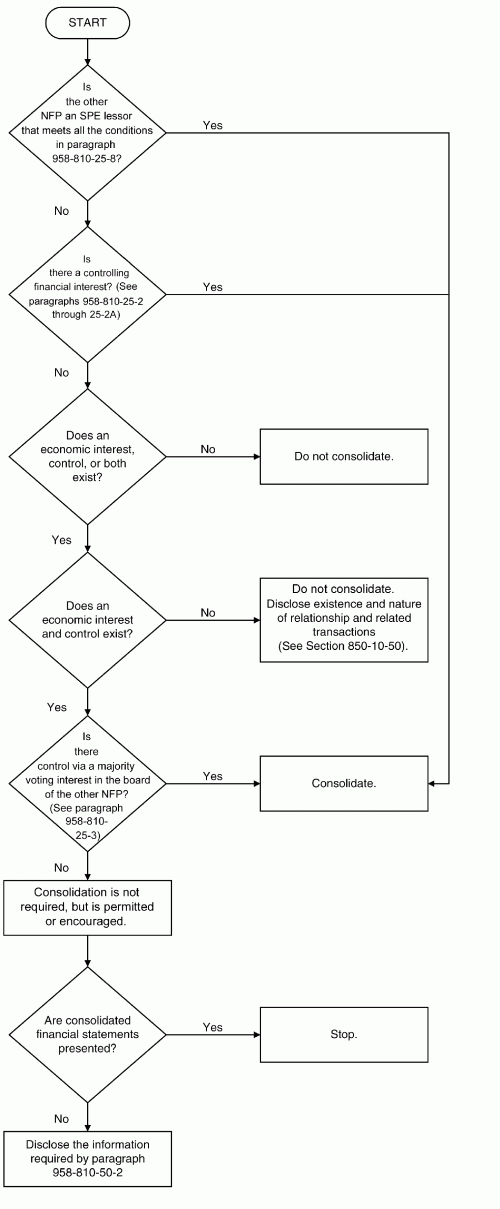
810-958-55-3
The following flowchart summarizes the guidance in Section 958-810-25.
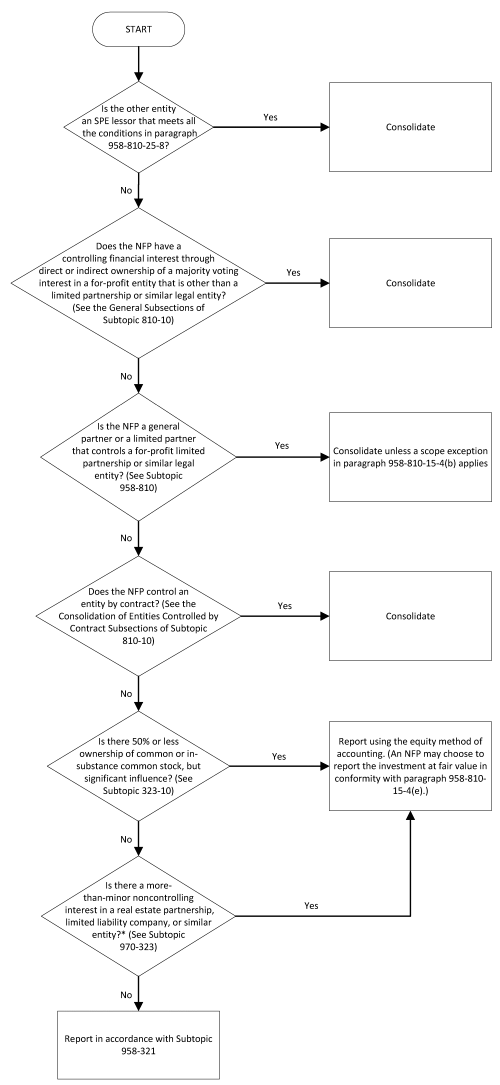
810-958-55-4
The following flowchart and related footnote indicate the order in which an NFP applies the guidance elsewhere in the Codification to determine the accounting for its relationship with a for-profit entity.
  • *According to paragraph 323-30-35-3, a limited liability company that maintains a specific ownership account for each investor—similar to a partnership capital account structure—should be viewed as similar to an investment in a limited partnership for purposes of determining whether a noncontrolling investment in a limited liability company should be accounted for in accordance with the guidance in Topic 321 or the equity method.
810-958-55-4A
This paragraph provides implementation guidance on the application of paragraph 958-810-25-2A to situations in which certain actions require approval by a supermajority vote of the board. That paragraph states that such voting requirements might overcome the presumption of control by the owner or holder of a majority voting interest. An NFP shall exercise judgment in evaluating such situations. If supermajority voting requirements exist—for example, a specified supermajority of the board is needed to approve fundamental actions such as amending the articles of incorporation or dissolving the entity, an NFP shall consider whether those voting requirements have little or no effect on the ability to control the other entity's operations or assets or, alternatively, whether those voting requirements are so restrictive as to call into question whether control rests with the holder of the majority voting interest. The guidance in paragraphs may be helpful in considering whether the inability of the majority voting interest to unilaterally approve certain actions due to supermajority voting requirements is substantial enough to overcome the presumption of control.
810-958-55-5
A majority voting interest in the board of another entity, as referred to in paragraph 958-810-25-3, is illustrated by the following example. Entity B has a five-member board, and a simple voting majority is required to approve board actions. Entity A will have a majority voting interest in the board of Entity B if Entity A has the ability to appoint three or more of Entity B's board members. If three of Entity A's board members, employees, or officers serve on the board of Entity B but Entity A does not have the ability to require that those members serve on the Entity B board, Entity A does not have a majority voting interest in the board of Entity B.
810-958-55-6
The following are examples of economic interests:
  1. a
    Other entities solicit funds in the name of and with the expressed or implied approval of the NFP, and substantially all of the funds solicited are intended by the contributor or are otherwise required to be transferred to the NFP or used at its discretion or direction.
  2. b
    An NFP transfers significant resources to another entity whose resources are held for the benefit of the NFP.
  3. c
    An NFP assigns certain significant functions to another entity.
  4. d
    An NFP provides or is committed to provide funds for another entity or guarantees significant debt of another entity.
  5. e
    An NFP has a right to or a responsibility for the operating results of another entity. Or upon dissolution, an NFP is entitled to the net assets, or is responsible for any deficit, of another entity.
810-958-55-7
For an NFP that is engaged in leasing transactions with a special-purpose-entity (SPE) lessor, this implementation guidance addresses the following matters:
  1. a
    Multiple properties within a single SPE lessor
  2. b
    Multitiered SPE structures
  3. c
    Payments to equity owners of an SPE during the lease term
  4. d
    Fees paid to owners of record of an SPE
  5. e
    Source of initial minimum equity investment
  6. f
    Payment to owners of record of an SPE before the lease term
  7. g
810-958-55-8
This implementation guidance addresses the application of paragraph 958-810-25-8(a) to a transaction involving all of the following characteristics:
  1. a
    An SPE is formed to acquire two separate properties that are to be leased to two unrelated lessees.
  2. b
    The two asset acquisitions are financed with the proceeds from two nonrecourse borrowings that do not contain cross-collateral provisions; that is, in the event of default, each borrowing is collateralized only by a pledge of the respective assets leased to a single lessee and an assignment of the respective lease payments under the related lease.
  3. c
    The SPE has no assets other than the leased properties and the related leases.
810-958-55-9
The use of nonrecourse debt with no cross-collateral provisions effectively segregates the cash flows and assets associated with the two leases and, therefore, in substance, creates two SPEs. For purposes of applying the provisions of paragraph 958-810-25-8, each lessee would be considered to have satisfied the condition in paragraph 958-810-25-8(a). For either lessee to be in a position of not satisfying that condition, the assets of the SPE (subject to the two leases) would need to be commingled such that, in the event of default, both lenders to the SPE would have equal rights (that is, pari passu) to the cash flows and assets related to both leases of the SPE. In this regard, the amounts of the cash flows from each lease and the fair values of the individual assets subject to the leases must represent more than a minor amount (that is, more than 10 percent) of the aggregate cash flows from all leases and the aggregate fair value of all assets of the SPE, respectively.
810-958-55-10
This implementation guidance addresses the level at which an entity should apply the conditions in paragraph 958-810-25-8 to a transaction having all of the following characteristics:
  1. a
    Sponsor forms an SPE, SPE A.
  2. b
    SPE A acquires property with the proceeds from nonrecourse debt and leases the property to Lessee A.
  3. c
    SPE A has no other activities and the terms of the lease satisfy the condition in paragraph 958-810-25-8(b), which discusses the residual risks and rewards associated with the leased assets and related debt.
  4. d
    The sponsor owns 100 percent of SPE A's voting common stock.
  5. e
    The sponsor contributes the common stock of SPE A to capitalize another SPE (SPE B) that is formed to own and lease assets to Lessee B.
  6. f
    The other assets of SPE B are financed entirely with nonrecourse debt and are subject to a lease, the terms of which also satisfy the condition in paragraph 958-810-25-8(b).
Thus, SPE B, which is wholly owned by the sponsor, becomes the parent of SPE A.
810-958-55-11
Consistent with the implementation guidance in paragraph 958-810-55-8 that addresses multiple properties within a single SPE, the conditions set forth in paragraph 958-810-25-8 shall be applied at the lowest level at which the parties to a transaction create an isolated entity, whether by contract or otherwise. Therefore, in the situation described in the preceding paragraph, the test for compliance with the condition in paragraph 958-810-25-8(a) should be applied to the parent-only financial statements of SPE B.
810-958-55-12
In the transaction described in paragraph 958-810-55-10, assume the assets of SPE B will include the common stock of SPE A and the assets leased to Lessee B. Ownership of the stock of another SPE that is engaged in leasing property would not constitute an activity contemplated by the condition in paragraph 958-810-25-8(a). Accordingly, in this situation, the lessee shall consider that condition to be satisfied in evaluating the activities of SPE B. In addition, the sponsor's contribution of the stock of SPE A to capitalize SPE B shall not be considered an initial substantive residual equity capital investment, as contemplated by the condition in paragraph 958-810-25-8(c), because a sponsor's investment shall not be used to capitalize more than one SPE for purposes of applying that condition.
810-958-55-13
The characterization of any payments made by the SPE-lessor to its owners of record shall be based on the SPE's GAAP basis financial statements. That is, distributions of the SPE-lessor's GAAP basis change in net assets shall be considered a return on equity capital, but any distribution in excess of previously undistributed GAAP change in net assets shall be considered a return of equity capital, which would reduce the amount of the equity capital investment that is at risk. If the amount of the equity capital investment is reduced below the minimum amount required as a result of a distribution in excess of previously undistributed GAAP change in net assets, the owner of record would have to make an additional investment to continue to avoid the condition in paragraph 958-810-25-8(c). An owner of record would not be required to make an additional equity capital investment if residual equity capital is reduced below the minimum amount required because of losses recorded by the SPE in accordance with generally accepted accounting principles.
810-958-55-14
Paragraph 842-10-30-5(e) states that, for a lessee, lease payments include fees that are paid by the lessee to the owners of the special-purpose entity for structuring the lease transaction. Paragraph 842-10-30-5(e) states that such fees shall be included as part of lease payments (but shall not be included in the fair value of the underlying asset) for purposes of applying the criterion in paragraph 842-10-25-2(d). With respect to the SPE and the application of the guidance in paragraph 958-810-25-8, the fees paid by the lessee to the owners of the SPE shall be considered a return of the owners' initial equity capital investment. To the extent that the fees reduce the equity capital investment below the minimum amount required, the owners of record would not be considered to have a substantive residual equity capital investment that is at risk during the entire term of the lease.
810-958-55-15
If the source of the funds used to make the initial minimum equity investment in an SPE lessor is financed with nonrecourse debt that is collateralized by a pledge of the investment, the investment shall not meet the at-risk requirement in paragraph 958-810-25-8(c). Similarly, that at-risk requirement shall not be met if the owners purchased residual insurance or obtained a residual guarantee in an amount that would ensure recovery of their equity investment. If the initial minimum equity investment is financed with recourse debt from a party not related to the lessee, the owners (borrowers) shall have other assets at risk to support the borrowing to avoid the condition in paragraph 958-810-25-8(c). Thus, if the loans were full recourse loans and if the fair value of the residual equity investment serves as collateral for the debt, the lessor-owner shall be considered at risk to the extent that the owners of record are liable for any decline in the fair value of the residual interest and have, and are expected to continue to have during the term of the lease, other significant assets, in addition to and of a value that exceeds their equity investment, that are at risk.
810-958-55-16
In some build-to-suit lease transactions involving SPEs, the lease or related construction agreement provides that the SPE will construct, or cause to be constructed, the property that is to be leased. The terms of the construction or lease agreements provide that payments are to be made by the SPE to the owners of record during the construction period, which, in some cases, may be several years. Such payments generally are made to provide the owners of record with a cash yield on their equity capital investments. Payments made by the SPE to the owners of record of the SPE during the construction period shall be deemed to be a return of their initial equity capital investment as opposed to a return on their equity capital investment. To the extent that those payments reduce the equity capital investment below the minimum amount required under paragraph 958-810-25-8, the owners of record of the SPE shall not be considered to have made an initial substantive residual equity capital investment that is at risk during the entire lease term.
810-958-55-16A
The following implementation guidance is intended to facilitate the understanding of how to assess whether the rights of the limited partners should be considered protective rights or participating rights and, if participating rights, whether the rights are substantive. Although this guidance illustrates possible assessments of individual limited partners' rights, the evaluation of limited partners' rights should consider all of the factors identified in paragraph 958-810-25-27 to determine whether the limited partners' rights, individually or in the aggregate, provide for the limited partners to effectively participate in significant decisions that would be expected to be made in the ordinary course of business.
810-958-55-16B
The rights of the limited partners relating to the approval of acquisitions and dispositions of assets that are expected to be undertaken in the ordinary course of business may be substantive participating rights. Rights related only to acquisitions that are not expected to be undertaken in the ordinary course of business usually are protective and do not overcome the presumption of control by the general partners in the limited partnership. Determining whether the right to approve the acquisition or disposition of assets is in the ordinary course of business should be based on an evaluation of the relevant facts and circumstances. In addition, if approval by the limited partners is necessary to incur additional indebtedness to finance an acquisition that is not in the limited partnership's ordinary course of business, then the approval by the limited partners is considered a protective right.
810-958-55-16C
Existing facts and circumstances should be considered in assessing whether the rights of the limited partners relating to a limited partnership incurring additional indebtedness are protective or participating rights. For example, if it is reasonably possible or probable that the limited partnership will need to incur the level of borrowing that requires limited partner approval in its ordinary course of business, the rights of the limited partners are viewed as substantive participating rights.
810-958-55-16D
The rights of the limited partners relating to dividends or other distributions may be protective or participating and should be assessed in light of the available facts and circumstances. For example, rights to block customary or expected dividends or other distributions may be substantive participating rights, while rights to block extraordinary distributions are protective rights.
810-958-55-16E
The rights of the limited partners relating to a limited partnership's specific action (for example, to lease property) in an existing business may be protective or participating and should be assessed in light of the available facts and circumstances. For example, if the limited partnership had the ability to purchase, rather than lease, the property without requiring the approval of the limited partners, then the rights of the limited partners to block the limited partnership from entering into a lease are not substantive participating rights.
810-958-55-16F
The rights of the limited partners relating to a limited partnership's negotiation of collective-bargaining agreements with unions may be protective or participating and should be assessed in light of the available facts and circumstances. For example, if a limited partnership does not have a collective-bargaining agreement with a union or if the union does not represent a substantial portion of the limited partnership's work force, then the rights of the limited partners to approve or veto a new or broader collective-bargaining agreement are not substantive participating rights.
810-958-55-16G
Provisions that govern what will occur if the limited partners block the action of the general partners need to be considered to determine whether the rights of the limited partners to block have substance. For example, if both of the following circumstances exist, then the rights of the limited partners to block the approval of the operating and capital budgets do not allow the limited partners to effectively participate and, thus, are not substantive participating rights:
  1. a
    The limited partnership agreement provides that if the limited partners block the approval of operating and capital budgets, then the budgets simply default to last year's budgets adjusted for inflation.
  2. b
    The limited partnership operates in a mature business for which year-to-year operating and capital budgets would not be expected to vary significantly.
810-958-55-16H
Limited partners' rights relating to the initiation or resolution of a lawsuit may be considered protective or participating depending on the available facts and circumstances. For example, if lawsuits are a part of, or are expected to be a part of, the limited partnership's ordinary course of business, as is the case for some insurance entities, then the limited partners' rights may be considered substantive participating rights.
810-958-55-16I
The limited partners have the right to veto the annual operating and capital budgets for the first X years of the limited partnership. Based on the facts and circumstances, during the first X years of the limited partnership, this right may be a substantive participating right. However, following Year X there is a significant change in the exercisability of the limited partners' right (for example, the veto right terminates). As of the beginning of the period following Year X the presumption that the general partners control the partnership no longer is overcome because that right no longer exists.

Illustrations

810-958-55-17
This Example illustrates one way in which the consolidated financial statements of an NFP might satisfy the presentation and disclosure requirements for noncontrolling interests in a consolidated subsidiary and subsequent changes in ownership interests of that subsidiary. This Example uses simplified assumptions and highly aggregated amounts to illustrate how to apply the provisions of Topic 810 and Subtopic 958-810.
810-958-55-18
For example, the consolidated statement of financial position in paragraph 958-810-55-23 shows relatively few highly aggregated amounts of assets and liabilities, and the consolidated statement of operations and other changes in net assets without donor restrictions in paragraph 958-810-55-24 shows relatively few highly aggregated amounts of revenues and expenses rather than details such as expenses by function or nature. The consolidated statement of financial position also does not classify assets and liabilities, which is required for a not-for-profit, business-oriented health care entity by paragraph 954-210-45-1. This Example also omits a statement of cash flows, which does not bear on the presentation and disclosure requirements for noncontrolling interests.
810-958-55-19
Formats or levels of detail other than those presented in this Example may be appropriate for other situations. For example, the related net assets and noncontrolling interest would be presented in net assets with donor restrictions if donor-imposed restrictions on the use of the subsidiary's net assets existed in this Example (see paragraph 958-810-45-1).
810-958-55-20
The following assumptions are applicable to all years:
  1. a
    Hospital A, a tax-exempt NFP has one subsidiary, Subsidiary A. That ownership interest in Subsidiary A was purchased; there are no donor-imposed restrictions on the use of Subsidiary A's net assets.
  2. b
    Subsidiary A is an investor-owned entity that is subject to income taxes. The tax rate for all years is 40 percent.
  3. c
    Subsidiary A has 10,000 shares of common stock outstanding and does not pay dividends.
810-958-55-21
The following assumptions are applicable to 20X2:
  1. a
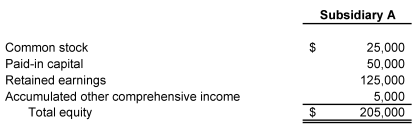
    On January 1, 20X2, Hospital A sells 2,000 of its 10,000 shares in Subsidiary A to an unrelated entity for $50,000 in cash, reducing its ownership interest from 100 percent to 80 percent. Immediately before the sale, Subsidiary A's equity was as follows.
    • Subsidiary A Common stock " $25,000 " Paid-in capital " 50,000 " Retained earnings " 125,000 " Accumulated other comprehensive income " 5,000 " Total equity " $205,000 "
  2. b
    The accumulated other comprehensive income balance of $5,000 represents an unrealized gain on a portfolio of debt securities purchased by Subsidiary A for $100,000, which it classifies as available-for-sale debt securities at the carrying amount of $105,000 and are the only investment securities of the consolidated group.
  3. c
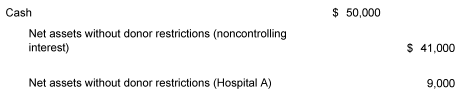
    The sale of Subsidiary A's shares is accounted for as an equity transaction (within net assets without donor restrictions) in the consolidated financial statements of Hospital A, as follows:
    1. 1
      A noncontrolling interest is recognized in net assets without donor restrictions in the amount of $41,000 ($205,000 × 20 percent).
    2. 2
      Net assets without donor restrictions attributable to Hospital A are increased by $9,000, calculated as the difference between the cash received ($50,000) and the carrying amount of the noncontrolling interest ($41,000).
    3. 3
      The top-level (consolidated) journal entry to record the sale of Subsidiary A's shares to the noncontrolling shareholder is as follows:
      • Cash " $50,000 " Net assets without donor restrictions (noncontrolling interest) " $41,000 " Net assets without donor restrictions (Hospital A) " 9,000 "
  4. d
    For the year ended December 31, 20X2, the amount of Subsidiary A's net income included in the consolidated financial statements is $20,000, which included a net loss for discontinued operations of $7,000.
810-958-55-22
The following assumptions are applicable to 20X3:
  1. a
    On January 1, 20X3, Hospital A purchases 1,000 shares in Subsidiary A from the noncontrolling shareholders (50 percent of the noncontrolling interest) for $30,000 cash, increasing its ownership interest from 80 percent to 90 percent. Immediately before that purchase, the carrying amount of the noncontrolling interest in Subsidiary A was $48,000. The purchase of shares from the noncontrolling shareholders is accounted for as an equity transaction in the consolidated financial statements, as follows:
    1. 1
      The noncontrolling interest balance within net assets without donor restrictions is reduced by $24,000 ($48,000 × 50 percent interest acquired by Hospital A).
    2. 2
      Net assets without donor restrictions attributable to Hospital A are decreased by $6,000, calculated as the difference between the cash paid ($30,000) and the adjustment to the carrying amount of the noncontrolling interest ($24,000).
    3. 3
      The top-level (consolidated) journal entry to record that purchase of Subsidiary A's shares from the noncontrolling shareholders is as follows:
      • Net assets without donor restrictions (noncontrolling interest) " $24,000 " Net assets without donor restrictions (Hospital A) " 6,000 " Cash " $30,000 "
  2. b
    For the year ended December 31, 20X3, the amount of Subsidiary A's net income included in the consolidated financial statements is $15,000.
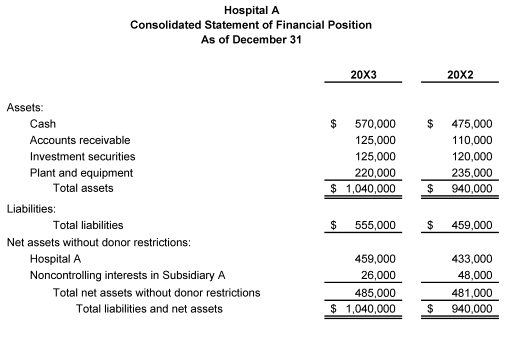
810-958-55-23
The following consolidated statement of financial position illustrates the requirement in paragraph 958-810-45-1 that Hospital A present the noncontrolling interest in the consolidated statement of financial position within net assets, but separately from the parent's net assets.
  • "Hospital A Consolidated Statement of Financial Position As of December 31" 20X3 20X2 Assets: Cash " $570,000 " " $475,000 " Accounts receivable " 125,000 " " 110,000 " Investment securities " 125,000 " " 120,000 " Plant and equipment " 220,000 " " 235,000 " Total assets " $1,040,000 " " $940,000 " Liabilities: Total liabilities " $555,000 " " $459,000 " Net assets without donor restrictions: Hospital A " 459,000 " " 433,000 " Noncontrolling interests in Subsidiary A " 26,000 " " 48,000 " Total net assets without donor restrictions " 485,000 " " 481,000 " Total liabilities and net assets " $1,040,000 " " $940,000 "
810-958-55-24
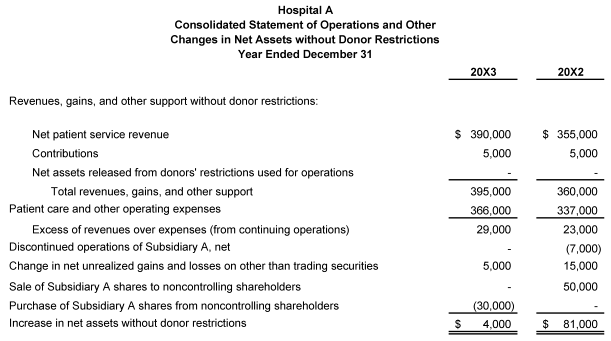
The following consolidated statement of operations and other changes in net assets without donor restrictions illustrates how the requirements in paragraph 958-810-50-5(a) for disclosure of the amounts of a performance indicator of a health care entity for an excess of revenues over expenses from continuing operations and in paragraph 958-810-50-5(b) for discontinued operations might be presented on the face of a consolidated statement of operations and other changes in net assets.
  • "Hospital A Consolidated Statement of Operations and Other Changes in Net Assets without Donor Restrictions Year Ended December 31" 20X3 20X2 "Revenues, gains, and other support without donor restrictions:" Net patient service revenue " $390,000 " " $355,000 " Contributions " 5,000 " " 5,000 " Net assets released from donors' restrictions used for operations - - "Total revenues, gains, and other support" " 395,000 " " 360,000 " Patient care and other operating expenses " 366,000 " " 337,000 " Excess of revenues over expenses (from continuing operations) " 29,000 " " 23,000 " "Discontinued operations of Subsidiary A, net" - " (7,000)" Change in net unrealized gains and losses on other than trading securities " 5,000 " " 15,000 " Sale of Subsidiary A shares to noncontrolling shareholders - " 50,000 " Purchase of Subsidiary A shares from noncontrolling shareholders " (30,000)" - Increase in net assets without donor restrictions " $4,000 " " $81,000 "
810-958-55-25
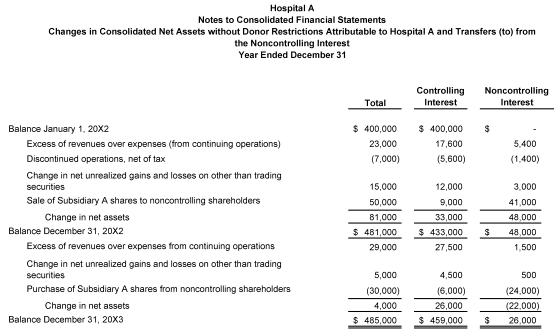
The following note depicts the changes in consolidated net assets attributable to the controlling financial interest of Hospital A (parent) and the noncontrolling interests. It illustrates the requirements in paragraph 958-810-50-4 that an NFP present a schedule that reconciles the beginning and the end of the period carrying amounts of the parent's controlling interest and the noncontrolling interests for each class of net assets for which a noncontrolling interest exists. This note also illustrates the disclosure requirements in paragraph 958-810-50-5(a) through (b) and (d) through (e) for the amounts of a performance indicator of a health care entity (which is equivalent to income from continuing operations), for the amounts of discontinued operations, changes in ownership interests in a subsidiary, and the aggregate amount of all other changes in net assets without donor restrictions and net assets with donor restrictions for the period.
  • "Hospital A Notes to Consolidated Financial Statements Changes in Consolidated Net Assets without Donor Restrictions Attributable to Hospital A and Transfers (to) from the Noncontrolling Interest Year Ended December 31" Total Controlling Interest Noncontrolling Interest "Balance January 1, 20X2" " $400,000 " " $400,000 " $- Excess of revenues over expenses (from continuing operations) " 23,000 " " 17,600 " " 5,400 " "Discontinued operations, net of tax" " (7,000)" " (5,600)" " (1,400)" "Change in net unrealized gains and losses on other than trading securities" " 15,000 " " 12,000 " " 3,000 " Sale of Subsidiary A shares to noncontrolling shareholders " 50,000 " " 9,000 " " 41,000 " Change in net assets " 81,000 " " 33,000 " " 48,000 " "Balance December 31, 20X2" " $481,000 " " $433,000 " " $48,000 " Excess of revenues over expenses from continuing operations " 29,000 " " 27,500 " " 1,500 " "Change in net unrealized gains and losses on other than trading securities" " 5,000 " " 4,500 " 500 Purchase of Subsidiary A shares from noncontrolling shareholders " (30,000)" " (6,000)" " (24,000)" Change in net assets " 4,000 " " 26,000 " " (22,000)" "Balance December 31, 20X3" " $485,000 " " $459,000 " " $26,000 "
810-958-55-26
This Example illustrates the guidance in paragraphs . To illustrate the application of the simple majority threshold, consider the following Cases A, B, and C in which the limited partnership agreement requires a simple majority of the limited partners' voting interests to remove the general partner and Case D in which a supermajority of the limited partners' voting interests is required for such removal:
  1. a
    Three equal-interest limited partners (Case A)
  2. b
    Two equal-interest limited partners (Case B)
  3. c
    One hundred equal-interest limited partners (Case C)
  4. d
    Required limited partner voting percentages greater than 50 percent (Case D).
810-958-55-27
Assume that a limited partnership has 3 limited partners, none of which have any relationship to the general partners, and that each holds an equal amount of the limited partners' voting interests (33.33 percent). In this Case, applying the simple majority requirement in the partnership agreement would require a vote of no more than two of the three limited partners to remove the general partners. Accordingly, a provision that entitles any individual limited partner to remove the general partner or a provision that requires a vote of two of the limited partners to remove the general partner would meet the requirements of paragraph 958-810-25-19(a) for a substantive kick-out right. However, if a vote of all three limited partners is required to remove the general partner, the right would not meet the requirements of that paragraph for a substantive kick-out right because the required vote is greater than a simple majority of the limited partners voting interests.
810-958-55-28
Consider the same facts as in Case A, except that there are two limited partners that each hold an equal interest. In this Case, a simple majority of the limited partners' voting interests would require a vote of both limited partners, so a provision entitling any individual limited partner to remove the general partner or a provision that requires a vote of both limited partners to remove the general partner would meet the requirements of paragraph 958-810-25-19(a) for a substantive kick-out right.
810-958-55-29
Consider the same facts as in Case A, except that there are 100 limited partners that each hold an equal interest. In this Case, a simple majority of the limited partners' voting interests would require a vote of 51 limited partners; therefore, a provision that requires a vote of less than 52 limited partners to remove the general partner would meet the requirements of paragraph 958-810-25-19(a) for a substantive kick-out right. However, if a vote of 52 or more limited partners is required to remove the general partner, that provision would not meet the requirements of that paragraph for a substantive kick-out right because the required vote is greater than a simple majority of the limited partners' voting interests.
810-958-55-30
In this Case, consider the following situations based on a limited partnership agreement that requires a vote of 66.66 percent of the limited partners' voting interests to remove the general partner:
  1. a
    Equal-interest limited partners (Case D1)
  2. b
    Limited partners with unequal interests (Case D2).
810-958-55-31
There are 3 independent limited partners that each hold an equal percentage (33.33 percent) of the limited partner voting interest. A vote of 2 of the 3 limited partners represents 66.66 percent of the limited partners voting interests, which also represents the smallest possible combination of voting interests that is at least a simple majority of the limited partners' voting interests. Assuming there are no barriers to the exercise of the kick-out rights, the kick-out rights in this Case meet the simple majority requirement and, therefore, represent substantive kick-out rights that overcome the presumption of control by the general partners.
810-958-55-32
There are 3 independent limited partners that hold 45 percent (Limited Partner 1), 25 percent (Limited Partner 2), and 30 percent (Limited Partner 3) of the limited partners' voting interests, respectively. To remove the general partners, a vote of Limited Partner 1 in combination with either Limited Partner 2 or Limited Partner 3 would be a simple majority of the limited partners' voting interests and would satisfy the 66.66 percent contractual requirement. In contrast, a vote to exercise the kick-out right by Limited Partner 2 and Limited Partner 3 also would represent a simple majority of the limited partners' voting interests, but their 55 percent voting interests would not meet the contractually required threshold of 66.66 percent to remove the general partners. Accordingly, the kick-out right in this Case would be assessed as nonsubstantive because the smallest possible combination (Limited Partner 2 and Limited Partner 3) that represents at least a simple majority of the limited partners' voting interests cannot remove the general partners. Assuming the limited partners do not possess substantive participating rights, the presumption of control by the general partners would not be overcome.

810-958-60Relationships

Source downloaded: .Record version ea29f1a5cee6. Effective date must be checked in the source.

Investments—Equity Method and Joint Ventures

810-958-60-1
For application of the equity method of accounting for an investment in a for-profit entity and the procedures for applying the equity method, see Subtopic 323-10.
810-958-60-2
For the disclosures that are generally applicable to the equity method of accounting for investments, see Section 323-10-50.

Consolidation

810-958-60-3
For a description of a controlling financial interest through direct or indirect ownership of a majority voting interest, see paragraph 810-10-15-8.
810-958-60-4
For the required disclosure of consolidation policy, see paragraph 810-10-50-1.
810-958-60-5
For circumstances in which combined financial statements of commonly controlled entities would be useful, see paragraph 810-10-55-1B.
810-958-60-6
For procedures for preparing combined financial statements, see paragraph 810-10-45-10.
810-958-60-7
For parent-entity financial statements, see paragraph 810-10-45-11.
810-958-60-8
For a definition of a related party and the required disclosures of material related party transactions, see Topic 850.

810-958-65Transition and Open Effective Date Information

Source downloaded: .Record version 7f62d39414c6. Effective date must be checked in the source.

810-958-65-1
Paragraph superseded on 04/13/2010 after the end of the transition period stated in FASB Staff Position SOP 94-3-1 and AAG HCO-1, Omnibus Changes to Consolidation and Equity Method Guidance for Not-for-Profit Organizations.
810-958-65-2
Paragraph superseded on 06/20/2018 after the end of the transition period stated in Accounting Standards Update No. 2017-02, Not-for-Profit Entities—Consolidation (Subtopic 958-810): Clarifying When a Not-for-Profit Entity That Is a General Partner or a Limited Partner Should Consolidate a For-Profit Limited Partnership or Similar Entity.

Related subtopics