ASC 805-10
Overall
805 Business Combinations
Source downloaded: .Record version e654801785c4. Effective date must be checked in the source.
ASC 805-10 is the Overall subtopic of Business Combinations: it sets the scope of the Topic and governs two of the four steps of the acquisition method — identifying the acquirer and determining the acquisition date — plus the definition of a business, the measurement period, and deciding what is (and is not) part of the business combination exchange. Every transaction meeting the definition of a business combination must be accounted for by the acquisition method (805-10-25-1); if the acquired set is not a business, it is an asset acquisition. It also sets the disclosure objectives and requirements enabling users to evaluate the nature and financial effects of a combination.
Key points (7)
- A business combination must be accounted for using the acquisition method, whose four steps are identifying the acquirer, determining the acquisition date, recognizing/measuring identifiable assets acquired, liabilities assumed and any noncontrolling interest, and recognizing/measuring goodwill or a bargain purchase gain (805-10-05-4; 805-10-25-1); the Topic does not apply to asset acquisitions, common-control combinations, or joint venture formations (805-10-15-4).
- The acquirer is the entity that obtains control, identified using the controlling financial interest guidance in the General Subsections of Subtopic 810-10; if that is not clear, the factors in 805-10-55-11 through 55-15 apply, and for an acquired VIE the primary beneficiary is the acquirer (805-10-25-5).
- The acquisition date is the date the acquirer obtains control, generally the closing date, but may be earlier or later based on all pertinent facts and circumstances (805-10-25-6 through 25-7).
- A set is a business only if it includes, at a minimum, an input and a substantive process that together significantly contribute to the ability to create output; if substantially all of the fair value of the gross assets acquired is concentrated in a single identifiable asset or group of similar identifiable assets, the set is not a business (805-10-55-5 through 55-5C).
- In a step acquisition the acquirer remeasures its previously held equity interest at acquisition-date fair value with the gain or loss in earnings, reclassifying related amounts (including cumulative translation adjustment) out of OCI (805-10-25-10).
- Provisional amounts may be adjusted during the measurement period — which ends when the information is obtained or is unobtainable, but never exceeds one year from the acquisition date — with a corresponding adjustment to goodwill recognized in the period the adjustment is determined; after that, changes are error corrections under Topic 250 (805-10-25-13 through 25-19).
- Transactions separate from the exchange for the acquiree (settlement of preexisting relationships, compensation for future services, reimbursement of acquisition costs) are accounted for under other GAAP, and acquisition-related costs are expensed as incurred except debt/equity issuance costs (805-10-25-20 through 25-23).
For students. This is the gateway subtopic: exams test whether a transaction is a business combination versus an asset acquisition (the concentration screen and the input/substantive process framework) and who the accounting acquirer is in a reverse acquisition. A common misunderstanding is that measurement-period adjustments are retrospectively restated — under current guidance they are recorded in the period determined, with the cumulative earnings effect (e.g., catch-up depreciation) recognized in current earnings.
Machine-generated study aid for ASC 805-10. Check the source paragraphs below.
805-10-00Status
Source downloaded: .Record version ab7afe7c1e60. Effective date must be checked in the source.
805-10-05Overview and Background
Source downloaded: .Record version e66fc8ead34c. Effective date must be checked in the source.
- aOverall
- bIdentifiable Assets and Liabilities, and Any Noncontrolling Interest
- cGoodwill or Gain from Bargain Purchase, Including Consideration Transferred
- dReverse Acquisitions
- eRelated Issues
- fIncome Taxes
- gJoint Venture Formations.
- aRecognizes and measures in its financial statements the identifiable assets acquired, the liabilities assumed, and any noncontrolling interest in the acquiree
- bRecognizes and measures the goodwill acquired in the business combination or a gain from a bargain purchase
- cDetermines what information to disclose to enable users of the financial statements to evaluate the nature and financial effects of the business combination.
- aWhether a particular transaction or event is a business combination
- bThe identification of the acquirer and the acquisition date
- cThe period of time that an acquirer has to adjust provisional amounts, referred to as the measurement period
- dThe determination of what is part of a business combination transaction.
- aIdentifying the acquirer
- bDetermining the acquisition date
- cRecognizing and measuring the identifiable assets acquired, the liabilities assumed, and any noncontrolling interest in the acquiree
- dRecognizing and measuring goodwill or a gain from a bargain purchase.
805-10-10Objectives
Source downloaded: .Record version cad106faac7d. Effective date must be checked in the source.
805-10-15Scope and Scope Exceptions
Source downloaded: .Record version 0c12eb02ec13. Effective date must be checked in the source.
Overall Guidance
Entities
Transactions
- aThe formation of a joint venture or a corporate joint venture (except as described in Subtopic 805-60)
- bThe acquisition of an asset or a group of assets that does not constitute a business or a nonprofit activity
- cA combination between entities, businesses, or nonprofit activities under common control (see paragraph 805-50-15-6 for examples)
- dAn acquisition by a not-for-profit entity for which the acquisition date is before December 15, 2009 or a merger of not-for-profit entities (NFPs)
- eA transaction or other event in which an NFP obtains control of a not-for-profit entity but does not consolidate that entity, as described in paragraph 958-810-25-4. The Business Combinations Topic also does not apply if an NFP that obtained control in a transaction or other event in which consolidation was permitted but not required decides in a subsequent annual reporting period to begin consolidating a controlled entity that it initially chose not to consolidate.
- fFinancial assets and financial liabilities of a consolidated variable interest entity that is a collateralized financing entity within the scope of the guidance on collateralized financing entities in Subtopic 810-10.
805-10-25Recognition
Source downloaded: .Record version ebfba9431309. Effective date must be checked in the source.
- aIdentifying the acquirer
- bIdentifying the acquisition date.
- aParticular types of business combinations
- bThe measurement period
- cDetermining what is part of the business combination transaction.
Identifying the Acquirer
Identifying the Acquisition Date
Particular Types of Business Combinations
- aThe acquiree repurchases a sufficient number of its own shares for an existing investor (the acquirer) to obtain control.
- bMinority veto rights lapse that previously kept the acquirer from controlling an acquiree in which the acquirer held the majority voting interest.
- cThe acquirer and acquiree agree to combine their businesses by contract alone. The acquirer transfers no consideration in exchange for control of an acquiree and holds no equity interests in the acquiree, either on the acquisition date or previously. Examples of business combinations achieved by contract alone include bringing two businesses together in a stapling arrangement or forming a dual-listed corporation.
The Measurement Period
- aThe identifiable assets acquired, liabilities assumed, and any noncontrolling interest in the acquiree (see Subtopic 805-20)
- bThe consideration transferred for the acquiree (or the other amount used in measuring goodwill in accordance with paragraphs )
- cIn a business combination achieved in stages, the equity interest in the acquiree previously held by the acquirer (see paragraph 805-30-30-1(a)(3))
- dThe resulting goodwill recognized in accordance with paragraph 805-30-30-1 or the gain on a bargain purchase recognized in accordance with paragraph 805-30-25-2.
Determining What Is Part of the Business Combination Transaction
- aA transaction that in effect settles preexisting relationships between the acquirer and acquiree (see paragraphs )
- bA transaction that compensates employees or former owners of the acquiree for future services (see paragraphs )
- cA transaction that reimburses the acquiree or its former owners for paying the acquirer's acquisition-related costs (see paragraph 805-10-25-23).
Acquisition-Related Costs
805-10-30Initial Measurement
Source downloaded: .Record version 19d55a8913c4. Effective date must be checked in the source.
805-10-35Subsequent Measurement
Source downloaded: .Record version df94910a5eb0. Effective date must be checked in the source.
- aReacquired rights (see paragraph 805-20-35-2)
- bAssets and liabilities arising from contingencies recognized as of the acquisition date (see paragraph 805-20-35-3)
- cIndemnification assets (see paragraph 805-20-35-4)
- dContingent consideration (see paragraph 805-30-35-1)
- eContingent consideration arrangements of an acquiree assumed by the acquirer (see paragraph 805-30-35-1A).
805-10-50Disclosure
Source downloaded: .Record version 9b5229871d3a. Effective date must be checked in the source.
Business Combinations Occurring during a Current Reporting Period or after the Reporting Date but before the Financial Statements Are Issued
- aDuring the current reporting period
- bAfter the reporting date but before the financial statements are issued or are available to be issued (as discussed in Section 855-10-25).
- aDuring the current reporting period
- bAfter the reporting date but before the financial statements are issued or are available to be issued (as discussed in Section 855-10-25).
- aThe name and a description of the acquiree
- bThe acquisition date
- cThe percentage of voting equity interests acquired
- dThe primary reasons for the business combination and a description of how the acquirer obtained control of the acquiree
- eFor transactions that are recognized separately from the acquisition of assets and assumptions of liabilities in the business combination (see paragraph 805-10-25-20), all of the following:
- 1A description of each transaction
- 2How the acquirer accounted for each transaction
- 3The amounts recognized for each transaction and the line item in the financial statements in which each amount is recognized
- 4If the transaction is the effective settlement of a preexisting relationship, the method used to determine the settlement amount.
- 1
- fThe disclosure of separately recognized transactions required in (e) shall include the amount of acquisition-related costs, the amount recognized as an expense, and the line item or items in the income statement in which those expenses are recognized. The amount of any issuance costs not recognized as an expense and how they were recognized also shall be disclosed.
- gIn a business combination achieved in stages, all of the following:
- 1The acquisition-date fair value of the equity interest in the acquiree held by the acquirer immediately before the acquisition date
- 2The amount of any gain or loss recognized as a result of remeasuring to fair value the equity interest in the acquiree held by the acquirer immediately before the business combination (see paragraph 805-10-25-10) and the line item in the income statement in which that gain or loss is recognized
- 3The valuation technique(s) used to measure the acquisition-date fair value of the equity interest in the acquiree held by the acquirer immediately before the business combination
- 4Information that enables users of the acquirer's financial statements to assess the inputs used to develop the fair value measurement of the equity interest in the acquiree held by the acquirer immediately before the business combination.
- 1
- hIf the acquirer is a public entity, all of the following:
- 1The amounts of revenue and earnings of the acquiree since the acquisition date included in the consolidated income statement for the reporting period.
- 2If comparative financial statements are not presented, the revenue and earnings of the combined entity for the current reporting period as though the acquisition date for all business combinations that occurred during the year had been as of the beginning of the annual reporting period (supplemental pro forma information).
- 3If comparative financial statements are presented, the revenue and earnings of the combined entity as though the business combination(s) that occurred during the current year had occurred as of the beginning of the comparable prior annual reporting period (supplemental pro forma information). For example, for a calendar year-end entity, disclosures would be provided for a business combination that occurs in 20X2, as if it occurred on January 1, 20X1. Such disclosures would not be revised if 20X2 is presented for comparative purposes with the 20X3 financial statements (even if 20X2 is the earliest period presented).
- 4The nature and amount of any material, nonrecurring pro forma adjustments directly attributable to the business combination(s) included in the reported pro forma revenue and earnings (supplemental pro forma information).
If disclosure of any of the information required by (h) is impracticable, the acquirer shall disclose that fact and explain why the disclosure is impracticable. In this context, the term impracticable has the same meaning as in paragraph 250-10-45-9. - 1
- aThe name and a description of the acquiree
- bThe acquisition date
- cThe percentage of voting equity interests acquired
- dThe primary reasons for the business combination and a description of how the acquirer obtained control of the acquiree
- eFor transactions that are recognized separately from the acquisition of assets and assumptions of liabilities in the business combination (see paragraph 805-10-25-20), all of the following:
- 1A description of each transaction
- 2How the acquirer accounted for each transaction
- 3The amounts recognized for each transaction and the line item in the financial statements in which each amount is recognized
- 4If the transaction is the effective settlement of a preexisting relationship, the method used to determine the settlement amount.
- 1
- fThe disclosure of separately recognized transactions required in (e) shall include the amount of acquisition-related costs, the amount recognized as an expense, and the line item or items in the income statement in which those expenses are recognized. The amount of any issuance costs not recognized as an expense and how they were recognized also shall be disclosed.
- gIn a business combination achieved in stages, all of the following:
- 1The acquisition-date fair value of the equity interest in the acquiree held by the acquirer immediately before the acquisition date
- 2The amount of any gain or loss recognized as a result of remeasuring to fair value the equity interest in the acquiree held by the acquirer immediately before the business combination (see paragraph 805-10-25-10) and the line item in the income statement in which that gain or loss is recognized
- 3The valuation technique(s) used to measure the acquisition-date fair value of the equity interest in the acquiree held by the acquirer immediately before the business combination
- 4Information that enables users of the acquirer's financial statements to assess the inputs used to develop the fair value measurement of the equity interest in the acquiree held by the acquirer immediately before the business combination.
- 1
- hIf the acquirer is a public entity, all of the following:
- 1The amounts of revenue and earnings of the acquiree since the acquisition date included in the consolidated income statement for the reporting period.
- 2If comparative financial statements are not presented, the revenue and earnings of the combined entity for the current reporting period as though the acquisition date for all business combinations that occurred during the year had been as of the beginning of the annual reporting period (supplemental pro forma information).
- 3If comparative financial statements are presented, the revenue and earnings of the combined entity as though the business combination(s) that occurred during the current year had occurred as of the beginning of the comparable prior annual reporting period (supplemental pro forma information). For example, for a calendar year-end entity, disclosures would be provided for a business combination that occurs in 20X2, as if it occurred on January 1, 20X1. Such disclosures would not be revised if 20X2 is presented for comparative purposes with the 20X3 financial statements (even if 20X2 is the earliest period presented).
- 4The nature and amount of any material, nonrecurring pro forma adjustments directly attributable to the business combination(s) included in the reported pro forma revenue and earnings (supplemental pro forma information).
If disclosure of any of the information required by (h) is impracticable, the acquirer shall disclose that fact and explain why the disclosure is impracticable. In this context, the term impracticable has the same meaning as in paragraph 250-10-45-9. - 1
The Financial Effects of Adjustments That Relate to Business Combinations That Occurred in the Current or Previous Reporting Periods
Other Disclosures
805-10-55Implementation Guidance and Illustrations
Source downloaded: .Record version cac766ebbe02. Effective date must be checked in the source.
Implementation Guidance
- aBy transferring cash, cash equivalents, or other assets (including net assets that constitute a business)
- bBy incurring liabilities
- cBy issuing equity interests
- dBy providing more than one type of consideration
- eWithout transferring consideration, including by contract alone (see paragraph 805-10-25-11).
- aOne or more businesses become subsidiaries of an acquirer or the net assets of one or more businesses are legally merged into the acquirer.
- bOne combining entity transfers its net assets or its owners transfer their equity interests to another combining entity or its owners.
- cAll of the combining entities transfer their net assets or the owners of those entities transfer their equity interests to a newly formed entity (sometimes referred to as a roll-up or put-together transaction).
- dA group of former owners of one of the combining entities obtains control of the combined entity.
- aInput. Any economic resource that creates, or has the ability to contribute to the creation of, outputs when one or more processes are applied to it. Examples include long-lived assets (including intangible assets or rights to use long-lived assets), intellectual property, the ability to obtain access to necessary materials or rights, and employees.
- bProcess. Any system, standard, protocol, convention, or rule that when applied to an input or inputs, creates or has the ability to contribute to the creation of outputs. Examples include strategic management processes, operational processes, and resource management processes. These processes typically are documented, but the intellectual capacity of an organized workforce having the necessary skills and experience following rules and conventions may provide the necessary processes that are capable of being applied to inputs to create outputs. Accounting, billing, payroll, and other administrative systems typically are not processes used to create outputs.
- cOutput. The result of inputs and processes applied to those inputs that provide goods or services to customers, investment income (such as dividends or interest), or other revenues.
- aA tangible asset that is attached to and cannot be physically removed and used separately from another tangible asset (or an intangible asset representing the right to use a tangible asset) without incurring significant cost or significant diminution in utility or fair value to either asset (for example, land and building)
- bIn-place lease intangibles, including favorable and unfavorable intangible assets or liabilities, and the related leased assets.
- aA tangible asset and an intangible asset
- bIdentifiable intangible assets in different major intangible asset classes (for example, customer-related intangibles, trademarks, and in-process research and development)
- cA financial asset and a nonfinancial asset
- dDifferent major classes of financial assets (for example, accounts receivable and marketable securities)
- eDifferent major classes of tangible assets (for example, inventory, manufacturing equipment, and automobiles)
- fIdentifiable assets within the same major asset class that have significantly different risk characteristics.
- aA process (or group of processes) is not critical if, for example, it is considered ancillary or minor in the context of all the processes required to create outputs.
- bInputs that employees who form an organized workforce could develop (or are developing) or convert into outputs could include the following:
- 1Intellectual property that could be used to develop a good or service
- 2Resources that could be developed to create outputs
- 3Access to necessary materials or rights that enable the creation of future outputs.
Examples of inputs that could be developed include technology, mineral interests, real estate, and in-process research and development. - 1
- aEmployees that form an organized workforce that has the necessary skills, knowledge, or experience to perform an acquired process (or group of processes) that when applied to an acquired input or inputs is critical to the ability to continue producing outputs. A process (or group of processes) is not critical if, for example, it is considered ancillary or minor in the context of all of the processes required to continue producing outputs.
- bAn acquired contract that provides access to an organized workforce that has the necessary skills, knowledge, or experience to perform an acquired process (or group of processes) that when applied to an acquired input or inputs is critical to the ability to continue producing outputs. An entity should assess the substance of an acquired contract and whether it has effectively acquired an organized workforce that performs a substantive process (for example, considering the duration and the renewal terms of the contract).
- cThe acquired process (or group of processes) when applied to an acquired input or inputs significantly contributes to the ability to continue producing outputs and cannot be replaced without significant cost, effort, or delay in the ability to continue producing outputs.
- dThe acquired process (or group of processes) when applied to an acquired input or inputs significantly contributes to the ability to continue producing outputs and is considered unique or scarce.
- aThe relative voting rights in the combined entity after the business combination. The acquirer usually is the combining entity whose owners as a group retain or receive the largest portion of the voting rights in the combined entity. In determining which group of owners retains or receives the largest portion of the voting rights, an entity shall consider the existence of any unusual or special voting arrangements and options, warrants, or convertible securities.
- bThe existence of a large minority voting interest in the combined entity if no other owner or organized group of owners has a significant voting interest. The acquirer usually is the combining entity whose single owner or organized group of owners holds the largest minority voting interest in the combined entity.
- cThe composition of the governing body of the combined entity. The acquirer usually is the combining entity whose owners have the ability to elect or appoint or to remove a majority of the members of the governing body of the combined entity.
- dThe composition of the senior management of the combined entity. The acquirer usually is the combining entity whose former management dominates the management of the combined entity.
- eThe terms of the exchange of equity interests. The acquirer usually is the combining entity that pays a premium over the precombination fair value of the equity interests of the other combining entity or entities.
- aThe reasons for the transaction. Understanding the reasons why the parties to the combination (the acquirer, the acquiree, and their owners, directors, managers, and their agents) entered into a particular transaction or arrangement may provide insight into whether it is part of the consideration transferred and the assets acquired or liabilities assumed. For example, if a transaction is arranged primarily for the benefit of the acquirer or the combined entity rather than primarily for the benefit of the acquiree or its former owners before the combination, that portion of the transaction price paid (and any related assets or liabilities) is less likely to be part of the exchange for the acquiree. Accordingly, the acquirer would account for that portion separately from the business combination.
- bWho initiated the transaction. Understanding who initiated the transaction may also provide insight into whether it is part of the exchange for the acquiree. For example, a transaction or other event that is initiated by the acquirer may be entered into for the purpose of providing future economic benefits to the acquirer or combined entity with little or no benefit received by the acquiree or its former owners before the combination. On the other hand, a transaction or arrangement initiated by the acquiree or its former owners is less likely to be for the benefit of the acquirer or the combined entity and more likely to be part of the business combination transaction.
- cThe timing of the transaction. The timing of the transaction may also provide insight into whether it is part of the exchange for the acquiree. For example, a transaction between the acquirer and the acquiree that takes place during the negotiations of the terms of a business combination may have been entered into in contemplation of the business combination to provide future economic benefits to the acquirer or the combined entity. If so, the acquiree or its former owners before the business combination are likely to receive little or no benefit from the transaction except for benefits they receive as part of the combined entity.
- aEffective settlement of a preexisting relationship between the acquirer and acquiree in a business combination
- bArrangements for contingent payments to employees or selling shareholders.
- aFor a preexisting noncontractual relationship, such as a lawsuit, fair value
- bFor a preexisting contractual relationship, the lesser of the following:
- 1The amount by which the contract is favorable or unfavorable from the perspective of the acquirer when compared with pricing for current market transactions for the same or similar items. An unfavorable contract is a contract that is unfavorable in terms of current market terms. It is not necessarily a loss contract in which the unavoidable costs of meeting the obligations under the contract exceed the economic benefits expected to be received under it.
- 2The amount of any stated settlement provisions in the contract available to the counterparty to whom the contract is unfavorable. If this amount is less than the amount in (b)(1), the difference is included as part of the business combination accounting.
- 1
- aContinuing employment. The terms of continuing employment by the selling shareholders who become key employees may be an indicator of the substance of a contingent consideration arrangement. The relevant terms of continuing employment may be included in an employment agreement, acquisition agreement, or some other document. A contingent consideration arrangement in which the payments are automatically forfeited if employment terminates is compensation for postcombination services. Arrangements in which the contingent payments are not affected by employment termination may indicate that the contingent payments are additional consideration rather than compensation.
- bDuration of continuing employment. If the period of required employment coincides with or is longer than the contingent payment period, that fact may indicate that the contingent payments are, in substance, compensation.
- cLevel of compensation. Situations in which employee compensation other than the contingent payments is at a reasonable level in comparison to that of other key employees in the combined entity may indicate that the contingent payments are additional consideration rather than compensation.
- dIncremental payments to employees. If selling shareholders who do not become employees receive lower contingent payments on a per-share basis than the selling shareholders who become employees of the combined entity, that fact may indicate that the incremental amount of contingent payments to the selling shareholders who become employees is compensation.
- eNumber of shares owned. The relative number of shares owned by the selling shareholders who remain as key employees may be an indicator of the substance of the contingent consideration arrangement. For example, if the selling shareholders who owned substantially all of the shares in the acquiree continue as key employees, that fact may indicate that the arrangement is, in substance, a profit-sharing arrangement intended to provide compensation for postcombination services. Alternatively, if selling shareholders who continue as key employees owned only a small number of shares of the acquiree and all selling shareholders receive the same amount of contingent consideration on a per-share basis, that fact may indicate that the contingent payments are additional consideration. The preacquisition ownership interests held by parties related to selling shareholders who continue as key employees, such as family members, also should be considered.
- fLinkage to the valuation. If the initial consideration transferred at the acquisition date is based on the low end of a range established in the valuation of the acquiree and the contingent formula relates to that valuation approach, that fact may suggest that the contingent payments are additional consideration. Alternatively, if the contingent payment formula is consistent with prior profit-sharing arrangements, that fact may suggest that the substance of the arrangement is to provide compensation.
- gFormula for determining consideration. The formula used to determine the contingent payment may be helpful in assessing the substance of the arrangement. For example, if a contingent payment is determined on the basis of a multiple of earnings, that might suggest that the obligation is contingent consideration in the business combination and that the formula is intended to establish or verify the fair value of the acquiree. In contrast, a contingent payment that is a specified percentage of earnings might suggest that the obligation to employees is a profit-sharing arrangement to compensate employees for services rendered.
- hOther agreements and issues. The terms of other arrangements with selling shareholders (such as noncompete agreements, executory contracts, consulting contracts, and property lease agreements) and the income tax treatment of contingent payments may indicate that contingent payments are attributable to something other than consideration for the acquiree. For example, in connection with the acquisition, the acquirer might enter into a property lease arrangement with a significant selling shareholder. If the lease payments specified in the lease contract are significantly below market, some or all of the contingent payments to the lessor (the selling shareholder) required by a separate arrangement for contingent payments might be, in substance, payments for the use of the leased property that the acquirer should recognize separately in its postcombination financial statements. In contrast, if the lease contract specifies lease payments that are consistent with market terms for the leased property, the arrangement for contingent payments to the selling shareholder may be contingent consideration in the business combination.
Illustrations
- aThe carrying amount of property, plant, and equipment as of March 31, 20X8, is increased by $9,000. That adjustment is measured as the fair value adjustment at the acquisition date of $10,000 less the additional depreciation that would have been recognized had the asset's fair value at the acquisition date been recognized from that date ($1,000 for 6 months' depreciation).
- bThe carrying amount of goodwill as of March 31, 20X8, is decreased by $10,000.
- cDepreciation expense for the period ended March 31, 20X8, is increased by $1,000 to reflect the effect on earnings as a result of the change to the provisional amount recognized.
- aIn its 20X7 financial statements, that the initial accounting for the business combination has not been completed because the appraisal of property, plant, and equipment has not yet been received
- bIn its March 31, 20X8 financial statements, the amounts and explanations of the adjustments to the provisional values recognized during the current reporting period. Therefore, Acquirer discloses that the increase to the fair value of the item of property, plant, and equipment was $10,000, with a corresponding decrease to goodwill. Additionally, the change to the provisional amount resulted in an increase in depreciation expense and accumulated depreciation of $1,000, of which $500 relates to the previous quarter.
- On June 30, 20X0, Acquirer acquired 15 percent of the outstanding common shares of Target. On June 30, 20X2, Acquirer acquired 60 percent of the outstanding common shares of Target. Target is a provider of data networking products and services in Canada and Mexico. As a result of the acquisition, Acquirer is expected to be the leading provider of data networking products and services in those markets. It also expects to reduce costs through economies of scale.
- The goodwill of $2,500 arising from the acquisition consists largely of the synergies and economies of scale expected from combining the operations of Acquirer and Target. All of the goodwill was assigned to Acquirer's network segment.
- None of the goodwill recognized is expected to be deductible for income tax purposes.
- The following table summarizes the consideration paid for Target and the amounts of the assets acquired and liabilities assumed recognized at the acquisition date, as well as the fair value at the acquisition date of the noncontrolling interest in Target.
- At June 30, 20X2
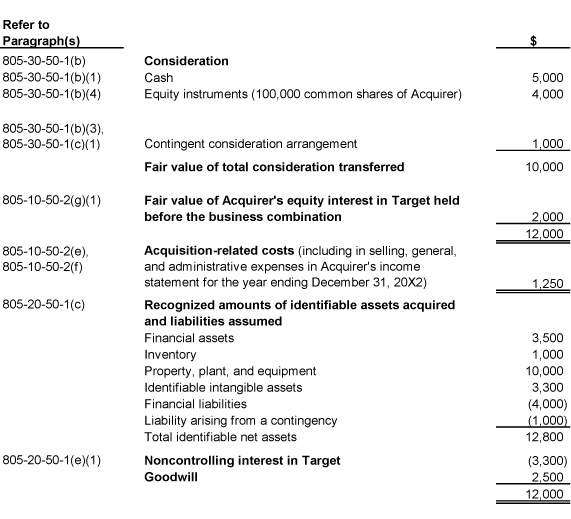 Refer to Paragraph(s) $ 805-30-50-1(b) Consideration 805-30-50-1(b)(1) Cash " 5,000 " 805-30-50-1(b)(4) "Equity instruments (100,000 common shares of Acquirer)" " 4,000 " " 805-30-50-1(b)(3), 805-30-50-1(c)(1)" Contingent consideration arrangement " 1,000 " Fair value of total consideration transferred " 10,000 " 805-10-50-2(g)(1) Fair value of Acquirer's equity interest in Target held before the business combination " 2,000 " " 12,000 " "805-10-50-2(e), 805-10-50-2(f)" "Acquisition-related costs (including in selling, general, and administrative expenses in Acquirer's income statement for the year ending December 31, 20X2)" " 1,250 " 805-20-50-1(c) Recognized amounts of identifiable assets acquired and liabilities assumed Financial assets " 3,500 " Inventory " 1,000 " "Property, plant, and equipment" " 10,000 " Identifiable intangible assets " 3,300 " Financial liabilities " (4,000)" Liability arising from a contingency " (1,000)" Total identifiable net assets " 12,800 " 805-20-50-1(e)(1) Noncontrolling interest in Target " (3,300)" Goodwill " 2,500 " " 12,000 "
- The fair value of the 100,000 common shares issued as part of the consideration paid for Target ($4,000) was determined on the basis of the closing market price of Acquirer's common shares on the acquisition date.
- The contingent consideration arrangement requires Acquirer to pay the former owners of Target 5 percent of the revenues of an unconsolidated equity investment, referred to as Investee, owned by Target, in excess of $7,500 for 20X3, up to a maximum amount of $2,500 (undiscounted). The potential undiscounted amount of all future payments that Acquirer could be required to make under the contingent consideration arrangement is between $0 and $2,500. The fair value of the contingent consideration arrangement of $1,000 was estimated by applying the income approach. That measure is based on significant inputs that are not observable in the market, which Section 820-10-35 refers to as Level 3 inputs. Key assumptions include a discount rate range of 20 percent to 25 percent and a probability-adjusted level of revenues in Investee between $10,000 and $20,000. As of December 31, 20X2, the amount recognized for the contingent consideration arrangement, the range of outcomes, and the assumptions used to develop the estimates had not changed.
- The fair value of the financial assets acquired includes receivables under sales-type leases or direct financing leases of data networking equipment with a fair value of $2,000. The gross amount due under the contracts is $3,100, of which $450 is expected to be uncollectible.
- The fair value of the acquired identifiable intangible assets of $3,300 is provisional pending receipt of the final valuations for those assets.
- A liability of $1,000 has been recognized at fair value for expected warranty claims on products sold by Target during the last 3 years. Acquirer expects that the majority of this expenditure will be incurred in 20X3 and that all will be incurred by the end of 20X4.
- The fair value of the noncontrolling interest in Target, a private entity, was estimated by applying the income approach and a market approach. This fair value measurement is based on significant inputs that are not observable in the market and thus represents a fair value measurement categorized within Level 3 of the fair value hierarchy as described in Section 820-10-35. Key assumptions include a discount rate range of 20 percent to 25 percent, a terminal value based on a range of terminal earnings before interest, taxes, depreciation, and amortization multiples between 3 and 5 (or, if appropriate, based on long-term sustainable growth rates ranging between 3 percent and 6 percent), financial multiples of entities deemed to be similar to Target, and adjustments because of the lack of control or lack of marketability that market participants would consider when measuring the fair value of the noncontrolling interest in Target.
- Acquirer recognized a gain of $500 as a result of remeasuring to fair value its 15 percent equity interest in Target held before the business combination. The gain is included in other income in Acquirer's income statement for the year ending December 31, 20X2.
- The amounts of Target's revenue and earnings included in Acquirer's consolidated income statement for the year ended December 31, 20X2, and the revenue and earnings of the combined entity had the acquisition date been January 1, 20X2 (if comparative financial statements are not presented), and January 1, 20X1 (if comparative financial statements are presented), are as follows.
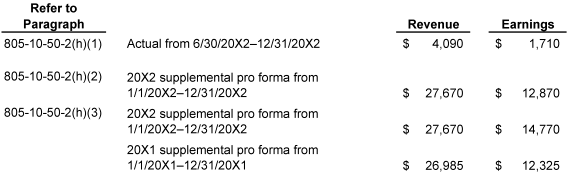 Refer to Paragraph Revenue Earnings 805-10-50-2(h)(1) Actual from 6/30/20X2-12/31/20X2 " $4,090 " " $1,710 " 805-10-50-2(h)(2) "20X2 supplemental pro forma from 1/1/20X2-12/31/20X2" " $27,670 " " $12,870 " 805-10-50-2(h)(3) "20X2 supplemental pro forma from 1/1/20X2-12/31/20X2" " $27,670 " " $14,770 " "20X1 supplemental pro forma from 1/1/20X1-12/31/20X1" " $26,985 " " $12,325 "
- 20X2 supplemental pro forma earnings were adjusted to exclude $1,250 of acquisition-related costs incurred in 20X2 and $650 of nonrecurring expense related to the fair value adjustment to acquisition-date inventory. 20X1 supplemental pro forma earnings were adjusted to include these charges.
- aIt does not include an organized workforce that could meet the criteria in paragraph 805-10-55-5E(a) through (b).
- bThere are no acquired processes that could meet the criteria in paragraph 805-10-55-5E(c) through (d).
- cIt does not include both an input and a substantive process.
805-10-65Transition and Open Effective Date Information
Source downloaded: .Record version aff6c3c006e4. Effective date must be checked in the source.
Transition Related to Accounting Standards Update No. 2017-01, <em class="ph i">Business Combinations (Topic 805): Clarifying the Definition of a Business</em>
- aThe pending content that links to this paragraph shall be effective for public business entities for annual periods beginning after December 15, 2017, including interim periods within those periods.
- bThe pending content that links to this paragraph shall be effective for all other entities for annual periods beginning after December 15, 2018, and interim periods within annual periods beginning after December 15, 2019.
- cEarlier application of the pending content that links to this paragraph is permitted for transactions for which the acquisition date occurs before the issuance date or the effective date of the pending content that links to this paragraph only when the transaction has not been reported in financial statements that have been issued or made available for issuance.
- dEarlier application of the pending content that links to this paragraph is permitted for transactions in which a subsidiary is deconsolidated or a group of assets is derecognized that occur before the issuance date or the effective date of the pending content that links to this paragraph only when the transaction has not been reported in financial statements issued or made available for issuance.
- eAn entity shall apply the pending content that links to this paragraph prospectively as of the beginning of the period of adoption.
Transition Related to Accounting Standards Update No. 2025-03, <em class="ph i">Business Combinations (Topic 805) and Consolidation (Topic 810): Determining the Accounting Acquirer in the Acquisition of a Variable Interest Entity</em>
- aAll entities shall apply the pending content that links to this paragraph for annual reporting periods beginning after December 15, 2026, and interim reporting periods within those annual reporting periods.
- bEarly adoption of the pending content that links to this paragraph is permitted in an interim or annual reporting period in which financial statements have not yet been issued (or made available for issuance). If an entity adopts the pending content that links to this paragraph in an interim reporting period, it shall adopt the pending content as of the beginning of that interim reporting period or the beginning of the annual reporting period that includes that interim reporting period.
- cAn entity shall apply the pending content that links to this paragraph on a prospective basis to all business combinations that have an acquisition date that occurs on or after the date of initial application of the pending content.
- dAn entity applying the pending content that links to this paragraph shall disclose in both the interim reporting period (if applicable) and the annual reporting period of the change the nature of and reason for the change in accounting principle.
805-10-S00StatusSEC
Source downloaded: .Record version d0bb17fd8fa7. Effective date must be checked in the source.
805-10-S25RecognitionSEC
Source downloaded: .Record version 5fe59f6305b3. Effective date must be checked in the source.
805-10-S30Initial MeasurementSEC
Source downloaded: .Record version ff387bd397d9. Effective date must be checked in the source.
Contribution of Businesses to a Newly Formed Joint Venture
805-10-S50DisclosureSEC
Source downloaded: .Record version 7e9e8cb6236f. Effective date must be checked in the source.
Pro Forma Disclosure
805-10-S55Implementation Guidance and IllustrationsSEC
Source downloaded: .Record version 2f0867871950. Effective date must be checked in the source.
Business Combinations Prior to an Initial Public Offering
805-10-S99SEC MaterialsSEC
Source downloaded: .Record version aba86300689b. Effective date must be checked in the source.
SEC Staff Guidance
- Facts: Two or more businesses combine in a single combination just prior to or contemporaneously with an initial public offering.
- Question: Does the guidance in SAB Topic 5.G apply to business combinations entered into just prior to or contemporaneously with an initial public offering?
- Interpretive Response: No. The guidance in SAB Topic 5.G is intended to address the transfer, just prior to or contemporaneously with an initial public offering, of nonmonetary assets in exchange for a company's stock. The guidance in SAB Topic 5.G is not intended to modify the requirements of FASB ASC Topic 805. Accordingly, the staff believes that the combination of two or more businesses should be accounted for in accordance with FASB ASC Topic 805.
- The SEC staff will object to a conclusion that did not result in the application of Topic 805 to transactions in which businesses are contributed to a newly formed, jointly controlled entity if that entity is not a joint venture. The SEC staff also would object to a conclusion that joint control is the only defining characteristic of a joint venture.
Related subtopics
- 805-20 Identifiable Assets and Liabilities, and Any Noncontrolling InterestBusiness Combinations
- 805-50 Related IssuesBusiness Combinations
- 740-805 Business CombinationsIncome Taxes
- 805-30 Goodwill or Gain from Bargain Purchase, Including Consideration TransferredBusiness Combinations
- 805-958 Not-for-Profit EntitiesBusiness Combinations
- 805-40 Reverse AcquisitionsBusiness Combinations