ASC

ASC 805-30

Goodwill or Gain from Bargain Purchase, Including Consideration Transferred

805 Business Combinations

Source downloaded: .Record version a8b9104b1c4e. Effective date must be checked in the source.

ASC 805-30 covers the piece of the acquisition method that produces goodwill or a bargain purchase gain. Goodwill equals the excess of (a) consideration transferred at acquisition-date fair value plus the fair value of any noncontrolling interest plus the acquisition-date fair value of any previously held equity interest, over (b) the net of the acquisition-date amounts of identifiable assets acquired and liabilities assumed (805-30-30-1); if (b) exceeds (a), the acquirer must first reassess its identification and measurement of all items and then recognize the remaining excess as a gain in earnings. It also governs measurement of consideration transferred, including contingent consideration and share-based payment replacement awards.

Key points (7)
  • Goodwill is recognized at the acquisition date as the excess of the sum of consideration transferred (generally acquisition-date fair value), the fair value of any noncontrolling interest, and the acquisition-date fair value of any previously held equity interest over the net of the acquisition-date amounts of identifiable assets acquired and liabilities assumed (805-30-25-1; 805-30-30-1).
  • In a bargain purchase, the acquirer must first reassess whether it correctly identified all assets acquired and liabilities assumed and review its measurement procedures (including NCI, previously held interest, and consideration transferred); any remaining excess is recognized as a gain in earnings attributed to the acquirer (805-30-25-2 through 25-4; 805-30-30-5 through 30-6).
  • Consideration transferred is the sum of acquisition-date fair values of assets transferred, liabilities incurred to former owners, and equity interests issued, and can include cash, other assets, a business, contingent consideration, equity instruments, options, warrants, and member interests (805-30-30-7); transferred assets retained within the combined entity are carried at carrying amount with no gain or loss (805-30-30-8).
  • Contingent consideration is recognized at acquisition-date fair value as part of consideration transferred and classified as a liability, equity, or asset under Subtopics 480-10 and 815-40 (805-30-25-5 through 25-7); post-acquisition, equity-classified amounts are not remeasured while asset/liability-classified amounts are remeasured to fair value each reporting date through earnings unless part of a Topic 815 hedge (805-30-35-1).
  • If the acquirer is obligated to replace acquiree share-based payment awards, the portion of the replacement award's fair-value-based measure attributable to precombination vesting is included in consideration transferred, and the remainder (including any excess of the replacement award's measure over the acquiree award's fair value) is postcombination compensation cost (805-30-30-9 through 30-12; 805-30-55-8 through 55-10).
  • For employee awards, the precombination portion equals the acquiree award's fair-value-based measure times the ratio of precombination service to the greater of the total service period or the acquiree award's original service period; if the acquirer is not obligated to replace expiring awards, all of the replacement award is postcombination compensation cost (805-30-30-10; 805-30-55-8).
  • Required disclosures include a qualitative description of the factors comprising goodwill, the fair value of total consideration and each major class, contingent consideration terms and range of outcomes, goodwill deductible for tax purposes, goodwill by reportable segment, and for a bargain purchase the gain amount, income statement line item, and reasons for the gain (805-30-50-1).

For students. Exam questions almost always test the goodwill formula (remember NCI is measured at full fair value and any previously held equity interest is remeasured to fair value) and the mandatory reassessment step before booking a bargain purchase gain. A common misunderstanding is thinking contingent consideration classified as equity gets remeasured through earnings — only asset/liability-classified contingent consideration is remeasured (805-30-35-1).

Machine-generated study aid for ASC 805-30. Check the source paragraphs below.

805-30-00Status

Source downloaded: .Record version 91e0a15bfa46. Effective date must be checked in the source.

805-30-00-1
The following table identifies the changes made to this Subtopic.
ParagraphActionAccounting Standards UpdateDate
AcquireeAmendedAccounting Standards Update No. 2010-0701/28/2010
AcquirerAmendedAccounting Standards Update No. 2025-0305/12/2025
BusinessAmendedAccounting Standards Update No. 2017-0101/05/2017
Business CombinationAmendedAccounting Standards Update No. 2010-0701/28/2010
GoodwillAmendedAccounting Standards Update No. 2023-0508/23/2023
GoodwillAmendedAccounting Standards Update No. 2010-0701/28/2010
Not-for-Profit EntityAddedAccounting Standards Update No. 2010-0701/28/2010
Private CompanyAddedAccounting Standards Update No. 2019-0605/30/2019
Variable Interest EntitySupersededAccounting Standards Update No. 2025-0305/12/2025
805-30-15-1AmendedAccounting Standards Update No. 2010-0701/28/2010
805-30-15-2AddedAccounting Standards Update No. 2010-0701/28/2010
805-30-30-7AmendedAccounting Standards Update No. 2018-0706/20/2018
805-30-30-9AmendedAccounting Standards Update No. 2018-0706/20/2018
805-30-30-10AmendedAccounting Standards Update No. 2010-0802/02/2010
AmendedAccounting Standards Update No. 2018-0706/20/2018
805-30-35-3AmendedAccounting Standards Update No. 2018-0706/20/2018
AmendedAccounting Standards Update No. 2025-1112/08/2025
805-30-50-1AmendedAccounting Standards Update No. 2024-0311/04/2024
805-30-50-4AmendedAccounting Standards Update No. 2021-0303/30/2021
805-30-50-4AmendedAccounting Standards Update No. 2019-0605/30/2019
805-30-50-4AmendedAccounting Standards Update No. 2011-0405/12/2011
805-30-55-2AmendedAccounting Standards Update No. 2011-0405/12/2011
AmendedAccounting Standards Update No. 2018-0706/20/2018
805-30-55-9AAddedAccounting Standards Update No. 2018-0706/20/2018
805-30-55-11AmendedAccounting Standards Update No. 2016-0903/30/2016
AmendedAccounting Standards Update No. 2018-0706/20/2018
AddedAccounting Standards Update No. 2018-0706/20/2018

805-30-05Overview and Background

Source downloaded: .Record version 332ff0a3b46b. Effective date must be checked in the source.

805-30-05-1
This Subtopic provides guidance on one aspect of the acquisition method (as described in paragraph 805-10-05-4)—the recognition and measurement of either goodwill or a gain from a bargain purchase.
805-30-05-2
The remaining aspects of the acquisition method are addressed in Subtopics 805-10 and 805-20. Subtopic 805-20 addresses the recognition and measurement of identifiable assets acquired, liabilities assumed, and any noncontrolling interest in the acquiree. Subtopic 805-10 addresses all of the following:
  1. a
    Identification of the acquirer
  2. b
    Determination of the acquisition date
  3. c
    Particular types of business combinations
  4. d
    Measurement period
  5. e
    Determination of what is part of a business combination.

805-30-15Scope and Scope Exceptions

Source downloaded: .Record version 3282088593b0. Effective date must be checked in the source.

Overall Guidance

805-30-15-1
This Subtopic follows the same Scope and Scope Exceptions as outlined in the Overall Subtopic, see Section 805-10-15, with specific exceptions noted below.

Entities

805-30-15-2
The guidance in this Subtopic does not apply to not-for-profit entities (NFPs). NFPs apply the guidance in Subtopic 958-805 for measuring goodwill acquired, a contribution received, and consideration transferred.

805-30-25Recognition

Source downloaded: .Record version 9fc0ee0bd8ed. Effective date must be checked in the source.

Goodwill Recognition

805-30-25-1
The acquirer shall recognize goodwill as of the acquisition date, measured as described in paragraph 805-30-30-1.

Gain from Bargain Purchase

805-30-25-2
Occasionally, an acquirer will make a bargain purchase, which is a business combination in which the amount in paragraph 805-30-30-1(b) exceeds the aggregate of the amounts specified in (a) in that paragraph. If that excess remains after applying the requirements in paragraph 805-30-25-4, the acquirer shall recognize the resulting gain in earnings on the acquisition date. The gain shall be attributed to the acquirer. Example 1 (see paragraph 805-30-55-14) provides an illustration of this guidance.
805-30-25-3
A bargain purchase might happen, for example, in a business combination that is a forced sale in which the seller is acting under compulsion. However, the recognition or measurement exceptions for particular items identified in paragraphs 805-20-25-16, and 805-20-30-10 also may result in recognizing a gain (or change the amount of a recognized gain) on a bargain purchase.
805-30-25-4
Before recognizing a gain on a bargain purchase, the acquirer shall reassess whether it has correctly identified all of the assets acquired and all of the liabilities assumed and shall recognize any additional assets or liabilities that are identified in that review. See paragraphs for guidance on the review of measurement procedures in connection with a reassessment required by this paragraph.

Contingent Consideration

805-30-25-5
The consideration the acquirer transfers in exchange for the acquiree includes any asset or liability resulting from a contingent consideration arrangement. The acquirer shall recognize the acquisition-date fair value of contingent consideration as part of the consideration transferred in exchange for the acquiree.
805-30-25-6
The acquirer shall classify an obligation to pay contingent consideration as a liability or as equity in accordance with Subtopics 480-10 and 815-40 or other applicable generally accepted accounting principles (GAAP). For example, Subtopic 480-10 provides guidance on whether to classify as a liability a contingent consideration arrangement that is, in substance, a put option written by the acquirer on the market price of the acquirer's shares issued in the business combination.
805-30-25-7
The acquirer shall classify as an asset a right to the return of previously transferred consideration if specified conditions are met.

805-30-30Initial Measurement

Source downloaded: .Record version 4b1836fcdf71. Effective date must be checked in the source.

Measurement of Goodwill

805-30-30-1
The acquirer shall recognize goodwill as of the acquisition date, measured as the excess of (a) over (b):
  1. a
    The aggregate of the following:
    1. 1
      The consideration transferred measured in accordance with this Section, which generally requires acquisition-date fair value (see paragraph 805-30-30-7)
    2. 2
      The fair value of any noncontrolling interest in the acquiree
    3. 3
      In a business combination achieved in stages, the acquisition-date fair value of the acquirer's previously held equity interest in the acquiree.
  2. b
    The net of the acquisition-date amounts of the identifiable assets acquired and the liabilities assumed measured in accordance with this Topic.
805-30-30-2
In a business combination in which the acquirer and the acquiree (or its former owners) exchange only equity interests, the acquisition-date fair value of the acquiree's equity interests may be more reliably measurable than the acquisition-date fair value of the acquirer's equity interests. If so, the acquirer shall determine the amount of goodwill by using the acquisition-date fair value of the acquiree's equity interests instead of the acquisition-date fair value of the equity interests transferred.
805-30-30-3
To determine the amount of goodwill in a business combination in which no consideration is transferred, the acquirer shall use the acquisition-date fair value of the acquirer's interest in the acquiree determined using a valuation technique in place of the acquisition-date fair value of the consideration transferred (see paragraph 805-30-30-1(a)(1)). Paragraphs provide additional guidance on applying the acquisition method to combinations of mutual entities, including measuring the acquisition-date fair value of the acquiree's equity interests using a valuation technique.

Required Reassessment of Measurement Procedures in a Bargain Purchase

805-30-30-4
As explained in paragraph 805-30-25-2, an acquirer will occasionally make a bargain purchase, which is a business combination in which the amount in paragraph 805-30-30-1(b) exceeds the aggregate of the amounts specified in (a) in that paragraph.
805-30-30-5
Paragraph 805-30-25-4 requires the acquirer to reassess whether it has correctly identified all of the assets acquired and all of the liabilities assumed before recognizing a gain on a bargain purchase. As part of that required reassessment, the acquirer shall then review the procedures used to measure the amounts this Topic requires to be recognized at the acquisition date for all of the following:
  1. a
    The identifiable assets acquired and liabilities assumed
  2. b
    The noncontrolling interest in the acquiree, if any
  3. c
    For a business combination achieved in stages, the acquirer's previously held equity interest in the acquiree
  4. d
    The consideration transferred.
805-30-30-6
The objective of the review is to ensure that the measurements appropriately reflect consideration of all available information as of the acquisition date.

Consideration Transferred

805-30-30-7
The consideration transferred in a business combination shall be measured at fair value, which shall be calculated as the sum of the acquisition-date fair values of the assets transferred by the acquirer, the liabilities incurred by the acquirer to former owners of the acquiree, and the equity interests issued by the acquirer. (However, any portion of the acquirer's share-based payment awards exchanged for awards held by the acquiree's grantees that is included in consideration transferred in the business combination shall be measured in accordance with paragraph 805-20-30-21 rather than at fair value.) Examples of potential forms of consideration include the following:
  1. a
    Cash
  2. b
    Other assets
  3. c
    A business or a subsidiary of the acquirer
  4. d
  5. e
    Common or preferred equity instruments
  6. f
    Options
  7. g
    Warrants
  8. h
    Member interests of mutual entities.
805-30-30-8
The consideration transferred may include assets or liabilities of the acquirer that have carrying amounts that differ from their fair values at the acquisition date (for example, nonmonetary assets or a business of the acquirer). If so, the acquirer shall remeasure the transferred assets or liabilities to their fair values as of the acquisition date and recognize the resulting gains or losses, if any, in earnings. However, sometimes the transferred assets or liabilities remain within the combined entity after the business combination (for example, because the assets or liabilities were transferred to the acquiree rather than to its former owners), and the acquirer therefore retains control of them. In that situation, the acquirer shall measure those assets and liabilities at their carrying amounts immediately before the acquisition date and shall not recognize a gain or loss in earnings on assets or liabilities it controls both before and after the business combination.
805-30-30-9
An acquirer may exchange its share-based payment awards for awards held by grantees of the acquiree. This Topic refers to such awards as replacement awards. Exchanges of share options or other share-based payment awards in conjunction with a business combination are modifications of share-based payment awards in accordance with Topic 718. If the acquirer is obligated to replace the acquiree awards, either all or a portion of the fair-value-based measure of the acquirer's replacement awards shall be included in measuring the consideration transferred in the business combination. The acquirer is obligated to replace the acquiree awards if the acquiree or its grantees have the ability to enforce replacement. For example, for purposes of applying this requirement, the acquirer is obligated to replace the acquiree's awards if replacement is required by any of the following:
  1. a
    The terms of the acquisition agreement
  2. b
    The terms of the acquiree's awards
  3. c
    Applicable laws or regulations.
805-30-30-10
In situations in which acquiree awards would expire as a consequence of a business combination and the acquirer replaces those awards even though it is not obligated to do so, all of the fair-value-based measure of the replacement awards shall be recognized as compensation cost in the postcombination financial statements. That is, none of the fair-value-based measure of those awards shall be included in measuring the consideration transferred in the business combination.
805-30-30-11
To determine the portion of a replacement award that is part of the consideration transferred for the acquiree, the acquirer shall measure both the replacement awards granted by the acquirer and the acquiree awards as of the acquisition date in accordance with Topic 718. The portion of the fair-value-based measure of the replacement award that is part of the consideration transferred in exchange for the acquiree equals the portion of the acquiree award that is attributable to precombination vesting.
805-30-30-12
The acquirer shall attribute a portion of a replacement award to postcombination vesting if it requires postcombination vesting, regardless of whether grantees had rendered all of the service or delivered all of the goods required in exchange for their acquiree awards before the acquisition date. The portion of a nonvested replacement award attributable to postcombination vesting equals the total fair-value-based measure of the replacement award less the amount attributed to precombination vesting. Therefore, the acquirer shall attribute any excess of the fair-value-based measure of the replacement award over the fair value of the acquiree award to postcombination vesting.
805-30-30-13
Paragraphs , , , and Example 2 (see paragraph 805-30-55-17) provide additional guidance and illustrations on distinguishing between the portion of a replacement award that is attributable to precombination vesting, which the acquirer includes in the consideration transferred in the business combination, and the portion that is attributed to postcombination vesting, which the acquirer recognizes as compensation cost in its postcombination financial statements.

805-30-35Subsequent Measurement

Source downloaded: .Record version f9f6e69ae805. Effective date must be checked in the source.

Contingent Consideration

805-30-35-1
Some changes in the fair value of contingent consideration that the acquirer recognizes after the acquisition date may be the result of additional information about facts and circumstances that existed at the acquisition date that the acquirer obtained after that date. Such changes are measurement period adjustments in accordance with paragraphs and Section 805-10-30. However, changes resulting from events after the acquisition date, such as meeting an earnings target, reaching a specified share price, or reaching a milestone on a research and development project, are not measurement period adjustments. The acquirer shall account for changes in the fair value of contingent consideration that are not measurement period adjustments as follows:
  1. a
    Contingent consideration classified as equity shall not be remeasured and its subsequent settlement shall be accounted for within equity.
  2. b
    Contingent consideration classified as an asset or a liability shall be remeasured to fair value at each reporting date until the contingency is resolved. The changes in fair value shall be recognized in earnings unless the arrangement is a hedging instrument for which Topic 815 requires the changes to be initially recognized in other comprehensive income.
805-30-35-1A
Contingent consideration arrangements of an acquiree assumed by the acquirer in a business combination shall be measured subsequently in accordance with the guidance for contingent consideration arrangements in the preceding paragraph.

Goodwill

805-30-35-2
The subsequent measurement of goodwill is addressed in Subtopic 350-20.

Replacement Share-Based Payment Awards

805-30-35-3
Topic 718 provides guidance on subsequent measurement and accounting for the portion of replacement share-based payment awards issued by an acquirer that is attributable to future goods or services.

805-30-50Disclosure

Source downloaded: .Record version 439146d75e21. Effective date must be checked in the source.

Business Combinations Occurring during a Current Reporting Period or after the Reporting Date but before the Financial Statements Are Issued

805-30-50-1
Paragraph 805-10-50-1 identifies one of the objectives of disclosures about a business combination. To meet that objective, the acquirer shall disclose all of the following information for each business combination that occurs during the reporting period:
  1. a
    A qualitative description of the factors that make up the goodwill recognized, such as expected synergies from combining operations of the acquiree and the acquirer, intangible assets that do not qualify for separate recognition, or other factors.
  2. b
    The acquisition-date fair value of the total consideration transferred and the acquisition-date fair value of each major class of consideration, such as the following:
    1. 1
      Cash
    2. 2
      Other tangible or intangible assets, including a business or subsidiary of the acquirer
    3. 3
      Liabilities incurred, for example, a liability for contingent consideration
    4. 4
      Equity interests of the acquirer, including the number of instruments or interests issued or issuable and the method of determining the fair value of those instruments or interests.
  3. c
    For contingent consideration arrangements, all of the following:
    1. 1
      The amount recognized as of the acquisition date
    2. 2
      A description of the arrangement and the basis for determining the amount of the payment
    3. 3
      An estimate of the range of outcomes (undiscounted) or, if a range cannot be estimated, that fact and the reasons why a range cannot be estimated. If the maximum amount of the payment is unlimited, the acquirer shall disclose that fact.
  4. d
    The total amount of goodwill that is expected to be deductible for tax purposes.
  5. e
    If the acquirer is required to disclose segment information in accordance with Subtopic 280-10, the amount of goodwill by reportable segment. If the assignment of goodwill to reporting units required by paragraphs has not been completed as of the date the financial statements are issued or are available to be issued (as discussed in Section 855-10-25), the acquirer shall disclose that fact.
  6. f
    In a bargain purchase (see paragraphs ), both of the following:
    1. 1
      The amount of any gain recognized in accordance with paragraph 805-30-25-2 and the line item in the income statement in which the gain is recognized
    2. 2
      A description of the reasons why the transaction resulted in a gain.
Transition date:(P) December 16, 2026; (N) December 16, 2026Transition guidance:
220-40-65-1Paragraph 805-10-50-1 identifies one of the objectives of disclosures about a business combination. To meet that objective, the acquirer shall disclose all of the following information for each business combination that occurs during the reporting period:
  1. a
    A qualitative description of the factors that make up the goodwill recognized, such as expected synergies from combining operations of the acquiree and the acquirer, intangible assets that do not qualify for separate recognition, or other factors.
  2. b
    The acquisition-date fair value of the total consideration transferred and the acquisition-date fair value of each major class of consideration, such as the following:
    1. 1
      Cash
    2. 2
      Other tangible or intangible assets, including a business or subsidiary of the acquirer
    3. 3
      Liabilities incurred, for example, a liability for contingent consideration
    4. 4
      Equity interests of the acquirer, including the number of instruments or interests issued or issuable and the method of determining the fair value of those instruments or interests.
  3. c
    For contingent consideration arrangements, all of the following:
    1. 1
      The amount recognized as of the acquisition date
    2. 2
      A description of the arrangement and the basis for determining the amount of the payment
    3. 3
      An estimate of the range of outcomes (undiscounted) or, if a range cannot be estimated, that fact and the reasons why a range cannot be estimated. If the maximum amount of the payment is unlimited, the acquirer shall disclose that fact.
  4. d
    The total amount of goodwill that is expected to be deductible for tax purposes.
  5. e
    If the acquirer is required to disclose segment information in accordance with Subtopic 280-10, the amount of goodwill by reportable segment. If the assignment of goodwill to reporting units required by paragraphs has not been completed as of the date the financial statements are issued or are available to be issued (as discussed in Section 855-10-25), the acquirer shall disclose that fact.
  6. f
    In a bargain purchase (see paragraphs ), both of the following:
    1. 1
      The amount of any gain recognized in accordance with paragraph 805-30-25-2 and the line item in the income statement in which the gain is recognized
    2. 2
      A description of the reasons why the transaction resulted in a gain.
    See paragraphs for additional disclosure requirements.
Transition date:(P) December 16, 2027; (N) December 16, 2028Transition guidance:
270-10-65-1Paragraph 805-10-50-1 identifies one of the objectives of disclosures about a business combination. To meet that objective, the acquirer shall disclose in interim and annual reporting periods all of the following information for each business combination that occurs during the reporting period:
  1. a
    A qualitative description of the factors that make up the goodwill recognized, such as expected synergies from combining operations of the acquiree and the acquirer, intangible assets that do not qualify for separate recognition, or other factors.
  2. b
    The acquisition-date fair value of the total consideration transferred and the acquisition-date fair value of each major class of consideration, such as the following:
    1. 1
      Cash
    2. 2
      Other tangible or intangible assets, including a business or subsidiary of the acquirer
    3. 3
      Liabilities incurred, for example, a liability for contingent consideration
    4. 4
      Equity interests of the acquirer, including the number of instruments or interests issued or issuable and the method of determining the fair value of those instruments or interests.
  3. c
    For contingent consideration arrangements, all of the following:
    1. 1
      The amount recognized as of the acquisition date
    2. 2
      A description of the arrangement and the basis for determining the amount of the payment
    3. 3
      An estimate of the range of outcomes (undiscounted) or, if a range cannot be estimated, that fact and the reasons why a range cannot be estimated. If the maximum amount of the payment is unlimited, the acquirer shall disclose that fact.
  4. d
    The total amount of goodwill that is expected to be deductible for tax purposes.
  5. e
    If the acquirer is required to disclose segment information in accordance with Subtopic 280-10, the amount of goodwill by reportable segment. If the assignment of goodwill to reporting units required by paragraphs has not been completed as of the date the financial statements are issued or are available to be issued (as discussed in Section 855-10-25), the acquirer shall disclose that fact.
  6. f
    In a bargain purchase (see paragraphs ), both of the following:
    1. 1
      The amount of any gain recognized in accordance with paragraph 805-30-25-2 and the line item in the income statement in which the gain is recognized
    2. 2
      A description of the reasons why the transaction resulted in a gain.
    See paragraphs for additional disclosure requirements.
805-30-50-2
For individually immaterial business combinations occurring during the reporting period that are material collectively, the acquirer shall disclose the information required by paragraph 805-30-50-1 in the aggregate.
Transition date:(P) December 16, 2027; (N) December 16, 2028Transition guidance:
270-10-65-1For individually immaterial business combinations occurring during the reporting period that are material collectively, the acquirer shall disclose the information required by paragraph 805-30-50-1 in the aggregate in interim and annual reporting periods.
805-30-50-3
If the acquisition date of a business combination is after the reporting date but before the financial statements are issued or are available to be issued (as discussed in Section 855-10-25), the acquirer shall disclose the information required by paragraph 805-30-50-1 unless the initial accounting for the business combination is incomplete at the time the financial statements are issued or are available to be issued. In that situation, the acquirer shall describe which disclosures could not be made and the reason why they could not be made.
Transition date:(P) December 16, 2027; (N) December 16, 2028Transition guidance:
270-10-65-1If the acquisition date of a business combination is after the reporting date but before the financial statements are issued or are available to be issued (as discussed in Section 855-10-25), the acquirer shall disclose the information required by paragraph 805-30-50-1in interim and annual reporting periods unless the initial accounting for the business combination is incomplete at the time the financial statements are issued or are available to be issued. In that situation, the acquirer shall describe which disclosures could not be made and the reason why they could not be made.

The Financial Effects of Adjustments That Relate to Business Combinations That Occurred in the Current or Previous Reporting Periods

805-30-50-4
Paragraph 805-10-50-5 identifies the second objective of disclosures about the effects of business combinations that occurred in the current or previous reporting periods. To meet the objective in that paragraph, the acquirer shall disclose the following information for each material business combination or in the aggregate for individually immaterial business combinations that are material collectively:
  1. a
    For each reporting period after the acquisition date until the entity collects, sells, or otherwise loses the right to a contingent consideration asset, or until the entity settles a contingent consideration liability or the liability is cancelled or expires, all of the following:
    1. 1
      Any changes in the recognized amounts, including any differences arising upon settlement
    2. 2
      Any changes in the range of outcomes (undiscounted) and the reasons for those changes
    3. 3
      The disclosures required by Section 820-10-50.
  2. b
    A reconciliation of the carrying amount of goodwill at the beginning and end of the reporting period as required by paragraph 350-20-50-1. A private company or not-for-profit entity that adopts the accounting alternative for amortizing goodwill in Subtopic 350-20 is not required to disclose the reconciliation.
Transition date:(P) December 16, 2027; (N) December 16, 2028Transition guidance:
270-10-65-1Paragraph 805-10-50-5 identifies the second objective of disclosures about the effects of business combinations that occurred in the current or previous reporting periods. To meet the objective in that paragraph, the acquirer shall disclose in interim and annual reporting periods the following information for each material business combination or in the aggregate for individually immaterial business combinations that are material collectively:
  1. a
    For each reporting period after the acquisition date until the entity collects, sells, or otherwise loses the right to a contingent consideration asset, or until the entity settles a contingent consideration liability or the liability is cancelled or expires, all of the following:
    1. 1
      Any changes in the recognized amounts, including any differences arising upon settlement
    2. 2
      Any changes in the range of outcomes (undiscounted) and the reasons for those changes
    3. 3
      The disclosures required by Section 820-10-50.
  2. b
    A reconciliation of the carrying amount of goodwill at the beginning and end of the reporting period as required by paragraph 350-20-50-1. A private company or not-for-profit entity that adopts the accounting alternative for amortizing goodwill in Subtopic 350-20 is not required to disclose the reconciliation.

805-30-55Implementation Guidance and Illustrations

Source downloaded: .Record version fc3fd9ef5353. Effective date must be checked in the source.

805-30-55-1
This Section is an integral part of the requirements of this Subtopic. This Section provides additional guidance and illustrations that address the application of accounting requirements for business combinations to goodwill or gain from bargain purchase including consideration transferred.

Implementation Guidance

805-30-55-2
In a business combination achieved without the transfer of consideration, the acquirer must substitute the acquisition-date fair value of its interest in the acquiree for the acquisition-date fair value of the consideration transferred to measure goodwill or a gain on a bargain purchase (see paragraphs ). Subtopic 820-10 provides guidance on using valuation techniques to measure fair value.
805-30-55-3
When two mutual entities combine, the fair value of the equity or member interests in the acquiree (or the fair value of the acquiree) may be more reliably measurable than the fair value of the member interests transferred by the acquirer. In that situation, paragraph requires the acquirer to determine the amount of goodwill by using the acquisition-date fair value of the acquiree's equity interests instead of the acquisition-date fair value of the acquirer's equity interests transferred as consideration. In addition, the acquirer in a combination of mutual entities shall recognize the acquiree's net assets as a direct addition to capital or equity in its statement of financial position, not as an addition to retained earnings, which is consistent with the way in which other types of entities apply the acquisition method.
805-30-55-4
Although they are similar in many ways to other businesses, mutual entities have distinct characteristics that arise primarily because their members are both customers and owners. Members of mutual entities generally expect to receive benefits for their membership, often in the form of reduced fees charged for goods and services or patronage dividends. The portion of patronage dividends allocated to each member is often based on the amount of business the member did with the mutual entity during the year.
805-30-55-5
A fair value measurement of a mutual entity should include the assumptions that market participants would make about future member benefits as well as any other relevant assumptions market participants would make about the mutual entity. For example, an estimated cash flow model may be used to determine the fair value of a mutual entity. The cash flows used as inputs to the model should be based on the expected cash flows of the mutual entity, which are likely to reflect reductions for member benefits, such as reduced fees charged for goods and services.
805-30-55-6
If the acquirer is obligated to replace the acquiree's share-based payment awards, paragraph 805-30-30-9 requires the acquirer to include either all or a portion of the fair-value-based measure of the replacement awards in the consideration transferred in the business combination. Paragraphs , , , and Example 2 (see paragraph 805-30-55-17) provide additional guidance on and illustrate how to determine the portion of an award to include in consideration transferred in a business combination and the portion to recognize as compensation cost in the acquirer's postcombination financial statements.
805-30-55-7
To determine the portion of a replacement award that is part of the consideration exchanged for the acquiree and the portion that is compensation for postcombination vesting, the acquirer first measures both the replacement awards and the acquiree awards as of the acquisition date in accordance with the requirements of Topic 718. In most situations, those requirements result in use of the fair-value-based measurement method, but that Topic permits use of the calculated value method or the intrinsic value method in specified circumstances. This discussion focuses on the fair-value-based method, but the guidance in paragraphs and the additional guidance cited in the preceding paragraph also apply in situations in which Topic 718 permits use of either the calculated value method or the intrinsic value method for both the acquiree awards and the replacement awards.
805-30-55-8
The portion of an employee replacement award attributable to precombination vesting is the fair-value-based measure of the acquiree award multiplied by the ratio of the precombination employee's service period to the greater of the total service period or the original service period of the acquiree award. (Example 2, Cases C and D [see paragraphs ] illustrate that calculation.) The total service period is the sum of the following amounts:
  1. a
    The part of the employee's requisite service period for the acquiree award that was completed before the acquisition date
  2. b
    The postcombination employee's requisite service period, if any, for the replacement award.
805-30-55-9
The employee's requisite service period includes explicit, implicit, and derived service periods during which employees are required to provide service in exchange for the award (consistent with the requirements of Topic 718).
805-30-55-9A
The portion of a nonemployee replacement award attributable to precombination vesting is based on the fair-value-based measure of the acquiree award multiplied by the percentage that would have been recognized had the grantor paid cash for the goods or services instead of paying with a nonemployee award. For this calculation, the percentage that would have been recognized is the lower of:
  1. a
    The percentage that would have been recognized calculated on the basis of the original vesting requirements of the nonemployee award
  2. b
    The percentage that would have been recognized calculated on the basis of the effective vesting requirements. Effective vesting requirements are equal to the services or goods provided before the acquisition date plus any additional postcombination services or goods required by the replacement award.
805-30-55-10
The portion of a nonvested replacement award (for employee and nonemployee) attributable to postcombination vesting, and therefore recognized as compensation cost in the postcombination financial statements, equals the total fair-value-based measure of the replacement award less the amount attributed to precombination vesting. Therefore, the acquirer attributes any excess of the fair-value-based measure of the replacement award over the fair value of the acquiree award to postcombination vesting and recognizes that excess as compensation cost in the postcombination financial statements.
805-30-55-11
Regardless of the accounting policy elected in accordance with paragraph 718-10-35-1D or 718-10-35-3, the portion of a nonvested replacement award included in consideration transferred shall reflect the acquirer's estimate of the number of replacement awards for which the service is expected to be rendered or the goods are expected to be delivered (that is, an acquirer that has elected an accounting policy to recognize forfeitures as they occur in accordance with paragraph 718-10-35-1D or 718-10-35-3 should estimate the number of replacement awards for which the service is expected to be rendered or the goods are expected to be delivered when determining the portion of a nonvested replacement award included in consideration transferred). For example, if the fair-value-based measure of the portion of a replacement award attributed to precombination vesting is $100 and the acquirer expects that the service will be rendered for only 95 percent of the instruments awarded, the amount included in consideration transferred in the business combination is $95. Changes in the number of replacement awards for which the service is expected to be rendered or the goods are expected to be delivered are reflected in compensation cost for the periods in which the changes or forfeitures occur—not as adjustments to the consideration transferred in the business combination. If an acquirer's accounting policy is to account for forfeitures as they occur, the amount excluded from consideration transferred (because the service is not expected to be rendered or the goods are not expected to be delivered) should be attributed to the postcombination vesting and recognized in compensation cost over the employee's requisite service period or the nonemployee's vesting period. Recognition of compensation cost for nonemployees should consider the recognition guidance provided in paragraph 718-10-25-2C. That is, recognition of the fair value of the nonemployee share-based payment award should be recognized in the same manner as if the grantor had paid cash for the goods or services instead of paying with or using the share-based payment awards.
805-30-55-12
Similarly, the effects of other events, such as modifications or the ultimate outcome of awards with performance conditions, that occur after the acquisition date are accounted for in accordance with Topic 718 in determining compensation cost for the period in which an event occurs. If the replacement award for an employee award has a graded vesting schedule, the acquirer shall recognize the related compensation cost in accordance with its policy election for other awards with graded vesting in accordance with paragraph 718-10-35-8.
805-30-55-13
The same requirements for determining the portions of a replacement award attributable to precombination and postcombination vesting apply regardless of whether a replacement award is classified as a liability or an equity instrument in accordance with the provisions of paragraphs 718-10-25-6 through 25-19A. All changes in the fair-value-based measure of awards classified as liabilities after the acquisition date and the related income tax effects are recognized in the acquirer's postcombination financial statements in the period(s) in which the changes occur.

Illustrations

805-30-55-14
Paragraphs establish the required accounting for a bargain purchase. This Example provides additional guidance on bargain purchases and illustrates its application.
805-30-55-15
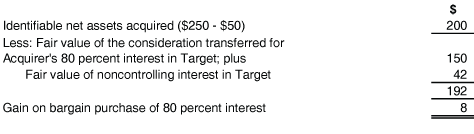
On January 1, 20X5, the acquiring entity, or Acquirer, acquires 80 percent of the equity interests of the acquiree, or Target, a private entity, in exchange for cash of $150. Because the former owners of Target needed to dispose of their investments in Target by a specified date, they did not have sufficient time to market Target to multiple potential buyers. The management of Acquirer initially measures the separately recognizable identifiable assets acquired and the liabilities assumed as of the acquisition date in accordance with the requirements of the Business Combinations Topic. The identifiable assets are measured at $250, and the liabilities assumed are measured at $50. Acquirer engages an independent consultant who determines that the fair value of the 20 percent noncontrolling interest in Target is $42. The amount of Target's identifiable net assets ($200, calculated as $250 - $50) exceeds the fair value of the consideration transferred plus the fair value of the noncontrolling interest in Target. Therefore, Acquirer reviews the procedures it used to identify and measure the assets acquired and liabilities assumed and to measure the fair value of both the noncontrolling interest in Target and the consideration transferred. After that review, Acquirer decides that the procedures and resulting measures were appropriate. Acquirer measures the gain on its purchase of the 80 percent interest as follows.
  • $ Identifiable net assets acquired ($250 - $50) 200 Less: Fair value of the consideration transferred for Acquirer's 80 percent interest in Target; plus 150 Fair value of noncontrolling interest in Target 42 192 Gain on bargain purchase of 80 percent interest 8
805-30-55-16
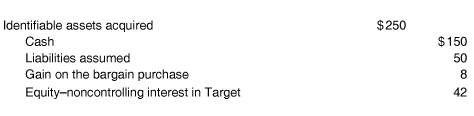
Acquirer would record its acquisition of Target in its consolidated financial statements as follows.
  • Identifiable assets acquired $250 Cash $150 Liabilities assumed 50 Gain on the bargain purchase 8 Equity-noncontrolling interest in Target 42
805-30-55-17
The following Cases illustrate the guidance referred to in paragraph 805-30-55-6 for replacement awards that the acquirer was obligated to issue. The Cases assume that all awards are classified as equity and that the awards have only an explicit service period. As discussed in paragraphs , the acquirer also must take any implicit or derived employee's service periods into account in determining the employee's requisite service period for a replacement award. In these Cases, the acquiring entity is referred to as Acquirer and the acquiree is referred to as Target:
  1. a
    Awards that require no postcombination vesting that are exchanged for acquiree awards for which employees:
    1. 1
      Have rendered the required service as of the acquisition date (Case A)
    2. 2
      Have not rendered all of the required service as of the acquisition date (Case D).
  2. b
    Awards that require postcombination vesting that are exchanged for acquiree awards for which employees:
    1. 1
      Have rendered the required service as of the acquisition date (Case B)
    2. 2
      Have not rendered all of the required service as of the acquisition date (Case C).
805-30-55-18
Acquirer issues replacement awards of $110 (fair-value-based measure) at the acquisition date for Target awards of $100 (fair-value-based measure) at the acquisition date. No postcombination vesting is required for the replacement awards, and Target's employees had rendered all of the required service for the acquiree awards as of the acquisition date.
805-30-55-19
The amount attributable to precombination vesting is the fair-value-based measure of Target's awards ($100) at the acquisition date; that amount is included in the consideration transferred in the business combination. The amount attributable to postcombination vesting is $10, which is the difference between the total value of the replacement awards ($110) and the portion attributable to precombination vesting ($100). Because no postcombination vesting is required for the replacement awards, Acquirer immediately recognizes $10 as compensation cost in its postcombination financial statements.
805-30-55-20
Acquirer exchanges replacement awards that require one year of postcombination vesting for share-based payment awards of Target for which employees had completed the requisite service period before the business combination. The fair-value-based measure of both awards is $100 at the acquisition date. When originally granted, Target's awards had a requisite service period of four years. As of the acquisition date, the Target employees holding unexercised awards had rendered a total of seven years of service since the grant date. Even though Target employees had already rendered all of the requisite service, Acquirer attributes a portion of the replacement award to postcombination compensation cost in accordance with paragraphs because the replacement awards require one year of postcombination vesting. The total service period is five years—the requisite service period for the original acquiree award completed before the acquisition date (four years) plus the requisite service period for the replacement award (one year). The portion attributable to precombination vesting equals the fair-value-based measure of the acquiree award ($100) multiplied by the ratio of the precombination vesting period (4 years) to the total vesting period (5 years). Thus, $80 ($100 × 4 ÷ 5 years) is attributed to the precombination vesting period and therefore included in the consideration transferred in the business combination. The remaining $20 is attributed to the postcombination vesting period and therefore is recognized as compensation cost in Acquirer's postcombination financial statements in accordance with Topic 718.
805-30-55-21
Acquirer exchanges replacement awards that require one year of postcombination vesting for share-based payment awards of Target for which employees had not yet rendered all of the required services as of the acquisition date. The fair-value-based measure of both awards is $100 at the acquisition date. When originally granted, the awards of Target had a requisite service period of four years. As of the acquisition date, the Target employees had rendered two years' service, and they would have been required to render two additional years of service after the acquisition date for their awards to vest. Accordingly, only a portion of Target's awards is attributable to precombination vesting.
805-30-55-22
The replacement awards require only one year of postcombination vesting. Because employees have already rendered two years of service, the total requisite service period is three years. The portion attributable to precombination vesting equals the fair-value-based measure of the acquiree award ($100) multiplied by the ratio of the precombination vesting period (2 years) to the greater of the total service period (3 years) or the original service period of Target's award (4 years). Thus, $50 ($100 x 2 ÷ 4 years) is attributable to precombination vesting and therefore included in the consideration transferred for the acquiree. The remaining $50 is attributable to postcombination vesting and therefore recognized as compensation cost in Acquirer's postcombination financial statements in accordance with Topic 718.
805-30-55-23
Assume the same facts as in Case C, except that Acquirer exchanges replacement awards that require no postcombination vesting for share-based payment awards of Target for which employees had not yet rendered all of the requisite service as of the acquisition date. The terms of the replaced Target awards did not eliminate any remaining requisite service period upon a change in control. (If the Target awards had included a provision that eliminated any remaining requisite service period upon a change in control, the guidance in Case A would apply.) The fair-value-based measure of both awards is $100. Because employees have already rendered two years of service and the replacement awards do not require any postcombination vesting, the total service period is two years.
805-30-55-24
The portion of the fair-value-based measure of the replacement awards attributable to precombination vesting equals the fair-value-based measure of the acquiree award ($100) multiplied by the ratio of the precombination vesting period (2 years) to the greater of the total service period (2 years) or the original service period of Target's award (4 years). Thus, $50 ($100 x 2 ÷ 4 years) is attributable to precombination vesting and therefore included in the consideration transferred for the acquiree. The remaining $50 is attributable to postcombination vesting. Because no postcombination vesting is required to vest in the replacement award, Acquirer recognizes the entire $50 immediately as compensation cost in the postcombination financial statements.
805-30-55-25
The following Cases illustrate the guidance referred to in paragraph 805-30-55-6 for replacement awards that the acquirer was obligated to issue and the attribution guidance for a nonemployee replacement award to precombination and postcombination vesting referenced in paragraph 805-30-55-9A.
805-30-55-26
In these Cases, the acquiring entity is referred to as Acquirer and the acquiree is referred to as Target:
  1. a
    Awards that require no postcombination vesting that are exchanged for acquiree awards for which grantees:
    1. 1
      Have met the vesting condition as of the acquisition date (Case A)
    2. 2
      Have not met the vesting condition as of the acquisition date (Case D).
  2. b
    Awards that require postcombination vesting that are exchanged for acquiree awards for which grantees:
    1. 1
      Have met the vesting condition as of the acquisition date (Case B)
    2. 2
      Have not met the vesting condition as of the acquisition date (Case C).
805-30-55-27
The Cases assume the following:
  1. a
    All awards are classified as equity.
  2. b
    The only vesting condition included in the awards, if any, involves the delivery of engines.
  3. c
    Target and Acquirer typically pay cash as each engine is delivered to their suppliers.
805-30-55-28
Acquirer issues replacement awards of $110 (fair-value-based measure) at the acquisition date for Target awards of $100 (fair-value-based measure) at the acquisition date. No postcombination vesting is required for the replacement awards, and Target's grantee has delivered all the engines necessary for the acquiree awards as of the acquisition date.
805-30-55-29
The amount attributable to precombination vesting is the fair-value-based measure of Target's awards ($100) at the acquisition date; that amount is included in the consideration transferred in the business combination. The amount attributable to postcombination vesting is $10, which is the difference between the total value of the replacement awards ($110) and the portion attributable to precombination vesting ($100). Because no postcombination vesting is required for the replacement awards, Acquirer immediately recognizes $10 as compensation cost in its postcombination financial statements.
805-30-55-30
Acquirer exchanges replacement awards that require the delivery of another 10 engines postcombination for share-based payment awards of Target for which the grantee had met the necessary vesting condition to deliver 40 engines before the business combination. The fair-value-based measure of both awards is $100 at the acquisition date. Even though the grantee already had met the vesting condition for the acquiree's award, Acquirer attributes a portion of the replacement award to postcombination compensation cost in accordance with paragraphs because the replacement awards require the delivery of an additional 10 engines.
805-30-55-31
The portion attributable to precombination vesting equals the fair-value-based measure of the acquiree award ($100) multiplied by the percentage that would have been recognized for the award. The percentage that would have been recognized is the lower of the calculation on the basis of the original vesting requirements and the percentage that would have been recognized on the basis of the effective vesting requirements as described in paragraph 805-30-55-9A. The percentage that would have been recognized on the basis of the original vesting requirements equals 100 percent, which is calculated as 40 engines delivered divided by 40 engines required to be delivered. The percentage that would have been recognized on the basis of the effective vesting requirements equals 80 percent, which is calculated as 40 engines delivered divided by 50 engines (the sum of 40 engines delivered plus 10 engines required postcombination). Thus, $80 ($100 × 80%) is attributed to the precombination vesting period and therefore is included in the consideration transferred in the business combination. The remaining $20 is attributed to the postcombination vesting period and therefore is recognized as compensation cost in Acquirer's postcombination financial statements in accordance with Topic 718.
805-30-55-32
Acquirer exchanges replacement awards that require the delivery of 10 engines postcombination for share-based payment awards of Target for which the grantee had not met the necessary vesting condition to deliver 40 engines before the business combination. The fair-value-based measure of both awards is $100 at the acquisition date. As of the acquisition date, Target grantee has delivered 20 engines, and Target grantee would have been required to deliver an additional 20 engines after the acquisition date for its awards to vest. Accordingly, only a portion of Target's awards is attributable to precombination vesting.
805-30-55-33
The portion attributable to precombination vesting equals the fair-value-based measure of the acquiree award ($100) multiplied by the percentage that would have been recognized on the award. The percentage that would have been recognized is the lower of the percentage that would have been recognized on the basis of the original vesting requirements and the percentage that would have been recognized on the basis of the effective vesting requirements as described in paragraph 805-30-55-9A. The percentage that would have been recognized on the basis of the original vesting requirements equals 50 percent, which is calculated as 20 engines delivered divided by 40 engines required to be delivered. The percentage that would have been recognized on the basis of the effective vesting requirements equals 66.67 percent, which is calculated as 20 engines delivered divided by 30 engines (the sum of 20 engines delivered plus 10 engines required postcombination). Thus, $50 ($100 × 50%) is attributed to precombination vesting and therefore is included in the consideration transferred in the business combination. The remaining $50 is attributed to the postcombination vesting and therefore is recognized as compensation cost in Acquirer's postcombination financial statements in accordance with Topic 718.
805-30-55-34
Assume the same facts as in Case C, except that Acquirer exchanges replacement awards that require no postcombination vesting for share-based payment awards of Target for which the grantee had not met the necessary vesting condition to deliver 40 engines before the business combination. The terms of the replaced Target awards did not eliminate the vesting condition upon a change in control. (If the Target awards had included a provision that eliminated the vesting condition upon a change in control, the guidance in Case A [see paragraph 805-30-55-28] would apply.) The fair-value-based measure of both awards is $100.
805-30-55-35
The portion attributable to precombination vesting equals the fair-value-based measure of the acquiree award ($100) multiplied by the percentage that would have been recognized on the award. The percentage that would have been recognized is the lower of the percentage that would have been recognized on the basis of the original vesting requirements and the percentage that would have been recognized on the basis of the effective vesting requirements as described in paragraph 805-30-55-9A. The percentage that would have been recognized on the basis of the original vesting requirements equals 50 percent, which is calculated as 20 engines delivered divided by 40 engines required to be delivered. The percentage that would have been recognized on the basis of the effective vesting requirements equals 100 percent, which is calculated as 20 engines delivered divided by 20 engines (the sum of 20 engines delivered plus zero engines required postcombination). Thus, $50 ($100 × 50%) is attributed to the precombination vesting and is therefore included in the consideration transferred in the business combination. The remaining $50 is attributed to the postcombination vesting. Because no postcombination vesting is required to vest in the replacement award, Acquirer recognizes the entire $50 immediately as compensation cost in the postcombination financial statements.

Related subtopics