ASC 350-20
Goodwill
350 Intangibles—Goodwill and Other
Source downloaded: .Record version 37283bac90de. Effective date must be checked in the source.
ASC 350-20 governs the accounting for goodwill after its initial recognition (initial recognition/measurement is in 805-30, 805-60, or 958-805) and prohibits capitalizing internally developed goodwill. Under the general model, goodwill is not amortized but is tested for impairment at least annually at the reporting unit level, with an optional qualitative "more likely than not" screen; if the quantitative test shows the reporting unit's carrying amount exceeds its fair value, a loss is recognized for that excess, capped at the goodwill allocated to the unit. Private companies and not-for-profit entities may elect accounting alternatives to amortize goodwill over 10 years or less and to test only upon a triggering event, and/or to evaluate triggering events only as of the end of each reporting period.
Key points (7)
- Goodwill shall not be amortized under the general model; it must be tested for impairment at least annually at the reporting unit level and between annual tests if an event makes it more likely than not that a reporting unit's fair value has fallen below its carrying amount (350-20-35-1; 35-28; 35-30); costs of internally developing goodwill are expensed as incurred (350-20-25-3).
- An entity may first perform an optional qualitative assessment of the events and circumstances listed in 350-20-35-3C(a) through (g) to decide whether the quantitative test is needed, and has an unconditional option to bypass it and go straight to the quantitative test (350-20-35-3A through 35-3B).
- The quantitative test compares the reporting unit's fair value with its carrying amount, including goodwill; if carrying amount exceeds fair value, an impairment loss equal to that excess is recognized, limited to the total goodwill allocated to the reporting unit, with a simultaneous-equation adjustment where goodwill is tax deductible (350-20-35-4; 35-8; 35-8B).
- Deferred income taxes are included in the reporting unit's carrying amount regardless of whether fair value assumes a taxable or nontaxable sale, and the entity must judge which assumption market participants would use (350-20-35-7; 35-25 through 35-27).
- After a goodwill impairment loss, the adjusted carrying amount is the new accounting basis and reversal of the loss is prohibited; other assets or asset groups tested at the same time are tested before goodwill (350-20-35-12 through 35-13; 35-31).
- Reporting units are determined using Topic 280: a component of an operating segment is a reporting unit if it is a business (or nonprofit activity) with discrete financial information regularly reviewed by segment management, and economically similar components must be aggregated (350-20-35-33 through 35-36).
- Private companies and NFPs may elect to amortize goodwill straight-line over 10 years or less and test at the entity or reporting unit level only upon a triggering event, and/or to evaluate triggering events only as of the end of each reporting period (350-20-15-4; 35-63; 35-65 through 35-66; 35-84).
For students. Exam questions almost always test the post-ASU 2017-04 single-step measurement: the loss equals carrying amount minus fair value of the reporting unit, capped at that unit's goodwill — there is no longer a Step 2 "implied fair value of goodwill" computation. Common misunderstandings are forgetting the goodwill cap, excluding deferred taxes from the reporting unit's carrying amount, and thinking impairment losses can later be reversed.
Machine-generated study aid for ASC 350-20. Check the source paragraphs below.
350-20-00Status
Source downloaded: .Record version 55bbf1a03209. Effective date must be checked in the source.
350-20-05Overview and Background
Source downloaded: .Record version 809492275a3e. Effective date must be checked in the source.
- aGeneral
- bAccounting Alternatives.
- aHow an entity should derecognize goodwill when it disposes of all or a portion of a reporting unit
- bHow goodwill should be presented in the balance sheet
- cHow impairment losses should be presented in the income statement
- dWhat disclosures about goodwill and related impairment considerations should be made in the notes to the financial statements.
Accounting Alternatives
- a An entity within the scope of paragraph 350-20-15-4 that elects the accounting alternative for amortizing goodwill. If elected, this accounting alternative allows an eligible entity to amortize goodwill and test that goodwill for impairment upon a triggering event.
- b An entity within the scope of paragraph 350-20-15-4A that elects the accounting alternative for a goodwill impairment triggering event evaluation. If elected, this accounting alternative allows an eligible entity to evaluate goodwill impairment triggering events only as of the end of each reporting period.
- a Scope and Scope Exceptions—paragraphs
- b Subsequent Measurement—paragraphs
- c Derecognition—paragraphs
- d Other Presentation Matters—paragraphs
- e Disclosure—paragraphs
- f Implementation Guidance and Illustrations—paragraphs .
350-20-15Scope and Scope Exceptions
Source downloaded: .Record version 9bc961ffae82. Effective date must be checked in the source.
Overall Guidance
Transactions
- a
- bThe costs of internally developing goodwill and other unidentifiable intangible assets with indeterminate lives
- c
- dAmounts recognized as goodwill in applying the equity method of accounting and to the excess reorganization value recognized by entities that adopt fresh-start reporting in accordance with Topic 852.
- e
Accounting Alternatives
- aGoodwill that an entity recognizes in a business combination in accordance with Subtopic 805-30, in an acquisition by a not-for-profit entity in accordance with Subtopic 958-805, or in a joint venture formation in accordance with Subtopic 805-60after it has been initially recognized and measured
- b
350-20-25Recognition
Source downloaded: .Record version 58aa00208180. Effective date must be checked in the source.
350-20-35Subsequent Measurement
Source downloaded: .Record version 7dc68c5a1fe4. Effective date must be checked in the source.
Overall Accounting for Goodwill
Recognition and Measurement of an Impairment Loss
- aMacroeconomic conditions such as a deterioration in general economic conditions, limitations on accessing capital, fluctuations in foreign exchange rates, or other developments in equity and credit markets
- bIndustry and market considerations such as a deterioration in the environment in which an entity operates, an increased competitive environment, a decline in market-dependent multiples or metrics (consider in both absolute terms and relative to peers), a change in the market for an entity's products or services, or a regulatory or political development
- cCost factors such as increases in raw materials, labor, or other costs that have a negative effect on earnings and cash flows
- dOverall financial performance such as negative or declining cash flows or a decline in actual or planned revenue or earnings compared with actual and projected results of relevant prior periods
- eOther relevant entity-specific events such as changes in management, key personnel, strategy, or customers; contemplation of bankruptcy; or litigation
- fEvents affecting a reporting unit such as a change in the composition or carrying amount of its net assets, a more-likely-than-not expectation of selling or disposing of all, or a portion, of a reporting unit, the testing for recoverability of a significant asset group within a reporting unit, or recognition of a goodwill impairment loss in the financial statements of a subsidiary that is a component of a reporting unit
- gIf applicable, a sustained decrease in share price (consider in both absolute terms and relative to peers).
Determining the Fair Value of a Reporting Unit
- aWhether the assumption is consistent with those that marketplace participants would incorporate into their estimates of fair value
- bThe feasibility of the assumed structure
- cWhether the assumed structure results in the highest and best use and would provide maximum value to the seller for the reporting unit, including consideration of related tax implications.
- aWhether the reporting unit could be sold in a nontaxable transaction
- bWhether there are any income tax laws and regulations or other corporate governance requirements that could limit an entity's ability to treat a sale of the unit as a nontaxable transaction.
When to Test Goodwill for Impairment
- a
- b
- c
- d
- e
- f
- g
Reporting Unit
Assigning Acquired Assets and Assumed Liabilities to a Reporting Unit
- aThe asset will be employed in or the liability relates to the operations of a reporting unit.
- bThe asset or liability will be considered in determining the fair value of the reporting unit.
Assigning Goodwill to Reporting Units
- aAn entity would determine the fair value of the acquired business (or portion thereof) to be included in a reporting unit—the fair value of the individual assets acquired and liabilities assumed that are assigned to the reporting unit. Subtopic 805-20 provides guidance on assigning the fair value of the acquiree to the assets acquired and liabilities assumed in a business combination.
- bAny excess of the fair value of the acquired business (or portion thereof) over the fair value of the individual assets acquired and liabilities assumed that are assigned to the reporting unit is the amount of goodwill assigned to that reporting unit.
- c
Reorganization of Reporting Structure
- aAcquisitions that a subsidiary made prior to its being acquired by the parent
- bAcquisitions that a subsidiary made subsequent to its being acquired by the parent
- cGoodwill arising from the business combination in which a subsidiary was acquired that the parent pushed down to the subsidiary's financial statements.
Deferred Income Taxes
Accounting Alternatives
Accounting Alternative for Amortizing Goodwill
Accounting Alternative for a Goodwill Impairment Triggering Event Evaluation
- aFor an entity that has elected the accounting alternative for amortizing goodwill, the entity's evaluation of a triggering event, as described in paragraph 350-20-35-66, shall be performed only as of each reporting date.
- bFor an entity that has not elected the accounting alternative for amortizing goodwill:
- 1If the entity performs its annual goodwill impairment test as of the end of the reporting period, the entity shall not evaluate its goodwill for impairment during the reporting period as described in paragraph 350-20-35-30.
- 2If the entity performs its annual goodwill impairment test on a date other than the end of the reporting period (in accordance with paragraph 350-20-35-28), the entity's evaluation of impairment between annual goodwill impairment tests (as described in paragraph 350-20-35-30) shall be performed only as of the end of a reporting period.
- 1
- aThe requirement to assess other assets for impairment (for example, long-lived assets and indefinite-lived intangibles) under existing guidance. If the impairment test related to other assets would have resulted in a goodwill impairment triggering event, an entity electing this accounting alternative should consider the results of an impairment test related to other assets in connection with its goodwill impairment test only as of its annual goodwill impairment testing date and the reporting date, whether that date is an interim or annual reporting date, as applicable.
- bThe requirements to test the remaining goodwill for impairment if only a portion of goodwill is allocated to a business or nonprofit activity to be disposed of in accordance with paragraph 350-20-40-7.
350-20-40Derecognition
Source downloaded: .Record version d4ad681847b9. Effective date must be checked in the source.
Disposal of All or a Portion of a Reporting Unit
Accounting Alternatives
Disposal of a Portion of an Entity (or a Reporting Unit)
350-20-45Other Presentation Matters
Source downloaded: .Record version 6a9f93b2c8f9. Effective date must be checked in the source.
Accounting Alternatives
350-20-50Disclosure
Source downloaded: .Record version 1a7a1d7b8c2f. Effective date must be checked in the source.
Information for Each Period for Which a Statement of Financial Position Is Presented
- aThe gross amount and accumulated impairment losses at the beginning of the period
- bAdditional goodwill recognized during the period, except goodwill included in a disposal group that, on acquisition, meets the criteria to be classified as held for sale in accordance with paragraph 360-10-45-9
- cAdjustments resulting from the subsequent recognition of deferred tax assets during the period in accordance with paragraphs and 805-740-45-2
- dGoodwill included in a disposal group classified as held for sale in accordance with paragraph 360-10-45-9 and goodwill derecognized during the period without having previously been reported in a disposal group classified as held for sale
- eImpairment losses recognized during the period in accordance with this Subtopic
- fNet exchange differences arising during the period in accordance with Topic 830
- gAny other changes in the carrying amounts during the period
- hThe gross amount and accumulated impairment losses at the end of the period.
Goodwill Impairment Loss
- aA description of the facts and circumstances leading to the impairment
- bThe amount of the impairment loss and the method of determining the fair value of the associated reporting unit (whether based on quoted market prices, prices of comparable businesses or nonprofit activities, a present value or other valuation technique, or a combination thereof)
- c
Accounting Alternatives
Disclosures about Additions to Goodwill
- aThe amount assigned to goodwill in total and by major business combination, by major acquisition by a not-for-profit entity, by joint venture formation, or by reorganization event resulting in fresh-start reporting
- bThe weighted-average amortization period in total and the amortization period by major business combination, by major acquisition by a not-for-profit entity, by joint venture formation, or by reorganization event resulting in fresh-start reporting.
Information for Each Period for Which a Statement of Financial Position Is Presented
- aThe gross carrying amounts of goodwill, accumulated amortization, and accumulated impairment loss
- bThe aggregate amortization expense for the period
- cGoodwill included in a disposal group classified as held for sale in accordance with paragraph 360-10-45-9 and goodwill derecognized during the period without having previously been reported in a disposal group classified as held for sale.
Goodwill Impairment Loss
- aA description of the facts and circumstances leading to the impairment
- bThe amount of the impairment loss and the method of determining the fair value of the entity or the reporting unit (whether based on prices of comparable businesses or nonprofit activities, a present value or other valuation technique, or a combination of those methods)
- cThe caption in the income statement or statement of activities in which the impairment loss is included
- dThe method of allocating the impairment loss to the individual amortizable units of goodwill.
350-20-55Implementation Guidance and Illustrations
Source downloaded: .Record version c59eb304c4c9. Effective date must be checked in the source.
Implementation Guidance
- aThe manner in which an entity operates its business or nonprofit activity and the nature of those operations
- bWhether goodwill is recoverable from the separate operations of each component business (or nonprofit activity) or from two or more component businesses (or nonprofit activities) working in concert (which might be the case if the components are economically interdependent)
- cThe extent to which the component businesses (or nonprofit activities) share assets and other resources, as might be evidenced by extensive transfer pricing mechanisms
- dWhether the components support and benefit from common research and development projects.
- aThe determination of reporting units under this Subtopic begins with the definition of an operating segment in paragraph 280-10-50-1 and considers disaggregating that operating segment into economically dissimilar components for the purpose of testing goodwill for impairment. The determination of reportable segments under Topic 280 also begins with an operating segment, but considers whether certain economically similar operating segments should be aggregated into a single operating segment or into a reportable segment.
- bThe level at which operating performance is reviewed differs between this Subtopic and Topic 280. It is the chief operating decision maker who reviews operating segments and the segment manager who reviews reporting units (components of operating segments). Therefore, a component of an operating segment would not be considered an operating segment for purposes of that Topic unless the chief operating decision maker regularly reviews its operating performance; however, that same component might be a reporting unit under this Subtopic if a segment manager regularly reviews its operating performance (and if other reporting unit criteria are met).
Illustrations
- aNet assets (excluding goodwill and deferred income taxes) of $60 with a tax basis of $35
- bGoodwill of $40
- cNet deferred tax liabilities of $10.
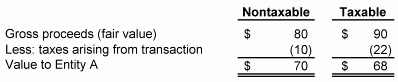 Nontaxable Taxable Gross proceeds (fair value) $80 $90 Less: taxes arising from transaction (10) (22) Value to Entity A $70 $68
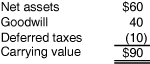 Net assets $60 Goodwill 40 Deferred taxes (10) Carrying value $90
- aNet assets (excluding goodwill and deferred income taxes) of $60 with a tax basis of $35
- bGoodwill of $40
- cNet deferred tax liabilities of $10.
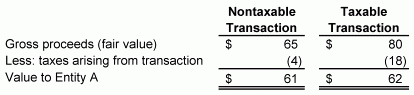 Nontaxable Transaction Taxable Transaction Gross proceeds (fair value) $65 $80 Less: taxes arising from transaction (4) (18) Value to Entity A $61 $62
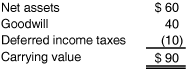 Net assets $60 Goodwill 40 Deferred income taxes (10) Carrying value $90
- Beta Entity has goodwill from an acquisition in Reporting Unit X. All of the goodwill allocated to Reporting Unit X is tax deductible. On October 1, 20X6 (the date of the annual impairment test for the reporting unit), Reporting Unit X had a book value of goodwill of $400, which is all tax deductible, deferred tax assets of $200 relating to the tax-deductible goodwill, and book value of other net assets of $400. Reporting Unit X is subject to a 40 percent income tax rate. Beta Entity estimated the fair value of Reporting Unit X at $900.
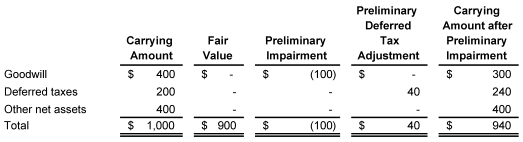 Carrying Amount Fair Value Preliminary Impairment Preliminary Deferred Tax Adjustment Carrying Amount after Preliminary Impairment Goodwill $400 $ - $(100) $ - $300 Deferred taxes 200 - - 40 240 Other net assets 400 - - - 400 Total " $1,000 " $900 $(100) $40 $940
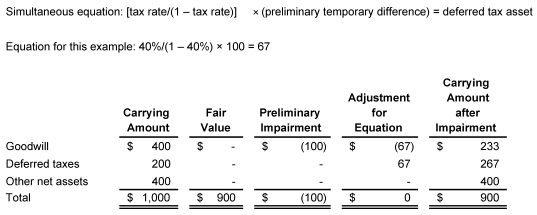 Simultaneous equation: [tax rate/(1 - tax rate)] × (preliminary temporary difference) = deferred tax asset Equation for this example: 40%/(1 - 40%) × 100 = 67 Carrying Amount Fair Value Preliminary Impairment Adjustment for Equation Carrying Amount after Impairment Goodwill $400 $ - $(100) $(67) $233 Deferred taxes 200 - - 67 267 Other net assets 400 - - - 400 Total " $1,000 " $900 $(100) $0 $900
- Theta Entity has three reporting units with goodwill—Software, Electronics, and Communications—and two reportable segments—Technology and Communications. The Electronics reporting unit has a negative carrying amount.
- Note C: Goodwill
- The changes in the carrying amount of goodwill for the year ended December 31, 20X3, are as follows.
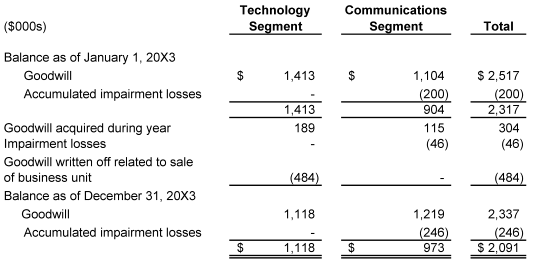 ($000s) "Technology Segment" "Communications Segment" Total "Balance as of January 1, 20X3" Goodwill " $1,413 " " $1,104 " " $2,517 " Accumulated impairment losses - (200) (200) "1,413" 904 " 2,317 " Goodwill acquired during year 189 115 304 Impairment losses - (46) (46) Goodwill written off related to sale of business unit (484) - (484) "Balance as of December 31, 20X3" Goodwill " 1,118 " " 1,219 " " 2,337 " Accumulated impairment losses - (246) (246) " $1,118 " $973 " $2,091 "
- The Communications segment is tested for impairment in the third quarter, after the annual forecasting process. Due to an increase in competition in the Texas and Louisiana cable industry, operating profits and cash flows were lower than expected in the fourth quarter of 20X2 and the first and second quarters of 20X3. Based on that trend, the earnings forecast for the next five years was revised. In September 20X3, a goodwill impairment loss of $46 was recognized in the Communications reporting unit. The fair value of that reporting unit was estimated using the expected present value of future cash flows.
- The Electronics reporting unit to which $498 of goodwill is allocated had a negative carrying amount on December 31, 20X3, and 20X2. This reporting unit is part of the Technology segment.
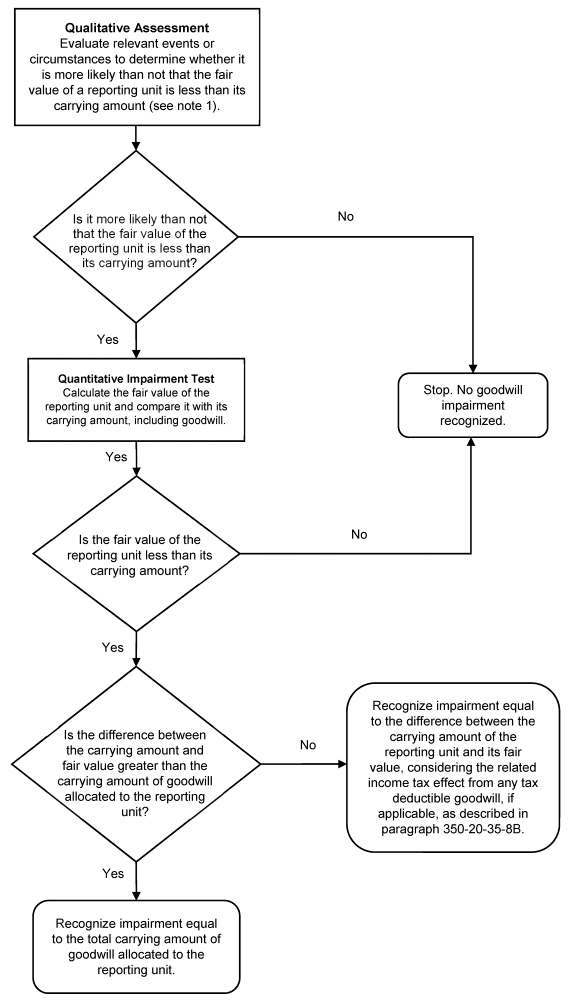
- 1An entity has the unconditional option to skip the qualitative assessment and proceed directly to calculating the fair value of the reporting unit and comparing that value with its carrying amount, including goodwill.
Accounting Alternatives
Implementation Guidance
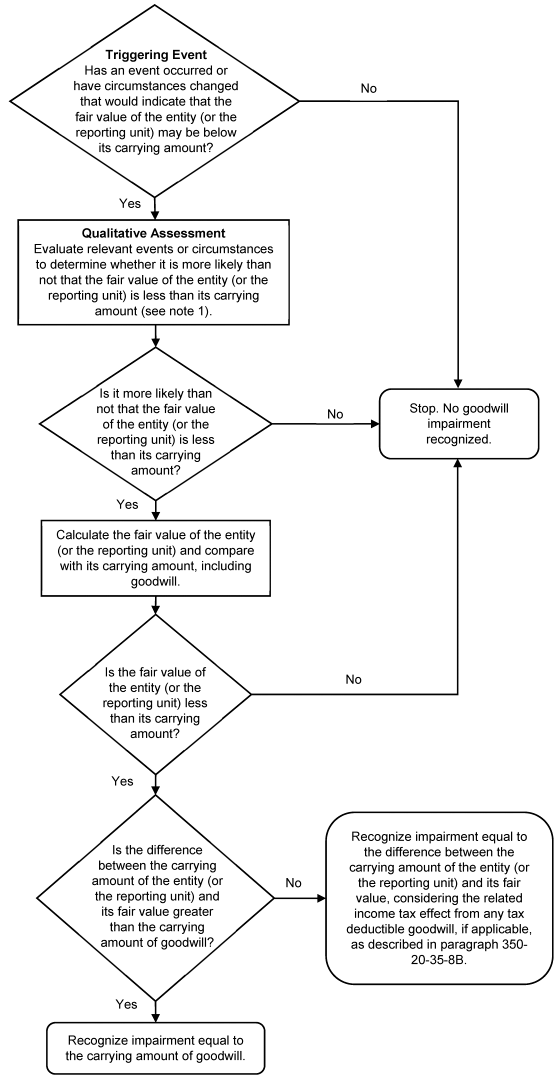 Qualitative Assessment Evaluate relevant events or circumstances to determine whether it is more likely than not that the fair value of the entity (or the reporting unit) is less than its carrying amount (see note 1). Is it more likely than not that the fair value of the entity (or the reporting unit) is less than its carrying amount? Calculate the fair value of the entity (or the reporting unit) and compare with its carrying amount, including goodwill. Is the fair value of the entity (or the reporting unit) less than its carrying amount? Recognize impairment equal to the difference between the carrying amount of the entity (or the reporting unit) and its fair value, not to exceed the carrying amount of goodwill. Yes Triggering Event Has an event occurred or circumstances changed that would indicate that the fair value of the entity (or the reporting unit) may be below its carrying amount? Yes No Yes No No Stop
- An entity has the unconditional option to skip the qualitative assessment and proceed directly to calculating the fair value of the entity (or the reporting unit) and comparing that value with its carrying amount, including goodwill.
Illustrations
350-20-65Transition and Open Effective Date Information
Source downloaded: .Record version 9112ab635d33. Effective date must be checked in the source.
Transition Related to Accounting Standards Updates No. 2014-02, <em class="ph i">Intangibles—Goodwill and Other (Topic 350): Accounting for Goodwill,</em> No. 2019-06, <em class="ph i">Intangibles—Goodwill and Other (Topic 350), Business Combinations (Topic 805), and Not-for-Profit Entities (Topic 958): Extending the Private Company Accounting Alternatives on Goodwill and Certain Identifiable Intangible Assets to Not-for-Profit Entities</em>, and No. 2021-03, <em class="ph i">Intangibles—Goodwill and Other (Topic 350): Accounting Alternative for Evaluating Triggering Events</em>
- aUpon adoption of the guidance for the accounting alternative for amortizing goodwill in the Accounting Alternatives Subsections of this Subtopic and the guidance in paragraph 323-10-35-13, that guidance shall be effective prospectively for new goodwill recognized after the adoption of that guidance. For existing goodwill, that guidance shall be effective as of the beginning of the first fiscal year in which the accounting alternative is adopted.
- bGoodwill existing as of the beginning of the period of adoption shall be amortized prospectively on a straight-line basis over 10 years, or less than 10 years if an entity demonstrates that another useful life is more appropriate.
- c
- dUpon adoption of the accounting alternative for amortizing goodwill, an entity shall make an accounting policy election to test goodwill for impairment at either the entity level or the reporting unit level.
- eA private company or not-for-profit entity that makes an accounting policy election to apply the accounting alternative for amortizing goodwill in the Accounting Alternatives Subsections of this Subtopic for the first time need not justify that the use of the accounting alternative is preferable as described in paragraph 250-10-45-2.
Transition Related to Accounting Standards Update No. 2021-03, <em class="ph i">Intangibles—Goodwill and Other (Topic 350): Accounting Alternative for Evaluating Triggering Events</em>
- aThe pending content that links to this paragraph shall be effective prospectively for fiscal years beginning after December 15, 2019. Early adoption is permitted for both interim and annual financial statements that have not yet been issued or made available for issuance as of March 30, 2021. A private company or not-for-profit entity that adopts the pending content that links to this paragraph shall apply it as of the beginning of the interim or annual period for financial statements that have not yet been issued or made available for issuance in the year of adoption. A private company or not-for-profit entity shall not retroactively adopt the pending content that links to this paragraph as of the beginning of an annual period for which interim-period financial statements have already been issued in the year of adoption.
- bFor a private company or not-for-profit entity that adopts the pending content that links to this paragraph after its original effective date, that pending content shall be applied prospectively as of the beginning of the first reporting period in which the accounting alternative is adopted.
- cA private company or not-for-profit entity that makes an accounting policy election to apply the pending content that links to this paragraph for the first time need not justify that the use of the accounting alternative is preferable as described in paragraph 250-10-45-2.
Related subtopics
- 350-10 OverallIntangibles—Goodwill and Other
- 350-30 General Intangibles Other Than GoodwillIntangibles—Goodwill and Other
- 740-805 Business CombinationsIncome Taxes
- 805-20 Identifiable Assets and Liabilities, and Any Noncontrolling InterestBusiness Combinations
- 825-10 OverallFinancial Instruments
- 805-50 Related IssuesBusiness Combinations