ASC

ASC 280-10

Overall

280 Segment Reporting

Download JSONDownload Markdown135 paragraphs · 10 sectionsIncludes SEC contentJump to summary

Source downloaded: .Record version 054e9442fa34. Effective date must be checked in the source.

ASC 280-10 requires public entities to disclose information about their operating segments using the "management approach" — segments are the components whose discrete financial results the chief operating decision maker (CODM) regularly reviews to allocate resources and assess performance (280-10-50-1). Operating segments that meet the 10 percent revenue, profit/loss, or asset thresholds (or are needed to reach the 75 percent of consolidated revenue floor) are reportable, and the entity must disclose segment profit or loss, assets, significant segment expenses, and reconciliations to consolidated amounts. All public entities, including single-reportable-segment entities, must also give entity-wide disclosures about products and services, geographic areas, and major customers.

Key points (7)
  • An operating segment is a component that engages in revenue-producing business activities, whose operating results are regularly reviewed by the chief operating decision maker to allocate resources and assess performance, and for which discrete financial information is available (280-10-50-1); corporate headquarters and pension/OPEB plans are not operating segments (280-10-50-4).
  • Two or more operating segments may be aggregated only if aggregation is consistent with the objective of the Subtopic, the segments have similar economic characteristics, and they are similar in all five criteria — nature of products/services, production processes, class of customer, distribution methods, and regulatory environment (280-10-50-11); below-threshold segments may be combined if they share only a majority of those criteria (280-10-50-13).
  • A segment is reportable if its revenue (including intersegment) is 10 percent or more of combined segment revenue, its absolute profit or loss is 10 percent or more of the greater of combined segment profit or combined segment loss, or its assets are 10 percent or more of combined segment assets (280-10-50-12); additional segments must be added until reportable segments cover at least 75 percent of consolidated external revenue (280-10-50-14).
  • A public entity must report a measure of profit or loss and total assets for each reportable segment, plus items such as external and intersegment revenues, interest revenue and expense, depreciation/amortization, equity method income, and income tax expense, if included in or otherwise regularly provided to the CODM (280-10-50-22, 280-10-50-25); it must also disclose significant segment expense categories and amounts and an 'other segment items' amount (280-10-50-26A through 50-26C).
  • Reported amounts are the measures used by the CODM under the management approach (280-10-50-27); if the CODM uses more than one profit measure, at least one reported measure must be the one most consistent with the consolidated financial statement measurement principles (280-10-50-28A).
  • Reconciliations of total reportable segment revenues, each measure of profit or loss, assets, and other significant items to consolidated amounts are required with significant reconciling items separately described (280-10-50-30 through 50-31), and prior periods must be recast for changes in segment composition or in identified significant segment expenses unless impracticable (280-10-50-34 through 50-35).
  • Entity-wide disclosures — revenues by product/service, revenues and long-lived assets by country of domicile versus foreign countries, and the fact and amount of revenues from any single external customer providing 10 percent or more of revenues — are required annually of all public entities, including those with a single reportable segment (280-10-50-39 through 50-42).

For students. Segment reporting is a pure disclosure standard driven by internal reporting, so the analysis always starts with what the CODM actually sees — not with legal entity structure or product lines described in the MD&A. Common mistakes: aggregating segments that share only a majority of the five criteria (a majority suffices only for below-threshold segments under 280-10-50-13), and assuming single-segment entities are exempt (they are not).

Machine-generated study aid for ASC 280-10. Check the source paragraphs below.

280-10-00Status

Source downloaded: .Record version 55097038e8d1. Effective date must be checked in the source.

280-10-00-1
The following table identifies the changes made to this Subtopic.
ParagraphActionAccounting Standards UpdateDate
Condensed StatementsAddedAccounting Standards Update No. 2025-1112/08/2025
Conduit Debt SecurityAddedMaintenance Update 2014-20 (PDF)09/29/2014
Public EntityAmendedMaintenance Update 2014-20 (PDF)09/29/2014
Public EntityAmendedAccounting Standards Update No. 2010-0701/28/2010
280-10-50-1AmendedAccounting Standards Update No. 2014-0905/28/2014
280-10-50-3AmendedAccounting Standards Update No. 2014-0905/28/2014
280-10-50-4AmendedAccounting Standards Update No. 2014-0905/28/2014
280-10-50-17AmendedAccounting Standards Update No. 2023-0711/27/2023
AmendedAccounting Standards Update No. 2023-0711/27/2023
280-10-50-22AmendedAccounting Standards Update No. 2015-0101/09/2015
280-10-50-24AmendedAccounting Standards Update No. 2023-0711/27/2023
AddedAccounting Standards Update No. 2023-0711/27/2023
AmendedAccounting Standards Update No. 2023-0711/27/2023
AddedAccounting Standards Update No. 2023-0711/27/2023
280-10-50-29AmendedAccounting Standards Update No. 2015-0101/09/2015
280-10-50-30AmendedAccounting Standards Update No. 2015-0101/09/2015
AmendedAccounting Standards Update No. 2023-0711/27/2023
280-10-50-32AmendedAccounting Standards Update No. 2025-1112/08/2025
280-10-50-32AmendedAccounting Standards Update No. 2015-0101/09/2015
AmendedAccounting Standards Update No. 2014-0905/28/2014
280-10-55-7AmendedAccounting Standards Update No. 2023-0711/27/2023
280-10-55-7AmendedAccounting Standards Update No. 2014-0804/10/2014
280-10-55-8AmendedAccounting Standards Update No. 2023-0711/27/2023
280-10-55-9SupersededAccounting Standards Update No. 2023-0711/27/2023
280-10-55-10SupersededAccounting Standards Update No. 2023-0711/27/2023
AddedAccounting Standards Update No. 2023-0711/27/2023
AmendedAccounting Standards Update No. 2023-0711/27/2023
280-10-55-17AAddedAccounting Standards Update No. 2023-0711/27/2023
280-10-55-40AmendedAccounting Standards Update No. 2023-0711/27/2023
AmendedAccounting Standards Update No. 2023-0711/27/2023
280-10-55-49AmendedAccounting Standards Update No. 2015-0101/09/2015
AddedAccounting Standards Update No. 2023-0711/27/2023
280-10-65-1AddedAccounting Standards Update No. 2023-0711/27/2023

280-10-05Overview and Background

Source downloaded: .Record version 84dfb0264ad7. Effective date must be checked in the source.

280-10-05-1
The Segment Reporting Topic contains only the Overall Subtopic.
280-10-05-2
This Subtopic provides guidance to public entities on how to report certain information about operating segments in complete sets of financial statements of the public entity and in condensed financial statements of interim periods issued to shareholders. It also requires that public entities report certain information about their products and services, the geographic areas in which they operate, and their major customers.
280-10-05-3
A public entity could provide complete sets of financial statements that are disaggregated in several different ways, for example, by products and services, by geography, by legal entity, or by type of customer. However, it is not feasible to provide all of that information in every set of financial statements. The guidance in this Subtopic requires that general-purpose financial statements include selected information reported on a single basis of segmentation. The method for determining what information to report is referred to as the management approach. The management approach is based on the way that management organizes the segments within the public entity for making operating decisions and assessing performance. Consequently, the segments are evident from the structure of the public entity's internal organization, and financial statement preparers should be able to provide the required information in a cost-effective and timely manner.
280-10-05-4
The management approach facilitates consistent descriptions of a public entity in its annual report and various other published information. It focuses on financial information that a public entity's decision makers use to make decisions about the public entity's operating matters. The components that management establishes for that purpose are called operating segments.
280-10-05-5
To provide some comparability between public entities, this Subtopic requires that an entity report certain information about the revenues that it derives from each of its products and services (or groups of similar products and services) and about the countries in which it earns revenues and holds assets, regardless of how the entity is organized. As a consequence, some entities are likely to be required to provide limited information that may not be used for making operating decisions and assessing performance.

280-10-10Objectives

Source downloaded: .Record version c68b3bd52065. Effective date must be checked in the source.

280-10-10-1
The objective of requiring disclosures about segments of a public entity and related information is to provide information about the different types of business activities in which a public entity engages and the different economic environments in which it operates to help users of financial statements do all of the following:
  1. a
    Better understand the public entity's performance
  2. b
    Better assess its prospects for future net cash flows
  3. c
    Make more informed judgments about the public entity as a whole.

280-10-15Scope and Scope Exceptions

Source downloaded: .Record version 8796a719eb74. Effective date must be checked in the source.

Overall Guidance

280-10-15-1
The Scope Section of the Overall Subtopic establishes the pervasive scope for the Segment Reporting Topic.

Entities

280-10-15-2
The guidance in the Segment Reporting Topic applies to all public entities, with certain exceptions noted below. Entities other than public entities are also encouraged to provide the disclosures described in this Subtopic.
280-10-15-3
The guidance in this Subtopic does not apply to the following entities:
  1. a
    Parent entities, subsidiaries, joint ventures, or investees accounted for by the equity method if those entities' separate company statements also are consolidated or combined in a complete set of financial statements and both the separate company statements and the consolidated or combined statements are included in the same financial report. However, this Subtopic does apply to those entities if they are public entities and their financial statements are issued separately.
  2. b
    Not-for-profit entities (regardless of whether the entity meets the definition of a public entity as defined above).
  3. c
    Nonpublic entities.

280-10-45Other Presentation Matters

Source downloaded: .Record version 6ba724b81610. Effective date must be checked in the source.

280-10-45-1
This Subtopic does not require that a public entity report segment cash flow. However, paragraphs 280-10-50-22 and 280-10-50-25 require that a public entity report certain items that may provide an indication of the cash-generating ability or cash requirements of an entity's operating segments.
280-10-45-2
Nothing in this Subtopic is intended to discourage a public entity from reporting additional information specific to that entity or to a particular line of business that may contribute to an understanding of the entity.

280-10-50Disclosure

Source downloaded: .Record version 008048107917. Effective date must be checked in the source.

Operating Segments

280-10-50-1
An operating segment is a component of a public entity that has all of the following characteristics:
  1. a
    It engages in business activities from which it may recognize revenues and incur expenses (including revenues and expenses relating to transactions with other components of the same public entity).
  2. b
    Its operating results are regularly reviewed by the public entity's chief operating decision maker to make decisions about resources to be allocated to the segment and assess its performance.
  3. c
    Its discrete financial information is available.
280-10-50-2
An operating segment shall include components of a public entity that sell primarily or exclusively to other operating segments of the public entity if the public entity is managed that way. Information about the components engaged in each stage of production is particularly important for understanding vertically integrated public entities in certain businesses, for example, oil and gas entities. This information is also important because different activities within the entity may have significantly different prospects for future cash flows.
280-10-50-3
An operating segment may engage in business activities for which it has yet to recognize revenues, for example, start-up operations may be operating segments before recognizing revenues.
280-10-50-4
Not every part of a public entity is necessarily an operating segment or part of an operating segment. For example, a corporate headquarters or certain functional departments may not recognize revenues or may recognize revenues that are only incidental to the activities of the public entity and would not be operating segments. For purposes of this Subtopic, a public entity's pension and other postretirement benefit plans are not considered operating segments.
280-10-50-5
The term chief operating decision maker identifies a function, not necessarily a manager with a specific title. That function is to allocate resources to and assess the performance of the segments of a public entity. Often the chief operating decision maker of a public entity is its chief executive officer or chief operating officer, but it may be a group consisting of, for example, the public entity's president, executive vice presidents, and others.
280-10-50-6
For many public entities, the three characteristics of operating segments described in paragraph 280-10-50-1 clearly identify a single set of operating segments. However, a public entity may produce reports in which its business activities are presented in a variety of different ways. If the chief operating decision maker uses more than one set of segment information, other factors may identify a single set of components as constituting a public entity's operating segments, including the nature of the business activities of each component, the existence of managers responsible for them, and information presented to the board of directors.
280-10-50-7
Generally, an operating segment has a segment manager who is directly accountable to and maintains regular contact with the chief operating decision maker to discuss operating activities, financial results, forecasts, or plans for the segment. The term segment manager identifies a function, not necessarily a manager with a specific title.
280-10-50-8
The chief operating decision maker also may be the segment manager for certain operating segments. A single manager may be the segment manager for more than one operating segment. If the characteristics in paragraphs 280-10-50-1 and 280-10-50-3 apply to more than one set of components of a public entity but there is only one set for which segment managers are held responsible, that set of components constitutes the operating segments.
280-10-50-9
The characteristics in paragraphs 280-10-50-1 and 280-10-50-3 may apply to two or more overlapping sets of components for which managers are held responsible. That structure is sometimes referred to as a matrix form of organization. For example, in some public entities, certain managers are responsible for different product and service lines worldwide, while other managers are responsible for specific geographic areas. The chief operating decision maker regularly reviews the operating results of both sets of components, and financial information is available for both. In that situation, the components based on products and services would constitute the operating segments.
280-10-50-10
A public entity shall report separately information about each operating segment that meets both of the following criteria:
  1. a
    Has been identified in accordance with paragraphs 280-10-50-1 and or results from aggregating two or more of those segments in accordance with the following paragraph
  2. b
    Exceeds the quantitative thresholds in paragraph 280-10-50-12.
Paragraphs specify other situations in which separate information about an operating segment shall be reported. Paragraph 280-10-55-26 and Examples 1 and 2 (see paragraphs ) illustrate how to apply the main provisions in this Subtopic for identifying reportable operating segments.
280-10-50-11
Operating segments often exhibit similar long-term financial performance if they have similar economic characteristics. For example, similar long-term average gross margins for two operating segments would be expected if their economic characteristics were similar. Two or more operating segments may be aggregated into a single operating segment if aggregation is consistent with the objective and basic principles of this Subtopic, if the segments have similar economic characteristics, and if the segments are similar in all of the following areas (see paragraphs and Example 2, Cases A and B [paragraphs ]):
  1. a
    The nature of the products and services
  2. b
    The nature of the production processes
  3. c
    The type or class of customer for their products and services
  4. d
    The methods used to distribute their products or provide their services
  5. e
    If applicable, the nature of the regulatory environment, for example, banking, insurance, or public utilities.
280-10-50-12
A public entity shall report separately information about an operating segment that meets any of the following quantitative thresholds (see Example 2, Cases C, D, and E [paragraphs ]):
  1. a
    Its reported revenue, including both sales to external customers and intersegment sales or transfers, is 10 percent or more of the combined revenue, internal and external, of all operating segments.
  2. b
    The absolute amount of its reported profit or loss is 10 percent or more of the greater, in absolute amount, of either:
    1. 1
      The combined reported profit of all operating segments that did not report a loss
    2. 2
      The combined reported loss of all operating segments that did report a loss.
  3. c
    Its assets are 10 percent or more of the combined assets of all operating segments.
Operating segments that do not meet any of the quantitative thresholds may be considered reportable, and separately disclosed, if management believes that information about the segment would be useful to readers of the financial statements.
280-10-50-13
An entity may combine information about operating segments that do not meet the quantitative thresholds with information about other operating segments that do not meet the quantitative thresholds to produce a reportable segment only if aggregation is consistent with the objective and basic principles of this Topic, the segments have similar economic characteristics, and the operating segments share a majority of the aggregation criteria listed in paragraph 280-10-50-11.
280-10-50-14
If total of external revenue reported by operating segments constitutes less than 75 percent of total consolidated revenue, additional operating segments shall be identified as reportable segments (even if they do not meet the criteria in paragraph 280-10-50-12) until at least 75 percent of total consolidated revenue is included in reportable segments.
280-10-50-15
Information about other business activities and operating segments that are not reportable shall be combined and disclosed in an all other category separate from other reconciling items in the reconciliations required by paragraphs . The sources of the revenue included in the all other category shall be described.
280-10-50-16
If management judges an operating segment identified as a reportable segment in the immediately preceding period to be of continuing significance, information about that segment shall continue to be reported separately in the current period even if it no longer meets the criteria for reportability in paragraph 280-10-50-12.
280-10-50-17
If an operating segment is identified as a reportable segment in the current period due to the quantitative thresholds, prior-period segment data presented for comparative purposes shall be recast to reflect the newly reportable segment as a separate segment even if that segment did not satisfy the criteria for reportability in paragraph 280-10-50-12 in the prior period unless it is impracticable to do so. For purposes of this Subtopic, information is impracticable to present if the necessary information is not available and the cost to develop it would be excessive.
280-10-50-18
There may be a practical limit to the number of reportable segments that a public entity separately discloses beyond which segment information may become overly detailed. Although no precise limit has been determined, as the number of segments that are reportable in accordance with paragraphs increases above 10, the public entity should consider whether a practical limit has been reached.
280-10-50-18A
An entity need not aggregate similar segments, and it may present segments that fall below the quantitative thresholds.
280-10-50-19
Public entities are encouraged to report information about segments that do not meet the quantitative thresholds if management believes that it is material. Those who are familiar with the particular circumstances of each public entity must decide what constitutes material.
280-10-50-20
All public entities, including those public entities that have a single reportable segment, shall disclose all of the following for each period for which an income statement is presented. However, reconciliations of balance sheet amounts for reportable segments to consolidated balance sheet amounts are required only for each year for which a balance sheet is presented. Previously reported information for prior periods shall be recast as described in paragraphs . (See paragraphs for additional guidance for public entities that have a single reportable segment.)
280-10-50-21
A public entity shall disclose the following general information (see Example 3, Case A [paragraph 280-10-55-47]):
  1. a
    Factors used to identify the public entity's reportable segments, including the basis of organization (for example, whether management has chosen to organize the public entity around differences in products and services, geographic areas, regulatory environments, or a combination of factors and whether operating segments have been aggregated)
  2. b
    Types of products and services from which each reportable segment derives its revenues
  3. c
    The title and position of the individual or the name of the group or committee identified as the chief operating decision maker.
280-10-50-22
A public entity shall report a measure of profit or loss and total assets for each reportable segment. A public entity also shall disclose all of the following about each reportable segment if the specified amounts are included in the measure of segment profit or loss reviewed by the chief operating decision maker or are otherwise regularly provided to the chief operating decision maker, even if not included in that measure of segment profit or loss (see Example 3, Case B [paragraph 280-10-55-48]):
  1. a
    Revenues from external customers
  2. b
    Revenues from transactions with other operating segments of the same public entity
  3. c
    Interest revenue
  4. d
    Interest expense
  5. e
    Depreciation, depletion, and amortization expense
  6. f
    Unusual items as described in paragraph 220-20-45-1
  7. g
    Equity in the net income of investees accounted for by the equity method
  8. h
    Income tax expense or benefit
  9. i
  10. j
    Significant noncash items other than depreciation, depletion, and amortization expense.
A public entity shall report interest revenue separately from interest expense for each reportable segment unless a majority of the segment's revenues are from interest and the chief operating decision maker relies primarily on net interest revenue to assess the performance of the segment and make decisions about resources to be allocated to the segment. In that situation, a public entity may report that segment's interest revenue net of its interest expense and disclose that it has done so. Nonetheless, a public entity shall separately disclose interest expense if it is a significant segment expense in accordance with paragraph 280-10-50-26A.
280-10-50-23
Disclosure of interest revenue and interest expense included in reported segment profit or loss is intended to provide information about the financing activities of a segment.
280-10-50-24
If a segment is primarily a financial operation, interest revenue probably constitutes most of segment revenues and interest expense will constitute most of the difference between reported segment revenues and reported segment profit or loss. If the segment has no financial operations or only immaterial financial operations, no information about interest is required unless interest expense is a significant segment expense to be disclosed in accordance with paragraph 280-10-50-26A.
280-10-50-25
A public entity shall disclose both of the following about each reportable segment if the specified amounts are included in the determination of segment assets reviewed by the chief operating decision maker or are otherwise regularly provided to the chief operating decision maker, even if not included in the determination of segment assets:
  1. a
    The amount of investment in equity method investees
  2. b
    Total expenditures for additions to long-lived assets other than any of the following (see Example 3, Case B [paragraph 280-10-55-48]):
    1. 1
      Financial instruments
    2. 2
      Long-term customer relationships of a financial institution
    3. 3
      Mortgage and other servicing rights
    4. 4
      Deferred policy acquisition costs
    5. 5
      Deferred tax assets.
280-10-50-26
If no asset information is provided for a reportable segment, that fact and the reason therefore shall be disclosed.
280-10-50-26A
A public entity shall disclose for each reportable segment the significant expense categories and amounts that are regularly provided to the chief operating decision maker and included in reported segment profit or loss. When determining the segment expense categories and amounts that shall be disclosed, a public entity shall first identify the expenses from the segment level information that is regularly provided to the chief operating decision maker and then disclose those segment expense categories and amounts that are significant. A public entity shall consider relevant qualitative and quantitative factors when determining whether segment expense categories and amounts are significant. When applying this guidance, a public entity shall evaluate for disclosure a segment expense that is regularly provided to the chief operating decision maker as well as a segment expense that is easily computable from information that is regularly provided to the chief operating decision maker. Paragraphs provide additional guidance on determining whether segment expense amounts can be easily computed for purposes of applying the guidance in this paragraph.
280-10-50-26B
A public entity shall disclose for each reportable segment an amount for other segment items. The amount for other segment items is the difference between reported segment revenues less the segment expenses disclosed in accordance with paragraph 280-10-50-26A and reported segment profit or loss. A qualitative description of the composition of other segment items also shall be disclosed. Other segment items may include:
  1. a
    The total of a reportable segment’s expenses that are included in the reported measure(s) of a segment’s profit or loss but are not regularly provided to the chief operating decision maker.
  2. b
    The total of a reportable segment’s expenses that are included in the reported measure(s) of a segment’s profit or loss but are not disclosed in accordance with paragraph 280-10-50-26A. A public entity is not precluded from separately disclosing an expense that is not significant for one reportable segment but is significant for another of its segments. However, if a segment expense that is not significant is not separately disclosed, it shall be included as part of other segment items.
  3. c
    The total of a reportable segment’s gains, losses, or other amounts that also are included in each reported measure of a segment’s profit or loss.
  4. d
    The items and amounts required by paragraph 280-10-50-22 when those specified items and amounts are included within the reported measure of segment profit or loss but are not disclosed in accordance with paragraph 280-10-50-26A. For example, a public entity may report net income as the measure of a segment’s profit or loss. In that case, if income tax expense by segment is not regularly provided to the chief operating decision maker, it may be included within other segment items. However, income tax expense is still required to be disclosed in accordance with paragraph 280-10-50-22.
280-10-50-26C
An amount and qualitative description of the composition of other segment items shall be disclosed for each reportable segment even when a public entity does not separately report significant segment expense categories and amounts in accordance with paragraph 280-10-50-26A for one or more of its reportable segments. Additionally, if a public entity does not disclose significant expense categories and amounts for one or more of its reportable segments, it shall explain the nature of the expense information the chief operating decision maker uses to manage operations (see paragraph 280-10-55-15G).
280-10-50-27
The amount of each segment item reported shall be the measure reported to the chief operating decision maker for purposes of making decisions about allocating resources to the segment and assessing its performance. Adjustments and eliminations made in preparing a public entity's general-purpose financial statements and allocations of revenues, expenses, and gains or losses shall be included in determining reported segment profit or loss only if they are included in the measure of the segment's profit or loss that is used by the chief operating decision maker. Similarly, only those assets that are included in the measure of the segment's assets that is used by the chief operating decision maker shall be reported for that segment. If amounts are allocated to reported segment profit or loss or assets, those amounts shall be allocated on a reasonable basis.
280-10-50-28
If the chief operating decision maker uses only one measure of a segment's assets in assessing segment performance and deciding how to allocate resources, segment assets shall be reported at that measure. If the chief operating decision maker uses more than one measure of a segment's assets, the reported measure shall be that which management believes is determined in accordance with the measurement principles most consistent with those used in measuring the corresponding amounts in the public entity's consolidated financial statements.
280-10-50-28A
If the chief operating decision maker uses only one measure of a segment’s profit or loss in assessing segment performance and deciding how to allocate resources, segment profit or loss shall be reported at that measure. If the chief operating decision maker uses more than one measure of a segment’s profit or loss in assessing segment performance and deciding how to allocate resources, a public entity may report one or more of those additional measures of segment profit. However, at least one of the reported segment profit or loss measures (or the single reported measure, if only one is disclosed) shall be that which management believes is determined in accordance with the measurement principles most consistent with those used in measuring the corresponding amounts in a public entity’s consolidated financial statements.
280-10-50-28B
If a public entity discloses more than one measure of a segment’s profit or loss in the current period, it shall report the additional measure or measures for the prior periods in which the measure or measures were provided to the chief operating decision maker. For example, if a public entity reports an additional measure in the current period for gross profit for a reportable segment, it should disclose gross profit for the reportable segment in the prior comparative periods if gross profit was provided to the chief operating decision maker in those periods. A public entity is not precluded from reporting the additional measure or measures for the prior periods in which the measure or measures were not provided to the chief operating decision maker.
280-10-50-28C
The disclosure requirements in paragraphs 280-10-50-22 through 50-24, paragraphs 280-10-50-26A through 50-26C, and paragraph 280-10-50-29 apply to each reported measure of a segment’s profit or loss. The reconciliation requirement in paragraph 280-10-50-30(a) applies to the total of the reportable segments’ revenues to a public entity’s consolidated revenues. The reconciliation requirement in paragraph 280-10-50-30(b) applies to the total of the reportable segments’ amount for each measure of profit or loss.
280-10-50-29
A public entity shall provide an explanation of the measurements of segment profit or loss and segment assets for each reportable segment. A public entity shall disclose all of the following (see Example 3, Cases A through C [paragraphs and Example 4, Cases A through B [paragraphs 280-10-55-53 through 55-55]):
  1. a
    The basis of accounting for any transactions between reportable segments.
  2. b
    The nature of any differences between the measurements of the reportable segments' profits or losses and the public entity's consolidated income before income taxes and discontinued operations (if not apparent from the reconciliations described in paragraphs ). Those differences could include accounting policies and policies for allocation of centrally incurred costs that are necessary for an understanding of the reported segment information.
  3. c
    The nature of any differences between the measurements of the reportable segments' assets and the public entity's consolidated assets (if not apparent from the reconciliations described in paragraphs ). Those differences could include accounting policies and policies for allocation of jointly used assets that are necessary for an understanding of the reported segment information.
  4. d
    The nature of any changes from prior periods in the measurement methods used to determine reported segment profit or loss, including significant changes from prior periods to the measurement methods of expenses, the method for allocating expenses to a segment, or changes in the method for allocating centrally incurred expenses, and the effect, if any, of those changes on the measure of segment profit or loss.
  5. e
    The nature and effect of any asymmetrical allocations to segments. For example, a public entity might allocate depreciation expense to a segment without allocating the related depreciable assets to that segment.
  6. f
    How the chief operating decision maker uses the reported measure(s) of segment profit or loss in assessing segment performance and deciding how to allocate resources.
280-10-50-30
A public entity shall provide reconciliations of all of the following (see Example 3, Cases B and C [paragraphs ] and Example 4, Case B [paragraph 280-10-55-55]):
  1. a
    The total of the reportable segments' revenues to the public entity's consolidated revenues.
  2. b
    The total of the reportable segments' amount for each measure of profit or loss to the public entity's consolidated income before income taxes and discontinued operations. However, if a public entity allocates items such as income taxes to segments, the public entity may choose to reconcile the total of the segments' measures of profit or loss to consolidated income after those items.
  3. c
    The total of the reportable segments' assets to the public entity's consolidated assets.
  4. d
    The total of the reportable segments' amounts for every other significant item of information disclosed to the corresponding consolidated amount (except for the segment disclosures required by paragraphs ). For example, a public entity may choose to disclose liabilities for its reportable segments, in which case the public entity would reconcile the total of reportable segments' liabilities for each segment to the public entity's consolidated liabilities if the segment liabilities are significant.
280-10-50-31
All significant reconciling items shall be separately identified and described. For example, the amount of each significant adjustment to reconcile accounting methods used in determining segment profit or loss to the public entity's consolidated amounts shall be separately identified and described.
280-10-50-32
A public entity shall disclose all of the following about each reportable segment in condensed financial statements of interim periods:
  1. a
  2. b
  3. c
  4. d
  5. e
    A description of differences from the last annual report in the basis of segmentation or in the basis of measurement of segment profit or loss
  6. ee
    The segment information required by paragraphs and
  7. f
    A reconciliation of the total of the reportable segments' amount for each measure of profit or loss, including the total of the reportable segments’ amount for any additional measure of profit or loss disclosed in accordance with paragraph 280-10-50-28A, to the public entity's consolidated income before income taxes and discontinued operations. However, if a public entity allocates items such as income taxes to segments, the public entity may choose to reconcile the total of the segments' measures of profit or loss to consolidated income after those items. Significant reconciling items shall be separately identified and described in that reconciliation.
Transition date:(P) December 16, 2027; (N) December 16, 2028Transition guidance:
270-10-65-1A public entity shall disclose all of the following about each reportable segment in condensed statementsof interim periods:
  1. a
  2. b
  3. c
  4. d
  5. e
    A description of differences from the last annual report in the basis of segmentation or in the basis of measurement of segment profit or loss
  6. ee
    The segment information required by paragraphs and
  7. f
    A reconciliation of the total of the reportable segments' amount for each measure of profit or loss, including the total of the reportable segments’ amount for any additional measure of profit or loss disclosed in accordance with paragraph 280-10-50-28A, to the public entity's consolidated income before income taxes and discontinued operations. However, if a public entity allocates items such as income taxes to segments, the public entity may choose to reconcile the total of the segments' measures of profit or loss to consolidated income after those items. Significant reconciling items shall be separately identified and described in that reconciliation.
280-10-50-33
Interim disclosures are required for the current quarter and year-to-date amounts. The information in paragraph 280-10-50-32 with respect to the current quarter and the current year-to-date or the last 12 months to date should be furnished together with comparable data for the preceding year.
280-10-50-34
If a public entity changes the structure of its internal organization in a manner that causes the composition of its reportable segments to change or the public entity changes the segment information that is regularly provided to the chief operating decision maker in a manner that causes the identification of significant segment expenses to change, the corresponding information for earlier periods, including interim periods, shall be recast unless it is impracticable to do so. Accordingly, a public entity shall recast to conform to the current-period presentation those individual items of disclosure that it can practicably recast but need not recast those individual items, if any, that it cannot practicably recast. In those cases, a public entity shall disclose whether it has recast the corresponding items of segment information for earlier periods.
280-10-50-34A
For example, a fundamental reorganization of an entity may cause it to be very difficult and expensive to recast segment information and, therefore, it may not be practicable.
280-10-50-35
If a public entity has changed the structure of its internal organization in a manner that causes the composition of its reportable segments to change or has changed the segment information that is regularly provided to the chief operating decision maker in a manner that causes the identification of significant segment expenses to change, and if segment information for earlier periods, including interim periods, is not recast to reflect the change, the public entity shall disclose in the year in which the change occurs segment information for the current period under both the old basis and the new basis of segmentation or the old and new significant segment expense categories, respectively, unless it is impracticable to do so.
280-10-50-36
Although recasting is not required to reflect a change in measurement of segment profit and loss, it is preferable to show all segment information on a comparable basis to the extent it is practicable to do so. If prior years' information is not recast, paragraph 280-10-50-29(d) nonetheless requires disclosure of the nature of any changes from prior periods in the measurement methods, including significant changes from prior periods to the measurement methods of expenses, the method for allocating expenses to a segment, or changes in the method for allocating centrally incurred expenses, used to determine reported segment profit or loss and the effect, if any, of those changes on the measure of segment profit or loss.
280-10-50-38
Paragraphs apply to all public entities subject to this Subtopic including those public entities that have a single reportable segment. Some public entities' business activities are not organized on the basis of differences in related products and services or differences in geographic areas of operations. That is, a public entity's segments may report revenues from a broad range of essentially different products and services, or more than one of its reportable segments may provide essentially the same products and services. Similarly, a public entity's segments may hold assets in different geographic areas and report revenues from customers in different geographic areas, or more than one of its segments may operate in the same geographic area. Information required by paragraphs need be provided only if it is not provided as part of the reportable operating segment information required by this Subtopic.
280-10-50-39
Entity-wide disclosures are required only for annual reporting.
280-10-50-40
A public entity shall report the revenues from external customers for each product and service or each group of similar products and services unless it is impracticable to do so. The amounts of revenues reported shall be based on the financial information used to produce the public entity's general-purpose financial statements. If providing the information is impracticable, that fact shall be disclosed.
280-10-50-41
A public entity shall report the following geographic information unless it is impracticable to do so (see Example 3, Case D [paragraph 280-10-55-51]):
  1. a
    Revenues from external customers attributed to the public entity's country of domicile and attributed to all foreign countries in total from which the public entity derives revenues. If revenues from external customers attributed to an individual foreign country are material, those revenues shall be disclosed separately. A public entity shall disclose the basis for attributing revenues from external customers to individual countries.
  2. b
    Long-lived assets other than financial instruments, long-term customer relationships of a financial institution, mortgage and other servicing rights, deferred policy acquisition costs, and deferred tax assets located in the public entity's country of domicile and located in all foreign countries in total in which the public entity holds assets. If assets in an individual foreign country are material, those assets shall be disclosed separately.
The amounts reported shall be based on the financial information that is used to produce the general-purpose financial statements. If providing the geographic information is impracticable, that fact shall be disclosed. A public entity may wish to provide, in addition to the information required by the preceding paragraph, subtotals of geographic information about groups of countries.
280-10-50-42
A public entity shall provide information about the extent of its reliance on its major customers. If revenues from transactions with a single external customer amount to 10 percent or more of a public entity's revenues, the public entity shall disclose that fact, the total amount of revenues from each such customer, and the identity of the segment or segments reporting the revenues. The public entity need not disclose the identity of a major customer or the amount of revenues that each segment reports from that customer. For purposes of this Subtopic, a group of entities known to a reporting public entity to be under common control shall be considered as a single customer, and the federal government, a state government, a local government (for example, a county or municipality), or a foreign government each shall be considered as a single customer (see Example 3, Case E [paragraph 280-10-55-52]).

280-10-55Implementation Guidance and Illustrations

Source downloaded: .Record version 7165bb3857c3. Effective date must be checked in the source.

280-10-55-1
This Implementation Guidance and Illustrations Section, which is an integral part of the requirements of this Subtopic, provides general guidance to assist users in the preparation of segment disclosures to be included in general-purpose financial statements of public entities. The Examples provide illustrations of the required disclosures and the determination of reportable segments.

Implementation Guidance

280-10-55-2
An equity method investee could be considered an operating segment, if, under the specific facts and circumstances being considered, it meets the definition in paragraphs 280-10-50-1 and 280-10-50-3. An investee accounted for by the equity method could be considered an operating segment even though the investor has no control over the performance of the investee. Paragraph 280-10-50-1(b) provides that an operating segment is one whose operating results are regularly reviewed by the public entity's chief operating decision maker to make decisions about resources to be allocated to the segment and assess its performance. Management may regularly review the operating results and performance of an equity method investee for purposes of evaluating whether to retain the investor-investee relationship. This Subtopic does not require that the chief operating decision maker be responsible for making decisions about resources to be allocated within the segment. That is, this Subtopic does not require that the chief operating decision maker be responsible for making decisions at the investee operating level that affect its operations and performance. Therefore, control over the investee is not a criterion for the investee to be considered an operating segment. For information relating to equity method investees, see Topic 323.
280-10-55-3
A corporate division that recognizes revenues (for example, a treasury operation that recognizes interest income) and incurs expenses could be considered an operating segment, if, under the specific facts and circumstances being considered, it meets the definition in paragraph 280-10-50-1. Some believe that corporate divisions could not be considered operating segments because paragraph 280-10-50-4 indicates that not every part of a public entity is necessarily an operating segment or part of an operating segment, for example, a corporate headquarters or certain functional departments that do not recognize revenues or that recognize revenues that are only incidental to the activities of the public entity.
280-10-55-4
However, a corporate division that recognizes revenues and that has available discrete financial information and whose operating results are reviewed regularly by the chief operating decision maker should be considered an operating segment. Even if the revenues are considered incidental, this Subtopic does not preclude such a division from being a reportable segment if management believes the additional information may contribute to a better understanding of the public entity.
280-10-55-5
A division that recognizes revenues and incurs expenses but does not have any assets associated with it for internal reporting purposes could be considered an operating segment, if, under the specific facts and circumstances being considered, it otherwise meets the definition in paragraph 280-10-50-1. For example, assume Division A of a public entity conducts business with a separate class of customer using assets shared with Division B and Division B allocates expenses associated with those shared assets to Division A, but the assets, themselves, are presented in the internal financial reports of Division B. A public entity may allocate an expense to a segment without allocating the related asset; however, disclosure of that fact is required. Therefore, allocation of assets is not a criterion for the component to be considered an operating segment.
280-10-55-6
Paragraph 280-10-50-26 explains that, if no asset information is provided for a reportable segment, that fact and the reason therefore shall be disclosed.
280-10-55-7
If a reportable segment meets the conditions in paragraphs to be reported in discontinued operations, an entity is not required to also disclose the information required by this Subtopic. Paragraph 280-10-55-19 addresses whether there is a need to recast previously reported information if there is a disposal of a component that was previously disclosed as a reportable segment.
280-10-55-7A
Paragraph 280-10-50-11 states that operating segments are considered to be similar if they can be expected to have essentially the same future prospects. Therefore, the similarity of the economic characteristics should be evaluated based on future prospects and not necessarily on the current indicators only. In other words, if the segments do not currently have similar gross margins and sales trends but the economic characteristics and the other five criteria are met and the segments are expected to again have similar long-term average gross margins and sales trends, the two segments may be aggregated.
280-10-55-7B
Likewise, if segments generally do not have similar economic characteristics, but in the current year have similar gross margins or sales trends and it is not expected that the similar gross margins or sales trends will continue in the future, it should not be presumed that the segments should be aggregated for the current-year segment disclosures just because current economic measures are similar.
280-10-55-7C
Aggregation of segments should be consistent with the objective and basic principles of this Subtopic—to provide information about the different types of business activities in which a public entity engages and the different economic environments in which it operates in order to help users of financial statements better understand the public entity's performance, better assess its prospects for future net cash flows, and make more informed judgments about the public entity as a whole. This Subtopic mentions that segments having similar economic characteristics would be expected to have similar long-term average gross margins. That measure is used, only as an example, because gross margin is a measure of profitability that is less likely to be affected by allocations. Evaluating similar economic characteristics is a matter of judgment that depends on specific facts and circumstances.
280-10-55-8
In measuring the performance of its equity investees, proportionate consolidation shall be used for reporting segment information if that is the way in which such information is reviewed by the chief operating decision maker. This Subtopic specifies that the amount of each segment item reported shall be the measure reported to the chief operating decision maker for purposes of making decisions about allocating resources to the segment and assessing its performance. If proportionate consolidation is used for segment reporting, this Subtopic also requires disclosure of the accounting policy followed for segment reporting (see paragraph 280-10-50-29(b)), the elimination of the investee's revenues and assets in reconciling to consolidated results (see paragraphs ), and the investment in and equity income from the investee (see paragraphs 280-10-50-22(g) and 280-10-50-25(a)). Even though the proportionate consolidation method may be used for internal reporting purposes (and thus for external reporting of segment information), that method is not permitted for purposes of preparing general-purpose financial statements in accordance with generally accepted accounting principles (GAAP) except where it is established industry practice (for example, in some oil and gas venture accounting).
280-10-55-11
For internal reporting purposes, if interest expense is charged to a segment on advances from another segment and the interest is included in the measure of performance, the amounts of interest expense and interest income shall include the amounts charged internally between the segments. Paragraph 280-10-50-22 requires disclosure of segment interest if it is included in the measure of segment profit or loss that is reviewed by the chief operating decision maker and, because the internal measure used by the chief operating decision makers includes intra-entity interest, that interest would be part of the measure reported. In addition, paragraph 280-10-50-27 discusses items that are included in segment amounts reported to the chief operating decision maker and therefore included in the segment reported amounts. Under the management approach, the amounts used by management are the amounts that are required to be disclosed; adjusting those amounts for any reason is not permitted. Paragraph 280-10-50-29(a) also requires disclosure of the basis of accounting for transactions between reportable segments.
280-10-55-12
The chief operating decision maker may evaluate the performance of its segments based on earnings before interest, taxes, depreciation, and amortization. Included in the management reports reviewed by the chief operating decision maker are summaries of depreciation and amortization expense related to each of the segments.
280-10-55-13
Since the reports include depreciation and amortization expense these amounts are required to be disclosed for each reportable segment even though the chief operating decision maker does not include these amounts in evaluating performance of the segment. Paragraph 280-10-50-22 requires that a public entity report a measure of profit or loss for each reportable segment. Paragraph 280-10-50-22 requires disclosure of certain other amounts about each reportable segment if the specified amounts are included in the measure of segment profit or loss reviewed by the chief operating decision maker. Although, in this case, depreciation and amortization expense is not included in the measure of segment profit or loss that is reviewed by the chief operating decision maker, such amounts are provided to the chief operating decision maker by segment. It is, therefore, assumed that the chief operating decision maker uses this information in evaluating the performance of the public entity's segments and, accordingly, disclosure of depreciation and amortization expense by each reportable segment would be required. This conclusion is based on paragraph 280-10-50-27. This conclusion does not change the requirement that, in this example, the measure of segment profit or loss to be disclosed for each reportable segment be based on the segment earnings before interest, taxes, depreciation, and amortization data that are used by the chief operating decision maker.
280-10-55-14
Note that this case deals specifically with earnings before interest, taxes, depreciation, and amortization as the measure of segment profit or loss and depreciation and amortization expense as the information that is excluded from earnings before interest, taxes, depreciation, and amortization but otherwise provided to the chief operating decision maker for purposes of evaluating segment performance. However, this example is applicable to any similar situation. That is, if the amounts of the items required by paragraphs 280-10-50-22 and 280-10-50-25 are included by segment in reports that are regularly provided to the chief operating decision maker, even though they are not included in the measure of segment profit or loss or in the determination of segment assets, as applicable, that is reviewed by the chief operating decision maker, then disclosure of those amounts is required.
280-10-55-15
In other words, the segment profit or loss amounts listed in paragraph 280-10-50-22 are required if they are included in the measure of segment profit or loss that is used by the chief operating decision maker or if they are otherwise regularly provided to the chief operating decision maker, even if not included in that measure. Disclosure of those amounts is required even though they may not be included in the measure of segment profit or loss or in the determination of segment assets, as applicable, that is reviewed by the chief operating decision maker.
280-10-55-15A
The information that is regularly provided to the chief operating decision maker may include segment expense information that is expressed in a form other than actual amounts, for example, as a ratio or an expense as a percentage of revenue. The requirements in paragraph 280-10-50-26A apply to expense amounts that can be easily computed from the information that is regularly provided to the chief operating decision maker.
280-10-55-15B
For example, if the information that is regularly provided to the chief operating decision maker includes a segment revenue amount and a segment gross margin amount, segment cost of sales can be easily computed from this information. Therefore, if cost of sales is significant, an entity should disclose the category and amount in accordance with paragraph 280-10-50-26A. As another example, the information that is regularly provided to the chief operating decision maker may include a segment revenue amount and segment warranty expense expressed as a percentage of segment revenue. In this example, segment warranty expense can be easily computed from this information. Therefore, if warranty expense is significant, the entity should disclose the category and amount in accordance with paragraph 280-10-50-26A.
280-10-55-15C
If the information regularly provided to the chief operating decision maker contains a category and amount for allocated corporate overhead expenses by segment that is included in reported segment profit or loss, a public entity should assess that category and amount for disclosure in accordance with paragraph 280-10-50-26A. For example, an entity would disclose allocated corporate overhead if it is a significant segment expense in accordance with paragraph 280-10-50-26A.
280-10-55-15D
All public entities, including those public entities that have a single reportable segment, are subject to the requirements of this Topic in its entirety. Paragraph 280-10-50-1(b) states that a characteristic of an operating segment is that it is a component of an entity whose operating results are regularly reviewed by the public entity’s chief operating decision maker to make decisions about resources to be allocated to the segment and assess its performance. Paragraph 280-10-50-4 states that not every part of a public entity is necessarily an operating segment or part of an operating segment; for example, corporate headquarters or certain functional departments may not be part of an operating segment. The entity should evaluate the guidance in paragraph 280-10-50-4 and the definition of an operating segment when identifying its operating segment (or segments) and determining whether that operating segment (or segments) constitutes all or part of the consolidated entity. For example, when a public entity has a single operating segment that constitutes part, but not all, of the consolidated entity, the chief operating decision maker may regularly review the operating results and performance of the operating segment differently than how management assesses the performance of the consolidated entity. Alternatively, when the single operating segment constitutes all of the consolidated entity, the chief operating decision maker may regularly review the entity-wide operating results and performance.
280-10-55-15E
A public entity that discloses a single reportable segment should identify the measure or measures (in accordance with paragraph 280-10-50-28A) of a segment’s profit or loss that the chief operating decision maker uses in assessing segment performance and deciding how to allocate resources, which may include a profit or loss measure that is not presented on the public entity’s consolidated income statement. For example, the chief operating decision maker of a single reportable segment entity may use both net income and earnings before interest, taxes, depreciation, and amortization as the measures of profit or loss for purposes of assessing segment performance and deciding how to allocate resources. However, earnings before interest, taxes, depreciation, and amortization is not presented on the public entity’s consolidated income statement.
280-10-55-15F
When the chief operating decision maker of a single reportable segment entity uses more than one measure of a segment’s profit or loss in assessing segment performance and deciding how to allocate resources, at least one of the reported segment profit or loss measures should be that which management believes is determined in accordance with the measurement principles most consistent with those used in measuring the corresponding amounts in a public entity’s consolidated financial statements and reconciled in accordance with paragraphs 280-10-50-30(b) and 280-10-50-32(f). A single reportable segment entity also may report additional performance measures that are used by the chief operating decision maker in assessing segment performance and deciding how to allocate resources in accordance with paragraphs .
280-10-55-15G
The chief operating decision maker may be regularly provided with segment expense categories and amounts for one segment and no segment expense categories and amounts for another segment. Alternatively, the chief operating decision maker may not be regularly provided with expense information for any of a public entity’s segments. Paragraphs apply to each reportable segment. When no significant expense categories and amounts are disclosed for a reportable segment, a public entity should report an amount and a description of the composition of other segment items in accordance with paragraph 280-10-50-26B and describe the expense information that the chief operating decision maker uses to manage the operations of that segment in accordance with paragraph 280-10-50-26C. For example, when no significant expenses are disclosed for a reportable segment, the public entity may disclose that the chief operating decision maker is regularly provided with only budgeted or forecasted expense information for that segment or uses consolidated expense information. The explanation of the expense information that the chief operating decision maker uses to manage operations is not required when significant expense categories and amounts are disclosed for a reportable segment.
280-10-55-16
Interim information is intended to be an update of the information that was presented in the most recent annual financial statements. Therefore, in the absence of a change in the structure of a public entity's internal organization during an interim period that would cause the composition of its reportable segments to change, generally, a public entity need not apply the quantitative tests in each interim period. However, if facts and circumstances change that would suggest that application of the quantitative tests in an interim period would reveal a reportable segment that was previously not reportable, and management expects that the segment will continue to be of significance, the segment should be disclosed as a new, separate reportable segment. This conclusion is consistent with the basic principle of interim financial reporting in paragraph 270-10-45-2.
280-10-55-17
Recasting of prior-period information to conform to current-period presentation is required (if practicable) when there has been a change in the composition of the segments resulting from changes in the structure of an entity's internal organization or when there has been a change in the segment expense information that is regularly provided to the chief operating decision maker in a manner that causes the identification of significant segment expenses to change. However, recasting of prior-period segment information for a change in measurement methods used to determine reported segment profit or loss is not required by this Subtopic.
280-10-55-17A
A public entity may change the segment information that is regularly provided to the chief operating decision maker in a manner that causes the identification of segment expense categories to change when applying paragraph 280-10-50-26A. For example, in the current period, the information regularly provided to the chief operating decision maker is changed to specify an amount for research and development expense by segment that is included in reported segment profit or loss. That information was not regularly provided to the chief operating decision maker in prior periods. Research and development expense by segment should be disclosed in the current period in accordance with paragraph 280-10-50-26A, if significant. The public entity also is required to recast the prior-period segment expense information to conform to current-period presentation unless it is impracticable to do so. If it is impracticable to do so, the public entity should disclose the information described in paragraph 280-10-50-35.
280-10-55-18
Paragraph 280-10-50-36 explains that although recasting is not required to reflect a change in measurement of segment profit or loss, it would be preferable to show all segment information on a comparable basis to the extent it is practicable to do so. If prior-period information is not recast, paragraph 280-10-50-29(d) nonetheless requires disclosure of the nature of any changes from prior periods in the measurement methods used to determine reported segment profit or loss, including significant changes from prior periods to the measurement methods of expenses, the method for allocating expenses to a segment, or changes in the methods for allocating centrally incurred expenses, and the effect, if any, of those changes on the measure of segment profit or loss.
280-10-55-19
Segment information for prior periods for disposal of a component that was previously disclosed as a reportable segment is not required to be recast. However, if the income statement and balance sheet information for the discontinued component have been reclassified in comparative financial statements, the segment information for the discontinued component need not be provided for those periods. Paragraph 280-10-55-7 addresses disclosure requirements if a component of a public entity that is reported as a discontinued operation is a reportable segment.
280-10-55-20
Paragraph 280-10-50-41 provides requirements for entity-wide disclosure of certain information by geographic areas. If revenues attributed to or assets located in an individual foreign country are material, such amounts are required to be disclosed.
280-10-55-21
Unlike other provisions of this Subtopic, in which segment information is disclosed on a management approach basis and, therefore, disclosure of certain items is not required if such amounts are not reviewed by or not included in measures that are reviewed by the chief operating decision maker, supplemental geographic disclosures should be disclosed in accordance with paragraph 280-10-50-41.
280-10-55-22
Paragraph 280-10-50-41 requires disclosure of revenues from external customers attributed to all foreign countries in total from which the public entity derives revenues and separate disclosure of revenues from external customers attributed to an individual foreign country if material. In determining the revenues attributed to foreign countries, a public entity may allocate revenues from external customers to geographic areas in whatever way it chooses (for example, by selling location, customer location, or the location to which the product is transported, which may differ from the location of the customer), as long as that method is reasonable, consistently applied, and disclosed.
280-10-55-23
This Subtopic does not define what is intended to be included in long-lived assets. In addition, the provisions of this Subtopic allow for flexibility and judgment by the preparer. However, the purpose of the entity-wide disclosures is to provide information about risks and uncertainties in certain geographic areas. One of the reasons for requiring disclosure of long-lived assets in geographic areas as opposed to total assets is that long-lived assets are potentially at greater risk because they are difficult to move and are relatively illiquid. Long-lived assets, as that phrase is used in paragraph 280-10-50-41, implies hard assets that cannot be readily removed, which would exclude intangibles.
280-10-55-24
The geographic information specified by paragraph 280-10-50-41 is required, if material, by country. That paragraph also states, however, that a public entity may always provide, in addition to the information required by this paragraph, subtotals of geographic information about groups of countries, for example, the European Monetary Union.
280-10-55-25
With regard to reporting geographic information as discussed in paragraph 280-10-50-41, the degree of interrelationship between the United States and Puerto Rico (as well as non-self-governing U.S. territories such as the Virgin Islands and American Samoa) is such that Puerto Rican operations of U.S. public entities shall be considered domestic operations. Factors such as proximity, economic affinity, and similarities in business environments also indicate this classification for the Puerto Rican operations of U.S. public entities. It should be noted that this Subtopic does not prohibit additional disclosures about Puerto Rican operations that might be useful in analyzing and understanding an entity's financial statements.

Illustrations

280-10-55-26
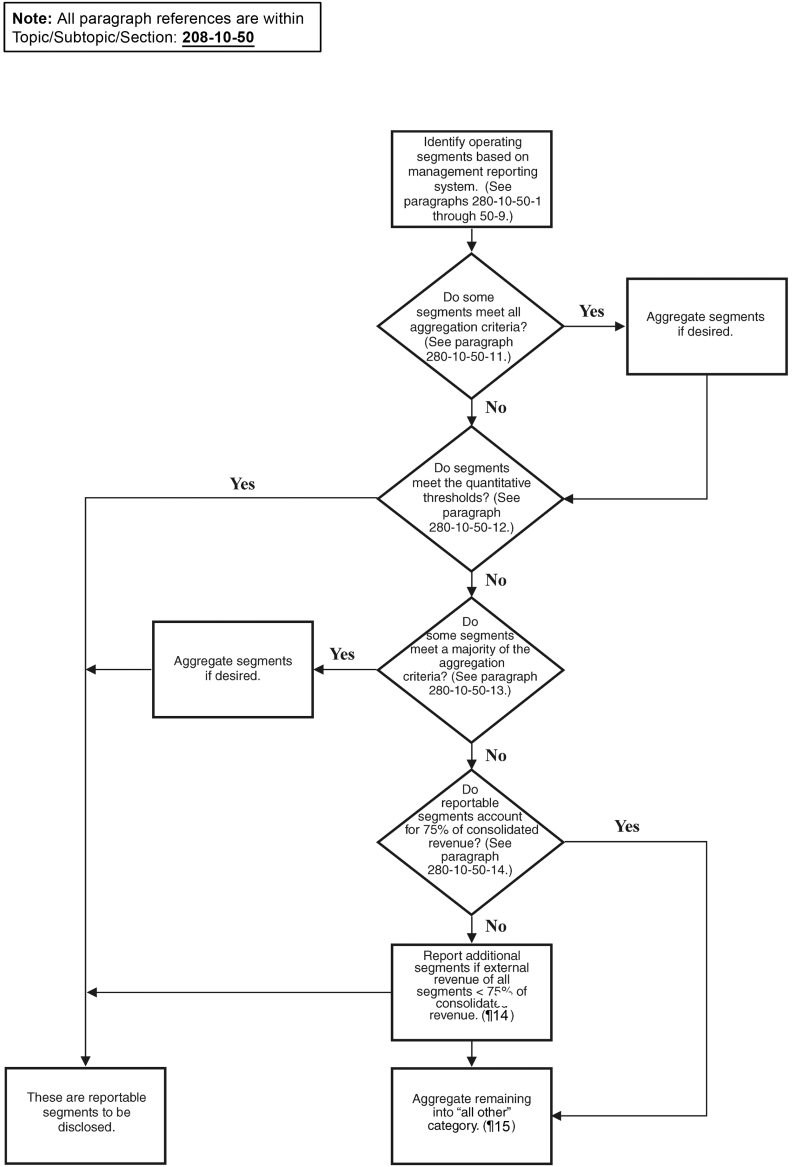
The following diagram illustrates how to apply the main provisions for identifying reportable operating segments as defined in this Subtopic. The diagram is a visual supplement to the written standards section. It should not be interpreted to alter any requirements of this Subtopic nor should it be considered a substitute for the requirements.
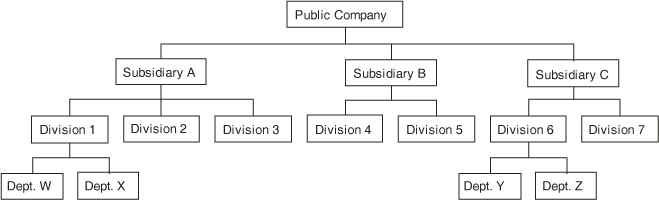
280-10-55-27
Assume that an entity is organized as follows.
280-10-55-28
This Example discusses the determination of reportable segments (see paragraph 280-10-50-10) by a public entity when one of its subsidiaries is itself a public entity and includes segment information in its separate financial statements.
280-10-55-29
Subsidiary C is itself a public entity because it has public debt outstanding. The segment information for the separate financial statements of Subsidiary C discloses three reportable segments (Dept. Y, Dept. Z, and Division 7).
280-10-55-30
In this situation it should not be automatically assumed that the reportable segments of Subsidiary C are also reportable segments within the consolidated financial statements of Public Company. Determining the number of operating segments of a public entity depends on the specific facts and circumstances and should be separately evaluated for each public entity that is required to apply this Subtopic.
280-10-55-31
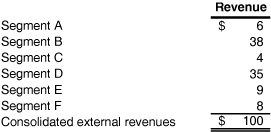
Assume that an entity has identified six operating segments prior to applying the aggregation criteria. Segments B and D have been identified as reportable segments based on the 10 percent threshold criteria in paragraph 280-10-50-12. The revenue from external customers (there are no intersegment transactions) for each of the six segments is as follows.
  • Revenue Segment A $6 Segment B 38 Segment C 4 Segment D 35 Segment E 9 Segment F 8 Consolidated external revenues $100
280-10-55-32
The following Cases illustrate the application of the aggregation (Cases A and B) and quantitative threshold (Cases C, D, and E) criteria for identifying reportable segments.
280-10-55-33
Segment E is below the 10 percent threshold while Segment D is above the 10 percent threshold. Assume that only a majority of the aggregation criteria is met.
280-10-55-34
The aggregation criteria in paragraph 280-10-50-11 (which requires all of the specified criteria to be met) permit aggregation of identified operating segments prior to an evaluation of the significance of the identified operating segments to determine which are reportable. In other words, segments are first identified, then identified segments may be aggregated, if management so chooses, and if the aggregation criteria in that paragraph are met (at this stage all of the specified criteria must be met to be able to aggregate the identified operating segments). Next, an evaluation of the significance of the identified operating segments is performed to determine which are reportable. An operating segment is considered reportable if it meets any one of the threshold criteria. After reportable segments are identified based on the threshold criteria, paragraph 280-10-50-13 permits a public entity to aggregate segments that do not meet the quantitative thresholds (at this stage only a majority of the specified criteria must be met). Therefore, if an operating segment is not a reportable segment because it does not meet any of the 10 percent threshold criteria in paragraph 280-10-50-12 and does not meet all of the aggregation criteria in paragraph 280-10-50-11 with another segment that does meet at least one of the 10 percent threshold criteria, it can only be aggregated with segments that do not meet the 10 percent threshold criteria if a majority of the aggregation criteria are met. In this Case, when only a majority of the criteria is met, Segment E could be aggregated with one or more of Segments A, C, or F but could not be aggregated with Segments B or D. When all of the criteria are met, any segments may be aggregated.
280-10-55-35
Assume that Segments A and B meet all of the five criteria for aggregation and have similar economic characteristics; however, this year certain economic performance measures differ. For example, gross margins differ slightly and sales of the segments, which typically move in tandem, trended slightly differently the current year. Those differences were due to inventory problems caused by the entity's suppliers, and it is expected that the margins and sales trends of Segments A and B will again be similar next year.
280-10-55-36
Even though economic performance measures differ, under this fact pattern Segment A may be aggregated with Segment B for current-year segment disclosures. Paragraph 280-10-50-11 states that operating segments are considered to be similar if they can be expected to have essentially the same future prospects. Paragraph 280-10-55-7A explains that the similarity of the economic characteristics should be evaluated based on future prospects and not necessarily on the current indicators only.
280-10-55-39
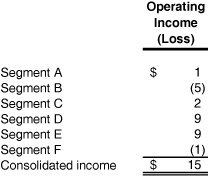
The intent of the threshold criterion of paragraph 280-10-50-12(b) is to require an evaluation of the magnitude of each segment profit or loss compared with a combined reported profit and loss of all operating segments, assuming profit or loss is determined on a consistent basis. That combined measure of all segment profits and losses should approximate (absent any reconciling items) the consolidated amount.
280-10-55-40
In the event that segments are evaluated based on different measures of segment profit or loss, the threshold criterion of paragraph 280-10-50-12(b) should be applied to a consistent measure of segment profit or loss that is determined for internal reporting purposes for each segment, whether or not that measure is consistently used by the chief operating decision maker for purposes of evaluating segment performance. For example, assume that the measure of segment profit or loss used by the chief operating decision maker is a different measure for each segment (for example, if the chief operating decision maker uses net income for purposes of evaluating the performance of Segments A and F but uses operating income for purposes of evaluating the performance of Segments B, C, D, and E). In this Case, the 10 percent of segment profit thresholds should be based on either operating income or net income of the segments. This would not affect the requirement in paragraph 280-10-50-22 to disclose the actual measure of segment profit or loss that is used by the chief operating decision maker for purposes of evaluating each reportable segment (that is, the amounts reported for segment profit or loss would be net income for Segments A and F and operating income for Segments B, C, D, and E) if the public entity discloses only one measure of a segment’s profit or loss. This also would not affect the requirement in paragraph 280-10-50-28A if the public entity discloses more than one measure of a segment’s profit or loss.
280-10-55-41
Because total external revenues of the segments identified as reportable in paragraph 280-10-55-31 only constitute 73 percent of consolidated external revenues (38 percent + 35 percent), an additional segment must be identified for reporting. Segment E is the next largest segment by percentage of external revenues. However, it is not necessarily required to be identified as a reportable segment in order to meet the 75 percent revenue test.
280-10-55-42
Paragraph 280-10-50-14 states that additional operating segments need to be identified as reportable segments (even if they do not meet the criteria in paragraph 280-10-50-12) until at least 75 percent of total consolidated revenue is included in reportable segments. Although in many instances it may be most logical that the next largest segment (in terms of revenues) be identified, paragraph 280-10-50-14 does not require that the additional segment or segments identified to satisfy this requirement be the next largest by any parameter. Therefore, in this Case, Segment A, C, E, or F may be identified as a reportable segment.
280-10-55-43
Assume that operating income (loss) of each of the six segments is as follows.
  • Operating Income (Loss) Segment A $1 Segment B (5) Segment C 2 Segment D 9 Segment E 9 Segment F (1) Consolidated income $15
    • Assume that based on the above information (and an evaluation of revenues and assets) Segments A and C do not meet any of the quantitative threshold criteria. The public entity chooses to apply the aggregation criteria of paragraph 280-10-50-11. Segments B and E meet all of the aggregation criteria and the public entity aggregates them into a single operating segment. When the quantitative thresholds are then evaluated, Segment C (which previously did not meet any of the quantitative thresholds) now meets the 10 percent of segment profit or loss criterion.
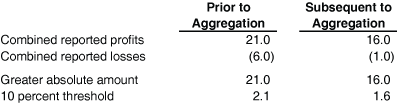
280-10-55-44
Threshold calculations based on the above assumptions are as follows.
    • Prior to Aggregation Subsequent to Aggregation Combined reported profits 21.0 16.0 Combined reported losses (6.0) (1.0) Greater absolute amount 21.0 16.0 10 percent threshold 2.1 1.6
280-10-55-45
Segment C, which previously did not meet the quantitative thresholds but subsequent to the first level of aggregation meets one of the quantitative thresholds, would be considered a reportable segment. This Subtopic provides the order of the steps that should be performed for purposes of identifying reportable segments. That process is also diagrammed in paragraph 280-10-55-26 and further explained in Example 2, Case A (see paragraphs ). This Subtopic requires that segments first be identified; then identified segments may be aggregated into a single segment; and then identified segments (as revised for aggregation, if applicable) are measured against the quantitative thresholds to determine if they are reportable. The fact that one segment did not meet the quantitative thresholds prior to the aggregation of other segments, in accordance with paragraph 280-10-50-11, does not preclude it from being considered a reportable segment subsequent to that aggregation.
280-10-55-46
Following are specific illustrations of the disclosures that are required by this Subtopic. The formats in the examples are not requirements, but the information should be formatted in the most understandable manner in the specific circumstances. The following Cases are for a hypothetical public entity referred to as Diversified Company that has multiple reportable segments and chooses to disclose more than one measure of a segment’s profit or loss that are used by the chief operating decision maker in assessing segment performance and deciding how to allocate resources.
280-10-55-47
The following is an example of the disclosure of descriptive information about a public entity's reportable segments.
  1. a
    Description of the types of products and services from which each reportable segment derives its revenues (see paragraph 280-10-50-21(b)).
    • Diversified Company has five reportable segments: auto parts, motor vessels, software, electronics, and finance. The auto parts segment produces replacement parts for sale to auto parts retailers. The motor vessels segment produces small motor vessels to serve the offshore oil industry and similar businesses. The software segment produces application software for sale to computer manufacturers and retailers. The electronics segment produces integrated circuits and related products for sale to computer manufacturers. The finance segment is responsible for portions of the company's financial operations including financing customer purchases of products from other segments and real estate lending operations in several states.
  2. b
    Measures of segment profit or loss and segment assets (see paragraph 280-10-50-29).
    • The accounting policies of the segments are the same as those described in the summary of significant accounting policies except that pension expense for each segment is recognized and measured on the basis of cash payments to the pension plan. Diversified Company evaluates performance for all of its reportable segments except the finance segment based on both segment gross profit and profit or loss from operations before interest and income taxes. The finance segment’s performance is evaluated based on pretax profit or loss.
  3. bb
    How the chief operating decision maker uses the reported measures of the segment’s profit or loss (see paragraph 280-10-50-29(f)).
    • For the auto parts, motor vessels, software, and electronics segments, the chief operating decision maker uses both segment gross profit and segment profit or loss from operations before interest and income taxes to allocate resources (including employees, property, and financial or capital resources) for each segment predominantly in the annual budget and forecasting process. The chief operating decision maker considers budget-to-actual variances on a monthly basis for both profit measures when making decisions about allocating capital and personnel to the segments. The chief operating decision maker also uses segment gross profit for evaluating product pricing and segment profit or loss from operations before interest and income taxes to assess the performance for each segment by comparing the results and return on assets of each segment with one another and in the compensation of certain employees.
    • For the finance segment, the chief operating decision maker uses segment pretax profit or loss to allocate resources (including employees, financial, or capital resources) to that segment in the annual budget and forecasting process and uses that measure as a basis for evaluating lending terms for customer loans. The chief operating decision maker also uses segment pretax profit or loss to assess the performance of the finance segment by monitoring the margin between interest revenue and interest expense.
  4. c
    Diversified Company accounts for intersegment sales and transfers as if the sales or transfers were to third parties, that is, at current market prices.
  5. d
    Factors that management used to identify the public entity's reportable segments (see paragraph 280-10-50-21(a)).
    • Diversified Company's reportable segments are strategic business units that offer different products and services. They are managed separately because each business requires different technology and marketing strategies. Most of the businesses were acquired as a unit, and the management at the time of the acquisition was retained.
  6. e
    The title and position of the individual or the group identified as the chief operating decision maker (see paragraph 280-10-50-21(c)).
    • Diversified Company’s chief operating decision maker is the chief executive officer.
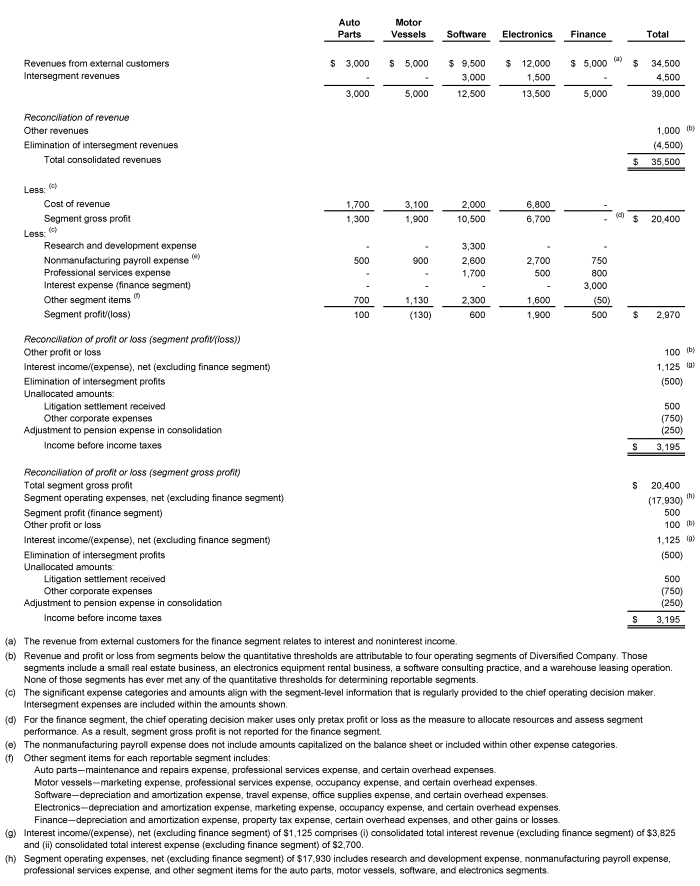
280-10-55-48
The following tables illustrate a format for presenting information about reported segment revenue, measures of a segment’s profit or loss, significant segment expenses, and measure of a segment's assets (see paragraphs 280-10-50-22, 280-10-50-25, and ) for the current reporting period. The tables do not illustrate comparative period disclosures. Diversified Company does not allocate income taxes or unusual items to segments. In addition, not all segments have significant noncash items other than depreciation and amortization in reported profit or loss. The amounts in this Example are assumed to be the amounts in management’s reports that are regularly provided to the chief operating decision maker, including interest revenue and interest expense. The following tables also illustrate a format for presenting the reconciliations of reportable segment revenues and measures of profit or loss to Diversified Company’s consolidated totals (see paragraph 280-10-50-30(a) through (b)).
  • Auto Parts Motor Vessels Software Electronics Finance Total Revenues from external customers " $3,000 " " $5,000 " " $9,500 " " $12,000 " " $5,000 " (a) " $34,500 " Intersegment revenues - - " 3,000 " " 1,500 " - " 4,500 " " 3,000 " " 5,000 " " 12,500 " " 13,500 " " 5,000 " " 39,000 " Reconciliation of revenue Other revenues " 1,000 " (b) Elimination of intersegment revenues " (4,500)" Total consolidated revenues " $35,500 " [Content moved from the illustration in paragraph 280-10-55-49] Less: (c) Cost of revenue " 1,700 " " 3,100 " " 2,000 " " 6,800 " - Segment gross profit " 1,300 " " 1,900 " " 10,500 " " 6,700 " - (d) " $20,400 " Less: (c) Research and development expense - - " 3,300 " - - Nonmanufacturing payroll expense (e) 500 900 " 2,600 " " 2,700 " 750 Professional services expense - - " 1,700 " 500 800 Interest expense (finance segment) - - - - " 3,000 " Other segment items (f) 700 " 1,130 " " 2,300 " " 1,600 " (50) Segment profit/(loss) 100 (130) 600 " 1,900 " 500 " $2,970 " Reconciliation of profit or loss (segment profit/(loss)) Other profit or loss 100 (b) "Interest income/(expense), net (excluding finance segment)" " 1,125 " (g) Elimination of intersegment profits (500) Unallocated amounts: Litigation settlement received 500 Other corporate expenses (750) Adjustment to pension expense in consolidation (250) Income before income taxes " $3,195 " Reconciliation of profit or loss (segment gross profit) Total segment gross profit " $20,400 " "Segment operating expenses, net (excluding finance segment)" " (17,930)" (h) Segment profit (finance segment) 500 Other profit or loss 100 (b) "Interest income/(expense), net (excluding finance segment)" " 1,125 " (g) Elimination of intersegment profits (500) Unallocated amounts: Litigation settlement received 500 Other corporate expenses (750) Adjustment to pension expense in consolidation (250) Income before income taxes " $3,195 " [Content amended and moved from the illustration in paragraph 280-10-55-49] (a) The revenue from external customers for the finance segment relates to interest and noninterest income. (b) "Revenue and profit or loss from segments below the quantitative thresholds are attributable to four operating segments of Diversified Company. Those segments include a small real estate business, an electronics equipment rental business, a software consulting practice, and a warehouse leasing operation. None of those segments has ever met any of the quantitative thresholds for determining reportable segments." (c) The significant expense categories and amounts align with the segment-level information that is regularly provided to the chief operating decision maker. Intersegment expenses are included within the amounts shown. (d) "For the finance segment, the chief operating decision maker uses only pretax profit or loss as the measure to allocate resources and assess segment performance. As a result, segment gross profit is not reported for the finance segment. " (e) The nonmanufacturing payroll expense does not include amounts capitalized on the balance sheet or included within other expense categories. (f) "Other segment items for each reportable segment includes: Auto parts—maintenance, professional services expense, and repairs expense and certain overhead expenses. Motor vessels—marketing expense, professional services expense, occupancy expense, and certain overhead expenses. Software—depreciation and amortization expense, travel expense, office supplies expense, and certain overhead expenses. Electronics—depreciation and amortization expense, marketing expense, occupancy expense, and certain overhead expenses. Finance—depreciation and amortization expense, property tax expense, certain overhead expenses, and other gains or losses." (g) "Interest income/(expense), net (excluding finance segment) of $1,125 comprises (i) consolidated total interest revenue (excluding finance segment) of $3,825 and (ii) consolidated total interest expense (excluding finance segment) of $2,700." (h) "Segment operating expenses, net (excluding finance segment) of $17,930 includes research and development expense, nonmanufacturing payroll expense, professional services expense, and other segment items for the auto parts, motor vessels, software, and electronics segments. "
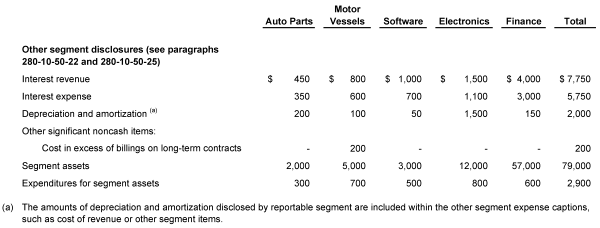
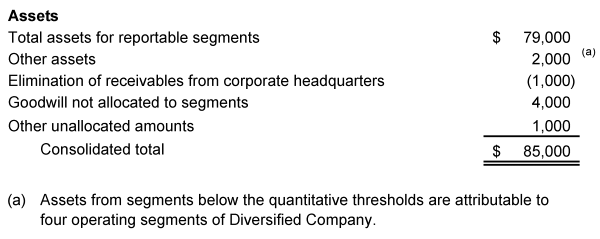
280-10-55-49
The following is an example of reconciliations of reportable segment assets and other significant items to the public entity's consolidated totals (see paragraph 280-10-50-30(c) through (d)). The public entity's financial statements are assumed not to include discontinued operations.
  • Assets Total assets for reportable segments " $79,000 " Other assets " 2,000 " (a) Elimination of receivables from corporate headquarters " (1,000)" Goodwill not allocated to segments " 4,000 " Other unallocated amounts " 1,000 " Consolidated total " $85,000 " (a) Assets from segments below the quantitative thresholds are attributable to four operating segments of Diversified Company.
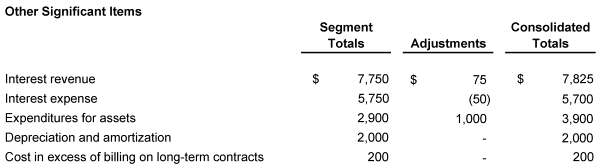
  • Other Significant Items Segment Totals Adjustments Consolidated Totals Interest revenue " $3,750 " $75 " $3,825 " Interest expense " 2,750 " (50) " 2,700 " Net interest revenue (finance segment only) " 1,000 " - " 1,000 " Expenditures for assets " 2,900 " " 1,000 " " 3,900 " Depreciation and amortization " 2,950 " - " 2,950 " Cost in excess of billing on long-term contracts 200 - 200
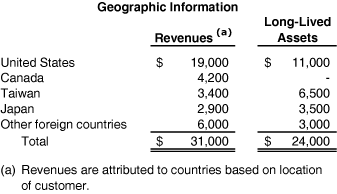
280-10-55-50
The reconciling item to adjust expenditures for assets is the amount of expenses incurred for the corporate headquarters building, which is not included in segment information. None of the other adjustments are significant.
280-10-55-51
The following illustrates the geographic information required by paragraph 280-10-50-41. Because Diversified Company's segments are based on differences in products and services, no additional disclosures of revenue information about products and services are required (see paragraph 280-10-50-40).
  • Geographic Information Revenues (a) Long-Lived Assets United States " $19,000 " " $11,000 " Canada " 4,200 " - Taiwan " 3,400 " " 6,500 " Japan " 2,900 " " 3,500 " Other foreign countries " 6,000 " " 3,000 " Total " $31,000 " " $24,000 " (a) Revenues are attributed to countries based on location of customer.
280-10-55-52
The following is an example of the information about major customers required by paragraph 280-10-50-42. Neither the identity of the customer nor the amount of revenues for each operating segment is required.
  • Revenues from one customer of Diversified Company's software and electronics segments represents approximately $5,000 of the company's consolidated revenues.
280-10-55-53
The following is an illustration of certain disclosures that are required by this Subtopic for a public entity that has a single reportable segment. The following Cases are for a hypothetical public entity referred to as ABC Company, which has one operating segment. The illustration for ABC Company does not include the entity-wide disclosures required by paragraphs .
280-10-55-54
The following is an example of the required disclosures about a public entity’s reportable segment.
  1. a
    Description of the types of products and services from which the reportable segment derives its revenues (see paragraph 280-10-50-21(b)).
    • The software segment derives revenues from customers by providing access to cloud computing applications under software-as-a-service arrangements. The most popular cloud computing application is an enterprise resource planning application used primarily by customers to manage functions such as accounting, financial management, project management, and procurement. The service term for the software arrangements is variable, with the median term being approximately five years.
  2. b
    Measure of segment profit or loss and assets (see paragraph 280-10-50-29).
    • The accounting policies of the software segment are the same as those described in the summary of significant accounting policies.
    • The chief operating decision maker assesses performance for the software segment and decides how to allocate resources based on net income that also is reported on the income statement as consolidated net income.
    • The measure of segment assets is reported on the balance sheet as total consolidated assets.
  3. c
    How the chief operating decision maker uses the reported measure of segment profit or loss (see paragraph 280-10-50-29(f)).
    • The chief operating decision maker uses net income to evaluate income generated from segment assets (return on assets) in deciding whether to reinvest profits into the software segment or into other parts of the entity, such as for acquisitions or to pay dividends.
    • Net income is used to monitor budget versus actual results. The chief operating decision maker also uses net income in competitive analysis by benchmarking to ABC Company’s competitors. The competitive analysis along with the monitoring of budgeted versus actual results are used in assessing performance of the segment and in establishing management’s compensation.
  4. d
    ABC Company does not have intra-entity sales or transfers.
  5. e
    Factors that management used to identify the public entity’s reportable segments (see paragraph 280-10-50-21(a)).
    • ABC Company has one reportable segment: software. The software segment provides cloud computing services to customers under software-as-a-service arrangements. ABC Company derives revenue primarily in North America and manages the business activities on a consolidated basis. The technology used in the customer arrangements is based on a single software platform that is deployed to and implemented by customers in a similar manner.
  6. f
    The title and position of the individual or the group identified as the chief operating decision maker (see paragraph 280-10-50-21(c)).
    • ABC Company’s chief operating decision maker is the senior executive committee that includes the chief operating officer, chief financial officer, and the chief executive officer.
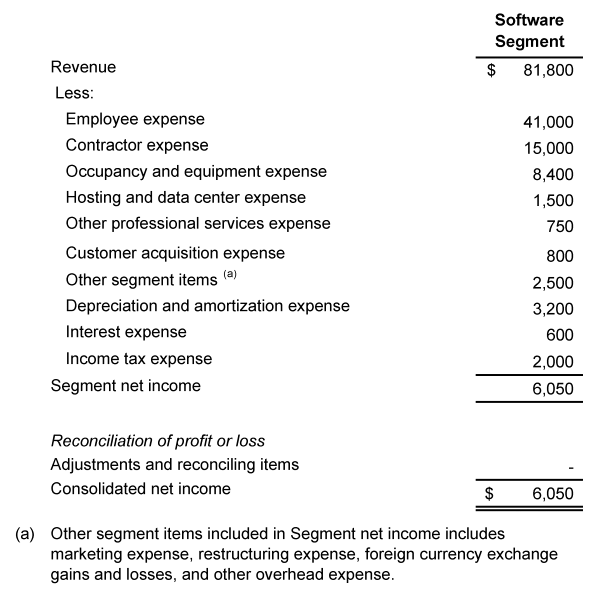
280-10-55-55
The following table illustrates a format for presenting information about reported segment revenue, segment profit or loss, and significant segment expenses. The Example does not separately illustrate all of the information required by paragraphs 280-10-50-22 and 280-10-50-25.
  • Software Segment Revenue " $81,800 " Less: Employee expense " 41,000 " Contractor expense " 15,000 " Occupancy and equipment expense " 8,400 " Hosting and data center expense " 1,500 " Other professional services expense 750 Customer acquisition expense 800 Other segment items (a) " 2,500 " Depreciation and amortization expense " 3,200 " Interest expense 600 Income tax expense " 2,000 " Segment net income " 6,050 " Reconciliation of profit or loss Adjustments and reconciling items - Consolidated net income " $6,050 " (a) "Other segment items included in Segment net income includes marketing expense, restructuring expense, foreign currency exchange gains and losses, and other overhead expense."

280-10-60Relationships

Source downloaded: .Record version 8f455a8509ca. Effective date must be checked in the source.

Intangibles—Goodwill and Other

280-10-60-1
For information to be disclosed about goodwill in each reportable segment and significant changes in the allocation of goodwill by reportable segments, see Topic 350.
280-10-60-2
For segment disclosures related to each impairment loss recognized related to an intangible asset, see Topic 350.

Exit or Disposal Cost Obligations

280-10-60-3
For segment information to be disclosed in the period in which an exit or disposal activity is initiated, see paragraph 420-10-50-1.

Airlines

280-10-60-4
For information about segmentation in the airline industry, see Subtopic 908-280.

Entertainment—Casinos

280-10-60-5
For segment guidance in the casino industry, see Subtopic 924-280.

280-10-65Transition and Open Effective Date Information

Source downloaded: .Record version fd117ace17f0. Effective date must be checked in the source.

280-10-65-1
Paragraph superseded on 06/30/2025 after the end of the transition period stated in Accounting Standards Update No. 2023-07, Segment Reporting (Topic 280): Improvements to Reportable Segment Disclosures.

280-10-S50DisclosureSEC

Source downloaded: .Record version 98484baf0cf4. Effective date must be checked in the source.

Segment Disclosures

280-10-S50-1
See paragraph 220-10-S99-1(e), Regulation S-X Rule 3-03(e), for requirements to provide segment disclosures.

Related subtopics