ASC

ASC 805-60

Joint Venture Formations

805 Business Combinations

Source downloaded: .Record version c974381c23fb. Effective date must be checked in the source.

ASC 805-60 governs how a newly formed joint venture (or corporate joint venture) accounts for its own formation in its separate financial statements. The joint venture must establish a new basis of accounting at the formation date, recognizing and measuring identifiable assets, liabilities, and any noncontrolling interest under Subtopic 805-20, but without identifying an acquirer. Goodwill, if any, is the excess of the formation-date fair value of the joint venture as a whole over the net of the identifiable assets and liabilities recognized; any excess of net assets over that fair value is credited to additional paid-in capital rather than recognized as a bargain purchase gain.

Key points (7)
  • A joint venture applies a new basis of accounting upon formation, treating the transaction as a transfer of net assets to a new reporting entity whose history begins at formation, and does not identify an acquirer (805-60-05-2; 805-60-25-2).
  • The formation date is the date the entity first meets the definition of a joint venture (not necessarily the legal formation date), and a single formation date serves as the measurement date for all contributions and for any multiple arrangements accounted for as one transaction (805-60-25-3 through 25-5).
  • New basis accounting applies whether or not the contributed assets constitute a business, and identifiable assets, liabilities, and any NCI are recognized and measured under Subtopic 805-20 (805-60-25-10 through 25-11; 805-60-30-1).
  • Goodwill equals the formation-date fair value of the joint venture as a whole (100% of equity immediately after formation, including NCI) less the net of the recognized identifiable assets and liabilities; more than insignificant goodwill is unusual if the contributed assets are not a business (805-60-25-13; 805-60-30-2).
  • Any excess of identifiable net assets over the fair value of the joint venture as a whole is recorded as an adjustment to additional paid-in capital (or members' equity), not as a gain (805-60-30-3).
  • Equity-classified instruments issued in the formation and the preformation-vesting portion of equity-classified replacement share-based payment awards are reallocations of additional paid-in capital and do not change total equity or goodwill; replacement awards are split between preformation vesting and postformation compensation cost under 805-30-30-9 through 30-13 (805-60-25-8; 805-60-30-4 through 30-5).
  • The measurement period guidance in 805-10-25-13 through 25-19 may be applied if initial accounting is incomplete, with disclosures required by 805-60-50-3; period-of-formation disclosures include the formation date, purpose, fair value of the joint venture as a whole, major classes of assets and liabilities, and qualitative goodwill factors (805-60-25-14; 805-60-50-2).

For students. Added by ASU 2023-05, this Subtopic finally answers a long-unsettled question: a joint venture steps up all contributed net assets to fair value in its own financial statements even though no acquirer exists. The classic trap is applying the acquisition method mechanically — there is no acquirer, no bargain purchase gain (the excess goes to APIC), no settlement-of-preexisting-relationship or acquisition-cost analogies (805-60-25-7), and goodwill is derived from the fair value of the venture as a whole rather than consideration transferred.

Machine-generated study aid for ASC 805-60. Check the source paragraphs below.

805-60-00Status

Source downloaded: .Record version d03c45f98c54. Effective date must be checked in the source.

805-60-00-1
The following table identifies the changes made to this Subtopic.
ParagraphActionAccounting Standards UpdateDate
AcquireeAddedAccounting Standards Update No. 2023-0508/23/2023
AcquirerAmendedAccounting Standards Update No. 2025-0305/12/2025
AcquirerAddedAccounting Standards Update No. 2023-0508/23/2023
Acquisition by a Not-for-Profit EntityAddedAccounting Standards Update No. 2023-0508/23/2023
Acquisition DateAddedAccounting Standards Update No. 2023-0508/23/2023
BusinessAddedAccounting Standards Update No. 2023-0508/23/2023
Business CombinationAddedAccounting Standards Update No. 2023-0508/23/2023
Control (3rd def.)AddedAccounting Standards Update No. 2023-0508/23/2023
Corporate Joint VentureAddedAccounting Standards Update No. 2023-0508/23/2023
Equity InterestsAddedAccounting Standards Update No. 2023-0508/23/2023
Fair Value (2nd def.)AddedAccounting Standards Update No. 2023-0508/23/2023
Financial AssetAddedAccounting Standards Update No. 2023-0508/23/2023
Formation DateAddedAccounting Standards Update No. 2023-0508/23/2023
GoodwillAddedAccounting Standards Update No. 2023-0508/23/2023
IdentifiableAddedAccounting Standards Update No. 2023-0508/23/2023
Intangible AssetsAddedAccounting Standards Update No. 2023-0508/23/2023
Joint VentureAddedAccounting Standards Update No. 2023-0508/23/2023
Legal EntityAddedAccounting Standards Update No. 2023-0508/23/2023
Market ParticipantsAddedAccounting Standards Update No. 2023-0508/23/2023
Noncontrolling InterestAddedAccounting Standards Update No. 2023-0508/23/2023
Nonprofit ActivityAddedAccounting Standards Update No. 2023-0508/23/2023
Not-for-Profit EntityAddedAccounting Standards Update No. 2023-0508/23/2023
Orderly TransactionAddedAccounting Standards Update No. 2023-0508/23/2023
OwnersAddedAccounting Standards Update No. 2023-0508/23/2023
Private CompanyAddedAccounting Standards Update No. 2023-0508/23/2023
Public Business EntityAddedAccounting Standards Update No. 2023-0508/23/2023
Related PartiesAddedAccounting Standards Update No. 2023-0508/23/2023
Security (2nd def.)AddedAccounting Standards Update No. 2023-0508/23/2023
Variable Interest EntitySupersededAccounting Standards Update No. 2025-0305/12/2025
Variable Interest EntityAddedAccounting Standards Update No. 2023-0508/23/2023
805-60-05-1AddedAccounting Standards Update No. 2023-0508/23/2023
805-60-05-2AddedAccounting Standards Update No. 2023-0508/23/2023
AddedAccounting Standards Update No. 2023-0508/23/2023
805-60-35-1AddedAccounting Standards Update No. 2023-0508/23/2023
805-60-35-2AddedAccounting Standards Update No. 2023-0508/23/2023
805-60-45-1AddedAccounting Standards Update No. 2023-0508/23/2023
AddedAccounting Standards Update No. 2023-0508/23/2023
805-60-65-1AddedAccounting Standards Update No. 2023-0508/23/2023

805-60-05Overview and Background

Source downloaded: .Record version 13f1b1290dd6. Effective date must be checked in the source.

805-60-05-1
This Subtopic provides guidance on the accounting and reporting for the formation of a joint venture or a corporate joint venture (collectively, joint ventures) in a joint venture’s separate financial statements.
805-60-05-2
Paragraph 805-60-25-2 requires that a joint venture account for its formation by applying a new basis of accounting. In accounting for the formation of a joint venture, none of the assets and/or businesses contributed to the joint venture are viewed as having survived the combination as independent entities. Rather, the formation is viewed as the transfer of the net assets to a new entity that assumes control over them. The history of that new reporting entity begins with the joint venture formation. A joint venture establishes a new basis of accounting upon formation by applying aspects of the acquisition method for business combinations, with adaptations that are unique to joint ventures as described in this Subtopic. Accounting for a joint venture formation includes the following steps:
  1. a
    Determining the formation date
  2. b
    Recognizing and measuring the identifiable assets, the liabilities, and any noncontrolling interest in the net assets recognized by the joint venture
  3. c
    Recognizing and measuring goodwill, if any, using the fair value of the joint venture as a whole immediately following formation.

805-60-15Scope and Scope Exceptions

Source downloaded: .Record version fd570149c321. Effective date must be checked in the source.

Overall Guidance

805-60-15-1
This Subtopic has its own discrete scope, which is separate and distinct from the pervasive scope for this Topic as outlined in Section 805-10-15.

Entities

805-60-15-2
The guidance in this Subtopic applies to the financial statements of joint venture and corporate joint venture entities (collectively, joint ventures) as defined in Section 805-60-20.

Transactions

805-60-15-3
The guidance in this Subtopic applies to the formation of joint ventures.
805-60-15-4
The guidance in this Subtopic does not apply to any of the following:
  1. a
    Transactions between a joint venture and its owners other than the formation of a joint venture
  2. b
    Formations of entities determined to be not-for-profit entities in accordance with Topic 958
  3. c
    Combinations between entities, businesses, or nonprofit activities under common control (see paragraph 805-50-15-6 for examples)
  4. d
    Entities in the construction or extractive industries that may be proportionately consolidated by any of their investor-venturers in accordance with paragraph 810-10-45-14
  5. e
    Collaborative arrangements within the scope of Topic 808, except for any part of the arrangement that is conducted in a separate legal entity that meets the definition of a joint venture.

805-60-25Recognition

Source downloaded: .Record version 3fdb79e2de79. Effective date must be checked in the source.

805-60-25-1
An entity shall determine whether a transaction or an event is a joint venture formation by applying the definition of joint venture (or corporate joint venture) and the guidance in paragraph 805-60-25-3 on its formation date. If the transaction or event is not a joint venture formation, the reporting entity shall account for the transaction or event in accordance with other generally accepted accounting principles (GAAP).
805-60-25-2
Accounting for joint venture formations as described in this Subtopic requires that a joint venture establish upon formation a new basis of accounting for its assets and liabilities in accordance with Subtopic 805-20 on identifiable assets and liabilities, and any noncontrolling interest. A joint venture shall recognize goodwill, if any, in accordance with paragraph 805-60-25-13. Unlike the acquisition method, accounting for the formation of a joint venture does not include the identification of an acquirer. This Section includes the following requirements:
  1. a
    Determining the formation date
  2. b
    Determining whether multiple arrangements should be accounted for as a single formation transaction
  3. c
    Determining what is part of the joint venture formation
  4. d
    Accounting for the formation of a joint venture, as applicable:
    1. 1
      New basis of accounting
    2. 2
      Private company accounting alternatives
    3. 3
      Goodwill
    4. 4
      Measurement period
    5. 5
      Transfers of financial assets.

Determining the Formation Date

805-60-25-3
The joint venture formation date is the date on which an entity initially meets the definition of a joint venture, which is not necessarily the legal entity formation date. A joint venture’s formation date is the measurement date for the formation transaction. A joint venture shall determine a single formation date and account for its formation as of that date. A joint venture shall consider the pertinent facts and circumstances in identifying its formation date. All contributions received, or that are receivable, as of the formation date, including consideration of the guidance in paragraphs 805-60-25-4 through 25-5 on multiple arrangements that should be accounted for as a single formation transaction, constitute the joint venture formation transaction.

Determining Whether Multiple Arrangements Should Be Accounted for as a Single Formation Transaction

805-60-25-4
Multiple arrangements may establish the formation of a joint venture and constitute the joint venture formation transaction. Circumstances sometimes indicate that the multiple arrangements should be accounted for as a single transaction. In determining whether to account for the multiple arrangements as a single transaction that establishes the formation, a joint venture shall consider the terms and conditions of the arrangements and their economic effects. Any of the following may indicate that the joint venture should account for the multiple arrangements as a single transaction that established the formation of the joint venture:
  1. a
    The multiple arrangements are entered into at the same time or in contemplation of one another.
  2. b
    The multiple arrangements form a single transaction designed to achieve an overall commercial effect.
  3. c
    The occurrence of one arrangement is dependent on the occurrence of at least one other arrangement.
  4. d
    One arrangement considered on its own is not economically justified, but the multiple arrangements are economically justified when considered together.
805-60-25-5
If multiple arrangements are accounted for as a single transaction in accordance with paragraph 805-60-25-4, then the formation date shall be the measurement date for all arrangements that form part of the single formation transaction. A joint venture shall recognize identifiable assets and liabilities that are part of that single transaction when they satisfy the recognition criteria described in paragraph 805-60-25-2.

Determining What Is Part of the Joint Venture Formation

805-60-25-6
A joint venture and its owners (the venturers) may enter into an arrangement upon formation that is separate from the formation of the joint venture. For example, a joint venture may enter into an arrangement with a venturer to compensate the venturer or others (such as employees of the venturers) for future services. A joint venture shall apply the guidance in paragraphs 805-10-55-24 through 55-26 when determining whether a transaction involving payments to be made by the joint venture to the venturers or others is separate from or part of a joint venture formation. A joint venture shall identify any amounts that are separate from the formation of the joint venture and shall recognize the identifiable assets and liabilities that are determined to be part of the joint venture formation. Separate transactions shall be accounted for in accordance with other relevant GAAP.
805-60-25-7
A joint venture shall not apply by analogy the guidance in paragraphs 805-10-55-20 through 55-23 (for a transaction that in effect settles preexisting relationships between the acquirer and the acquiree) or paragraph 805-10-25-23 (for acquisition-related costs and transactions that reimburse the acquiree or its former owners for paying the acquirer’s acquisition-related costs).
805-60-25-8
If, upon formation, a joint venture issues share-based payment awards to replace awards held by grantees of the contributed entities, then the joint venture shall apply the guidance in paragraphs 805-30-30-9 through 30-13 to allocate the fair-value-based measure of replacement share-based payment awards between preformation vesting and postformation compensation cost. Paragraphs 805-60-55-2 through 55-14 provide illustrations of the accounting for the issuance of replacement share-based payment awards in a joint venture formation.
805-60-25-9
For the purposes of applying the business combinations guidance on arrangements that include contingent payments to employees or selling shareholders and replacement share-based payment awards referenced in paragraphs 805-60-25-6 through 25-8:
  1. a
    The joint venture shall be viewed as analogous to the acquirer in a business combination.
  2. b
    The venturers shall be viewed as analogous to the selling shareholders.
  3. c
    The recognized businesses and/or assets shall be viewed as analogous to an acquiree.

Accounting for the Formation of a Joint Venture

805-60-25-10
At the formation date, a joint venture shall account for its formation by establishing a new basis of accounting for its identifiable assets and liabilities, and any noncontrolling interest, in accordance with Subtopic 805-20.
805-60-25-11
A joint venture shall account for its formation in accordance with this Subtopic regardless of whether the assets or group of assets recognized by the joint venture constitute a business in accordance with Subtopic 805-10.
805-60-25-12
A joint venture that is a private company may elect to apply the accounting alternative for the recognition of identifiable intangible assets described in paragraphs 805-20-25-30 through 25-33. In accordance with paragraph 805-20-15-4, a joint venture that elects to apply this accounting alternative must adopt the accounting alternative for amortizing goodwill in the Accounting Alternatives Subsections of Subtopic 350-20.
805-60-25-13
In accounting for its formation, a joint venture shall recognize goodwill as of the formation date, when applicable. The presence of more than an insignificant amount of goodwill is expected to be unusual if, at formation, the assets or group of assets recognized by the joint venture do not constitute a business in accordance with Subtopic 805-10. Paragraph 805-60-30-2 describes how a joint venture should measure goodwill upon its formation.
805-60-25-14
If the initial accounting for a joint venture formation is incomplete by the end of the reporting period in which the formation date occurs, the joint venture may apply the measurement period guidance in paragraphs 805-10-25-13 through 25-19 for the items for which the accounting is incomplete. Joint ventures that apply the measurement period guidance shall disclose the information described in paragraph 805-60-50-3.
805-60-25-15
If a venturer transfers financial assets that are within the scope of Subtopic 860-10 to the joint venture upon formation, then the joint venture shall determine whether the transfer results in the recognition of the transferred financial assets by the joint venture by applying the guidance in Subtopic 860-10.

805-60-30Initial Measurement

Source downloaded: .Record version a3dc5c96bef3. Effective date must be checked in the source.

Identifiable Assets and Liabilities, and Any Noncontrolling Interest

805-60-30-1
A joint venture shall measure its identifiable assets and liabilities, and any noncontrolling interest, recognized at the formation date in accordance with Subtopic 805-20.

Goodwill

805-60-30-2
A joint venture shall apply the guidance in this paragraph to measure goodwill, when applicable. A joint venture shall recognize goodwill, if any, upon formation, measured as the excess of (a) over (b):
  1. a
    The formation-date fair value of the joint venture as a whole. The formation-date fair value of the joint venture as a whole shall equal the fair value of 100 percent of the joint venture’s equity (net assets) immediately following formation (including any noncontrolling interest in the net assets recognized by the joint venture).
  2. b
    The net of the formation-date amounts of the identifiable assets and liabilities recognized by the joint venture and measured in accordance with Subtopic 805-20.
805-60-30-3
Upon formation, a joint venture shall recognize the amount of its identifiable net assets recognized in excess of the fair value of the joint venture as a whole, if any, as an adjustment to additional paid-in capital (or other similar equity account, such as members’ equity).

Instruments, Contracts, and Share-Based Payment Awards Classified as Equity

805-60-30-4
The amount of any separately recognized equity-classified instruments or contracts issued by a joint venture as part of the formation transaction, other than equity-classified replacement share-based payment awards (see paragraph 805-60-30-5), shall be accounted for as a reallocation of additional paid-in capital (or other similar equity account, such as members’ equity) and shall not affect the total amount of equity or goodwill recognized by the joint venture upon formation.
805-60-30-5
A joint venture shall initially measure equity-classified replacement share-based payment awards at the fair-value-based measurement method described in Topic 718 on stock compensation. The fair-value-based amount allocated to preformation vesting (in accordance with paragraph 805-60-25-8) of any replacement share-based payments classified as equity shall be recognized as a reallocation of additional paid-in capital (or other similar equity account, such as members’ equity) and shall not affect the total amount of equity or goodwill recognized by the joint venture upon formation.

Liability-Classified and Asset-Classified Contingent Payments and Replacement Share-Based Payment Awards

805-60-30-6
A joint venture shall initially measure any contingent payment arrangements between the joint venture and its venturers that are classified as liabilities (or assets), other than replacement share-based payment awards, in accordance with paragraph 805-60-30-1. A joint venture shall not account for those arrangements generated as a result of the joint venture formation as contingent consideration or as an assumed contingent consideration arrangement.
805-60-30-7
A joint venture shall initially measure liability-classified replacement share-based payment awards using the fair-value-based measurement method described in Topic 718 on stock compensation (consistent with the requirements in paragraphs 805-60-25-8 and 805-60-30-1).

805-60-35Subsequent Measurement

Source downloaded: .Record version e442a9c339fc. Effective date must be checked in the source.

805-60-35-1
A joint venture shall subsequently measure and account for the assets and liabilities recognized upon formation in accordance with the requirements for acquirers of a business in Sections 805-10-35, 805-20-35, and 805-30-35, and other generally accepted accounting principles (GAAP), as applicable.
805-60-35-2
A joint venture that is a private company may elect to apply the accounting alternatives for the subsequent measurement of goodwill described in paragraphs 350-20-35-62 through 35-82.

805-60-45Other Presentation Matters

Source downloaded: .Record version 5cdc8a9644e8. Effective date must be checked in the source.

Disclosure of Formation Date Balance Sheet

805-60-45-1
To satisfy the requirements in paragraph 805-60-50-2(e), a joint venture may, in lieu of disclosure in the notes to financial statements, present a statement of financial position as of the formation date that reflects the amounts recognized by the joint venture for each major class of assets and liabilities as a result of its formation.

805-60-50Disclosure

Source downloaded: .Record version 2c8194be2f1a. Effective date must be checked in the source.

805-60-50-1
A joint venture shall disclose information that enables users of its financial statements to understand the nature and financial effect of the joint venture formation in the period in which the formation date occurs.
805-60-50-2
In the period of formation, a joint venture shall disclose the following:
  1. a
    The formation date
  2. b
    A description of the purpose for which the joint venture was formed (for example, to share risks and rewards in developing a new market, product, or technology; to combine complementary technological knowledge; or to pool resources in developing production or other facilities)
  3. c
    The formation-date fair value of the joint venture as a whole
  4. d
    A description of the assets and liabilities recognized by the joint venture at the formation date
  5. e
    The amounts recognized by the joint venture for each major class of assets and liabilities as a result of accounting for its formation, either presented on the face of financial statements or disclosed in the notes to financial statements (see paragraph 805-60-45-1)
  6. f
    A qualitative description of the factors that make up any goodwill recognized, such as expected synergies from combining operations of the contributed assets or businesses, intangible assets that do not qualify for separate recognition, or other factors.
805-60-50-3
If the initial accounting for a joint venture formation is incomplete (see paragraph 805-60-25-14) for particular assets, liabilities, noncontrolling interests, or the formation-date fair value of the joint venture as a whole and the amounts recognized in the financial statements for the joint venture formation thus have been determined only provisionally, the joint venture shall disclose the following information:
  1. a
    The reasons why the initial accounting is incomplete
  2. b
    The assets, liabilities, noncontrolling interests, or the formation-date fair value of the joint venture as a whole for which the initial accounting is incomplete
  3. c
    The nature and amount of any measurement period adjustments recognized during the reporting period, including separately the amount of adjustment to current-period income statement line items relating to the income effects that would have been recognized in previous periods if the adjustment to provisional amounts was recognized as of the formation date.

805-60-55Implementation Guidance and Illustrations

Source downloaded: .Record version 0b6f6f4e7005. Effective date must be checked in the source.

805-60-55-1
This Section is an integral part of the requirements of this Subtopic. This Section provides illustrations that address the general application of accounting requirements for joint venture formations.

Illustrations

805-60-55-2
On January 1, 20X0, a newly formed corporation with no assets or liabilities, New Venture, receives contributions of a controlling financial interest in Business A (90 percent voting interest) from Venturer 1 and Business B (100 percent voting interest) from Venturer 2 and, in exchange, issues 50 common shares to each Venturer 1 and Venturer 2. Assume that New Venture has no other classes of equity or any other equity instruments outstanding before receiving the contributions. It is determined that New Venture first met the definition of a joint venture on January 1, 20X0. New Venture determines January 1, 20X0, to be its formation date.
805-60-55-3
In accordance with paragraph 805-60-30-2, but before consideration of any liabilities for share-based payments, New Venture determines that the fair value of the joint venture as a whole is $100 million including a noncontrolling interest (10 percent voting interest) in Business A that is owned by an outside entity. It also determines, in accordance with paragraph 805-60-30-2, that the formation-date fair value of the identifiable assets is $120 million, the fair value of the liabilities is $40 million, and the fair value of the noncontrolling interest in Business A is $5 million.
805-60-55-4
Upon formation, New Venture exchanges replacement awards that require one year of postformation vesting for share-based payment awards of Business A for which employees had not yet rendered all of the required services as of the formation date. The fair-value-based measure of both awards (the original awards and the replacement awards) is $20 million at the formation date. When originally granted, the awards of the contributed business had a requisite service period of four years. As of the formation date, the contributed business’s employees had rendered two years’ service, and they would have been required to render two additional years of service after the formation date for their awards to vest. Accordingly, only a portion of the contributed business’s awards is attributable to preformation vesting.
805-60-55-5
The replacement awards require only one year of postformation vesting. Because employees have already rendered two years of service, the total requisite service period is three years. For simplicity, assume that New Venture estimates that there will be no forfeitures of the replacement share-based payment awards. The portion attributable to preformation vesting equals the fair-value-based measure of the contributed business’s award ($20 million) multiplied by the ratio of the preformation vesting period (2 years) to the greater of the total service period (3 years) and the original service period of the contributed business’s award (4 years). Thus, $10 million ($20 million × 2 ÷ 4 years) is attributable to preformation vesting and, therefore, New Venture’s additional paid-in capital upon formation. The remaining $10 million is attributable to postformation vesting and therefore recognized as compensation cost in New Venture’s postformation financial statements in accordance with Topic 718 on stock compensation.
805-60-55-6
New Venture applies the guidance in Topic 718 to determine whether the share-based payments should be classified as liabilities or equity.
805-60-55-7
If New Venture determines that the replacement share-based payment awards are classified as liabilities, then total liabilities will equal $50 million ($40 million + $10 million). For simplicity, when taking the share-based payment liabilities into account, the fair value of New Venture as a whole is $90 million ($100 million – $10 million).
805-60-55-8
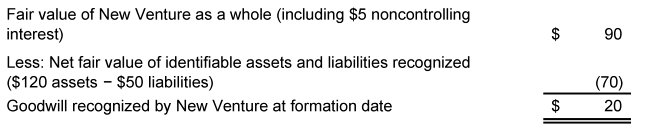
New Venture calculates goodwill as follows (in millions), consistent with the guidance in paragraph 805-60-30-2. The formation-date fair value of the joint venture as a whole is equal to the fair value of 100 percent of the joint venture’s equity (net assets) immediately following formation (including any noncontrolling interest in the net assets recognized by the joint venture).
  • Fair value of New Venture as a whole (including $5 noncontrolling interest) $90 Less: Net fair value of identifiable assets and liabilities recognized ($120 assets − $50 liabilities) (70) Goodwill recognized by New Venture at formation date $20
805-60-55-9
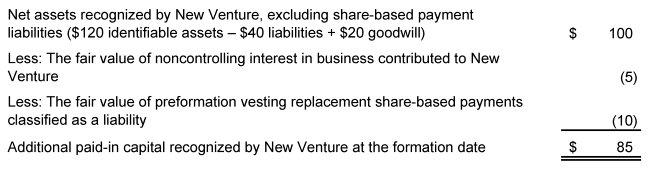
New Venture calculates additional paid-in capital as follows (in millions).
  • "Net assets recognized by New Venture, excluding share-based payment liabilities ($120 identifiable assets – $40 liabilities + $20 goodwill)" $100 Less: The fair value of noncontrolling interest in business contributed to New Venture (5) Less: The fair value of preformation vesting replacement share-based payments classified as a liability (10) Additional paid-in capital recognized by New Venture at the formation date $85
805-60-55-10
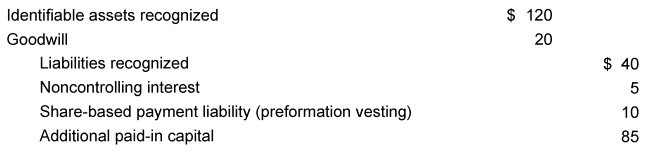
New Venture records the following entry at the formation date (in millions).
  • Identifiable assets recognized $120 Goodwill 20 Liabilities recognized $40 Noncontrolling interest 5 Share-based payment liability (preformation vesting) 10 Additional paid-in capital 85
805-60-55-11
If New Venture determines that the replacement share-based payment awards are classified as equity, then total liabilities will equal $40 million and the fair value of New Venture as a whole is $100 million.
805-60-55-12
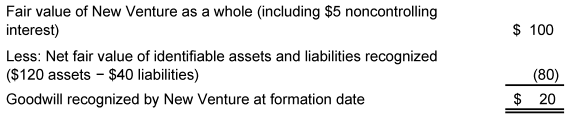
New Venture calculates goodwill as follows (in millions), consistent with the guidance in paragraph 805-60-30-2. The formation-date fair value of the joint venture as a whole is equal to the fair value of 100 percent of the joint venture’s equity (net assets) immediately following formation (including any noncontrolling interest in the net assets recognized by the joint venture).
  • Fair value of New Venture as a whole (including $5 noncontrolling interest) $100 Less: Net fair value of identifiable assets and liabilities recognized ($120 assets − $40 liabilities) (80) Goodwill recognized by New Venture at formation date $20
805-60-55-13
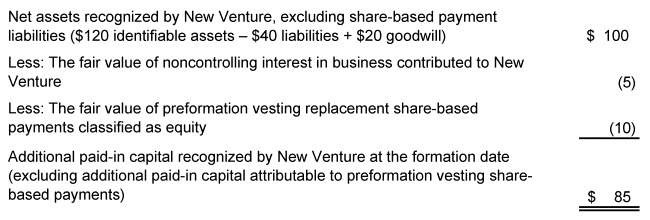
New Venture calculates additional paid-in capital, excluding additional paid-in capital attributable to share-based payments, as follows (in millions).
  • "Net assets recognized by New Venture, excluding share-based payment liabilities ($120 identifiable assets – $40 liabilities + $20 goodwill)" $100 Less: The fair value of noncontrolling interest in business contributed to New Venture (5) Less: The fair value of preformation vesting replacement share-based payments classified as equity (10) Additional paid-in capital recognized by New Venture at the formation date (excluding additional paid-in capital attributable to preformation vesting share-based payments) $85
805-60-55-14
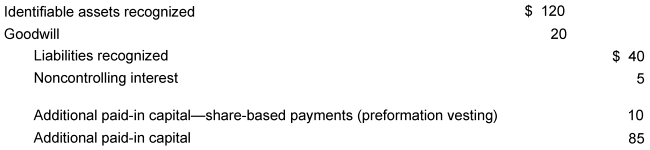
New Venture records the following entry at the formation date (in millions).
  • Identifiable assets recognized $120 Goodwill 20 Liabilities recognized $40 Noncontrolling interest 5 Additional paid-in capital—share-based payments (preformation vesting) 10 Additional paid-in capital 85

805-60-65Transition and Open Effective Date Information

Source downloaded: .Record version c34172f946f8. Effective date must be checked in the source.

805-60-65-1
Paragraph superseded on 07/02/2026 after the end of the transition period stated in Accounting Standards Update No. 2023-05, Business Combinations—Joint Venture Formations (Subtopic 805-60): Recognition and Initial Measurement.

Related subtopics