ASC 740-20
Intraperiod Tax Allocation
740 Income Taxes
Source downloaded: .Record version d09b1ff7a578. Effective date must be checked in the source.
ASC 740-20 governs intraperiod tax allocation: after total income tax expense or benefit for the period is computed under ASC 740-10, this Subtopic allocates that total among continuing operations, discontinued operations, other comprehensive income, and items charged or credited directly to shareholders' equity (740-20-45-2). Continuing operations is computed first ("with-and-without"), considering only items in continuing operations (740-20-45-7), and the residual is assigned to the single other item, or apportioned among multiple other items in proportion to their individual effects (740-20-45-12 and 45-14).
Key points (7)
- Total income tax expense or benefit (current plus deferred) is first computed under Subtopic 740-10, then allocated among continuing operations, discontinued operations, other comprehensive income, and items charged or credited directly to shareholders' equity (740-20-45-1 through 45-2).
- The tax effect of pretax income or loss from continuing operations must be determined by a computation that does not consider the tax effects of items excluded from continuing operations (740-20-45-7); the amount allocated to continuing operations also includes tax effects of changes in judgment about realizability of deferred tax assets, changes in tax laws or rates, changes in tax status, and tax-deductible dividends paid to shareholders (740-20-45-8).
- The tax benefit of an operating loss carryforward or carryback is reported in the same manner as the source of income or loss in the current year, not the source of the prior loss or of expected future income, except for items allocated to equity under 740-20-45-11(c) through (f) (740-20-45-3).
- If there is only one item other than continuing operations, the entire residual after allocation to continuing operations goes to that item; if there are two or more, the residual is apportioned in proportion to their individual effects, with tax benefit apportioned ratably to net loss items first and the remaining expense ratably to net gain items (740-20-45-12, 45-14).
- Tax effects charged or credited directly to OCI or equity include retained earnings adjustments for changes in accounting principle or error corrections, gains and losses in comprehensive income but excluded from net income, increases/decreases in contributed capital, deductible temporary differences and carryforwards existing at a quasi reorganization, and changes in tax bases from transactions with shareholders (740-20-45-11).
- A valuation allowance established at the same time as a deferred tax asset for a net unrealized loss on available-for-sale securities is charged to OCI (740-20-45-15), but a valuation allowance recognized or reversed in a subsequent fiscal year due to a change in judgment is reported in continuing operations (740-20-45-16, 45-17).
- Changes in the beginning-of-year valuation allowance from changes in judgment about future realization are ordinarily allocated to continuing operations under 740-10-45-20, while other valuation allowance changes are allocated using the general methodology of this Section (740-20-45-4).
For students. Exam questions almost always test the "incremental" mechanics: compute tax on continuing operations as if the other items did not exist, then plug the residual to the other items. The most common error is letting a gain in discontinued operations or OCI influence the continuing-operations computation (e.g., using it to avoid a valuation allowance), which 740-20-45-7 prohibits.
Machine-generated study aid for ASC 740-20. Check the source paragraphs below.
740-20-00Status
Source downloaded: .Record version e16a2949c824. Effective date must be checked in the source.
740-20-05Overview and Background
Source downloaded: .Record version 8c449bc2222b. Effective date must be checked in the source.
- aContinuing operations
- bDiscontinued operations
- c
- dOther comprehensive income
- eItems charged or credited directly to shareholders' equity.
740-20-15Scope and Scope Exceptions
Source downloaded: .Record version 88976f16f034. Effective date must be checked in the source.
Overall Guidance
Transactions
740-20-45Other Presentation Matters
Source downloaded: .Record version 528c47a3d4b9. Effective date must be checked in the source.
Allocation of Income Tax Expense or Benefit for the Year
- a Continuing operations
- b Discontinued operations
- c
- d Other comprehensive income
- e Items charged or credited directly to shareholders' equity.
- a
- b
Allocation to Continuing Operations
- a Changes in circumstances that cause a change in judgment about the realization of deferred tax assets in future years (see paragraph 740-10-45-20 for a discussion of exceptions to this allocation for certain items)
- b Changes in tax laws or rates (see paragraph 740-10-35-4)
- c Changes in tax status (see paragraphs 740-10-25-32 and 740-10-40-6)
- d Tax-deductible dividends paid to shareholders.
Allocations to Items Other Than Continuing Operations
- a Adjustments of the opening balance of retained earnings for certain changes in accounting principles or a correction of an error. Paragraph 250-10-45-8 addresses the effects of a change in accounting principle, including any related income tax effects.
- b Gains and losses included in comprehensive income but excluded from net income (for example, translation adjustments accounted for under the requirements of Topic 830 and changes in the unrealized holding gains and losses of securities classified as available-for-sale as required by Topic 320).
- c An increase or decrease in contributed capital (for example, deductible expenditures reported as a reduction of the proceeds from issuing capital stock).
- d
- e
- f Deductible temporary differences and carryforwards that existed at the date of a quasi reorganization.
- g All changes in the tax bases of assets and liabilities caused by transactions among or with shareholders shall be included in equity including the effect of valuation allowances initially required upon recognition of any related deferred tax assets. Changes in valuation allowances occurring in subsequent periods shall be included in the income statement.
Single Item of Allocation Other Than Continuing Operations
Multiple Items of Allocation Other Than Continuing Operations
- a Determine the effect on income tax expense or benefit for the year of the total net loss for all net loss items.
- b Apportion the tax benefit determined in (a) ratably to each net loss item.
- c Determine the amount that remains, that is, the difference between the amount to be allocated to all items other than continuing operations and the amount allocated to all net loss items.
- d Apportion the tax expense determined in (c) ratably to each net gain item.
Presentation of Deferred Tax Assets Relating to Losses on Available-for-Sale Debt Securities
740-20-55Implementation Guidance and Illustrations
Source downloaded: .Record version 36070cf6596d. Effective date must be checked in the source.
Illustrations
- a Changes in circumstances that cause a change in judgment about the realization of deferred tax assets in future years
- b Changes in tax laws or rates
- c Changes in tax status
- d Tax-deductible dividends paid to shareholders.
- a Tax rates are 40 percent for Years 1, 2, and 3 and 30 percent for Year 4 and subsequent years. No valuation allowances are required for deferred tax assets.
- b At the end of Year 1, there is a $500 taxable temporary difference relating to the entity's contracting operations and a $200 deductible temporary difference related to its other operations. Determination of the entity's deferred tax assets and liabilities at the end of Year 1 is as follows.
-
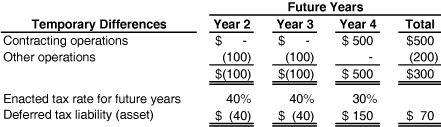 Future Years Temporary Differences Year 2 Year 3 Year 4 Total Contracting operations $- $- $500 $500 Other operations (100) (100) - (200) $(100) $(100) $500 $300 Enacted tax rate for future years 40% 40% 30% Deferred tax liability (asset) $(40) $(40) $150 $70
-
- c During Year 2, the entity decides that it will sell its contracting operations in Year 3. As a result, all temporary differences related to the contracting operations (the $500 taxable temporary difference that existed at the end of Year 1, plus an additional $200 taxable temporary difference that arose during Year 2) are now considered to result in taxable amounts in Year 3 because the contracting operations will be sold in Year 3.
- d At the end of Year 2, the entity also has $300 of deductible temporary differences ($100 of the temporary difference that existed at the end of Year 1, plus an additional $200 that arose during Year 2) from continuing operations.
- e For Year 2, the entity has $50 of pretax reported income from continuing operations and $200 of pretax reported income from discontinued operations.
- f Determination of the entity's deferred tax asset and liability at the end of Year 2 is as follows.
-
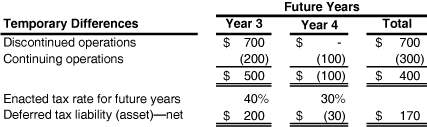 Future Years Temporary Differences Year 3 Year 4 Total Discontinued operations $700 $- $700 Continuing operations (200) (100) (300) $500 $(100) $400 Enacted tax rate for future years 40% 30% Deferred tax liability (asset)—net $200 $(30) $170
-
-
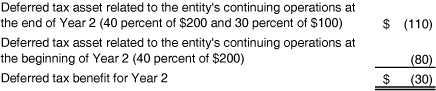 Deferred tax asset related to the entity's continuing operations at the end of Year 2 (40 percent of $200 and 30 percent of $100) $(110) Deferred tax asset related to the entity's continuing operations at the beginning of Year 2 (40 percent of $200) (80) Deferred tax benefit for Year 2 $(30)
-
 Deferred tax liability at the end of Year 2 (40 percent of $700) $280 Deferred tax liability at the end of Year 1 (30 percent of $500) (150) Deferred tax expense for Year 2 $130
-
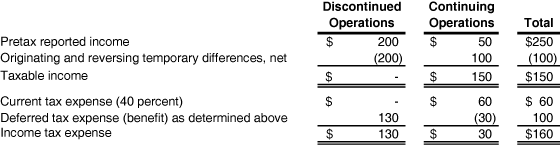 Discontinued Operations Continuing Operations Total Pretax reported income $200 $50 $250 "Originating and reversing temporary differences, net" (200) 100 (100) Taxable income $- $150 $150 Current tax expense (40 percent) $- $60 $60 Deferred tax expense (benefit) as determined above 130 (30) 100 Income tax expense $130 $30 $160
- aLoss from continuing operations with an extraordinary gain (Case A)
- bIncome from continuing operations with a loss from discontinued operations (Case B).
- a The entity's pretax financial income and taxable income are the same.
- b The entity's ordinary loss from continuing operations is $500.
- c The entity also has a gain on discontinued operations of $900 that is a capital gain for tax purposes.
- d The tax rate is 40 percent on ordinary income and 30 percent on capital gains. Income taxes currently payable are $120 ($400 at 30 percent).
- e The entity has determined that the deferred tax asset that would have resulted from the loss from continuing operations if the gain on discontinued operations had not occurred would be expected to be realized (that is, a valuation allowance would not have been needed).
-
 Total income tax expense $120 Tax benefit allocated to the loss from operations (200) Incremental tax expense allocated to the gain on discontinued operations $320
-
 Total income tax expense $120 Tax benefit allocated to the loss from operations - Incremental tax expense allocated to the gain on discontinued operations $120
- a The entity's pretax financial income and taxable income are the same.
- b Pretax financial income for the year comprises $300 from continuing operations and $400 from a gain on discontinued operations.
- c The tax rate is 40 percent. Taxes payable for the year are zero because $330 of tax credits that arose in the current year more than offset the $280 of tax otherwise payable on $700 of taxable income.
- d A $50 deferred tax asset is recognized for the $50 ($330 - $280) tax credit carryforward. Based on the weight of available evidence, management concludes that no valuation allowance is necessary.
-
 Total income tax benefit $(50) Tax expense (benefit) allocated to income from continuing operations: Tax (before tax credits) on $300 of taxable income at 40 percent $120 Tax credits (330) (210) Tax expense allocated to the extraordinary gain $160
-
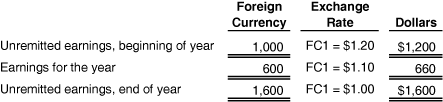 Foreign Currency Exchange Rate Dollars "Unremitted earnings, beginning of year" " 1,000 " FC1 = $1.20 " $1,200 " Earnings for the year 600 FC1 = $1.10 660 "Unremitted earnings, end of year" " 1,600 " FC1 = $1.00 " $1,600 "
-
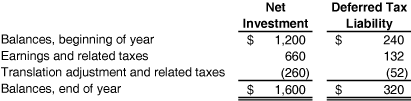 . Net Investment Deferred Tax Liability "Balances, beginning of year" " $1,200 " $240 Earnings and related taxes 660 132 Translation adjustment and related taxes (260) (52) "Balances, end of year" " $1,600 " $320
740-20-60Relationships
Source downloaded: .Record version 7aed054a7509. Effective date must be checked in the source.