ASC

ASC 740-830

Foreign Currency Matters

740 Income Taxes

Source downloaded: .Record version be9bc96d8067. Effective date must be checked in the source.

This subtopic governs deferred tax accounting for basis differences that arise in foreign operations when tax or financial reporting bases are restated — because of a change in functional currency, general price-level (inflation) indexing, or a functional currency that differs from the local currency. Its core rules: when an economy ceases to be highly inflationary and new functional currency bases are established for nonmonetary items, the resulting differences from local currency tax bases are temporary differences requiring deferred taxes recognized in other comprehensive income as an adjustment to cumulative translation adjustments (830-740-45-2); by contrast, no deferred taxes are recognized for nonmonetary assets remeasured at historical exchange rates whose differences arise from exchange rate changes or tax indexing (740-10-25-3(f)).

Key points (7)
  • When an economy ceases to be highly inflationary and the functional currency changes from the reporting currency to the local currency, new functional currency bases for nonmonetary items are established by translating historical reporting currency amounts at current rates, and the excess of those bases over local currency tax bases is a temporary difference for which deferred taxes must be recognized (830-740-25-2 through 25-3).
  • Those deferred taxes are presented as an adjustment to the cumulative translation adjustments component of shareholders' equity and recognized in other comprehensive income (830-740-45-2).
  • For price-level restated foreign financial statements using end-of-current-year purchasing power units, temporary differences equal the difference between the indexed tax basis amount and the price-level restated financial reporting amount (830-740-25-5).
  • Deferred tax expense or benefit in price-level restated statements is the difference between current year-end deferred tax balances and prior year-end deferred tax balances remeasured into current purchasing power units; the remeasurement of the prior-year balances is reported as a restatement of beginning equity (830-740-30-1 through 30-2).
  • The indefinite reversal criteria of Subtopic 740-30 do not apply to inside basis differences of a foreign subsidiary, so a deferred tax liability must be provided on a tax revaluation surplus that will become taxable on liquidation or distribution (830-740-25-7 through 25-8).
  • No deferred tax liability or asset is recognized for differences on assets and liabilities remeasured from local currency into the functional currency at historical exchange rates that result from exchange rate changes or tax indexing (740-10-25-3(f); 830-740-25-10).
  • When the reporting currency is the functional currency, remeasuring a deferred foreign tax liability or asset after an exchange rate change produces a transaction gain or loss in net income that may be presented within deferred tax expense or benefit, but it remains part of the aggregate transaction gain or loss disclosed under 830-20-45-1 (830-740-45-1).

For students. Exam traps: deferred taxes arising when an economy stops being highly inflationary go to OCI/CTA, not to income tax expense; and the indefinite reversal exception of 740-30 never applies to inside basis differences such as a tax revaluation surplus. Also remember the flip side — no deferred taxes at all for nonmonetary items remeasured at historical rates under 740-10-25-3(f).

Machine-generated study aid for ASC 740-830. Check the source paragraphs below.

740-830-00Status

Source downloaded: .Record version 656aa93199cb. Effective date must be checked in the source.

740-830-00-1
The following table identifies the changes made to this Subtopic.

740-830-05Overview and Background

Source downloaded: .Record version 844a9259bd96. Effective date must be checked in the source.

740-830-05-1
Topic 740 addresses the majority of differences between the financial reporting (or book) basis and tax basis of assets and liabilities (basis differences).
740-830-05-2
This Subtopic addresses the accounting for specific types of basis differences for entities operating in foreign countries. The accounting addressed in this Subtopic is limited to the deferred tax accounting for changes in tax or financial reporting bases due to their restatement under the requirements of tax laws or generally accepted accounting principles (GAAP) in the United States. These changes arise from tax or financial reporting basis changes caused by any of the following:
  1. a
    Changes in an entity's functional currency
  2. b
    Price-level related changes
  3. c
    A foreign entity's functional currency being different from its local currency.
This Subtopic addresses whether these changes, which can affect the amount of basis differences, result in recognition of changes to deferred tax assets or liabilities.

740-830-15Scope and Scope Exceptions

Source downloaded: .Record version 1fb1d42b8753. Effective date must be checked in the source.

Overall Guidance

740-830-15-1
This Subtopic follows the same Scope and Scope Exceptions as outlined in the Overall Subtopic, see Section 830-10-15, with specific qualifications noted below.

Entities

740-830-15-2
The guidance in this Subtopic applies to all entities operating in foreign countries.

Transactions

740-830-15-3
The guidance in this Subtopic applies to certain specified deferred tax accounting matters, specifically to the income tax consequences of changes to tax or financial reporting bases from their restatements caused by:
  1. a
    Changes in an entity's functional currency
  2. b
    Price-level related changes
  3. c
    A foreign entity's functional currency being different from its local currency.

740-830-25Recognition

Source downloaded: .Record version 1d0a758f3d0a. Effective date must be checked in the source.

Remeasurement Changes Causing Deferred Tax Recognition

740-830-25-1
This Section addresses basis differences that result from remeasurement of assets and liabilities due to changes in functional currency and price levels. These remeasurement changes will often affect the amount of temporary differences for which deferred taxes are recognized.
740-830-25-2
Subtopic 830-10 requires that a change in functional currency from the reporting currency to the local currency when an economy ceases to be considered highly inflationary shall be accounted for by establishing new functional currency bases for nonmonetary items. Those bases are computed by translating the historical reporting currency amounts of nonmonetary items into the local currency at current exchange rates.
740-830-25-3
As a result of applying those requirements, the functional currency bases generally will exceed the local currency tax bases of nonmonetary items. The differences between the new functional currency bases and the tax bases represent temporary differences under Subtopic 740-10, for which deferred taxes shall be recognized. Paragraph 830-740-45-2 addresses the presentation of the effect of recognizing these deferred taxes.
740-830-25-4
Entities located in countries with highly inflationary economies may prepare financial statements restated for general price-level changes in accordance with generally accepted accounting principles (GAAP) in the United States. The tax bases of assets and liabilities of those entities are often restated for the effects of inflation.
740-830-25-5
When preparing financial statements restated for general price-level changes using end-of-current-year purchasing power units, temporary differences are determined based on the difference between the indexed tax basis amount of the asset or liability and the related price-level restated amount reported in the financial statements. Example 1 (see paragraph 830-740-55-1) illustrates the application of this guidance.

Inside Basis Differences within Foreign Subsidiaries That Meet the Indefinite Reversal Criterion

740-830-25-6
Temporary differences within an entity's foreign subsidiaries are referred to as inside basis differences. Differences between the tax basis and the financial reporting basis of an investment in a foreign subsidiary are referred to as outside basis differences.
740-830-25-7
Inside basis differences of a foreign subsidiary of a U.S. parent where the local currency is the functional currency may result from foreign laws that provide for the occasional restatement of fixed assets for tax purposes to compensate for the effects of inflation. The amount that offsets the increase in the tax basis of fixed assets is sometimes described as a credit to revaluation surplus, which some view as a component of equity for tax purposes. That amount becomes taxable in certain situations, such as in the event of a liquidation of the foreign subsidiary or if the earnings associated with the revaluation surplus are distributed. In this situation, it is assumed that no mechanisms are available under the tax law to avoid eventual treatment of the revaluation surplus as taxable income. The indefinite reversal criteria of Subtopic 740-30 shall not be applied to inside basis differences of a foreign subsidiary, as indicated in paragraph 740-30-25-17, and a deferred tax liability shall be provided on the amount of the revaluation surplus.
740-830-25-8
Paragraph 740-10-25-24 indicates that some temporary differences are deferred taxable income and have balances only on the income tax balance sheet. Therefore, these differences cannot be identified with a particular asset or liability for financial reporting purposes. Because the inside basis difference related to the revaluation surplus results in taxable amounts in future years based on the provisions of the foreign tax law, it qualifies as a temporary difference even though it may be characterized as a component of equity for tax purposes. Subtopic 740-30 clearly limits the indefinite reversal criterion to the temporary differences described in paragraph 740-10-25-3(a) and shall not be applied to analogous types of temporary differences.

Remeasurement Changes Not Resulting in Deferred Tax Recognition

740-830-25-9
Some remeasurement-caused changes in basis differences do not result in recognition of deferred taxes.
740-830-25-10
As indicated in paragraph 740-10-25-3(f), recognition is prohibited for a deferred tax liability or asset for differences related to assets and liabilities that, under the requirements of Subtopic 830-10, are remeasured from the local currency into the functional currency using historical exchange rates and that result from changes in exchange rates or indexing for tax purposes.
740-830-25-11
Paragraph 830-10-45-16 provides additional guidance on accounting for the eventual recognition of indexing related deferred tax benefits after an entity's functional currency changes from the foreign currency to the reporting currency because the foreign economy becomes highly inflationary.

740-830-30Initial Measurement

Source downloaded: .Record version 1a1157b9ddfa. Effective date must be checked in the source.

Foreign Financial Statements Restated for General Price Level Changes

740-830-30-1
In foreign financial statements that are restated for general price-level changes, the deferred tax expense or benefit shall be calculated as the difference between the following two measures:
  1. a
    Deferred tax assets and liabilities reported at the end of the current year, determined in accordance with paragraph 830-740-25-5
  2. b
    Deferred tax assets and liabilities reported at the end of the prior year, remeasured to units of current general purchasing power at the end of the current year.
740-830-30-2
The remeasurement of deferred tax assets and liabilities at the end of the prior year is reported together with the remeasurement of all other assets and liabilities as a restatement of beginning equity.
740-830-30-3
Example 1 (see paragraph 830-740-55-1) illustrates the application of this guidance.

740-830-45Other Presentation Matters

Source downloaded: .Record version 514af840227a. Effective date must be checked in the source.

740-830-45-1
As indicated in paragraph 830-20-45-3, when the reporting currency (not the foreign currency) is the functional currency, remeasurement of an entity's deferred foreign tax liability or asset after a change in the exchange rate will result in a transaction gain or loss that is recognized currently in determining net income. Paragraph 830-20-45-1 requires disclosure of the aggregate transaction gain or loss included in determining net income but does not specify how to display that transaction gain or loss or its components for financial reporting. Accordingly, a transaction gain or loss that results from remeasuring a deferred foreign tax liability or asset may be included in the reported amount of deferred tax benefit or expense if that presentation is considered to be more useful. If reported in that manner, that transaction gain or loss is still included in the aggregate transaction gain or loss for the period to be disclosed as required by that paragraph.
740-830-45-2
The deferred taxes associated with the temporary differences that arise from a change in functional currency discussed in paragraph 830-740-25-3 when an economy ceases to be considered highly inflationary shall be presented as an adjustment to the cumulative translation adjustments component of shareholders' equity and therefore shall be recognized in other comprehensive income.

740-830-55Implementation Guidance and Illustrations

Source downloaded: .Record version 5d4c513da1c7. Effective date must be checked in the source.

Illustrations

740-830-55-1
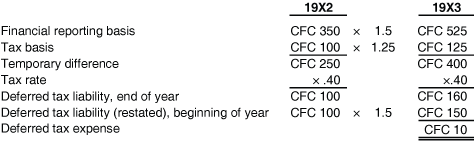
This Example illustrates the guidance in paragraphs 830-740-25-5 and .An entity has one asset, a nonmonetary asset that is not depreciated for financial reporting or tax purposes. The local currency is FC. Units of current purchasing power are referred to as CFC. The enacted tax rate is 40 percent. The asset had a price-level-adjusted financial reporting amount of CFC 350 and an indexed basis for tax purposes of CFC 100 at December 31, 19X2, both measured using CFC at December 31, 19X2. The entity has a taxable temporary difference of CFC 250 (CFC 350 - CFC 100) and a related deferred tax liability of CFC 100 (CFC 250 x 40 percent) using CFC at December 31, 19X2.
740-830-55-2
General price levels increase by 50 percent in 19X3, and indexing allowed for 19X3 for tax purposes is 25 percent. At December 31, 19X3, the asset has a price-level-adjusted financial reporting amount of CFC 525 (CFC 350 x 150 percent) and an indexed basis for tax purposes of CFC 125 (CFC 100 x 125 percent), using CFC at December 31, 19X3. The entity has a taxable temporary difference of CFC 400 (CFC 525 - CFC 125) and a related deferred tax liability of CFC 160 (CFC 400 x 40 percent) at December 31, 19X3, using CFC at December 31, 19X3. The deferred tax liability at December 31, 19X2 is restated to units of current general purchasing power as of December 31, 19X3. The restated December 31, 19X2 deferred tax liability is CFC 150 (CFC 100 x 150 percent). For 19X3, the difference between CFC 160 and CFC 150 is reported as deferred tax expense in income from continuing operations. The difference between the deferred tax liability of CFC 100 at December 31, 19X2 and the restated December 31, 19X2 deferred tax liability of CFC 150 is reported in 19X3 as a restatement of beginning equity.
740-830-55-3
The following is a tabular presentation of this Example.
  • 19X2 19X3 Financial reporting basis CFC 350 × 1.5 CFC 525 Tax basis CFC 100 × 1.25 CFC 125 Temporary difference CFC 250 CFC 400 Tax rate × .40 ×.40 "Deferred tax liability, end of year" CFC 100 CFC 160 "Deferred tax liability (restated), beginning of year" CFC 100 × 1.5 CFC 150 Deferred tax expense CFC 10

Related subtopics