ASC

ASC 740-10

Overall

740 Income Taxes

Download JSONDownload Markdown452 paragraphs · 21 sectionsIncludes SEC contentJump to summary

Source downloaded: .Record version 8df659d52638. Effective date must be checked in the source.

ASC 740-10 is the Overall subtopic for income taxes and contains the core asset-and-liability model: recognize (1) current taxes payable or refundable for the year and (2) deferred tax assets and liabilities for the future tax consequences of temporary differences and operating loss/tax credit carryforwards (740-10-10-1; 740-10-25-2). Deferred taxes are measured using enacted tax rates expected to apply when the item reverses, are not discounted, and deferred tax assets are reduced by a valuation allowance if it is more likely than not that some or all will not be realized (740-10-30-5, 740-10-30-8). It also houses the two-step uncertain tax position model — more-likely-than-not recognition on technical merits, then measurement at the largest benefit greater than 50 percent likely of being realized on settlement (740-10-25-6; 740-10-30-7).

Key points (7)
  • Two basic recognition requirements: recognize a tax liability/asset for estimated taxes payable or refundable on current and prior year returns, and a deferred tax liability/asset for the future tax effects of all temporary differences and carryforwards (740-10-25-2; 740-10-25-29), subject only to the limited exceptions in 740-10-25-3 (foreign subsidiary outside basis, pre-1993 domestic undistributed earnings, thrift bad debt reserves, policyholders' surplus, leveraged leases, nondeductible goodwill, intra-entity inventory transfers, and 830-10 historical-rate remeasurement differences).
  • A temporary difference is a difference between the tax basis of an asset or liability and its reported amount that will result in taxable or deductible amounts when the asset is recovered or the liability settled; the inherent balance sheet assumption means the only question is when, not whether, reversal occurs (740-10-05-7; 740-10-25-20; 740-10-25-28).
  • Deferred taxes are computed separately for each tax-paying component in each tax jurisdiction using the enacted rate expected to apply in the period of settlement or realization, are never discounted, and reflect enacted law only — future changes in law or rates are not anticipated (740-10-30-2; 740-10-30-5; 740-10-30-8); the effect of a change in tax law or rate is recognized at the enactment date (740-10-25-47; 740-10-35-4).
  • A valuation allowance is required to reduce deferred tax assets to the amount more likely than not to be realized, weighing all positive and negative evidence; the four sources of taxable income are reversals of taxable temporary differences, future taxable income, carryback to prior years, and prudent and feasible tax-planning strategies (740-10-30-5(e); 740-10-30-18 through 30-19; 740-10-30-21 through 30-23) — cumulative losses in recent years are significant negative evidence that is difficult to overcome.
  • Uncertain tax positions: recognize the benefit only if, based on technical merits, it is more likely than not (greater than 50 percent) the position will be sustained on examination, presuming the taxing authority has full knowledge and evaluating each position without offset or aggregation (740-10-25-6 through 25-7); the recognized amount is the largest benefit greater than 50 percent likely of being realized on settlement (740-10-30-7); the difference is an unrecognized tax benefit (740-10-25-16).
  • A benefit not initially recognized is recognized in the first interim period in which the MLTN threshold is met, the position is effectively settled, or the statute of limitations expires (740-10-25-8 through 25-10); derecognition occurs in the first period it is no longer MLTN, and a valuation allowance may not substitute for derecognition (740-10-40-2). Changes in judgment on prior annual periods are discrete items in the period of change (740-10-25-15).
  • Presentation: all deferred tax liabilities and assets are classified as noncurrent and offset to a single net noncurrent amount per tax-paying component per jurisdiction, with no offset across components or jurisdictions (740-10-45-4; 740-10-45-6); an unrecognized tax benefit is presented as a reduction of an available NOL or credit carryforward DTA, otherwise as a liability (740-10-45-10A through 45-10B).

For students. This is the backbone of income tax accounting and is heavily tested: know the asset-and-liability model, the enacted-rate rule, and the valuation allowance evidence analysis cold. The most common misunderstanding is conflating the two separate MLTN judgments — one governs whether an uncertain tax position may be recognized at all (740-10-25-6), the other governs whether a deferred tax asset needs a valuation allowance (740-10-30-5(e)) — and assuming a valuation allowance can be used instead of derecognizing a tax position, which 740-10-40-2 expressly prohibits.

Machine-generated study aid for ASC 740-10. Check the source paragraphs below.

740-10-00Status

Source downloaded: .Record version af0c19591b1c. Effective date must be checked in the source.

740-10-00-1
The following table identifies the changes made to this Subtopic.
ParagraphActionAccounting Standards UpdateDate
AcquirerAmendedAccounting Standards Update No. 2025-0305/12/2025
Acquisition by a Not-for-Profit EntityAddedAccounting Standards Update No. 2010-0701/28/2010
BusinessAmendedAccounting Standards Update No. 2017-0101/05/2017
Commencement Date of the Lease (Commencement Date)AddedAccounting Standards Update No. 2016-0202/25/2016
Conduit Debt SecuritiesSupersededAccounting Standards Update No. 2023-0912/14/2023
ContractAddedAccounting Standards Update No. 2014-0905/28/2014
Contract AssetAddedAccounting Standards Update No. 2014-0905/28/2014
Corporate Joint VentureAmendedAccounting Standards Update No. 2010-0802/02/2010
CustomerAddedAccounting Standards Update No. 2014-0905/28/2014
Deferred Tax Expense (or Benefit)AmendedAccounting Standards Update No. 2015-0101/09/2015
Formation DateAddedAccounting Standards Update No. 2023-0508/23/2023
InventoryAddedAccounting Standards Update No. 2016-1610/24/2016
Joint VentureAddedAccounting Standards Update No. 2023-0508/23/2023
LeaseAddedAccounting Standards Update No. 2016-0202/25/2016
LesseeAddedAccounting Standards Update No. 2016-0202/25/2016
LessorAddedAccounting Standards Update No. 2016-0202/25/2016
Leveraged LeaseAddedAccounting Standards Update No. 2016-0202/25/2016
Nonpublic Entity (5th def.)SupersededAccounting Standards Update No. 2023-0912/14/2023
Merger of Not-for-Profit EntitiesAddedAccounting Standards Update No. 2010-0701/28/2010
Not-for-Profit EntityAddedAccounting Standards Update No. 2010-0701/28/2010
Public Business EntityAmendedMaintenance Update 2017-06 (PDF)04/07/2017
Public Business EntityAmendedMaintenance Update 2016-11 (PDF)06/27/2016
Public Business EntityAddedAccounting Standards Update No. 2015-1711/20/2015
Public Entity (2nd def.)SupersededAccounting Standards Update No. 2023-0912/14/2023
RevenueAddedAccounting Standards Update No. 2014-0905/28/2014
Tax PositionAmendedAccounting Standards Update No. 2009-0609/02/2009
Temporary DifferenceAmendedAccounting Standards Update No. 2016-1610/24/2016
Underlying AssetAddedAccounting Standards Update No. 2016-0202/25/2016
Variable Interest EntitySupersededAccounting Standards Update No. 2025-0305/12/2025
740-10-05-4AmendedAccounting Standards Update No. 2017-1512/05/2017
740-10-05-8AmendedAccounting Standards Update No. 2023-0508/23/2023
740-10-15-2AAAmendedAccounting Standards Update No. 2015-1006/12/2015
740-10-15-2AAAddedAccounting Standards Update No. 2009-0609/02/2009
740-10-15-4AmendedAccounting Standards Update No. 2019-1212/18/2019
740-10-25-3AmendedAccounting Standards Update No. 2017-1512/05/2017
740-10-25-3AmendedAccounting Standards Update No. 2016-1610/24/2016
740-10-25-3AmendedAccounting Standards Update No. 2016-0202/25/2016
AmendedAccounting Standards Update No. 2016-1610/24/2016
740-10-25-20AmendedAccounting Standards Update No. 2010-0701/28/2010
740-10-25-25AmendedAccounting Standards Update No. 2014-0905/28/2014
740-10-25-46AmendedAccounting Standards Update No. 2023-0203/29/2023
740-10-25-53AmendedAccounting Standards Update No. 2018-0907/16/2018
740-10-25-54AmendedAccounting Standards Update No. 2019-1212/18/2019
740-10-25-55SupersededAccounting Standards Update No. 2018-0907/16/2018
740-10-25-55AmendedAccounting Standards Update No. 2016-1610/24/2016
740-10-30-4AmendedAccounting Standards Update No. 2023-0508/23/2023
740-10-30-4AmendedAccounting Standards Update No. 2010-0701/28/2010
740-10-30-16AmendedAccounting Standards Update No. 2016-0101/05/2016
740-10-30-22AmendedAccounting Standards Update No. 2015-0101/09/2015
740-10-30-26AmendedAccounting Standards Update No. 2015-0101/09/2015
740-10-30-27AAddedAccounting Standards Update No. 2019-1212/18/2019
740-10-45-1AmendedAccounting Standards Update No. 2018-0202/14/2018
740-10-45-4AmendedAccounting Standards Update No. 2015-1711/20/2015
740-10-45-5SupersededAccounting Standards Update No. 2015-1711/20/2015
740-10-45-6AmendedAccounting Standards Update No. 2015-1711/20/2015
SupersededAccounting Standards Update No. 2015-1711/20/2015
740-10-45-10AAddedAccounting Standards Update No. 2013-1107/18/2013
740-10-45-10BAddedAccounting Standards Update No. 2013-1107/18/2013
AmendedAccounting Standards Update No. 2013-1107/18/2013
740-10-45-29AddedAccounting Standards Update No. 2018-0202/14/2018
740-10-50-1AAddedAccounting Standards Update No. 2023-0912/14/2023
AmendedAccounting Standards Update No. 2023-0912/14/2023
740-10-50-10AAddedAccounting Standards Update No. 2023-0912/14/2023
740-10-50-10BAddedAccounting Standards Update No. 2023-0912/14/2023
AmendedAccounting Standards Update No. 2023-0912/14/2023
740-10-50-11AAddedAccounting Standards Update No. 2023-0912/14/2023
AddedAccounting Standards Update No. 2023-0912/14/2023
740-10-50-15AmendedAccounting Standards Update No. 2009-0609/02/2009
740-10-50-15AAddedAccounting Standards Update No. 2009-0609/02/2009
740-10-50-17AAddedAccounting Standards Update No. 2019-1212/18/2019
740-10-50-18AmendedAccounting Standards Update No. 2015-1006/12/2015
740-10-50-22AddedAccounting Standards Update No. 2023-0912/14/2023
740-10-50-23AddedAccounting Standards Update No. 2023-0912/14/2023
740-10-55-1AmendedAccounting Standards Update No. 2015-1711/20/2015
740-10-55-2AmendedAccounting Standards Update No. 2015-1711/20/2015
740-10-55-9AmendedMaintenance Update 2015-11 (PDF)06/19/2015
740-10-55-15AmendedAccounting Standards Update No. 2015-1711/20/2015
740-10-55-26AmendedAccounting Standards Update No. 2019-1212/18/2019
740-10-55-35AmendedAccounting Standards Update No. 2016-0903/30/2016
740-10-55-38AmendedAccounting Standards Update No. 2025-1212/17/2025
740-10-55-38AmendedAccounting Standards Update No. 2015-0101/09/2015
740-10-55-51SupersededAccounting Standards Update No. 2020-0608/05/2020
740-10-55-63AmendedAccounting Standards Update No. 2015-1711/20/2015
740-10-55-66AmendedAccounting Standards Update No. 2020-1010/29/2020
740-10-55-77SupersededAccounting Standards Update No. 2015-1711/20/2015
740-10-55-78SupersededAccounting Standards Update No. 2015-1711/20/2015
740-10-55-78AmendedAccounting Standards Update No. 2014-0905/28/2014
AmendedAccounting Standards Update No. 2019-1212/18/2019
740-10-55-156AmendedAccounting Standards Update No. 2016-0202/25/2016
740-10-55-158AmendedAccounting Standards Update No. 2016-0202/25/2016
740-10-55-168AmendedAccounting Standards Update No. 2018-0907/16/2018
740-10-55-203AmendedAccounting Standards Update No. 2018-0907/16/2018
740-10-55-203AmendedAccounting Standards Update No. 2016-1610/24/2016
SupersededAccounting Standards Update No. 2015-1711/20/2015
740-10-55-217AmendedAccounting Standards Update No. 2023-0912/14/2023
740-10-55-223AddedAccounting Standards Update No. 2009-0609/02/2009
740-10-55-224AddedAccounting Standards Update No. 2009-0609/02/2009
740-10-55-225AddedAccounting Standards Update No. 2009-0609/02/2009
740-10-55-226AddedAccounting Standards Update No. 2009-0609/02/2009
740-10-55-227AddedAccounting Standards Update No. 2009-0609/02/2009
740-10-55-228AddedAccounting Standards Update No. 2009-0609/02/2009
740-10-55-229AddedAccounting Standards Update No. 2009-0609/02/2009
AddedAccounting Standards Update No. 2023-0912/14/2023
740-10-60-4AmendedAccounting Standards Update No. 2016-0202/25/2016
740-10-65-2AddedAccounting Standards Update No. 2009-0609/02/2009
740-10-65-3AddedAccounting Standards Update No. 2013-1107/18/2013
740-10-65-4AddedAccounting Standards Update No. 2015-1711/20/2015
740-10-65-5AddedAccounting Standards Update No. 2016-1610/24/2016
740-10-65-6AddedAccounting Standards Update No. 2017-1512/05/2017
740-10-65-7AddedAccounting Standards Update No. 2018-0907/16/2018
740-10-65-8AddedAccounting Standards Update No. 2019-1212/18/2019
740-10-65-9AddedAccounting Standards Update No. 2023-0912/14/2023

740-10-05Overview and Background

Source downloaded: .Record version 3b8240374965. Effective date must be checked in the source.

740-10-05-1
The Income Taxes Topic addresses financial accounting and reporting for the effects of income taxes that result from an entity's activities during the current and preceding years. Specifically, this Topic establishes standards of financial accounting and reporting for income taxes that are currently payable and for the tax consequences of all of the following:
  1. a
    Revenues, expenses, gains, or losses that are included in taxable income of an earlier or later year than the year in which they are recognized in financial income
  2. b
    Other events that create differences between the tax bases of assets and liabilities and their amounts for financial reporting
  3. c
    Operating loss or tax credit carrybacks for refunds of taxes paid in prior years and carryforwards to reduce taxes payable in future years.
740-10-05-2
This Topic includes the following Subtopics:
  1. a
    Overall
  2. b
    Intraperiod Tax Allocation
  3. c
    Other Considerations or Special Areas
  4. d
    Interim Reporting.
740-10-05-3
The Overall Subtopic provides the majority of the accounting and reporting guidance related to income taxes. The other Subtopics in this Topic provide more detailed guidance on narrower elements of accounting and reporting for income taxes.
740-10-05-4
Other Topics, including industry-specific Topics, may also have Income Taxes Subtopics that address the Topic-specific requirements for income taxes. Guidance in those Subtopics is intended to be incremental to the guidance otherwise established in the Income Taxes Topic. Topics with incremental Income Taxes Subtopics are:
  1. a
    Investments—Equity Method and Joint Ventures, Subtopic 323-740
  2. b
    Compensation—Stock Compensation, Subtopic 718-740
  3. c
    Business Combinations, Subtopic 805-740
  4. d
    Foreign Currency Matters, Subtopic 830-740
  5. e
    Reorganizations, Subtopic 852-740
  6. f
    Entertainment—Casinos, Subtopic 924-740
  7. g
    Extractive Activities—Oil and Gas, Subtopic 932-740
  8. h
    Financial Services—Depository and Lending, Subtopic 942-740
  9. i
    Financial Services—Insurance, Subtopic 944-740
  10. j
    Health Care Entities, Subtopic 954-740
  11. k
    Real Estate—Common Interest Realty Associations, Subtopic 972-740
  12. l
    Regulated Operations, Subtopic 980-740
  13. m
740-10-05-5
There are two basic principles related to accounting for income taxes, each of which considers uncertainty through the application of recognition and measurement criteria:
  1. a
    To recognize the estimated taxes payable or refundable on tax returns for the current year as a tax liability or asset
  2. b
    To recognize a deferred tax liability or asset for the estimated future tax effects attributable to temporary differences and carryforwards.
740-10-05-6
This Subtopic provides guidance for recognizing and measuring tax positions taken or expected to be taken in a tax return that directly or indirectly affect amounts reported in financial statements. This Subtopic also provides accounting guidance for the related income tax effects of individual tax positions that do not meet the recognition thresholds required in order for any part of the benefit of that tax position to be recognized in an entity's financial statements. Under this Subtopic, a tax position is first evaluated for recognition based on its technical merits. Tax positions that meet a recognition criterion are then measured to determine an amount to recognize in the financial statements. That measurement incorporates information about potential settlements with taxing authorities.
740-10-05-7
A temporary difference refers to a difference between the tax basis of an asset or liability, determined based on recognition and measurement requirements for tax positions, and its reported amount in the financial statements that will result in taxable or deductible amounts in future years when the reported amount of the asset or liability is recovered or settled, respectively. Deferred tax assets and liabilities represent the future effects on income taxes that result from temporary differences and carryforwards that exist at the end of a period. Deferred tax assets and liabilities are measured using enacted tax rates and provisions of the enacted tax law and are not discounted to reflect the time-value of money.
740-10-05-8
As indicated in paragraph 740-10-25-23, temporary differences that will result in taxable amounts in future years when the related asset or liability is recovered or settled are often referred to as taxable temporary differences. Likewise, temporary differences that will result in deductible amounts in future years are often referred to as deductible temporary differences. Business combinations and joint venture formations may give rise to both taxable and deductible temporary differences.
740-10-05-9
As indicated in paragraph 740-10-25-30, certain basis differences may not result in taxable or deductible amounts in future years when the related asset or liability for financial reporting is recovered or settled and, therefore, may not be temporary differences for which a deferred tax liability or asset is recognized.
740-10-05-10
As indicated in paragraph 740-10-25-24, some temporary differences are deferred taxable income or tax deductions and have balances only on the income tax balance sheet and therefore cannot be identified with a particular asset or liability for financial reporting. In such instances, there is no related, identifiable asset or liability for financial reporting, but there is a temporary difference that results from an event that has been recognized in the financial statements and, based on provisions in the tax law, the temporary difference will result in taxable or deductible amounts in future years.

740-10-10Objectives

Source downloaded: .Record version e5ecd26cfd8d. Effective date must be checked in the source.

740-10-10-1
There are two primary objectives related to accounting for income taxes:
  1. a
    To recognize the amount of taxes payable or refundable for the current year
  2. b
    To recognize deferred tax liabilities and assets for the future tax consequences of events that have been recognized in an entity's financial statements or tax returns.
As it relates to the second objective, some events do not have tax consequences. Certain revenues are exempt from taxation and certain expenses are not deductible. In some tax jurisdictions, for example, interest earned on certain municipal obligations is not taxable and fines are not deductible.
740-10-10-2
Ideally, the second objective might be stated more specifically to recognize the expected future tax consequences of events that have been recognized in the financial statements or tax returns. However, that objective is realistically constrained because:
  1. a
    The tax payment or refund that results from a particular tax return is a joint result of all the items included in that return.
  2. b
    Taxes that will be paid or refunded in future years are the joint result of events of the current or prior years and events of future years.
  3. c
    Information available about the future is limited. As a result, attribution of taxes to individual items and events is arbitrary and, except in the simplest situations, requires estimates and approximations.
740-10-10-3
Conceptually, a deferred tax liability or asset represents the increase or decrease in taxes payable or refundable in future years as a result of temporary differences and carryforwards at the end of the current year. That concept is an incremental concept. A literal application of that concept would result in measurement of the incremental tax effect as the difference between the following two measurements:
  1. a
    The amount of taxes that will be payable or refundable in future years inclusive of reversing temporary differences and carryforwards
  2. b
    The amount of taxes that would be payable or refundable in future years exclusive of reversing temporary differences and carryforwards.
However, in light of the constraints identified in the preceding paragraph, in computing the amount of deferred tax liabilities and assets, the objective is to measure a deferred tax liability or asset using the enacted tax rate(s) expected to apply to taxable income in the periods in which the deferred tax liability or asset is expected to be settled or realized.

740-10-15Scope and Scope Exceptions

Source downloaded: .Record version a8e80f389c43. Effective date must be checked in the source.

Overall Guidance

740-10-15-1
The Scope Section of the Overall Subtopic establishes the pervasive scope for all Subtopics of the Income Taxes Topic. Unless explicitly addressed within specific Subtopics, the following scope guidance applies to all Subtopics of the Income Taxes Topic.

Entities

740-10-15-2
The principles and requirements of the Income Taxes Topic are applicable to domestic and foreign entities in preparing financial statements in accordance with U.S. generally accepted accounting principles (GAAP), including not-for-profit entities (NFP) with activities that are subject to income taxes.
740-10-15-2AA
The guidance in this Subtopic relating to accounting for uncertainty in income taxes applies to all entities, including tax-exempt not-for-profit entities, pass-through entities, and entities that are taxed in a manner similar to pass-through entities such as real estate investment trusts and registered investment companies.

Transactions

740-10-15-3
The guidance in the Income Taxes Topic applies to:
  1. a
    Domestic federal (national) income taxes (U.S. federal income taxes for U.S. entities) and foreign, state, and local (including franchise) taxes based on income
  2. b
    An entity's domestic and foreign operations that are consolidated, combined, or accounted for by the equity method.
740-10-15-4
The guidance in this Topic does not apply to the following transactions and activities:
  1. a
    A franchise tax (or similar tax) to the extent it is based on capital or a non-income-based amount and there is no portion of the tax based on income. If a franchise tax (or similar tax) is partially based on income (for example, an entity pays the greater of an income-based tax and a non-income-based tax), deferred tax assets and liabilities shall be recognized and accounted for in accordance with this Topic. Deferred tax assets and liabilities shall be measured using the applicable statutory income tax rate. An entity shall not consider the effect of potentially paying a non-income-based tax in future years when evaluating the realizability of its deferred tax assets. The amount of current tax expense equal to the amount that is based on income shall be accounted for in accordance with this Topic, with any incremental amount incurred accounted for as a non-income-based tax. See Example 17 (paragraph 740-10-55-139) for an example of how to apply this guidance.
  2. b
    A withholding tax for the benefit of the recipients of a dividend. A tax that is assessed on an entity based on dividends distributed is, in effect, a withholding tax for the benefit of recipients of the dividend and is not an income tax if both of the following conditions are met:
    1. 1
      The tax is payable by the entity if and only if a dividend is distributed to shareholders. The tax does not reduce future income taxes the entity would otherwise pay.
    2. 2
      Shareholders receiving the dividend are entitled to a tax credit at least equal to the tax paid by the entity and that credit is realizable either as a refund or as a reduction of taxes otherwise due, regardless of the tax status of the shareholders.
    See the guidance in paragraphs dealing with determining whether a payment made to a taxing authority based on dividends distributed is an income tax.

740-10-25Recognition

Source downloaded: .Record version c3cc0f7470c8. Effective date must be checked in the source.

740-10-25-1
This Section establishes the recognition requirements necessary to implement the objectives of accounting for income taxes identified in Section 740-10-10. The following paragraph sets forth the basic recognition requirements while paragraph 740-10-25-3 identifies specific, limited exceptions to the basic requirements.
740-10-25-2
Other than the exceptions identified in the following paragraph, the following basic requirements are applied in accounting for income taxes at the date of the financial statements:
  1. a
    A tax liability or asset shall be recognized based on the provisions of this Subtopic applicable to tax positions, in paragraphs , for the estimated taxes payable or refundable on tax returns for the current and prior years.
  2. b
    A deferred tax liability or asset shall be recognized for the estimated future tax effects attributable to temporary differences and carryforwards.
740-10-25-3
The only exceptions in applying those basic requirements are:
  1. a
    Certain exceptions to the requirements for recognition of deferred taxes whereby a deferred tax liability is not recognized for the following types of temporary differences unless it becomes apparent that those temporary differences will reverse in the foreseeable future:
    1. 1
      An excess of the amount for financial reporting over the tax basis of an investment in a foreign subsidiary or a foreign corporate joint venture that is essentially permanent in duration. See paragraphs for the specific requirements related to this exception.
    2. 2
      Undistributed earnings of a domestic subsidiary or a domestic corporate joint venture that is essentially permanent in duration that arose in fiscal years beginning on or before December 15, 1992. A last-in, first-out (LIFO) pattern determines whether reversals pertain to differences that arose in fiscal years beginning on or before December 15, 1992. See paragraphs for the specific requirements related to this exception.
    3. 3
      Bad debt reserves for tax purposes of U.S. savings and loan associations (and other qualified thrift lenders) that arose in tax years beginning before December 31, 1987. See paragraphs for the specific requirements related to this exception.
    4. 4
      Policyholders' surplus of stock life insurance entities that arose in fiscal years beginning on or before December 15, 1992. See paragraph 944-740-25-2 for the specific requirements related to this exception.
  2. b
  3. c
    The pattern of recognition of after-tax income for leveraged leases or the allocation of the purchase price in a purchase business combination to acquired leveraged leases as required by Subtopic 842-50
  4. d
    A prohibition on recognition of a deferred tax liability related to goodwill (or the portion thereof) for which amortization is not deductible for tax purposes (see paragraph 805-740-25-3)
  5. e
    A prohibition on recognition of a deferred tax asset for the difference between the tax basis of inventory in the buyer's tax jurisdiction and the carrying value as reported in the consolidated financial statements as a result of an intra-entity transfer of inventory from one tax-paying component to another tax-paying component of the same consolidated group. Income taxes paid on intra-entity profits on inventory remaining within the consolidated group are accounted for under the requirements of Subtopic 810-10.
  6. f
    A prohibition on recognition of a deferred tax liability or asset for differences related to assets and liabilities that, under Subtopic 830-10, are remeasured from the local currency into the functional currency using historical exchange rates and that result from changes in exchange rates or indexing for tax purposes. See Subtopic 830-740 for guidance on foreign currency related income taxes matters.
740-10-25-4
References in this Subtopic to income taxes currently payable and (total) income tax expense are intended to also include income taxes currently refundable and (total) income tax benefit, respectively.

Basic Recognition Threshold

740-10-25-5
This Subtopic requires the application of a more-likely-than-not recognition criterion to a tax position before and separate from the measurement of a tax position. See paragraph 740-10-55-3 for guidance related to this two-step process.
740-10-25-6
An entity shall initially recognize the financial statement effects of a tax position when it is more likely than not, based on the technical merits, that the position will be sustained upon examination. The term more likely than not means a likelihood of more than 50 percent; the terms examined and upon examination also include resolution of the related appeals or litigation processes, if any. For example, if an entity determines that it is certain that the entire cost of an acquired asset is fully deductible, the more-likely-than-not recognition threshold has been met. The more-likely-than-not recognition threshold is a positive assertion that an entity believes it is entitled to the economic benefits associated with a tax position. The determination of whether or not a tax position has met the more-likely-than-not recognition threshold shall consider the facts, circumstances, and information available at the reporting date. The level of evidence that is necessary and appropriate to support an entity's assessment of the technical merits of a tax position is a matter of judgment that depends on all available information.
740-10-25-7
In making the required assessment of the more-likely-than-not criterion:
  1. a
    It shall be presumed that the tax position will be examined by the relevant taxing authority that has full knowledge of all relevant information.
  2. b
    Technical merits of a tax position derive from sources of authorities in the tax law (legislation and statutes, legislative intent, regulations, rulings, and case law) and their applicability to the facts and circumstances of the tax position. When the past administrative practices and precedents of the taxing authority in its dealings with the entity or similar entities are widely understood, for example, by preparers, tax practitioners and auditors, those practices and precedents shall be taken into account.
  3. c
    Each tax position shall be evaluated without consideration of the possibility of offset or aggregation with other positions.
740-10-25-8
If the more-likely-than-not recognition threshold is not met in the period for which a tax position is taken or expected to be taken, an entity shall recognize the benefit of the tax position in the first interim period that meets any one of the following conditions:
  1. a
    The more-likely-than-not recognition threshold is met by the reporting date.
  2. b
    The tax position is effectively settled through examination, negotiation or litigation.
  3. c
    The statute of limitations for the relevant taxing authority to examine and challenge the tax position has expired.
Accordingly, a change in facts after the reporting date but before the financial statements are issued or are available to be issued (as discussed in Section 855-10-25) shall be recognized in the period in which the change in facts occurs.
740-10-25-9
A tax position could be effectively settled upon examination by a taxing authority. Assessing whether a tax position is effectively settled is a matter of judgment because examinations occur in a variety of ways. In determining whether a tax position is effectively settled, an entity shall make the assessment on a position-by-position basis, but an entity could conclude that all positions in a particular tax year are effectively settled.
740-10-25-10
As required by paragraph 740-10-25-8(b) an entity shall recognize the benefit of a tax position when it is effectively settled. An entity shall evaluate all of the following conditions when determining effective settlement:
  1. a
    The taxing authority has completed its examination procedures including all appeals and administrative reviews that the taxing authority is required and expected to perform for the tax position.
  2. b
    The entity does not intend to appeal or litigate any aspect of the tax position included in the completed examination.
  3. c
    It is remote that the taxing authority would examine or reexamine any aspect of the tax position. In making this assessment management shall consider the taxing authority's policy on reopening closed examinations and the specific facts and circumstances of the tax position. Management shall presume the relevant taxing authority has full knowledge of all relevant information in making the assessment on whether the taxing authority would reopen a previously closed examination.
740-10-25-11
In the tax years under examination, a tax position does not need to be specifically reviewed or examined by the taxing authority to be considered effectively settled through examination. Effective settlement of a position subject to an examination does not result in effective settlement of similar or identical tax positions in periods that have not been examined.
740-10-25-12
An entity may obtain information during the examination process that enables that entity to change its assessment of the technical merits of a tax position or of similar tax positions taken in other periods. However, the effectively settled conditions in paragraph 740-10-25-10 do not provide any basis for the entity to change its assessment of the technical merits of any tax position in other periods.
740-10-25-13
The appropriate unit of account for determining what constitutes an individual tax position, and whether the more-likely-than-not recognition threshold is met for a tax position, is a matter of judgment based on the individual facts and circumstances of that position evaluated in light of all available evidence. The determination of the unit of account to be used shall consider the manner in which the entity prepares and supports its income tax return and the approach the entity anticipates the taxing authority will take during an examination. Because the individual facts and circumstances of a tax position and of an entity taking that position will determine the appropriate unit of account, a single defined unit of account would not be applicable to all situations.
740-10-25-14
Subsequent recognition shall be based on management's best judgment given the facts, circumstances, and information available at the reporting date. A tax position need not be legally extinguished and its resolution need not be certain to subsequently recognize the position. Subsequent changes in judgment that lead to changes in recognition shall result from the evaluation of new information and not from a new evaluation or new interpretation by management of information that was available in a previous financial reporting period. See Sections 740-10-35 and 740-10-40 for guidance on changes in judgment leading to derecognition of and measurement changes for a tax position.
740-10-25-15
A change in judgment that results in subsequent recognition, derecognition, or change in measurement of a tax position taken in a prior annual period (including any related interest and penalties) shall be recognized as a discrete item in the period in which the change occurs. Paragraph 740-270-35-6 addresses the different accounting required for such changes in a prior interim period within the same fiscal year.
740-10-25-16
The amount of benefit recognized in the statement of financial position may differ from the amount taken or expected to be taken in a tax return for the current year. These differences represent unrecognized tax benefits. A liability is created (or the amount of a net operating loss carryforward or amount refundable is reduced) for an unrecognized tax benefit because it represents an entity's potential future obligation to the taxing authority for a tax position that was not recognized under the requirements of this Subtopic.
740-10-25-17
A tax position recognized in the financial statements may also affect the tax bases of assets or liabilities and thereby change or create temporary differences. A taxable and deductible temporary difference is a difference between the reported amount of an item in the financial statements and the tax basis of an item as determined by applying this Subtopic's recognition threshold and measurement provisions for tax positions. See paragraph 740-10-30-7 for measurement requirements.

Temporary Differences

740-10-25-18
Income taxes currently payable for a particular year usually include the tax consequences of most events that are recognized in the financial statements for that year.
740-10-25-19
However, because tax laws and financial accounting standards differ in their recognition and measurement of assets, liabilities, equity, revenues, expenses, gains, and losses, differences arise between:
  1. a
    The amount of taxable income and pretax financial income for a year
  2. b
    The tax bases of assets or liabilities and their reported amounts in financial statements.
Guidance for computing the tax bases of assets and liabilities for financial reporting purposes is provided in this Subtopic.
740-10-25-20
An assumption inherent in an entity's statement of financial position prepared in accordance with generally accepted accounting principles (GAAP) is that the reported amounts of assets and liabilities will be recovered and settled, respectively. Based on that assumption, a difference between the tax basis of an asset or a liability and its reported amount in the statement of financial position will result in taxable or deductible amounts in some future year(s) when the reported amounts of assets are recovered and the reported amounts of liabilities are settled. Examples include the following:
  1. a
    Revenues or gains that are taxable after they are recognized in financial income. An asset (for example, a receivable from an installment sale) may be recognized for revenues or gains that will result in future taxable amounts when the asset is recovered.
  2. b
    Expenses or losses that are deductible after they are recognized in financial income. A liability (for example, a product warranty liability) may be recognized for expenses or losses that will result in future tax deductible amounts when the liability is settled.
  3. c
    Revenues or gains that are taxable before they are recognized in financial income. A liability (for example, subscriptions received in advance) may be recognized for an advance payment for goods or services to be provided in future years. For tax purposes, the advance payment is included in taxable income upon the receipt of cash. Future sacrifices to provide goods or services (or future refunds to those who cancel their orders) will result in future tax deductible amounts when the liability is settled.
  4. d
    Expenses or losses that are deductible before they are recognized in financial income. The cost of an asset (for example, depreciable personal property) may have been deducted for tax purposes faster than it was depreciated for financial reporting. Amounts received upon future recovery of the amount of the asset for financial reporting will exceed the remaining tax basis of the asset, and the excess will be taxable when the asset is recovered.
  5. e
    A reduction in the tax basis of depreciable assets because of tax credits. Amounts received upon future recovery of the amount of the asset for financial reporting will exceed the remaining tax basis of the asset, and the excess will be taxable when the asset is recovered. For example, a tax law may provide taxpayers with the choice of either taking the full amount of depreciation deductions and a reduced tax credit (that is, investment tax credit and certain other tax credits) or taking the full tax credit and a reduced amount of depreciation deductions.
  6. f
    Investment tax credits accounted for by the deferral method. Under the deferral method as established in paragraph 740-10-25-46, investment tax credits are viewed and accounted for as a reduction of the cost of the related asset (even though, for financial statement presentation, deferred investment tax credits may be reported as deferred income). Amounts received upon future recovery of the reduced cost of the asset for financial reporting will be less than the tax basis of the asset, and the difference will be tax deductible when the asset is recovered.
  7. g
    An increase in the tax basis of assets because of indexing whenever the local currency is the functional currency. The tax law for a particular tax jurisdiction might require adjustment of the tax basis of a depreciable (or other) asset for the effects of inflation. The inflation-adjusted tax basis of the asset would be used to compute future tax deductions for depreciation or to compute gain or loss on sale of the asset. Amounts received upon future recovery of the local currency historical cost of the asset will be less than the remaining tax basis of the asset, and the difference will be tax deductible when the asset is recovered.
  8. h
    Business combinations and combinations accounted for by not-for-profit entities (NFPs). There may be differences between the tax bases and the recognized values of assets acquired and liabilities assumed in a business combination. There also may be differences between the tax bases and the recognized values of assets acquired and liabilities assumed in an acquisition by a not-for-profit entity or between the tax bases and the recognized values of the assets and liabilities carried over to the records of a new entity formed by a merger of not-for-profit entities. Those differences will result in taxable or deductible amounts when the reported amounts of the assets or liabilities are recovered or settled, respectively.
  9. i
    Intra-entity transfers of an asset other than inventory. There may be a difference between the tax basis of an asset in the buyer's tax jurisdiction and the carrying value of the asset reported in the consolidated financial statements as the result of an intra-entity transfer of an asset other than inventory from one tax-paying component to another tax-paying component of the same consolidated group. That difference will result in taxable or deductible amounts when the asset is recovered.
740-10-25-21
The examples in (a) through (d) in paragraph 740-10-25-20 illustrate revenues, expenses, gains, or losses that are included in taxable income of an earlier or later year than the year in which they are recognized in pretax financial income. Those differences between taxable income and pretax financial income also create differences (sometimes accumulating over more than one year) between the tax basis of an asset or liability and its reported amount in the financial statements. The examples in (e) through (i) in paragraph 740-10-25-20 illustrate other events that create differences between the tax basis of an asset or liability and its reported amount in the financial statements. For all of the examples, the differences result in taxable or deductible amounts when the reported amount of an asset or liability in the financial statements is recovered or settled, respectively.
740-10-25-22
This Topic refers collectively to the types of differences illustrated by the examples in paragraph 740-10-25-20 and to the ones described in paragraph 740-10-25-24 as temporary differences.
740-10-25-23
Temporary differences that will result in taxable amounts in future years when the related asset or liability is recovered or settled are often referred to as taxable temporary differences (the examples in paragraph 740-10-25-20(a), (d), and (e) are taxable temporary differences). Likewise, temporary differences that will result in deductible amounts in future years are often referred to as deductible temporary differences (the examples in paragraph 740-10-25-20(b), (c), (f), and (g) are deductible temporary differences). Business combinations and intra-entity transfers of assets other than inventory (the examples in paragraph 740-10-25-20(h) through (i)) may give rise to both taxable and deductible temporary differences.
740-10-25-24
Some temporary differences are deferred taxable income or tax deductions and have balances only on the income tax balance sheet and therefore cannot be identified with a particular asset or liability for financial reporting.
740-10-25-25
That occurs, for example, when revenue on a long-term contractwith a customer is recognized over time using a measure of progress to depict performance over time in accordance with the guidance in Subtopic 606-10, for financial reporting that is different from the recognition pattern used for tax purposes (for example, when the contract is completed). The temporary difference (income on the contract) is deferred income for tax purposes that becomes taxable when the contract is completed. Another example is organizational costs that are recognized as expenses when incurred for financial reporting and are deferred and deducted in a later year for tax purposes.
740-10-25-26
In both instances, there is no related, identifiable asset or liability for financial reporting, but there is a temporary difference that results from an event that has been recognized in the financial statements and, based on provisions in the tax law, the temporary difference will result in taxable or deductible amounts in future years.
740-10-25-27
An entity might be able to delay the future reversal of taxable temporary differences by delaying the events that give rise to those reversals, for example, by delaying the recovery of related assets or the settlement of related liabilities.
740-10-25-28
A contention that those temporary differences will never result in taxable amounts, however, would contradict the accounting assumption inherent in the statement of financial position that the reported amounts of assets and liabilities will be recovered and settled, respectively; thereby making that statement internally inconsistent. Because of that inherent accounting assumption, the only question is when, not whether, temporary differences will result in taxable amounts in future years.
740-10-25-29
Except for the temporary differences addressed in paragraph 740-10-25-3, which shall be accounted for as provided in that paragraph, an entity shall recognize a deferred tax liability or asset for all temporary differences and operating loss and tax credit carryforwards in accordance with the measurement provisions of paragraph 740-10-30-5.

Basis Differences that Are Not Temporary Differences

740-10-25-30
Certain basis differences may not result in taxable or deductible amounts in future years when the related asset or liability for financial reporting is recovered or settled and, therefore, may not be temporary differences for which a deferred tax liability or asset is recognized. One example, depending on the provisions of the tax law, could be the excess of cash surrender value of life insurance over premiums paid. That excess is a temporary difference if the cash surrender value is expected to be recovered by surrendering the policy, but is not a temporary difference if the asset is expected to be recovered without tax consequence upon the death of the insured (if under provisions of the tax law there will be no taxable amount if the insurance policy is held until the death of the insured).
740-10-25-31
Tax-to-tax differences are not temporary differences. Recognition of a deferred tax asset for tax-to-tax differences is prohibited as tax-to-tax differences are not one of the exceptions identified in paragraph 740-10-25-3. An example of a tax-to-tax difference is an excess of the parent entity's tax basis of the stock of an acquired entity over the tax basis of the net assets of the acquired entity.

Change in Tax Status

740-10-25-32
An entity's tax status may change from nontaxable to taxable or from taxable to nontaxable. An example is a change from a partnership to a corporation and vice versa. A deferred tax liability or asset shall be recognized for temporary differences in accordance with the requirements of this Subtopic at the date that a nontaxable entity becomes a taxable entity. A decision to classify an entity as tax exempt is a tax position.
740-10-25-33
The effect of an election for a voluntary change in tax status is recognized on the approval date or on the filing date if approval is not necessary and a change in tax status that results from a change in tax law is recognized on the enactment date.
740-10-25-34
For example, if an election to change an entity's tax status is approved by the taxing authority (or filed, if approval is not necessary) early in Year 2 and before the financial statements are issued or are available to be issued (as discussed in Section 855-10-25) for Year 1, the effect of that change in tax status shall not be recognized in the financial statements for Year 1.

Tax Holidays

740-10-25-35
There are tax jurisdictions that may grant an entity a holiday from income taxes for a specified period. These are commonly referred to as tax holidays. An entity may have an expected future reduction in taxes payable during a tax holiday.
740-10-25-36
Recognition of a deferred tax asset for any tax holiday is prohibited because of the practical problems in distinguishing unique tax holidays (if any exist) for which recognition of a deferred tax asset might be appropriate from generally available tax holidays and measuring the deferred tax asset.

Effect of Anticipated Future Special Deductions, Losses, and Tax Credits

740-10-25-37
The tax benefit of statutory depletion and other types of special deductions such as those that may be available for certain health benefit entities and small life insurance entities in future years shall not be anticipated for purposes of offsetting a deferred tax liability for taxable temporary differences at the end of the current year. The tax benefit of special deductions ordinarily is recognized no earlier than the year in which those special deductions are deductible on the tax return. However, some portion of the future tax effects of special deductions are implicitly recognized in determining the average graduated tax rate to be used for measuring deferred taxes when graduated tax rates are a significant factor and the need for a valuation allowance for deferred tax assets. In those circumstances, implicit recognition is unavoidable because those special deductions are one of the determinants of future taxable income and future taxable income determines the average graduated tax rate and sometimes determines the need for a valuation allowance. See Section 740-10-30 for measurement requirements related to determining tax rates and a valuation allowance for deferred tax assets.
740-10-25-38
Conceptually, under an incremental approach as discussed in paragraph 740-10-10-3, the tax consequences of tax losses expected in future years would be anticipated for purposes of:
  1. a
    Nonrecognition of a deferred tax liability for taxable temporary differences if there will be no future sacrifice because of future tax losses that otherwise would expire unused
  2. b
    Recognition of a deferred tax asset for the carryback refund of taxes paid for the current or a prior year because of future tax losses that otherwise would expire unused.
However, the anticipation of the tax consequences of future tax losses is prohibited.
740-10-25-39
Certain foreign jurisdictions tax corporate income at different rates depending on whether that income is distributed to shareholders. For example, while undistributed profits in a foreign jurisdiction may be subject to a corporate tax rate of 45 percent, distributed income may be taxed at 30 percent. Entities that pay dividends from previously undistributed income may receive a tax credit (or tax refund) equal to the difference between the tax computed at the undistributed rate in effect the year the income is earned (for tax purposes) and the tax computed at the distributed rate in effect the year the dividend is distributed.
740-10-25-40
In the separate financial statements of an entity that pays dividends subject to the tax credit to its shareholders, a deferred tax asset shall not be recognized for the tax benefits of future tax credits that will be realized when the previously taxed income is distributed; rather, those tax benefits shall be recognized as a reduction of income tax expense in the period that the tax credits are included in the entity's tax return.
740-10-25-41
The accounting required in the preceding paragraph may differ in the consolidated financial statements of a parent that includes a foreign subsidiary that receives a tax credit for dividends paid, if the parent expects to remit the subsidiary's earnings. Assume that the parent has not availed itself of the exception for foreign unremitted earnings that may be available under paragraph 740-30-25-17. In that case, in the consolidated financial statements of a parent, the future tax credit that will be received when dividends are paid and the deferred tax effects related to the operations of the foreign subsidiary shall be recognized based on the distributed rate because, as assumed in that case, the parent is not applying the indefinite reversal criteria exception that may be available under that paragraph. However, the undistributed rate shall be used in the consolidated financial statements to the extent that the parent has not provided for deferred taxes on the unremitted earnings of the foreign subsidiary as a result of applying the indefinite reversal criteria recognition exception.

Alternative Minimum Tax

740-10-25-42
The following guidance refers to provisions of the Tax Reform Act of 1986; however, it shall not be considered a definitive interpretation of the Act for any purpose.
740-10-25-43
The Tax Reform Act of 1986 established an alternative minimum tax system in the United States. Under the Act, an entity's federal income tax liability is the greater of the tax computed using the regular tax system (regular tax) or the tax under the alternative minimum tax system. A credit (alternative minimum tax credit) may be earned for tax paid on an alternative minimum tax basis that is in excess of the amount of regular tax that would have otherwise been paid. With certain exceptions, the alternative minimum tax credit can be carried forward indefinitely and used to reduce regular tax, but not below the alternative minimum tax for that future year. The alternative minimum tax system shall be viewed as a separate but parallel tax system that may generate a credit carryforward. Alternative minimum tax in excess of regular tax shall not be viewed as a prepayment of future regular tax to the extent that it results in alternative minimum tax credits.
740-10-25-44
A deferred tax asset is recognized for alternative minimum tax credit carryforwards in accordance with the provisions of paragraphs 740-10-30-5(d) through (e).

Investment Tax Credits

740-10-25-45
An investment credit shall be reflected in the financial statements to the extent it has been used as an offset against income taxes otherwise currently payable or to the extent its benefit is recognizable under the provisions of this Topic.
740-10-25-46
While it shall be considered preferable for the allowable investment credit to be reflected in net income over the productive life of acquired property (the deferral method), treating the credit as a reduction of federal income taxes of the year in which the credit arises (the flow-through method) is also acceptable. For investments that meet the conditions in paragraph 323-740-25-1 for which an entity has elected to apply the proportional amortization method, the flow-through method shall be used.

Changes in Laws or Rates

740-10-25-47
The effect of a change in tax laws or rates shall be recognized at the date of enactment.
740-10-25-48
The tax effect of a retroactive change in enacted tax rates on current and deferred tax assets and liabilities shall be determined at the date of enactment using temporary differences and currently taxable income existing as of the date of enactment.

Acquired Temporary Differences in Certain Purchase Transactions That Are Not Accounted for as Business Combinations

740-10-25-49
The following guidance addresses the accounting when an asset is acquired outside of a business combination and the tax basis of the asset differs from the amount paid.
740-10-25-50
The tax basis of an asset is the amount used for tax purposes and is a question of fact under the tax law. An asset's tax basis is not determined simply by the amount that is depreciable for tax purposes. For example, in certain circumstances, an asset's tax basis may not be fully depreciable for tax purposes but would nevertheless be deductible upon sale or liquidation of the asset. In other cases, an asset may be depreciated at amounts in excess of tax basis; however, such excess deductions are subject to recapture in the event of sale.
740-10-25-51
The tax effect of asset purchases that are not business combinations in which the amount paid differs from the tax basis of the asset shall not result in immediate income statement recognition. The simultaneous equations method shall be used to record the assigned value of the asset and the related deferred tax asset or liability. (See Example 25, Cases A and B [paragraphs ] for illustrations of the simultaneous equations method.) For purposes of applying this requirement, the following applies:
  1. a
    An acquired financial asset shall be recorded at fair value, an acquired asset held for disposal shall be recorded at fair value less cost to sell, and deferred tax assets shall be recorded at the amount required by this Topic.
  2. b
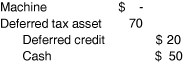
    An excess of the amounts assigned to the acquired assets over the consideration paid shall be allocated pro rata to reduce the values assigned to noncurrent assets acquired (except financial assets, assets held for disposal, and deferred tax assets). If the allocation reduces the noncurrent assets to zero, the remainder shall be classified as a deferred credit. (See Example 25, Cases C and D [paragraphs ] for illustrations of transactions that result in a deferred credit.) The deferred credit is not a temporary difference under this Subtopic.
  3. c
    A reduction in the valuation allowance of the acquiring entity that is directly attributable to the asset acquisition shall be accounted for in accordance with paragraph 805-740-30-3. Subsequent accounting for an acquired valuation allowance (for example, the subsequent recognition of an acquired deferred tax asset by elimination of a valuation allowance established at the date of acquisition of the asset) would be in accordance with paragraphs 805-740-25-3 and 805-740-45-2.
740-10-25-52
The net tax benefit (that is, the difference between the amount paid and the deferred tax asset recognized) resulting from the purchase of future tax benefits from a third party which is not a government acting in its capacity as a taxing authority shall be recorded using the same model described in the preceding paragraph. (See Example 25, Case F [paragraph 740-10-55-199] for an illustration of a purchase of future tax benefits.)

Transactions Directly between a Taxpayer and a Government

740-10-25-53
Transactions directly between a taxpayer and a government (in its capacity as a taxing authority) shall be recorded directly in income (in a manner similar to the way in which an entity accounts for changes in tax laws, rates, or other tax elections under this Subtopic). (See Example 26 [paragraph 740-10-55-202] for an illustration of a transaction directly with a governmental taxing authority.)
740-10-25-54
An entity shall determine whether a step up in the tax basis of goodwill relates to the business combination in which the book goodwill was originally recognized or whether it relates to a separate transaction. In situations in which the tax basis step up relates to the business combination in which the book goodwill was originally recognized, no deferred tax asset would be recorded for the increase in basis except to the extent that the newly deductible goodwill amount exceeds the remaining balance of book goodwill. In situations in which the tax basis step up relates to a separate transaction, a deferred tax asset would be recorded for the entire amount of the newly created tax goodwill in accordance with this Subtopic. Factors that may indicate that the step up in tax basis relates to a separate transaction include, but are not limited to, the following:
  1. a
    A significant lapse in time between the transactions has occurred.
  2. b
    The tax basis in the newly created goodwill is not the direct result of settlement of liabilities recorded in connection with the acquisition.
  3. c
    The step up in tax basis is based on a valuation of the goodwill or the business that was performed as of a date after the business combination.
  4. d
    The transaction resulting in the step up in tax basis requires more than a simple tax election.
  5. e
    The entity incurs a cash tax cost or sacrifices existing tax attributes to achieve the step up in tax basis.
  6. f
    The transaction resulting in the step up in tax basis was not contemplated at the time of the business combination.

Interest and Penalties

740-10-25-56
When the tax law requires interest to be paid on an underpayment of income taxes, an entity shall begin recognizing interest expense in the first period the interest would begin accruing according to the provisions of the relevant tax law.
740-10-25-57
If a tax position does not meet the minimum statutory threshold to avoid payment of penalties (considering the factors in paragraph 740-10-25-7), an entity shall recognize an expense for the amount of the statutory penalty in the period in which the entity claims or expects to claim the position in the tax return. If penalties were not recognized when the position was initially taken, the expense shall be recognized in the period in which the entity's judgment about meeting the minimum statutory threshold changes.

740-10-30Initial Measurement

Source downloaded: .Record version 6235af4ec37d. Effective date must be checked in the source.

740-10-30-1
This Section provides guidance on the measurement of total income tax expense. While most of this guidance focuses on the initial measurement of deferred tax assets and liabilities, including determining the appropriate tax rate to be used, the requirements for measuring current taxes payable or refundable are also established. This guidance also addresses the consideration and establishment of a valuation allowance for deferred tax assets. Requirements for entities that issue separate financial statements and are part of a group that files a consolidated tax return are also established in this Section.

Basic Requirements

740-10-30-2
The following basic requirements are applied to the measurement of current and deferred income taxes at the date of the financial statements:
  1. a
    The measurement of current and deferred tax liabilities and assets is based on provisions of the enacted tax law; the effects of future changes in tax laws or rates are not anticipated.
  2. b
    The measurement of deferred tax assets is reduced, if necessary, by the amount of any tax benefits that, based on available evidence, are not expected to be realized.
740-10-30-3
Total income tax expense (or benefit) for the year is the sum of deferred tax expense (or benefit) and income taxes currently payable or refundable.
740-10-30-4
Deferred tax expense (or benefit) is the change during the year in an entity's deferred tax liabilities and assets. For deferred tax liabilities and assets recognized in a business combination or in an acquisition by a not-for-profit entity during the year, it is the change since the acquisition date. For deferred tax liabilities and assets recognized by a corporate joint venture upon formation, during the year that includes the formation date, it is the change since the formation date. Paragraph 830-740-45-1 addresses the manner of reporting the transaction gain or loss that is included in the net change in a deferred foreign tax liability or asset when the reporting currency is the functional currency.
740-10-30-5
Deferred taxes shall be determined separately for each tax-paying component (an individual entity or group of entities that is consolidated for tax purposes) in each tax jurisdiction. That determination includes the following procedures:
  1. a
    Identify the types and amounts of existing temporary differences and the nature and amount of each type of operating loss and tax credit carryforward and the remaining length of the carryforward period.
  2. b
    Measure the total deferred tax liability for taxable temporary differences using the applicable tax rate (see paragraph 740-10-30-8).
  3. c
    Measure the total deferred tax asset for deductible temporary differences and operating loss carryforwards using the applicable tax rate.
  4. d
    Measure deferred tax assets for each type of tax credit carryforward.
  5. e
    Reduce deferred tax assets by a valuation allowance if, based on the weight of available evidence, it is more likely than not (a likelihood of more than 50 percent) that some portion or all of the deferred tax assets will not be realized. The valuation allowance shall be sufficient to reduce the deferred tax asset to the amount that is more likely than not to be realized.
740-10-30-6
Income taxes payable or refundable (current tax expense [or benefit]) are determined under the recognition and measurement requirements for tax positions established in paragraph 740-10-25-2 for recognition and in this Section for measurement.
740-10-30-7
A tax position that meets the more-likely-than-not recognition threshold shall initially and subsequently be measured as the largest amount of tax benefit that is greater than 50 percent likely of being realized upon settlement with a taxing authority that has full knowledge of all relevant information. Measurement of a tax position that meets the more-likely-than-not recognition threshold shall consider the amounts and probabilities of the outcomes that could be realized upon settlement using the facts, circumstances, and information available at the reporting date. As used in this Subtopic, the term reporting date refers to the date of the entity's most recent statement of financial position. For further explanation and illustration, see Examples 5 through 10 (paragraphs ).

Applicable Tax Rate Used to Measure Deferred Taxes

740-10-30-8
Paragraph 740-10-10-3 establishes that the objective is to measure a deferred tax liability or asset using the enacted tax rate(s) expected to apply to taxable income in the periods in which the deferred tax liability or asset is expected to be settled or realized. Deferred taxes shall not be accounted for on a discounted basis.
740-10-30-9
Under tax law with a graduated tax rate structure, if taxable income exceeds a specified amount, all taxable income is taxed, in substance, at a single flat tax rate. That tax rate shall be used for measurement of a deferred tax liability or asset by entities for which graduated tax rates are not a significant factor. Entities for which graduated tax rates are a significant factor shall measure a deferred tax liability or asset using the average graduated tax rate applicable to the amount of estimated annual taxable income in the periods in which the deferred tax liability or asset is estimated to be settled or realized. See Example 16 (paragraph 740-10-55-136) for an illustration of the determination of the average graduated tax rate. Other provisions of enacted tax laws shall be considered when determining the tax rate to apply to certain types of temporary differences and carryforwards (for example, the tax law may provide for different tax rates on ordinary income and capital gains). If there is a phased-in change in tax rates, determination of the applicable tax rate requires knowledge about when deferred tax liabilities and assets will be settled and realized.
740-10-30-10
In the U.S. federal tax jurisdiction, the applicable tax rate is the regular tax rate, and a deferred tax asset is recognized for alternative minimum tax credit carryforwards in accordance with the provisions of paragraph 740-10-30-5(d) through (e).
740-10-30-11
The objective established in paragraph 740-10-10-3 relating to enacted tax rate(s) expected to apply is not achieved through measurement of deferred taxes using the lower alternative minimum tax rate if an entity currently is an alternative minimum tax taxpayer and expects to always be an alternative minimum tax taxpayer. No one can predict whether an entity will always be an alternative minimum tax taxpayer. Furthermore, it would be counterintuitive if the addition of alternative minimum tax provisions to the tax law were to have the effect of reducing the amount of an entity's income tax expense for financial reporting, given that the provisions of alternative minimum tax may be either neutral or adverse but never beneficial to an entity. It also would be counterintuitive to assume that an entity would permit its alternative minimum tax credit carryforward to expire unused at the end of the life of the entity, which would have to occur if that entity was always an alternative minimum tax taxpayer. Use of the lower alternative minimum tax rate to measure an entity's deferred tax liability could result in understatement for either of the following reasons:
  1. a
    It could be understated if the entity currently is an alternative minimum tax taxpayer because of temporary differences. Temporary differences reverse and, over the entire life of the entity, cumulative income will be taxed at regular tax rates.
  2. b
    It could be understated if the entity currently is an alternative minimum tax taxpayer because of preference items but does not have enough alternative minimum tax credit carryforward to reduce its deferred tax liability from the amount of regular tax on regular tax temporary differences to the amount of tentative minimum tax on alternative minimum tax temporary differences. In those circumstances, measurement of the deferred tax liability using alternative minimum tax rates would anticipate the tax benefit of future special deductions, such as statutory depletion, which have not yet been earned.
740-10-30-12
If alternative tax systems exist in jurisdictions other than the U.S. federal jurisdiction, the applicable tax rate is determined in a manner consistent with the tax law after giving consideration to any interaction (that is, a mechanism similar to the U.S. alternative minimum tax credit) between the two systems.
740-10-30-13
As required by paragraph 740-10-25-37, the tax benefit of special deductions ordinarily is recognized no earlier than the year in which those special deductions are deductible on the tax return. However, some portion of the future tax effects of special deductions are implicitly recognized in determining the average graduated tax rate to be used for measuring deferred taxes when graduated tax rates are a significant factor and the need for a valuation allowance for deferred tax assets. In those circumstances, implicit recognition is unavoidable because those special deductions are one of the determinants of future taxable income and future taxable income determines the average graduated tax rate and sometimes determines the need for a valuation allowance.
740-10-30-14
Paragraph 740-10-25-39 notes that certain foreign jurisdictions may tax corporate income at different rates depending on whether that income is distributed to shareholders. Paragraph 740-10-25-40 addresses recognition of future tax credits that will be realized when the previously taxed income is distributed. Under these circumstances, the entity shall measure the tax effects of temporary differences using the undistributed rate.
740-10-30-15
As noted in paragraph 740-10-25-41, the accounting required in the consolidated financial statements of a parent that includes a foreign subsidiary that receives a tax credit for dividends paid may differ from the accounting required for the subsidiary. See that paragraph for the rates required to be used to measure deferred income taxes in such consolidated financial statements.

Establishment of a Valuation Allowance for Deferred Tax Assets

740-10-30-16
As established in paragraph 740-10-30-2(b), there is a basic requirement to reduce the measurement of deferred tax assets not expected to be realized. An entity shall evaluate the need for a valuation allowance on a deferred tax asset related to available-for-sale debt securities in combination with the entity's other deferred tax assets.
740-10-30-17
All available evidence, both positive and negative, shall be considered to determine whether, based on the weight of that evidence, a valuation allowance for deferred tax assets is needed. Information about an entity's current financial position and its results of operations for the current and preceding years ordinarily is readily available. That historical information is supplemented by all currently available information about future years. Sometimes, however, historical information may not be available (for example, start-up operations) or it may not be as relevant (for example, if there has been a significant, recent change in circumstances) and special attention is required.
740-10-30-18
Future realization of the tax benefit of an existing deductible temporary difference or carryforward ultimately depends on the existence of sufficient taxable income of the appropriate character (for example, ordinary income or capital gain) within the carryback, carryforward period available under the tax law. The following four possible sources of taxable income may be available under the tax law to realize a tax benefit for deductible temporary differences and carryforwards:
  1. a
    Future reversals of existing taxable temporary differences
  2. b
    Future taxable income exclusive of reversing temporary differences and carryforwards
  3. c
    Taxable income in prior carryback year(s) if carryback is permitted under the tax law
  4. d
    Tax-planning strategies (see paragraph 740-10-30-19) that would, if necessary, be implemented to, for example:
    1. 1
      Accelerate taxable amounts to utilize expiring carryforwards
    2. 2
      Change the character of taxable or deductible amounts from ordinary income or loss to capital gain or loss
    3. 3
      Switch from tax-exempt to taxable investments.
Evidence available about each of those possible sources of taxable income will vary for different tax jurisdictions and, possibly, from year to year. To the extent evidence about one or more sources of taxable income is sufficient to support a conclusion that a valuation allowance is not necessary, other sources need not be considered. Consideration of each source is required, however, to determine the amount of the valuation allowance that is recognized for deferred tax assets.
740-10-30-19
In some circumstances, there are actions (including elections for tax purposes) that:
  1. a
    Are prudent and feasible
  2. b
    An entity ordinarily might not take, but would take to prevent an operating loss or tax credit carryforward from expiring unused
  3. c
    Would result in realization of deferred tax assets.
This Subtopic refers to those actions as tax-planning strategies. An entity shall consider tax-planning strategies in determining the amount of valuation allowance required. Significant expenses to implement a tax-planning strategy or any significant losses that would be recognized if that strategy were implemented (net of any recognizable tax benefits associated with those expenses or losses) shall be included in the valuation allowance. See paragraphs for additional guidance. Implementation of the tax-planning strategy shall be primarily within the control of management but need not be within the unilateral control of management.
740-10-30-20
When a tax-planning strategy is contemplated as a source of future taxable income to support the realizability of a deferred tax asset, the recognition and measurement requirements for tax positions in paragraphs ; 740-10-25-13; and 740-10-30-7 shall be applied in determining the amount of available future taxable income.
740-10-30-21
Forming a conclusion that a valuation allowance is not needed is difficult when there is negative evidence such as cumulative losses in recent years. Other examples of negative evidence include, but are not limited to, the following:
  1. a
    A history of operating loss or tax credit carryforwards expiring unused
  2. b
    Losses expected in early future years (by a presently profitable entity)
  3. c
    Unsettled circumstances that, if unfavorably resolved, would adversely affect future operations and profit levels on a continuing basis in future years
  4. d
    A carryback, carryforward period that is so brief it would limit realization of tax benefits if a significant deductible temporary difference is expected to reverse in a single year or the entity operates in a traditionally cyclical business.
740-10-30-22
Examples (not prerequisites) of positive evidence that might support a conclusion that a valuation allowance is not needed when there is negative evidence include, but are not limited to, the following:
  1. a
    Existing contracts or firm sales backlog that will produce more than enough taxable income to realize the deferred tax asset based on existing sales prices and cost structures
  2. b
    An excess of appreciated asset value over the tax basis of the entity's net assets in an amount sufficient to realize the deferred tax asset
  3. c
    A strong earnings history exclusive of the loss that created the future deductible amount (tax loss carryforward or deductible temporary difference) coupled with evidence indicating that the loss (for example, an unusual or infrequent item) is an aberration rather than a continuing condition.
740-10-30-23
An entity shall use judgment in considering the relative impact of negative and positive evidence. The weight given to the potential effect of negative and positive evidence shall be commensurate with the extent to which it can be objectively verified. The more negative evidence that exists, the more positive evidence is necessary and the more difficult it is to support a conclusion that a valuation allowance is not needed for some portion or all of the deferred tax asset. A cumulative loss in recent years is a significant piece of negative evidence that is difficult to overcome.
740-10-30-24
Future realization of a tax benefit sometimes will be expected for a portion but not all of a deferred tax asset, and the dividing line between the two portions may be unclear. In those circumstances, application of judgment based on a careful assessment of all available evidence is required to determine the portion of a deferred tax asset for which it is more likely than not a tax benefit will not be realized.
740-10-30-25
See paragraphs for additional guidance related to carrybacks and carryforwards.

Tax Rates Applicable to Items Not Included in Income from Continuing Operations

740-10-30-26
The reported tax effect of items not included in income from continuing operations (for example, discontinued operations, cumulative effects of changes in accounting principles, and items charged or credited directly to shareholders' equity) that arose during the current fiscal year and before the date of enactment of tax legislation shall be measured based on the enacted rate at the time the transaction was recognized for financial reporting purposes.

Allocation of Consolidated Tax Expense to Separate Financial Statements of Members

740-10-30-27
The consolidated amount of current and deferred tax expense for a group that files a consolidated tax return shall be allocated among the members of the group when those members issue separate financial statements. This Subtopic does not require a single allocation method. The method adopted, however, shall be systematic, rational, and consistent with the broad principles established by this Subtopic. A method that allocates current and deferred taxes to members of the group by applying this Topic to each member as if it were a separate taxpayer meets those criteria. In that situation, the sum of the amounts allocated to individual members of the group may not equal the consolidated amount. That may also be the result when there are intra-entity transactions between members of the group. The criteria are satisfied, nevertheless, after giving effect to the type of adjustments (including eliminations) normally present in preparing consolidated financial statements.
740-10-30-27A
An entity is not required to allocate the consolidated amount of current and deferred tax expense to legal entities that are not subject to tax. However, an entity may elect to allocate the consolidated amount of current and deferred tax expense to legal entities that are both not subject to tax and disregarded by the taxing authority (for example, disregarded entities such as single-member limited liability companies). The election is not required for all members of a group that files a consolidated tax return; that is, the election may be made for individual members of the group that files a consolidated tax return. An entity shall not make the election to allocate the consolidated amount of current and deferred tax expense for legal entities that are partnerships or are other pass-through entities that are not wholly owned.
740-10-30-28
Examples of methods that are not consistent with the broad principles established by this Subtopic include the following:
  1. a
    A method that allocates only current taxes payable to a member of the group that has taxable temporary differences
  2. b
    A method that allocates deferred taxes to a member of the group using a method fundamentally different from the asset and liability method described in this Subtopic (for example, the deferred method that was used before 1989)
  3. c
    A method that allocates no current or deferred tax expense to a member of the group that has taxable income because the consolidated group has no current or deferred tax expense.

Interest and Penalties on Unrecognized Tax Benefits

740-10-30-29
Paragraph 740-10-25-56 establishes the requirements under which an entity shall accrue interest on an underpayment of income taxes. The amount of interest expense to be recognized shall be computed by applying the applicable statutory rate of interest to the difference between the tax position recognized in accordance with the requirements of this Subtopic for tax positions and the amount previously taken or expected to be taken in a tax return.
740-10-30-30
Paragraph 740-10-25-57 establishes both when an entity shall record an expense for penalties attributable to certain tax positions as well as the amount.

740-10-35Subsequent Measurement

Source downloaded: .Record version b5c08236ca17. Effective date must be checked in the source.

740-10-35-1
Section 740-10-30 addresses initial measurement of current and deferred income tax accounts. This Section addresses the accounting for certain changes subsequent to initial measurement. The guidance in this Section is incremental to the guidance for initial measurement.

New Information Affecting Measurement of Tax Positions

740-10-35-2
Subsequent measurement of a tax position meeting the recognition requirements of paragraph 740-10-25-6 shall be based on management's best judgment given the facts, circumstances, and information available at the reporting date. Paragraph 740-10-30-7 explains that the reporting date is the date of the entity's most recent statement of financial position. A tax position need not be legally extinguished and its resolution need not be certain to subsequently measure the position. Subsequent changes in judgment that lead to changes in measurement shall result from the evaluation of new information and not from a new evaluation or new interpretation by management of information that was available in a previous financial reporting period.
740-10-35-3
Paragraph 740-10-25-15 requires that a change in judgment that results in a change in measurement of a tax position taken in a prior annual period (including any related interest and penalties) shall be recognized as a discrete item in the period in which the change occurs. Paragraph 740-270-35-6 addresses the different accounting required for such changes in a prior interim period within the same fiscal year.

Changes in Tax Laws or Rates

740-10-35-4
Deferred tax liabilities and assets shall be adjusted for the effect of a change in tax laws or rates. A change in tax laws or rates may also require a reevaluation of a valuation allowance for deferred tax assets.

Deferred Credit Arising from Asset Acquisitions that Are Not Business Combinations

740-10-35-5
A deferred credit may arise under the accounting required by paragraph 740-10-25-51 when an asset is acquired outside of a business combination. Any deferred credit arising from the application of such accounting requirements shall be amortized to income tax expense in proportion to the realization of the tax benefits that gave rise to the deferred credit.

740-10-40Derecognition

Source downloaded: .Record version 452bc1fbac61. Effective date must be checked in the source.

740-10-40-1
Section 740-10-25 addresses recognition of current and deferred income tax accounts, including accrued interest and penalties. The guidance in this Section addresses certain subsequent events that result in derecognizing previously recognized amounts and is incremental to the guidance for recognition.

Tax Position No Longer Meets Recognition Criterion

740-10-40-2
An entity shall derecognize a previously recognized tax position in the first period in which it is no longer more likely than not that the tax position would be sustained upon examination. Use of a valuation allowance is not a permitted substitute for derecognizing the benefit of a tax position when the more-likely-than-not recognition threshold is no longer met. Derecognition shall be based on management's best judgment given the facts, circumstances, and information available at the reporting date. Paragraph 740-10-30-7 explains that the reporting date is the date of the entity's most recent statement of financial position. Subsequent changes in judgment that lead to derecognition shall result from the evaluation of new information and not from a new evaluation or new interpretation by management of information that was available in a previous financial reporting period.
740-10-40-3
If an entity that had previously considered a tax position effectively settled becomes aware that the taxing authority may examine or reexamine the tax position or intends to appeal or litigate any aspect of the tax position, the tax position is no longer considered effectively settled and the entity shall reevaluate the tax position in accordance with the requirements of this Subtopic for tax positions.
740-10-40-4
Paragraph 740-10-25-15 requires that a change in judgment that results in derecognition of a tax position taken in a prior annual period (including any related interest and penalties) shall be recognized as a discrete item in the period in which the change occurs. Paragraph 740-270-35-6 addresses the different accounting required for such changes in a prior interim period within the same fiscal year.
740-10-40-5
A tax position that did not meet the recognition requirements of paragraph 740-10-25-6 may have resulted in the accrual of interest and penalties under the requirements of paragraphs . Previously recognized interest and penalties associated with tax positions that subsequently meet one of the conditions in paragraph 740-10-25-8 shall be derecognized in the period that condition is met.

Cessation of an Entity's Taxable Status

740-10-40-6
A deferred tax liability or asset shall be eliminated at the date an entity ceases to be a taxable entity. As indicated in paragraph 740-10-25-33, the effect of an election for a voluntary change in tax status is recognized on the approval date or on the filing date if approval is not necessary and a change in tax status that results from a change in tax law is recognized on the enactment date.

740-10-45Other Presentation Matters

Source downloaded: .Record version 78a7d8d3f171. Effective date must be checked in the source.

740-10-45-1
This Section provides guidance on statement of financial position, income statement and statement of shareholder equity classification, and presentation matters applicable to all the following:
  1. a
    Statement of financial position classification of income tax accounts
  2. b
    Income statement presentation of certain measurement changes to income tax accounts
  3. c
    Income statement classification of interest and penalties
  4. d
    Presentation matters related to investment tax credits under the deferral method.
  5. e
    Statement of shareholder equity reclassification of certain income tax effects from accumulated other comprehensive income.
740-10-45-2
See Subtopic 740-20 for guidance on the intraperiod allocation of total income tax expense (or benefit).

Statement of Financial Position Classification of Income Tax Accounts

740-10-45-3
Topic 210 provides general guidance for classification of accounts in statements of financial position. The following guidance addresses classification matters applicable to income tax accounts and is incremental to the general guidance.
740-10-45-4
In a classified statement of financial position, an entity shall classify deferred tax liabilities and assets as noncurrent amounts.
740-10-45-6
For a particular tax-paying component of an entity and within a particular tax jurisdiction, all deferred tax liabilities and assets, as well as any related valuation allowance, shall be offset and presented as a single noncurrent amount. However, an entity shall not offset deferred tax liabilities and assets attributable to different tax-paying components of the entity or to different tax jurisdictions.
740-10-45-10A
Except as indicated in paragraphs 740-10-45-10B and 740-10-45-12, an unrecognized tax benefit, or a portion of an unrecognized tax benefit, shall be presented in the financial statements as a reduction to a deferred tax asset for a net operating loss carryforward, a similar tax loss, or a tax credit carryforward.
740-10-45-10B
To the extent a net operating loss carryforward, a similar tax loss, or a tax credit carryforward is not available at the reporting date under the tax law of the applicable jurisdiction to settle any additional income taxes that would result from the disallowance of a tax position or the tax law of the applicable jurisdiction does not require the entity to use, and the entity does not intend to use, the deferred tax asset for such purpose, the unrecognized tax benefit shall be presented in the financial statements as a liability and shall not be combined with deferred tax assets. The assessment of whether a deferred tax asset is available is based on the unrecognized tax benefit and deferred tax asset that exist at the reporting date and shall be made presuming disallowance of the tax position at the reporting date.
740-10-45-11
An entity that presents a classified statement of financial position shall classify an unrecognized tax benefit that is presented as a liability in accordance with paragraphs as a current liability to the extent the entity anticipates payment (or receipt) of cash within one year or the operating cycle, if longer.
740-10-45-12
An unrecognized tax benefit presented as a liability shall not be classified as a deferred tax liability unless it arises from a taxable temporary difference. Paragraph 740-10-25-17 explains how the recognition and measurement of a tax position may affect the calculation of a temporary difference.
740-10-45-13
The offset of cash or other assets against the tax liability or other amounts owing to governmental bodies is not acceptable except as noted in paragraphs 210-20-45-6 and .

Income Statement Presentation of Certain Measurement Changes to Income Tax Accounts

740-10-45-14
The following guidance addresses the presentation on the income statement of the effect of changes in deferred tax accounts caused by the following types of changes:
  1. a
    Changes in tax laws or rates
  2. b
    Changes in the tax status of an entity
  3. c
    Changes that impact the valuation allowance for deferred tax assets
  4. d
    Changes related to assets acquired outside of a business combination.
740-10-45-15
When deferred tax accounts are adjusted as required by paragraph 740-10-35-4 for the effect of a change in tax laws or rates, the effect shall be included in income from continuing operations for the period that includes the enactment date.
740-10-45-16
Paragraph 740-10-25-48 provides the recognition guidance when a tax law retroactively changes tax rates. In such cases, the cumulative tax effect is included in income from continuing operations.
740-10-45-17
Paragraph 740-10-30-26 provides the measurement guidance for a change in tax rates on items not included in income from continuing operations that arose during the current fiscal year and prior to the date of enactment. In such cases, the tax effect of a retroactive change in enacted tax rates on current or deferred tax assets and liabilities related to those items is included in income from continuing operations in the period of enactment.
740-10-45-18
Paragraph 740-10-25-47 requires that the effect of a change in tax laws or rates be recognized at the date of enactment. Accordingly, if an entity were adopting a new accounting standard as of a date prior to the enactment date, the effect of the change in tax laws or rates would not be recognized in the cumulative effect of adopting the standard, but would be recognized in income from continuing operations for the period that includes the enactment date. This would be true regardless of whether the change was retroactive to the earlier date.
740-10-45-19
When deferred tax accounts are recognized or derecognized as required by paragraphs 740-10-25-32 and 740-10-40-6 due to a change in tax status, the effect of recognizing or derecognizing the deferred tax liability or asset shall be included in income from continuing operations.
740-10-45-20
The effect of a change in the beginning-of-the-year balance of a valuation allowance that results from a change in circumstances that causes a change in judgment about the realizability of the related deferred tax asset in future years ordinarily shall be included in income from continuing operations. The only exceptions are changes to valuation allowances of certain tax benefits that are adjusted within the measurement period as required by paragraph 805-740-45-2 related to business combinations and the initial recognition (that is, by elimination of the valuation allowances) of tax benefits related to the items specified in paragraph 740-20-45-11(c) through (f). The effect of other changes in the balance of a valuation allowance are allocated among continuing operations and items other than continuing operations as required by paragraphs 740-20-45-2 and 740-20-45-8.
740-10-45-21
Changes in valuation allowances due to changed expectations about the realization of deferred tax assets caused by transactions among or with shareholders shall be included in the income statement. A write-off of a preexisting deferred tax asset that an entity can no longer realize as a result of a transaction among or with its shareholders shall similarly be charged to the income statement. The same net effect results from eliminating a deferred tax asset and increasing a valuation allowance to 100 percent of the amount of the related deferred tax asset.
740-10-45-22
Paragraph 740-10-25-51 addresses the accounting when an asset is acquired outside of a business combination and the tax basis of the asset differs from the amount paid and identifies related examples. In the event that the accounting results in the recognition of a deferred tax asset and if, subsequent to the acquisition, it becomes more likely than not that some or all of the acquired deferred tax asset will not be realized, the effect of such adjustment shall be recognized in continuing operations as part of income tax expense. A proportionate share of any remaining unamortized deferred credit balance arising from the accounting required in that paragraph shall be recognized as an offset to income tax expense. The deferred credit shall not be classified as part of deferred tax liabilities or as an offset to deferred tax assets.
740-10-45-23
Income tax uncertainties that exist at the date of acquisition of the asset shall be accounted for in accordance with this Subtopic.
740-10-45-24
As indicated in paragraph 740-10-25-51, subsequent accounting for an acquired valuation allowance (for example, the subsequent recognition of an acquired deferred tax asset by elimination of a valuation allowance established at the date of acquisition of the asset) would be in accordance with paragraphs and 805-740-45-2.

Income Statement Classification of Interest and Penalties

740-10-45-25
Interest recognized in accordance with paragraph 740-10-25-56 may be classified in the financial statements as either income taxes or interest expense, based on the accounting policy election of the entity. Penalties recognized in accordance with paragraph 740-10-25-57 may be classified in the financial statements as either income taxes or another expense classification, based on the accounting policy election of the entity. Those elections shall be consistently applied.

Investment Tax Credits Under the Deferral Method

740-10-45-26
Paragraph 740-10-25-46 describes two acceptable methods for recognizing the benefit of investment tax credits. The following guidance addresses presentation matters related to one of those methods, the deferral method.
740-10-45-27
The reflection of the allowable credit as a reduction in the net amount at which the acquired property is stated (either directly or by inclusion in an offsetting account) may be preferable in many cases. However, it is equally appropriate to treat the credit as deferred income, provided it is amortized over the productive life of the acquired property.
740-10-45-28
It is preferable that the statement of income in the year in which the allowable investment credit arises should be affected only by the results which flow from the accounting for the credit set forth in paragraph 740-10-25-46. Nevertheless, reflection of income tax provisions, in the income statement, in the amount payable (that is, after deduction of the allowable investment credit) is appropriate provided that a corresponding charge is made to an appropriate cost or expense (for example, to the provision for depreciation) and the treatment is adequately disclosed in the financial statements of the first year of its adoption.

Statement of Shareholder Equity Reclassification of Certain Income Tax Effects from Accumulated Other Comprehensive Income

740-10-45-29
Paragraph 220-10-45-12A provides guidance on the reclassification of certain income tax effects of items within accumulated other comprehensive income to retained earnings. That guidance results from H.R.1, An Act to Provide for Reconciliation Pursuant to Titles II and V of the Concurrent Resolution on the Budget for Fiscal Year 2018 (Tax Cuts and Jobs Act).

740-10-50Disclosure

Source downloaded: .Record version 52d0f01c55b5. Effective date must be checked in the source.

740-10-50-1
This Section provides guidance on the financial statement disclosure requirements relating to income taxes applicable to all entities.
740-10-50-1A
Transition date:(P) December 16, 2024; (N) December 16, 2025Transition guidance:
740-10-65-9 Nothing in this Subtopic is intended to discourage an entity from reporting additional information specific to its income tax rate reconciliation or income taxes paid to further an understanding of the entity and the related disclosures.
740-10-50-2
The components of the net deferred tax liability or asset recognized in an entity's statement of financial position shall be disclosed as follows:
  1. a
    The total of all deferred tax liabilities measured in paragraph 740-10-30-5(b)
  2. b
    The total of all deferred tax assets measured in paragraph 740-10-30-5(c) through (d)
  3. c
    The total valuation allowance recognized for deferred tax assets determined in paragraph 740-10-30-5(e).
The net change during the year in the total valuation allowance also shall be disclosed.
740-10-50-3
An entity shall disclose both of the following:
  1. a
    The amounts and expiration dates of operating loss and tax credit carryforwards for tax purposes
  2. b
    Any portion of the valuation allowance for deferred tax assets for which subsequently recognized tax benefits will be credited directly to contributed capital (see paragraph 740-20-45-11).
740-10-50-4
In the event that a change in an entity's tax status becomes effective after year-end in Year 2 but before the financial statements for Year 1 are issued or are available to be issued (as discussed in Section 855-10-25), the entity's financial statements for Year 1 shall disclose the change in the entity's tax status for Year 2 and the effects of that change, if material.
740-10-50-5
An entity's temporary difference and carryforward information requires additional disclosure. The additional disclosure differs for public and nonpublic entities.
Transition date:(P) December 16, 2024; (N) December 16, 2025Transition guidance:
740-10-65-9 An entity's temporary difference and carryforward information requires additional disclosure. The additional disclosure differs for public business entities and entities other than public business entities.
740-10-50-6
A public entity shall disclose the approximate tax effect of each type of temporary difference and carryforward that gives rise to a significant portion of deferred tax liabilities and deferred tax assets (before allocation of valuation allowances).
Transition date:(P) December 16, 2024; (N) December 16, 2025Transition guidance:
740-10-65-9
Editor's Note: The content of paragraph 740-10-50-6 will be amended upon transition, together with a change in the heading noted below.
∙ > Public Business Entities
A public business entity shall disclose the approximate tax effect of each type of temporary difference and carryforward that gives rise to a significant portion of deferred tax liabilities and deferred tax assets (before allocation of valuation allowances).
740-10-50-7
See paragraph 740-10-50-16 for disclosure requirements applicable to a public entity that is not subject to income taxes.
Transition date:(P) December 16, 2024; (N) December 16, 2025Transition guidance:
740-10-65-9 See paragraph 740-10-50-16 for disclosure requirements applicable to a public business entity that is not subject to income taxes.
740-10-50-8
A nonpublic entity shall disclose the types of significant temporary differences and carryforwards but may omit disclosure of the tax effects of each type.
Transition date:(P) December 16, 2024; (N) December 16, 2025Transition guidance:
740-10-65-9
Editor's Note: The content of paragraph 740-10-50-8 will be amended upon transition, together with a change in the heading noted below.
∙ > Entities Other Than Public Business Entities
An entity other than a public business entity shall disclose the types of significant temporary differences and carryforwards but may omit disclosure of the tax effects of each type.
740-10-50-9
The significant components of income tax expense attributable to continuing operations for each year presented shall be disclosed in the financial statements or notes thereto. Those components would include, for example:
  1. a
  2. b
    Deferred tax expense (or benefit) (exclusive of the effects of other components listed below)
  3. c
    Investment tax credits
  4. d
    Government grants (to the extent recognized as a reduction of income tax expense)
  5. e
    The benefits of operating loss carryforwards
  6. f
    Tax expense that results from allocating certain tax benefits directly to contributed capital
  7. g
    Adjustments of a deferred tax liability or asset for enacted changes in tax laws or rates or a change in the tax status of the entity
  8. h
    Adjustments of the beginning-of-the-year balance of a valuation allowance because of a change in circumstances that causes a change in judgment about the realizability of the related deferred tax asset in future years. For example, any acquisition-date income tax benefits or expenses recognized from changes in the acquirer's valuation allowance for its previously existing deferred tax assets as a result of a business combination (see paragraph 805-740-30-3).
740-10-50-10
The amount of income tax expense (or benefit) allocated to continuing operations and the amounts separately allocated to other items (in accordance with the intraperiod tax allocation provisions of paragraphs and 852-740-45-3) shall be disclosed for each year for which those items are presented.
740-10-50-10A
Transition date:(P) December 16, 2024; (N) December 16, 2025Transition guidance:
740-10-65-9 Income (or loss) from continuing operations before income tax expense (or benefit) disaggregated between domestic and foreign shall be disclosed for each annual reporting period.
740-10-50-10B
Transition date:(P) December 16, 2024; (N) December 16, 2025Transition guidance:
740-10-65-9 Income tax expense (or benefit) from continuing operations disaggregated by federal (national), state, and foreign shall be disclosed for each annual reporting period. Income taxes on foreign earnings that are imposed by the jurisdiction of domicile shall be included in the amount for that jurisdiction of domicile (that is, the jurisdiction imposing the tax).

Income Tax Expense Compared to Statutory Expectations

740-10-50-11
The reported amount of income tax expense may differ from an expected amount based on statutory rates. The following guidance establishes the disclosure requirements for such situations and differs for public and nonpublic entities.
Transition date:(P) December 16, 2024; (N) December 16, 2025Transition guidance:
740-10-65-9
Editor's Note: The content of paragraph 740-10-50-11 will be amended upon transition, together with a change in the heading noted below.
> Rate Reconciliation between Income Tax Expense (or Benefit) and Statutory Expectations
The reported amount of income tax expense (or benefit) may differ from an expected amount based on statutory tax rates. The following guidance establishes the disclosure requirements for such situations and differs for public business entities and entities other than public business entities.
740-10-50-11A
Transition date:(P) December 16, 2024; (N) December 16, 2025Transition guidance:
740-10-65-9 The objective of these disclosure requirements is for an entity, particularly an entity operating in multiple jurisdictions, to disclose sufficient information to enable users of financial statements to understand the nature and magnitude of factors contributing to the difference between the effective tax rate and the statutory tax rate.
740-10-50-12
A public entity shall disclose a reconciliation using percentages or dollar amounts of the reported amount of income tax expense attributable to continuing operations for the year to the amount of income tax expense that would result from applying domestic federal statutory tax rates to pretax income from continuing operations. The statutory tax rates shall be the regular tax rates if there are alternative tax systems. The estimated amount and the nature of each significant reconciling item shall be disclosed.
Transition date:(P) December 16, 2024; (N) December 16, 2025Transition guidance:
740-10-65-9
Editor's Note: The content of paragraph 740-10-50-12 will be amended upon transition, together with a change in the heading noted below.
∙ > Public Business Entities
A public business entity shall disclose a reconciliation for each annual reporting period, in accordance with paragraphs , between the amount of reported income tax expense (or benefit) from continuing operations and the amount computed by multiplying the income (or loss) from continuing operations before income taxes by the applicable statutory federal (national) income tax rate of the jurisdiction (country) of domicile. In circumstances in which a public business entity, as the parent entity, is not domiciled in the United States, the federal (national) income tax rate in that entity’s jurisdiction (country) of domicile shall normally be used in the reconciliation, and different rates shall not be used for subsidiaries or segments of the public business entity. When the rate used by a public business entity is other than the United States federal corporate income tax rate, the public business entity shall disclose the rate used and the basis for using that rate. The statutory tax rates shall be the regular tax rates if there are alternative tax systems.
740-10-50-12A
Transition date:(P) December 16, 2024; (N) December 16, 2025Transition guidance:
740-10-65-9 For each annual reporting period, a public business entity shall disclose a tabular reconciliation, using both percentages and reporting currency amounts, according to the following requirements:
  1. a
    The following specific categories shall be disclosed:
    1. 1
      State and local income tax, net of federal (national) income tax effect
    2. 2
      Foreign tax effects
    3. 3
      Effect of changes in tax laws or rates enacted in the current period
    4. 4
      Effect of cross-border tax laws
    5. 5
      Tax credits
    6. 6
      Changes in valuation allowances
    7. 7
      Nontaxable or nondeductible items
    8. 8
      Changes in unrecognized tax benefits.
  2. b
    Separate disclosure shall be required for any reconciling item listed below in which the effect of the reconciling item is equal to or greater than 5 percent of the amount computed by multiplying the income (or loss) from continuing operations before income taxes by the applicable statutory federal (national) income tax rate of the jurisdiction (country) of domicile. When disaggregating the following reconciling items by nature, an entity should consider the reconciling item’s fundamental or essential characteristics, such as the event that caused the reconciling item and the activity with which the reconciling item is associated. Reconciling items shall be presented on a gross basis unless specific guidance in (c) permits net presentation with a related reconciling item.
    1. 1
      If the reconciling item is within the effect of cross-border tax laws, tax credits, or nontaxable or nondeductible items categories, it shall be disaggregated by nature.
    2. 2
      If the reconciling item is within the foreign tax effects category, it shall be disaggregated by jurisdiction (country) and by nature, except for reconciling items related to changes in unrecognized tax benefits discussed in (c). If a foreign jurisdiction meets the 5 percent threshold, it shall be separately disclosed as a reconciling item. Within any foreign jurisdiction (regardless of whether it meets the 5 percent threshold), the reconciling item shall be separately disclosed by nature if its gross amount (positive or negative) meets the 5 percent threshold.
    3. 3
      If the reconciling item is not within any of the categories listed in (a), it shall be disaggregated by nature.
  3. c
    For the purpose of categorizing and presenting reconciling items:
    1. 1
      Except for reconciling items related to changes in unrecognized tax benefits discussed in (c)(2), the state and local income tax category reflects income taxes imposed at the state or local level within the jurisdiction (country) of domicile, the foreign tax effects category reflects income taxes imposed by foreign jurisdictions, and the remaining categories listed in (a) reflect federal (national) income taxes imposed by the jurisdiction (country) of domicile.
    2. 2
      For reconciling items related to changes in unrecognized tax benefits:
      1. i
        Reconciling items resulting from changes in judgment related to tax positions taken in prior annual reporting periods (such as subsequent recognition, derecognition, and change in measurement of unrecognized tax benefits) are reflected in the changes in unrecognized tax benefits category.
      2. ii
        When an unrecognized tax benefit is recorded in the current annual reporting period for a tax position taken or expected to be taken in the same reporting period, the unrecognized tax benefit and its related tax position may be presented on a net basis in the category where the tax position is presented.
      3. iii
        Reconciling items presented in the changes in unrecognized tax benefits category may be disclosed on an aggregated basis for all jurisdictions.
    3. 3
      The effect of cross-border tax laws category reflects the effect of incremental income taxes imposed by the jurisdiction (country) of domicile on income earned in foreign jurisdictions. When the jurisdiction (country) of domicile taxes cross-border income but also provides a tax credit on the same income during the same reporting period, the tax effect of both the cross-border tax and its related tax credit may be presented on a net basis in the effect of cross-border tax laws category. For example, the tax effect related to the global intangible low-taxed income and its related foreign tax credits may be presented on a net basis as one reconciling item in the effect of cross-border tax laws category.
    4. 4
      The effect of changes in tax laws or rates enacted in the current period category reflects the cumulative tax effects of a change in enacted tax laws or rates on current or deferred tax assets and liabilities at the date of enactment.
See paragraph 740-10-55-231 for an illustration of a tabular rate reconciliation disclosure.
740-10-50-12B
Transition date:(P) December 16, 2024; (N) December 16, 2025Transition guidance:
740-10-65-9 A public business entity shall provide a qualitative description of the states and local jurisdictions that make up the majority (greater than 50 percent) of the effect of the state and local income tax category. For the purpose of identifying the states and local jurisdictions that make up the majority of the effect, a public business entity shall begin with the state or local jurisdiction that has the largest effect and in descending order add states or local jurisdictions with the next largest effect until the aggregated effect is greater than 50 percent.
740-10-50-12C
Transition date:(P) December 16, 2024; (N) December 16, 2025Transition guidance:
740-10-65-9 A public business entity shall provide an explanation, if not otherwise evident, of individual reconciling items required by paragraph 740-10-50-12A, such as the nature, effect, and underlying causes of the reconciling items and the judgment used in categorizing the reconciling items.
740-10-50-13
A nonpublic entity shall disclose the nature of significant reconciling items but may omit a numerical reconciliation.
Transition date:(P) December 16, 2024; (N) December 16, 2025Transition guidance:
740-10-65-9
Editor's Note: The content of paragraph 740-10-50-13 will be amended upon transition, together with a change in the heading noted below.
∙ > Entities Other Than Public Business Entities
An entity other than a public business entity shall qualitatively disclose the nature and effect of specific categories of reconciling items listed in paragraph 740-10-50-12A(a) and individual jurisdictions that result in a significant difference between the statutory tax rate and the effective tax rate, but a numerical reconciliation is not required. See paragraphs for an illustration of a qualitative disclosure of rate reconciling items.
740-10-50-14
If not otherwise evident from the disclosures required by this Section, all entities shall disclose the nature and effect of any other significant matters affecting comparability of information for all periods presented.
Transition date:(P) December 16, 2024; (N) December 16, 2025Transition guidance:
740-10-65-9 If not otherwise evident from the disclosures required by this Section, an entity shall disclose the nature and effect of any other significant matters affecting comparability of information for all periods presented.
740-10-50-15
All entities shall disclose all of the following at the end of each annual reporting period presented:
  1. a
  2. b
  3. c
    The total amounts of interest and penalties recognized in the statement of operations and the total amounts of interest and penalties recognized in the statement of financial position
  4. d
    For positions for which it is reasonably possible that the total amounts of unrecognized tax benefits will significantly increase or decrease within 12 months of the reporting date:
    1. 1
      The nature of the uncertainty
    2. 2
      The nature of the event that could occur in the next 12 months that would cause the change
    3. 3
      An estimate of the range of the reasonably possible change or a statement that an estimate of the range cannot be made.
  5. e
    A description of tax years that remain subject to examination by major tax jurisdictions.
Transition date:(P) December 16, 2024; (N) December 16, 2025Transition guidance:
740-10-65-9 An entity shall disclose the following at the end of each annual reporting period presented:
  1. a
  2. b
  3. c
    The total amounts of interest and penalties recognized in the statement of operations and the total amounts of interest and penalties recognized in the statement of financial position
  4. d
  5. e
    A description of tax years that remain subject to examination by major tax jurisdictions.
740-10-50-15A
Public entities shall disclose both of the following at the end of each annual reporting period presented:
  1. a
    A tabular reconciliation of the total amounts of unrecognized tax benefits at the beginning and end of the period, which shall include at a minimum:
    1. 1
      The gross amounts of the increases and decreases in unrecognized tax benefits as a result of tax positions taken during a prior period
    2. 2
      The gross amounts of increases and decreases in unrecognized tax benefits as a result of tax positions taken during the current period
    3. 3
      The amounts of decreases in the unrecognized tax benefits relating to settlements with taxing authorities
    4. 4
      Reductions to unrecognized tax benefits as a result of a lapse of the applicable statute of limitations.
  2. b
    The total amount of unrecognized tax benefits that, if recognized, would affect the effective tax rate.
See Example 30 (paragraph 740-10-55-217) for an illustration of disclosures about uncertainty in income taxes.
Transition date:(P) December 16, 2024; (N) December 16, 2025Transition guidance:
740-10-65-9 A public business entity shall disclose both of the following at the end of each annual reporting period presented:
  1. a
    A tabular reconciliation of the total amounts of unrecognized tax benefits at the beginning and end of the period, which shall include at a minimum:
    1. 1
      The gross amounts of the increases and decreases in unrecognized tax benefits as a result of tax positions taken during a prior period
    2. 2
      The gross amounts of increases and decreases in unrecognized tax benefits as a result of tax positions taken during the current period
    3. 3
      The amounts of decreases in the unrecognized tax benefits relating to settlements with taxing authorities
    4. 4
      Reductions to unrecognized tax benefits as a result of a lapse of the applicable statute of limitations.
  2. b
    The total amount of unrecognized tax benefits that, if recognized, would affect the effective tax rate.
See Example 30 (paragraph 740-10-55-217) for an illustration of disclosures about uncertainty in income taxes.

Public Entities Not Subject to Income Taxes

740-10-50-16
A public entity that is not subject to income taxes because its income is taxed directly to its owners shall disclose that fact and the net difference between the tax bases and the reported amounts of the entity's assets and liabilities.
Transition date:(P) December 16, 2024; (N) December 16, 2025Transition guidance:
740-10-65-9
Editor's Note: The content of paragraph 740-10-50-16 will be amended upon transition, together with the change in the heading noted below.
> Public Business Entities Not Subject to Income Taxes
A public business entity that is not subject to income taxes because its income is taxed directly to its owners shall disclose that fact and the net difference between the tax bases and the reported amounts of the entity's assets and liabilities.

Entities with Separately Issued Financial Statements That Are Members of a Consolidated Tax Return

740-10-50-17
An entity that is a member of a group that files a consolidated tax return shall disclose in its separately issued financial statements:
  1. a
    The aggregate amount of current and deferred tax expense for each statement of earnings presented and the amount of any tax-related balances due to or from affiliates as of the date of each statement of financial position presented
  2. b
    The principal provisions of the method by which the consolidated amount of current and deferred tax expense is allocated to members of the group and the nature and effect of any changes in that method (and in determining related balances to or from affiliates) during the years for which the above disclosures are presented.
740-10-50-17A
An entity that is both not subject to tax and disregarded by the taxing authority that elects to include the allocated amount of current and deferred tax expense in its separately issued financial statements in accordance with paragraph 740-10-30-27A shall disclose that fact and provide the disclosures required by paragraph 740-10-50-17.
740-10-50-18
Acceptable alternative policy choices available to an entity require disclosure as follows in paragraphs .
740-10-50-19
An entity shall disclose its policy on classification of interest and penalties in accordance with the alternatives permitted in paragraph 740-10-45-25 in the notes to the financial statements.
740-10-50-20
Paragraph 740-10-25-46 identifies the deferral method and the flow-through method as acceptable methods of accounting for investment tax credits. Whichever method of accounting for the investment credit is adopted, it is essential that full disclosure be made of the method followed and amounts involved, when material.

Other Disclosures

740-10-50-21
In addition to disclosures required by this Subtopic, disclosures regarding estimates meeting certain criteria are established in paragraph 275-10-50-8 for nongovernmental entities. See Example 31 (paragraph 740-10-55-218) for an illustration of disclosure relating to the realizability of a deferred tax asset under the requirements of Topic 275.
740-10-50-22
Transition date:(P) December 16, 2024; (N) December 16, 2025Transition guidance:
740-10-65-9 For each annual reporting period, all entities shall disclose the amount of income taxes paid (net of refunds received) disaggregated by federal (national), state, and foreign.
740-10-50-23
Transition date:(P) December 16, 2024; (N) December 16, 2025Transition guidance:
740-10-65-9 For each annual reporting period, all entities shall disclose the amount of income taxes paid (net of refunds received) to each individual jurisdiction in which income taxes paid (net of refunds received) is equal to or greater than 5 percent of total income taxes paid (net of refunds received).

740-10-55Implementation Guidance and Illustrations

Source downloaded: .Record version aed1495752b3. Effective date must be checked in the source.

740-10-55-1
This Section is an integral part of the requirements of this Subtopic. This Section provides additional guidance and illustrations that address the application of accounting requirements to specific aspects of accounting for income taxes, including disclosures. The guidance and illustrations that follow, unless stated otherwise, assume that the tax law requires offsetting net deductions in a particular year against net taxable amounts in the 3 preceding years and then in the 15 succeeding years. These assumptions about the tax law are for illustrative purposes only. This Subtopic requires that the enacted tax law for a particular tax jurisdiction be used for recognition and measurement of deferred tax liabilities and assets.

Implementation Guidance

740-10-55-2
The guidance is organized as follows:
  1. a
    Application of accounting requirements for income taxes to specific situations
  2. b
  3. c
    Income tax related disclosures.
740-10-55-3
The application of the requirements of this Subtopic related to tax positions requires a two-step process that separates recognition from measurement. The first step is determining whether a tax position has met the recognition threshold; the second step is measuring a tax position that meets the recognition threshold. The recognition threshold is met when the taxpayer (the reporting entity) concludes that, consistent with paragraphs and 740-10-25-13, it is more likely than not that the taxpayer will sustain the benefit taken or expected to be taken in the tax return in a dispute with taxing authorities if the taxpayer takes the dispute to the court of last resort.
740-10-55-4
Relatively few disputes are resolved through litigation, and very few are taken to the court of last resort. Generally, the taxpayer and the taxing authority negotiate a settlement to avoid the costs and hazards of litigation. As a result, the measurement of the tax position is based on management's best judgment of the amount the taxpayer would ultimately accept in a settlement with taxing authorities.
740-10-55-5
The recognition and measurement requirements of this Subtopic related to tax positions require that the entity recognize the largest amount of benefit that is greater than 50 percent likely of being realized upon settlement.
740-10-55-6
See Examples 1 through 12 (paragraphs ) for illustrations of this guidance.
740-10-55-7
Subject to certain specific exceptions identified in paragraph 740-10-25-3, a deferred tax liability is recognized for all taxable temporary differences, and a deferred tax asset is recognized for all deductible temporary differences and operating loss and tax credit carryforwards. A valuation allowance is recognized if it is more likely than not that some portion or all of the deferred tax asset will not be realized. See Example 12 (paragraph 740-10-55-120) for an illustration of this guidance.
740-10-55-8
To the extent that evidence about one or more sources of taxable income is sufficient to eliminate any need for a valuation allowance, other sources need not be considered. Detailed forecasts, projections, or other types of analyses are unnecessary if expected future taxable income is more than sufficient to realize a tax benefit.
740-10-55-9
The terms forecast and projection refer to any process by which available evidence is accumulated and evaluated for purposes of estimating whether future taxable income will be sufficient to realize a deferred tax asset. Judgment is necessary to determine how detailed or formalized that evaluation process should be. Furthermore, information about expected future taxable income is necessary only to the extent positive evidence available from other sources (see paragraph 740-10-30-18) is not sufficient to support a conclusion that a valuation allowance is not needed. The requirements of this Subtopic do not require either a financial forecast or a financial projection within the meaning of those terms in the Statements on Standards for Attestation Engagements and Related Attest Engagements Interpretations [AT], AT section 301, Financial Forecasts and Projections issued by the American Institute of Certified Public Accountants.
740-10-55-10
See Example 12 (paragraph 740-10-55-120) for an illustration of a situation where detailed analyses are not necessary.
740-10-55-11
See Example 13 (paragraph 740-10-55-124) for an illustration of determining a valuation allowance for deferred tax assets.
740-10-55-12
The tax law determines whether future reversals of temporary differences will result in taxable and deductible amounts that offset each other in future years. The tax law also determines the extent to which deductible temporary differences and carryforwards will offset the tax consequences of income that is expected to be earned in future years. For example, the tax law may provide that capital losses are deductible only to the extent of capital gains. In that case, a tax benefit is not recognized for temporary differences that will result in future deductions in the form of capital losses unless those deductions will offset any of the following:
  1. a
    Other existing temporary differences that will result in future capital gains
  2. b
    Capital gains that are expected to occur in future years
  3. c
    Capital gains of the current year or prior years if carryback (of those capital loss deductions from the future reversal years) is expected.
740-10-55-13
The particular years in which temporary differences result in taxable or deductible amounts generally are determined by the timing of the recovery of the related asset or settlement of the related liability. However, there are exceptions to that general rule. For example, a temporary difference between the tax basis and the reported amount of inventory for which cost is determined on a last-in, first-out (LIFO) basis does not reverse when present inventory is sold in future years if it is replaced by purchases or production of inventory in those same future years. A LIFO inventory temporary difference becomes taxable or deductible in the future year that inventory is liquidated and not replaced.
740-10-55-14
For some assets or liabilities, temporary differences may accumulate over several years and then reverse over several years. That pattern is common for depreciable assets. Future originating differences for existing depreciable assets and their subsequent reversals are a factor to be considered when assessing the likelihood of future taxable income (see paragraph 740-10-30-18(b)) for realization of a tax benefit for existing deductible temporary differences and carryforwards.
740-10-55-15
Reversal patterns of existing temporary differences may need to be scheduled under the requirements of this Subtopic as follows:
  1. a
  2. b
    Deferred tax assets are recognized without reference to offsetting, and then an assessment is made about the need for a valuation allowance. Paragraph 740-10-30-18 lists four possible sources of taxable income that may be available to realize such deferred tax assets. In many cases it may be possible to determine without scheduling that expected future taxable income (see paragraph 740-10-30-18(b)) will be adequate to eliminate the need for a valuation allowance. Disclosure of the amounts and expiration dates (or a reasonable aggregation of expiration dates) of operating loss and tax credit carryforwards is required only on a tax basis and does not require scheduling.
  3. c
    The adoption of a tax rate convention for measuring deferred taxes when graduated tax rates are a significant factor will, in many cases, eliminate the need for the scheduling. In addition, alternative minimum tax rates and laws are a factor only in considering the need for a valuation allowance for a deferred tax asset for alternative minimum tax credit carryforwards. When there is a phased-in change in tax rates, however, scheduling will often be necessary. See paragraphs 740-10-55-24; ; and Examples 14 through 16 (paragraphs ).
740-10-55-16
Paragraph 740-10-30-18 lists four possible sources of taxable income that may be available to realize a future tax benefit for deductible temporary differences and carryforwards. One source is future taxable income exclusive of reversing temporary differences and carryforwards. Future originating temporary differences and their subsequent reversal are implicit in estimates of future taxable income. Where it can be easily demonstrated that future taxable income will more likely than not be adequate to realize future tax benefits of existing deferred tax assets, scheduling of reversals of existing taxable temporary differences would be unnecessary.
740-10-55-17
In other cases it may be easier to demonstrate that no valuation allowance is needed by considering the reversal of existing taxable temporary differences. Even in that case, the extent of scheduling will depend on the relative magnitudes involved. For example, if existing taxable temporary differences that will reverse over a long number of future years greatly exceed deductible differences that are expected to reverse over a short number of future years, it may be appropriate to conclude, in view of a long (for example, 15 years) carryforward period for net operating losses, that realization of future tax benefits for the deductible differences is thereby more likely than not without the need for scheduling.
740-10-55-18
A general understanding of reversal patterns is, in many cases, relevant in assessing the need for a valuation allowance. Judgment is crucial in making that assessment. The amount of scheduling, if any, that will be required will depend on the facts and circumstances of each situation.
740-10-55-19
The following concepts however, underlie the determination of reversal patterns for existing temporary differences:
  1. a
    The particular years in which temporary differences result in taxable or deductible amounts generally are determined by the timing of the recovery of the related asset or settlement of the related liability (see paragraph 740-10-55-13).
  2. b
    The tax law determines whether future reversals of temporary differences will result in taxable and deductible amounts that offset each other in future years (see paragraph 740-10-55-14).
740-10-55-20
State income taxes are deductible for U.S. federal income tax purposes and therefore a deferred state income tax liability or asset gives rise to a temporary difference for purposes of determining a deferred U.S. federal income tax asset or liability, respectively. The pattern of deductible or taxable amounts in future years for temporary differences related to deferred state income tax liabilities or assets should be determined by estimates of the amount of those state income taxes that are expected to become payable or recoverable for particular future years and, therefore, deductible or taxable for U.S. federal tax purposes in those particular future years.
740-10-55-21
An entity may have claimed certain deductions, such as repair expenses, on its income tax returns. However, the entity may have recognized a liability (including interest) for the unrecognized tax benefit of those tax positions. If scheduling of future taxable or deductible differences is necessary, liabilities for unrecognized tax benefits should be considered. Accrual of a liability for unrecognized tax benefits of expenses, such as repairs, has the effect of capitalizing those expenses for tax purposes. Those capitalized expenses are considered to result in deductible amounts in the later years, for example, as depreciation expense. If the liability for unrecognized tax benefits is based on an overall evaluation of the technical merits of the tax position, scheduling should reflect the evaluations made in determining the liability for unrecognized tax benefits that was recognized. The effect of those evaluations may indicate a source of taxable income (see paragraph 740-10-30-18(c)) for purposes of assessing the need for a valuation allowance for deductible temporary differences. Those evaluations may also indicate lower amounts of taxable income in other years. A deductible amount for any accrued interest related to unrecognized tax benefits would be scheduled for the future year in which that interest is expected to become deductible.
740-10-55-22
Minimizing complexity is an appropriate consideration in selecting a method for determining reversal patterns. The methods used for determining reversal patterns should be systematic and logical. The same method should be used for all temporary differences within a particular category of temporary differences for a particular tax jurisdiction. Different methods may be used for different categories of temporary differences. If the same temporary difference exists in two tax jurisdictions (for example, U.S. federal and a state tax jurisdiction), the same method should be used for that temporary difference in both tax jurisdictions. The same method for a particular category in a particular tax jurisdiction should be used consistently from year to year. A change in method is a change in accounting principle under the requirements of Topic 250. Two examples of a category of temporary differences are those related to liabilities for deferred compensation and investments in direct financing and sales-type leases.
740-10-55-23
The tax rate or rates that are used to measure deferred tax liabilities and deferred tax assets are the enacted tax rates expected to apply to taxable income in the years that the liability is expected to be settled or the asset recovered. Measurements are based on elections (for example, an election for loss carryforward instead of carryback) that are expected to be made for tax purposes in future years. Presently enacted changes in tax laws and rates that become effective for a particular future year or years must be considered when determining the tax rate to apply to temporary differences reversing in that year or years. Tax laws and rates for the current year are used if no changes have been enacted for future years. An asset for deductible temporary differences that are expected to be realized in future years through carryback of a future loss to the current or a prior year (or a liability for taxable temporary differences that are expected to reduce the refund claimed for the carryback of a future loss to the current or a prior year) is measured using tax laws and rates for the current or a prior year, that is, the year for which a refund is expected to be realized based on loss carryback provisions of the tax law. See Examples 14 through 16 (paragraphs ) for illustrations of this guidance.
740-10-55-24
Deferred tax liabilities and assets are measured using enacted tax rates applicable to capital gains, ordinary income, and so forth, based on the expected type of taxable or deductible amounts in future years. For example, evidence based on all facts and circumstances should determine whether an investor's liability for the tax consequences of temporary differences related to its equity in the earnings of an investee should be measured using enacted tax rates applicable to a capital gain or a dividend. Computation of a deferred tax liability for undistributed earnings based on dividends should also reflect any related dividends received deductions or foreign tax credits, and taxes that would be withheld from the dividend.
740-10-55-25
If deferred tax assets or liabilities for a state or local tax jurisdiction are significant, this Subtopic requires a separate deferred tax computation when there are significant differences between the tax laws of that and other tax jurisdictions that apply to the entity. In the United States, however, many state or local income taxes are based on U.S. federal taxable income, and aggregate computations of deferred tax assets and liabilities for at least some of those state or local tax jurisdictions might be acceptable. In assessing whether an aggregate calculation is appropriate, matters such as differences in tax rates or the loss carryback and carryforward periods in those state or local tax jurisdictions should be considered. Also, the provisions of paragraph 740-10-45-6 about offset of deferred tax liabilities and assets of different tax jurisdictions should be considered. In assessing the significance of deferred tax expense for a state or local tax jurisdiction, it is appropriate to consider the deferred tax consequences that those deferred state or local tax assets or liabilities have on other tax jurisdictions, for example, on deferred federal income taxes.
740-10-55-26
Local (including franchise) taxes based on income are within the scope of this Topic. A tax, to the extent it is based on capital, is a non-income-based tax. As indicated in paragraph 740-10-15-4(a), if there is an amount of a franchise tax based on income, that amount is considered an income tax. Any additional amount incurred is considered a non-income-based tax. An example that illustrates this guidance is presented in Example 17 (see paragraph 740-10-55-139).
740-10-55-27
The following discussion and Example 18 (see paragraph 740-10-55-145) refer to and describe a provision within the American Jobs Creation Act of 2004; however, they shall not be considered a definitive interpretation of any provision of the Act for any purpose.
740-10-55-28
On October 22, 2004, the Act was signed into law by the president. This Act includes a tax deduction of up to 9 percent (when fully phased-in) of the lesser of qualified production activities income, as defined in the Act, or taxable income (after the deduction for the utilization of any net operating loss carryforwards). This tax deduction is limited to 50 percent of W-2 wages paid by the taxpayer.
740-10-55-29
The qualified production activities deduction's characteristics are similar to special deductions discussed in paragraph 740-10-25-37 because the qualified production activities deduction is contingent upon the future performance of specific activities, including the level of wages. Accordingly, the deduction should be accounted for as a special deduction in accordance with that paragraph.
740-10-55-30
The special deduction should be considered by an entity in measuring deferred taxes when graduated tax rates are a significant factor and assessing whether a valuation allowance is necessary as required by paragraph 740-10-25-37. Example 18 (see paragraph 740-10-55-145) illustrates the application of the requirements of this Subtopic for the impact of the qualified production activities deduction upon enactment of the Act in 2004.
740-10-55-31
Temporary differences such as depreciation differences are one reason why tentative minimum tax may exceed regular tax. Temporary differences, however, ultimately reverse and, absent a significant amount of preference items, total taxes paid over the entire life of the entity will be based on the regular tax system. Preference items are another reason why tentative minimum tax may exceed regular tax. If preference items are large enough, an entity could be subject, over its lifetime, to the alternative minimum tax system; and the cumulative amount of alternative minimum tax credit carryforwards would expire unused. No one can know beforehand which scenario will prevail because that determination can only be made after the fact. In the meantime, this Subtopic requires procedures that provide a practical solution to that problem.
740-10-55-32
Under the requirements of this Subtopic, an entity shall:
  1. a
    Measure the total deferred tax liability and asset for regular tax temporary differences and carryforwards using the regular tax rate
  2. b
    Measure the total deferred tax asset for all alternative minimum tax credit carryforward
  3. c
    Reduce the deferred tax asset for alternative minimum tax credit carryforward by a valuation allowance if, based on the weight of available evidence, it is more likely than not that some portion or all of that deferred tax asset will not be realized.
740-10-55-33
Paragraph 740-10-30-18 identifies four sources of taxable income that shall be considered in determining the need for and amount of a valuation allowance. No valuation allowance is necessary if the deferred tax asset for alternative minimum tax credit carryforward can be realized in any of the following ways:
  1. a
    Under paragraph 740-10-30-18(a), by reducing a deferred tax liability from the amount of regular tax on regular tax temporary differences to not less than the amount of tentative minimum tax on alternative minimum taxable temporary differences
  2. b
    Under paragraph 740-10-30-18(b), by reducing taxes on future income from the amount of regular tax on regular taxable income to not less than the amount of tentative minimum tax on alternative minimum taxable income
  3. c
    Under paragraph 740-10-30-18(c), by loss carryback
  4. d
    Under paragraph 740-10-30-18(d), by a tax-planning strategy such as switching from tax-exempt to taxable interest income.
740-10-55-34
An operating loss, certain deductible items that are subject to limitations, and some tax credits arising but not utilized in the current year may be carried back for refund of taxes paid in prior years or carried forward to reduce taxes payable in future years. A receivable, to the extent it meets the recognition requirements of this Subtopic for tax positions, is recognized for the amount of taxes paid in prior years that is refundable by carryback of an operating loss or unused tax credits of the current year.
740-10-55-35
A deferred tax asset, to the extent it meets the recognition requirements of this Subtopic for tax positions, is recognized for an operating loss or tax credit carryforward. This requirement pertains to all investment tax credit carryforwards regardless of whether the flow-through or deferral method is used to account for investment tax credits.
740-10-55-36
In assessing the need for a valuation allowance, provisions in the tax law that limit utilization of an operating loss or tax credit carryforward are applied in determining whether it is more likely than not that some portion or all of the deferred tax asset will not be realized by reduction of taxes payable on taxable income during the carryforward period. Example 19 (see paragraph 740-10-55-149) illustrates recognition of the tax benefit of an operating loss in the loss year and in subsequent carryforward years when a valuation allowance is necessary in the loss year.
740-10-55-37
An operating loss or tax credit carryforward from a prior year (for which the deferred tax asset was offset by a valuation allowance) may sometimes reduce taxable income and taxes payable that are attributable to certain revenues or gains that the tax law requires be included in taxable income for the year that cash is received. For financial reporting, however, there may have been no revenue or gain and a liability is recognized for the cash received. Future sacrifices to settle the liability will result in deductible amounts in future years. Under those circumstances, the reduction in taxable income and taxes payable from utilization of the operating loss or tax credit carryforward gives no cause for recognition of a tax benefit because, in effect, the operating loss or tax credit carryforward has been replaced by temporary differences that will result in deductible amounts when a nontax liability is settled in future years. The requirements for recognition of a tax benefit for deductible temporary differences and for operating loss carryforwards are the same, and the manner of reporting the eventual tax benefit recognized (that is, in income or as required by paragraph 740-20-45-3) is not affected by the intervening transaction reported for tax purposes. Example 20 (see paragraph 740-10-55-156) illustrates recognition of the tax benefit of an operating loss in the loss year and in subsequent carryforward years when a valuation allowance is necessary in the loss year.
740-10-55-38
Except as noted in paragraph 740-20-45-3, the manner of reporting the tax benefit of an operating loss carryforward or carryback is determined by the source of the income or loss in the current year and not by the source of the operating loss carryforward or taxes paid in a prior year or the source of expected future income that will result in realization of a deferred tax asset for an operating loss carryforward from the current year. Deferred tax expense (or benefit) that results because a change in circumstances causes a change in judgment about the future realization of the tax benefit of an operating loss carryforward is allocated to continuing operations (see paragraph 740-10-45-20). Thus, for example:
  1. a
    The tax benefit of an operating loss carryforward that resulted from a loss on discontinued operations in a prior year and that is first recognized in the financial statements for the current year:
    1. 1
      Is allocated to continuing operations if it offsets the current or deferred tax consequences of income from continuing operations
    2. 2
      Is allocated to a gain on discontinued operations if it offsets the current or deferred tax consequences of that gain
    3. 3
      Is allocated to continuing operations if it results from a change in circumstances that causes a change in judgment about future realization of a tax benefit.
  2. b
    The current or deferred tax benefit of a loss from continuing operations in the current year is allocated to continuing operations regardless of whether that loss offsets the current or deferred tax consequences of a gain on discontinued operations that:
    1. 1
      Occurred in the current year
    2. 2
      Occurred in a prior year (that is, if realization of the tax benefit will be by carryback refund)
    3. 3
      Is expected to occur in a future year.
Transition date:(P) December 16, 2026; (N) December 16, 2026Transition guidance:
105-10-65-10Except as noted in paragraph 740-20-45-3, the manner of reporting the tax benefit of an operating loss carryforward or carryback is determined by the source of the income or loss in the current year and not by the source of the operating loss carryforward or taxes paid in a prior year or the source of expected future income that will result in realization of a deferred tax asset for an operating loss carryforward from the current year. Deferred tax expense (or benefit) that results because a change in circumstances causes a change in judgment about the future realization of the tax benefit of an operating loss carryforward is allocated to continuing operations (see paragraph 740-10-45-20). Thus, for example:
  1. a
    The tax benefit of an operating loss carryforward that resulted from a loss on discontinued operations in a prior year and that is first recognized in the financial statements for the current year:
    1. 1
      Is allocated to continuing operations if it offsets the current or deferred tax consequences of income from continuing operations
    2. 2
      Is allocated to a gain on discontinued operations if it offsets the current or deferred tax consequences of that gain
    3. 3
      Is allocated to continuing operations if it results from a change in circumstances that causes a change in judgment about future realization of a tax benefit.
  2. b
    The current or deferred tax benefit of a loss from continuing operations in the current year is allocated to continuing operations regardless of whether that loss offsets the current or deferred tax consequences of a gain on discontinued operations that:
    1. 1
      Occurred in the current year, provided that any tax benefit related to the continuing operations loss would have been realizable absent the gain on discontinued operations
    2. 2
      Occurred in a prior year (that is, if realization of the tax benefit will be by carryback refund)
    3. 3
      Is expected to occur in a future year.
740-10-55-39
Expectations about future taxable income incorporate numerous assumptions about actions, elections, and strategies to minimize income taxes in future years. For example, an entity may have a practice of deferring taxable income whenever possible by structuring sales to qualify as installment sales for tax purposes. Actions such as that are not tax-planning strategies, as that term is used in this Topic because they are actions that management takes in the normal course of business. For purposes of applying the requirements of this Subtopic, a tax-planning strategy is an action that management ordinarily might not take but would take, if necessary, to realize a tax benefit for a carryforward before it expires. For example, a strategy to sell property and lease it back for the expressed purpose of generating taxable income to utilize a carryforward before it expires is not an action that management takes in the normal course of business. A qualifying tax-planning strategy is an action that:
  1. a
    Is prudent and feasible. Management must have the ability to implement the strategy and expect to do so unless the need is eliminated in future years. For example, management would not have to apply the strategy if income earned in a later year uses the entire amount of carryforward from the current year.
  2. b
    An entity ordinarily might not take, but would take to prevent an operating loss or tax credit carryforward from expiring unused. All of the various strategies that are expected to be employed for business or tax purposes other than utilization of carryforwards that would otherwise expire unused are, for purposes of this Subtopic, implicit in management's estimate of future taxable income and, therefore, are not tax-planning strategies as that term is used in this Topic.
  3. c
    Would result in realization of deferred tax assets. The effect of qualifying tax-planning strategies must be recognized in the determination of the amount of a valuation allowance. Tax-planning strategies need not be considered, however, if positive evidence available from other sources (see paragraph 740-10-30-18) is sufficient to support a conclusion that a valuation allowance is not necessary.
740-10-55-40
Paragraph 740-10-30-19 indicates that tax-planning strategies include elections for tax purposes. The following are some examples of elections under current U.S. federal tax law that, if they meet the criteria for tax-planning strategies, should be considered in determining the amount, if any, of valuation allowance required for deferred tax assets:
  1. a
    The election to file a consolidated tax return
  2. b
    The election to claim either a deduction or a tax credit for foreign taxes paid
  3. c
    The election to forgo carryback and only carry forward a net operating loss.
740-10-55-41
Because the effects of known qualifying tax-planning strategies must be recognized (see Example 22 [paragraph 740-10-55-163]), management should make a reasonable effort to identify those qualifying tax-planning strategies that are significant. Management's obligation to apply qualifying tax-planning strategies in determining the amount of valuation allowance required is the same as its obligation to apply the requirements of other Topics for financial accounting and reporting. However, if there is sufficient evidence that taxable income from one of the other sources of taxable income listed in paragraph 740-10-30-18 will be adequate to eliminate the need for any valuation allowance, a search for tax-planning strategies is not necessary.
740-10-55-42
Tax-planning strategies may shift estimated future taxable income between future years. For example, assume that an entity has a $1,500 operating loss carryforward that expires at the end of next year and that its estimate of taxable income exclusive of the future reversal of existing temporary differences and carryforwards is approximately $1,000 per year for each of the next several years. That estimate is based, in part, on the entity's present practice of making sales on the installment basis and on provisions in the tax law that result in temporary deferral of gains on installment sales. A tax-planning strategy to increase taxable income next year and realize the full tax benefit of that operating loss carryforward might be to structure next year's sales in a manner that does not meet the tax rules to qualify as installment sales. Another strategy might be to change next year's depreciation procedures for tax purposes.
740-10-55-43
Tax-planning strategies also may shift the estimated pattern and timing of future reversals of temporary differences. For example, if an operating loss carryforward otherwise would expire unused at the end of next year, a tax-planning strategy to sell the entity's installment sale receivables next year would accelerate the future reversal of taxable temporary differences for the gains on those installment sales. In other circumstances, a tax-planning strategy to accelerate the future reversal of deductible temporary differences in time to offset taxable income that is expected in an early future year might be the only means to realize a tax benefit for those deductible temporary differences if they otherwise would reverse and provide no tax benefit in some later future year(s). Examples of actions that would accelerate the future reversal of deductible temporary differences include the following:
  1. a
    An annual payment that is larger than an entity's usual annual payment to reduce a long-term pension obligation (recognized as a liability in the financial statements) might accelerate a tax deduction for pension expense to an earlier year than would otherwise have occurred.
  2. b
    Disposal of obsolete inventory that is reported at net realizable value in the financial statements would accelerate a tax deduction for the amount by which the tax basis exceeds the net realizable value of the inventory.
  3. c
    Sale of loans at their reported amount (that is, net of an allowance for bad debts) would accelerate a tax deduction for the allowance for bad debts.
740-10-55-44
A significant expense might need to be incurred to implement a particular tax-planning strategy, or a significant loss might need to be recognized as a result of implementing a particular tax-planning strategy. In either case, that expense or loss (net of any future tax benefit that would result from that expense or loss) reduces the amount of tax benefit that is recognized for the expected effect of a qualifying tax-planning strategy. For that purpose, the future effect of a differential in interest rates (for example, between the rate that would be earned on installment sale receivables and the rate that could be earned on an alternative investment if the tax-planning strategy is to sell those receivables to accelerate the future reversal of related taxable temporary differences) is not considered.
740-10-55-45
Example 21 (see paragraph 740-10-55-159) illustrates recognition of a deferred tax asset based on the expected effect of a qualifying tax-planning strategy when a significant expense would be incurred to implement the strategy.
740-10-55-46
Under this Subtopic, the requirements for consideration of tax-planning strategies pertain only to the determination of a valuation allowance for a deferred tax asset. A deferred tax liability ordinarily is recognized for all taxable temporary differences. The only exceptions are identified in paragraph 740-10-25-3. Certain seemingly taxable temporary differences, however, may or may not result in taxable amounts when those differences reverse in future years. One example is an excess of cash surrender value of life insurance over premiums paid (see paragraph 740-10-25-30). Another example is an excess of the book over the tax basis of an investment in a domestic subsidiary (see paragraph 740-30-25-7). The determination of whether those differences are taxable temporary differences does not involve a tax-planning strategy as that term is used in this Topic.
740-10-55-47
Example 22 (see paragraph 740-10-55-163) provides an example where an entity has identified multiple tax-planning strategies.
740-10-55-48
Under current U.S. federal tax law, approval of an entity's change from taxable C corporation status to nontaxable S corporation status is automatic if the criteria for S corporation status are met. If an entity meets those criteria but has not changed to S corporation status, a strategy to change to nontaxable S corporation status would not permit an entity to not recognize deferred taxes because a change in tax status is a discrete event. Paragraph 740-10-25-32 requires that the effect of a change in tax status be recognized at the date that the change in tax status occurs, that is, at the date that the change is approved by the taxing authority (or on the date of filing the change if approval is not necessary). For example, as required by paragraph 740-10-25-34, if an election to change an entity's tax status is approved by the taxing authority (or filed, if approval is not necessary) early in Year 2 and before the financial statements are issued or are available to be issued (as discussed in Section 855-10-25) for Year 1, the effect of that change in tax status shall not be recognized in the financial statements for Year 1.
740-10-55-49
The following guidance presents examples of temporary differences. These examples are intended to be illustrative and not all-inclusive. Any references to various tax laws shall not be considered definitive interpretations of such laws for any purpose.
740-10-55-50
Differences between the recognition for financial accounting purposes and income tax purposes of discount or premium resulting from determination of the present value of a note should be treated as temporary differences in accordance with this Topic.
740-10-55-52
An entity may use the LIFO method to value inventories for tax purposes which may result in LIFO inventory temporary differences, that is, for the excess of the amount of LIFO inventory for financial reporting over its tax basis.
740-10-55-53
Even though a deferred tax liability for the LIFO inventory of a subsidiary will not be settled if that subsidiary is sold before the LIFO inventory temporary difference reverses, recognition of a deferred tax liability is required regardless of whether the LIFO inventory happens to belong to the parent entity or one of its subsidiaries.
740-10-55-54
The following guidance and Example 23 (see paragraph 740-10-55-165) refer to provisions of the Medicare Prescription Drug, Improvement, and Modernization Act of 2003; however, they shall not be considered definitive interpretations of the Act for any purpose. That Example provides a simple illustration of this guidance.
740-10-55-55
As indicated in paragraph 715-60-05-9, on December 8, 2003, the president signed the Medicare Prescription Drug, Improvement, and Modernization Act of 2003 into law. The Act introduces a prescription drug benefit under Medicare (Medicare Part D) as well as a federal subsidy to sponsors of retiree health care benefit plans that provide a benefit that is at least actuarially equivalent to Medicare Part D. An employer's eligibility for the 28 percent subsidy depends on whether the prescription drug benefit available under its plan is at least actuarially equivalent to the Medicare Part D benefit.
740-10-55-56
The Act excludes receipt of the subsidy from the taxable income of the employer for federal income tax purposes. That provision affects the accounting for the temporary difference related to the employer's accrued postretirement benefit cost under the requirements of this Topic.
740-10-55-57
In the periods in which the subsidy affects the employer's accounting for the plan, it shall have no effect on any plan-related temporary difference accounted for under this Topic because the subsidy is exempt from federal taxation. That is, the measure of any temporary difference shall continue to be determined as if the subsidy did not exist. Example 23 (see paragraph 740-10-55-165) provides a simple illustration of this guidance.
740-10-55-58
The following guidance refers to provisions of the Tax Reform Act of 1986 and the Omnibus Budget Reconciliation Act of 1987; however, it shall not be considered a definitive interpretation of the Acts for any purpose.
740-10-55-59
A change in tax law may require a change in accounting method for tax purposes, for example, the uniform cost capitalization rules required by the Tax Reform Act of 1986. For calendar-year taxpayers, inventories on hand at the beginning of 1987 are revalued as though the new rules had been in effect in prior years. That initial catch-up adjustment is deferred and taken into taxable income over not more than four years. This deferral of the initial catch-up adjustment for a change in accounting method for tax purposes gives rise to two temporary differences.
740-10-55-60
One temporary difference is related to the additional amounts initially capitalized into inventory for tax purposes. As a result of those additional amounts, the tax basis of the inventory exceeds the amount of the inventory for financial reporting. That temporary difference is considered to result in a deductible amount when the inventory is expected to be sold. Therefore, the excess of the tax basis of the inventory over the amount of the inventory for financial reporting as of December 31, 1986, is considered to result in a deductible amount in 1987 when the inventory turns over. As of subsequent year-ends, the deductible temporary difference to be considered would be the amount capitalized for tax purposes and not for financial reporting as of those year-ends. The expected timing of the deduction for the additional amounts capitalized in this example assumes that the inventory is not measured on a LIFO basis; temporary differences related to LIFO inventories reverse when the inventory is sold and not replaced as provided in paragraph 740-10-55-13.
740-10-55-61
The other temporary difference is related to the deferred income for tax purposes that results from the initial catch-up adjustment. As stated above, that deferred income likely will be included in taxable income over four years. Ordinarily, the reversal pattern for this temporary difference should be considered to follow the tax pattern and would also be four years. This assumes that it is expected that inventory sold will be replaced. However, under the tax law, if there is a one-third reduction in the amount of inventory for two years running, any remaining balance of that deferred income is included in taxable income for the second year. If such inventory reductions are expected, then the reversal pattern will be less than four years.
740-10-55-62
Paragraph 740-10-35-4 requires recognition of the effect of a change in tax law or rate in the period that includes the enactment date. For example, the Tax Reform Act of 1986 was enacted in 1986. Therefore, the effects are recognized in a calendar-year entity's 1986 financial statements.
740-10-55-63
The Omnibus Budget Reconciliation Act of 1987 requires family-owned farming businesses to use the accrual method of accounting for tax purposes. The initial catch-up adjustment to change from the cash to the accrual method of accounting is deferred. It is included in taxable income if the business ceases to be family-owned (for example, it goes public). It also is included in taxable income if gross receipts from farming activities in future years drop below certain 1987 levels as set forth in the tax law. The deferral of the initial catch-up adjustment for that change in accounting method for tax purposes gives rise to a temporary difference because an assumption inherent in an entity's statement of financial position is that the reported amounts of assets and liabilities will be recovered and settled. Under the requirements of this Topic, deferred tax liabilities may not be eliminated or reduced because an entity may be able to delay the settlement of those liabilities by delaying the events that would cause taxable temporary differences to reverse. Accordingly, the deferred tax liability is recognized. If the events that trigger the payment of the tax are not expected in the foreseeable future, the reversal pattern of the related temporary difference is indefinite.
740-10-55-64
An entity may change from taxable C corporation status to nontaxable S corporation status. An entity that makes that status change shall continue to recognize a deferred tax liability to the extent that the entity would be subject to a corporate-level tax on net unrecognized built-in gains.
740-10-55-65
A C corporation that has temporary differences as of the date of change to S corporation status shall determine its deferred tax liability in accordance with the tax law. Since the timing of realization of a built-in gain can determine whether it is taxable, and therefore significantly affect the deferred tax liability to be recognized, actions and elections that are expected to be implemented shall be considered. For purposes of determining that deferred tax liability, the lesser of an unrecognized built-in gain (as defined by the tax law) or an existing temporary difference is used in the computations described in the tax law to determine the amount of the tax on built-in gains. Example 24 (see paragraph 740-10-55-168) illustrates this guidance.
740-10-55-66
Gain or loss resulting from an involuntary conversion of a nonmonetary asset to monetary assets that is not recognized for income tax reporting purposes in the same period in which the gain or loss is recognized for financial reporting purposes is a temporary difference for which a deferred tax liability or deferred tax asset should be recognized as required by this Subtopic.
740-10-55-67
An entity may make payments to taxing authorities for different reasons. The following guidance addresses certain of these payments.
740-10-55-68
The following guidance refers to provisions of the Tax Reform Act of 1986 and the Revenue Act of 1987; however, it shall not be considered a definitive interpretation of the Acts for any purpose.
740-10-55-69
The guidance addresses how a payment should be recorded in the financial statements of an entity for a payment to a taxing authority to retain their fiscal year.
740-10-55-70
On December 22, 1987, the Revenue Act of 1987 was enacted, which allowed partnerships and S corporations to elect to retain their fiscal year rather than adopt a calendar year for tax purposes as previously required by the Tax Reform Act of 1986. Entities that elected to retain a fiscal year are required to make an annual payment in a single installment each year that approximates the income tax that the partners-owners would have paid on the short-period income had the entity switched to a calendar year. The payment is made by the entity and is not identified with individual partners-owners. Additionally the amount is not adjusted if a partner-owner leaves the entity.
740-10-55-71
In this fact pattern, partnerships and S corporations should account for the payment as an asset since the payment is viewed as a deposit that is adjusted annually and will be realized when the entity liquidates, its income declines to zero, or it converts to a calendar year-end.
740-10-55-72
The following guidance refers to provisions which may be present in the French tax structure; however, it shall not be considered a definitive interpretation of the historical or current French tax structure for any purpose.
740-10-55-73
The French income tax structure is based on the concept of an integrated tax system. The system utilizes a tax credit at the shareholder level to eliminate or mitigate the double taxation that would otherwise apply to a dividend. The tax credit is automatically available to a French shareholder receiving a dividend from a French corporation. The precompte mobilier (or precompte) is a mechanism that provides for the integration of the tax credit to the shareholder with the taxes paid by the corporation. The precompte is a tax paid by the corporation at the time of a dividend distribution that is equal to the difference between a tax based on the regular corporation tax rate applied to the amount of the declared dividend and taxes previously paid by the corporation on the income being distributed. In addition, if a corporation pays a dividend from earnings that have been retained for more than five years, the corporation loses the benefit of any taxes previously paid in the computation of the precompte.
740-10-55-74
Paragraph 740-10-15-4(b) sets forth criteria for determining whether a tax that is assessed on an entity based on dividends distributed is, in effect, a withholding tax for the benefit of recipients of the dividend to be recorded in equity as part of the dividend distribution in that entity's separate financial statements. A tax that is assessed on a corporation based on dividends distributed that meets the criteria in that paragraph, such as the French precompte tax, should be considered to be in effect a withholding of tax for the recipient of the dividend and recorded in equity as part of the dividend paid to shareholders.
740-10-55-75
An employer that withdraws excess plan assets from its pension plan may be subject to an excise tax. If the excise tax is independent of taxable income, that is, it is a tax due on a specific transaction regardless of whether there is any taxable income for the period in which the transaction occurs, it is not an income tax and the employer should recognize it as an expense (not classified as income taxes) in the period of the withdrawal.
740-10-55-76
Example 26 (see paragraph 740-10-55-202) illustrates a transaction directly with a governmental taxing authority.
740-10-55-79
Paragraph 740-10-50-9 requires disclosure of the significant components of income tax expense attributable to continuing operations. The sum of the amounts disclosed for the components of tax expense should equal the amount of tax expense that is reported in the statement of earnings for continuing operations. Insignificant components that are not separately disclosed should be combined and disclosed as a single amount so that the sum of the amounts disclosed will equal total income tax expense attributable to continuing operations. Separate disclosure of the tax benefit of operating loss carryforwards and tax credits and tax credit carryforwards that have been recognized as a reduction of current tax expense and deferred tax expense is required. There are a number of ways to satisfy that disclosure requirement. Three acceptable approaches, referred to as the gross method, the net method, and the statutory tax rate reconciliation method, are illustrated in Example 29 (see paragraph 740-10-55-212).
740-10-55-80
Income tax expense is defined as the sum of current and deferred tax expense, and the amount to be disclosed under any of the above approaches is only the amount by which total income tax expense from continuing operations has been reduced by tax credits or an operating loss carryforward. For example, assume that a tax benefit is recognized for an operating loss or tax credit carryforward by recognizing a deferred tax asset in Year 1, with no valuation allowance required because of an existing deferred tax liability. Further, assume that the carryforward is realized on the tax return in Year 2. For financial reporting in Year 2:
  1. a
    Current tax expense will be reduced for the tax benefit of the operating loss or tax credit carryforward realized on the tax return.
  2. b
    Deferred tax expense will be larger (or a deferred tax benefit will be smaller) by the same amount.
In those circumstances, the operating loss or tax credit carryforward affects only income tax expense (the sum of current and deferred tax expense) in Year 1 when a tax asset (with no valuation allowance) is recognized. There is no effect on income tax expense in Year 2 because the separate effects on current and deferred tax expense offset each other. Accordingly, the requirement for separate disclosure of the effects of tax credits or an operating loss carryforward is not applicable for Year 2. However, that disclosure requirement applies to financial statements for Year 1 that are presented for comparative purposes.

Illustrations

740-10-55-81
This Example illustrates the initial and subsequent determination by an entity of the unit of account for a tax position. Paragraph 740-10-25-13 requires an entity to determine an appropriate unit of account for an individual tax position. The following Cases illustrate:
  1. a
    The determination of the unit of account (Case A)
  2. b
    A change in the unit of account (Case B).
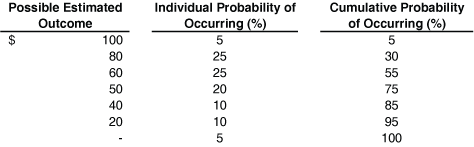
740-10-55-82
Cases A and B share all of the following assumptions.
740-10-55-83
An entity anticipates claiming a $1 million research and experimentation credit on its tax return for the current fiscal year. The credit comprises equal spending on 4 separate projects (that is, $250,000 of tax credit per project). The entity expects to have sufficient taxable income in the current year to fully utilize the $1 million credit. Upon review of the supporting documentation, management believes it is more likely than not that the entity will ultimately sustain a benefit of approximately $650,000. The anticipated benefit consists of approximately $200,000 per project for the first 3 projects and $50,000 for the fourth project.
740-10-55-84
This Case illustrates an entity's initial determination of the unit of account for a tax position.
740-10-55-85
In its evaluation of the appropriate amount to recognize, management first determines the appropriate unit of account for the tax position. Because of the magnitude of expenditures in each project, management concludes that the appropriate unit of account is each individual research project. In reaching this conclusion, management considers both the level at which it accumulates information to support the tax return and the level at which it anticipates addressing the issue with taxing authorities. In this Case, upon review of the four projects including the magnitude of expenditures, management determines that it accumulates information at the project level. Management also anticipates the taxing authority will address the issues during an examination at the level of individual projects.
740-10-55-86
In evaluating the projects for recognition, management determines that three projects meet the more-likely-than-not recognition threshold. However, due to the nature of the activities that constitute the fourth project, it is uncertain that the tax benefit related to this project will be allowed. Because the tax benefit related to that fourth project does not meet the more-likely-than-not recognition threshold, it should not be recognized in the financial statements, even though tax positions associated with that project will be included in the tax return. The entity would recognize a $600,000 financial statement benefit related to the first 3 projects but would not recognize a financial statement benefit related to the fourth project.
740-10-55-87
This Case illustrates a change in an entity's initial determination of the unit of account for a tax position.
740-10-55-88
In Year 2, the entity increases its spending on research and experimentation projects and anticipates claiming significantly larger research credits in its Year 2 tax return. In light of the significant increase in expenditures, management reconsiders the appropriateness of the unit of account and concludes that the project level is no longer the appropriate unit of account for research credits. This conclusion is based on the magnitude of spending and anticipated claimed credits and on previous experience and is consistent with the advice of external tax advisors. Management anticipates the taxing authority will focus the examination on functional expenditures when examining the Year 2 return and thus needs to evaluate whether it can change the unit of account in subsequent years' tax returns.
740-10-55-89
Determining the unit of account requires evaluation of the entity's facts and circumstances. In making that determination, management evaluates the manner in which it prepares and supports its income tax return and the manner in which it anticipates addressing issues with taxing authorities during an examination. The unit of account should be consistently applied to similar positions from period to period unless a change in facts and circumstances indicates that a different unit of account is more appropriate. Because of the significant change in the tax position in Year 2, management's conclusion that the taxing authority will likely examine tax credits in the Year 2 tax return at a more detailed level than the individual project is reasonable and appropriate. Accordingly, the entity should reevaluate the unit of account for the Year 2 financial statements based on the new facts and circumstances.
740-10-55-90
The guidance in paragraph 740-10-25-7(b) on evaluating a taxing authority's widely understood administrative practices and precedents shall be taken into account when assessing the more-likely-than-not recognition threshold established in paragraph 740-10-25-6. This Example illustrates such consideration.
740-10-55-91
An entity has established a capitalization threshold of $2,000 for its tax return for routine property and equipment purchases. Assets purchased for less than $2,000 are claimed as expenses on the tax return in the period they are purchased. The tax law does not prescribe a capitalization threshold for individual assets, and there is no materiality provision in the tax law. The entity has not been previously examined. Management believes that based on previous experience at a similar entity and current discussions with its external tax advisors, the taxing authority will not disallow tax positions based on that capitalization policy and the taxing authority's historical administrative practices and precedents.
740-10-55-92
Some might deem the entity's capitalization policy a technical violation of the tax law, since that law does not prescribe capitalization thresholds. However, in this situation the entity has concluded that the capitalization policy is consistent with the demonstrated administrative practices and precedents of the taxing authority and the practices of other entities that are regularly examined by the taxing authority. Based on its previous experience with other entities and consultation with its external tax advisors, management believes the administrative practice is widely understood. Accordingly, because management expects the taxing authority to allow this position when and if examined, the more-likely-than-not recognition threshold has been met.
740-10-55-93
The guidance in paragraph 740-10-25-7(b) on evaluating a taxing authority's widely understood administrative practices and precedents shall be taken into account when assessing the more-likely-than-not recognition threshold established in paragraph 740-10-25-6. This Example illustrates such consideration.
740-10-55-94
An entity has been incorporated in Jurisdiction A for 50 years; it has filed a tax return in Jurisdiction A in each of those 50 years. The entity has been doing business in Jurisdiction B for approximately 20 years and has filed a tax return in Jurisdiction B for each of those 20 years. However, the entity is not certain of the exact date it began doing business, or the date it first had nexus, in Jurisdiction B.
740-10-55-95
The entity understands that if a tax return is not filed, the statute of limitations never begins to run; accordingly, failure to file a tax return effectively means there is no statute of limitations. The entity has become familiar with the administrative practices and precedents of Jurisdiction B and understands that Jurisdiction B will look back only six years in determining if there is a tax return due and a deficiency owed. Because of the administrative practices of the taxing authority and the facts and circumstances, the entity believes it is more likely than not that a tax return is not required to be filed in Jurisdiction B at an earlier date and that a liability for tax exposures for those periods is not required.
740-10-55-96
Paragraph 740-10-30-20 requires that entities determine the amount of available future taxable income from a tax-planning strategy based on the application of the recognition and measurement requirements of this Subtopic for tax positions. This Example illustrates the recognition aspect of that requirement.
740-10-55-97
An entity has a wholly owned subsidiary with certain deferred tax assets as a result of several years of losses from operations. Management has determined that it is more likely than not that sufficient future taxable income will not be available to realize those deferred tax assets. Therefore, management recognizes a full valuation allowance for those deferred tax assets both in the separate financial statements of the subsidiary and in the consolidated financial statements of the entity.
740-10-55-98
Management has identified certain tax-planning strategies that might enable the realization of those deferred tax assets. Management has determined that the strategies will meet the minimum statutory threshold to avoid penalties and that it is not more likely than not that the strategies would be sustained upon examination based on the technical merits. Accordingly, those strategies may not be used to reduce the valuation allowance on the deferred tax assets. Only a tax-planning strategy that meets the more-likely-than-not recognition threshold would be considered in evaluating the sufficiency of future taxable income for realization of deferred tax assets.
740-10-55-99
This Example illustrates the recognition and measurement criteria of this Subtopic to tax positions where the tax law is unambiguous. The recognition and measurement criteria of this Subtopic applicable to tax positions begin in paragraph 740-10-25-5 for recognition and paragraph 740-10-30-7 for measurement.
740-10-55-100
An entity has taken a tax position that it believes is based on clear and unambiguous tax law for the payment of salaries and benefits to employees. The class of salaries being evaluated in this tax position is not subject to any limitations on deductibility (for example, executive salaries are not included), and none of the expenditures are required to be capitalized (for example, the expenditures do not pertain to the production of inventories); all amounts accrued at year-end were paid within the statutorily required time frame subsequent to the reporting date. Management concludes that the salaries are fully deductible.
740-10-55-101
All tax positions are subject to the requirements of this Subtopic. However, because the deduction is based on clear and unambiguous tax law, management has a high confidence level in the technical merits of this position. Accordingly, the tax position clearly meets the recognition criterion and should be evaluated for measurement. In determining the amount to measure, management is highly confident that the full amount of the deduction will be allowed and it is clear that it is greater than 50 percent likely that the full amount of the tax position will be ultimately realized. Accordingly, the entity would recognize the full amount of the tax position in the financial statements.
740-10-55-102
This Example demonstrates an application of the measurement requirements of paragraph 740-10-30-7 for a tax position that meets the paragraph 740-10-25-6 requirements for recognition. Measurement in this Example is based on identified information about settlement.
740-10-55-103
In applying the recognition criterion of this Subtopic for tax positions, an entity has determined that a tax position resulting in a benefit of $100 qualifies for recognition and should be measured. The entity has considered the amounts and probabilities of the possible estimated outcomes as follows.
  • Possible Estimated Outcome Individual Probability of Occurring (%) Cumulative Probability of Occurring (%) $100 5 5 80 25 30 60 25 55 50 20 75 40 10 85 20 10 95 - 5 100

740-10-55-104
Because $60 is the largest amount of benefit that is greater than 50 percent likely of being realized upon settlement, the entity would recognize a tax benefit of $60 in the financial statements.
740-10-55-105
As in the preceding Example, this Example also demonstrates an application of the measurement requirements of paragraph 740-10-30-7 for a tax position determined to meet recognition requirements. While measurement in this Example is also based on identified information about settlement, the information is more limited than in the preceding Example.
740-10-55-106
In applying the recognition criterion of this Subtopic for tax positions an entity has determined that a tax position resulting in a benefit of $100 qualifies for recognition and should be measured. There is limited information about how a taxing authority will view the position. After considering all relevant information, management's confidence in the technical merits of the tax position exceeds the more-likely-than-not recognition threshold, but management also believes it is likely it would settle for less than the full amount of the entire position when examined. Management has considered the amounts and the probabilities of the possible estimated outcomes.
  • Possible Estimated Outcome Individual Probability of Occurring (%) Cumulative Probability of Occurring (%) $100 25 25 75 50 75 50 25 100
740-10-55-107
Because $75 is the largest amount of benefit that is greater than 50 percent likely of being realized upon settlement, the entity would recognize a tax benefit of $75 in the financial statements.
740-10-55-108
This Example demonstrates an application of the measurement requirements of paragraph 740-10-30-7 for a tax position that meets the paragraph 740-10-25-6 requirements for recognition. Measurement in this Example is based on settlement of a similar tax position with the taxing authority.
740-10-55-109
In applying the recognition criterion of this Subtopic for tax positions, an entity has determined that a tax position resulting in a benefit of $100 qualifies for recognition and should be measured. In a recent settlement with the taxing authority, the entity has agreed to the treatment for that position for current and future years. There are no recently issued relevant sources of tax law that would affect the entity's assessment. The entity has not changed any assumptions or computations, and the current tax position is consistent with the position that was recently settled. In this case, the entity would have a very high confidence level about the amount that will be ultimately realized and little information about other possible outcomes. Management will not need to evaluate other possible outcomes because it can be confident of the largest amount of benefit that is greater than 50 percent likely of being realized upon settlement without that evaluation.
740-10-55-110
This Example demonstrates an application of the measurement requirements of paragraph 740-10-30-7 for a tax position that meets the paragraph 740-10-25-6 requirements for recognition. Measurement in this Example is based on the timing of the deduction.
740-10-55-111
In Year 1, an entity acquired a separately identifiable intangible asset for $15 million that has an indefinite life for financial statement purposes and is, therefore, not subject to amortization. Based on some uncertainty in the tax code, the entity decides for tax purposes to deduct the entire cost of the asset in Year 1. While the entity is certain that the full amount of the intangible is ultimately deductible for tax purposes, the timing of deductibility is uncertain under the tax code. In applying the recognition criterion of this Subtopic for tax positions, the entity has determined that the tax position qualifies for recognition and should be measured. The entity believes it is 25 percent likely it would be able to realize immediate deduction upon settlement, and it is certain it could sustain a 15-year amortization for tax purposes. Thus, the largest Year 1 benefit that is greater than 50 percent likely of being realized upon settlement is the tax effect of $1 million (the Year 1 deduction from straight-line amortization of the asset over 15 years).
740-10-55-112
At the end of Year 1, the entity should reflect a deferred tax liability for the tax effect of the temporary difference created by the difference between the financial statement basis of the asset ($15 million) and the tax basis of the asset computed in accordance with the guidance in this Subtopic for tax positions ($14 million, the cost of the asset reduced by $1 million of amortization). The entity also should reflect a tax liability for the tax-effected difference between the as-filed tax position ($15 million deduction) and the amount of the deduction that is considered more likely than not of being sustained ($1 million). The entity should evaluate the tax position for accrual of statutory penalties as well as interest expense on the difference between the amounts reported in the financial statements and the tax position taken in the tax return.
740-10-55-113
This Example demonstrates an application of the measurement requirements of paragraph 740-10-30-7 for a tax position that meets the paragraph 740-10-25-6 requirements for recognition. Measurement in this Example is based on a change in timing of deductibility.
740-10-55-114
In 20X1 an entity took a tax position in which it amortizes the cost of an acquired asset on a straight-line basis over three years, while the amortization period for financial reporting purposes is seven years. After one year, the entity has deducted one-third of the cost of the asset in its income tax return and one-seventh of the cost in the financial statements and, consequently, has a deferred tax liability for the difference between the financial reporting and tax bases of the asset.
740-10-55-115
In accordance with the requirements of this Subtopic, the entity evaluates the tax position as of the reporting date of the financial statements. In 20X2, the entity determines that it is still certain that the entire cost of the acquired asset is fully deductible, so the more-likely-than-not recognition threshold has been met according to paragraph 740-10-25-6. However, in 20X2, the entity now believes based on new information that the largest benefit that is greater than 50 percent likely of being realized upon settlement is straight-line amortization over 7 years.
740-10-55-116
In this Example, the entity would recognize a liability for unrecognized tax benefits based on the difference between the three- and seven-year amortization. In 20X2, no deferred tax liability should be recognized, as there is no longer a temporary difference between the financial statement carrying value of the asset and the tax basis of the asset based on this Subtopic's measurement requirements for tax positions. Additionally, the entity should evaluate the need to accrue interest and penalties, if applicable under the tax law.
740-10-55-117
Paragraphs 740-10-25-6 and 740-10-25-8 require that tax positions be recognized and measured based on information available at the reporting date. This Example demonstrates the effect of information becoming available after the reporting date but before the financial statements are issued or are available to be issued (as discussed in Section 855-10-25).
740-10-55-118
Entity A has evaluated a tax position at its most recent reporting date and has concluded that the position meets the more-likely-than-not recognition threshold. In evaluating the tax position for recognition, Entity A considered all relevant sources of tax law, including a court case in which the taxing authority has fully disallowed a similar tax position with an unrelated entity (Entity B). The taxing authority and Entity B are aggressively litigating the matter. Although Entity A was aware of that court case at the recent reporting date, management determined that the more-likely-than not recognition threshold had been met. After the reporting date, but before the financial statements are issued or are available to be issued (as discussed in Section 855-10-25), the taxing authority prevailed in its litigation with Entity B, and Entity A concludes that it is no longer more likely than not that it will sustain the position.
740-10-55-119
Paragraph 740-10-40-2 provides the guidance that an entity shall derecognize a previously recognized tax position in the first period in which it is no longer more likely than not that the tax position would be sustained upon examination, and paragraphs 740-10-25-14; 740-10-35-2; and740-10-40-2 establish that subsequent recognition, derecognition, and measurement shall be based on management's best judgment given the facts, circumstances, and information available at the reporting date. Because the resolution of Entity B's litigation with the taxing authority is the information that caused Entity A to change its judgment about the sustainability of the position and that information was not available at the reporting date, the change in judgment would be recognized in the first quarter of the current fiscal year.
740-10-55-120
This Example illustrates the guidance in paragraphs relating to recognition of deferred tax assets and liabilities, including when a detailed analysis of sources of taxable income may not be necessary in considering the need for a valuation allowance for deferred tax assets. In this Example, an entity has $2,400 of deductible temporary differences and $1,500 of taxable temporary differences at the end of Year 3 (the current year).
740-10-55-121
A deferred tax liability is recognized at the end of Year 3 for the $1,500 of taxable temporary differences, and deferred tax asset is recognized for the $2,400 of deductible temporary differences. All available evidence, both positive and negative, is considered to determine whether, based on the weight of that evidence, a valuation allowance is needed for some portion or all of the deferred tax asset. If evidence about one or more sources of taxable income (see paragraph 740-10-30-18) is sufficient to support a conclusion that a valuation allowance is not needed, other sources of taxable income need not be considered. For example, if the weight of available evidence indicates that taxable income will exceed $2,400 in each future year, a conclusion that no valuation allowance is needed can be reached without considering the pattern and timing of the reversal of the temporary differences, the existence of qualifying tax-planning strategies, and so forth.
740-10-55-122
Similarly, if the deductible temporary differences will reverse within the next 3 years and taxable income in the current year exceeds $2,400, nothing needs to be known about future taxable income exclusive of reversing temporary differences because the deferred tax asset could be realized by carryback to the current year. A valuation allowance is needed, however, if the weight of available evidence indicates that some portion or all of the $2,400 of tax deductions from future reversals of the deductible temporary differences will not be realized by offsetting any of the following:
  1. a
    The $1,500 of taxable temporary differences and $900 of future taxable income exclusive of reversing temporary differences
  2. b
    $2,400 of future taxable income exclusive of reversing temporary differences
  3. c
    $2,400 of taxable income in the current or prior years by loss carryback to those years
  4. d
    $2,400 of taxable income in one or more of the circumstances described above and as a result of a qualifying tax-planning strategy (see paragraphs ).
Paragraph 740-10-55-8 provides guidance on when a detailed analysis of sources of taxable income may not be necessary in considering the need for a valuation allowance for deferred tax assets.
740-10-55-123
Detailed analyses are not necessary, for example, if the entity earned $500 of taxable income in each of Years 1-3 and there is no evidence to suggest it will not continue to earn that level of taxable income in future years. That level of future taxable income is more than sufficient to realize the tax benefit of $2,400 of tax deductions over a period of at least 19 years (the year(s) of the deductions, 3 carryback years, and 15 carryforward years) in the U.S. federal tax jurisdiction.
740-10-55-124
This Example illustrates the guidance in paragraphs relating to recognition of a valuation allowance for a portion of a deferred tax asset in one year and a subsequent change in circumstances that requires adjustment of the valuation allowance at the end of the following year. This Example has the following assumptions:
  1. a
    At the end of the current year (Year 3), an entity's only temporary differences are deductible temporary differences in the amount of $900.
  2. b
    Pretax financial income, taxable income, and taxes paid for each of Years 1-3 are all positive, but relatively negligible, amounts.
  3. c
    The enacted tax rate is 40 percent for all years.

740-10-55-125
A deferred tax asset in the amount of $360 ($900 at 40 percent) is recognized at the end of Year 3. If management concludes, based on an assessment of all available evidence (see guidance in paragraphs ), that it is more likely than not that future taxable income will not be sufficient to realize a tax benefit for $400 of the $900 of deductible temporary differences at the end of the current year, a $160 valuation allowance ($400 at 40 percent) is recognized at the end of Year 3.
740-10-55-126
Assume that pretax financial income and taxable income for Year 4 turn out to be as follows.
  • Pretax financial loss $(50) Reversing deductible temporary differences (300) Loss carryforward for tax purposes $(350)

740-10-55-127
The $50 pretax loss in Year 4 is additional negative evidence that must be weighed against available positive evidence to determine the amount of valuation allowance necessary at the end of Year 4. Deductible temporary differences and carryforwards at the end of Year 4 are as follows.
  • Loss carryforward from Year 4 for tax purposes (see above) $350 Unreversed deductible temporary differences ($900 - $300) 600 $950
740-10-55-128
The $360 deferred tax asset recognized at the end of Year 3 is increased to $380 ($950 at 40 percent) at the end of Year 4. Based on an assessment of all evidence available at the end of Year 4, management concludes that it is more likely than not that $240 of the deferred tax asset will not be realized and, therefore, that a $240 valuation allowance is necessary. The $160 valuation allowance recognized at the end of Year 3 is increased to $240 at the end of Year 4. The $60 net effect of those 2 adjustments (the $80 increase in the valuation allowance less the $20 increase in the deferred tax asset) results in $60 of deferred tax expense that is recognized in Year 4.
740-10-55-129
This Example illustrates the guidance in paragraph 740-10-55-23 for determination of the tax rate for measurement of a deferred tax liability for taxable temporary differences when there is a phased-in change in tax rates. At the end of Year 3 (the current year), an entity has $2,400 of taxable temporary differences, which are expected to result in taxable amounts of approximately $800 on the future tax returns for each of Years 4-6. Enacted tax rates are 35 percent for Years 1-3, 40 percent for Years 4-6, and 45 percent for Year 7 and thereafter.
740-10-55-130
The tax rate that is used to measure the deferred tax liability for the $2,400 of taxable temporary differences differs depending on whether the tax effect of future reversals of those temporary differences is on taxes payable for Years 1-3, Years 4-6, or Year 7 and thereafter. The tax rate for measurement of the deferred tax liability is 40 percent whenever taxable income is expected in Years 4-6. If tax losses are expected in Years 4-6, however, the tax rate is:
  1. a
    35 percent if realization of a tax benefit for those tax losses in Years 4-6 will be by loss carryback to Years 1-3
  2. b
    45 percent if realization of a tax benefit for those tax losses in Years 4-6 will be by loss carryforward to Year 7 and thereafter.
740-10-55-131
This Example illustrates the guidance in paragraph 740-10-55-23 for determination of the tax rate for measurement of a deferred tax asset for deductible temporary differences when there is a change in tax rates. This Example has the following assumptions:
  1. a
    Enacted tax rates are 30 percent for Years 1-3 and 40 percent for Year 4 and thereafter.
  2. b
    At the end of Year 3 (the current year), an entity has $900 of deductible temporary differences, which are expected to result in tax deductions of approximately $300 on the future tax returns for each of Years 4-6.
740-10-55-132
The tax rate is 40 percent if the entity expects to realize a tax benefit for the deductible temporary differences by offsetting taxable income earned in future years. Alternatively, the tax rate is 30 percent if the entity expects to realize a tax benefit for the deductible temporary differences by loss carryback refund.
740-10-55-133
Further assume for this Example both of the following:
  1. a
    The entity recognizes a $360 ($900 at 40 percent) deferred tax asset to be realized by offsetting taxable income in future years.
  2. b
    Taxable income and taxes payable in each of Years 1-3 were $300 and $90, respectively.
740-10-55-134
Realization of a tax benefit of at least $270 ($900 at 30 percent) is assured because carryback refunds totaling $270 may be realized even if no taxable income is earned in future years. Recognition of a valuation allowance for the other $90 ($360 - $270) of the deferred tax asset depends on management's assessment of whether, based on the weight of available evidence, a portion or all of the tax benefit of the $900 of deductible temporary differences will not be realized at 40 percent tax rates in future years.
740-10-55-135
Alternatively, if enacted tax rates are 40 percent for Years 1-3 and 30 percent for Year 4 and thereafter, measurement of the deferred tax asset at a 40 percent tax rate could only occur if tax losses are expected in future Years 4-6.
740-10-55-136
This Example illustrates the guidance in paragraph 740-10-55-23 for determination of the average graduated tax rate for measurement of deferred tax liabilities and assets by an entity for which graduated tax rates ordinarily are a significant factor. At the end of Year 3 (the current year), an entity has $1,500 of taxable temporary differences and $900 of deductible temporary differences, which are expected to result in net taxable amounts of approximately $200 on the future tax returns for each of Years 4-6. Enacted tax rates are 15 percent for the first $500 of taxable income, 25 percent for the next $500, and 40 percent for taxable income over $1,000. This Example assumes that there is no income (for example, capital gains) subject to special tax rates.
740-10-55-137
The deferred tax liability and asset for those reversing taxable and deductible temporary differences in Years 4-6 are measured using the average graduated tax rate for the estimated amount of annual taxable income in future years. Thus, the average graduated tax rate will differ depending on the expected level of annual taxable income (including reversing temporary differences) in Years 4-6. The average tax rate will be:
  1. a
    15 percent if the estimated annual level of taxable income in Years 4-6 is $500 or less
  2. b
    20 percent if the estimated annual level of taxable income in Years 4-6 is $1,000
  3. c
    30 percent if the estimated annual level of taxable income in Years 4-6 is $2,000.
740-10-55-138
Temporary differences usually do not reverse in equal annual amounts as in the Example above, and a different average graduated tax rate might apply to reversals in different future years. However, a detailed analysis to determine the net reversals of temporary differences in each future year usually is not warranted. It is not warranted because the other variable (that is, taxable income or losses exclusive of reversing temporary differences in each of those future years) for determination of the average graduated tax rate in each future year is no more than an estimate. For that reason, an aggregate calculation using a single estimated average graduated tax rate based on estimated average annual taxable income in future years is sufficient. Judgment is permitted, however, to deal with unusual situations, for example, an abnormally large temporary difference that will reverse in a single future year, or an abnormal level of taxable income that is expected for a single future year. The lowest graduated tax rate should be used whenever the estimated average graduated tax rate otherwise would be zero.
740-10-55-139
The guidance in paragraph 740-10-55-26 addressing when a tax is an income tax is illustrated using the following example.
740-10-55-140
A state's franchise tax on each corporation is set at the greater of 0.25 percent of the corporation's net taxable capital and 4.5 percent of the corporation's net taxable earned surplus. Net taxable earned surplus is a term defined by the tax statute for federal taxable income.
740-10-55-141
In this Example, the amount of franchise tax equal to the tax on the corporation's net taxable earned surplus is an income tax.
740-10-55-142
Deferred tax assets and liabilities are required to be recognized under this Subtopic for the temporary differences that exist as of the date of the statement of financial position using the tax rate to be applied to the corporation's net taxable earned surplus (4.5 percent).
740-10-55-143
The portion of the total computed franchise tax that exceeds the amount equal to the tax on the corporation's net taxable earned surplus should not be presented as a component of income tax expense during any period in which the total computed franchise tax exceeds the amount equal to the tax on the corporation's net taxable earned surplus.
740-10-55-144
While the tax statutes of states or other jurisdictions differ, the accounting described in paragraphs would be appropriate if the tax structure of another state or jurisdiction was essentially the same as in this Example.
740-10-55-145
Paragraph 740-10-55-27 introduces guidance relating to a special deduction for qualified production activities that may be available to an entity under the American Jobs Creation Act of 2004.
740-10-55-146
This Example illustrates how an entity with a calendar year-end would apply paragraphs 740-10-25-37 and 740-10-35-4 to the qualified production activities deduction at December 31, 2004. In particular, this Example illustrates the methodology used to evaluate the qualified production activities deduction's effect on determining the need for a valuation allowance on an entity's existing net deferred tax assets. This Example intentionally is not comprehensive (for example, it excludes state and local taxes).
740-10-55-147
This Example has the following assumptions:
  1. a
    Expected taxable income (excluding the qualified production activities deduction and net operating loss carryforwards) for 2005: $21,000
  2. b
    Expected qualified production activities income for 2005: $50,000
  3. c
    Net operating loss carryforwards at December 31, 2004, which expire in 2005: $20,000
  4. d
    Expected W-2 wages for 2005: $10,000
  5. e
    Assumed statutory income tax rate: 35%
  6. f
    Qualified production activities deduction: 3% of the lesser of qualified production activities income or taxable income (after deducting the net operating loss carryforwards); limited to 50% of W-2 wages: $30.
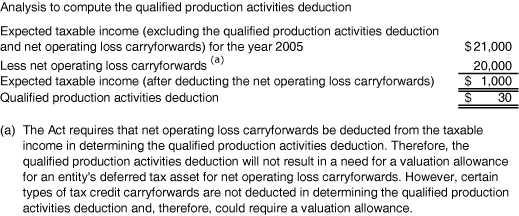
740-10-55-148
Based on these assumptions, the entity would not recognize a valuation allowance for the net operating loss carryforwards at December 31, 2004, because expected taxable income in 2005 (after deducting the qualified production activities deduction) exceeds the net operating loss carryforwards, as follows.
  • Analysis to compute the qualified production activities deduction Expected taxable income (excluding the qualified production activities deduction and net operating loss carryforwards) for the year 2005 " $21,000 " Less net operating loss carryforwards (a) " 20,000 " Expected taxable income (after deducting the net operating loss carryforwards) " $1,000 " Qualified production activities deduction $30 (a) "The Act requires that net operating loss carryforwards be deducted from the taxable income in determining the qualified production activities deduction. Therefore, the qualified production activities deduction will not result in a need for a valuation allowance for an entity's deferred tax asset for net operating loss carryforwards. However, certain types of tax credit carryforwards are not deducted in determining the qualified production activities deduction and, therefore, could require a valuation allowance."

  • Analysis to determine the effect of the qualified production activities deduction on the need for a valuation allowance for deferred tax assets for the net operating loss carryforwards Expected taxable income after deducting the qualified production activities deduction " $20,970 " Net operating loss carryforwards " 20,000 " Expected taxable income exceeds the net operating loss carryforwards $970
740-10-55-149
This Example illustrates the guidance in paragraphs for recognition of the tax benefit of an operating loss in the loss year and in subsequent carryforward years when a valuation allowance is necessary in the loss year. This Example has the following assumptions:
  1. a
    The enacted tax rate is 40 percent for all years.
  2. b
    An operating loss occurs in Year 5.
  3. c
    The only difference between financial and taxable income results from use of accelerated depreciation for tax purposes. Differences that arise between the reported amount and the tax basis of depreciable assets in Years 1-7 will result in taxable amounts before the end of the loss carryforward period from Year 5.
  4. d
    Financial income, taxable income, and taxes currently payable or refundable are as follows.
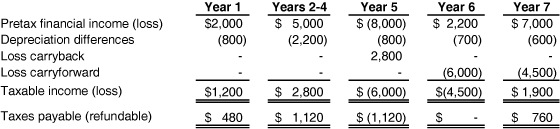
    • Year 1 Years 2-4 Year 5 Year 6 Year 7 Pretax financial income (loss) " $2,000 " " $5,000 " " $(8,000)" " $2,200 " " $7,000 " Depreciation differences (800) " (2,200)" (800) (700) (600) Loss carryback - - " 2,800 " - - Loss carryforward - - - " (6,000)" " (4,500)" Taxable income (loss) " $1,200 " " $2,800 " " $(6,000)" " $(4,500)" " $1,900 " Taxes payable (refundable) $480 " $1,120 " " $(1,120)" $- $760
  5. e
    At the end of Year 5, profits are not expected in Years 6 and 7 and later years, and it is concluded that a valuation allowance is necessary to the extent realization of the deferred tax asset for the operating loss carryforward depends on taxable income (exclusive of reversing temporary differences) in future years.
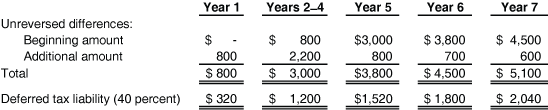
740-10-55-150
The deferred tax liability for the taxable temporary differences is calculated at the end of each year as follows.
  • Year 1 Years 2-4 Year 5 Year 6 Year 7 Unreversed differences: Beginning amount $- $800 " $3,000 " " $3,800 " " $4,500 " Additional amount 800 " 2,200 " 800 700 600 Total $800 " $3,000 " " $3,800 " " $4,500 " " $5,100 " Deferred tax liability (40 percent) $320 " $1,200 " " $1,520 " " $1,800 " " $2,040 "

740-10-55-151
The deferred tax asset and related valuation allowance for the loss carryforward are calculated at the end of each year as follows.
  • Year 1 Years 2-4 Year 5 Year 6 Year 7 Loss carryforward for tax purposes $- $- " $6,000 " " $4,500 " $- Deferred tax asset (40 percent) $- $- " $2,400 " " $1,800 " $- Valuation allowance equal to the amount by which the deferred tax asset exceeds the deferred tax liability - - (880) - - Net deferred tax asset $- $- " $1,520 " " $1,800 " $-

740-10-55-152
Total tax expense for each period is as follows.
  • Year 1 Years 2-4 Year 5 Year 6 Year 7 Deferred tax expense (benefit): Increase in deferred tax liability $320 $880 $320 $280 $240 (Increase) decrease in net deferred tax asset - - " (1,520)" (280) " 1,800 " 320 880 " (1,200)" - " 2,040 " Currently payable (refundable) 480 " 1,120 " " (1,120)" - 760 Total tax expense (benefit) $800 " $2,000 " " $(2,320)" $- " $2,800 "
740-10-55-153
In Year 5, $2,800 of the loss is carried back to reduce taxable income in Years 2-4, and $1,120 of taxes paid for those years is refunded. In addition, a $1,520 deferred tax liability is recognized for $3,800 of taxable temporary differences, and a $2,400 deferred tax asset is recognized for the $6,000 loss carryforward. However, based on the conclusion described in paragraph 740-10-55-149(e), a valuation allowance is recognized for the amount by which that deferred tax asset exceeds the deferred tax liability.
740-10-55-154
In Year 6, a portion of the deferred tax asset for the loss carryforward is realized because taxable income is earned in that year. The remaining balance of the deferred tax asset for the loss carryforward at the end of Year 6 equals the deferred tax liability for the taxable temporary differences. A valuation allowance is not needed.
740-10-55-155
In Year 7, the remaining balance of the loss carryforward is realized, and $760 of taxes are payable on net taxable income of $1,900. A $2,040 deferred tax liability is recognized for the $5,100 of taxable temporary differences.
740-10-55-156
This Example illustrates the guidance in paragraph 740-10-55-37 for the interaction of loss carryforwards and temporary differences that will result in net deductible amounts in future years. This Example has the following assumptions:
  1. a
    The financial loss and the loss reported on the tax return for an entity's first year of operations are the same.
  2. b
    In Year 2, a gain of $2,500 from a transaction that is a sale for tax purposes but does not meet the sale recognition criteria for financial reporting purposes is the only difference between pretax financial income and taxable income.
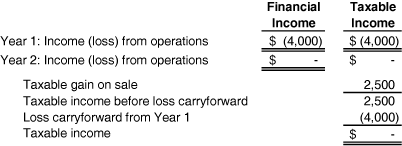
740-10-55-157
Financial and taxable income in this Example are as follows.
  • Financial Income Taxable Income Year 1: Income (loss) from operations " $(4,000)" " $(4,000)" Year 2: Income (loss) from operations $- $- Taxable gain on sale " 2,500 " Taxable income before loss carryforward " 2,500 " Loss carryforward from Year 1 " (4,000)" Taxable income $-
740-10-55-158
The $4,000 operating loss carryforward at the end of Year 1 is reduced to $1,500 at the end of Year 2 because $2,500 of it is used to reduce taxable income. The $2,500 reduction in the loss carryforward becomes $2,500 of deductible temporary differences that will reverse and result in future tax deductions when the sale occurs (that is, control of the asset transfers to the buyer-lessor). The entity has no deferred tax liability to be offset by those future tax deductions, the future tax deductions cannot be realized by loss carryback because no taxes have been paid, and the entity has had pretax losses for financial reporting since inception. Unless positive evidence exists that is sufficient to overcome the negative evidence associated with those losses, a valuation allowance is recognized at the end of Year 2 for the full amount of the deferred tax asset related to the $2,500 of deductible temporary differences and the remaining $1,500 of operating loss carryforward.
740-10-55-159
This Example illustrates the guidance in paragraph 740-10-55-44 for recognition of a deferred tax asset based on the expected effect of a qualifying tax-planning strategy when a significant expense would be incurred to implement the strategy. This Example has the following assumptions:
  1. a
    A $900 operating loss carryforward expires at the end of next year.
  2. b
    Based on historical results and the weight of other available evidence, the estimated level of taxable income exclusive of the future reversal of existing temporary differences and the operating loss carryforward next year is $100.
  3. c
    Taxable temporary differences in the amount of $1,200 ordinarily would result in taxable amounts of approximately $400 in each of the next 3 years.
  4. d
    There is a qualifying tax-planning strategy to accelerate the future reversal of all $1,200 of taxable temporary differences to next year.
  5. e
    Estimated legal and other expenses to implement that tax-planning strategy are $150.
  6. f
    The enacted tax rate is 40 percent for all years.
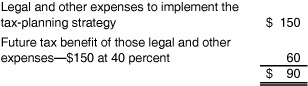
740-10-55-160
Without the tax-planning strategy, only $500 of the $900 operating loss carryforward could be realized next year by offsetting $100 of taxable income exclusive of reversing temporary differences and $400 of reversing taxable temporary differences. The other $400 of operating loss carryforward would expire unused at the end of next year. Therefore, the $360 deferred tax asset ($900 at 40 percent) would be offset by a $160 valuation allowance ($400 at 40 percent), and a $200 net deferred tax asset would be recognized for the operating loss carryforward.
740-10-55-161
With the tax-planning strategy, the $900 operating loss carryforward could be applied against $1,300 of taxable income next year ($100 of taxable income exclusive of reversing temporary differences and $1,200 of reversing taxable temporary differences). The $360 deferred tax asset is reduced by a $90 valuation allowance recognized for the net-of-tax expenses necessary to implement the tax-planning strategy. The amount of that valuation allowance is determined as follows.
  • Legal and other expenses to implement the tax-planning strategy $150 Future tax benefit of those legal and other expenses—$150 at 40 percent 60 $90
740-10-55-162
In summary, a $480 deferred tax liability is recognized for the $1,200 of taxable temporary differences, a $360 deferred tax asset is recognized for the $900 operating loss carryforward, and a $90 valuation allowance is recognized for the net-of-tax expenses of implementing the tax-planning strategy.
740-10-55-163
This Example illustrates the guidance in paragraphs relating to tax-planning strategies. An entity might identify several qualifying tax-planning strategies that would either reduce or eliminate the need for a valuation allowance for a deferred tax asset. For example, assume that an entity's required valuation allowance would be reduced $5,000 based on Strategy A, $7,000 based on Strategy B, and $12,000 based on both strategies. The entity may not recognize the effect of one of those strategies in the current year and postpone recognition of the effect of the other strategy to a later year.
740-10-55-164
The entity should recognize the effect of both tax-planning strategies and reduce the valuation allowance by $12,000 at the end of the current year. Paragraph 740-10-30-19 provides guidance on tax-planning strategies and establishes the requirement that strategies meeting the criteria set forth in that paragraph shall be considered in determining the required valuation allowance.
740-10-55-165
Paragraph 740-10-55-54 introduces guidance relating to a nontaxable subsidy that may be available to an entity under the Medicare Prescription Drug, Improvement, and Modernization Act of 2003. This Example illustrates that guidance.
740-10-55-166
Before the accounting for the effects of the Act, an employer's carrying amount of accrued postretirement benefit cost (the amount recognized in the statement of financial position) is $100 for a noncontributory, unfunded prescription drug benefit plan with only inactive participants who are not yet eligible to collect benefits. Assuming a tax rate of 35 percent and no corresponding tax basis for the accrued postretirement benefit cost, the employer would report a $35 deferred tax asset related to that $100 deductible temporary difference. Because the employer has a policy of amortizing gains and losses under paragraph 715-60-35-29, upon recognition of a $28 actuarial gain resulting from the estimate of the expected subsidy, neither the carrying amount of accrued postretirement benefit cost nor the deferred tax asset would change. Subsequently, ignoring interest on the accumulated postretirement benefit obligation (which includes interest on the subsidy), as the actuarial gain related to the subsidy is amortized as a component of net periodic postretirement benefit cost, the carrying amount of accrued postretirement cost would be reduced. However, the associated temporary difference and deferred tax asset would remain unchanged. That is, after the gain related to the subsidy is amortized in its entirety, the carrying amount of accrued postretirement benefit cost would be $72, and the deferred tax asset would remain at $35.
740-10-55-167
For purposes of simplicity, this Example ignores complexities regarding the amount and timing of the subsidies reflected in the carrying amount of accrued postretirement benefit cost arising from any of the following:
  1. a
    Netting gains and losses and application of the corridor amortization approach described in paragraph 715-60-35-29
  2. b
    Recognition of additional subsidies through amortization of prior service costs that include effects of the subsidy
  3. c
    Reduction in future service and interest costs.
Those complexities must be considered in determining the temporary difference on which the deferred tax effects under this Topic will be based.
740-10-55-168
This Example illustrates an entity's change from taxable C corporation status to nontaxable S corporation status, in accordance with the guidance provided in paragraph 740-10-55-65. This Example has the following assumptions:
  1. a
    An entity's S corporation election is effective for calendar-year 1990 and that at the conversion date its assets comprise marketable securities, finished goods inventory, and depreciable assets as follows.
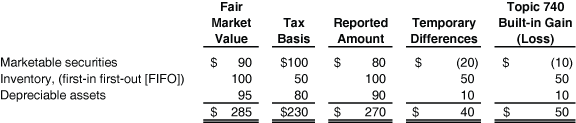
    • Fair Market Value Tax Basis Reported Amount Temporary Differences Topic 740 Built-in Gain (Loss) Marketable securities $90 $100 $80 $(20) $(10) "Inventory, (first-in first-out [FIFO])" 100 50 100 50 50 Depreciable assets 95 80 90 10 10 $285 $230 $270 $40 $50
  2. b
    The entity has no tax loss or credit carryforwards available to offset the built-in gains.
  3. c
    The depreciable assets will be recovered by use in operations (and, therefore, will not result in a taxable amount pursuant to the tax law applied to built-in gains).
  4. d
    The marketable securities will be sold in the same year that the inventory is sold, the $50 built-in gain on the inventory is reduced by the $10 built-in loss on the marketable securities, and $40 would be taxed in the year that the inventory turns over and the securities are sold. Accordingly, the entity should continue to display in its statement of financial position a deferred tax liability for that $40 net taxable amount.
740-10-55-169
At subsequent financial statement dates until the end of the 10 years following the conversion date, the entity should remeasure the deferred tax liability for net built-in gains based on the provisions of the tax law. Deferred tax expense (or benefit) should be recognized for any change in that deferred tax liability.
740-10-55-170
Paragraph 740-10-25-51 addresses the accounting when an asset is acquired outside of a business combination and the tax basis of the asset differs from the amount paid. The following Cases illustrate the required accounting for purchase transactions that are not accounted for as business combinations in the following circumstances:
  1. a
    The amount paid is less than the tax basis of the asset (Case A).
  2. b
    The amount paid is more than the tax basis of the asset (Case B).
  3. c
    The transaction results in a deferred credit (Case C).
  4. d
    A deferred credit is created by a financial asset (Case D).
  5. e
  6. f
    The result is a purchase of future tax benefits (Case F).
740-10-55-171
This Case illustrates an asset purchase that is not a business combination in which the amount paid differs from the tax basis of the asset (tax basis is greater).
740-10-55-172
As an incentive for acquiring specific types of equipment in certain sectors, a foreign jurisdiction permits a deduction, for tax purposes, of an amount in excess of the cost of the acquired asset. To illustrate, assume that Entity A purchases a machine for $100 and its tax basis is automatically increased to $150. Upon sale of the asset, there is no recapture of the extra tax deduction. The tax rate is 35 percent.
740-10-55-173
In accordance with paragraph 740-10-25-51, the amounts assigned to the equipment and the related deferred tax asset should be determined using the simultaneous equations method as follows (where FBB is Final Book Basis; CPP is Cash Purchase Price; and DTA is Deferred Tax Asset):
  • Equation A (determine the final book basis of the equipment):
    • FBB - [Tax Rate × (FBB - Tax Basis)] = CPP
  • Equation B (determine the amount assigned to the deferred tax asset):
    • (Tax Basis - FBB) × Tax Rate = DTA.
740-10-55-174
In this Case, the following variables are known:
  1. a
    Tax Basis = $150
  2. b
    Tax Rate = 35 percent
  3. c
    CPP = $100.
740-10-55-175
The unknown variables (FBB and DTA) are solved as follows:
  • Equation A: FBB = $73
  • Equation B: DTA = $27.
740-10-55-176
Accordingly, the entity would record the following journal entry.
  • Equipment $73 Deferred tax asset 27 Cash $100
740-10-55-177
This Case illustrates an asset purchase that is not a business combination in which the amount paid differs from the tax basis of the asset (tax basis is less).
740-10-55-178
Assume that an entity pays $1,000,000 for the stock of an entity in a nontaxable acquisition (that is, carryover basis for tax purposes). The acquired entity's sole asset is a Federal Communications Commission (FCC) license that has a tax basis of zero. Since the acquisition of the entity is in substance the acquisition of an FCC license, no goodwill is recognized. A deferred tax liability would need to be recorded for the temporary difference (in this Case, the entire $1,000,000 plus the tax-on-tax effect from increasing the carrying amount of the FCC license acquired) related to the FCC license. The tax rate is 35 percent.
740-10-55-179
In accordance with paragraph 740-10-25-51, the amounts assigned to the FCC license and the related deferred tax liability should be determined using the simultaneous equations method as follows (where FBB is Final Book Basis; CPP is Cash Purchase Price; and DTL is Deferred Tax Liability):
  • Equation A (determine the FBB of the FCC license):
    • FBB - [Tax Rate × (FBB - Tax Basis)] = CPP
  • Equation B (determine the amount assigned to the DTL):
    • (FBB - Tax Basis) × Tax Rate = DTL.
740-10-55-180
In this Case, the following variables are known:
  1. a
    Tax Basis = $0
  2. b
    Tax Rate = 35 percent
  3. c
    CPP = $1,000,000.
740-10-55-181
The unknown variables (FBB and DTL) are solved as follows:
  • Equation A: FBB = $1,538,462
  • Equation B: DTL = $538,462.
740-10-55-182
Accordingly, the entity would record the following journal entry.
  • FCC license " $1,538,462 " Deferred tax liability " $538,462 " Cash " $1,000,000 "
740-10-55-183
This Case provides an illustration of a transaction that results in a deferred credit.
740-10-55-184
Entity A buys a machine for $50 with a tax basis of $200. The tax rate is 35 percent.
740-10-55-185
In accordance with paragraph 740-10-25-51, the amounts assigned to the machine and the deferred tax asset should be determined using the simultaneous equations method as follows (where FBB is Final Book Basis; CPP is Cash Purchase Price; and DTA is Deferred Tax Asset):
  • Equation A (determine the FBB of the machine):
    • FBB - [Tax Rate × (FBB - Tax Basis)] = CPP
  • Equation B (determine the amount assigned to the DTA):
    • (Tax Basis - FBB) × Tax Rate = DTA.
740-10-55-186
In this Case, the following variables are known:
  1. a
    Tax Basis = $200
  2. b
    Tax Rate = 35 percent
  3. c
    CPP = $50.
740-10-55-187
The unknown variables (FBB and DTA) are solved as follows:
  • Equation A: FBB = $(31). However, because the FBB cannot be less than zero, the FBB is recorded at zero.
  • Equation B: DTA = $70.
740-10-55-188
The excess of the amount assigned to the deferred tax asset over the cash purchase price paid for the machine is recorded as a deferred credit. Accordingly, the entity would record the following journal entry.
  • Machine $- Deferred tax asset 70 Deferred credit $20 Cash $50
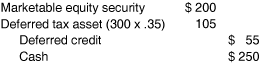
740-10-55-189
This Case provides an illustration of a deferred credit created by the acquisition of a financial asset.
740-10-55-190
Entity A acquires the stock of another corporation for $250. The principal asset of the corporation is a marketable equity security with a readily determinable fair value of $200 and a tax basis of $500. The tax rate is 35 percent. The acquired entity has no operations and so the acquisition is accounted for as an asset purchase and not as a business combination.
740-10-55-191
In accordance with paragraph 740-10-25-51, the acquired financial asset should be recognized at fair value, and a deferred tax asset should be recorded at the amount required by this Subtopic. The excess of the fair value of the financial asset and the deferred tax asset recorded over the cash purchase price should be recorded as a deferred credit. Accordingly, the entity would record the following journal entry.
  • Marketable equity security $200 Deferred tax asset (300 x .35) 105 Deferred credit $55 Cash $250

740-10-55-199
This Case provides an illustration of the purchase of future tax benefits.
740-10-55-200
A foreign entity that has nominal assets other than its net operating loss carryforwards is acquired by a foreign subsidiary of a U.S. entity for the specific purpose of utilizing the net operating loss carryforwards (this type of transaction is often referred to as a tax loss acquisition). It is presumed that this transaction does not constitute a business combination, since the acquired entity has no operations and is merely a shell entity. As a result of the time value of money and because the target entity is in financial difficulty and has ceased operations, the foreign subsidiary is able to acquire the shell entity at a discount from the amount corresponding to the gross deferred tax asset for the net operating loss carryforwards. Assume, for example, that $2,000,000 is paid for net operating loss carryforwards having a deferred tax benefit of $5,000,000 for which it is more likely than not that the full benefit will be realized. The tax rate is 35 percent.
740-10-55-201
In accordance with paragraph 740-10-25-51, the amount assigned to the deferred tax asset should be recorded at its gross amount (in accordance with this Subtopic) and the excess of the amount assigned to the deferred tax asset over the purchase price should be recorded as a deferred credit as follows.
  • Deferred tax asset " $5,000,000 " Deferred credit " $3,000,000 " Cash " $2,000,000 "

740-10-55-202
Guidance is provided on various types of payments made to taxing authorities in paragraphs . This Example illustrates one possible payment situation.
740-10-55-203
In this Example, tax laws in a foreign country enable corporate taxpayers to elect to step up the tax basis for certain fixed assets ($1,000,000) to fair value ($2,000,000) in exchange for a current payment to the government of 3 percent of the step-up ($30,000). An entity would be expected to avail itself of this election (and make the upfront payment) as long as it believed that it was likely that it would be able to utilize the additional deductions (at a tax rate of 35 percent) that were created as a result of the step-up to reduce future taxable income and that the timing and amount of the resulting future tax savings justified the current payment. (For purposes of this Example, it is assumed that the transaction that accomplishes this step-up for tax purposes does not create a taxable temporary difference. A taxable temporary difference would exist, for example, if the tax benefit associated with the transaction with the governmental taxing authority becomes taxable in certain situations, such as those described in paragraph 830-740-25-7.)
740-10-55-204
In this Example, the tax effects of transactions directly with a taxing authority are recorded directly in income as follows.
  • Deferred tax asset " $350,000 " Deferred income tax benefit " $320,000 " Cash " $30,000 "
740-10-55-212
Paragraph 740-10-55-79 provides guidance on satisfying the required disclosure of the significant components of income taxes and identifies three acceptable approaches illustrated in this Example:
  1. a
    The gross method (Case A)
  2. b
    The net method (Case B)
  3. c
    The statutory tax rate reconciliation method (Case C).
740-10-55-213
Cases A, B, and C share the following assumptions:
  1. a
    An entity has $1,588 of taxable income and $100 of investment tax credits for the current year. The $100 deferred tax asset for $295 of operating loss carryforwards was fully reserved at the beginning of the current year.
  2. b
    Pretax financial income from continuing operations is $5,000.
  3. c
    Income tax expense from continuing operations is $1,500.
  4. d
    Effective tax rate is 30%.
  5. e
    Statutory tax rate is 34%.
740-10-55-214
The first acceptable approach, illustrated as follows, to disclosure of components of income tax expense from continuing operations is referred to as the gross method.
  • Current Deferred Tax expense before application of investment tax credits and operating loss carryforwards $540 " $1,160 " Investment tax credits (100) - Tax benefit of operating loss carryforwards (100) - Tax expense from continuing operations $340 " $1,160 "

740-10-55-215
The second acceptable approach, illustrated as follows, to disclosure of components of income tax expense from continuing operations is referred to as the net method.
  • Current tax expense (net of $100 investment tax credits and $100 tax benefit of operating loss carryforwards) $340 Deferred tax expense " 1,160 " Tax expense from continuing operations " $1,500 "
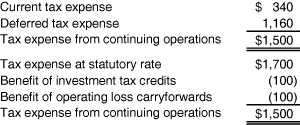
740-10-55-216
The third acceptable approach, illustrated as follows, to disclosure of components of income tax expense from continuing operations is referred to as the statutory tax rate reconciliation method.
  • Current tax expense $340 Deferred tax expense " 1,160 " Tax expense from continuing operations " $1,500 " Tax expense at statutory rate " $1,700 " Benefit of investment tax credits (100) Benefit of operating loss carryforwards (100) Tax expense from continuing operations " $1,500 "
740-10-55-217
This Example illustrates the guidance in paragraph 740-10-50-15 for disclosures about uncertainty in income taxes.
  • The Company or one of its subsidiaries files income tax returns in the U.S. federal jurisdiction, and various states and foreign jurisdictions. With few exceptions, the Company is no longer subject to U.S. federal, state and local, or non-U.S. income tax examinations by tax authorities for years before 20X1. The Internal Revenue Service (IRS) commenced an examination of the Company's U.S. income tax returns for 20X2 through 20X4 in the first quarter of 20X7 that is anticipated to be completed by the end of 20X8. As of December 31, 20X7, the IRS has proposed certain significant adjustments to the Company's transfer pricing and research credits tax positions. Management is currently evaluating those proposed adjustments to determine if it agrees, but if accepted, the Company does not anticipate the adjustments would result in a material change to its financial position. However, the Company anticipates that it is reasonably possible that an additional payment in the range of $80 to $100 million will be made by the end of 20X8. A reconciliation of the beginning and ending amount of unrecognized tax benefits is as follows.
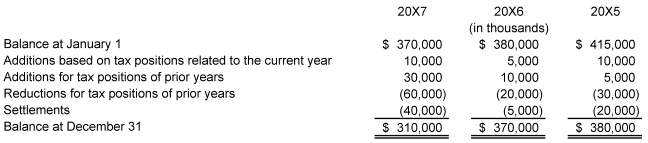
    • 20X7 20X6 20X5 (in thousands) Balance at January 1 " $370,000 " " 380,000 " " 415,000 " Additions based on tax positions related to the current year " 10,000 " " 5,000 " " 10,000 " Additions/Reductions for tax positions of prior years " 30,000 " " 10,000 " " 5,000 " Reductions for tax positions of prior years " (60,000)" " (20,000)" " (30,000)" Settlements " (40,000)" " (5,000)" " (20,000)" Balance at December 31 " $310,000 " " 370,000 " " 380,000 "
  • At December 31, 20X7, 20X6, and 20X5, there are $60, $55, and $40 million of unrecognized tax benefits that if recognized would affect the annual effective tax rate.
  • The Company recognizes interest accrued related to unrecognized tax benefits in interest expense and penalties in operating expenses. During the years ended December 31, 20X7, 20X6, and 20X5, the Company recognized approximately $10, $11, and $12 million in interest and penalties. The Company had approximately $60 and $50 million for the payment of interest and penalties accrued at December 31, 20X7, and 20X6, respectively.
Transition date:(P) December 16, 2024; (N) December 16, 2025Transition guidance:
740-10-65-9This Example illustrates the guidance in paragraph 740-10-50-15 for disclosures about uncertainty in income taxes.
  • The Company or one of its subsidiaries files income tax returns in the U.S. federal jurisdiction, and various states and foreign jurisdictions. With few exceptions, the Company is no longer subject to U.S. federal, state and local, or non-U.S. income tax examinations by tax authorities for years before 20X1. The Internal Revenue Service (IRS) commenced an examination of the Company's U.S. income tax returns for 20X2 through 20X4 in the first quarter of 20X7 that is anticipated to be completed by the end of 20X8. A reconciliation of the beginning and ending amount of unrecognized tax benefits is as follows.
    • 20X7 20X6 20X5 (in thousands) Balance at January 1 " $370,000 " " 380,000 " " 415,000 " Additions based on tax positions related to the current year " 10,000 " " 5,000 " " 10,000 " Additions/Reductions for tax positions of prior years " 30,000 " " 10,000 " " 5,000 " Reductions for tax positions of prior years " (60,000)" " (20,000)" " (30,000)" Settlements " (40,000)" " (5,000)" " (20,000)" Balance at December 31 " $310,000 " " 370,000 " " 380,000 "
  • At December 31, 20X7, 20X6, and 20X5, there are $60, $55, and $40 million of unrecognized tax benefits that if recognized would affect the annual effective tax rate.
  • The Company recognizes interest accrued related to unrecognized tax benefits in interest expense and penalties in operating expenses. During the years ended December 31, 20X7, 20X6, and 20X5, the Company recognized approximately $10, $11, and $12 million in interest and penalties. The Company had approximately $60 and $50 million for the payment of interest and penalties accrued at December 31, 20X7, and 20X6, respectively.
740-10-55-218
This Example illustrates the guidance in paragraph 275-10-50-8 for disclosure relating to the realizability estimates of a deferred tax asset.
740-10-55-219
In this Example, Entity A develops, manufactures, and markets limited-use vaccines. The entity has a dominant share of the narrow market it serves. As of December 31, 19X4, the entity has no temporary differences and has aggregate loss carryforwards of $12 million that originated in prior years and that expire in varying amounts between 19X5 and 19X7. As of December 31, 19X4, the entity has a deferred tax asset of $4.8 million that represents the benefit of the remaining $12 million in loss carryforwards, and it has concluded at that date that a valuation allowance is unnecessary. The loss carryforwards arose during the entity's development stage when it incurred high levels of research and development expenses prior to commencing sales. While the entity has earned, on average, $6 million income before tax (taxable income before carryforwards) in each of the last 5 years, future profitability in this competitive industry depends on continually developing new products. The entity has a number of promising new vaccines under development, but it is aware that other entities recently began testing vaccines that would compete with the vaccines being developed by the entity as well as products that will compete with the vaccines that are currently generating the entity's profits. Rapid introduction of competing products or failure of the entity's development efforts could reduce estimates of future profitability in the near term, which could affect the entity's ability to fully utilize its loss carryforward.
740-10-55-220
Illustrative disclosure for the entity follows.
  • The entity has recorded a deferred tax asset of $4.8 million reflecting the benefit of $12 million in loss carryforwards, which expire in varying amounts between 19X5 and 19X7. Realization is dependent on generating sufficient taxable income prior to expiration of the loss carryforwards. Although realization is not assured, management believes it is more likely than not that all of the deferred tax asset will be realized. The amount of the deferred tax asset considered realizable, however, could be reduced in the near term if estimates of future taxable income during the carryforward period are reduced.
740-10-55-221
In addition to other disclosures, information as to the amount of loss carryforwards and their expiration dates and the amount of any valuation allowance with respect to the recorded deferred tax asset is required under this Subtopic.
740-10-55-222
The disclosure in this Example informs users that:
  1. a
    Realization of the deferred tax asset depends on achieving a certain minimum level of future taxable income within the next three years.
  2. b
    Although management currently believes that achievement of the required future taxable income is more likely than not, it is at least reasonably possible that this belief could change in the near term, resulting in establishment of a valuation allowance.
740-10-55-223
Entity A has sales in Jurisdiction S but no physical presence. Management has reviewed the nexus rules for filing a return in Jurisdiction S and must determine whether filing a tax return in Jurisdiction S is required. In evaluating the tax position to file a tax return, management should consider all relevant sources of tax law. The evaluation of nexus has to be made for all jurisdictions where Entity A might be subject to income taxes. Each of these evaluations is a separate tax position that is subject to the recognition, measurement, and disclosure requirements of this Subtopic.
740-10-55-224
Entity S converted to an S Corporation from a C Corporation effective January 1, 20X0. In 20X7, Entity S disposed of assets subject to built-in gains and reported a tax liability on its 20X7 tax returns. Tax positions to consider related to the built-in gains tax include, but are not limited to:
  1. a
    Whether other assets were sold subject to the built-in gains tax
  2. b
    Whether the income associated with the calculation of the taxable amount of the built-in gains is correct
  3. c
    Whether the basis associated with the built-in gains calculation is correct.
It should be noted that whether or not Entity S is subject to the built-in gains tax also is a tax position subject to the provisions of this Subtopic.
740-10-55-225
Entity N, a tax-exempt not-for-profit entity, enters into transactions that may be subject to income tax on unrelated business income. Tax positions to consider include but are not limited to:
  1. a
    Entity N's characterization of its activities as related or unrelated to its exempt purpose
  2. b
    Entity N's allocation of revenue between activities that relate to its exempt purpose and those that are allocated to unrelated business income
  3. c
    The allocation of Entity N's expenses between activities that relate to its exempt purpose and those that are allocated to unrelated business activities.
Even if Entity N were not subject to income taxes on unrelated business income, it still has a tax position of whether it qualifies as a tax-exempt not-for-profit entity.
740-10-55-226
Entity A, a partnership with two partners—Partner 1 and Partner 2—has nexus in Jurisdiction J. Jurisdiction J assesses an income tax on Entity A and allows Partners 1 and 2 to file a tax return and use their pro rata share of Entity A's income tax payment as a credit (that is, payment against the tax liability of the owners). Because the owners may file a tax return and utilize Entity A's payment as a payment against their personal income tax, the income tax would be attributed to the owners by Jurisdiction J's laws whether or not the owners file an income tax return. Because the income tax has been attributed to the owners, payments to Jurisdiction J for income taxes should be treated as a transaction with the owners. The result would not change even if there were an agreement between Entity A and its two partners requiring Entity A to reimburse Partners 1 and 2 for any taxes the partners may owe to Jurisdiction J. This is because attribution is based on the laws and regulations of the taxing authority rather than on obligations imposed by agreements between an entity and its owners.
740-10-55-227
If the fact pattern in paragraph 740-10-55-226 changed such that Jurisdiction J has no provision for the owners to file tax returns and the laws and regulations of Jurisdiction J do not indicate that the payments are made on behalf of Partners 1 and 2, income taxes are attributed to Entity A on the basis of Jurisdiction J's laws and are accounted for based on the guidance in this Subtopic.
740-10-55-228
Entity S, an S Corporation, files a tax return in Jurisdiction J. An analysis of the laws and regulations of Jurisdiction J indicates that Jurisdiction J can hold Entity S and its owners jointly and severally liable for payment of income taxes. The laws and regulations also indicate that if payment is made by Entity S, the payments are made on behalf of the owners. Because the laws and regulations attribute the income tax to the owners regardless of who pays the tax, any payments to Jurisdiction J for income taxes should be treated as a transaction with its owners.
740-10-55-229
Entity A, a partnership with 2 partners, owns a 100 percent interest in Entity B and is required to issue consolidated financial statements. Entity B is a taxable entity that has unrecognized tax positions and a related liability for unrecognized tax benefits. Because entities within a consolidated or combined group should consider the tax positions of all entities within the group regardless of the tax status of the reporting entity, Entity A should include in its financial statements the assets, liabilities, income, and expenses of both Entity A and Entity B, including those relating to the implementation of this Subtopic to Entity B. This is required even though Entity A is a pass-through entity.
740-10-55-230
Transition date:(P) December 16, 2024; (N) December 16, 2025Transition guidance:
740-10-65-9The following Cases illustrate the rate reconciliation disclosure for a public business entity (Case A) and for an entity other than a public business entity (Case B).
740-10-55-231
Transition date:(P) December 16, 2024; (N) December 16, 2025Transition guidance:
740-10-65-9The following illustrates the specific categories and the reconciling items disclosed by a public business entity in its tabular rate reconciliation in accordance with paragraphs . The entity is domiciled in the United States and presents comparative financial statements. For the disclosure of foreign tax effects in accordance with paragraph 740-10-50-12A(b)(2), it is assumed that the 5 percent threshold, computed by multiplying the income (or loss) from continuing operations before income taxes by the applicable statutory federal (national) income tax rate of the United States, is met:
  1. a
    For Ireland, both at the jurisdiction level and for certain individual reconciling items of the same nature within Ireland
  2. b
    For the United Kingdom, for certain individual reconciling items of the same nature within the United Kingdom, but not at the jurisdiction level
  3. c
    For Switzerland and Mexico, at the jurisdiction level, but not for any individual reconciling items of the same nature within each jurisdiction.
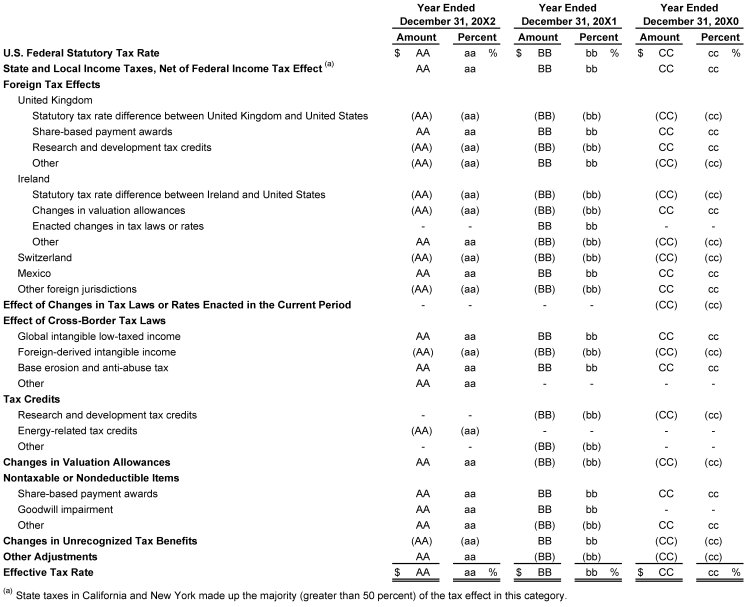
"Year Ended December 31, 20X2" "Year Ended December 31, 20X1" "Year Ended December 31, 20X0" Amount Percent Amount Percent Amount Percent U.S. Federal Statutory Tax Rate $ AA aa % $ BB bb % $ CC cc % "State and Local Income Taxes, Net of Federal Income Tax Effect (a)" AA aa BB bb CC cc Foreign Tax Effects United Kingdom Statutory tax rate difference between United Kingdom and United States (AA) (aa) (BB) (bb) (CC) (cc) Share-based payment awards AA aa BB bb CC cc Research and development tax credits (AA) (aa) (BB) (bb) CC cc Other (AA) (aa) BB bb (CC) (cc) Ireland Statutory tax rate difference between Ireland and United States (AA) (aa) (BB) (bb) (CC) (cc) Changes in valuation allowances (AA) (aa) (BB) (bb) CC cc Enacted changes in tax laws or rates - - BB bb - - Other AA aa (BB) (bb) (CC) (cc) Switzerland (AA) (aa) (BB) (bb) (CC) (cc) Mexico AA aa BB bb CC cc Other foreign jurisdictions (AA) (aa) (BB) (bb) CC cc Effect of Changes in Tax Laws or Rates Enacted in the Current Period - - - - (CC) (cc) Effect of Cross-Border Tax Laws Global intangible low-taxed income AA aa BB bb CC cc Foreign-derived intangible income (AA) (aa) (BB) (bb) (CC) (cc) Base erosion and anti-abuse tax AA aa BB bb CC cc Other AA aa - - - - Tax Credits Research and development tax credits - - (BB) (bb) (CC) (cc) Energy-related tax credits (AA) (aa) - - - - Other - - (BB) (bb) - - Changes in Valuation Allowances AA aa (BB) (bb) (CC) (cc) Nontaxable or Nondeductible Items Share-based payment awards AA aa BB bb CC cc Goodwill impairment AA aa BB bb - - Other AA aa (BB) (bb) CC cc Changes in Unrecognized Tax Benefits (AA) (aa) BB bb (CC) (cc) Other Adjustments AA aa (BB) (bb) (CC) (cc) Effective Tax Rate $ AA aa % $ BB bb % $ CC cc % (a) State taxes in California and New York made up the majority (greater than 50 percent) of the tax effect in this category.
740-10-55-232
Transition date:(P) December 16, 2024; (N) December 16, 2025Transition guidance:
740-10-65-9The following illustrates significant reconciling items disclosed by an entity other than a public business entity in accordance with paragraph 740-10-50-13.
740-10-55-233
Transition date:(P) December 16, 2024; (N) December 16, 2025Transition guidance:
740-10-65-9The difference between Entity W’s effective tax rate and its statutory tax rate is primarily attributed to tax credits, state taxes, and foreign taxes. More specifically, the foreign tax effects of Entity W’s operations in Ireland had a decreasing effect on its effective tax rate, while the foreign tax effects of Entity W’s operations in France had an increasing effect on its effective tax rate. Entity W received federal research and development tax credits, which decreased its effective tax rate, while state taxes in California increased its effective tax rate.

740-10-60Relationships

Source downloaded: .Record version 1bd31ee196f2. Effective date must be checked in the source.

Compensation—Retirement Benefits

740-10-60-1
For treatment of the difference between net periodic pension income and the amount deductible for tax purposes, see Subtopic 715-30.

Stock Compensation

740-10-60-1A
For the required accounting for income taxes in connection with stock compensation, see Subtopic 718-740.

Business Combinations

740-10-60-2
For the required accounting for income taxes in connection with business combinations, see Subtopic 805-740.

Reorganizations

740-10-60-3
For the required accounting for income taxes in connection with reorganizations, see Topic 852.

Leases

740-10-60-4
For the specific requirements for accounting for income taxes related to leveraged leases, see Subtopic 842-50.

740-10-65Transition and Open Effective Date Information

Source downloaded: .Record version b5084c2cf35e. Effective date must be checked in the source.

740-10-65-1
Paragraph superseded on 07/01/2010 after the end of the transition period stated in FASB Staff Position FIN 48-3, Effective Date of FASB Interpretation No. 48 for Certain Nonpublic Enterprises.
740-10-65-2
Paragraph superseded on 07/01/2010 after the end of the transition period stated in Accounting Standards Update No. 2009-06, Income Taxes (Topic 740): Implementation Guidance on Accounting for Uncertainty in Income Taxes and Disclosure Amendments for Nonpublic Entities.
740-10-65-3
Paragraph superseded on 06/23/2016 after the end of the transition period stated in Accounting Standards Update No. 2013-11, Income Taxes (Topic 740): Presentation of an Unrecognized Tax Benefit When a Net Operating Loss Carryforward, a Similar Tax Loss, or a Tax Credit Carryforward Exists.
740-10-65-4
Paragraph superseded on 07/17/2019 after the end of the transition period stated in Accounting Standards Update No. 2015-17, Income Taxes (Topic 740): Balance Sheet Classification of Deferred Taxes.
740-10-65-5
Paragraph superseded on 08/19/2021 after the end of the transition period stated in Accounting Standards Update No. 2016-16, Income Taxes (Topic 740): Intra-Entity Transfers of Assets Other Than Inventory.
740-10-65-6
Paragraph superseded on 07/20/2020 after the end of the transition period stated in Accounting Standards Update No. 2017-15, Codification Improvements to Topic 995, U.S. Steamship Entities: Elimination of Topic 995.
740-10-65-7
Paragraph superseded on 08/19/2021 after the end of the transition period stated in Accounting Standards Update No. 2018-09, Codification Improvements.
740-10-65-8
Paragraph superseded on 07/10/2023 after the end of the transition period stated in Accounting Standards Update No. 2019-12, Income Taxes (Topic 740): Simplifying the Accounting for Income Taxes.
740-10-65-9
Accounting Standards Update 2023-09
2025-12-16
2024-12-16
2024-12-16
2025-12-16
2025-12-16
2025-12-16
2025-12-16
2025-12-16
2025-12-16
2025-12-16
2025-12-16
2025-12-16
2025-12-16
2025-12-16
2025-12-16
The following represents the transition and effective date information related to Accounting Standards Update No. 2023-09, Income Taxes (Topic 740): Improvements to Income Tax Disclosures:
  1. a
    The pending content that links to this paragraph shall be effective for public business entities for annual periods beginning after December 15, 2024.
  2. b
    For entities other than public business entities, the pending content that links to this paragraph shall be effective for annual periods beginning after December 15, 2025.
  3. c
    Early adoption of the pending content that links to this paragraph is permitted for annual financial statements that have not yet been issued (or made available for issuance).
  4. d
    An entity shall apply the pending content that links to this paragraph on a prospective basis to financial statements for annual periods beginning after the effective date. Retrospective application to each period presented in the financial statements is permitted.

740-10-S00StatusSEC

Source downloaded: .Record version 3da01834efbd. Effective date must be checked in the source.

740-10-S25RecognitionSEC

Source downloaded: .Record version c663bb921bb8. Effective date must be checked in the source.

Acquired Temporary Differences in Certain Purchase Transactions that Are Not Accounted for as Business Combinations

740-10-S25-1
See paragraph 740-10-S99-3, SEC Observer Comment: Accounting for Acquired Temporary Difference in Certain Purchase Transactions that Are Not Accounted for as Business Combinations, for SEC Staff views on accounting for such transactions.

Income Tax Accounting Implications of the Tax Cuts and Jobs Act

740-10-S25-2
See paragraph 740-10-S99-2A, SAB Topic 5.EE, for SEC Staff views on income tax accounting implications of the Tax Cuts and Jobs Act.

740-10-S30Initial MeasurementSEC

Source downloaded: .Record version b82127bf0603. Effective date must be checked in the source.

Income Tax Accounting Implications of the Tax Cuts and Jobs Act

740-10-S30-1
See paragraph 740-10-S99-2A, SAB Topic 5.EE, for SEC Staff views on income tax accounting implications of the Tax Cuts and Jobs Act.

740-10-S35Subsequent MeasurementSEC

Source downloaded: .Record version c0ee079dfc9f. Effective date must be checked in the source.

Income Tax Accounting Implications of the Tax Cuts and Jobs Act

740-10-S35-1
See paragraph 740-10-S99-2A, SAB Topic 5.EE, for SEC Staff views on income tax accounting implications of the Tax Cuts and Jobs Act.

740-10-S45Other Presentation MattersSEC

Source downloaded: .Record version ba6697f305bc. Effective date must be checked in the source.

Income Tax Accounting Implications of the Tax Cuts and Jobs Act

740-10-S45-1
See paragraph 740-10-S99-2A, SAB Topic 5.EE, for SEC Staff views on income tax accounting implications of the Tax Cuts and Jobs Act.

740-10-S50DisclosureSEC

Source downloaded: .Record version c690d7a99ef7. Effective date must be checked in the source.

Income Tax Disclosures

740-10-S50-1
See paragraph 235-10-S99-1, Regulation S-X Rule 4-08(h), for required disclosures related to income taxes.
740-10-S50-2
See paragraph 740-10-S99-2, SAB Topic 11.C, for SEC Staff views on disclosures related to income tax holidays.

Income Tax Accounting Implications of the Tax Cuts and Jobs Act

740-10-S50-3
See paragraph 740-10-S99-2A, SAB Topic 5.EE, for SEC Staff views on income tax accounting implications of the Tax Cuts and Jobs Act.

740-10-S55Implementation Guidance and IllustrationsSEC

Source downloaded: .Record version c730b17bb49f. Effective date must be checked in the source.

Statutory to Effective Tax Rate Reconciliation

740-10-S55-1
See paragraph 740-10-S99-1, SAB Topic 6.I.1, for SEC Staff views on the rate used in the federal income tax rate to effective tax rate reconciliation.

Equity Method Investee Income Taxes

740-10-S55-2
See paragraph 740-10-S99-1, SAB Topic 6.I.2, for SEC Staff views concerning required disclosures pertaining to the income taxes of an equity method investee.

Disclosures When an Item Is Presented on a Net of Tax Basis

740-10-S55-3
See paragraph 740-10-S99-1, SAB Topic 6.I.3, for SEC Staff views on disclosures when certain items are presented net of tax on the income statement.

Reconciliation of Tax Recovery in a Loss Year

740-10-S55-4
See paragraph 740-10-S99-1, SAB Topic 6.I.4, for SEC Staff views on whether a reconciliation of a tax recovery is required in a loss year.

Foreign Registrants

740-10-S55-5
See paragraph 740-10-S99-1, SAB Topic 6.I.5, for SEC Staff views on required disclosures for foreign registrants.

Reconciliation of Certain Securities Gains and Losses to the Statutory Federal Income Tax Rate

740-10-S55-6
See paragraph 740-10-S99-1, SAB Topic 6.I.6, for SEC Staff views on the necessity of a reconciliation of certain securities gains and losses to the statutory federal income tax rate.

Disclosure When Income Tax Expense Is Allocated to More than One Financial Statement Caption

740-10-S55-7
See paragraph 740-10-S99-1, SAB Topic 6.I.7, for SEC Staff views on whether an overall presentation is acceptable when income tax expense is allocated to more than one caption in the financial statements.

Income Tax Accounting Implications of the Tax Cuts and Jobs Act

740-10-S55-8
See paragraph 740-10-S99-2A, SAB Topic 5.EE, for SEC Staff views on income tax accounting implications of the Tax Cuts and Jobs Act.

740-10-S99SEC MaterialsSEC

Source downloaded: .Record version 8759b31fecf8. Effective date must be checked in the source.

SEC Staff Guidance

740-10-S99-1
The following is the text of SAB Topic 6.I, Accounting Series Release 149—Improved Disclosure of Income Tax Expense (Adopted November 28, 1973 and Modified by ASR 280 Adopted on September 2, 1980).
  • Facts: ASR 149 and 280 amend Regulation S-X to include:
    • 1. Disclosure of tax effect of timing differences comprising deferred income tax expense.
    • 2. Disclosure of the components of income tax expense, including currently payable and the net tax effects of timing differences.
    • 3. Disclosure of the components of income [loss] before income tax expense [benefit] as either domestic or foreign.
    • 4. Reconciliation between the statutory Federal income tax rate and the effective tax rate.
  • 1. Tax Rate
    • Question 1: In reconciling to the effective tax rate should the rate used be a combination of state and Federal income tax rates?
    • Interpretive Response: No, the reconciliation should be made to the Federal income tax rate only.
    • Interpretive Response: The applicable statutory Federal income tax rate is the normal rate applicable to the reporting entity. Hence, the statutory rate for a U.S. partnership is zero. If, for example, the statutory rate for U.S. corporations is 22% on the first $25,000 of taxable income and 46% on the excess over $25,000, the "normalized rate" for corporations would fluctuate in the range between 22% and 46% depending on the amount of pretax accounting income a corporation has.
  • 2. Taxes of Investee Company
    • Question: If a registrant records its share of earnings or losses of a 50% or less owned person on the equity basis and such person has an effective tax rate which differs by more than 5% from the applicable statutory Federal income tax rate, is a reconciliation as required by Rule 4-08(g) necessary?
    • Interpretive Response: Whenever the tax components are known and material to the investor's (registrant's) financial position or results of operations, appropriate disclosure should be made. In some instances where 50% or less owned persons are accounted for by the equity method of accounting in the financial statements of the registrant, the registrant may not know the rate at which the various components of income are taxed and it may not be practicable to provide disclosure concerning such components.
    • It should also be noted that it is generally necessary to disclose the aggregate dollar and per-share effect of situations where temporary tax exemptions or "tax holidays" exist, and that such disclosures are also applicable to 50% or less owned persons. Such disclosures should include a brief description of the factual circumstances and give the date on which the special tax status will terminate. See Topic 11.C.
  • 3. Net of Tax Presentation
    • Question: What disclosure is required when an item is reported on a net of tax basis (e. g., extraordinary items, discontinued operations, or cumulative adjustment related to accounting change)?
    • Interpretive Response: When an item is reported on a net of tax basis, additional disclosure of the nature of the tax component should be provided by reconciling the tax component associated with the item to the applicable statutory Federal income tax rate or rates.
  • 4. Loss Years
    • Question: Is a reconciliation of a tax recovery in a loss year required?
    • Interpretive Response: Yes, in loss years the actual book tax benefit of the loss should be reconciled to expected normal book tax benefit based on the applicable statutory Federal income tax rate.
  • 5. Foreign Registrants
    • Question 1: Occasionally, reporting foreign persons may not operate under a normal income tax base rate such as the current U.S. Federal corporate income tax rate. What form of disclosure is acceptable in these circumstances?
    • Interpretive Response: In such instances, reconciliations between year-to-year effective rates or between a weighted average effective rate and the current effective rate of total tax expense may be appropriate in meeting the requirements of Rule 4-08(h)(2). A brief description of how such a rate was determined would be required in addition to other required disclosures. Such an approach would not be acceptable for a U.S. registrant with foreign operations. Foreign registrants with unusual tax situations may find that these guidelines are not fully responsive to their needs. In such instances, registrants should discuss the matter with the staff.
    • Question 2: Where there are significant reconciling items that relate in significant part to foreign operations as well as domestic operations, is it necessary to disclose the separate amounts of the tax component by geographical area, e.g., statutory depletion allowances provided for by U.S. and by other foreign jurisdictions?
    • Interpretive Response: It is not practicable to give an all-encompassing answer to this question. However, in many cases such disclosure would seem appropriate.
  • 6. Securities Gains and Losses
    • Question: If the tax on the securities gains and losses of banks and insurance companies varies by more than 5% from the applicable statutory Federal income tax rate, should a reconciliation to the statutory rate be provided?
    • Interpretive Response: Yes.
  • 7. Tax Expense Components v. "Overall" Presentation
    • Facts: Rule 4-08(h) requires that the various components of income tax expense be disclosed, e.g., currently payable domestic taxes, deferred foreign taxes, etc. Frequently income tax expense will be included in more than one caption in the financial statements. For example, income taxes may be allocated to continuing operations, discontinued operations, extraordinary items, cumulative effects of an accounting change and direct charges and credits to shareholders' equity.
    • Question: In instances where income tax expense is allocated to more than one caption in the financial statements, must the components of income tax expense included in each caption be disclosed or will an "overall" presentation such as the following be acceptable?
    • The components of income tax expense are:
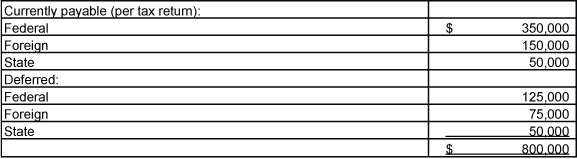
      • Currently payable (per tax return): Federal " $350,000 " Foreign " 150,000 " State " 50,000 " Deferred: Federal " 125,000 " Foreign " 75,000 " State " 50,000 " " $800,000 "
    • Income tax expense is included in the financial statements as follows:

      • Continuing operations " $600,000 " Discontinued operations " (200,000)" Extraordinary income " 300,000 " Cumulative effect of change in accounting principle " 100,000 " " $800,000 "
    • Interpretive Response: An overall presentation of the nature described will be acceptable.
740-10-S99-2
The following is the text of SAB Topic 11.C, Tax Holidays.
  • Facts: Company C conducts business in a foreign jurisdiction which attracts industry by granting a "holiday" from income taxes for a specified period.
  • Question: Does the staff generally request disclosure of this fact?
  • Interpretive Response: Yes. In such event, a note must (1) disclose the aggregate dollar and per share effects of the tax holiday and (2) briefly describe the factual circumstances including the date on which the special tax status will terminate.
740-10-S99-2A
The following is the text of SAB Topic 5.EE, Income Tax Accounting Implications of the Tax Cuts and Jobs Act [H.R.1, An Act to Provide for Reconciliation Pursuant to Titles II and V of the Concurrent Resolution on the Budget for Fiscal Year 2018].
  • The Tax Cuts and Jobs Act (the "Act") changes existing United States tax law and includes numerous provisions that will affect businesses. The Act, for instance, introduces changes that impact U.S. corporate tax rates, business-related exclusions, and deductions and credits. The Act will also have international tax consequences for many companies that operate internationally. The Act has widespread applicability to registrants.
  • ASC Topic 740 provides accounting and disclosure guidance on accounting for income taxes under generally accepted accounting principles ("U.S. GAAP"). This guidance addresses the recognition of taxes payable or refundable for the current year and the recognition of deferred tax liabilities and deferred tax assets for the future tax consequences of events that have been recognized in an entity's financial statements or tax returns. FN1 ASC Topic 740 also addresses the accounting for income taxes upon a change in tax laws or tax rates. FN2 The income tax accounting effect of a change in tax laws or tax rates includes, for example, adjusting (or re-measuring) deferred tax liabilities and deferred tax assets, as well as evaluating whether a valuation allowance is needed for deferred tax assets. FN3
  • The guidance in ASC Topic 740 does not, however, address certain circumstances that may arise for registrants in accounting for the income tax effects of the Act. The staff understands from outreach that registrants will potentially encounter a situation in which the accounting for certain income tax effects of the Act will be incomplete by the time financial statements are issued for the reporting period that includes the enactment date of December 22, 2017. Questions have arisen regarding different approaches to the application of the accounting and disclosure guidance in ASC Topic 740 to such a situation. Accordingly, the SEC staff believes clarification is appropriate to address any uncertainty or diversity of views in practice regarding the application of ASC Topic 740 in situations where a registrant does not have the necessary information available, prepared, or analyzed (including computations) in reasonable detail to complete the accounting under ASC Topic 740 for certain income tax effects of the Act for the reporting period in which the Act was enacted.
  • The staff's views have been informed by guidance issued after enactment of the American Jobs Creation Act of 2004. FN4 The staff's views also have been informed by the guidance in ASC Topic 805, Business Combinations, which addresses the accounting for certain items in a business combination for which the accounting is incomplete upon issuance of the financial statements that include the reporting period in which the business combination occurred.
    • FN4 In 2004, the FASB issued limited guidance to address the income tax accounting effects of the American Jobs Creation Act of 2004. See FASB Staff Position ("FSP") FAS 109-2, Accounting and Disclosure Guidance for the Foreign Earnings Repatriation Provision within the American Jobs Creation Act of 2004.
  • The staff believes the guidance in this staff accounting bulletin ("SAB") will assist registrants and address any uncertainty or diversity of views in applying ASC Topic 740 in the reporting period in which the Act was enacted. Specifically, the staff is issuing this SAB to address situations where the accounting under ASC Topic 740 is incomplete for certain income tax effects of the Act upon issuance of an entity's financial statements for the reporting period in which the Act was enacted.
  • Facts: The Act was signed into law prior to the end of Company A's reporting period and will affect Company A's current and deferred taxes. Company A determined that the accounting for certain income tax effects of the Act under ASC Topic 740 will be completed by the time it issues its financial statements that will include the reporting period in which the Act was enacted. However, there are other income tax effects of the Act for which Company A may not be able to complete the accounting under ASC Topic 740 by the time it issues its financial statements that include the reporting period in which the Act was enacted.
  • Question 1: If the accounting for certain income tax effects of the Act is not completed by the time Company A issues its financial statements that include the reporting period in which the Act was enacted, what amounts should Company A include in its financial statements for those income tax effects for which the accounting under ASC Topic 740 is incomplete?
  • Interpretive Response: To the extent that Company A's accounting for certain income tax effects of the Act is incomplete, but Company A can determine a reasonable estimate for those effects, the staff would not object to Company A including in its financial statements the reasonable estimate that it had determined. Conversely, the staff does not believe it would be appropriate for Company A to exclude a reasonable estimate from its financial statements to the extent a reasonable estimate had been determined. The reasonable estimate should be included in Company A's financial statements in the first reporting period in which Company A was able to determine the reasonable estimate. The reasonable estimate would be reported as a provisional amount FN5 in Company A's financial statements FN6 during a "measurement period." FN7 The measurement period is described in further detail below.
    • FN5 Provisional amounts would include, for example, reasonable estimates that give rise to new current or deferred taxes based on certain provisions within the Act, as well as adjustments to existing current or deferred taxes that existed prior to the Act's enactment date.
    • FN6 The staff would also not object to a Foreign Private Issuer reporting under International Financial Reporting Standards applying a measurement period solely for purposes of completing the accounting requirements for the income tax effects of the Act under International Accounting Standard 12, Income Taxes.
    • FN7 The staff was informed, in part, by the measurement period guidance applied in certain situations when accounting for business combinations under ASC Topic 805, Business Combinations. The measurement period guidance in ASC paragraph 805-10-25-13 addresses situations where the initial accounting for a business combination is incomplete upon issuance of the financial statements that include the reporting period the business combination occurred.
  • The staff believes reporting provisional amounts for certain income tax effects of the Act will address circumstances in which an entity does not have the necessary information available, prepared, or analyzed (including computations) in reasonable detail to complete the accounting under ASC Topic 740.
  • An entity may not have the necessary information available, prepared, or analyzed (including computations) for certain income tax effects of the Act in order to determine a reasonable estimate to be included as provisional amounts. The staff would expect no related provisional amounts would be included in an entity's financial statements for those specific income tax effects for which a reasonable estimate cannot be determined. In circumstances in which provisional amounts cannot be prepared, the staff believes an entity should continue to apply ASC Topic 740 (e.g., when recognizing and measuring current and deferred taxes) based on the provisions of the tax laws that were in effect immediately prior to the Act being enacted. That is, the staff does not believe an entity should adjust its current or deferred taxes for those tax effects of the Act until a reasonable estimate can be determined.
  • Therefore, to summarize the above and for the avoidance of doubt, in Company A's financial statements that include the reporting period in which the Act was enacted, Company A must first reflect the income tax effects of the Act in which the accounting under ASC Topic 740 is complete. These completed amounts would not be provisional amounts. Company A would then also report provisional amounts for those specific income tax effects of the Act for which the accounting under ASC Topic 740 will be incomplete but a reasonable estimate can be determined. For any specific income tax effects of the Act for which a reasonable estimate cannot be determined, Company A would not report provisional amounts and would continue to apply ASC Topic 740 based on the provisions of the tax laws that were in effect immediately prior to the Act being enacted. For those income tax effects for which Company A was not able to determine a reasonable estimate (such that no related provisional amount was reported for the reporting period in which the Act was enacted), Company A would report provisional amounts in the first reporting period in which a reasonable estimate can be determined.
  • Measurement period timeframe
  • The measurement period begins in the reporting period that includes the Act's enactment date and ends when an entity has obtained, prepared, and analyzed the information that was needed in order to complete the accounting requirements under ASC Topic 740. During the measurement period, the staff expects that entities will be acting in good faith to complete the accounting under ASC Topic 740. The staff believes that in no circumstances should the measurement period extend beyond one year from the enactment date.
  • Changes in subsequent reporting periods
  • During the measurement period, an entity may need to reflect adjustments to its provisional amounts upon obtaining, preparing, or analyzing additional information about facts and circumstances that existed as of the enactment date that, if known, would have affected the income tax effects initially reported as provisional amounts. Further, an entity may also need to report additional tax effects during the measurement period, based on obtaining, preparing, or analyzing additional information about facts and circumstances that existed as of the enactment date that was not initially reported as provisional amounts. Any income tax effects of events unrelated to the Act should not be reported as measurement period adjustments.
  • Reporting
  • Any provisional amounts or adjustments to provisional amounts included in an entity's financial statements during the measurement period should be included in income from continuing operations as an adjustment to tax expense or benefit in the reporting period the amounts are determined.
  • Applicability
  • This staff guidance is only applicable to the application of ASC Topic 740 in connection with the Act and should not be relied upon for purposes of applying ASC Topic 740 to other changes in tax laws.
  • Examples
  • Example 1- Prior to the reporting period in which the Act was enacted, Company X did not recognize a deferred tax liability related to unremitted foreign earnings because it overcame the presumption of the repatriation of foreign earnings. FN8 Upon enactment, the Act imposes a tax on certain foreign earnings and profits at various tax rates. Based on Company X's facts and circumstances, it was not able to determine a reasonable estimate of the tax liability for this item for the reporting period in which the Act was enacted by the time that it issues its financial statements for that reporting period; that is, Company X did not have the necessary information available, prepared, or analyzed to develop a reasonable estimate of the tax liability for this item (or evaluate how the Act will impact Company X's existing accounting position to indefinitely reinvest unremitted foreign earnings). As a result, Company X would not include a provisional amount for this item in its financial statements that include the reporting period in which the Act was enacted, but would do so in its financial statements issued for subsequent reporting periods that fall within the measurement period, beginning with the first reporting period falling within the measurement period by which the necessary information became available, prepared, or analyzed in order to develop the reasonable estimate, and ending with the first reporting period within the measurement period in which Company X was able to obtain, prepare, and analyze the necessary information to complete the accounting under ASC Topic 740.
  • Example 1a- Assume a similar fact pattern as Example 1; however, Company Y was able to determine a reasonable estimate of the income tax effects of the Act on its unremitted foreign earnings for the reporting period in which the Act was enacted. Company Y, therefore, reported a provisional amount for the income tax effects related to its unremitted foreign earnings in its financial statements that included the reporting period the Act was enacted. In a subsequent reporting period within the measurement period, Company Y was able to obtain, prepare, and analyze the necessary information to complete the accounting under ASC Topic 740, which resulted in an adjustment to Company Y's initial provisional amount to recognize its tax liability.
  • Example 2- Company Z has deferred tax assets (assume Company Z was able to comply with ASC Topic 740 and re-measure its deferred tax assets based on the Act's new tax rates) for which a valuation allowance may need to be recognized (or released) based on application of certain provisions in the Act. If Company Z determines that a reasonable estimate cannot be made for the reporting period the Act was enacted, no amount for the recognition (or release) of a valuation allowance would be reported. In the next reporting period (following the reporting period in which the Act was enacted), Company Z was able to obtain, prepare, and analyze the necessary information in order to determine that no valuation allowance needed to be recognized (or released) in order to complete the accounting under ASC Topic 740.
  • Question 2: If an entity accounts for certain income tax effects of the Act under a measurement period approach, what disclosures should be provided?
  • Interpretive Response: The staff believes an entity should include financial statement disclosures to provide information about the material financial reporting impacts of the Act for which the accounting under ASC Topic 740 is incomplete, including:
  • a. Qualitative disclosures of the income tax effects of the Act for which the accounting is incomplete;
  • b. Disclosures of items reported as provisional amounts;
  • c. Disclosures of existing current or deferred tax amounts for which the income tax effects of the Act have not been completed;
  • d. The reason why the initial accounting is incomplete;
  • e. The additional information that is needed to be obtained, prepared, or analyzed in order to complete the accounting requirements under ASC Topic 740;
  • f. The nature and amount of any measurement period adjustments recognized during the reporting period;
  • g. The effect of measurement period adjustments on the effective tax rate; and
  • h. When the accounting for the income tax effects of the Act has been completed.
740-10-S99-3
The following is the text of SEC Observer Comment: Accounting for Acquired Temporary Differences in Certain Purchase Transactions that Are Not Accounted for as Business Combinations.
  • Paragraph 740-10-25-50 provides guidance on the accounting for acquired temporary differences in purchase transactions that are not business combinations. The SEC staff would object to broadly extending this guidance to adjust the basis in an asset acquisition to situations different from those illustrated in Examples 25 through 26 (see paragraphs ) without first having a clear and complete understanding of those specific fact patterns.
740-10-S99-4
The following is the text of SEC Staff Announcement: Accounting for the Health Care and Education Reconciliation Act of 2010 and the Patient Protection and Affordable Care Act
  • On March 30, 2010, the President signed the Health Care and Education Reconciliation Act of 2010, which is a reconciliation bill that amends the Patient Protection and Affordable Care Act that was signed by the President on March 23, 2010 (collectively the "Acts").
  • Recently, questions have arisen about the effect, if any, that the different signing dates might have on the accounting for these two Acts. This timing difference, related solely to the signing dates, should not have an impact on a majority of registrants because the Acts were both signed within a relatively short time period, which for the vast majority of companies falls into the same reporting period. However, there may be a limited number of registrants with a period end that falls between the signing dates for which the timing difference could raise questions about whether the different signing dates have an accounting impact. For example, FASB Codification Topic 740, Income Taxes, requires the measurement of current and deferred tax liabilities and assets to be based on provisions of enacted tax law; the effects of future changes in tax laws or rates are not anticipated.
  • After consultation with the FASB staff, the Office of the Chief Accountant would not object to a view that the two Acts should be considered together for accounting purposes. That is, in this specific fact pattern the SEC staff would not object to a registrant incorporating the effects of the Health Care and Education Reconciliation Act of 2010 when accounting for the Patient Protection and Affordable Care Act. This view is based in part on the SEC staff's understanding that the two Acts, when taken together, represent the current health care reforms as passed by Congress and signed by the President. The SEC staff does not believe that it would be appropriate to analogize to this view in any other fact patterns.

Related subtopics