ASC 360-970
Real Estate—General
360 Property, Plant, and Equipment
Source downloaded: .Record version 4c358944ef37. Effective date must be checked in the source.
ASC 360-970 gathers the real estate–specific property, plant, and equipment guidance in two sets of subsections: Real Estate Syndication and Real Estate Project Costs. It requires costs clearly associated with the acquisition, development, and construction of a real estate project to be capitalized and then allocated to project components (by specific identification, then relative fair value/sales value, then area methods), addresses donated and abandoned real estate and changes in use, and applies the Subtopic 360-10 impairment model project by project. For syndications, fees paid to and rentals received from a developer-seller under a master leaseback are adjustments to the basis of the property.
Key points (7)
- Payments to and receipts from a developer-seller under a master leaseback negotiated with a real estate syndication are treated by the syndication as adjustments to the basis of the property, affecting future depreciation (360-970-25-1; 360-970-55-2).
- Project costs clearly associated with acquisition, development, and construction of a real estate project shall be capitalized as a cost of that project, and indirect project costs relating to several projects shall be capitalized and allocated among them (360-970-25-2 through 25-3).
- Capitalized costs are assigned to individual project components by specific identification; if impracticable, land and common costs (including amenities) are allocated to benefited parcels on relative fair value before construction and construction costs to units on relative sales value, and if that too is impracticable, by area or other value methods (360-970-30-1).
- Real estate donated to municipalities or governmental agencies for uses benefiting the project is not an abandonment; its cost is allocated as a common cost of the project (360-970-35-1).
- On a change in use under a formal plan expected to produce a higher economic yield, costs charged to expense are limited to the excess of capitalized costs incurred and to be incurred over the estimated value of the revised project when substantially complete (360-970-35-2).
- Impairment follows Subtopic 360-10 (held-for-sale model for substantially completed projects to be sold; held-and-used model for property under or awaiting development and completed projects to be held for rental), evaluated on an individual-project basis, where a project consists of relatively homogeneous integral components (360-970-35-3); insufficient rental demand for a rental project under construction is an additional impairment indicator (360-970-35-4).
- If real estate or rights to real estate are abandoned (e.g., allowing a mortgage foreclosure or option lapse), the capitalized costs shall be expensed and not allocated to other components or projects (360-970-40-1).
For students. Exam traps here are the allocation hierarchy (specific identification → relative fair value before construction for land/common costs and relative sales value for construction costs → area methods) and the sharp contrast between donated land (a common cost allocated to the project) and abandoned real estate (expensed immediately, never reallocated). Students often wrongly test impairment at the multiphase-development level; each homogeneous project (tract, condo complex, subdivision) is evaluated separately.
Machine-generated study aid for ASC 360-970. Check the source paragraphs below.
360-970-00Status
Source downloaded: .Record version 7fa1bead34f2. Effective date must be checked in the source.
| Paragraph | Action | Accounting Standards Update | Date |
| Phase (1st def.) | Superseded | Accounting Standards Update No. 2014-06 | 03/14/2014 |
| Phase (2nd def.) | Added | Accounting Standards Update No. 2014-06 | 03/14/2014 |
| 970-360-25-2 | Amended | Accounting Standards Update No. 2020-10 | 10/29/2020 |
| 970-360-25-2 | Amended | Accounting Standards Update No. 2014-09 | 05/28/2014 |
| 970-360-25-4 | Amended | Accounting Standards Update No. 2014-09 | 05/28/2014 |
| 970-360-30-1 | Amended | Accounting Standards Update No. 2014-06 | 03/14/2014 |
| 970-360-55-4 | Superseded | Accounting Standards Update No. 2014-09 | 05/28/2014 |
| 970-360-55-5 | Superseded | Accounting Standards Update No. 2014-09 | 05/28/2014 |
360-970-05Overview and Background
Source downloaded: .Record version e8336d0b9301. Effective date must be checked in the source.
Real Estate Syndication
Real Estate Project Costs
360-970-15Scope and Scope Exceptions
Source downloaded: .Record version e26d4ea9fae1. Effective date must be checked in the source.
Overall Guidance
Real Estate Syndication
Real Estate Project Costs
360-970-25Recognition
Source downloaded: .Record version 6af13e83ce94. Effective date must be checked in the source.
Real Estate Syndication
Real Estate Project Costs
Capitalized Project Costs
Assets Transferred Between Entities
Other Considerations
360-970-30Initial Measurement
Source downloaded: .Record version c16addaccd9c. Effective date must be checked in the source.
Real Estate Project Costs
Allocation of Capitalized Costs
- a Land cost and all other common costs, including the costs of amenities to be allocated as common costs per paragraphs (before construction), shall be allocated to each land parcel benefited. Allocation shall be based on the relative fair value before construction.
- b Construction costs shall be allocated to individual units in the phase on the basis of relative sales value of each unit.
360-970-35Subsequent Measurement
Source downloaded: .Record version 41e6a45cfe20. Effective date must be checked in the source.
Real Estate Project Costs
Real Estate Donated to Government Agencies
Changes in Use of Real Estate Acquired for Development
Recoverability
360-970-40Derecognition
Source downloaded: .Record version a11f91eaf38f. Effective date must be checked in the source.
Real Estate Project Costs
Abandonments
360-970-55Implementation Guidance and Illustrations
Source downloaded: .Record version 432a75a62550. Effective date must be checked in the source.
Real Estate Syndication
Implementation Guidance
Real Estate Project Costs
360-970-S00StatusSEC
Source downloaded: .Record version f8796ffe245e. Effective date must be checked in the source.
| Paragraph | Action | Accounting Standards Update | Date |
| 970-360-S99-1 | Amended | Accounting Standards Update No. 2019-07 | 07/26/2019 |
360-970-S50DisclosureSEC
Source downloaded: .Record version e59170c2fa76. Effective date must be checked in the source.
Supplemental Schedules
360-970-S99SEC MaterialsSEC
Source downloaded: .Record version 9aede7591946. Effective date must be checked in the source.
SEC Rules, Regulations, and Interpretations
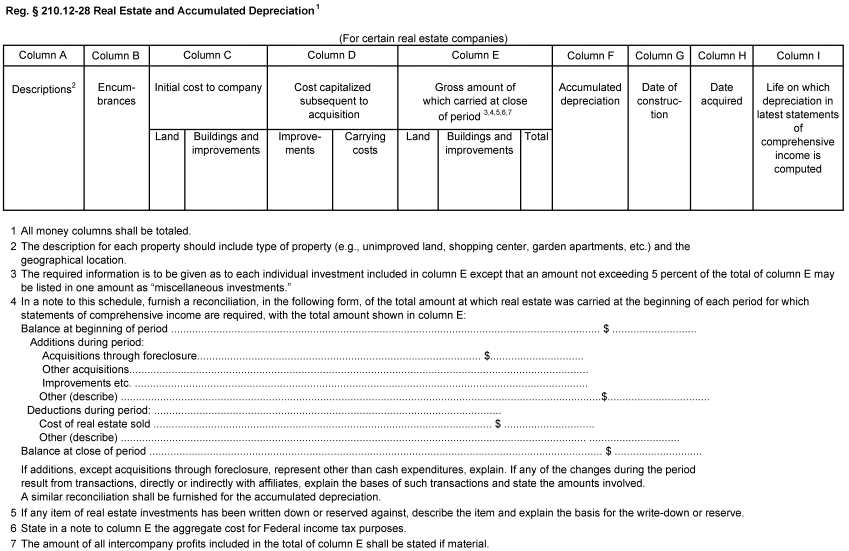 Reg. § 210.12-28 Real Estate and Accumulated Depreciation1 (For certain real estate companies) Column A Column B Column C Column D Column E Column F Column G Column H Column I Descriptions2 "Encum- brances " Initial cost to company "Cost capitalized subsequent to acquisition" "Gross amount of which carried at close of period 3,4,5,6,7" Accumulated depreciation Date of construc- tion Date acquired Life on which depreciation in latest statements of comprehensive income is computed Land Buildings and improvements "Improve- ments " Carrying costs Land Buildings and improvements Total 1 All money columns shall be totaled. 2 "The description for each property should include type of property (e.g., unimproved land, shopping center, garden apartments, etc.) and the geographical location." 3 The required information is to be given as to each individual investment included in column E except that an amount not exceeding 5 percent of the total of column E may be listed in one amount as “miscellaneous investments.” 4 "In a note to this schedule, furnish a reconciliation, in the following form, of the total amount at which real estate was carried at the beginning of each period for which statements of comprehensive income are required, with the total amount shown in column E: Balance at beginning of period .............................................................................................................................................. $ ............................ Additions during period: Acquisitions through foreclosure.............................................................................................. $............................... Other acquisitions........................................................................................................................................................ Improvements etc. ...................................................................................................................................................... Other (describe) ...............................................................................................................................................................$.................................. Deductions during period: ................................................................................................................... Cost of real estate sold ................................................................................................................ $ .............................. Other (describe) .......................................................................................................................................................... .............................. Balance at close of period ...................................................................................................................................................... $ ............................. " "If additions, except acquisitions through foreclosure, represent other than cash expenditures, explain. If any of the changes during the period result from transactions, directly or indirectly with affiliates, explain the bases of such transactions and state the amounts involved. A similar reconciliation shall be furnished for the accumulated depreciation." 5 "If any item of real estate investments has been written down or reserved against, describe the item and explain the basis for the write-down or reserve." 6 State in a note to column E the aggregate cost for Federal income tax purposes. 7 The amount of all intercompany profits included in the total of column E shall be stated if material.
Related subtopics
- 970-10 OverallReal Estate—General
- 340-970 Real Estate—GeneralOther Assets and Deferred Costs
- 323-970 Real Estate—GeneralInvestments—Equity Method and Joint Ventures
- 360-944 Financial Services—InsuranceProperty, Plant, and Equipment
- 360-20 Real Estate SalesProperty, Plant, and Equipment
- 974-10 OverallReal Estate—Real Estate Investment Trusts