ASC 325-962
Plan Accounting—Defined Contribution Pension Plans
325 Investments—Other
Source downloaded: .Record version c959885324e8. Effective date must be checked in the source.
ASC 962-325 governs how a defined contribution pension plan reports its investments and insurance contracts. The core rule is that plan investments (including derivatives) are reported at fair value under Topic 820, with two exceptions: fully benefit-responsive investment contracts are reported at contract value, and insurance contracts as defined in Subtopic 944-20 are presented the same way as in the plan's ERISA Form 5500 filing (fair value or contract value). It also prescribes trade-date recording, presentation of investments by general type, master trust disclosures, and disclosures about benefit-responsive contracts.
Key points (7)
- Plan investments are generally presented at fair value at the reporting date, reduced if significant by brokerage commissions and other costs normally incurred in a sale (962-325-35-1 and 35-1A).
- Defined contribution plans report investments, including derivative contracts, at fair value except insurance contracts and fully benefit-responsive investment contracts; contract value is the relevant measure for the portion of net assets attributable to fully benefit-responsive investment contracts (962-325-35-5 and 35-5A).
- Insurance contracts as defined by Subtopic 944-20 are presented as in the plan's ERISA annual report—either fair value or contract value—and non-ERISA plans follow as if subject to the Act (962-325-35-6).
- Each contract is evaluated individually for benefit responsiveness, and contracts with prospective interest adjustments can still be fully benefit-responsive if the crediting rate cannot be less than zero (962-325-35-9 and 35-10).
- Purchases and sales of securities are recorded on a trade-date basis; settlement-date accounting is acceptable only if fair value did not change significantly and the plan's asset composition is not significantly affected (962-325-25-1).
- A plan whose fiscal year-end is not a month-end may elect, applied consistently, to measure investments and investment-related accounts at the nearest month-end, and must disclose the election, the measurement date, and any intervening contributions, distributions, or significant events (962-325-35-1B, 50-2A, 50-2B).
- Investments measured at fair value must be presented by general type (mutual funds, government securities, common-collective trusts, common stocks, real estate, self-directed brokerage accounts, etc.), and plans must disclose master trust investments by general type plus the plan's dollar interest in each type and in the master trust's other assets and liabilities (962-325-45-5, 50-8A through 50-8C).
For students. This is the employee benefit plan analogue of Topic 820: nearly everything is at fair value, and the tested exception is fully benefit-responsive investment contracts (stable value/GIC-type contracts) measured at contract value. A common misunderstanding is thinking a contract is benefit-responsive whenever a third party guarantees value—the guarantee must cover participant-initiated withdrawals, loans, and transfers at contract value, and each contract is tested separately.
Machine-generated study aid for ASC 325-962. Check the source paragraphs below.
325-962-00Status
Source downloaded: .Record version c9f0ba8eaa27. Effective date must be checked in the source.
325-962-05Overview and Background
Source downloaded: .Record version 4a05d744af54. Effective date must be checked in the source.
- aForfeitures
- bInvestment experience
- cAdministrative expenses.
325-962-15Scope and Scope Exceptions
Source downloaded: .Record version b666421918a8. Effective date must be checked in the source.
Overall Guidance
325-962-25Recognition
Source downloaded: .Record version 3c0979667ba6. Effective date must be checked in the source.
- aThe fair value of securities purchased or sold immediately before the financial statement date does not change significantly from the trade date to the financial statement date.
- bThe purchases or sales do not significantly affect the composition of the plan's assets available for benefits.
325-962-35Subsequent Measurement
Source downloaded: .Record version fb9ae9150b00. Effective date must be checked in the source.
Reporting at Fair Value
- a Real estate
- b Mortgages or other loans
- c Limited partnerships
- d Restricted securities
- e Unregistered securities
- f Securities that are traded in inactive markets
- g Nontransferable investment contracts.
- a To satisfy themselves that all appropriate factors relevant to the value of the investments have been considered
- b To select a method to measure the fair value of the investments.
Investment and Insurance Contracts
Evaluation of Benefit Responsiveness
Application of Benefit Responsiveness
325-962-45Other Presentation Matters
Source downloaded: .Record version ce91814dfccb. Effective date must be checked in the source.
- aRegistered investment companies (for example, mutual funds)
- bGovernment securities
- cCommon-collective trusts
- dPooled separate accounts
- eShort-term securities
- fCorporate bonds
- gCommon stocks
- hMortgages
- i
- jReal estate
- kSelf-directed brokerage accounts (that is, an investment option that allows participants to select investments outside the plan's core options).
325-962-50Disclosure
Source downloaded: .Record version cde80bca103a. Effective date must be checked in the source.
Fully Benefit-Responsive Investment Contracts
- aA description of the nature of those investment contracts (including how they operate) by the type of investment contract (for example, synthetic investment contracts or traditional investment contracts).
- 1
- 2
- b
- c
- dA description of the events that limit the ability of the plan to transact at contract value with the issuer, including a statement that the occurrence of each of those events that would limit the plan's ability to transact at contract value with participants in the plan is not probable of occurring. The following are examples of events that may limit the ability of the plan to transact at contract value:
- 1Premature termination of the contracts by the plan
- 2Plant closings
- 3Layoffs
- 4Plan termination
- 5Bankruptcy
- 6Mergers
- 7Early retirement incentives.
The term probable is used in this Subtopic consistent with its use in Section 450-20-25. - 1
- eA description of the events and circumstances that would allow issuers to terminate fully benefit-responsive investment contracts with the plan and settle at an amount different from contract value.
- fThe total contract value of each type of investment contract (for example, synthetic investment contracts or traditional investment contracts).
Non-Participant-Directed Investments
Interests in Master Trusts
- aNet appreciation or depreciation in the fair value of investments of the master trust. Net appreciation or depreciation includes realized gains and losses on investments that were both purchased and sold during the period as well as unrealized appreciation or depreciation of the investments held at year-end.
- bInvestment income (exclusive of (a)).
- aDescription of the basis used to allocate both of the following:
- 1Net assets
- 2Total investment income. See paragraph 962-325-50-7 for the components of total investment income.
- 3
- 1
- bFor a plan with an undivided interest in the master trust (that is, when the plan has a proportionate, rather than a specific, interest in the master trust), its percentage interest in the master trust as of the date of each statement of net assets available for benefits presented.
- aRegistered investment companies (for example, mutual funds)
- bGovernment securities
- cCommon-collective trusts
- dPooled separate accounts
- eShort-term securities
- fCorporate bonds
- gCommon stocks
- hMortgages
- iReal estate
- jSelf-directed brokerage accounts (that is, an investment option that allows participants to select investments outside the plan's core options).
- aAmounts due from brokers for securities sold
- bAmounts due to brokers for securities purchased
- cReceivables relating to derivatives
- dPayables relating to derivatives
- eAccrued interest and dividends
- fAccrued expenses.
Investments Measured Using the Net Asset Value per Share Practical Expedient
325-962-55Implementation Guidance and Illustrations
Source downloaded: .Record version 067afc1e2801. Effective date must be checked in the source.
Implementation Guidance
- aLiquidity at contract value is not guaranteed for benefits that are attributable to termination of the plan, a plan spinoff to a new employer plan, or amendments to plan provisions. Net assets available for benefits should reflect the contract value for this investment contract, unless it is probable that the plan will be terminated, spun off, or amended.
- bLiquidity at contract value is not guaranteed for benefits that are attributable to the layoff of a large group of workers or an early retirement program. Net assets available for benefits should reflect the contract value for this investment contract, unless it is probable that termination of the employment of a significant number of employees will occur.
- cThe contract will pay for benefits of up to 30 percent of the contract at contract value, and any excess benefits will be at some adjusted value. Net assets available for benefits should reflect the fair value for this investment contract because they are not fully benefit-responsive.
- dThe contract will pay benefits at contract value, but only if the issuer of the contract determines that there is sufficient liquidity in the portfolio of assets that backs the contract. Because the third party has not guaranteed liquidity for participant-initiated withdrawals, net assets available for benefits should reflect the fair value for this investment contract because they are not fully benefit-responsive.
- eThe contract will not pay benefits at contract value if benefits are due to participant transfers to another fixed income investment option, unless the funds are invested in an equity option for at least three months (equity wash provisions). Net assets available for benefits shall reflect the contract value for this investment contract because the contract would be considered fully benefit-responsive.
Illustrations
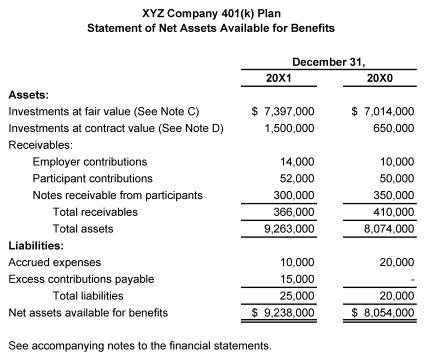 "XYZ Company 401(k) Plan" "Statement of Net Assets Available for Benefits" "December 31, " 20X1 20X0 Assets: Investments at fair value (See Note C) " $7,397,000 " " $7,014,000 " Investments at contract value (See Note D) " 1,500,000 " " 650,000 " Receivables: Employer contributions " 14,000 " " 10,000 " Participant contributions " 52,000 " " 50,000 " Notes receivable from participants " 300,000 " " 350,000 " Total receivables " 366,000 " " 410,000 " Total assets " 9,263,000 " " 8,074,000 " Liabilities: Accrued expenses " 10,000 " " 20,000 " Excess contributions payable " 15,000 " - Total liabilities " 25,000 " " 20,000 " Net assets available for benefits " $9,238,000 " " $8,054,000 " See accompanying notes to the financial statements.
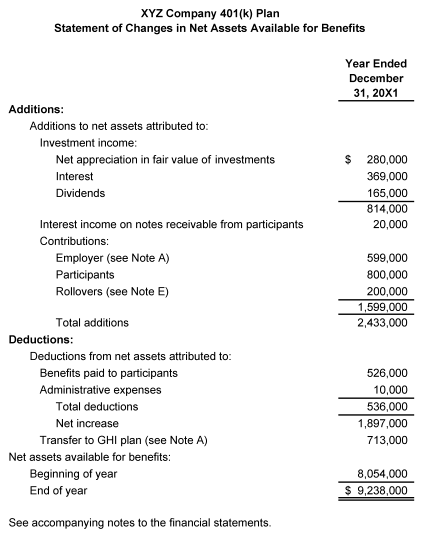 "XYZ Company 401(k) Plan" "Statement of Changes in Net Assets Available for Benefits" "Year Ended December 31, 20X1" Additions: Additions to net assets attributed to: Investment income: Net appreciation in fair value of investments " $280,000 " Interest " 369,000 " Dividends " 165,000 " " 814,000 " Interest income on notes receivable from participants " 20,000 " Contributions: Employer (see Note A) " 599,000 " Participants " 800,000 " Rollovers (see Note E) " 200,000 " " 1,599,000 " Total additions " 2,433,000 " Deductions: Deductions from net assets attributed to: Benefits paid to participants " 526,000 " Administrative expenses " 10,000 " Total deductions " 536,000 " Net increase " 1,897,000 " Transfer to GHI plan (see Note A) " 713,000 " Net assets available for benefits: Beginning of year " 8,054,000 " End of year " $9,238,000 " See accompanying notes to the financial statements.
- Notes to Financial Statements
- A. Description of Plan
- The following description of the XYZ Company (Company) 401(k) Plan (Plan) provides only general information. Participants should refer to the plan agreement for a more complete description of the Plan's provisions.
- 1General. The Plan is a defined contribution plan covering all full-time employees of the Company and its wholly owned subsidiaries who have 1 year of service and are age 21 or older. The Plan is subject to the provisions of the Employment Retirement Income Security Act of 1974 (ERISA). In November 20X1, the Company sold its wholly owned subsidiary, Sub Company. As a result of its sale, on December 1, 20X1, the accounts of all Sub Company employees were transferred out of the Plan to GHI Plan (an existing plan controlled by the acquiring company).
- 2Contributions. Each year, participants may contribute up to XX percent of pretax annual compensation, as defined in the Plan. Participants who have attained age 50 before the end of the Plan year are eligible to make catch-up contributions. Participants also may contribute amounts representing distributions from other qualified defined benefit or defined contribution plans (rollover). Participants direct the investment of their contributions into various investment options offered by the Plan. The Plan includes an auto-enrollment provision whereby all newly eligible employees are automatically enrolled in the Plan unless they affirmatively elect not to participate in the Plan. Automatically enrolled participants have their deferral rate set at 2 percent of eligible compensation and their contributions invested in a designated balanced fund until changed by the participant. The Company contributes 25 percent of the first 6 percent of base compensation that a participant contributes to the Plan. The matching Company contribution is invested as directed by the participant.
- 3Participant accounts. Each participant's account is credited with the participant's contributions and the Company's matching contributions, as well as allocations of Plan earnings. Participant accounts are charged with an allocation of administrative expenses. Allocations are based on participant earnings, account balances, or specific participant transactions, as defined. The benefit to which a participant is entitled is the benefit that can be provided from the participant's vested account.
- 4Vesting. Participants are vested immediately in their contributions plus actual earnings on the contributions. Vesting in the Company's contribution portion of their accounts is based on years of continuous service. A participant is 100 percent vested after 3 years of credited service.
- 5Notes receivable from participants. Participants may borrow from their fund accounts a minimum of $1,000 up to a maximum equal to the lesser of $50,000 or 50 percent of their account balance. The loans are secured by the balance in the participant's account. The loan interest rate, determined quarterly, is set at 2 percent above the prime rate, as defined. Principal and interest is paid ratably through monthly payroll deductions.
- 6Payment of benefits. On termination of service due to death, disability, or retirement, a participant may elect to receive either a lump-sum amount equal to the value of the participant's vested interest in his or her account or annual installments over a 10-year period. For termination of service for other reasons, a participant may receive the value of the vested interest in his or her account as a lump-sum distribution.
- 7Forfeited accounts. At December 31, 20X1, and 20X0, forfeited nonvested accounts totaled $7,500 and $5,000, respectively. These accounts will be used to reduce future employer contributions. Also, in 20X1, employer contributions were reduced by $5,000 from forfeited nonvested accounts.
- 1
- B. Summary of Accounting Policies
- Basis of Accounting
- The financial statements of the Plan are prepared on the accrual basis of accounting.
- Investments held by a defined contribution plan are required to be reported at fair value, except for fully benefit-responsive investment contracts. Contract value is the relevant measure for the portion of the net assets available for benefits of a defined contribution plan attributable to fully benefit-responsive investment contracts because contract value is the amount participants normally would receive if they were to initiate permitted transactions under the terms of the Plan.
- Use of Estimates
- The preparation of financial statements in accordance with U.S. GAAP requires management to make estimates and assumptions that affect the reported amounts of assets and liabilities and changes in those assets and liabilities, and disclosure of contingent assets and liabilities. Actual results could differ from those estimates.
- Investment Valuation and Income Recognition
- Investments are reported at fair value (except for fully benefit-responsive investment contracts, which are reported at contract value). Fair value is the price that would be received to sell an asset or paid to transfer a liability in an orderly transaction between market participants at the measurement date. The Plan's Investment Committee determines the Plan's valuation policies utilizing information provided by the investment advisers, custodians, and insurance company. See Note C for discussion of fair value measurements.
- Purchases and sales of securities are recorded on a trade-date basis. Interest income is recorded on the accrual basis. Dividends are recorded on the ex-dividend date. Net appreciation includes the Plan's gains and losses on investments purchased and sold as well as held during the year.
- Notes Receivable from Participants
- Notes receivable from participants are measured at their unpaid principal balance plus any accrued but unpaid interest. Interest income is recorded on the accrual basis. Related fees are recorded as administrative expenses and are expensed when they are incurred. No allowance for credit losses has been recorded as of December 31, 20X1, or 20X0. Delinquent participant loans are recorded as distributions on the basis of the terms of the Plan agreement.
- Excess Contributions Payable
- Amounts payable to participants for contributions in excess of amounts allowed by the Internal Revenue Service are recorded as a liability with a corresponding reduction to contributions. The Plan distributed the 20X1 excess contributions to the applicable participants before March 15, 20X2.
- Payment of Benefits
- Benefits are recorded when paid.
- Expenses
- Certain expenses incurred maintaining the Plan are paid directly by the Company and are excluded from these financial statements. Investment-related expenses are included in net appreciation of fair value of investments.
- Subsequent Events
- The Plan has evaluated subsequent events through [insert date], the date the financial statements were available to be issued.
- C. Fair Value Measurements
- The framework for measuring fair value provides a fair value hierarchy that prioritizes the inputs to valuation techniques used to measure fair value. The hierarchy gives the highest priority to unadjusted quoted prices in active markets for identical assets or liabilities (Level 1) and the lowest priority to unobservable inputs (Level 3). Valuation techniques maximize the use of relevant observable inputs and minimize the use of unobservable inputs. The three levels of the fair value hierarchy under Topic 820 are described as follows:
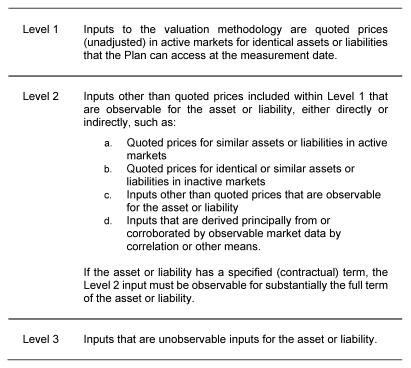 Level 1 Inputs to the valuation methodology are quoted prices (unadjusted) in active markets for identical assets or liabilities that the Plan can access at the measurement date. Level 2 "Inputs other than quoted prices included within Level 1 that are observable for the asset or liability, either directly or indirectly, such as:" a. Quoted prices for similar assets or liabilities in active markets b. Quoted prices for identical or similar assets or liabilities in inactive markets c. Inputs other than quoted prices that are observable for the asset or liability d. Inputs that are derived principally from or corroborated by observable market data by correlation or other means. "If the asset or liability has a specified (contractual) term, the Level 2 input must be observable for substantially the full term of the asset or liability." Level 3 Inputs that are unobservable inputs for the asset or liability.
- Following is a description of the valuation methodologies used for assets measured at fair value. There have been no changes in the methodologies used at December 31, 20X1, and 20X0.
- 1Common stocks. Valued at the closing price reported on the active market on which the individual securities are traded.
- 2Self-directed brokerage accounts. Accounts primarily consist of mutual funds and common stocks that are valued on the basis of readily determinable market prices.
- 3Corporate bonds. Valued using pricing models maximizing the use of observable inputs for similar securities. This includes basing the value on yields currently available on comparable securities of issuers with similar credit ratings. When quoted prices are not available for identical or similar bonds, those corporate bonds are valued under a discounted cash flow approach that maximizes observable inputs, such as current yields or similar instruments, but includes adjustments for certain risks that may not be observable, such as credit and liquidity risks.
- 4Mutual funds. Valued at the daily closing price as reported by the fund. Mutual funds held by the Plan are open-end mutual funds that are registered with the U.S. Securities and Exchange Commission. These funds are required to publish their daily net asset value and to transact at that price. The mutual funds held by the Plan are deemed to be actively traded.
- 5
- 6U.S. government securities. Valued using pricing models maximizing the use of observable inputs for similar securities.
- 1
- The following table sets forth by level, within the fair value hierarchy, the Plan's assets at fair value as of December 31, 20X1, and 20X0. Classification within the fair value hierarchy table is based on the lowest level of any input that is significant to the fair value measurement.
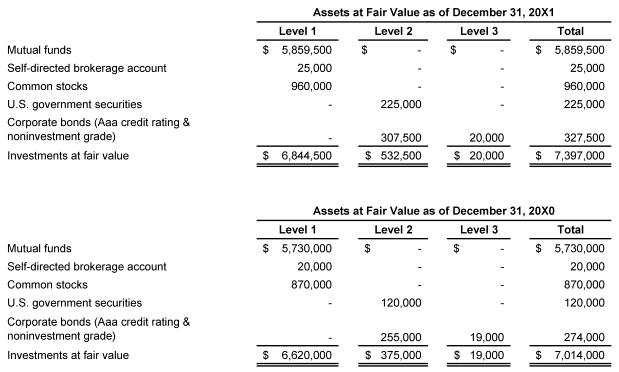 "Assets at Fair Value as of December 31, 20X1" Level 1 Level 2 Level 3 Total Mutual funds " $5,859,500 " $ - $ - " $5,859,500 " Self-directed brokerage account " 25,000 " - - " 25,000 " Common stocks " 960,000 " - - " 960,000 " U.S. government securities - " 225,000 " - " 225,000 " Corporate bonds (Aaa credit rating & noninvestment grade) - " 307,500 " " 20,000 " " 327,500 " Investments at fair value " $6,844,500 " " $532,500 " " $20,000 " " $7,397,000 " "Assets at Fair Value as of December 31, 20X0" Level 1 Level 2 Level 3 Total Mutual funds " $5,730,000 " $- $- " $5,730,000 " Self-directed brokerage account " 20,000 " - - " 20,000 " Common stocks " 870,000 " - - " 870,000 " U.S. government securities - " 120,000 " - " 120,000 " Corporate bonds (Aaa credit rating & noninvestment grade) - " 255,000 " " 19,000 " " 274,000 " Investments at fair value " $6,620,000 " " $375,000 " " $19,000 " " $7,014,000 "
- Transfers between Levels
- For years ended December 31, 20X1, and 20X0, there were no significant transfers between Levels 1 and 2 and no transfers in or out of Level 3.
- Changes in Fair Value of Level 3 Assets and Related Gains and Losses
- The following table sets forth a summary of changes in the fair value of the Plan's Level 3 assets for the year ended December 31, 20X1.
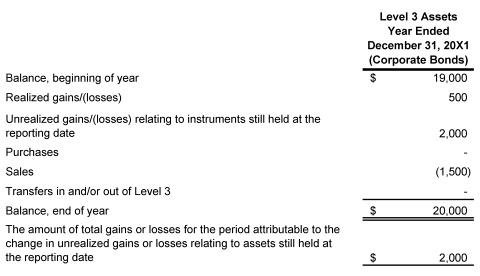 Level 3 Assets Year Ended " December 31, 20X1 " (Corporate Bonds) "Balance, beginning of year" " $19,000 " Realized gains/(losses) 500 Unrealized gains/(losses) relating to instruments still held at the reporting date " 2,000 " Purchases - Sales " (1,500)" Transfers in and/or out of Level 3 - "Balance, end of year" " $20,000 " The amount of total gains or losses for the period attributable to the change in unrealized gains or losses relating to assets still held at the reporting date " $2,000 "
- Quantitative Information about Significant Unobservable Inputs Used in Level 3 Fair Value Measurements
- The following table represents the Plan's Level 3 financial instruments, the valuation techniques used to measure the fair value of those financial instruments, and the significant unobservable inputs and the ranges of values for those inputs.
 Instrument Fair Value Principal Valuation Technique Unobservable Inputs Range of Significant Input Values Weighted Average Corporate bonds "$20,000 " Discounted cash flow Credit risk (basis points) xx-xxx Y% Liquidity risk (basis points) xx-xxx Y%
- D. Fully Benefit-Responsive Investment Contracts
- The Plan holds a portfolio of investment contracts that are directly effected with the issuer that comprises a traditional investment contract and a portfolio of synthetic investment contracts. These contracts meet the fully benefit-responsive investment contract criteria and therefore are reported at contract value. Contract value is the relevant measure for fully benefit-responsive investment contracts because this is the amount received by participants if they were to initiate permitted transactions under the terms of the Plan. Contract value represents contributions made under each contract, plus earnings, less participant withdrawals, and administrative expenses. The following represents the disaggregation of contract value between types of investment contracts held by the Plan.
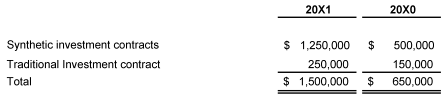 20X1 20X0 Synthetic investment contracts " $1,250,000 " " $500,000 " Traditional Investment contract " 250,000 " " 150,000 " Total " $1,500,000 " " $650,000 "
- The key difference between a synthetic investment contract and a traditional investment contract is that the Plan owns the underlying assets of the synthetic investment contract. A synthetic investment contract includes a wrapper contract, which is an agreement for the wrap issuer, such as a bank or insurance company, to make payments to the Plan in certain circumstances. The wrapper contract typically includes certain conditions and limitations on the underlying assets owned by the Plan. With traditional investment contracts, the Plan owns only the contract itself. Synthetic and traditional investment contracts are designed to accrue interest based on crediting rates established by the contract issuers.
- The synthetic investment contracts held by the Plan include wrapper contracts that provide a guarantee that the credit rate will not fall below 0 percent. Cash flow volatility (for example, timing of benefit payments) as well as asset underperformance can be passed through to the Plan through adjustments to future contract crediting rates. Formulas are provided in each contract that adjusts renewal crediting rates to recognize the difference between the fair value and the book value of the underlying assets. Crediting rates are reviewed monthly for resetting.
- The traditional investment contract held by the Plan is a guaranteed investment contract. The contract issuer is contractually obligated to repay the principal and interest at a specified interest rate that is guaranteed to the Plan. The crediting rate is based on a formula established by the contract issuer but may not be less than 4 percent. The crediting rate is reviewed on a quarterly basis for resetting. The contract cannot be terminated before the scheduled maturity date.
- The Plan's ability to receive amounts due in accordance with fully benefit-responsive investment contracts is dependent on the third-party issuer's ability to meet its financial obligations. The issuer's ability to meet its contractual obligations may be affected by future economic and regulatory developments.
- Certain events might limit the ability of the Plan to transact at contract value with the contract issuer. These events may be different under each contract. Examples of such events include the following:
- 1The Plan's failure to qualify under Section 401(a) of the Internal Revenue Code or the failure of the trust to be tax-exempt under Section 501(a) of the Internal Revenue Code
- 2Premature termination of the contracts
- 3Plan termination or merger
- 4Changes to the Plan's prohibition on competing investment options
- 5Bankruptcy of the plan sponsor or other plan sponsor events (for example, divestitures or spinoffs of a subsidiary) that significantly affect the Plan's normal operations.
- 1
- No events are probable of occurring that might limit the ability of the Plan to transact at contract value with the contract issuers and that also would limit the ability of the Plan to transact at contract value with the participants.
- In addition, certain events allow the issuer to terminate the contracts with the Plan and settle at an amount different from contract value. Those events may be different under each contract. Examples of such events include the following:
- 1An uncured violation of the Plan's investment guidelines
- 2A breach of material obligation under the contract
- 3A material misrepresentation
- 4A material amendment to the agreements without the consent of the issuer.
- 1
- E. Rollover Contributions
- On January 20, 20X1, XYZ Company acquired ABC Company and approved an amendment to terminate the ABC 401(k) Plan effective November 1, 20X1. All participants in the ABC 401(k) Plan became 100 percent vested in that plan upon termination and were provided with the option to have their account balance rolled into any qualified plan (including the Plan) or IRA, receive a lump-sum distribution, or be paid through an annuity contract. An aggregate of $XXX,000 was rolled into the Plan during the year ended December 31, 20X1, and is included in rollovers on the statement of changes in net assets available for benefits.
- F. Related-Party Transactions and Party-in-Interest Transactions
- Certain Plan investments are shares of mutual funds managed by Prosperity Investments. Prosperity Investments is the trustee as defined by the Plan, and, therefore, these transactions qualify as party-in-interest transactions. Fees incurred and paid directly by the Plan for the investment management services were $10,000.
- G. Plan Termination
- Although it has not expressed any intent to do so, the Company has the right under the Plan to discontinue its contributions at any time and to terminate the Plan subject to the provisions of ERISA. In the event of Plan termination, participants would become 100 percent vested in their employer contributions.
- H. Tax Status
- The IRS has determined and informed the Company by a letter dated August 30, 20XX, that the Plan and related trust are designed in accordance with applicable sections of the Internal Revenue Code. Although the Plan has been amended since receiving the determination letter, the Plan administrator and the Plan's tax counsel believe that the Plan is designed, and is currently being operated, in compliance with the applicable requirements of the Internal Revenue Code and, therefore, believe that the Plan is qualified and that the related trust is tax-exempt.
- I. Risks and Uncertainties
- The Plan invests in various investment securities. Investment securities are exposed to various risks, such as interest rate, market, and credit risks. Because of the level of risk associated with certain investment securities, it is at least reasonably possible that changes in the values of investment securities will occur in the near term and that such changes could materially affect participants' account balances and the amounts reported in the statement of net assets available for benefits.
- J. Reconciliation of Financial Statements to Form 5500
- The following is a reconciliation of net assets available for benefits per the financial statements at December 31, 20X1, and 20X0, to Form 5500:
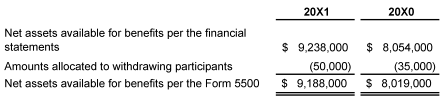 20X1 20X0 "Net assets available for benefits per the financial statements" " $9,238,000 " " $8,054,000 " Amounts allocated to withdrawing participants " (50,000)" " (35,000)" Net assets available for benefits per the Form 5500 " $9,188,000 " " $8,019,000 "
- The following is a reconciliation of benefits paid to participants per the financial statements for the year ended December 31, 20X1, to Form 5500:
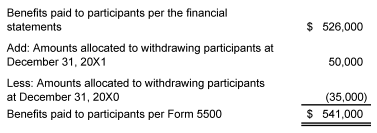 "Benefits paid to participants per the financial statements" " $526,000 " "Add: Amounts allocated to withdrawing participants at December 31, 20X1" " 50,000 " "Less: Amounts allocated to withdrawing participants at December 31, 20X0" " (35,000)" Benefits paid to participants per Form 5500 " $541,000 "
- Amounts allocated to withdrawing participants are recorded on Form 5500 for benefit claims that have been processed and approved for payment before year-end, but not yet paid as of that date.
- "XYZ Company 401(k) Plan" "Statement of Net Assets Available for Benefits" "December 31, " 20X1 20X0 Assets: Investments at fair value (See Note C) " $7,397,000 " " $7,014,000 " Investments at contract value (See Note D) " 1,500,000 " " 650,000 " Receivables: Employer contributions " 14,000 " " 10,000 " Participant contributions " 52,000 " " 50,000 " Notes receivable from participants " 300,000 " " 350,000 " Total receivables " 366,000 " " 410,000 " Total assets " 9,263,000 " " 8,074,000 " Liabilities: Accrued expenses " 10,000 " " 20,000 " Excess contributions payable " 15,000 " - Total liabilities " 25,000 " " 20,000 " Net assets available for benefits " $9,238,000 " " $8,054,000 " See accompanying notes to the financial statements.
- "XYZ Company 401(k) Plan" "Statement of Changes in Net Assets Available for Benefits" "Year Ended December 31, 20X1" Additions: Additions to net assets attributed to: Investment income: Net appreciation in fair value of investments " $280,000 " Interest " 369,000 " Dividends " 165,000 " " 814,000 " Interest income on notes receivable from participants " 20,000 " Contributions: Employer (see Note A) " 599,000 " Participants " 800,000 " Rollovers (see Note E) " 200,000 " " 1,599,000 " Total additions " 2,433,000 " Deductions: Deductions from net assets attributed to: Benefits paid to participants " 526,000 " Administrative expenses " 10,000 " Total deductions " 536,000 " Net increase " 1,897,000 " Transfer to GHI plan (see Note A) " 713,000 " Net assets available for benefits: Beginning of year " 8,054,000 " End of year " $9,238,000 " See accompanying notes to the financial statements.
- Notes to Financial Statements
- A. Description of Plan
- The following description of the XYZ Company (Company) 401(k) Plan (Plan) provides only general information. Participants should refer to the plan agreement for a more complete description of the Plan's provisions.
- 1General. The Plan is a defined contribution plan covering all full-time employees of the Company and its wholly owned subsidiaries who have 1 year of service and are age 21 or older. The Plan is subject to the provisions of the Employment Retirement Income Security Act of 1974 (ERISA). In November 20X1, the Company sold its wholly owned subsidiary, Sub Company. As a result of its sale, on December 1, 20X1, the accounts of all Sub Company employees were transferred out of the Plan to GHI Plan (an existing plan controlled by the acquiring company).
- 2Contributions. Each year, participants may contribute up to XX percent of pretax annual compensation, as defined in the Plan. Participants who have attained age 50 before the end of the Plan year are eligible to make catch-up contributions. Participants also may contribute amounts representing distributions from other qualified defined benefit or defined contribution plans (rollover). Participants direct the investment of their contributions into various investment options offered by the Plan. The Plan includes an auto-enrollment provision whereby all newly eligible employees are automatically enrolled in the Plan unless they affirmatively elect not to participate in the Plan. Automatically enrolled participants have their deferral rate set at 2 percent of eligible compensation and their contributions invested in a designated balanced fund until changed by the participant. The Company contributes 25 percent of the first 6 percent of base compensation that a participant contributes to the Plan. The matching Company contribution is invested as directed by the participant.
- 3Participant accounts. Each participant's account is credited with the participant's contributions and the Company's matching contributions, as well as allocations of Plan earnings. Participant accounts are charged with an allocation of administrative expenses. Allocations are based on participant earnings, account balances, or specific participant transactions, as defined. The benefit to which a participant is entitled is the benefit that can be provided from the participant's vested account.
- 4Vesting. Participants are vested immediately in their contributions plus actual earnings on the contributions. Vesting in the Company's contribution portion of their accounts is based on years of continuous service. A participant is 100 percent vested after 3 years of credited service.
- 5Notes receivable from participants. Participants may borrow from their fund accounts a minimum of $1,000 up to a maximum equal to the lesser of $50,000 or 50 percent of their account balance. The loans are secured by the balance in the participant's account. The loan interest rate, determined quarterly, is set at 2 percent above the prime rate, as defined. Principal and interest is paid ratably through monthly payroll deductions.
- 6Payment of benefits. On termination of service due to death, disability, or retirement, a participant may elect to receive either a lump-sum amount equal to the value of the participant's vested interest in his or her account or annual installments over a 10-year period. For termination of service for other reasons, a participant may receive the value of the vested interest in his or her account as a lump-sum distribution.
- 7Forfeited accounts. At December 31, 20X1, and 20X0, forfeited nonvested accounts totaled $7,500 and $5,000, respectively. These accounts will be used to reduce future employer contributions. Also, in 20X1, employer contributions were reduced by $5,000 from forfeited nonvested accounts.
- 1
- B. Summary of Accounting Policies
- Basis of Accounting
- The financial statements of the Plan are prepared on the accrual basis of accounting.
- Investments held by a defined contribution plan are required to be reported at fair value, except for fully benefit-responsive investment contracts. Contract value is the relevant measure for the portion of the net assets available for benefits of a defined contribution plan attributable to fully benefit-responsive investment contracts because contract value is the amount participants normally would receive if they were to initiate permitted transactions under the terms of the Plan.
- Use of Estimates
- The preparation of financial statements in accordance with U.S. GAAP requires management to make estimates and assumptions that affect the reported amounts of assets and liabilities and changes in those assets and liabilities, and disclosure of contingent assets and liabilities. Actual results could differ from those estimates.
- Investment Valuation and Income Recognition
- Investments are reported at fair value (except for fully benefit-responsive investment contracts, which are reported at contract value). Fair value is the price that would be received to sell an asset or paid to transfer a liability in an orderly transaction between market participants at the measurement date. The Plan's Investment Committee determines the Plan's valuation policies utilizing information provided by the investment advisers, custodians, and insurance company. See Note C for discussion of fair value measurements.
- Purchases and sales of securities are recorded on a trade-date basis. Interest income is recorded on the accrual basis. Dividends are recorded on the ex-dividend date. Net appreciation includes the Plan's gains and losses on investments purchased and sold as well as held during the year.
- Notes Receivable from Participants
- Notes receivable from participants are measured at their unpaid principal balance plus any accrued but unpaid interest. Interest income is recorded on the accrual basis. Related fees are recorded as administrative expenses and are expensed when they are incurred. Delinquent participant loans are recorded as distributions on the basis of the terms of the Plan agreement.
- Excess Contributions Payable
- Amounts payable to participants for contributions in excess of amounts allowed by the Internal Revenue Service are recorded as a liability with a corresponding reduction to contributions. The Plan distributed the 20X1 excess contributions to the applicable participants before March 15, 20X2.
- Payment of Benefits
- Benefits are recorded when paid.
- Expenses
- Certain expenses incurred maintaining the Plan are paid directly by the Company and are excluded from these financial statements. Investment-related expenses are included in net appreciation of fair value of investments.
- Subsequent Events
- The Plan has evaluated subsequent events through [insert date], the date the financial statements were available to be issued.
- C. Fair Value Measurements
- The framework for measuring fair value provides a fair value hierarchy that prioritizes the inputs to valuation techniques used to measure fair value. The hierarchy gives the highest priority to unadjusted quoted prices in active markets for identical assets or liabilities (Level 1) and the lowest priority to unobservable inputs (Level 3). Valuation techniques maximize the use of relevant observable inputs and minimize the use of unobservable inputs. The three levels of the fair value hierarchy under Topic 820 are described as follows:
- Level 1 Inputs to the valuation methodology are quoted prices (unadjusted) in active markets for identical assets or liabilities that the Plan can access at the measurement date. Level 2 "Inputs other than quoted prices included within Level 1 that are observable for the asset or liability, either directly or indirectly, such as:" a. Quoted prices for similar assets or liabilities in active markets b. Quoted prices for identical or similar assets or liabilities in inactive markets c. Inputs other than quoted prices that are observable for the asset or liability d. Inputs that are derived principally from or corroborated by observable market data by correlation or other means. "If the asset or liability has a specified (contractual) term, the Level 2 input must be observable for substantially the full term of the asset or liability." Level 3 Inputs that are unobservable inputs for the asset or liability.
- Following is a description of the valuation methodologies used for assets measured at fair value. There have been no changes in the methodologies used at December 31, 20X1, and 20X0.
- 1Common stocks. Valued at the closing price reported on the active market on which the individual securities are traded.
- 2Self-directed brokerage accounts. Accounts primarily consist of mutual funds and common stocks that are valued on the basis of readily determinable market prices.
- 3Corporate bonds. Valued using pricing models maximizing the use of observable inputs for similar securities. This includes basing the value on yields currently available on comparable securities of issuers with similar credit ratings. When quoted prices are not available for identical or similar bonds, those corporate bonds are valued under a discounted cash flow approach that maximizes observable inputs, such as current yields or similar instruments, but includes adjustments for certain risks that may not be observable, such as credit and liquidity risks.
- 4Mutual funds. Valued at the daily closing price as reported by the fund. Mutual funds held by the Plan are open-end mutual funds that are registered with the U.S. Securities and Exchange Commission. These funds are required to publish their daily net asset value and to transact at that price. The mutual funds held by the Plan are deemed to be actively traded.
- 5
- 6U.S. government securities. Valued using pricing models maximizing the use of observable inputs for similar securities.
- 1
- The following table sets forth by level, within the fair value hierarchy, the Plan's assets at fair value as of December 31, 20X1, and 20X0. Classification within the fair value hierarchy table is based on the lowest level of any input that is significant to the fair value measurement.
- "Assets at Fair Value as of December 31, 20X1" Level 1 Level 2 Level 3 Total Mutual funds " $5,859,500 " $ - $ - " $5,859,500 " Self-directed brokerage account " 25,000 " - - " 25,000 " Common stocks " 960,000 " - - " 960,000 " U.S. government securities - " 225,000 " - " 225,000 " Corporate bonds (Aaa credit rating & noninvestment grade) - " 307,500 " " 20,000 " " 327,500 " Investments at fair value " $6,844,500 " " $532,500 " " $20,000 " " $7,397,000 " "Assets at Fair Value as of December 31, 20X0" Level 1 Level 2 Level 3 Total Mutual funds " $5,730,000 " $- $- " $5,730,000 " Self-directed brokerage account " 20,000 " - - " 20,000 " Common stocks " 870,000 " - - " 870,000 " U.S. government securities - " 120,000 " - " 120,000 " Corporate bonds (Aaa credit rating & noninvestment grade) - " 255,000 " " 19,000 " " 274,000 " Investments at fair value " $6,620,000 " " $375,000 " " $19,000 " " $7,014,000 "
- Level 3 Transfers
- For years ended December 31, 20X1, and 20X0, there were no transfers in or out of Level 3.
- Changes in Fair Value of Level 3 Assets and Related Gains and Losses
- The following table sets forth a summary of changes in the fair value of the Plan's Level 3 assets for the year ended December 31, 20X1.
- Level 3 Assets Year Ended " December 31, 20X1 " (Corporate Bonds) "Balance, beginning of year" " $19,000 " Realized gains/(losses) 500 Unrealized gains/(losses) relating to instruments still held at the reporting date " 2,000 " Purchases - Sales " (1,500)" Transfers in and/or out of Level 3 - "Balance, end of year" " $20,000 " The amount of total gains or losses for the period attributable to the change in unrealized gains or losses relating to assets still held at the reporting date " $2,000 "
- Quantitative Information about Significant Unobservable Inputs Used in Level 3 Fair Value Measurements
- The following table represents the Plan's Level 3 financial instruments, the valuation techniques used to measure the fair value of those financial instruments, and the significant unobservable inputs and the ranges of values for those inputs.
- Instrument Fair Value Principal Valuation Technique Unobservable Inputs Range of Significant Input Values Weighted Average Corporate bonds "$20,000 " Discounted cash flow Credit risk (basis points) xx-xxx Y% Liquidity risk (basis points) xx-xxx Y%
- D. Fully Benefit-Responsive Investment Contracts
- The Plan holds a portfolio of investment contracts that are directly effected with the issuer that comprises a traditional investment contract and a portfolio of synthetic investment contracts. These contracts meet the fully benefit-responsive investment contract criteria and therefore are reported at contract value. Contract value is the relevant measure for fully benefit-responsive investment contracts because this is the amount received by participants if they were to initiate permitted transactions under the terms of the Plan. Contract value represents contributions made under each contract, plus earnings, less participant withdrawals, and administrative expenses. The following represents the disaggregation of contract value between types of investment contracts held by the Plan.
- 20X1 20X0 Synthetic investment contracts " $1,250,000 " " $500,000 " Traditional Investment contract " 250,000 " " 150,000 " Total " $1,500,000 " " $650,000 "
- The key difference between a synthetic investment contract and a traditional investment contract is that the Plan owns the underlying assets of the synthetic investment contract. A synthetic investment contract includes a wrapper contract, which is an agreement for the wrap issuer, such as a bank or insurance company, to make payments to the Plan in certain circumstances. The wrapper contract typically includes certain conditions and limitations on the underlying assets owned by the Plan. With traditional investment contracts, the Plan owns only the contract itself. Synthetic and traditional investment contracts are designed to accrue interest based on crediting rates established by the contract issuers.
- The synthetic investment contracts held by the Plan include wrapper contracts that provide a guarantee that the credit rate will not fall below 0 percent. Cash flow volatility (for example, timing of benefit payments) as well as asset underperformance can be passed through to the Plan through adjustments to future contract crediting rates. Formulas are provided in each contract that adjusts renewal crediting rates to recognize the difference between the fair value and the book value of the underlying assets. Crediting rates are reviewed monthly for resetting.
- The traditional investment contract held by the Plan is a guaranteed investment contract. The contract issuer is contractually obligated to repay the principal and interest at a specified interest rate that is guaranteed to the Plan. The crediting rate is based on a formula established by the contract issuer but may not be less than 4 percent. The crediting rate is reviewed on a quarterly basis for resetting. The contract cannot be terminated before the scheduled maturity date.
- The Plan's ability to receive amounts due in accordance with fully benefit-responsive investment contracts is dependent on the third-party issuer's ability to meet its financial obligations. The issuer's ability to meet its contractual obligations may be affected by future economic and regulatory developments.
- Certain events might limit the ability of the Plan to transact at contract value with the contract issuer. These events may be different under each contract. Examples of such events include the following:
- 1The Plan's failure to qualify under Section 401(a) of the Internal Revenue Code or the failure of the trust to be tax-exempt under Section 501(a) of the Internal Revenue Code
- 2Premature termination of the contracts
- 3Plan termination or merger
- 4Changes to the Plan's prohibition on competing investment options
- 5Bankruptcy of the plan sponsor or other plan sponsor events (for example, divestitures or spinoffs of a subsidiary) that significantly affect the Plan's normal operations.
- 1
- No events are probable of occurring that might limit the ability of the Plan to transact at contract value with the contract issuers and that also would limit the ability of the Plan to transact at contract value with the participants.
- In addition, certain events allow the issuer to terminate the contracts with the Plan and settle at an amount different from contract value. Those events may be different under each contract. Examples of such events include the following:
- 1An uncured violation of the Plan's investment guidelines
- 2A breach of material obligation under the contract
- 3A material misrepresentation
- 4A material amendment to the agreements without the consent of the issuer.
- 1
- E. Rollover Contributions
- On January 20, 20X1, XYZ Company acquired ABC Company and approved an amendment to terminate the ABC 401(k) Plan effective November 1, 20X1. All participants in the ABC 401(k) Plan became 100 percent vested in that plan upon termination and were provided with the option to have their account balance rolled into any qualified plan (including the Plan) or IRA, receive a lump-sum distribution, or be paid through an annuity contract. An aggregate of $XXX,000 was rolled into the Plan during the year ended December 31, 20X1, and is included in rollovers on the statement of changes in net assets available for benefits.
- F. Related-Party Transactions and Party-in-Interest Transactions
- Certain Plan investments are shares of mutual funds managed by Prosperity Investments. Prosperity Investments is the trustee as defined by the Plan, and, therefore, these transactions qualify as party-in-interest transactions. Fees incurred and paid directly by the Plan for the investment management services were $10,000.
- G. Plan Termination
- Although it has not expressed any intent to do so, the Company has the right under the Plan to discontinue its contributions at any time and to terminate the Plan subject to the provisions of ERISA. In the event of Plan termination, participants would become 100 percent vested in their employer contributions.
- H. Tax Status
- The IRS has determined and informed the Company by a letter dated August 30, 20XX, that the Plan and related trust are designed in accordance with applicable sections of the Internal Revenue Code. Although the Plan has been amended since receiving the determination letter, the Plan administrator and the Plan's tax counsel believe that the Plan is designed, and is currently being operated, in compliance with the applicable requirements of the Internal Revenue Code and, therefore, believe that the Plan is qualified and that the related trust is tax-exempt.
- I. Risks and Uncertainties
- The Plan invests in various investment securities. Investment securities are exposed to various risks, such as interest rate, market, and credit risks. Because of the level of risk associated with certain investment securities, it is at least reasonably possible that changes in the values of investment securities will occur in the near term and that such changes could materially affect participants' account balances and the amounts reported in the statement of net assets available for benefits.
- J. Reconciliation of Financial Statements to Form 5500
- The following is a reconciliation of net assets available for benefits per the financial statements at December 31, 20X1, and 20X0, to Form 5500:
- 20X1 20X0 "Net assets available for benefits per the financial statements" " $9,238,000 " " $8,054,000 " Amounts allocated to withdrawing participants " (50,000)" " (35,000)" Net assets available for benefits per the Form 5500 " $9,188,000 " " $8,019,000 "
- The following is a reconciliation of benefits paid to participants per the financial statements for the year ended December 31, 20X1, to Form 5500:
- "Benefits paid to participants per the financial statements" " $526,000 " "Add: Amounts allocated to withdrawing participants at December 31, 20X1" " 50,000 " "Less: Amounts allocated to withdrawing participants at December 31, 20X0" " (35,000)" Benefits paid to participants per Form 5500 " $541,000 "
- Amounts allocated to withdrawing participants are recorded on Form 5500 for benefit claims that have been processed and approved for payment before year-end, but not yet paid as of that date.
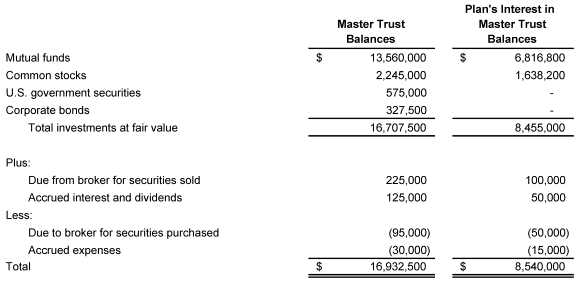 Master Trust Balances Plan's Interest in Master Trust Balances Mutual funds " $13,560,000 " " $6,816,800 " Common stocks " 2,245,000 " " 1,638,200 " U.S. government securities " 575,000 " - Corporate bonds " 327,500 " - Total investments at fair value " 16,707,500 " " 8,455,000 " Plus: Due from broker for securities sold " 225,000 " " 100,000 " Accrued interest and dividends " 125,000 " " 50,000 " Less: Due to broker for securities purchased " (95,000)" " (50,000)" Accrued expenses " (30,000)" " (15,000)" Total " $16,932,500 " " $8,540,000 "
Related subtopics
- 205-960 Plan Accounting—Defined Benefit Pension PlansPresentation of Financial Statements
- 205-965 Plan Accounting—Health and Welfare Benefit PlansPresentation of Financial Statements
- 715-80 Multiemployer PlansCompensation—Retirement Benefits
- 715-20 Defined Benefit Plans—GeneralCompensation—Retirement Benefits
- 325-965 Plan Accounting—Health and Welfare Benefit PlansInvestments—Other
- 205-962 Plan Accounting—Defined Contribution Pension PlansPresentation of Financial Statements