ASC

ASC 835-20

Capitalization of Interest

835 Interest

Source downloaded: .Record version a89690481d47. Effective date must be checked in the source.

ASC 835-20 requires interest cost incurred while a qualifying asset is being readied for its intended use to be capitalized as part of the asset's historical cost, on the theory that such interest is an avoidable cost caused by the acquisition. Qualifying assets include assets constructed for an entity's own use, discrete projects built for sale or lease, and equity-method investments in investees that have not yet begun planned principal operations; routinely mass-produced inventory, assets already in use or idle, and gift/grant-funded assets are excluded. The amount capitalized equals the capitalization rate (rate on specific new borrowing, then weighted average of other borrowings) applied to average accumulated expenditures, capped at total interest cost incurred in the period.

Key points (7)
  • Interest is capitalized only on qualifying assets — assets constructed or produced for the entity's own use (including those built by others with deposits/progress payments), assets built as discrete projects for sale or lease, and equity-method investments while the investee has activities in progress to commence planned principal operations (835-20-15-5).
  • Interest is not capitalized on assets in use or ready for use, idle assets not undergoing readying activities, assets outside the consolidated balance sheet, equity-method investees after planned principal operations begin, regulated investees capitalizing debt and equity cost, assets funded by restricted gifts and grants, or inventories routinely produced in large quantities on a repetitive basis (835-20-15-6).
  • The capitalization period begins when all three conditions exist — expenditures have been made, activities necessary to ready the asset are in progress, and interest cost is being incurred — and continues while they persist (835-20-25-3).
  • Capitalization ceases when the asset is substantially complete and ready for its intended use, and is suspended if the entity suspends substantially all activities, though brief, externally imposed, or inherent delays do not stop capitalization (835-20-25-4 through 25-6).
  • The amount capitalized equals the capitalization rate times average accumulated expenditures; a specific new borrowing's rate applies up to that borrowing's amount, with a weighted average of other borrowing rates applied to the excess (835-20-30-3), and total interest capitalized may not exceed total interest cost incurred in the period (835-20-30-6).
  • Interest earned may not be offset against interest cost except for qualifying assets financed with externally restricted tax-exempt borrowings, where net interest (cost less interest earned on related investments) is capitalized from the date of borrowing (835-20-30-8 through 30-11; 835-20-25-8).
  • Disclose interest cost incurred and charged to expense when none is capitalized, and both total interest incurred and the amount capitalized when some is capitalized (835-20-50-1).

For students. Exam questions almost always test the mechanics: average accumulated expenditures × capitalization rate, capped at actual interest incurred. The classic trap is offsetting interest income against interest cost — prohibited except for externally restricted tax-exempt borrowings — and forgetting that routinely mass-produced inventory and idle or already-in-use assets never qualify.

Machine-generated study aid for ASC 835-20. Check the source paragraphs below.

835-20-00Status

Source downloaded: .Record version 96a410e93ec6. Effective date must be checked in the source.

835-20-05Overview and Background

Source downloaded: .Record version 71ec9b3c526a. Effective date must be checked in the source.

835-20-05-1
This Subtopic establishes standards of financial accounting and reporting for capitalizing interest cost as a part of the historical cost of acquiring certain assets. The historical cost of acquiring an asset includes the costs necessarily incurred to bring it to the condition and location necessary for its intended use. If an asset requires a period of time in which to carry out the activities necessary to bring it to that condition and location, the interest cost incurred during that period as a result of expenditures for the asset is a part of the historical cost of acquiring the asset.

835-20-10Objectives

Source downloaded: .Record version a611831c1e56. Effective date must be checked in the source.

835-20-10-1
The objectives of capitalizing interest are to obtain a measure of acquisition cost that more closely reflects an entity's total investment in the asset and to charge a cost that relates to the acquisition of a resource that will benefit future periods against the revenues of the periods benefited.
835-20-10-2
On the premise that the historical cost of acquiring an asset should include all costs necessarily incurred to bring it to the condition and location necessary for its intended use, in principle, the cost incurred in financing expenditures for an asset during a required construction or development period is itself a part of the asset's historical acquisition cost. The cause-and-effect relationship between acquiring an asset and the incurrence of interest cost makes interest cost analogous to a direct cost that is readily and objectively assignable to the acquired asset. Failure to capitalize the interest cost associated with the acquisition of qualifying assets improperly reduces reported earnings during the period of acquisition and increases reported earnings in later periods.

835-20-15Scope and Scope Exceptions

Source downloaded: .Record version b2692b64aa44. Effective date must be checked in the source.

Entities

835-20-15-1
The guidance in this Subtopic applies to all entities.

Other Considerations

835-20-15-2
In concept, interest cost is capitalizable for all assets that require a period of time to get them ready for their intended use (an acquisition period). However, in many cases, the benefit in terms of information about the entity's resources and earnings may not justify the additional accounting and administrative cost involved in providing the information. The significance of the effect of interest capitalization in relation to the entity's resources and earnings is the most important consideration in assessing its benefit. The ease with which qualifying assets and related expenditures can be separately identified and the number of assets subject to interest capitalization are important factors in assessing the cost of implementation.
835-20-15-3
Interest capitalization is required only when the balance of the informational benefit and the cost of implementation is favorable. A favorable balance is most likely to be achieved where an asset is constructed or produced as a discrete project for which costs are separately accumulated and where construction of the asset takes considerable time, entails substantial expenditures, and is likely to involve a significant amount of interest cost. A favorable balance is unlikely in the case of inventory items that are routinely manufactured or otherwise produced in large quantities on a repetitive basis. Accordingly, this Subtopic proscribes interest capitalization on those types of inventories (that is, inventory items that are routinely manufactured or produced in large quantities on a repetitive basis) and provides for interest capitalization on assets that are constructed or produced as discrete projects.
835-20-15-4
Minimum threshold levels are common in inventory and property, plant, and equipment accounting. Many entities do not include the costs of minor items in inventory, and many entities do not capitalize individual items of property, plant, and equipment, the costs of which are less than a specified threshold. Such thresholds are designed to minimize the burden of capitalizing large numbers of assets and accounting for those costs as the assets are used. Those thresholds are justified on the grounds that the assets whose costs are charged to expense as purchased are immaterial both individually and in the aggregate. This Subtopic does not affect the use of threshold levels established in conformity with such materiality tests.
835-20-15-5
Interest shall be capitalized for the following types of assets (qualifying assets):
  1. a
    Assets that are constructed or otherwise produced for an entity's own use, including assets constructed or produced for the entity by others for which deposits or progress payments have been made.
  2. b
    Assets intended for sale or lease that are constructed or otherwise produced as discrete projects (for example, ships or real estate developments).
  3. c
    Investments (equity, loans, and advances) accounted for by the equity method while the investee has activities in progress necessary to commence its planned principal operations provided that the investee's activities include the use of funds to acquire qualifying assets for its operations. The investor's investment in the investee, not the individual assets or projects of the investee, is the qualifying asset for purposes of interest capitalization.
835-20-15-6
Interest shall not be capitalized for the following types of assets:
  1. a
    Assets that are in use or ready for their intended use in the earning activities of the entity
  2. b
    Assets that are not being used in the earning activities of the entity and that are not undergoing the activities necessary to get them ready for use
  3. c
    Assets that are not included in the consolidated balance sheet of the parent entity and consolidated subsidiaries
  4. d
    Investments accounted for by the equity method after the planned principal operations of the investee begin (see paragraph 835-20-55-2 for clarification of the phrase after planned principal operations begin)
  5. e
    Investments in regulated investees that are capitalizing both the cost of debt and equity capital (see paragraph 835-20-55-3 for guidance on capitalization of costs by a regulated investee)
  6. f
    Assets acquired with gifts and grants that are restricted by the donor or grantor to acquisition of those assets to the extent that funds are available from such gifts and grants. Interest earned from temporary investment of those funds that is similarly restricted shall be considered an addition to the gift or grant for this purpose.
  7. g
    Inventories that are routinely manufactured or otherwise produced in large quantities on a repetitive basis.
835-20-15-7
Accretion expense related to exit costs and asset retirement obligations shall not be considered to be interest cost for purposes of applying this Subtopic. See Topic 420 or Subtopic 410-20 for guidance on those areas. The interest cost component of net periodic pension cost shall not be considered to be interest for purposes of applying this Subtopic. See Subtopic 715-30 for guidance.
835-20-15-8
Land that is not undergoing activities necessary to get it ready for its intended use is not a qualifying asset. If activities are undertaken for the purpose of developing land for a particular use, the expenditures to acquire the land qualify for interest capitalization while those activities are in progress. The interest cost capitalized on those expenditures is a cost of acquiring the asset that results from those activities. If the resulting asset is a structure, such as a plant or a shopping center, interest capitalized on the land expenditures is part of the acquisition cost of the structure. If the resulting asset is developed land, such as land that is to be sold as developed lots, interest capitalized on the land expenditures is part of the acquisition cost of the developed land.

835-20-25Recognition

Source downloaded: .Record version 9d733d7d3978. Effective date must be checked in the source.

835-20-25-1
This Section provides guidance on the capitalization period over which capitalizable interest costs are required to be recognized. See Section 835-20-30 for guidance on the amount of interest costs that is capitalizable as part of the initial investment in an asset.

The Capitalization Period

835-20-25-2
The capitalization period is determined by the definition of the circumstances in which interest is capitalizable. Essentially, the capitalization period covers the duration of the activities required to get the asset ready for its intended use, provided that expenditures for the asset have been made and interest cost is being incurred. Interest capitalization continues as long as those activities and the incurrence of interest cost continue.
835-20-25-3
The capitalization period shall begin when the following three conditions are present:
  1. a
    Expenditures for the asset have been made.
  2. b
    Activities that are necessary to get the asset ready for its intended use are in progress.
  3. c
    Interest cost is being incurred.
Interest capitalization shall continue as long as those three conditions are present.
835-20-25-4
If the entity suspends substantially all activities related to acquisition of the asset, interest capitalization shall cease until activities are resumed. However, brief interruptions in activities, interruptions that are externally imposed, and delays that are inherent in the asset acquisition process shall not require cessation of interest capitalization.
835-20-25-5
The capitalization period shall end when the asset is substantially complete and ready for its intended use. Consider the capitalization period that is appropriate in each of the following examples:
  1. a
    Some assets are completed in parts, and each part is capable of being used independently while work is continuing on other parts. An example is a condominium. For such assets, interest capitalization shall stop on each part when it is substantially complete and ready for use.
  2. b
    Some assets must be completed in their entirety before any part of the asset can be used. An example is a facility designed to manufacture products by sequential processes. For such assets, interest capitalization shall continue until the entire asset is substantially complete and ready for use.
  3. c
    Some assets cannot be used effectively until a separate facility has been completed. Examples are the oil wells drilled in Alaska before completion of the pipeline. For such assets, interest capitalization shall continue until the separate facility is substantially complete and ready for use.
835-20-25-6
With respect to the requirement that the capitalization period ends when the asset is substantially complete and ready for its intended use, the words substantially complete prohibit continuation of interest capitalization in situations in which completion of the asset is intentionally delayed. For example, it is customary for a condominium developer to defer installation of certain fixtures and fittings until units are sold, so that buyers may choose the types and colors they want. An intentional delay of that kind is related more to marketing of the asset than to the exigencies of the asset acquisition process. Similarly, interest is not to be capitalized during periods when the entity intentionally defers or suspends activities related to the asset. Interest cost incurred during such periods is a holding cost, not an acquisition cost. However, delays that are inherent in the asset acquisition process and interruptions in activities that are imposed by external forces are unavoidable in acquiring the asset and as such do not call for a cessation of interest capitalization.
835-20-25-7
Interest capitalization shall not cease when present accounting principles require recognition of a lower value for the asset than acquisition cost. The provision required to reduce acquisition cost to such lower value shall be increased appropriately. See Subtopic 360-10 for guidance on recognizing impairment of long-lived assets held for use.

The Capitalization Period for Assets Financed with Tax-Exempt Borrowings

835-20-25-8
In situations involving qualifying assets financed with the proceeds of tax-exempt borrowings that are externally restricted as specified in this Subtopic, the capitalization period begins at the date of the borrowing.

835-20-30Initial Measurement

Source downloaded: .Record version 91b529044b03. Effective date must be checked in the source.

835-20-30-1
This Section addresses the amount of interest cost to be capitalized as part of the initial investment in an asset.

The Amount of Interest Cost to Be Capitalized

835-20-30-2
The amount of interest cost to be capitalized for qualifying assets is intended to be that portion of the interest cost incurred during the assets' acquisition periods that theoretically could have been avoided (for example, by avoiding additional borrowings or by using the funds expended for the assets to repay existing borrowings) if expenditures for the assets had not been made. The notion of interest on borrowings as an avoidable cost does not require that the practicability of repaying individual borrowings be considered.
835-20-30-3
The amount capitalized in an accounting period shall be determined by applying the capitalization rate to the average amount of accumulated expenditures for the asset during the period. The capitalization rates used in an accounting period shall be based on the rates applicable to borrowings outstanding during the period. If an entity's financing plans associate a specific new borrowing with a qualifying asset, the entity may use the rate on that borrowing as the capitalization rate to be applied to that portion of the average accumulated expenditures for the asset that does not exceed the amount of that borrowing. If average accumulated expenditures for the asset exceed the amounts of specific new borrowings associated with the asset, the capitalization rate to be applied to such excess shall be a weighted average of the rates applicable to other borrowings of the entity.
835-20-30-4
In identifying the borrowings to be included in the weighted average rate, the objective is a reasonable measure of the cost of financing acquisition of the asset in terms of the interest cost incurred that otherwise could have been avoided. Accordingly, judgment will be required to make a selection of borrowings that best accomplishes that objective in the circumstances. For example, depending on the facts and circumstances, it may be appropriate to include all borrowings of the parent entity and its consolidated subsidiaries or to include only the borrowings of the corporate entity constructing the qualifying asset. For some multinational entities, it may be appropriate for each foreign subsidiary to use an average of the rates applicable to its own borrowings. However, the use of judgment in determining capitalization rates shall not circumvent the requirement that a capitalization rate be applied to all capitalized expenditures for a qualifying asset to the extent that interest cost has been incurred during an accounting period.
835-20-30-5
Reasonable approximations of net capitalized expenditures may be used. For example, capitalized costs for an asset may be used as a reasonable approximation of capitalized expenditures unless the difference is material. Capitalized asset retirement costs do not qualify as expenditures. See Subtopic 410-20 for guidance on asset retirement obligations.
835-20-30-6
The total amount of interest cost capitalized in an accounting period shall not exceed the total amount of interest cost incurred by the entity in that period. In consolidated financial statements, that limitation shall be applied by reference to the total amount of interest cost incurred by the parent entity and consolidated subsidiaries on a consolidated basis. In any separately issued financial statements of a parent entity or a consolidated subsidiary and in the financial statements (whether separately issued or not) of unconsolidated subsidiaries and other investees accounted for by the equity method, the limitation shall be applied by reference to the total amount of interest cost (including interest on intra-entity borrowings) incurred by the separate entity.
835-20-30-7
Subtopic 815-25 addresses the effect of derivative gains and losses on the capitalization of interest under this Subtopic. See paragraphs 815-25-35-14 and 815-25-55-52 for guidance on the appropriate interest rate to be used in capitalizing interest related to fixed-rate debt designated as the hedged item in a fair value hedge. See paragraph 815-30-35-45 for guidance on reclassifying amounts in accumulated comprehensive income related to a cash flow hedge of the variability of interest when the variable-rate interest on a specific borrowing is associated with an asset under construction and capitalized as a cost of that asset.
835-20-30-8
If qualifying assets are financed with the proceeds of tax-exempt borrowings and those funds are externally restricted to the acquisition of specified qualifying assets or to service the related debt, the amount of interest cost capitalized shall be determined in accordance with paragraphs .
835-20-30-9
The timing and use of tax-exempt borrowings are generally an integral part of the decision to acquire the related asset, and the net interest cost from the date of borrowing to the time the acquired asset is substantially complete and ready for its intended use is an essential part of the cost of acquiring that asset.
835-20-30-10
Interest earned shall not be offset against interest cost in determining either capitalization rates or limitations on the amount of interest cost to be capitalized except in situations involving acquisition of qualifying assets financed with the proceeds of tax-exempt borrowings if those funds are externally restricted to finance acquisition of specified qualifying assets or to service the related debt. Those situations include many governmental borrowings and most governmentally sponsored borrowings (such as industrial revenue bonds and pollution control bonds). In such situations, interest earned generally is considered in and is significant to the initial decision to acquire the asset, and the capitalization of net interest cost provides a better measure of the entity's net investment in the qualifying assets. In those circumstances the association is direct and the funds flows from borrowing, temporary investment, and construction expenditures are so intertwined and restricted as to require accounting for the total net cost of financing as a cost of the qualifying assets. In all other situations, offsetting of interest income against interest cost is not appropriate.
835-20-30-11
The amount of interest cost capitalized on qualifying assets acquired with proceeds of tax-exempt borrowings that are externally restricted as specified in the preceding paragraph shall be all interest cost of the borrowing less any interest earned on related interest-bearing investments acquired with proceeds of the related tax-exempt borrowings from the date of the borrowing until the assets are ready for their intended use. The interest cost and interest earned on any portion of the proceeds of the tax-exempt borrowings that are not designated for the acquisition of specified qualifying assets and servicing the related debt are excluded.
835-20-30-12
Interest cost of a tax-exempt borrowing shall be eligible for capitalization on other qualifying assets of the entity when the specified qualifying assets are no longer eligible for interest capitalization. The entire interest cost on that portion of the proceeds that is available for other uses (such as refunding of an existing debt issue other than a construction loan related to those assets) is eligible for capitalization on other qualifying assets.
See Example 1 (paragraph 835-20-55-4) for an illustration of this guidance.

835-20-35Subsequent Measurement

Source downloaded: .Record version 97ae5829ff97. Effective date must be checked in the source.

835-20-35-1
This Section addresses the accounting for capitalized interest subsequent to the initial measurement of the related asset.

Amortization of Capitalized Interest on an Equity Method Investment

835-20-35-2
This Subtopic requires capitalization of interest cost on an investment accounted for by the equity method that has not begun its planned principal operations while the investee has activities in progress necessary to commence its planned principal operations provided that the investee's activities include the use of funds to acquire qualifying assets for its operations. Under those circumstances, capitalized interest cost may be associated with the estimated useful lives of the investee's assets and amortized over the same period as those assets. Interest capitalized on the investments accounted for by the equity method is amortized consistent with paragraph 323-10-35-13.

Compounding of Interest

835-20-35-3
This paragraph addresses whether capitalized interest should be compounded. The compounding of capitalized interest is conceptually consistent with the conclusion that interest on expenditures for the asset is a cost of acquiring the asset. While some portion of the interest incurred during an accounting period may be unpaid at the end of the period, that complication usually may be ignored to simplify practical application.

835-20-40Derecognition

Source downloaded: .Record version 9082c428b9de. Effective date must be checked in the source.

835-20-40-1
Interest cost is an integral part of the total cost of acquiring a qualifying asset. Therefore, its disposition shall be the same as the disposition of other components of asset cost.
835-20-40-2
Interest capitalized on an investment accounted for by the equity method shall be accounted for in accordance with paragraph 323-10-35-13.

835-20-50Disclosure

Source downloaded: .Record version 2f7688374b86. Effective date must be checked in the source.

835-20-50-1
An entity shall disclose the following information with respect to interest cost in the financial statements or related notes:
  1. a
    For an accounting period in which no interest cost is capitalized, the amount of interest cost incurred and charged to expense during the period
  2. b
    For an accounting period in which some interest cost is capitalized, the total amount of interest cost incurred during the period and the amount thereof that has been capitalized.

835-20-55Implementation Guidance and Illustrations

Source downloaded: .Record version 2668fe4a8ca9. Effective date must be checked in the source.

Implementation Guidance

835-20-55-1
The following provides implementation guidance related to the application of the scope guidance in paragraph 835-20-15-6(d) through (e).
835-20-55-2
This paragraph provides clarification of the phrase when planned principal operations begin (in paragraph 835-20-15-6(d)) to be able to determine when the investment in the investee that is the qualifying asset is ready for its intended use and interest capitalization ceases. Planned principal operations may not have commenced if the entity is devoting substantially all of its efforts to establishing a new business through activities such as the following:
  1. a
    Financial planning
  2. b
    Raising capital
  3. c
    Exploring for natural resources
  4. d
    Developing natural resources
  5. e
    Research and development
  6. f
    Establishing sources of supply
  7. g
    Acquiring property, plant, and equipment or other operating assets, such as mineral rights
  8. h
    Recruiting and training personnel
  9. i
    Developing markets
  10. j
    Starting up production.
835-20-55-3
This paragraph elaborates on the guidance in paragraph 835-20-15-6(e) regarding an investment by an investor in a regulated investee that is accounted for by the equity method while the investee is constructing qualifying assets. Paragraphs 980-835-25-1, 980-835-30-1, and 980-835-35-1 address how a regulated investee capitalizes both a cost of debt and a cost of equity capital during its construction period rather than the amount of interest that it would capitalize in accordance with this Subtopic. That method imputes a cost to the investee's equity capital and recognizes that cost as part of the carrying amount of the asset under construction and as current earnings of the investee. Since the investor, by recognizing its equity in the investee's current earnings, includes its prorated share of that imputed cost in the carrying amount of its investment and in its current earnings, the investor should not capitalize an additional cost.

Illustrations

835-20-55-4
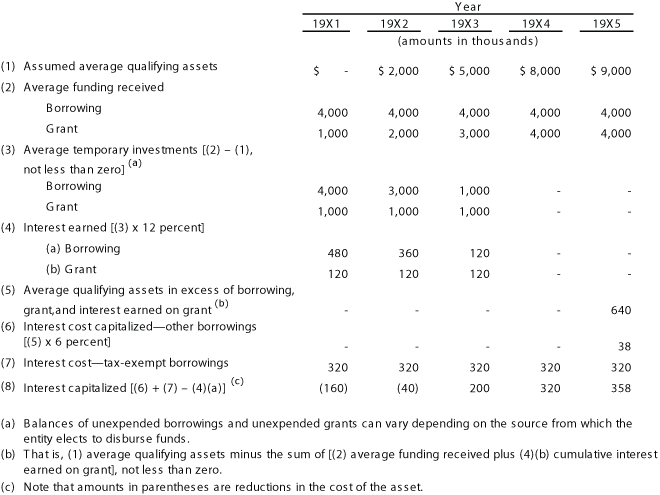
This Example illustrates the application of the guidance in this Subtopic related to capitalization of interest cost in situations involving certain tax-exempt borrowings and certain gifts and grants (see paragraphs ).
  1. a
    Entity A is committed to construct a project at a cost of $10 million. The project is to be financed from three sources:
    1. 1
      $4 million government grant restricted to use for the specified construction project, payable $1 million per year
    2. 2
      $4 million tax-exempt borrowing at an interest rate of 8 percent ($320,000 per year)
    3. 3
      $2 million from operations.
  2. b
    Entity A has $10 million in other borrowings that are outstanding throughout the construction of the project. The interest rate on those borrowings is 6 percent. Other qualifying assets of the entity never exceed $5 million during the construction of the project.
  3. c
    The proceeds from the borrowing and the initial phase of the grant are received 1 year in advance of starting construction on the project and are temporarily invested in interest-bearing investments yielding 12 percent. Interest income earned from temporary investments is not reinvested.
  4. d
    The project will take four years after start of construction to complete.
  5. e
    The following table sets forth the amount of interest to be capitalized as part of the entity's investment in the project.
    • Year 19X1 19X2 19X3 19X4 19X5 (amounts in thousands) (1) Assumed average qualifying assets $- " $2,000 " " $5,000 " " $8,000 " " $9,000 " (2) Average funding received Borrowing " 4,000 " " 4,000 " " 4,000 " " 4,000 " " 4,000 " Grant " 1,000 " " 2,000 " " 3,000 " " 4,000 " " 4,000 " (3) "Average temporary investments [(2) - (1), not less than zero] (a)" Borrowing " 4,000 " " 3,000 " " 1,000 " - - Grant " 1,000 " " 1,000 " " 1,000 " - - (4) Interest earned [(3) x 12 percent] (a) Borrowing 480 360 120 - - (b) Grant 120 120 120 - - (5) "Average qualifying assets in excess of borrowing, grant,and interest earned on grant (b)" - - - - 640 (6) Interest cost capitalized—other borrowings [(5) x 6 percent] - - - - 38 (7) Interest cost—tax-exempt borrowings 320 320 320 320 320 (8) Interest capitalized [(6) + (7) - (4)(a)] (c) (160) (40) 200 320 358 (a) Balances of unexpended borrowings and unexpended grants can vary depending on the source from which the entity elects to disburse funds. (b) "That is, (1) average qualifying assets minus the sum of [(2) average funding received plus (4)(b) cumulative interest earned on grant], not less than zero." (c) Note that amounts in parentheses are reductions in the cost of the asset.
  6. f
    Over the course of construction, the net cost of financing is $678,000, the sum of the interest capitalized for the five years. Accordingly, Entity A's total net investment in the project will be $10,678,000.

835-20-60Relationships

Source downloaded: .Record version 8ad43c66aa6f. Effective date must be checked in the source.

Accounting Changes and Error Corrections

835-20-60-1
For guidance on reporting for previously capitalized interest cost when an accounting change results in financial statements that are, in effect, the statements of a different reporting entity, see Subtopic 250-10.

Debt

835-20-60-2
For guidance on the capitalization of interest recognized for a participating mortgage loan, see Subtopic 470-30.

Extractive Activities—Oil and Gas

835-20-60-3
For guidance for when capitalization of interest cost is permitted in oil- and gas-producing operations, see Subtopic 932-835.

Related subtopics