ASC

ASC 326-30

Available-for-Sale Debt Securities

326 Financial Instruments—Credit Losses

Source downloaded: .Record version bc187479097e. Effective date must be checked in the source.

ASC 326-30 governs measurement of credit losses on debt securities classified as available-for-sale (AFS), including loans meeting the definition of debt securities classified as AFS. Unlike the pooled CECL model in 326-20, impairment is assessed at the individual security level: when fair value is below amortized cost, the entity determines how much of the decline is credit-related by comparing the present value of expected cash flows with amortized cost, records that amount as an allowance for credit losses (capped at the amount fair value is below amortized cost), and puts the remaining decline in other comprehensive income. If the entity intends to sell or more likely than not must sell before recovery, the allowance is written off and the security is written down to fair value through earnings.

Key points (7)
  • An AFS debt security is impaired when fair value is less than amortized cost basis; the credit-related portion is recorded through an allowance for credit losses limited by the amount fair value is below amortized cost, with the non-credit portion recorded in other comprehensive income net of tax (326-30-35-1; 326-30-35-2).
  • A credit loss exists when the present value of cash flows expected to be collected, discounted at the effective interest rate implicit in the security at acquisition, is less than the amortized cost basis (326-30-35-6; 326-30-35-7); an entity may elect by major security type to adjust that rate for expected prepayments (326-30-35-7A).
  • Impairment must be assessed at the individual security level; a general allowance for unidentified impairment in a portfolio is not appropriate, and a debt security may not be combined with a separate guarantee or credit enhancement contract (326-30-35-4; 326-30-35-5).
  • If the entity intends to sell, or more likely than not will be required to sell, before recovery of amortized cost, any allowance is written off and the security is written down to fair value through earnings, and that new amortized cost basis is not adjusted for later recoveries in fair value (326-30-35-10; 326-30-35-14; 326-30-35-15).
  • Credit losses are reassessed each reporting period with changes recorded as credit loss expense or reversal, but the allowance may never be reversed below zero (326-30-35-3; 326-30-35-12).
  • Purchased AFS debt securities meeting the credit-deterioration indicators in 326-30-55-1 are purchased financial assets with credit deterioration; amortized cost basis equals purchase price plus the allowance, and estimated credit losses are discounted at the rate equating expected cash flows to the purchase price (326-30-30-2; 326-30-30-3).
  • AFS debt securities are presented at fair value with amortized cost basis and the allowance shown parenthetically, and disclosures include unrealized losses without an allowance split between less than 12 months and 12 months or longer, methodology and significant inputs, and a tabular allowance rollforward by major security type (326-30-45-1; 326-30-50-4 through 50-6; 326-30-50-7; 326-30-50-9).

For students. Exams test the contrast between this AFS model (individual security, allowance capped at the fair value shortfall, non-credit decline to OCI) and the pooled lifetime CECL model in 326-20; a common error is applying a lifetime expected-loss estimate to AFS securities or forgetting the fair value floor on the allowance. Also note that the old permanent "other-than-temporary impairment" write-down was replaced by a reversible allowance, except when intent or a required sale forces a write-down to fair value through earnings, and that time in an unrealized loss position alone can never prove no credit loss exists (326-30-55-1).

Machine-generated study aid for ASC 326-30. Check the source paragraphs below.

326-30-00Status

Source downloaded: .Record version a9bcf699a8ce. Effective date must be checked in the source.

326-30-00-1
The following table identifies the changes made to this Subtopic.
ParagraphActionAccounting Standards UpdateDate
Amortized Cost BasisAddedAccounting Standards Update No. 2016-1306/16/2016
Available-for-Sale SecuritiesAddedAccounting Standards Update No. 2016-1306/16/2016
Debt Security (1st def.)AmendedAccounting Standards Update No. 2016-1912/14/2016
Debt Security (1st def.)AddedAccounting Standards Update No. 2016-1306/16/2016
Effective Interest RateAmendedAccounting Standards Update No. 2016-1912/14/2016
Effective Interest RateAddedAccounting Standards Update No. 2016-1306/16/2016
Fair Value (2nd def.)AddedAccounting Standards Update No. 2016-1306/16/2016
Financial Asset (1st def.)SupersededAccounting Standards Update No. 2016-1912/14/2016
Financial Asset (1st def.)AddedAccounting Standards Update No. 2016-1306/16/2016
Financial Asset (2nd def.)AddedAccounting Standards Update No. 2016-1912/14/2016
Holding Gain or LossAddedAccounting Standards Update No. 2016-1306/16/2016
Loan (2nd def.)AddedAccounting Standards Update No. 2016-1306/16/2016
Market ParticipantsAddedAccounting Standards Update No. 2016-1306/16/2016
Orderly TransactionAddedAccounting Standards Update No. 2016-1306/16/2016
Purchased Financial Assets with Credit DeteriorationAmendedAccounting Standards Update No. 2016-1912/14/2016
Purchased Financial Assets with Credit DeteriorationAddedAccounting Standards Update No. 2016-1306/16/2016
Related PartiesAddedAccounting Standards Update No. 2016-1306/16/2016
326-30-05-1AddedAccounting Standards Update No. 2016-1306/16/2016
326-30-15-1AddedAccounting Standards Update No. 2016-1306/16/2016
326-30-15-2AddedAccounting Standards Update No. 2016-1306/16/2016
AddedAccounting Standards Update No. 2016-1306/16/2016
326-30-30-1AAddedAccounting Standards Update No. 2019-0404/25/2019
326-30-30-1BAddedAccounting Standards Update No. 2019-0404/25/2019
326-30-30-2AmendedAccounting Standards Update No. 2016-1912/14/2016
AddedAccounting Standards Update No. 2016-1306/16/2016
326-30-35-1AAddedAccounting Standards Update No. 2022-0103/28/2022
326-30-35-4AmendedAccounting Standards Update No. 2022-0103/28/2022
326-30-35-7AAddedAccounting Standards Update No. 2019-0404/25/2019
326-30-35-11AmendedAccounting Standards Update No. 2019-0404/25/2019
326-30-35-13AmendedAccounting Standards Update No. 2019-0404/25/2019
326-30-35-13AAmendedMaintenance Update 2020-18 (PDF)11/25/2020
326-30-35-13AAddedAccounting Standards Update No. 2019-0404/25/2019
326-30-45-1AmendedAccounting Standards Update No. 2019-0404/25/2019
AddedAccounting Standards Update No. 2016-1306/16/2016
326-30-50-3AmendedAccounting Standards Update No. 2016-1912/14/2016
AddedAccounting Standards Update No. 2019-0404/25/2019
326-30-50-4AmendedAccounting Standards Update No. 2019-0404/25/2019
326-30-50-5AmendedAccounting Standards Update No. 2025-1112/08/2025
326-30-50-6AmendedAccounting Standards Update No. 2025-1112/08/2025
326-30-50-8AmendedAccounting Standards Update No. 2025-1112/08/2025
326-30-50-9AmendedAccounting Standards Update No. 2024-0311/04/2024
AddedAccounting Standards Update No. 2016-1306/16/2016

326-30-05Background

Source downloaded: .Record version c1227973880d. Effective date must be checked in the source.

326-30-05-1
This Subtopic provides guidance on how an entity should measure credit losses on available-for-sale debt securities.

326-30-15Scope

Source downloaded: .Record version 31a125c74910. Effective date must be checked in the source.

Entities

326-30-15-1
The guidance in this Subtopic applies to all entities.

Instruments

326-30-15-2
The guidance in this Subtopic applies to debt securities classified as available-for-sale securities, including loans that meet the definition of debt securities and are classified as available-for-sale securities.

326-30-30Initial Measurement

Source downloaded: .Record version 515a5845f2fc. Effective date must be checked in the source.

326-30-30-1
Throughout this Subtopic, the term earnings shall be read as performance indicator, and other comprehensive income shall be read as outside the performance indicator for debt securities that are within the scope of Subtopic 958-320 on debt securities of not-for-profit entities.
326-30-30-1A
If for the purposes of identifying and measuring an impairment the applicable accrued interest is excluded from both the fair value and the amortized cost basis of the available-for-sale debt security, an entity may develop its estimate of expected credit losses by measuring components of the amortized cost basis on a combined basis or by separately measuring the applicable accrued interest component from the other components of amortized cost basis.
326-30-30-1B
If an entity excludes applicable accrued interest from both the fair value and the amortized cost basis of the available-for-sale debt security, the entity may make an accounting policy election, at the major security-type level, not to measure an allowance for credit losses for accrued interest receivables if it writes off the uncollectible accrued interest receivable balance in a timely manner. An entity that elects the accounting policy in this paragraph shall meet the disclosure requirements in paragraph 326-30-50-3C. This accounting policy election shall be considered separately from the accounting policy election in paragraph 326-30-35-13A. An entity may not analogize this guidance to components of amortized cost basis other than accrued interest.

Purchased Financial Assets with Credit Deterioration

326-30-30-2
A purchased debt security classified as available-for-sale shall be considered to be a purchased financial asset with credit deterioration when the indicators of a credit loss in paragraph 326-30-55-1 have been met. The allowance for credit losses for purchased financial assets with credit deterioration shall be measured at the individual security level in accordance with paragraphs . The amortized cost basis for purchased financial assets with credit deterioration shall be considered to be the purchase price plus any allowance for credit losses. See paragraphs for implementation guidance.
326-30-30-3
Estimated credit losses shall be discounted at the rate that equates the present value of the purchaser's estimate of the security's future cash flows with the purchase price of the asset.
326-30-30-4
An entity shall record the holding gain or loss through other comprehensive income, net of applicable taxes.

326-30-35Subsequent Measurement

Source downloaded: .Record version 93dbcca7268f. Effective date must be checked in the source.

Impairment of Individual Available-for-Sale Securities

326-30-35-1
An investment is impaired if the fair value of the investment is less than its amortized cost basis.
326-30-35-1A
An entity shall not consider a basis adjustment related to an existing portfolio layer method hedge designated in accordance with paragraph 815-20-25-12A when measuring impairment of the individual investments or individual beneficial interest included in a closed portfolio hedged using the portfolio layer method.
326-30-35-2
For individual debt securities classified as available-for-sale securities, an entity shall determine whether a decline in fair value below the amortized cost basis has resulted from a credit loss or other factors. An entity shall record impairment relating to credit losses through an allowance for credit losses. However, the allowance shall be limited by the amount that the fair value is less than the amortized cost basis. Impairment that has not been recorded through an allowance for credit losses shall be recorded through other comprehensive income, net of applicable taxes. An entity shall consider the guidance in paragraphs 326-30-35-6 and when determining whether a credit loss exists.
326-30-35-3
At each reporting date, an entity shall record an allowance for credit losses that reflects the amount of the impairment related to credit losses, limited by the amount that fair value is less than the amortized cost basis. Changes in the allowance shall be recorded in the period of the change as credit loss expense (or reversal of credit loss expense).
326-30-35-4
Impairment shall be assessed at the individual security level (referred to as an investment). The impairment assessment of the individual securities or individual beneficial interest in a closed portfolio hedged using the portfolio layer method shall not consider the basis adjustment related to an existing portfolio layer method hedge. Individual security level means the level and method of aggregation used by the reporting entity to measure realized and unrealized gains and losses on its debt securities. (For example, debt securities bearing the same Committee on Uniform Security Identification Procedures [CUSIP] number that were purchased in separate trade lots may be aggregated by a reporting entity on an average cost basis if that corresponds to the basis used to measure realized and unrealized gains and losses for the debt securities.) Providing a general allowance for an unidentified impairment in a portfolio of debt securities is not appropriate.
326-30-35-5
An entity shall not combine separate contracts (a debt security and a guarantee or other credit enhancement) for purposes of determining whether a debt security is impaired or can contractually be prepaid or otherwise settled in such a way that the entity would not recover substantially all of its cost.
326-30-35-6
In assessing whether a credit loss exists, an entity shall compare the present value of cash flows expected to be collected from the security with the amortized cost basis of the security. If the present value of cash flows expected to be collected is less than the amortized cost basis of the security, a credit loss exists and an allowance for credit losses shall be recorded for the credit loss, limited by the amount that the fair value is less than amortized cost basis. Credit losses on an impaired security shall continue to be measured using the present value of expected future cash flows.
326-30-35-7
In determining whether a credit loss exists, an entity shall consider the factors in paragraphs and use its best estimate of the present value of cash flows expected to be collected from the debt security. One way of estimating that amount would be to consider the methodology described in paragraphs . Briefly, the entity would discount the expected cash flows at the effective interest rate implicit in the security at the date of acquisition.
326-30-35-7A
As an accounting policy election for each major security type of debt securities classified as available-for-sale securities, an entity may adjust the effective interest rate used to discount expected cash flows to consider the timing (and changes in the timing) of expected cash flows resulting from expected prepayments.
326-30-35-8
The estimates of expected future cash flows shall be the entity's best estimate based on past events, current conditions, and on reasonable and supportable forecasts. Available evidence shall be considered in developing the estimate of expected future cash flows. The weight given to the information used in the assessment shall be commensurate with the extent to which the evidence can be verified objectively. If an entity estimates a range for either the amount or timing of possible cash flows, the likelihood of the possible outcomes shall be considered in determining the best estimate of expected future cash flows.
326-30-35-9
Available information would include existing environmental factors, for example, existing industry, geographical, economic, and political factors that are relevant to the collectibility of that debt security.
326-30-35-10
If an entity intends to sell the debt security (that is, it has decided to sell the security), or more likely than not will be required to sell the security before recovery of its amortized cost basis, any allowance for credit losses shall be written off and the amortized cost basis shall be written down to the debt security's fair value at the reporting date with any incremental impairment reported in earnings. If an entity does not intend to sell the debt security, the entity shall consider available evidence to assess whether it more likely than not will be required to sell the security before the recovery of its amortized cost basis (for example, whether its cash or working capital requirements or contractual or regulatory obligations indicate that the security will be required to be sold before the forecasted recovery occurs). In assessing whether the entity more likely than not will be required to sell the security before recovery of its amortized cost basis, the entity shall consider the factors in paragraphs .
326-30-35-11
If the security's contractual interest rate varies based on subsequent changes in an independent factor, such as an index or rate, for example, the prime rate, the London Interbank Offered Rate (LIBOR), or the U.S. Treasury bill weekly average, that security's effective interest rate (used to discount expected cash flows as described in paragraph 326-30-35-7) may be calculated based on the factor as it changes over the life of the security or is projected to change over the life of the security, or may be fixed at the rate in effect at the date an entity determines that the security has a credit loss as determined in accordance with paragraphs . The entity's choice shall be applied consistently for all securities whose contractual interest rate varies based on subsequent changes in an independent factor. An entity is not required to project changes in the factor for purposes of estimating expected future cash flows. If the entity projects changes in the factor for the purposes of estimating expected future cash flows, it shall use the same projections in determining the effective interest rate used to discount those cash flows. In addition, if the entity projects changes in the factor for the purposes of estimating expected future cash flows, it shall adjust the effective interest rate used to discount expected cash flows to consider the timing (and changes in the timing) of expected cash flows resulting from expected prepayments in accordance with paragraph 326-30-35-7A. Subtopic 310-20 on receivables—nonrefundable fees and other costs provides guidance on the calculation of interest income for variable rate instruments.

Accounting for Debt Securities after a Credit Impairment

326-30-35-12
An entity shall reassess the credit losses each reporting period when there is an allowance for credit losses. An entity shall record subsequent changes in the allowance for credit losses on available-for-sale debt securities with a corresponding adjustment recorded in the credit loss expense on available-for-saledebt securities. An entity shall not reverse a previously recorded allowance for credit losses to an amount below zero.
326-30-35-13
An entity shall recognize writeoffs of available-for-sale debt securities in accordance with paragraph 326-20-35-8.
326-30-35-13A
If for the purposes of identifying and measuring an impairment the applicable accrued interest is excluded from both the fair value and the amortized cost basis of the available-for-sale debt security, an entity may make an accounting policy election, at the major security-type level, to write off accrued interest receivables by reversing interest income or recognizing credit loss expense, or a combination of both. This accounting policy election shall be considered separately from the accounting policy election in paragraph 326-30-30-1B. An entity that elects this accounting policy shall meet the disclosure requirements in paragraph 326-30-50-3D. An entity may not analogize this guidance to components of amortized cost basis other than accrued interest.

Accounting after a Write-Down Resulting from an Intent to Sell or a More-Likely-Than-Not Requirement to Sell

326-30-35-14
Once an individual debt security has been written down in accordance with paragraph 326-30-35-10, the previous amortized cost basis less writeoffs, including non-credit-related impairment reported in earnings, shall become the new amortized cost basis of the investment. That new amortized cost basis shall not be adjusted for subsequent recoveries in fair value.
326-30-35-15
For debt securities for which impairments were reported in earnings as a writeoff because of an intent to sell or a more-likely-than-not requirement to sell, the difference between the new amortized cost basis and the cash flows expected to be collected shall be accreted in accordance with existing applicable guidance as interest income. An entity shall continue to estimate the present value of cash flows expected to be collected over the life of the debt security. For debt securities accounted for in accordance with Subtopic 325-40, an entity should look to that Subtopic to account for changes in cash flows expected to be collected. For all other debt securities, if upon subsequent evaluation, there is a significant increase in the cash flows expected to be collected or if actual cash flows are significantly greater than cash flows previously expected, those changes shall be accounted for as a prospective adjustment to the yield. Subsequent increases in the fair value of available-for-sale securities after the write-down shall be included in other comprehensive income. (This Section does not address when a holder of a debt security would place a debt security on nonaccrual status or how to subsequently report income on a nonaccrual debt security.)

Purchased Financial Assets with Credit Deterioration

326-30-35-16
An entity shall measure changes in the allowance for credit losses on a purchased financial asset with credit deterioration in accordance with paragraph 326-30-35-6. The entity shall report changes in the allowance for credit losses in net income as credit loss expense (or reversal of credit loss expense) in each reporting period.
326-30-35-17
This Subtopic does not address how an entity shall recognize interest income. See paragraphs for guidance on recognition of interest income on purchased financial assets with credit deterioration.

326-30-45Other Presentation Matters

Source downloaded: .Record version c7db270fbdca. Effective date must be checked in the source.

326-30-45-1
An entity shall present available-for-saledebt securities on the statement of financial position at fair value. In addition, an entity shall present parenthetically the amortized cost basis and the allowance for credit losses. If for the purposes of identifying and measuring an impairment the applicable accrued interest is excluded from both the fair value and the amortized cost basis of the available-for-sale debt security, an entity may present separately on the statement of financial position or within another statement of financial position line item the accrued interest receivable balance, net of the allowance for credit losses (if any). An entity that presents the accrued interest receivable balance, net of the allowance for credit losses (if any), within another statement of financial position line item shall apply the disclosure requirements in paragraph 326-30-50-3A.
326-30-45-2
An entity shall separately present, in the financial statement in which the components of accumulated other comprehensive income are reported, amounts reported therein related to available-for-sale debt securities for which an allowance for credit losses has been recorded.
326-30-45-3
When an entity applies the guidance in paragraph 326-30-35-7, the change in present value of cash flows expected to be collected from one reporting period to the next may result not only from the passage of time but also from changes in estimates of the timing or amount of expected future cash flows. An entity is permitted to report the entire change in present value as a credit loss expense (or a reversal of credit loss expense). Alternatively, an entity may report the change in present value attributable to the passage of time as interest income. See paragraph 326-30-50-8 for a disclosure requirement applicable to creditors that choose the latter alternative and report changes in present value attributable to the passage of time as interest income.

326-30-50Disclosure

Source downloaded: .Record version 7e63296b8ec0. Effective date must be checked in the source.

326-30-50-1
For instruments within the scope of this Subtopic, this Section provides the following disclosure guidance related to credit risk and the measurement of credit losses:
  1. a
    Available-for-sale debt securities in unrealized loss positions without an allowance for credit losses
  2. b
    Allowance for credit losses
  3. c
326-30-50-2
The disclosure guidance in this Section should enable a user of the financial statements to understand the following:
  1. a
    The credit risk inherent in available-for-sale debt securities
  2. b
    Management's estimate of credit losses
  3. c
    Changes in the estimate of credit losses that have taken place during the period.
326-30-50-3
An entity shall determine, in light of the facts and circumstances, how much detail it must provide to satisfy the disclosure requirements in this Section and how it disaggregates information into major security types. An entity must strike a balance between obscuring important information as a result of too much aggregation and overburdening financial statements with excessive detail that may not assist a financial statement user to understand an entity's securities and allowance for credit losses. For example, an entity should not obscure important information by including it with a large amount of insignificant detail. Similarly, an entity should not disclose information that is so aggregated that it obscures important differences between the different types of financial assets and associated risks.
326-30-50-3A
An entity that makes the accounting policy election to present separately the accrued interest receivable balance within another statement of financial position line item as described in paragraph 326-30-45-1 shall disclose the amount of applicable accrued interest, net of the allowance for credit losses (if any), and shall disclose in which line item on the statement of financial position that amount is presented.
326-30-50-3B
If for the purposes of identifying and measuring an impairment the applicable accrued interest is excluded from both the fair value and the amortized cost basis of the available-for-sale debt security, an entity may, as a practical expedient, exclude the applicable accrued interest that is included in the amortized cost basis for the purposes of the disclosure requirements in paragraphs . If an entity elects this practical expedient, it shall disclose the total amount of accrued interest, net of the allowance for credit losses (if any), excluded from the disclosed amortized cost basis.
326-30-50-3C
An entity that makes the accounting policy election in paragraph 326-30-30-1B shall disclose its accounting policy not to measure an allowance for credit losses for accrued interest receivables. The accounting policy shall include information about what time period or periods, at the major security-type level, are considered timely.
326-30-50-3D
An entity that makes the accounting policy election in paragraph 326-30-35-13A shall disclose its accounting policy to write off accrued interest receivables by reversing interest income or recognizing credit loss expense or a combination of both. The entity also shall disclose the amount of accrued interest receivables written off by reversing interest income by major security type.

Available-for-Sale Debt Securities in Unrealized Loss Positions without an Allowance for Credit Losses

326-30-50-4
For available-for-sale debt securities, including those that fall within the scope of Subtopic 325-40 on beneficial interests in securitized financial assets, in an unrealized loss position for which an allowance for credit losses has not been recorded, an entity shall disclose all of the following in its interim and annual financial statements:
  1. a
    As of each date for which a statement of financial position is presented, quantitative information, aggregated by category of investment—each major security type that the entity discloses in accordance with this Subtopic—in tabular form:
    1. 1
      The aggregate related fair value of investments with unrealized losses
    2. 2
      The aggregate amount of unrealized losses (that is, the amount by which amortized cost basis exceeds fair value).
  2. b
    As of the date of the most recent statement of financial position, additional information (in narrative form) that provides sufficient information to allow a financial statement user to understand the quantitative disclosures and the information that the entity considered (both positive and negative) in reaching the conclusion that an allowance for credit losses is unnecessary. The disclosures required may be aggregated by investment categories, but individually significant unrealized losses generally shall not be aggregated. This disclosure could include all of the following:
    1. 1
      The nature of the investment(s)
    2. 2
      The cause(s) of the impairment(s)
    3. 3
      The number of investment positions that are in an unrealized loss position
    4. 4
      The severity of the impairment(s)
    5. 5
      Other evidence considered by the investor in reaching its conclusion that an allowance for credit losses is not necessary, including, for example, any of the following:
      1. i
        Performance indicators of the underlying assets in the security, including any of the following:
        1. 01
          Default rates
        2. 02
          Delinquency rates
        3. 03
          Percentage of nonperforming assets.
      2. ii
        Debt-to-collateral-value ratios
      3. iii
        Third-party guarantees
      4. iv
        Current levels of subordination
      5. v
        Vintage
      6. vi
        Geographic concentration
      7. vii
        Industry analyst reports
      8. viii
        Credit ratings
      9. ix
        Volatility of the security's fair value
      10. x
        Interest rate changes since purchase
      11. xi
        Any other information that the investor considers relevant.
326-30-50-5
The disclosures in (a)(1) through (a)(2) in paragraph 326-30-50-4 shall be disaggregated by those investments that have been in a continuous unrealized loss position for less than 12 months and those that have been in a continuous unrealized loss position for 12 months or longer.
Transition date:(P) December 16, 2027; (N) December 16, 2028Transition guidance:
270-10-65-1For interim and annual reporting periods, the disclosures in (a)(1) through (a)(2) in paragraph 326-30-50-4 shall be disaggregated by those investments that have been in a continuous unrealized loss position for less than 12 months and those that have been in a continuous unrealized loss position for 12 months or longer.
326-30-50-6
The reference point for determining how long an investment has been in a continuous unrealized loss position is the balance sheet date of the reporting period in which the impairment is identified. For entities that do not prepare interim financial information, the reference point is the annual balance sheet date of the period during which the impairment was identified. The continuous unrealized loss position ceases upon the investor becoming aware of a recovery of fair value up to (or beyond) the amortized cost basis of the investment during the period.
Transition date:(P) December 16, 2027; (N) December 16, 2028Transition guidance:
270-10-65-1The reference point for determining how long an investment has been in a continuous unrealized loss position is the balance sheet date of the reporting period in which the impairment is identified. For entities that do not prepare interim financial statements and notes in accordance with generally accepted accounting principles, the reference point is the annual balance sheet date of the period during which the impairment was identified. The continuous unrealized loss position ceases upon the investor becoming aware of a recovery of fair value up to (or beyond) the amortized cost basis of the investment during the period.

Allowance for Credit Losses

326-30-50-7
For interim and annual periods in which an allowance for credit losses of an available-for-sale debt security is recorded, an entity shall disclose by major security type, the methodology and significant inputs used to measure the amount related to credit loss, including its accounting policy for recognizing writeoffs of uncollectible available-for-sale debt securities. Examples of significant inputs include, but are not limited to, all of the following:
  1. a
    Performance indicators of the underlying assets in the security, including all of the following:
    1. 1
      Default rates
    2. 2
      Delinquency rates
    3. 3
      Percentage of nonperforming assets
  2. b
    Debt-to-collateral-value ratios
  3. c
    Third-party guarantees
  4. d
    Current levels of subordination
  5. e
    Vintage
  6. f
    Geographic concentration
  7. g
    Industry analyst reports and forecasts
  8. h
    Credit ratings
  9. i
    Other market data that are relevant to the collectibility of the security.
326-30-50-8
Paragraph 326-30-45-3 explains that an entity may report the change in the allowance for credit losses due to changes in time value as credit loss expense (or reversal of credit loss expense) but also may report the change as interest income. An entity that chooses the latter alternative shall disclose the amount recorded to interest income that represents the change in present value attributable to the passage of time.
Transition date:(P) December 16, 2027; (N) December 16, 2028Transition guidance:
270-10-65-1Paragraph 326-30-45-3 explains that an entity may report the change in the allowance for credit losses due to changes in time value as credit loss expense (or reversal of credit loss expense) but also may report the change as interest income. An entity that chooses the latter alternative shall disclose in interim and annual reporting periods the amount recorded to interest income that represents the change in present value attributable to the passage of time.
326-30-50-9
For each interim and annual reporting period presented, an entity shall disclose by major security type, a tabular rollforward of the allowance for credit losses, which shall include, at a minimum, all of the following:
  1. a
    The beginning balance of the allowance for credit losses on available-for-sale debt securities held by the entity at the beginning of the period
  2. b
    Additions to the allowance for credit losses on securities for which credit losses were not previously recorded
  3. c
    Additions to the allowance for credit losses arising from purchases of available-for-sale debt securities accounted for as purchased financial assets with credit deterioration (including beneficial interests that meet the criteria in paragraph 325-40-30-1A)
  4. d
    Reductions for securities sold during the period (realized)
  5. e
    Reductions in the allowance for credit losses because the entity intends to sell the security or more likely than not will be required to sell the security before recovery of its amortized cost basis
  6. f
    If the entity does not intend to sell the security and it is not more likely than not that the entity will be required to sell the security before recovery of its amortized cost basis, additional increases or decreases to the allowance for credit losses on securities that had an allowance recorded in a previous period
  7. g
    Writeoffs charged against the allowance
  8. h
    Recoveries of amounts previously written off
  9. i
    The ending balance of the allowance for credit losses related to debt securities held by the entity at the end of the period.
Transition date:(P) December 16, 2026; (N) December 16, 2026Transition guidance:
220-40-65-1For each interim and annual reporting period presented, an entity shall disclose by major security type, a tabular rollforward of the allowance for credit losses, which shall include, at a minimum, all of the following:
  1. a
    The beginning balance of the allowance for credit losses on available-for-sale debt securities held by the entity at the beginning of the period
  2. b
    Additions to the allowance for credit losses on securities for which credit losses were not previously recorded
  3. c
    Additions to the allowance for credit losses arising from purchases of available-for-sale debt securities accounted for as purchased financial assets with credit deterioration (including beneficial interests that meet the criteria in paragraph 325-40-30-1A)
  4. d
    Reductions for securities sold during the period (realized)
  5. e
    Reductions in the allowance for credit losses because the entity intends to sell the security or more likely than not will be required to sell the security before recovery of its amortized cost basis
  6. f
    If the entity does not intend to sell the security and it is not more likely than not that the entity will be required to sell the security before recovery of its amortized cost basis, additional increases or decreases to the allowance for credit losses on securities that had an allowance recorded in a previous period
  7. g
    Writeoffs charged against the allowance
  8. h
    Recoveries of amounts previously written off
  9. i
    The ending balance of the allowance for credit losses related to debt securities held by the entity at the end of the period.
See paragraphs for additional disclosure requirements.

Purchased Financial Assets with Credit Deterioration

326-30-50-10
To the extent an entity acquired purchased financial assets with credit deterioration during the current reporting period, an entity shall provide a reconciliation of the difference between the purchase price of the assets and the par value of the available-for-sale debt securities, including:
  1. a
    The purchase price
  2. b
    The allowance for credit losses at the acquisition date based on the acquirer's assessment
  3. c
    The discount (or premium) attributable to other factors
  4. d
    The par value.

326-30-55Implementation Guidance and Illustrations

Source downloaded: .Record version 0d9102574f1b. Effective date must be checked in the source.

Implementation Guidance

326-30-55-1
There are numerous factors to be considered in determining whether a credit loss exists. The length of time a security has been in an unrealized loss position should not be a factor, by itself or in combination with others, that an entity would use to conclude that a credit loss does not exist. The following list is not meant to be all inclusive. All of the following factors should be considered:
  1. a
    The extent to which the fair value is less than the amortized cost basis
  2. b
    Adverse conditions specifically related to the security, an industry, or geographic area; for example, changes in the financial condition of the issuer of the security, or in the case of an asset-backed debt security, changes in the financial condition of the underlying loan obligors. Examples of those changes include any of the following:
    1. 1
      Changes in technology
    2. 2
      The discontinuance of a segment of the business that may affect the future earnings potential of the issuer or underlying loan obligors of the security
    3. 3
      Changes in the quality of the credit enhancement.
  3. c
    The payment structure of the debt security (for example, nontraditional loan terms as described in paragraphs ) and the likelihood of the issuer being able to make payments that increase in the future
  4. d
    Failure of the issuer of the security to make scheduled interest or principal payments
  5. e
    Any changes to the rating of the security by a rating agency.
326-30-55-2
An entity should consider available information relevant to the collectibility of the security, including information about past events, current conditions, and reasonable and supportable forecasts, when developing the estimate of cash flows expected to be collected. That information should include all of the following:
  1. a
    The remaining payment terms of the security
  2. b
    Prepayment speeds
  3. c
    The financial condition of the issuer(s)
  4. d
    Expected defaults
  5. e
    The value of any underlying collateral.
326-30-55-3
To achieve the objective in paragraph 326-30-55-2, the entity should consider, for example, all of the following to the extent they influence the estimate of expected cash flows on a security:
  1. a
    Industry analyst reports and forecasts
  2. b
    Credit ratings
  3. c
    Other market data that are relevant to the collectibility of the security.
326-30-55-4
An entity also should consider how other credit enhancements affect the expected performance of the security, including consideration of the current financial condition of the guarantor of a security (if the guarantee is not a separate contract as discussed in paragraph 326-30-35-5), the willingness of the guarantor to pay, and/or whether any subordinated interests are capable of absorbing estimated losses on the loans underlying the security. The remaining payment terms of the security could be significantly different from the payment terms in prior periods (such as for some securities backed by nontraditional loans; see paragraph 825-10-55-1). Thus, an entity should consider whether a security backed by currently performing loans will continue to perform when required payments increase in the future (including balloon payments). An entity also should consider how the value of any collateral would affect the expected performance of the security. If the fair value of the collateral has declined, an entity should assess the effect of that decline on its ability to collect the balloon payment.

Illustrations

326-30-55-5
This Example illustrates one way an entity may identify purchased financial assets with credit deterioration.
326-30-55-6
Entity A purchases a portfolio of debt securities with varying levels of credit quality that it classifies as available for sale. When determining which individual available-for-sale debt securities should be considered to be in the scope of the guidance for purchased financial assets with credit deterioration, Entity A considers the indicators of impairment in paragraph 326-30-55-1. Entity A also considers its practices for identifying credit losses on available-for-sale debt securities. If Entity A determines that, on an individual basis, the purchased debt securities are purchased financial assets with credit deterioration, it should classify them as such.
326-30-55-7
Entity A also considers the securities that are within the scope of Subtopic 325-40 on beneficial interests in securitized financial assets. Entity A purchases a residual tranche and determines that there is a significant difference between contractual cash flows and expected cash flows. In accordance with paragraph 325-40-30-1A(a), Entity A applies the accounting for purchased financial assets with credit deterioration to the residual tranche.
326-30-55-8
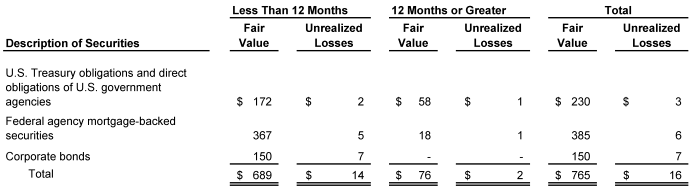
326-30-50The table shows the gross unrealized losses and fair value of Entity B's investments with unrealized losses that are not deemed to have credit losses (in millions), aggregated by investment category and length of time that individual securities have been in a continuous unrealized loss position at December 31, 20X3. This Example illustrates the application of paragraphs and, in doing so, describes Entity B's rationale for not reporting all or a portion of unrealized losses presented in the table as credit losses. In the application of paragraph 326-30-50-4(b), Entity B should provide meaningful disclosure about individually significant unrealized losses. To facilitate the narrative disclosures and for simplicity, this Example presents only the quantitative information as of the date of the latest statement of financial position. However, in accordance with paragraphs , that information is required as of each date for which a statement of financial position is presented.
  • Less Than 12 Months 12 Months or Greater Total Description of Securities Fair Value Unrealized Losses Fair Value Unrealized Losses Fair Value Unrealized Losses U.S. Treasury obligations and direct obligations of U.S. government agencies $172 $2 $58 $1 $230 $3 Federal agency mortgage-backed securities 367 5 18 1 385 6 Corporate bonds 150 7 - - 150 7 Marketable equity securities 44 8 - - 44 8 Investments in equity securities carried at cost 20 1 - - 20 1 Total $753 $23 $76 $2 $829 $25
326-30-55-9
  • U.S. Treasury obligations. The unrealized losses on Entity B's investments in U.S. Treasury obligations and direct obligations of U.S. government agencies were caused by interest rate increases. The contractual terms of those investments do not permit the issuer to settle the securities at a price less than the amortized cost bases of the investments. Entity B does not intend to sell the investments and it is not more likely than not that Entity B will be required to sell the investments before recovery of their amortized cost bases.
    Federal agency mortgage-backed securities. The unrealized losses on Entity B's investment in federal agency mortgage-backed securities were caused by interest rate increases. Entity B purchased those investments at a discount relative to their face amount, and the contractual cash flows of those investments are guaranteed by an agency of the U.S. government. Accordingly, it is expected that the securities would not be settled at a price less than the amortized cost bases of Entity B's investments. Entity B does not intend to sell the investments and it is not more likely than not that Entity B will be required to sell the investments before recovery of their amortized cost bases.
    Corporate bonds. Entity B's unrealized loss on investments in corporate bonds relates to a $150 investment in Entity C's Series C Debentures. Entity C is a manufacturer. The unrealized loss was primarily caused by a recent decrease in profitability and near-term profit forecasts by industry analysts resulting from intense competitive pricing pressure in the manufacturing industry and a recent sector downgrade by several industry analysts. The contractual terms of those investments do not permit Entity C to settle the security at a price less than the amortized cost basis of the investment. While Entity C's credit rating has decreased from A to BBB (Standard & Poor's), Entity B currently does not expect Entity C to settle the debentures at a price less than the amortized cost basis of the investment (that is, Entity B expects to recover the entire amortized cost basis of the security). Entity B does not intend to sell the investment and it is not more likely than not that Entity B will be required to sell the investment before recovery of its amortized cost basis.

Related subtopics