ASC 926-20
Other Assets—Film Costs
926 Entertainment—Films
Source downloaded: .Record version 70c1482ab298. Effective date must be checked in the source.
ASC 926-20 governs how film production and distribution entities capitalize, amortize, impair, and disclose film costs, which must be reported as a separate asset on the balance sheet (926-20-25-1). Films predominantly monetized on their own are amortized by the individual-film-forecast-computation method — current-period revenue over remaining unrecognized ultimate revenue as of the beginning of the fiscal year (926-20-35-1) — while films in a film group are expensed based on a reasonably reliable estimate of the film's use (926-20-35-2). Unamortized film costs are written down to fair value when triggering events indicate impairment, and such write-downs may never be restored (926-20-35-13).
Key points (7)
- Film costs are reported as a separate balance sheet asset and include production overhead and property/adaptation costs, but exclude administrative and general expenses and losses on abandoned properties (926-20-25-1 through 25-5); costs of significant changes to a film are added to film costs and expensed as related revenue is recognized (926-20-25-8).
- The predominant monetization strategy (on its own vs. with other films and/or license agreements, i.e., a film group) is determined when capitalization begins and is reassessed only upon a significant change in strategy, evaluated over the film's entire life; results differing from expectations are not a significant change (926-20-35-3B through 35-3C).
- Amortization for a film monetized on its own begins upon release and uses the individual-film-forecast fraction: current-period actual revenue divided by estimated remaining unrecognized ultimate revenue at the beginning of the fiscal year, applied to unamortized costs (926-20-35-1); multiple seasons of an episodic television series are a single product.
- Estimates of ultimate revenue are revised each reporting date and changes are applied prospectively from the beginning of the fiscal year of change, with the catch-up difference charged or credited in the period of revision (926-20-35-3).
- Ultimate revenue is capped at 10 years from initial release (20 years from acquisition for film libraries of films released at least 3 years before acquisition; 5 years from the most recent episode for series still in production) and excludes unproven technologies, inflation projections, and advertising reimbursements, which offset exploitation costs (926-20-35-5).
- Unamortized film costs are tested for impairment when triggering events indicate fair value of a film or film group may be below carrying amount; the excess is written off to income, is not restorable, and a film-group loss is allocated pro rata on relative carrying amounts without reducing an individually valued film below its fair value (926-20-35-12 through 35-19).
- A property not set for production within three years of the first capitalized transaction is presumed disposed of; loss equals carrying amount less fair value, which is presumed zero absent a committed plan to sell, and remaining unamortized costs are written off when a film is substantively abandoned (926-20-40-1 through 40-5).
For students. The exam trap is the mechanics of revised estimates: the denominator resets to ultimate revenue remaining from the beginning of the fiscal year of change (revised ultimate revenue less cumulative prior recognized revenue) and is applied prospectively to unamortized costs — never restated retroactively. Also remember that post-ASU 2019-02, streaming-style films in a film group are not amortized by the forecast method at all, and film cost write-downs can never be reversed.
Machine-generated study aid for ASC 926-20. Check the source paragraphs below.
926-20-00Status
Source downloaded: .Record version 94d81cb48c39. Effective date must be checked in the source.
926-20-05Overview and Background
Source downloaded: .Record version e4a6fcd5ef5e. Effective date must be checked in the source.
926-20-15Scope and Scope Exceptions
Source downloaded: .Record version 2fde46e40ce6. Effective date must be checked in the source.
Overall Guidance
926-20-25Recognition
Source downloaded: .Record version c2e3e4ace7c7. Effective date must be checked in the source.
Film Costs Capitalization
Production Overhead
Overall Deals
Rights to Film Properties
Significant Changes to a Film
926-20-35Subsequent Measurement
Source downloaded: .Record version 2335f7cdcf82. Effective date must be checked in the source.
Film Costs Amortization
Predominant Monetization Strategy
Ultimate Revenue
- aFor films other than episodic television series, ultimate revenue shall include estimates over a period not to exceed 10 years following the date of the film's initial release. For episodic television series, ultimate revenue shall include estimates of revenue over a period not to exceed 10 years from the date of delivery of the first episode or, if still in production, 5 years from the date of delivery of the most recent episode, if later. For previously released films acquired as part of a film library, ultimate revenue shall include estimates over a period not to exceed 20 years from the date of acquisition. For the purposes of this Topic, an entity shall categorize as part of a film library only those individual films whose initial release dates were at least three years prior to the acquisition date.
- bUltimate revenue shall include estimates of revenue from a market or territory only if persuasive evidence exists that such revenue will occur, or if an entity can demonstrate a history of recognizing such revenue in that market or territory. Ultimate revenue shall include estimates of revenue from newly developing territories only if an existing arrangement provides persuasive evidence that an entity will realize such amounts.
- cUltimate revenue shall include estimates of revenue from licensing arrangements with third parties to market film-related products only if persuasive evidence exists that such revenue from that arrangement will occur for that particular film (such as a signed contract to receive a nonrefundable minimum guarantee or a nonrefundable advance) or if an entity can demonstrate a history of recognizing such revenue from that form of arrangement.
- dUltimate revenue shall include estimates of the portion of the wholesale or retail revenue from an entity's sale of peripheral items (such as toys and apparel) that is attributable to the exploitation of themes, characters, or other contents related to a particular film only if the entity can demonstrate a history of recognizing such revenue from that form of exploitation in similar kinds of films. For example, an entity may conclude that the portion of revenue from the sale of peripheral items that it shall include in ultimate revenue is an estimate of what would be recognized by the entity if rights for such form of exploitation had been granted under licensing arrangements with third parties. Ultimate revenue shall not, however, include estimates of the entire amount of wholesale or retail revenue from an entity's sale of peripheral items.
- eUltimate revenue shall not include estimates of revenue from unproven or undeveloped technologies.
- fUltimate revenue shall not include estimates of wholesale promotion or advertising reimbursements to be received from third parties. Such amounts shall be offset against exploitation costs.
- gUltimate revenue shall not include estimates of amounts related to the sale of film rights for periods after those identified in (a).
Impairment
- aAn adverse change in the expected performance of a film prior to release
- bActual costs substantially in excess of budgeted costs
- cSubstantial delays in completion or release schedules
- dChanges in release plans, such as a reduction in the initial release pattern
- eInsufficient funding or resources to complete the film and to market it effectively
- fActual performance subsequent to release failing to meet expectations set before release due to factors such as the following:
- 1A significant adverse change in technological, regulatory, legal, economic, or social factors that could affect the public's perception of a film or the availability of a film for future showings
- 2A significant decrease in the amount of ultimate revenue expected to be recognized.
- 1
- gA change in the predominant monetization strategy of a film resulting in the film being predominantly monetized with other films and/or license agreements.
- aA significant adverse change in technological, regulatory, legal, economic, or social factors that could affect the fair value of the film group
- bA significant decrease in the number of subscribers or forecasted subscribers, or the loss of a major distributor
- cA current-period operating or cash flow loss combined with a history of operating or cash flow losses or a projection of continuing losses associated with the use or exploitation of a film group.
- aIf previously released, the film's performance in prior markets
- bThe public's perception of the film's story, cast, director, or producer
- cHistorical results of similar films
- dHistorical results of the cast, director, or producer on prior films
- eRunning time of the film.
926-20-40Derecognition
Source downloaded: .Record version 40a79084f5e1. Effective date must be checked in the source.
Film Properties
926-20-45Other Presentation Matters
Source downloaded: .Record version 730a0e2dd39d. Effective date must be checked in the source.
Film Costs
926-20-50Disclosure
Source downloaded: .Record version 558b53f3bc0f. Effective date must be checked in the source.
Film Costs
- aThe method(s) used in computing amortization
- bFor impairment, a description of the unit(s) of account used for impairment testing and the method(s) used for determining fair value.
- aThe aggregate amortization expense for each period, separately for films predominantly monetized on their own and films predominantly monetized with other films and/or license agreements
- bThe caption in the income statement where the amortization is recorded.
- aThe aggregate amortization expense for each period, separately for films predominantly monetized on their own and films predominantly monetized with other films and/or license agreements
- bThe caption in the income statement where the amortization is recorded.
- aFor completed and not released films, the portion of the costs of completed films that an entity expects to amortize during the upcoming operating cycle. An operating cycle is presumed to be 12 months. An entity shall disclose its operating cycle if it is other than 12 months.
- bFor released films, the portion of the costs of released films recognized at the date of the most recent statement of financial position that an entity expects to amortize within each of the next three operating cycles.
- aA general description of the facts and circumstances leading to the impairment
- bThe aggregate amount of impairment losses
- cThe caption in the income statement where the impairment losses are recorded
- dIf applicable, the segment(s) under Topic 280 where the impairment losses are recorded.
- aA general description of the facts and circumstances leading to the impairment
- bThe aggregate amount of impairment losses
- cThe caption in the income statement where the impairment losses are recorded
- dIf applicable, the segment(s) under Topic 280 where the impairment losses are recorded.
Film Libraries
926-20-55Implementation Guidance and Illustrations
Source downloaded: .Record version ef78916f8892. Effective date must be checked in the source.
Illustrations
- aFilm cost: $50,000
- bEstimated ultimate revenue: $100,000
- cActual revenue recognized in Year 1: $60,000
- dEstimated ultimate participation costs: $10,000.
- $60,000 recognized revenue/$100,000 ultimate revenue x $50,000 film cost = $30,000
- $60,000 recognized revenue/$100,000 ultimate revenue x $10,000 ultimate participation costs = $6,000
- aFilm cost: $50,000
- bEstimated ultimate revenue:
- 1Year 1: $100,000
- 2Year 2: $90,000 (Note: not the remaining ultimate revenue starting from this year).
- 1
- cActual revenue recognized:
- 1In Year 1: $60,000
- 2In Year 2: $10,000.
- 1
- dEstimated ultimate participation costs:
- 1Year 1: $10,000
- 2Year 2: $9,000 (Note: not the remaining ultimate participation costs starting from this year).
- 1
- eFor Year 1, film cost amortization was $30,000 and participation costs accrued were $6,000.
- fYear 2 revised ultimate revenue is $90,000.
- $10,000 recognized revenue/$30,000 remaining ultimate revenue x $20,000 unamortized film costs = $6,667. The $30,000 remaining ultimate revenue is computed as follows: Year 2 revised ultimate revenue of $90,000 minus cumulative prior recognized revenue of $60,000. The $20,000 unamortized film costs is computed as follows: Film cost of $50,000 minus cumulative prior amortization of $30,000.
- $10,000 recognized revenue/$30,000 remaining ultimate revenue x $3,000 remaining ultimate participation costs = $1,000. The $30,000 remaining ultimate revenue is computed as follows: Year 2 revised ultimate revenue of $90,000 minus cumulative prior recognized revenue of $60,000. The $3,000 remaining ultimate participation costs is as follows: Year 2 revised ultimate participation expense of $9,000 minus cumulative prior accrual of $6,000.
- aAn entity produces and distributes an episodic television series. Two seasons of the series are ultimately produced.
- bThe entity's fiscal year end corresponds directly with the completion of each production season.
- c
- dCosts of production are the following:
- 1
- 2Season 1: $16,000
- 3Season 2: $18,000.
- eRecognized and remaining ultimate revenues are the following.
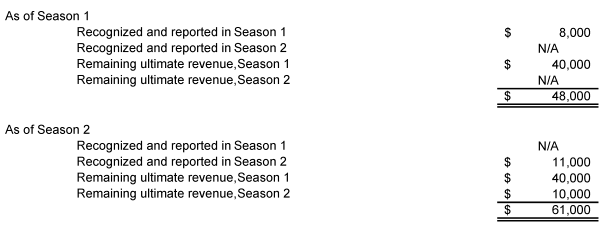 As of Season 1 Recognized and reported in Season 1 " $8,000 " Recognized and reported in Season 2 N/A "Remaining ultimate revenue, Season 1" " $40,000 " "Remaining ultimate revenue, Season 2" N/A " $48,000 " As of Season 2 Recognized and reported in Season 1 N/A Recognized and reported in Season 2 " $11,000 " "Remaining ultimate revenue, Season 1" " $40,000 " "Remaining ultimate revenue, Season 2" " $10,000 " " $61,000 "
- fUltimate participation costs are as follows.
 As of Season 1 " $2,000 " As of Season 2 " $3,000 "
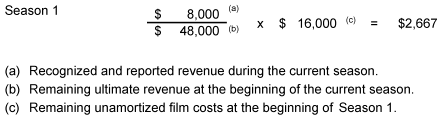 Season 1 " $8,000 " (a) x " $16,000 " (c) = "$2,667 " " $48,000 " (b) (a) Recognized and reported revenue during the current season. (b) Remaining ultimate revenue at the beginning of the current season. (c) Remaining unamortized film costs at the beginning of Season 1.
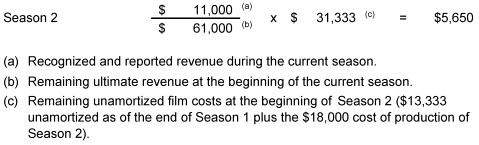 Season 2 " $11,000 " (a) x " $31,333 " (c) = "$5,650 " " $61,000 " (b) (a) Recognized and reported revenue during the current season. (b) Remaining ultimate revenue at the beginning of the current season. (c) "Remaining unamortized film costs at the beginning of Season 2 ($13,333 unamortized as of the end of Season 1 plus the $18,000 cost of production of Season 2)."
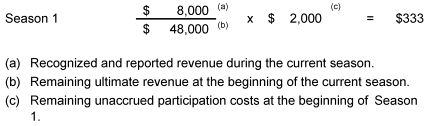 Season 1 " $8,000 " (a) x " $2,000 " (c) = $333 " $48,000 " (b) (a) Recognized and reported revenue during the current season. (b) Remaining ultimate revenue at the beginning of the current season. (c) Remaining unaccrued participation costs at the beginning of Season 1.
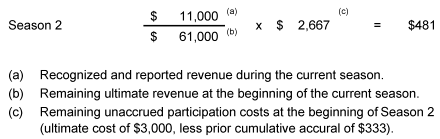 Season 2 " $11,000 " (a) x " $2,667 " (c) = $481 " $61,000 " (b) (a) Recognized and reported revenue during the current season. (b) Remaining ultimate revenue at the beginning of the current season. (c) "Remaining unaccrued participation costs at the beginning of Season 2 (ultimate cost of $3,000, less prior cumulative accural of $333)."
926-20-65Transition and Open Effective Date Information
Source downloaded: .Record version 672779105ff1. Effective date must be checked in the source.