ASC 730-912
Contractors—Federal Government
730 Research and Development
Source downloaded: .Record version 6cdf6d19f276. Effective date must be checked in the source.
This subtopic tells government contractors how to account for best-efforts-basis, research-and-development-cost-sharing arrangements with the federal government. When all six scope conditions in 730-912-15-2 are met (qualifying R&D, contractor retains rights to data/results, best-efforts-only obligation, mutual expectation that costs will exceed funding, no contract combination under 606-10-25-9, and the federal government as sole or principal ultimate customer), the arrangement is not a revenue contract under Topic 606. Instead, costs are expensed as R&D as incurred under Topic 730, and customer funding is recorded as an offset to aggregate R&D expense rather than as contract revenue (730-912-25-1).
Key points (7)
- The Subtopic applies only if all conditions of 730-912-15-2 are met, including that the activities qualify as research and development under Subtopic 730-10 and the contractor retains a right to the data and results.
- The contract must obligate the contractor to perform only on a best-efforts basis toward agreed-on objectives, not to deliver a product or service meeting defined performance or design specifications (730-912-15-2(c)).
- At contract inception both parties must expect costs to exceed amounts funded, evidenced by contractual or other documentation, implying significant uncertainty about securing follow-on contracts (730-912-15-2(d)).
- The arrangement must not be combined with other contracts under paragraph 606-10-25-9, and the federal government (including foreign military sales) must be the sole or principal expected ultimate customer (730-912-15-2(e)-(f)).
- Arrangements in scope differ from contracts with customers under Topic 606 and are research and development as described in paragraph 730-10-15-4(c) (730-912-15-3).
- Costs are recognized as research and development expense as incurred in conformity with Topic 730, and amounts funded by the customer are recognized as an offset to aggregate R&D expense rather than as contract revenues (730-912-25-1).
- Example 1 (730-912-55-1 through 55-3) illustrates the offset accounting where estimated aggregate costs are $150, anticipated customer reimbursement is $100, 50% of costs have been incurred, and the customer has paid 30% of its pro rata funding.
For students. The exam trap is treating customer funding as revenue: under this Subtopic the reimbursement is netted against R&D expense, not presented as contract revenue, because the arrangement is cost sharing rather than a Topic 606 contract with a customer. Watch the six scope conditions closely—failing even one (e.g., defined performance specifications, or a non-federal ultimate customer) pushes the arrangement back into Topic 606.
Machine-generated study aid for ASC 730-912. Check the source paragraphs below.
730-912-00Status
Source downloaded: .Record version 15728f05b7ca. Effective date must be checked in the source.
| Paragraph | Action | Accounting Standards Update | Date |
| Contracts | Added | Accounting Standards Update No. 2014-09 | 05/28/2014 |
| Customer | Added | Accounting Standards Update No. 2014-09 | 05/28/2014 |
| Revenue | Added | Accounting Standards Update No. 2014-09 | 05/28/2014 |
| 912-730-15-2 | Amended | Accounting Standards Update No. 2014-09 | 05/28/2014 |
| 912-730-15-3 | Amended | Accounting Standards Update No. 2014-09 | 05/28/2014 |
730-912-05Overview and Background
Source downloaded: .Record version 24697d3d61ef. Effective date must be checked in the source.
Best-Efforts-Basis, Research-and-Development-Cost-Sharing Arrangements
730-912-15Scope and Scope Exceptions
Source downloaded: .Record version b481fa568af1. Effective date must be checked in the source.
Overall Guidance
Instruments
- aThe activities performed in connection with the contractual arrangement qualify as research and development (see Subtopic 730-10).
- bThe contractor retains a right to the data and results of the research and development activities.
- cThe contractual arrangement obligates the contractor to perform only on a best-efforts basis to achieve the agreed-on objectives of the research and development activity, rather than to deliver a product or service meeting defined performance or other (such as design) specifications.
- dAt the inception of the contract, the contractor and the customer enter into the arrangement with the expectation that costs will be incurred in excess of amounts to be funded. This condition will be met if contractual or other documentation specifically evidences acknowledgment of this expectation by both the contractor and the customer. Implicit in this condition is the existence of significant uncertainty at the date the contractor enters into the arrangement regarding the likelihood of successfully securing follow-on contracts related to the research and development activity.
- eThe research and development arrangement is not combined with other contracts in accordance with the guidance on combining contracts in paragraph 606-10-25-9.
- fThe federal government is the sole or principal expected ultimate customer (including foreign military sales) for the research and development activity or products directly resulting from the research and development activity subject to the arrangements.
730-912-25Recognition
Source downloaded: .Record version 477046970803. Effective date must be checked in the source.
Best-Efforts-Basis, Research-and-Development-Cost-Sharing Arrangements
730-912-55Implementation Guidance and Illustrations
Source downloaded: .Record version 185c73d7107f. Effective date must be checked in the source.
Illustrations
- a Estimated aggregate cost to be incurred by contractor in the specified research and development activity: $150
- b Anticipated reimbursement from customer: $100
- c As of the current reporting date 50 percent of the estimated aggregate costs have been incurred
- d Customer has paid 30 percent of its pro rata funding.
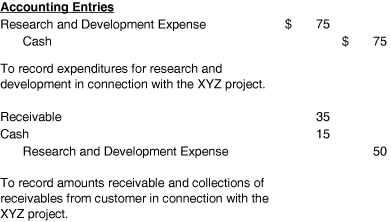 Accounting Entries Research and Development Expense $75 Cash $75 To record expenditures for research and development in connection with the XYZ project. Receivable 35 Cash 15 Research and Development Expense 50 To record amounts receivable and collections of receivables from customer in connection with the XYZ project.
Related subtopics
- 730-20 Research and Development ArrangementsResearch and Development
- 730-10 OverallResearch and Development
- 810-30 Research and Development ArrangementsConsolidation
- 912-20 Contract CostsContractors—Federal Government
- 912-10 OverallContractors—Federal Government
- 835-912 Contractors—Federal GovernmentInterest