Codification page
Page 2147480428
This Section, which is an integral part of the requirements of this Subtopic, provides general guidance to be used in distinguishing contributions from exchange transactions, including membership dues and agency transactions.
The following diagram illustrates the process for determining whether a transfer of assets to a recipient is a contribution, an exchange transaction, or another type of transaction and whether a contribution is conditional. The diagram also illustrates whether there is an associated donor restriction with a contribution.
-
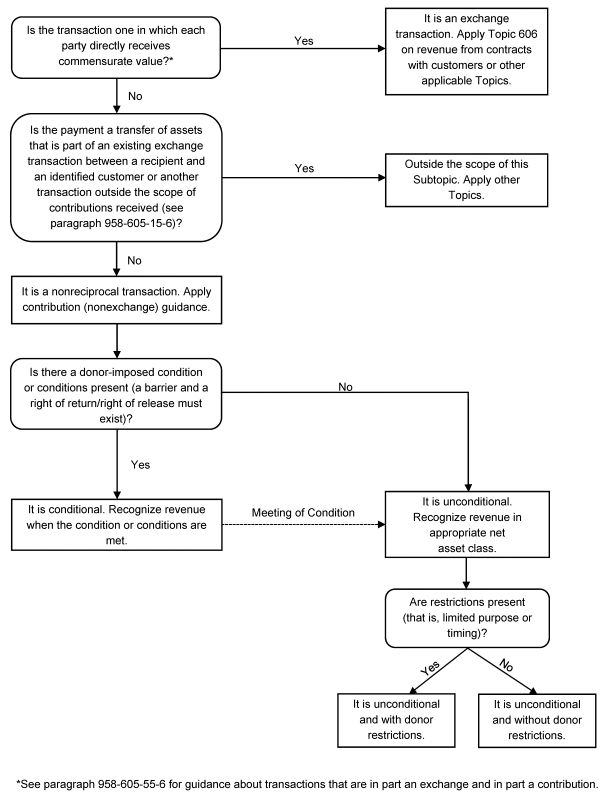 Is the transaction one in which each party directly receives commensurate value? It is an exchange transaction. Apply Topic 606 on revenue from contracts with customers or other applicable Topics. Is the payment a transfer of assets that is part of an existing exchange transaction between a recipient and an identified customer or another transaction outside the scope of contributions received (see paragraph 958-605-15-6)? Outside the scope of this Subtopic. Apply other Topics. It is a nonreciprocal transaction. Apply contribution (nonexchange) guidance. Is there a donor-imposed condition or conditions present (a barrier and a right of return/right of release must exist)? It is conditional. Recognize revenue when the condition or conditions are met. It is unconditional. Recognize revenue in appropriate net asset class. Are restrictions present (that is, limited purpose or timing)? It is unconditional and with donor restrictions. It is unconditional and without donor restrictions.
The accounting and reporting of grants, membership dues, and sponsorships is determined by the underlying substance of the transaction. Those terms are broadly used to refer not only to contributions but also to assets transferred in exchange transactions. A grant, sponsorship, or membership may be entirely a contribution, entirely an exchange, or a combination of the two; therefore, care must be taken in evaluating each grant, sponsorship, or membership agreement. In addition, those resource transfers may also have the characteristics of agency transactions.
The implementation guidance is organized as follows:
- aDistinguishing contributions from exchange transactions (see paragraphs )
- bDistinguishing the contribution portion of membership dues (see paragraphs )
- cDistinguishing contributions from agency transactions (see paragraph 958-605-55-13).
The guidance in this Subtopic about distinguishing between contributions and exchange transactions applies to both a resource provider (for example, a corporate foundation, a corporation, or a not-for-profit entity [NFP]) and a recipient.
Foundations, business entities, and other types of entities may provide resources to NFPs or business entities under programs referred to as grants, awards, or sponsorships. Those asset transfers are contributions if the resource providers do not receive commensurate value in exchange for the assets transferred or if the value received by the resource providers is incidental to the potential public benefit from using the assets transferred. A grant made by a resource provider to an NFP would likely be a contribution if the activity specified by the grant is to be planned and carried out by the NFP and the NFP has the right to the benefits of carrying out the activity. If, however, the grant is made by a resource provider that provides materials to be tested in the activity and that retains the right to any patents or other results of the activity, the grant would likely be an exchange transaction. A careful assessment of the characteristics of the transaction, from the perspectives of both the resource provider and the recipient, is necessary to determine whether a contribution has occurred.
For example, a resource provider may sponsor research and development activities at a research university and retain proprietary rights or other privileges, such as patents, copyrights, or advance and exclusive knowledge of the research outcomes. The research outcomes may be intangible, uncertain, or difficult to measure, and may be perceived by the university as a sacrifice of little or no value; however, their value often is commensurate with the value that a resource provider expects in exchange. Similarly, a resource provider may sponsor research and development activities and specify the protocol of the testing so the research outcomes are particularly valuable to the resource provider. Those transactions are not contributions if their potential public benefits are secondary to the potential proprietary benefits to the resource providers.
Moreover, a single transaction may be in part an exchange and in part a contribution. For example, if a donor transfers a building to an entity at a price significantly lower than its fair value and no unstated rights or privileges are involved, the transaction is in part an exchange of assets and in part a contribution to be accounted for as required by the Contributions Received Subsections of this Subtopic. See paragraphs for premiums provided to donors and Example 4 (paragraphs ) for direct benefits provided to donors at special events.
Example 1 (see paragraph 958-30-55-2) and paragraphs 958-605-55-13A through 55-14I illustrate the need to assess the relevant facts and circumstances to distinguish between the receipt of resources in an exchange and the receipt of resources in a contribution.
The term members is used broadly by some NFPs to refer to their donors and by other NFPs to refer to individuals or other entities that pay dues in exchange for a defined set of benefits. Some NFPs receive dues from their members. These transfers often have elements of both a contribution and an exchange transaction because members receive tangible or intangible benefits from their membership in the NFP. Usually, the determination of whether membership dues are contributions rests on whether the value received by the member is commensurate with the dues paid.
For example, if an NFP has annual dues of $100 and the only benefit members receive is a monthly newsletter with a fair value of $25, $25 of the dues are received in an exchange transaction and should be recognized as revenue as the earnings process is completed and $75 of the dues are a contribution. (See paragraph 958-605-25-1 for recognition of the exchange portion of membership dues. See the Contributions Received Subsections of this Subtopic for the reporting of the contribution portion.)
Member benefits generally have value regardless of how often (or whether) the benefits are used. For example, most would agree that a health club membership is an exchange transaction, even if the member stops using the facilities before the completion of the membership period. It may be difficult, however, to measure the benefits members receive and to determine whether the value of those benefits is approximately equal to the dues paid by the members.
The following table contains a list of indicators that may be helpful in determining whether membership dues are contributions, exchange transactions, or a combination of both. Depending on the facts and circumstances, some indicators may be more significant than others; however, no single indicator is determinative of the classification of a particular transaction.
- Indicators Useful for Determining the Contribution and Exchange Portions of Membership Dues
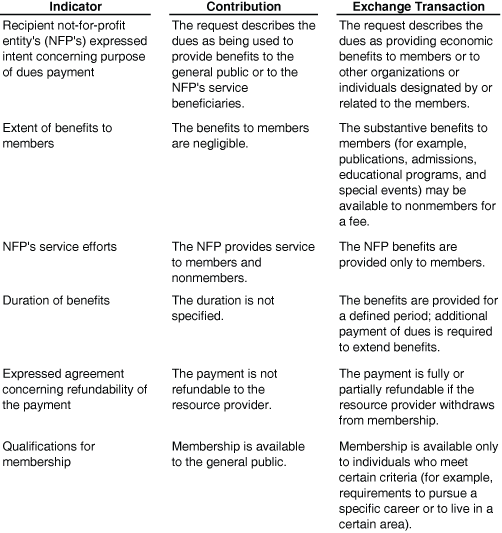 Indicator Contribution Exchange Transaction Recipient not-for-profit entity's (NFP's) expressed intent concerning purpose of dues payment The request describes the dues as being used to provide benefits to the general public or to the NFP's service beneficiaries. The request describes the dues as providing economic benefits to members or to other organizations or individuals designated by or related to the members. Extent of benefits to members The benefits to members are negligible. "The substantive benefits to members (for example, publications, admissions, educational programs, and special events) may be available to nonmembers for a fee." NFP's service efforts The NFP provides service to members and nonmembers. The NFP benefits are provided only to members. Duration of benefits The duration is not specified. The benefits are provided for a defined period; additional payment of dues is required to extend benefits. Expressed agreement concerning refundability of the payment The payment is not refundable to the resource provider. The payment is fully or partially refundable if the resource provider withdraws from membership. Qualifications for membership Membership is available to the general public. "Membership is available only to individuals who meet certain criteria (for example, requirements to pursue a specific career or to live in a certain area)."
A transfer of assets may appear to be a contribution if a donor uses a recipient entity as its intermediary, agent, or trustee to transfer assets to a third-party donee, particularly if the recipient entity indirectly achieves its mission by disbursing the assets. Although the transaction between the donor and the donee may be a contribution, the transfer of assets from the donor is not a contribution received by the recipient entity, and the transfer of assets to the donee is not a contribution made by the recipient entity. (See the Transfers of Assets to a Not-for-Profit Entity or Charitable Trust that Raises or Holds Contributions for Others Subsection of this Section for implementation guidance on and illustrations of agency transactions.)
Examples 1 through 5 illustrate the guidance in Section 958-605-15 for determining whether a transaction is an exchange or a contribution. The analysis in each Example is not intended to represent the only manner in which the guidance could be applied, and the Examples are not intended to apply to only a specific illustration. Although some aspects of the Examples may be present in actual fact patterns, all relevant facts and circumstances of a particular fact pattern should be evaluated when applying the guidance in this Subtopic. The guidance in these Examples about distinguishing between contributions and exchange transactions applies to both a resource provider (for example, a corporate foundation, a corporation, or an NFP) and a recipient.
Not-for-Profit Entity A (NFP A) is a large research university with a cancer research center. NFP A regularly conducts research to discover more effective methods of treating cancer and often receives contributions to support its efforts. NFP A receives resources from a pharmaceutical entity to finance the costs of a clinical trial of an experimental cancer drug the pharmaceutical entity developed. The pharmaceutical entity specifies the protocol of the testing, including the number of participants to be tested, the dosages to be administered, and the frequency and nature of follow-up examinations. The pharmaceutical entity requires a detailed report of the test outcome within two months of the test's conclusion. Additionally, the rights to the results of the study belong to the pharmaceutical entity.
Because the results of the clinical trial have particular commercial value for the pharmaceutical entity, the pharmaceutical entity is receiving commensurate value as the resource provider. Therefore, the receipt of the resources is not a contribution received by NFP A, nor is the disbursement of the resources a contribution made by the pharmaceutical entity. See paragraph 958-605-15-5A.
Student L is enrolled at University A. Student L's total tuition charged for the semester is $30,000. Student L received a grant in the amount of $2,000 to use toward the tuition fee, which is paid directly by the grantor to University A.
The grant was awarded to Student L, not to University A. University A entered into an exchange transaction with Student L and accounts for the $30,000 of revenue in accordance with the guidance in the appropriate Subtopic. The $2,000 grant does not create additional revenue but, rather, serves as a partial payment against the $30,000 due to University A. Student L is an identified customer of University A who is receiving the benefit from the grant transaction. See paragraph 958-605-15-6(e).
Patient R is a patient at Hospital B. The total amount due for services rendered is $10,000. Patient R has Medicare, and it covers $8,000 of the services, which is paid directly by the government to Hospital B. Hospital B bills Patient R for $2,000.
Medicare is a form of insurance. Hospital B has a contract with a customer (Patient R) and determines that the $10,000 should be accounted for as an exchange transaction in accordance with the guidance in the appropriate Topic. The Medicare payment of $8,000 and Patient R's payment of $2,000 serve as a payment source for services rendered in the amount of $10,000 owed to Hospital B. The payment to Hospital B relates to an existing exchange transaction between Hospital B and an identified customer (Patient R). See paragraph 958-605-15-6(e).
The local government provided funding to NFP C to perform a research study on the benefits of a longer school year. The agreement requires NFP C to plan the study, perform the research, and summarize and submit the research to the local government. The local government retains all rights to the study.
NFP C concludes that this is a procurement arrangement in which commensurate value is being exchanged between two parties and that it should follow the relevant guidance for exchange transactions. NFP C is to perform a research study for the local government and turn over a summary of the study's findings to the local government. The local government retains the rights to the study. See paragraph 958-605-15-5A(c).
University D applied for and was awarded a grant from the federal government. University D must follow the rules and regulations established by the Office of Management and Budget of the federal government and the federal awarding agency. University D is required to incur qualifying expenses to be entitled to the assets. Any unspent money during the grant period is forfeited, and University D is required to return any advanced funding that does not have related qualifying expenses. University D also is required to submit a summary of research findings to the federal government, but University D retains the rights to the findings and has permission to publish the findings if it desires.
University D concludes that this grant is not a transaction in which there is commensurate value being exchanged. The federal government, as the resource provider, does not receive direct commensurate value in exchange for the assets provided to University D because University D retains all rights to the research and findings. University D and the public receive the primary benefit of any findings, and the federal government receives an indirect benefit because the research and findings serve the general public. Thus, University D determines that this grant should be accounted for under the contribution guidance in this Subtopic. See paragraph 958-605-15-5A(a).
Distinguishing between a condition stipulated by a donor and a restriction on the use of a contribution imposed by a donor may require the exercise of judgment. A donor-imposed condition depends on whether the agreement includes a barrier that must be overcome before a recipient is entitled to the assets transferred or promised. The agreement also must give either the contributor a right of return of the assets it has transferred or the promisor a right of release from its obligation to transfer assets. Donor-imposed conditions should be substantially met by the entity before the receipt of assets (including contributions receivable) is recognized as a contribution. In contrast to donor-imposed conditions, donor-imposed restrictions limit the use of the contribution, but they do not affect whether the recipient is entitled to the contribution.
If donor stipulations do not clearly state whether the right to receive or retain payment or take delivery depends on meeting those stipulations, or if those stipulations are ambiguous, distinguishing a conditional promise to give from an unconditional promise to give may be difficult. If the ambiguity cannot be resolved by reviewing the facts and circumstances surrounding the contribution and communicating with the donor, presume that a promise containing stipulations that are not clearly unconditional is a conditional promise to give. However, if the stipulation is not related to the purpose of the agreement (generally stipulations that are administrative or trivial), that stipulation is not indicative of a barrier (for example, a stipulation that an annual report must be provided by the donee to receive subsequent annual payments on a multiyear promise is not a barrier if the administrative requirement is not related to the purpose of the agreement.)
A challenge (matching) grant is a common form of a conditional promise to give. For example, a resource provider promises to contribute $1 for each $1 of contributions received by a not-for-profit entity (NFP), up to $100,000, over the next 6 months. As contributions are received from other resource providers, the conditions would be met and the promise would become unconditional. For example, if $10,000 is received in the first month from donors, $10,000 of the conditional promise would become unconditional and should be recognized as contribution revenue.
A donor-imposed condition must have both:
- aOne or more barriers that must be overcome before a recipient is entitled to the assets transferred or promised.
- bA right of return to the contributor for assets transferred (or for a reduction, settlement, or cancellation of liabilities) or a right of release of the promisor from its obligation to transfer assets (or to reduce, settle, or cancel liabilities).
It is possible that some agreements that do not contain any barriers could contain either a right of return of assets transferred or a right of release from obligation. For example, some foundations include a right-of-return or a right-of-release-from-obligation clause in their agreements as a matter of policy and standard wording but impose no barriers that must be achieved before a recipient is entitled to the resources. The resources would be considered unconditional, and revenue would be recognized immediately.
Some agreements include multiple requirements that must be overcome before an entity is entitled to transferred assets or a future transfer of assets. An entity must consider facts and circumstances and use judgment to determine which stipulations, if any, of an agreement are deemed to be a barrier or barriers that must be achieved before an entity is entitled to assets.
As described in paragraph 958-605-25-5D, a measurable performance-related barrier or other measurable barrier may be indicative of a donor-imposed condition. Examples of measurable performance-related barriers or other measurable barriers could include:
- aSpecified level of service. An entity is given assets, and the resource provider stipulates that the assets must be used to provide a specific level of service (for example, 1,000 meals per week for a soup kitchen). The barrier that must be overcome before the recipient is entitled to the resources is the specified level of service that must be achieved.
- bSpecific output or outcome. An entity is given assets, entitlement to which is contingent upon producing a specific output or achieving a measurable outcome stemming from the entity's activities (for example, students achieving a minimum standardized test score, a decline in drop-out rates following an entity's educational efforts, and community residents exhibiting a decline in symptoms of malnutrition following an entity's efforts in providing meals).
- cMatching. A resource provider specifies the ratio or amount of a matching contribution. The recipient is not entitled to receive the promised assets until it has met the required match (the barrier or hurdle that must be overcome).
- dOutside event. Agreements may include requirements that are imposed on, and would need to be overcome by, other parties, including the resource provider. A resource provider specifies that a certain outside event needs to occur for the recipient to be entitled to receive the assets (for example, a resource provider promises to contribute a certain amount of assets if the resource provider's net worth reaches a specified level).
As described in paragraph 958-605-25-5D, limited discretion may be indicative of a donor-imposed condition. Limited discretion of the recipient on the conduct of an activity is more specific than a donor-imposed restriction. Restrictions limit the use of a contribution to a specific activity or time but do not necessarily place limitations on how the activity is performed. This indicator focuses on limitations concerning specific requirements about how an activity must be conducted for a recipient to be entitled to the resources. For example, an agreement might specify that the recipient should incur qualifying expenses in compliance with established rules and regulations. This is in contrast to a restriction, which typically places limits only on a specific activity that is being funded and does not affect the extent to which a recipient is entitled to the resources (for example, a requirement that a contribution be used to fund one of an organization's programs).
An indicator noting that a stipulation is related to the purpose of the agreement could be helpful in the context of considering the agreement collectively with the other indicators. If a stipulation is unrelated to the purpose of the agreement (for example, trivial or administrative stipulations), the stipulation would not be indicative of a barrier. If administrative tasks are required that are unrelated to the purpose of the agreement, there most likely would be other requirements that would be more indicative of a barrier that must be overcome before the recipient is entitled to the resources (for example, a specific event or activity to occur). Producing an annual report is a common requirement in contribution agreements; however, the annual report typically is not related to the underlying purpose of the agreement. Generally, a report is administrative in nature and is intended to provide a resource provider with information to confirm that the transferred assets were used in accordance with the purpose of the agreement and is not intended to affect the extent to which the recipient is entitled to the contribution.
A promise to give is a written or oral agreement to contribute cash or other assets to another entity. The Contributions Received Subsections of this Subtopic avoid using the term pledge because that term is used to describe not only promises to give but also plans or intentions to give that are not promises. There are other terms used to describe promises to give such as subscriptions, awards, appropriations, or grants. A communication received from a potential donor must be carefully evaluated to determine if it is a promise to give, since a communication that clearly is not a promise is not recognized in the financial statements.
Pursuant to paragraph 958-605-25-8, to be recognized in financial statements there must be sufficient evidence in the form of verifiable documentation that a promise to give was made and received. That requirement does not preclude recognition of verifiable oral promises, such as those documented by tape recordings, written registers, or other means that permit subsequent verification.
Promises to give services generally involve personal services that, if not explicitly conditional, are often implicitly conditioned upon the future and uncertain availability of specific individuals whose services have been promised.
Certain promises become unconditional in stages because they are dependent on several or a series of conditions—milestones—rather than on a single condition and are recognized in increments as each of the conditions is met. Similarly, other promises are conditioned on promisees' incurring certain qualifying expenses (or costs). Those promises become unconditional and are recognized to the extent that the expenses are incurred. A portion of those contributions should be recognized as revenue as each of those stages is met.
The present value of the future cash flows is one valuation technique for measuring the fair value of contributions arising from unconditional promises to give cash; other valuation techniques also are available, as described in Topic 820. The following table illustrates the use of present value techniques for initial recognition and measurement of unconditional promises to give cash that are expected to be collected one year or more after the financial statement date.
- Initial Recognition of Unconditional Promises to Give Cash
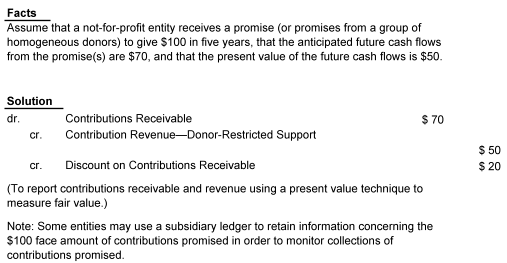 Facts "Assume that a not-for-profit entity receives a promise (or promises from a group of homogeneous donors) to give $100 in five years, that the anticipated future cash flows from the promise(s) are $70, and that the present value of the future cash flows is $50." Solution dr. Contributions Receivable $70 cr. Contribution Revenue—Donor-Restricted Support $50 cr. Discount on Contributions Receivable $20 (To report contributions receivable and revenue using a present value technique to measure fair value.) Note: Some entities may use a subsidiary ledger to retain information concerning the $100 face amount of contributions promised in order to monitor collections of contributions promised.
The use of property, utilities, or advertising time is considered to be forms of contributed assets, rather than contributed services. Pursuant to paragraph 958-605-25-2, an NFP would recognize the fair value of the use of property, utilities, or advertising time as both revenue and expense in the period received and used. Fair value could be estimated by using billing rates normally charged to other customers under similar circumstances. Whether those contributions should be reported is unaffected by whether the NFP could afford to purchase the utilities or facilities at their fair value. If the transaction is an unconditional promise to give electric, telephone, or other utilities for a specified number of periods, the promise should be reported as a contribution receivable and as donor-restricted support that increases net assets with donor restrictions, pursuant to paragraph 958-605-25-8.
Unconditional promises to give the use of long-lived assets (such as a building or other facilities) for a specified number of periods in which the donor retains legal title to the long-lived asset may be received in connection with leases or may be similar to leases but have no lease payments. For example, an NFP may use facilities under a lease agreement that calls for lease payments at amounts below the fair rental value of the property. In circumstances in which an NFP receives an unconditional promise to give for a specified number of periods, the promise should be reported as revenue and as a contribution receivable for the difference between the fair rental value of the property and the stated amount of the lease payments. In other words, if a donor promises that the NFP can use a facility for 10 years, the NFP has received a multiyear promise to give and should report the fair value of that promise as a contribution with a donor-imposed restriction in Year 1. Amounts reported as contributions shall not exceed the fair value of the long-lived asset at the time the NFP receives the unconditional promise to give. The contribution receivable may be described in the financial statements based on the item whose use is being contributed, such as a building, rather than as contributions receivable.
Property and equipment used in exchange transactions (other than lease transactions), such as federal contracts, in which the resource provider retains legal title during the term of the arrangement should be reported as a contribution at fair value at the date received by the NFP only if it is probable that the NFP will be permitted to keep the assets when the arrangement terminates.
Transition date:(P) December 16, 2026; (N) December 16, 2026Transition guidance:
105-10-65-10Paragraph superseded by Accounting Standards Update No. 2025-12.Contributions are received in several different forms. Most often the item contributed is an asset, but it also can be forgiveness of a liability. The types of assets commonly contributed include cash, marketable securities, land, buildings, use of facilities or utilities, materials and supplies, intangible assets, other goods or services, and unconditional promises to give those items in the future. The Contributions Received Subsection of Section 958-605-30 requires NFPs receiving contributions to recognize them at the fair values of the assets received. However, recognition of contributions of works of art, historical treasures, and similar assets is not required if the donated items are added to collections (see paragraph 958-360-25-1), and recognition of contributions of services is prohibited if the services do meet any of the criteria in paragraph 958-605-25-16.
Examples 1 through 6 (see paragraphs ) provide illustrations on different types of contributed assets, including the following:
- aReal property
- bWorks of art
- cHistorical objects
- dUtilities
- eUse of property
- fInterest in an estate.
Recognition of contributions of services is required for those contributed services received that meet any of the specified conditions of paragraph 958-605-25-16 and is precluded for contributed services that do not. The criterion in paragraph 958-605-25-16(b)requires that recognized services be specialized skills provided by individuals possessing those skills. An individual who receives some training does not necessarily possess a specialized skill. For example, if a volunteer receives some training from an NFP to learn how to help other people learn to read, that volunteer does not possess the specialized skills that a reading teacher possesses.
Examples 7 through 11 (see paragraphs ) provide illustrations on different types of contributed services, including the following:
- aConstruction services
- bTeaching services
- cBoard of trustee services
- dCompanion services
- eFundraising services.
See paragraph 275-10-50-18 for guidance on disclosures about risk concentrations.
Example 12 (see paragraph 958-605-55-69) illustrates the situation in which an NFP relies on specific donors for contributions.
This Example illustrates the application of the recognition and measurement principles of paragraphs 958-605-25-2 and 958-605-30-2.
Mission A, a religious NFP, receives a building (including the land on which it was constructed) as a gift from a local corporation with the understanding that the building will be used principally as an education and training center for Mission A's members or for any other purpose consistent with Mission A's plans.
Mission A would recognize the contributed property as an asset and as support and measure that property at its fair value (see paragraph 958-605-30-2). Information necessary to estimate the fair value of that property could be obtained from various sources, including amounts recently paid for similar properties in the locality, and estimates of its replacement cost adjusted to reflect the price that would be received for the contributed property. This contribution is revenue without donor restrictions because the donated assets may be used for any purpose and the donor did not impose a time restriction.
This Example illustrates the application of the recognition and measurement principles of paragraph 958-605-25-19.
Museum B, which preserves its collections as described in paragraph 958-605-25-19, receives a gift of a valuable painting from a donor. The donor obtained an independent appraisal of the fair value of the painting for tax purposes and furnished a copy to the museum. The museum staff evaluated the painting to determine its authenticity and worthiness for addition to the museum's collection. The staff recommended that the gift be accepted, adding that it was not aware of any evidence contradicting the fair value provided by the donor and the donor's appraiser.
If Museum B capitalizes its collections, Museum B would recognize the fair value of the contributed work of art received as revenue and capitalize it as an asset at its fair value (see paragraph 958-605-25-19). If Museum B does not capitalize its collections, Museum B is precluded from recognizing the contribution (see that paragraph) and would provide the information required by paragraphs 958-360-45-3 and 958-360-45-5.
If Museum B accepted the painting with the donor's understanding that it would be sold rather than added to its collection, Museum B would recognize the contribution of the painting received as revenue without donor restrictions and as an asset at its fair value (see paragraphs 958-605-30-2 and 958-605-45-6).
This Example illustrates the application of the recognition and measurement principles of paragraph 958-605-25-19.
Historical Society C receives several old photographs as a gift from a long-time local resident. The photographs depict a particular area as it was 75 years ago. After evaluating whether the photographs were worthy of addition to the historical society's collection, the staff concluded the photographs should be accepted solely because of their potential historical and educational use; that is, the photographs may be of interest to future researchers, historians, or others interested in studying the area. The photographs are not suitable for display and no alternative use exists.
Regardless of whether Historical Society C capitalizes its collections, Historical Society C would not recognize the contributed photographs as assets because there is major uncertainty about the existence of value and no alternative use exists (see paragraph 958-605-25-4).
This Example illustrates the application of the recognition and measurement principles of paragraphs 958-605-25-2 and 958-605-30-2.
Foundation D operates from a building it owns. The holding company of a local utility has been contributing electricity on a continuous basis subject to the donor's cancellation.
The simultaneous receipt and use of electricity or other utilities is a form of contributed assets and not services. Foundation D would recognize the fair value of the contributed electricity as both revenue and expense in the period it is received and used (see paragraph 958-605-30-2). Foundation D could estimate the fair value of the electricity received by using rates normally charged to a consumer of similar usage requirements.
This Example illustrates the application of the recognition and measurement principles of paragraphs 958-605-25-2 and 958-605-30-2.
Charity E receives the free use of 10,000 square feet of prime office space provided by a local entity. The local entity has informed Charity E that it intends to continue providing the space as long as it is available, and although it expects it would be able to give the charity 30 days advance notice, it may discontinue providing the space at any time. The local entity normally rents similar space for $14 to $16 annually per square foot, the going market rate for office space in the area. Charity E decides to accept this gift—the free use of office space—to conduct its daily central administrative activities.
The simultaneous receipt and use of facilities is a form of contributed assets and not services. Charity E would recognize the fair value of the contributed use of facilities as both revenue and expense in the period it is received and used (see paragraph 958-605-30-2).
If the local entity explicitly and unconditionally promises the use of the facility for a specified period of time (for example, five years), the promise would be an unconditional promise to give. In that case, Charity E would recognize the receipt of the unconditional promise as a receivable and as donor-restricted support at its fair value. The donor would recognize the unconditional promise when made as a payable and an expense at its fair value (see paragraph 720-25-25-1).
This Example illustrates the application of the recognition and measurement principles of paragraphs 958-605-25-2 and 958-605-30-2.
In 19X0, Individual notifies Church F that she has remembered the church in her will and provides a written copy of the will. In 19X5, Individual dies. In 19X6, Individual's last will and testament enters probate and the probate court declares the will valid. The executor informs Church F that the will has been declared valid and that it will receive 10 percent of Individual's estate, after satisfying the estate's liabilities and certain specific bequests. The executor provides an estimate of the estate's assets and liabilities and the expected amount and time for payment of Church F's interest in the estate.
The 19X0 communication between Individual and Church F specified an intention to give. The ability to modify a will at any time prior to death is well established; thus in 19X0 Church F did not receive a promise to give and did not recognize a contribution received. When the probate court declares the will valid, Church F would recognize a receivable and revenue for an unconditional promise to give at the fair value of its interest in the estate (see paragraphs 958-310-35-6, 958-605-30-5, and 958-605-30-6). If the promise to give contained in the valid will was instead conditional based on a barrier that must be overcome for Church F to be entitled to the assets, Church F would recognize the contribution when the condition was substantially met. A conditional promise in a valid will would be disclosed in notes to financial statements (see paragraph 958-310-50-4).
This Example illustrates the application of the recognition and measurement principles of paragraphs 958-605-25-16 and 958-605-30-10.
Institute G decides to construct a building on its property. It obtains the necessary architectural plans and specifications and purchases the necessary continuing architectural services, materials, permits, and so forth at a total cost of $400,000. A local construction entity contributes the necessary labor and equipment. An independent appraisal of the building (exclusive of land), obtained for insurance purposes, estimates its fair value at $725,000.
Institute G would recognize the services contributed by the construction entity because the contributed services received meet the condition in paragraph 958-605-25-16(a) (the services received create or enhance nonfinancial assets) or because the services meet the condition in paragraph 958-605-25-16(b) (the services require specialized skills, are provided by individuals possessing those skills, and would typically need to be purchased if not provided by donation). Contributions of services that create or enhance nonfinancial assets may be measured by referring to either the fair value of the services received or the fair value of the asset or of the asset enhancement resulting from the services (see paragraph 958-605-30-10). In this Example, the fair value of the contributed services received could be determined by subtracting the cost of the purchased services, materials, and permits ($400,000) from the fair value of the asset created ($725,000), which results in contributed services received of $325,000. Alternatively, the amount the construction entity would have charged could be used if more readily available.
If some of the labor did not require specialized skills and was provided by volunteers, those services still would be recognized because they meet the condition in paragraph 958-605-25-16(a).
This Example illustrates the application of the recognition and measurement principles of paragraphs 958-605-25-16 and 958-605-30-10.
Faculty salaries are a major expense of University H. The faculty includes both compensated faculty members (approximately 80 percent) and uncompensated faculty members (approximately 20 percent) who are associated with religious orders and contribute their services to the university. The performance of both compensated and uncompensated faculty members is regularly and similarly evaluated; both must meet the university's standards and both provide services in the same way.
University H would recognize both revenue and expense for the services contributed by the uncompensated faculty members because the contribution meets the condition in paragraph 958-605-25-16(b). Teaching requires specialized skills; the religious personnel are qualified and trained to provide those skills; and University H typically would hire paid instructors if the religious personnel did not donate their services. University H could refer to the salaries it pays similarly qualified compensated faculty members to determine fair value of the services received.
Similarly, if the uncompensated faculty members were given a nominal stipend to help defray certain of their out-of-pocket expenses, University H still would recognize both revenue and expense for the services contributed. The contribution received would be measured at the fair value of the services received less the amount of the nominal stipend paid.
This Example illustrates the application of the recognition and measurement principles of paragraphs 958-605-25-16 and 958-605-30-10.
A member of the board of trustees of Civic Organization I is a lawyer and from time to time in the capacity of a trustee provides advice on general business matters, including questions about business opportunities and risks and ethical, moral, and legal matters. The advice provided on legal matters is provided as a trustee in the role of a trustee, not as a lawyer, and the opinions generally are limited to routine matters. Generally, the lawyer suggests that Civic Organization I seek the opinion of its attorneys on substantive or complex legal questions. All of Civic Organization I's trustees serve without compensation, and most trustees have specialized expertise (for example, a chief executive officer, a minister, a physician, a professor, and a public accountant) that makes their advice valuable to Civic Organization I. The trustee-lawyer also serves without compensation as a trustee for two other charitable organizations.
Civic Organization I would be precluded from recognizing the contributed services it receives from its trustee-lawyer or its other trustees because the services contributed do not meet either of the conditions in paragraph 958-605-25-16. The condition in (a) in that paragraph is not relevant. The trustee-lawyer's services do not meet the condition in (b) in that paragraph because the substantive or complex legal questions that require the specialized skills of a lawyer are referred to Civic Organization I's attorneys or because the advice provided by trustees typically would not be purchased if not provided by donation.
This Example illustrates the application of the recognition and measurement principles of paragraphs 958-605-25-16 and 958-605-30-10.
Hospital J provides short-term inpatient and outpatient care and also provides long-term care for the elderly. As part of the long-term care program, the hospital has organized a program whereby local high school students may contribute a minimum of 10 hours a week, from 3:00 p.m. to 6:00 p.m., to the hospital. These students are assigned various duties, such as visiting and talking with the patients, distributing books and magazines, reading, playing chess, and similar activities. Hospital J does not pay for these services or similar services. The services are accepted as a way of enhancing or supplementing the quality of care and comfort provided to the elderly long-term care patients.
Hospital J would be precluded from recognizing the contributed services because the services contributed do not meet either of the conditions in paragraph 958-605-25-16. The condition in (a) in that paragraph is not relevant. The condition in (b) in that paragraph has not been met because the services the students provide do not require specialized skills nor would they typically need to be purchased if not provided by donation.
This Example illustrates the application of the recognition and measurement principles of paragraphs 958-605-25-16 and 958-605-30-10.
College K conducts an annual fund-raising campaign to solicit contributions from its alumni. In prior years, College K recruited unpaid student volunteers to make phone calls to its alumni. This year, a telemarketing entity, whose president is an alumnus of College K, contributed its services to College K for the annual alumni fundraising campaign. The entity normally provides telemarketing services to a variety of clients on a fee basis. College K provided the entity with a list of 10,000 alumni, several copies of a typed appeal to be read over the phone, and blank contribution forms to record pledges received. The entity contacted most of the 10,000 alumni.
College K would be precluded from recognizing the contributed services of the telemarketing entity. The condition in paragraph 958-605-25-16(a) is not relevant. The condition in paragraph 958-605-25-16(b) has not been met because the services do not require specialized skills or because College K typically would not need to purchase the services if they were not provided by donation. College K normally conducts its campaign with untrained students in a manner similar to the manner used by the telemarketing firm.
This Example illustrates the disclosure requirements of paragraphs 275-10-50-16.
Zebra Zoo is supported by contributions from the public. In the current year, 2 contributors provided 35 percent of Zebra Zoo's combined revenues. The following disclosure is required (see paragraph 275-10-50-16) because the two contributors provided a significant portion of Zebra Zoo's revenues. It is always considered reasonably possible that a customer, grantor, or contributor will be lost in the near term.
- Approximately 35 percent of Zebra Zoo's combined revenues were provided by 2 contributors.
Examples 13 through 21 (paragraphs ) illustrate how an entity might apply certain aspects of the guidance in this Subtopic in determining whether a contribution is conditional (all fact patterns are considered to be contributions or conditional contributions within the scope of this Subtopic). The analysis in each Example is not intended to represent the only manner in which the guidance could be applied, and the Examples are not intended to apply to only a specific illustration. Although some aspects of the Examples may be present in actual fact patterns, all relevant facts and circumstances of a particular fact pattern would need to be evaluated when applying the guidance in this Subtopic (for guidance on release from restrictions, see Section 958-605-45). Some examples are presented from the perspective of a resource provider (for example, an individual, a business corporation, a foundation, or an other NFP), and other examples are presented from the perspective of a resource recipient. The guidance in this Subtopic on determining whether a contribution is conditional applies to both contributions made by a resource provider and contributions received by a recipient.
Many agreements include a requirement that assets must be used for allowable and reasonable qualifying expenses (or costs) that are based on specific requirements of an agreement about the conduct of an activity (for example, in compliance with principles issued by the Office of Management and Budget or other similarly restrictive grant documents) that results in limited discretion by a recipient on the conduct of an activity and, thus, is indicative of a donor-imposed condition. These agreements often are paid on a cost-reimbursement basis that requires a recipient to incur specific qualifying expenses to be entitled to the promised resources. The specific requirements about allowable qualifying expenses are often accompanied by very close cost reporting and monitoring by the resource provider.
Foundation A gives NFP D a grant in the amount of $400,000 to provide specific career training to disabled veterans. The grant requires NFP D to provide training to at least 8,000 disabled veterans during the next fiscal year (2,000 during each quarter), with specific minimum targets that must be met each quarter. Foundation A specifies a right of release from the obligation in the agreement that it will only give NFP D $100,000 each quarter if NFP D demonstrates that those services have been provided to at least 2,000 disabled veterans during the quarter.
Foundation A determines that it should account for this grant as conditional. The agreement contains a right of release from obligation because the resource provider will only transfer assets if NFP D provides training to at least 8,000 disabled veterans during the year (with a minimum requirement of 2,000 disabled veterans per quarter) as specified in the agreement. Foundation A requires NFP D to achieve a specific level of service that would be considered a measurable performance-related barrier (in the form of milestones by specifying 2,000 disabled veterans per quarter). In this Example, NFP D's entitlement to the transferred assets is contingent upon serving at least 2,000 disabled veterans. The likelihood of serving at least 2,000 disabled veterans for the quarter is not a consideration from the perspective of either Foundation A or NFP D when assessing whether the contribution contains a barrier and is deemed conditional.
NFP B is a hospital that has a research program. NFP B receives a $300,000 grant from the federal awarding agency to fund thyroid cancer research. The terms of the grant specify that NFP B must incur certain qualifying expenses (or costs) in compliance with rules and regulations established by the Office of Management and Budget and the federal awarding agency. The grant is paid on a cost-reimbursement basis by NFP B initiating drawdowns of the grant assets. Any unused assets are forfeited, and any unallowed costs that have been drawn down by NFP B are required to be refunded.
NFP B determines that this grant is conditional. The grant agreement limits NFP's discretion as a result of the specific requirements on how NFP B may spend the assets (incurring certain qualifying expenses in accordance with the Office of Management and Budget rules and regulations). The grant also includes a release from the promisor's obligation for unused assets. The requirement to spend the assets on qualifying expenses is a barrier to entitlement because the requirement limits NFP B's discretion about how to use the assets, and the assets would need to be spent on specific items on the basis of the requirements of the agreement (for example, adherence to cost principles) before NFP B is entitled to the assets. This is in contrast to a restriction that typically places limits only on a specific activity that is being funded. NFP B records revenue during the grant period when the barriers have been overcome as it incurs qualifying expenses. The likelihood of incurring qualifying expenses is not a consideration when assessing whether the contribution is deemed conditional.
NFP E is a public charity that performs research on various diseases and allergies, including gluten-related allergies, as part of its overall mission. It receives a $100,000 grant from a foundation to perform research on gluten-related allergies over the next year. The grant agreement includes a right of return as part of the foundation's standard wording and a requirement that at the end of the grant period a report must be filed with the foundation that explains how the assets were spent.
NFP E determines that the grant is not a conditional contribution. The purpose of research on gluten-related allergies results in donor-restricted revenue because the purpose of the grant (working on gluten-free allergies) is narrower than the overall mission of the entity. There are no requirements in the agreement that would indicate that a barrier exists, which must be overcome before the recipient is entitled to the resources. NFP E also determines that the reporting requirement alone is not a barrier because it is an administrative requirement and not related to the purpose of the agreement, which is the actual research. This is an example in which a grant including a right of return could not be considered conditional because the return clause is not coupled with a barrier to be overcome, as determined by NFP E using judgment to assess the indicators of a barrier.
NFP DD is a hospital that received an upfront cash contribution from an individual to perform research on Alzheimer's disease during NFP DD's next fiscal year. The agreement does not include a right of return or a barrier that must be overcome to be entitled to the funds.
NFP DD determines that this contribution is not conditional because it does not include a right of return (or similar language) of the assets that have been transferred upfront. NFP DD concludes that it should recognize the revenue upon receipt of the assets from the individual as donor-restricted because it is required to use the assets for Alzheimer's research, which is narrower than NFP DD's overall mission, during the next fiscal year.
Foundation B receives a grant proposal from an animal rescue facility, NFP F, which requests a 2-year grant in the amount of $500,000 upfront to be used to expand its operations. The agreement indicates that NFP F must expand its facility by at least 5,000 square feet to accommodate additional animals by the end of the 2 years. The grant contains a right of return if the minimum expansion target is not achieved.
Foundation B determines that this grant is conditional. The grant includes a measurable barrier (5,000 additional square feet) that must be achieved by NFP F to be entitled to the assets and a right of return for unused assets or unmet requirements.
NFP G is a university that is conducting a capital campaign to build a new building to house its school of mathematics and to make capital improvements to existing buildings on campus, including a new heating system and an upgraded telephone and computer network. NFP G receives an upfront grant in the amount of $10,000 from a foundation as part of its capital campaign. The agreement contains a right of return requiring that the assets be reimbursed to the resource provider if the assets are not used for the purposes outlined in the capital campaign solicitation materials. The resource provider does not include any specifications in the agreement about how the building should be constructed or on how other improvements should be made.
NFP G determines that this grant is not conditional because the agreement places limits only on the specific activity that is being funded (for example, the assets can be used toward the new building or toward other capital improvements such as the heating system and an upgraded telephone and computer network within existing buildings on campus). The resource provider does not include any specifications about how the building should be constructed, and the agreement only indicates that NFP G must use the grant for the purpose outlined in the capital campaign materials. NFP G recognizes this grant as donor-restricted revenue because it must be used for capital purposes, which is narrower than NFP G's overall mission. This Example illustrates a fact pattern in which a grant can include a right of return and would be deemed a contribution that does not contain a donor-imposed condition because the return clause is not coupled with a barrier to be overcome, as determined by NFP G using judgment to assess the indicators of a barrier.
NFP I is a museum that receives a grant from an individual donor to build a new wing on the existing museum building. The agreement contains a $1 million multiyear promise to give the money to be used for the new wing on the building. The agreement also includes specific building requirements, including square footage and that the new wing must be environmentally friendly with Leadership in Energy and Environmental Design certification. The first installment of the gift will not be paid until NFP I submits architectural designs that meet the building requirements. Additional installments of the grant will be paid in specified increments upon achieving other milestones identified in the grant agreement. If a particular milestone is not achieved, the donor is released from its obligation to make installment payments.
NFP I determines that this agreement is conditional because NFP I is not entitled to the assets until a milestone is met (for example, an architectural plan including square footage and Leadership in Energy and Environmental Design certification). In this example, a milestone is deemed a measurable performance barrier because NFP I's entitlement to the transferred assets is contingent upon the completion of a milestone. In addition, the agreement includes a release of the resource provider's obligation to transfer assets if the stipulations are not met. NFP I recognizes the revenue as the barriers are overcome, which is upon meeting the specific requirements as NFP I builds the new wing. The likelihood of meeting a milestone is not a consideration when assessing whether the contribution is deemed conditional.
NFP J operates as a homeless shelter that provides individuals with temporary accommodations, meals, and counseling. NFP J receives an upfront grant of $75,000 from the city for its meals program. The grant requires NFP J to use the assets to provide at least 5,000 meals to the homeless. The grant contains a right of return for meals not served.
NFP J determines that this grant is conditional because it contains a measurable performance-related barrier (to provide 5,000 meals) and a right of return. NFP J recognizes assets received in advance of satisfying the conditions as a refundable advance liability and will then recognize $75,000 as donor-restricted revenue when at least 5,000 meals are served because the purpose of the grant is narrower than the overall purpose of NFP J. The likelihood of providing the meals is not a consideration when assessing whether the contribution is deemed conditional.
NFP H is a recreational organization that provides various sports programs to children that live in the community. NFP H receives an upfront grant in the amount of $40,000 from a foundation to be used toward its tennis program. Consistent with NFP H's grant proposal, the agreement includes specific guidelines for which NFP H could use the assets (for example, to hire 10 tennis instructors or to provide a summer camp for 9 weeks) but does not specify that NFP H's entitlement to the $40,000 is dependent upon NFP H meeting any of the specific indicated guidelines in the agreement. The grant contains a right of return for funds not spent on the tennis program.
NFP H determines that this grant is not conditional because it does not contain a barrier to overcome to be entitled to the transferred assets. Although the grant agreement contains guidelines for how NFP H could spend the $40,000, the agreement does not specify that entitlement to the transferred assets are dependent upon meeting any of the guidelines. Because the guidelines in the grant agreement were not required to be met to be entitled to the funding, the agreement does not contain a barrier to overcome. NFP H should recognize the revenue upon receipt of the assets as donor restricted because it is required to use the assets for the tennis program, which is narrower than NFP H's overall mission.
This Example illustrates the requirements described in paragraph 958-605-50-1A. Those disclosure requirements are not prescriptive on how the information should be disclosed; therefore, this Example demonstrates two alternative formats. This Example does not illustrate all categories of contributed nonfinancial assets, such as intangible assets. An NFP may be required to include disclosure information about valuation techniques and inputs, including assumptions and judgments that an NFP makes, in addition to those included in this Example, which is consistent with the fair value disclosures required by Topic 820. The valuation language used in this Example is not intended to provide guidance on how contributions of nonfinancial assets should be valued, including whether the principal market (or most advantageous market) disclosed is appropriate in the circumstances. While not illustrated in this Example, there may be additional information about the nature and extent of contributed services, including nonrecognized contributed services, that an entity may disclose in accordance with paragraph 958-605-50-1B.
The following illustration includes a table disclosing the amounts recognized within the statement of activities by category as well as a narrative disclosure about donor-imposed restrictions and valuation techniques and inputs for each category of contributed nonfinancial asset.
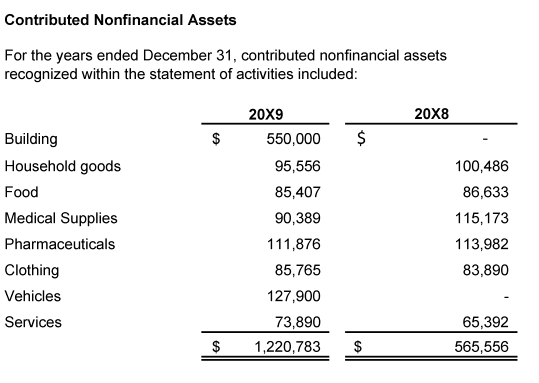 Contributed Nonfinancial Assets "For the years ended December 31, contributed nonfinancial assets recognized within the statement of activities included:" 20X9 20X8 Building Building " $550,000 " $ - Household goods Household goods " 95,556 " " 100,486 " Food Food " 85,407 " " 86,633 " Medical supplies Medical Supplies " 90,389 " " 115,173 " Pharmaceuticals Pharmaceuticals " 111,876 " " 113,982 " Clothing Clothing " 85,765 " " 83,890 " Vehicles Vehicles " 127,900 " - Services Services " 73,890 " " 65,392 " " $1,220,783 " " $565,556 "
- NFP K recognized contributed nonfinancial assets within revenue, including a contributed building, vehicles, household goods, food, medical supplies, pharmaceuticals, clothing, and services. Unless otherwise noted, contributed nonfinancial assets did not have donor-imposed restrictions.
- It is NFP K's policy to sell all contributed vehicles immediately upon receipt at auction or for salvage unless the vehicle is restricted for use in a specific program by the donor. No vehicles received during the period were restricted for use. All vehicles were sold and valued according to the actual cash proceeds on their disposition.
- The contributed building will be used for general and administrative activities. In valuing the contributed building, which is located in Metropolitan Area B, NFP K estimated the fair value on the basis of recent comparable sales prices in Metropolitan Area B's real estate market.
- Contributed food was utilized in the following programs: natural disaster services, domestic community development, and services to community shelters. Contributed household goods were used in domestic community development and services to community shelters. Contributed clothing was used in specific community shelters. Contributed medical supplies were utilized in natural disaster services. In valuing household goods, food, clothing, and medical supplies, NFP K estimated the fair value on the basis of estimates of wholesale values that would be received for selling similar products in the United States.
- Contributed pharmaceuticals were restricted by donors to use outside the United States and were utilized in international health services and natural disaster services. In valuing contributed pharmaceuticals otherwise legally permissible for sale in the United States, NFP K used the Federal Upper Limit based on the weighted average of the most recently reported monthly Average Manufacturer Prices (AMP) that approximate wholesale prices in the United States (that is, the principal market). In valuing pharmaceuticals not legally permissible for sale in the United States (and primarily consumed in developing markets), NFP K used third-party sources representing wholesale exit prices in the developing markets in which the products are approved for sale (that is, the principal markets).
- Contributed services recognized comprise professional services from attorneys advising NFP K on various administrative legal matters. Contributed services are valued and are reported at the estimated fair value in the financial statements based on current rates for similar legal services.
The following table illustrates the disclosures in paragraph 958-605-55-70V for each category of contributed nonfinancial asset. It includes both amounts and narrative disclosure. For illustrative purposes, only one year is presented.
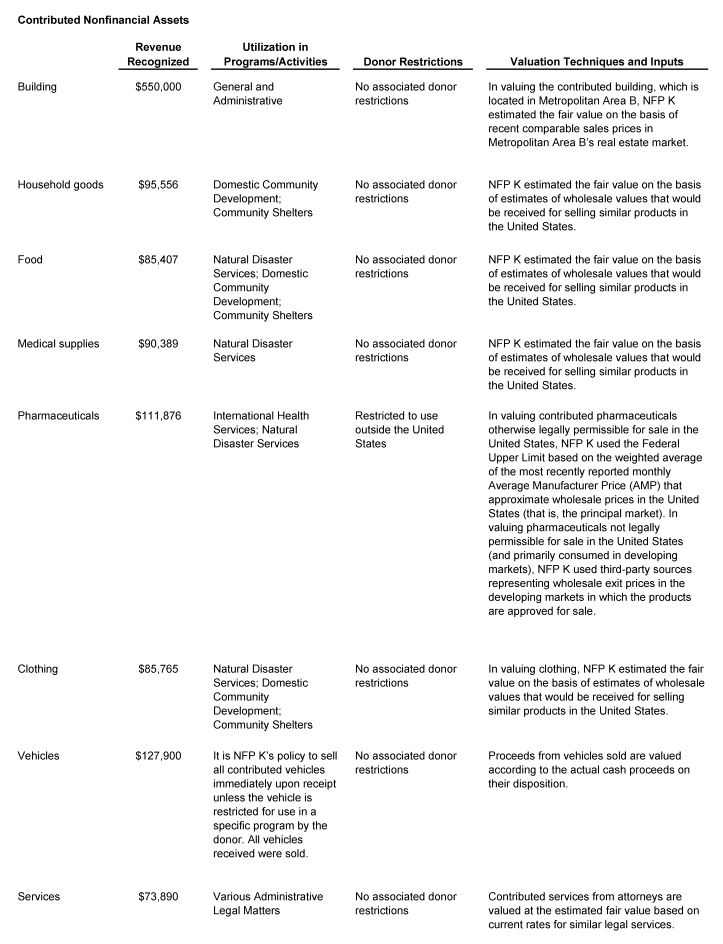 Contributed Nonfinancial Assets "Revenue Recognized" Utilization in Programs/Activities Donor Restrictions Valuation Techniques and Inputs Building "$550,000" General and Administrative No associated donor restrictions "In valuing the contributed building, which is located in Metropolitan Area B, NFP K estimated the fair value on the basis of recent comparable sales prices in Metropolitan Area B's real estate market. " Household goods "$95,556" Domestic Community Development; Community Shelters No associated donor restrictions NFP K estimated the fair value on the basis of estimates of wholesale values that would be received for selling similar products in the United States. Food "$85,407" Natural Disaster Services; Domestic Community Development; Community Shelters No associated donor restrictions NFP K estimated the fair value on the basis of estimates of wholesale values that would be received for selling similar products in the United States. Medical supplies "$90,389" Natural Disaster Services No associated donor restrictions NFP K estimated the fair value on the basis of estimates of wholesale values that would be received for selling similar products in the United States. Pharmaceuticals "$111,876" International Health Services; Natural Disaster Services Restricted to use outside the United States "In valuing contributed pharmaceuticals otherwise legally permissible for sale in the United States, NFP K used the Federal Upper Limit based on the weighted average of the most recently reported monthly Average Manufacturer Price (AMP), that approximate wholesale prices in the United States (that is, the principal market). In valuing pharmaceuticals not legally permissible for sale in the United States (and primarily consumed in developing markets), NFP K used third-party sources representing wholesale exit prices in the developing markets in which the products are approved for sale." Clothing "$85,765" Natural Disaster Services; Domestic Community Development; Community Shelters No associated donor restrictions "In valuing clothing, NFP K estimated the fair value on the basis of estimates of wholesale values that would be received for selling similar products in the United States. " Vehicles "$127,900" It is NFP K's policy to sell all contributed vehicles immediately upon receipt unless the vehicle is restricted for use in a specific program by the donor. All vehicles received were sold. No associated donor restrictions Proceeds from vehicles sold are valued according to the actual cash proceeds on their disposition. Services "$73,890" Various Administrative legal matters No associated donor restrictions Contributed services from attorneys are valued at the estimated fair value based on current rates for similar legal services.
A transfer of assets may appear to be a contribution when a donor uses an agent, a trustee, or an intermediary to transfer assets to a donee. Receipts of resources as an agent, trustee, or intermediary of a donor are not contributions received to the agent because the recipient of assets who is an agent or trustee has little or no discretion in determining how the assets transferred will be used. For the same reason, deliveries of resources as an agent, trustee, or intermediary of a donor are not contributions made by the agent. Similarly, contributions of services (time, skills, or expertise) between donors and donees that are facilitated by an intermediary are not contributions received or contributions made by the intermediary.
Examples 1 through 11 (see paragraphs ) illustrate the need to assess the relevant facts and circumstances to distinguish between the receipt of resources as a donee and the receipt of resources as an agent, a trustee, or an intermediary organization.
The following flowchart is a visual supplement to the written standards. It should not be interpreted to alter any requirements of the Transfers of Assets to a Not-for-Profit Entity or Charitable Trust that Raises or Holds Contributions for Others Subsections or of Subtopic 958-20, nor should it be considered a substitute for those requirements. The relevant paragraphs of the standards are identified in the parenthetical notes. Examples 1 through 11 (see paragraphs ) illustrate the application of the standards in specific situations.
The diagram depicts the process for determining the appropriate accounting for a transfer of assets from a donor to a recipient entity that accepts the assets and agrees to use those assets on behalf of a beneficiary specified by the donor or transfer those assets, the return on investment of those assets, or both to a beneficiary specified by the donor. (For additional information about how a beneficiary is specified, see paragraphs .) The diagram also depicts the process for determining the appropriate accounting for a transfer from a resource provider that takes place in a similar manner but is not a contribution because the transfer is revocable, repayable, or reciprocal.
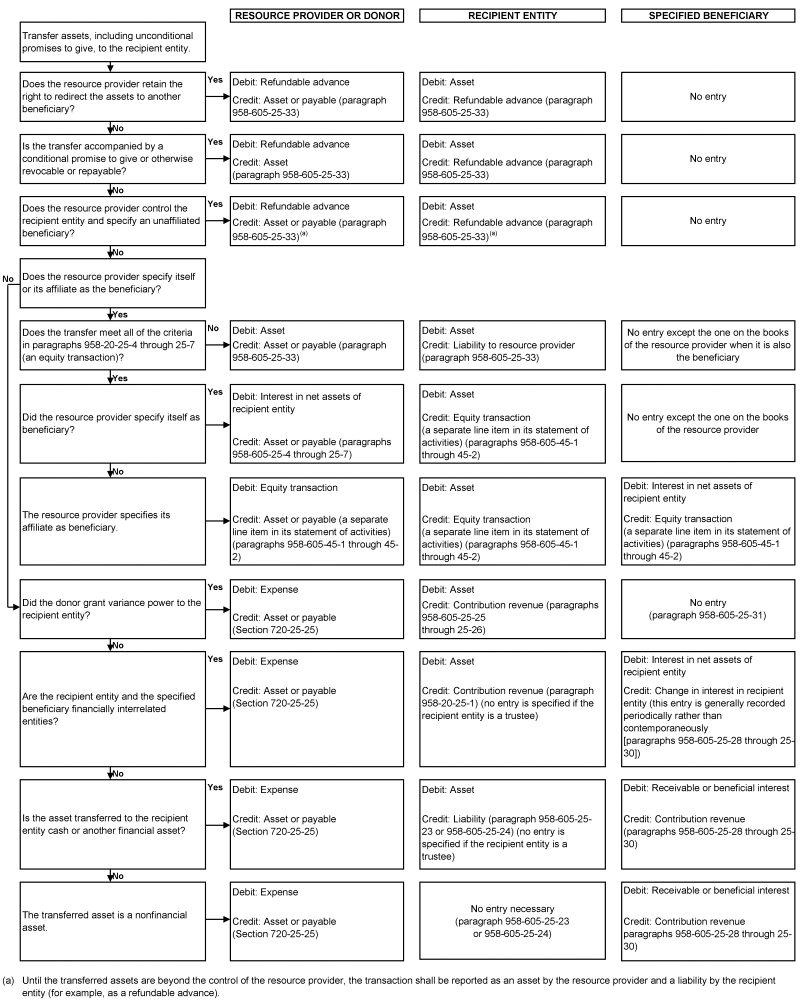 RESOURCE PROVIDER OR DONOR RECIPIENT ENTITY SPECIFIED BENEFICIARY "Transfer assets, including unconditional promises to give, to the recipient entity." Does the resource provider retain the right to redirect the assets to another beneficiary? Yes Debit: Refundable advance Debit: Asset No entry Credit: Asset or payable (paragraph 958-605-25-33) Credit: Refundable advance (paragraph 958-605-25-33) No Is the transfer accompanied by a conditional promise to give or otherwise revocable or repayable? Yes Debit: Refundable advance Debit: Asset No entry "Credit: Asset (paragraph 958-605-25-33)" Credit: Refundable advance (paragraph 958-605-25-33) No Does the resource provider control the recipient entity and specify an unaffiliated beneficiary? Yes Debit: Refundable advance Debit: Asset No entry Credit: Asset or payable (paragraph 958-605-25-33)(a) Credit: Refundable advance (paragraph 958-605-25-33)(a) No " No" Does the resource provider control the recipient entity and specify an unaffiliated beneficiary? Yes Does the transfer meet all of the criteria in paragraphs 958-605-25-4 through 25-7 (an equity transaction)? Yes Debit: Asset Debit: Asset No entry except the one on the books of the resource provider when it is also the beneficiary "Credit: Asset or payable (paragraph 958-605-25-33) " Credit: Liability to resource provider (paragraph 958-605-25-33) Yes Did the resource provider specify itself as beneficiary? Yes Debit: Interest in net assets of recipient entity Debit: Asset No entry except the one on the books of the resource provider "Credit: Equity transaction (a separate line item in its statement of activities) (paragraphs 958-605-45-1 through 45-2)" Credit: Asset or payable (paragraphs 958-605-25-4 through 25-7) No The resource provider specifies its affiliate as beneficiary. Debit: Equity transaction Debit: Asset Debit: Interest in net assets of recipient entity Credit: Credit: Asset or payable (a separate line item in its statement of activities) (paragraphs 958-605-45-1 through 45-2) "Credit: Equity transaction (a separate line item in its statement of activities) (paragraphs 958-605-45-1 through 45-2)" "Credit: Equity transaction (a separate line item in its statement of activities) (paragraphs 958-605-45-1 through 45-2)" Did the donor grant variance power to the recipient entity? Yes Debit: Expense Debit: Asset "No entry (paragraph 958-605-25-31)" "Credit: Asset or payable (Section 720-25-25)" "Credit: Contribution revenue (paragraphs 958-605-25-25 through 25-26)" No Are the recipient entity and the specified beneficiary financially interrelated entities? Yes Debit: Expense Debit: Asset Debit: Interest in net assets of recipient entity "Credit: Asset or payable (Section 720-25-25)" Credit: Contribution revenue (paragraph 958-20-25-1) (no entry is specified if the recipient entity is a trustee) "Credit: Change in interest in recipient entity (this entry is generally recorded periodically rather than contemporaneously [paragraphs 958-605-25-28 through 25-30])" No Is the asset transferred to the recipient entity cash or another financial asset? Yes Debit: Expense Debit: Asset Debit: Receivable or beneficial interest "Credit: Asset or payable (Section 720-25-25)" Credit: Liability (paragraph 958-605-25-23 or 958-605-25-24) (no entry is specified if the recipient entity is a trustee) Credit: Contribution revenue (paragraphs 958-605-25-28 through 25-30) No The transferred asset is a nonfinancial asset. Debit: Expense "No entry necessary (paragraph 958-605-25-23 or 958-605-25-24)" Debit: Receivable or beneficial interest "Credit: Asset or payable (Section 720-25-25)" Credit: Contribution revenue paragraphs 958-605-25-28 through 25-30) (a) "Until the transferred assets are beyond the control of the resource provider, the transaction shall be reported as an asset by the resource provider and a liability by the recipient entity (for example, as a refundable advance)."
Discretion to determine the timing of the distribution to the specified beneficiary, by itself, does not give the recipient entity discretion sufficient to recognize a contribution. That limited discretion is not sufficient. The ability to choose a payment date does not relieve an entity from its obligation to pay.
A recipient entity has discretion sufficient to recognize a contribution received if it can choose the beneficiaries of the assets. For example, if a recipient receives cash that it must disburse to any who meet guidelines specified by a resource provider or return the cash, those receipts may be deposits held by the recipient as an agent rather than contributions received as a donee. Similarly, if a recipient receives cash that it must disburse to individuals identified by a resource provider or return the cash, neither the receipt nor the disbursement is a contribution for the agent, trustee, or intermediary. In contrast, if a resource provider allows the recipient to establish, define, and carry out the programs that disburse the cash, products, or services to the recipient's beneficiaries, the recipient generally is involved in receiving and making contributions.
Thus, if a donor uses broad generalizations to describe beneficiaries or to indicate a field of interest, such as Midwestern flood victims, homeless individuals, or teenaged children, the recipient entity has the ability to choose the beneficiaries of the assets and is a donee. Similarly, the recipient entity has the ability to choose the beneficiaries if neither the language used by the donor nor the representations of the recipient entity cause the donor to believe that it can direct the gift to a specified beneficiary. For example, a recipient entity might request that a donor indicate a not-for-profit entity (NFP) that best serves the needs of the community and tell the donor that the information will be considered by the allocation committee when it makes its distributions to NFPs in the community. If that request is conveyed in a manner that leads a donor to reasonably conclude that its role is merely to propose a possible allocation, the recipient entity has the discretion to choose the beneficiary of the assets.
Conversely, if that request is conveyed in a manner that creates a donor's reasonable expectation that the gift will be used for the benefit of or will be transferred to the indicated beneficiary, the recipient entity does not have discretion to choose the beneficiary unless the donor explicitly grants variance power. (See the following paragraph and paragraph 958-605-25-25.) A donor may specify the beneficiary by name, by stating that all entities that meet a set of donor-defined criteria are beneficiaries, or by actions surrounding the transfer that make clear the identity of the beneficiary, such as by responding to a request from a recipient entity that exists to raise assets for the beneficiary.
A recipient entity may obtain the power to redirect the use of assets transferred to it through various means, including standard provisions in donor-choice forms or explicit donor stipulation in gift instruments. For example, a community foundation may obtain the unilateral power to redirect the use of assets transferred to them through explicit reference to the variance power granted to them by donors in written gift instruments. The variance power may be explicitly referred to in the terms of the gift instrument and further explained in the community foundation's declaration of trust, articles of incorporation, or governing instruments.
This Example illustrates the guidance in paragraphs . Not-for-Profit Entity A (NFP A) receives relief supplies from Individual with instructions to deliver the supplies to specified third-party beneficiaries. NFP A accepts responsibility for delivering those supplies because it has a distribution network and a mutual interest in serving the needs of the specified beneficiaries. NFP A has no discretion in determining the parties to be benefited; it must deliver the resources to the specified beneficiaries. Receipt of those goods is not a contribution received to NFP A, nor is the delivery of those goods to the beneficiaries a contribution made by NFP A. Rather, a contribution of goods is made by Individual and received by the third-party beneficiaries.
This Example illustrates the guidance in paragraph 958-605-25-23. Not-for-Profit Entity B (NFP B) develops and maintains a list of lawyers and law firms that are interested in providing services without charge to charitable organizations and certain individuals. NFP B encourages individuals in need of free legal services to contact NFP B for referral to lawyers in the individual's community that may be willing to serve them. The decision about whether and how to serve a specific individual rests with the lawyer. Under those circumstances, NFP B merely acts as an intermediary in bringing together a willing donor and donee. The free legal services are not a contribution received by NFP B.
This Example illustrates the guidance in paragraphs .
Federated Fundraising Organization D provides three choices to donors in its annual workplace campaign. Donors can give without restriction, direct their gifts to one of four community needs identified by Federated Fundraising Organization D, or specify that their gifts be transferred to an NFP of their choice. The campaign literature informs donors that if they choose to specify an NFP to which their gift should be transferred, the NFP must be a social welfare organization within the community that has tax-exempt status under Internal Revenue Code Section 501(c)(3). The campaign literature also provides a schedule of the administrative fees that will be deducted from all gifts that are to be transferred to the donor's chosen beneficiary.
Federated Fundraising Organization D would recognize the following transactions:
- aIt would recognize the fair values of the gifts without donor restrictions as contribution revenue that increases net assets without donor restrictions.
- bIt would recognize the fair values of the gifts targeted to the four specified community needs as contribution revenue that increases net assets with donor restrictions.
- cIt would recognize the fair values of gifts that are to be transferred to beneficiaries chosen by the donors as increases in its assets and as liabilities to those specified beneficiaries (see paragraph 958-605-25-24).
- dIt would recognize as revenue the administrative fees withheld from amounts to be transferred to the donors' chosen beneficiary.
The beneficiaries chosen by the donors would recognize the fair value of the transferred assets as contribution revenue in accordance with the provisions of paragraph 958-605-45-6 for unconditional promises to give. Thus, the revenue would increase net assets with donor restrictions or net assets without donor restrictions, depending on the existence or absence of donor-imposed restrictions. For example, if a donor specified that the transferred assets must be maintained in perpetuity, the revenue would increase net assets with donor restrictions. However, if the donor specified that the transferred assets are for current-period use, the revenue would increase net assets without donor restrictions. In accordance with paragraph 958-220-45-14, the beneficiaries would report the gross amounts of the gifts as contribution revenue and the administrative fees withheld by Federated Fundraising Organization D as expenses. The net amount would be recognized as a receivable (see paragraph 958-605-25-28).
Instead of conducting the campaign as described in this Example, Federated Fundraising Organization D's campaign literature, including the form that donors use to specify a beneficiary, clearly states that if donors choose to give and specify a beneficiary, the allocation committee has the authority to redirect their gifts if the committee perceives needs elsewhere in the community that are greater. By giving under those terms, donors explicitly grant Federated Fundraising Organization D variance power. Thus, Federated Fundraising Organization D would recognize as contribution revenue without donor-imposed restrictions (see paragraph 958-605-25-25), and the specified beneficiaries would be precluded from recognizing their potential for future distributions from the assets (see paragraph 958-605-25-31).
This Example illustrates the guidance in paragraphs .
The governing board of City Botanical Society E decides to raise funds to build an endowment. The governing board signs an agreement to establish a fund at Community Foundation F. Community Foundation F and City Botanical Society E are not financially interrelated entities. City Botanical Society E solicits gifts to the fund. The campaign materials inform donors that the endowment will be owned and held by Community Foundation F. The materials explain that the gifts will be invested and that the return from their investment will be distributed to City Botanical Society E, subject to Community Foundation F's spending policy and to Community Foundation F's right to redirect the return to another beneficiary without the approval of the donor, City Botanical Society E, or any other party if distributions to City Botanical Society E become unnecessary, impossible, or inconsistent with the needs of the community. The donor-response card also clearly describes Community Foundation F's right to redirect the return of the fund. The campaign materials indicate that donors should send their contributions to Community Foundation F using a preaddressed envelope included for that purpose.
Community Foundation F would recognize the fair value of gifts received as assets and as contribution revenue. The donors explicitly granted variance power by using a donor-response card that clearly states that gifts are subject to Community Foundation F's unilateral power to redirect the return to another beneficiary (see paragraph 958-605-25-25).
City Botanical Society E is precluded from recognizing its potential rights to the assets held by Community Foundation F because the donors explicitly granted variance power (see paragraph 958-605-25-31). City Botanical Society E would recognize only its annual grants from Community Foundation F as contributions.
Whether a donor intended to make a contribution to Community Foundation F may not be clear if the donor responds to the campaign materials by sending a contribution and the donor-response card directly to City Botanical Society E. City Botanical Society E could resolve the ambiguity by a review of the facts and circumstances surrounding the gift, communications with the donor, or both. If it is ultimately determined that the donor intended to make a gift to the fund owned and held by Community Foundation F and to explicitly grant variance power, City Botanical Society E would be an agent responsible for transferring that gift to Community Foundation F (see paragraph 958-605-25-24).
This Example illustrates the guidance in paragraph 958-605-25-23.
Local Church G transfers cash to Seminary H and instructs Seminary H to use the money to grant a scholarship to Individual, who is a parishioner of Local Church G.
Seminary H would recognize the cash and a liability to Individual in the same amount because it merely is facilitating the cash transfer from Local Church G to Individual (see paragraph 958-605-25-23).
This Example illustrates the guidance in paragraph 958-605-15-9.
Individual transfers assets to National Bank J to establish an irrevocable charitable trust for the sole benefit of Museum I. National Bank J will serve as trustee. Individual sets forth in the trust agreement the policies that direct the economic activities of the trust. The trust term is five years. Each year, the income received on the investments of the trust will be distributed to Museum I. At the end of Year 5, the corpus of the trust (original assets and net appreciation on those assets) will be paid to Museum I.
The Contribution Received Subsections of this Subtopic do not establish standards for the trustee, National Bank J (see paragraph 958-605-15-9). Because Museum I is unable to influence the operating or financial decisions of the trustee, Museum I and National Bank are not financially interrelated entities. Therefore, Museum I would recognize its asset (a beneficial interest in the trust) and contribution revenue that increases net assets with donor restrictions (see paragraph 958-605-35-3). Museum I would measure its beneficial interest at fair value. That value generally can be measured by the fair value of the assets contributed to the trust.
This Example illustrates the guidance in paragraph 958-20-15-2.
Some foundations and associations raise contributions for a large number of unaffiliated NFPs, often referred to as member organizations. By virtue of their numbers, those member organizations generally do not individually influence the operating and financial decisions of the foundation (or association). Thus, any one member organization and the foundation (or association) are not financially interrelated entities (see paragraph 958-20-15-2[a]). Because the entities are not financially interrelated, the foundation (or association) recognizes a liability if a donor to the foundation (or association) specifies that the gift should be transferred to a particular member organization (see paragraph 958-605-25-4). The specified member organization would recognize a receivable and contribution revenue that increases net assets with donor restrictions or net assets without donor restrictions, depending on the existence or absence of donor-imposed restrictions.
This Example illustrates the guidance in paragraph 958-605-25-4.
Individual transfers a car to Federated Fundraising Organization K and requests that the car be transferred to Local Daycare Center L. Individual specifies that Federated Fundraising Organization K may use the car for one year before transferring it to Local Daycare Center L. Local Daycare Center L is a member organization of Federated Fundraising Organization K, but that status does not confer any ability to actively participate in the policymaking processes of Federated Fundraising Organization K.
Because Federated Fundraising Organization K and Local Daycare Center L are not financially interrelated entities, Federated Fundraising Organization K would recognize the car as an asset and a liability to Local Daycare Center L if its policy were to recognize nonfinancial assets; otherwise, it would recognize neither the nonfinancial assets nor a liability (see paragraph 958-605-25-24).
If, instead of refusing the gift of the use of the car, Federated Fundraising Organization K decides to use it for a year before transferring it to Local Daycare Center L, Federated Fundraising Organization K would recognize the fair value of the gift of one-year's use of the car in accordance with paragraph 958-605-30-2. The use of a car is a contributed asset and not a contributed service.
Local Daycare Center L would recognize a receivable and contribution revenue that increases net assets with donor restrictions (see paragraph 958-605-25-30). It would measure the contribution received at the fair value of the car; however, if Federated Fundraising Organization L chooses to use the car for a year before transferring it, the fair value would be reduced accordingly.
This Example illustrates the guidance in paragraph 958-605-25-33.
Symphony Orchestra M receives a large gift without donor restrictions of securities from Individual. Because it has no investment expertise, Symphony Orchestra M transfers the securities to Community Foundation N to establish an endowment fund. The agreement between Symphony Orchestra M and Community Foundation N states that the transfer is irrevocable and that the transferred assets will not be returned to Symphony Orchestra M. However, Community Foundation N will make annual distributions of the income earned on the endowment fund, subject to Community Foundation N's spending policy. The agreement also permits Community Foundation N to substitute another beneficiary in the place of Symphony Orchestra M if Symphony Orchestra M ceases to exist or if the governing board of Community Foundation N votes that support of Symphony Orchestra M either is no longer necessary or is inconsistent with the needs of the community. (That is, Symphony Orchestra M explicitly grants variance power to Community Foundation N.) The agreement does not permit either entity to appoint members to the other entity's governing board or otherwise participate in the policymaking processes of the other.
Community Foundation N would recognize the fair value of the transferred securities as an increase in investments and a liability to Symphony Orchestra M because Symphony Orchestra M transferred assets to Community Foundation N and specified itself as beneficiary (see paragraph 958-605-25-33(d)). The transfer is not an equity transaction because Community Foundation N and Symphony Orchestra M are not financially interrelated entities (see paragraph 958-20-25-4(b)). Symphony Orchestra M is unable to influence the operating or financial decisions of Community Foundation N (see paragraph 958-20-15-2(a)).
Symphony Orchestra M would recognize the fair value of the gift of securities from Individual as contribution revenue. When it transfers the securities to Community Foundation N, it would recognize the transfer as a decrease in investments and an increase in an asset, for example, as a beneficial interest in assets held by Community Foundation N (see paragraph 958-605-25-33(d)). Also, Symphony Orchestra M would disclose in its financial statements the identity of Community Foundation N, the terms under which Community Foundation N will distribute amounts to Symphony Orchestra M, a description of the variance power granted to Community Foundation N, and the aggregate amount reported in the statement of financial position and how that amount is described (see paragraph 958-605-50-6).
If a resource provider transfers assets to a recipient entity and specifies itself or its affiliate as the beneficiary, a presumption that the transfer is reciprocal, and therefore not a contribution, is necessary even if the resource provider explicitly grants the recipient entity variance power. Thus, Symphony Orchestra M would recognize an asset and Community Foundation N would recognize a liability because the transaction is deemed to be reciprocal. Symphony Orchestra M transfers its securities to Community Foundation N in exchange for future distributions. Community Foundation N, by its acceptance of the transfer, agrees that at the time of the transfer distributions to Symphony Orchestra M are capable of fulfillment and consistent with the foundation's mission. Although the fair value of those future distributions may not be commensurate with the fair value of the securities given up (because Symphony Orchestra M is at risk of cessation of the distributions), the transaction is accounted for as though those values are commensurate. In comparison, the donors to Community Foundation F in Example 5 (see paragraph 958-605-55-88) explicitly grant variance power to Community Foundation F in a nonreciprocal transfer. In that Example, it is clear that the donors have made a contribution because they retain no beneficial interests in the transferred assets. Because the donors in that Example explicitly grant variance power to Community Foundation F, it, rather than City Botanical Society E, is the recipient of that contribution.
This Example illustrates the guidance in paragraph 958-605-25-33.
The governing board of Private Elementary School O creates a foundation to hold and manage the school's investments. It transfers its investment portfolio to the newly created PES Foundation P. An agreement between Private Elementary School O and PES Foundation P allows the school to request distributions from both the original investments and the return on those investments, subject to approval by the governing board of PES Foundation P, which will not be unreasonably withheld. The agreement also permits Private Elementary School O to transfer additional investments in the future.
PES Foundation P would recognize the fair value of the investments as assets and a liability to Private Elementary School O because Private Elementary School O transferred assets to PES Foundation P and specified itself as beneficiary (see paragraph 958-605-25-33[d]). The transfer of assets is not an equity transaction because Private Elementary School O expects repayment of the transferred assets, and thus the transaction does not meet the criterion in paragraph 958-20-25-4(c).
Private Elementary School O would decrease its investments and recognize another asset, for example, a beneficial interest in assets held by PES Foundation P (see paragraph 958-605-25-33[d]). Also, Private Elementary School O would disclose in its financial statements the identity of PES Foundation P, the terms of the agreement under which it can receive future distributions, including the fact that the distributions are not subject to variance power, and the aggregate amount reported in the statement of financial position and how that amount is described (see paragraph 958-605-50-6).
See Subtopic 958-20 if Private Elementary School O and PES Foundation P are financially interrelated entities.
Text as published in the FASB Accounting Standards Codification, Basic View.