ASC

ASC 958-30

Split-Interest Agreements

958 Not-for-Profit Entities

Source downloaded: .Record version 4919c0e0fb68. Effective date must be checked in the source.

ASC 958-30 governs how a not-for-profit entity accounts for split-interest agreements—trusts or similar arrangements (charitable lead/remainder annuity trusts and unitrusts, charitable gift annuities, pooled income funds) in which the NFP shares the benefits of donated assets with other, usually non-charitable, beneficiaries. Revocable agreements are treated as intentions to give (assets recorded as a refundable advance); irrevocable agreements are recognized on execution at fair value, with contribution revenue equal to the assets received less the fair value of the obligation to other beneficiaries. When a third party holds the assets, the NFP instead recognizes a beneficial interest at fair value, and the liability side of period-certain, variable-payment agreements may contain a bifurcable embedded derivative under Topic 815.

Key points (7)
  • Revocable split-interest agreements are accounted for as intentions to give: assets received as trustee are recognized at fair value with an offsetting refundable advance, and contribution revenue is recognized only when the agreement becomes irrevocable or the assets are distributed for the NFP's unconditional use (958-30-25-2; 958-30-30-3).
  • For an irrevocable agreement naming the NFP trustee or fiscal agent and absent donor-imposed conditions, the NFP recognizes assets at fair value, a liability for future payments to other beneficiaries at fair value (often the present value of future payments), and contribution revenue for the difference, all at execution (958-30-25-4; 958-30-25-6; 958-30-30-4 through 30-8).
  • A liability that is solely life-contingent qualifies for the exception in 815-10-15-52 through 15-57 and is outside Topic 815, but a liability with variable payments over a period-certain generally contains an embedded derivative that must be bifurcated under 815-15-25-1 unless a fair value election is made (958-30-25-8 through 25-14; 958-30-55-8 through 55-29).
  • For pooled income funds and net income unitrusts, assets are recognized at fair value when received, the remainder interest is recognized as contribution revenue, and the difference is deferred revenue for the discount for future interest, amortized as a change in the value of split-interest agreements (958-30-25-15; 958-30-30-10; 958-30-35-9).
  • When a third party controls the assets, the NFP recognizes a beneficial interest asset and contribution revenue at fair value when notified—unless the trustee has variance power or the NFP's rights are conditional—remeasures it at fair value through the statement of activities, and records no liability (958-30-25-16 through 25-19; 958-30-30-11; 958-30-35-10).
  • If the fair value option is not elected, the liability is remeasured only for amortization of the discount and revaluations based on changes in life expectancy and other actuarial assumptions, and the discount rate is not revised after initial recognition (958-30-35-6; 958-30-35-7); on termination the accounts are closed and residual amounts recognized as changes in the value of split-interest agreements (958-30-40-1).
  • Contribution revenue is classified as an increase in net assets with donor restrictions unless the NFP has the immediate unrestricted right to use the assets; a charitable gift annuity contribution is unrestricted only if the donor imposes no restriction and no law or agreement requires the assets to be invested until the income beneficiary's death (958-30-45-1; 958-30-45-2).

For students. Exam questions usually turn on two switches: who controls the assets (NFP as trustee vs. third-party trustee, which decides liability vs. beneficial-interest accounting) and whether the payments are fixed/life-contingent or variable/period-certain (which decides embedded derivative bifurcation). The common misunderstanding is treating the full amount of assets received as contribution revenue—revenue is only the net contribution portion after deducting the fair value of the obligation to the other beneficiaries.

Machine-generated study aid for ASC 958-30. Check the source paragraphs below.

958-30-00Status

Source downloaded: .Record version 9ce279581303. Effective date must be checked in the source.

958-30-00-1
The following table identifies the changes made to this Subtopic.
Paragraph Action Accounting Standards Update Date
Board-Designated Endowment Fund Amended Accounting Standards Update No. 2016-14 08/18/2016
Board-Designated Net Assets Added Accounting Standards Update No. 2016-14 08/18/2016
Conditional Contribution Added Accounting Standards Update No. 2018-08 06/21/2018
Contribution Amended Accounting Standards Update No. 2018-08 06/21/2018
Contribution Amended Accounting Standards Update No. 2010-07 01/28/2010
Donor-Imposed Condition Amended Accounting Standards Update No. 2018-08 06/21/2018
Donor-Imposed Restriction Added Accounting Standards Update No. 2016-14 08/18/2016
Donor-Restricted Endowment Fund Added Accounting Standards Update No. 2016-14 08/18/2016
Donor-Restricted Support Added Accounting Standards Update No. 2016-14 08/18/2016
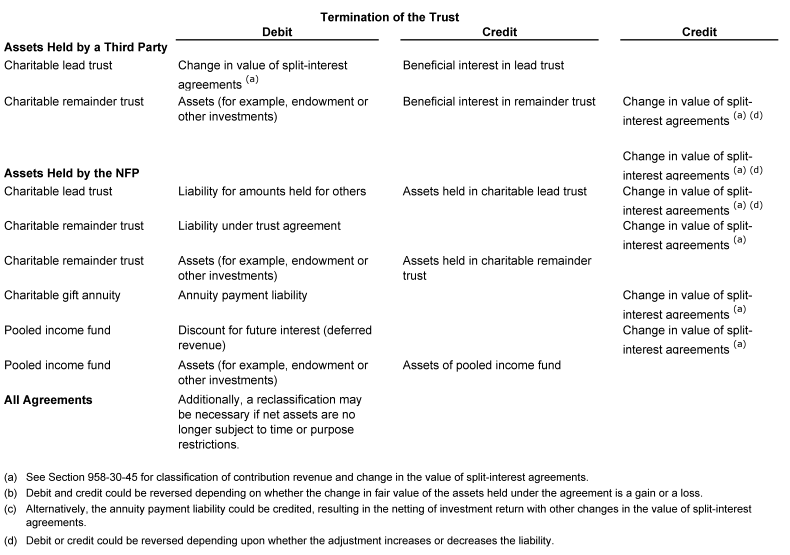
Endowment Fund Amended Accounting Standards Update No. 2016-14 08/18/2016
Funds Functioning as Endowment Added Accounting Standards Update No. 2016-14 08/18/2016
Net Assets Added Accounting Standards Update No. 2016-14 08/18/2016
Net Assets with Donor Restrictions Added Accounting Standards Update No. 2016-14 08/18/2016
Net Assets without Donor Restrictions Added Accounting Standards Update No. 2016-14 08/18/2016
Permanent Endowment Superseded Accounting Standards Update No. 2016-14 08/18/2016
Permanently Restricted Net Assets Superseded Accounting Standards Update No. 2016-14 08/18/2016
Promise to Give Added Accounting Standards Update No. 2018-08 06/21/2018
Reclassification of Net Assets Added Accounting Standards Update No. 2016-14 08/18/2016
Restricted Support Superseded Accounting Standards Update No. 2016-14 08/18/2016
Temporarily Restricted Net Assets Superseded Accounting Standards Update No. 2016-14 08/18/2016
Temporary Restriction Superseded Accounting Standards Update No. 2016-14 08/18/2016
Unrestricted Net Assets Superseded Accounting Standards Update No. 2016-14 08/18/2016
Unrestricted Support Superseded Accounting Standards Update No. 2016-14 08/18/2016
958-30-25-2 Amended Accounting Standards Update No. 2016-01 01/05/2016
958-30-25-4 Amended Accounting Standards Update No. 2016-01 01/05/2016
958-30-25-17 Amended Accounting Standards Update No. 2012-04 10/01/2012
958-30-35-4 Amended Accounting Standards Update No. 2016-01 01/05/2016
958-30-35-11 Amended Accounting Standards Update No. 2016-01 01/05/2016
Amended Accounting Standards Update No. 2016-14 08/18/2016
958-30-45-6 Amended Maintenance Update 2020-18 (PDF) 11/25/2020
958-30-45-7 Amended Maintenance Update 2020-18 (PDF) 11/25/2020
958-30-45-7 Amended Accounting Standards Update No. 2016-14 08/18/2016
958-30-50-1 Amended Accounting Standards Update No. 2018-13 08/28/2018
958-30-50-1 Amended Accounting Standards Update No. 2012-04 10/01/2012
958-30-50-1 Amended Accounting Standards Update No. 2011-04 05/12/2011
958-30-50-2 Amended Accounting Standards Update No. 2016-14 08/18/2016
958-30-50-3 Amended Accounting Standards Update No. 2016-14 08/18/2016
958-30-55-4 Amended Accounting Standards Update No. 2016-14 08/18/2016
958-30-55-5 Superseded Accounting Standards Update No. 2016-14 08/18/2016
958-30-55-30 Amended Accounting Standards Update No. 2016-14 08/18/2016

958-30-05Overview and Background

Source downloaded: .Record version db1f4163f9ee. Effective date must be checked in the source.

958-30-05-1
This Subtopic provides guidance for reporting arrangements under which a not-for-profit entity (NFP) shares the benefits of assets with other beneficiaries (a split-interest agreement). Those other beneficiaries generally are not NFPs. For example, a donor may give an NFP the right to receive all or a portion of the specified cash flows from a charitable trust or other identifiable pool of assets that is held either by the NFP or by an unrelated third party (such as a bank, trust company, foundation, or private individual).
958-30-05-2
If the NFP shares the cash flows with another beneficiary, that agreement is subject to the guidance in this Subtopic.
958-30-05-3
If the NFP controls the rights to all of the specified cash flows from the trust or other identifiable pool of assets, the agreement is subject to the guidance in paragraphs .

General Structure

958-30-05-4
Split-interest agreements are agreements in which donors enter into trusts or other arrangements under which an NFP receives benefits that are shared with other beneficiaries that generally are not NFPs. A typical split-interest agreement has the following two components:
  1. a
  2. b
958-30-05-5
The lead interest is the right to the benefits (cash flows or use) of assets during the term of the split-interest agreement, which generally starts upon the signing of the agreement and terminates at either of the following times:
  1. a
    After a specified number of years (period-certain)
  2. b
    Upon the occurrence of a certain event, commonly either the death of the donor or the death of the lead interest beneficiary (life-contingent).
The remainder interest is the right to receive all or a portion of the assets of a split-interest agreement remaining at the end of the agreement's term.
958-30-05-7
The terms of some agreements do not allow donors to revoke their gifts; other agreements may be revocable by donors in certain situations. This Subtopic addresses the accounting for both revocable and irrevocable split-interest agreements.
958-30-05-8
The donor may transfer the assets to an unrelated third party (such as a bank, trust company, foundation, or private individual) or may give the NFP the right to control the contributed assets by either of the following:
  1. a
    Naming the NFP as trustee of the trust holding the assets
  2. b
    Granting the NFP the right to hold the assets as general assets of the entity.
This Subtopic addresses the accounting for all of those situations.

Charitable Lead Annuity Trusts and Lead Unitrusts

958-30-05-9
Assets such as cash or shares of stock are contributed by the donor either to the control of the NFP through its role as trustee of a trust holding the assets or to a third-party trustee. The NFP receives periodic cash payments (the lead interest) that are either a fixed dollar amount (an annuity trust) or a specified percentage of the fair value of the assets as of the beginning of each period (a unitrust). Some of the assets may need to be liquidated to make the required payments. At the termination of the agreement, the remaining assets revert to the donor or the donor's beneficiary (the remainder interest).

Charitable Remainder Annuity Trusts and Remainder Unitrusts

958-30-05-10
Assets such as cash or shares of stock are contributed by the donor either to the control of the NFP through its role as trustee of a trust holding the assets or to a third-party trustee. The NFP (or the trust) makes periodic payments to the donor or the donor's beneficiary that are either a fixed dollar amount (an annuity trust) or a specified percentage of the fair value of the assets during the term of the agreement (a unitrust). Some of the assets may need to be liquidated to make the payments. At the termination of the agreement, the remaining assets revert to the NFP.

Charitable Gift Annuities

958-30-05-11
A charitable gift annuity is an arrangement between a donor and an NFP in which the donor contributes assets to the NFP in exchange for a promise by the NFP to pay a fixed amount for a specified period of time to the donor or to individuals or entities designated by the donor. The agreements are similar to charitable remainder annuity trusts except that no trust exists, the assets received are held as general assets of the NFP, and the annuity liability is a general obligation of the NFP.

Pooled Income Fund

958-30-05-12
Some NFPs form, invest, and manage pooled income funds. These funds are divided into units, and contributions of many donors' life income gifts are pooled and invested as a group.

958-30-15Scope and Scope Exceptions

Source downloaded: .Record version 542f3cfd51c6. Effective date must be checked in the source.

Overall Guidance

958-30-15-1
This Subtopic follows the same Scope and Scope Exceptions as outlined in the Overall Subtopic, see Section 958-10-15.

958-30-25Recognition

Source downloaded: .Record version c40c3102a970. Effective date must be checked in the source.

958-30-25-1
This Section provides recognition guidance for two types of split-interest agreements:
  1. a
    Revocable agreements
  2. b
    Irrevocable agreements.

Revocable Agreements

958-30-25-2
Revocable split-interest agreements shall be accounted for as intentions to give. Assets received by a not-for-profit entity (NFP) acting as a trustee under a revocable split-interest agreement shall be recognized when received as assets and as a refundable advance. If those assets are investments, they shall be recognized in conformity with Section 958-320-25, 958-321-25, or 958-325-25, as appropriate. Contribution revenue for the assets received shall be recognized when the agreement becomes irrevocable or when the assets are distributed to the NFP for its unconditional use, whichever occurs first.

Irrevocable Agreements

958-30-25-3
Under irrevocable split-interest agreements the assets contributed by the donor may be either:
  1. a
    Held by an NFP
  2. b
    Held by a third party.
958-30-25-4
In the absence of donor-imposed conditions, an NFP shall recognize contribution revenue and related assets and liabilities when an irrevocable split-interest agreement naming it trustee or fiscal agent is executed. Assets received under those agreements shall be recorded when received. If those assets are investments, they shall be recognized in conformity with Section 958-320-25, 958-321-25, or 958-325-25, as appropriate. The contribution portion of the agreement (that is, the part that represents the unconditional transfer of assets in a voluntary nonreciprocal transaction) shall be recognized as revenue or gain (see paragraph 958-30-45-7).
958-30-25-5
Paragraphs provide guidance on the following types of donor agreements:
  1. a
    Split-interest agreements other than pooled income funds or net income unitrusts
  2. b
    Pooled income funds or net income unitrusts.
958-30-25-6
If the split-interest agreement is other than a pooled income fund or net income unitrust (for example, a charitable gift annuity, a charitable lead trust, or a charitable remainder trust), the transferred assets, or a portion of those assets, are being held for the benefit of others, such as the donor or third parties designated by the donor. A liability for the future payments to be made to those other beneficiaries shall also be recognized at the date of initial recognition. See paragraphs to determine whether the agreement contains an embedded derivative.
958-30-25-7
The following two aspects of a split-interest agreement's payment terms affect the accounting treatment for an NFP's liability for the payment or payments to the donor or the donor's beneficiary:
  1. a
    Whether the payments are a fixed or variable cash amount
  2. b
    Whether the agreement is period-certain or life-contingent.
958-30-25-8
An NFP's liability for its obligation to the donor or the donor's beneficiary under an irrevocable split-interest agreement shall be analyzed to determine whether it qualifies for the exception in paragraphs , in which case that liability would not be subject to the requirements of Topic 815. For example, if the obligation is solely life-contingent (that is, contingent upon the survival of an identified individual, in which case the payments are made only if the individual is alive when the payments are due), that obligation would qualify for the exception in paragraphs .
958-30-25-9
If an NFP's liability for its obligation under the split-interest agreement does not qualify for the exception in paragraphs because the agreement is not solely life-contingent, the NFP shall determine whether that liability meets the definition of a derivative instrument in its entirety under paragraph 815-10-15-83 or whether it contains an embedded derivative that could warrant separate accounting under paragraph 815-15-25-1 unless a fair value election is made pursuant to Section 815-15-25.
958-30-25-10
The NFP's liability for its obligation under a split-interest agreement would typically not meet the definition of a derivative instrument in its entirety because it would not meet the criterion in paragraph 815-10-15-83(b) that requires the contract to have no initial net investment or an initial net investment that is smaller than would be required for other types of contracts that would be expected to have a similar response to changes in market factors. In contrast, the initial net investment for the liability recognized for typical split-interest agreements is its fair value.
958-30-25-11
If an NFP's liability for its obligation under the split-interest agreement does not in its entirety meet the definition of a derivative instrument in paragraph 815-10-15-83, that liability shall be analyzed to determine whether it contains provisions that constitute an embedded derivative that warrants separate accounting under paragraph 815-15-25-1.
958-30-25-12
Generally, the liability representing an obligation under a split-interest agreement contains an embedded derivative if the payments are variable and the agreement is period-certain (rather than life-contingent). The embedded derivative shall be bifurcated and accounted for as a derivative instrument pursuant to the requirements of paragraph 815-15-25-1 unless a fair value election is made pursuant to Section 815-15-25 or the Fair Value Option Subsections of Subtopic 825-10.
958-30-25-13
Example 2, Cases A through H (see paragraphs ) illustrate the applicability of paragraphs to various split-interest agreements that are invested in shares of common stock.
958-30-25-14
Other split-interest agreements may involve the gift of corporate or U.S. government debt securities, or other securities that are not equity. In determining whether or not those split-interest agreements contain an embedded derivative, the same analysis outlined in paragraph 815-15-25-1 shall be applied. The notion of clearly and closely related, as defined in paragraph 815-15-25-1(a), shall involve an assessment of the economic characteristics and risks associated with the nonequity securities in relation to the economic characteristics and risks of the NFP's debt host contract. Generally, because of the differences in credit risk, the change in the fair value of corporate bonds (based on that corporation's credit and interest rate risk) will not be clearly and closely related to the change in the economic characteristics and risks of the NFP's debt host contract. Thus, an embedded derivative requiring bifurcation and separate accounting for the embedded derivative would exist unless a fair value election is made pursuant to Section 815-15-25 or the Fair Value Option Subsections of Subtopic 825-10.
958-30-25-15
The assets received from the donor under a pooled income fund agreement or a net income unitrust shall be recognized when received. An NFP also shall recognize its remainder interest in the assets received as contribution revenue in the period in which the assets are received from the donor. The difference between the assets recognized and the revenue recognized shall be recorded as deferred revenue, representing the amount of the discount for future interest.
958-30-25-16
Some NFPs are parties to split-interest agreements that involve a third party who maintains control of the donor's contributed assets. In a split-interest agreement in which cash or other assets contributed by a donor are held by an independent trustee (such as a charitable trust for which a bank, trust company, foundation, or private individual is the trustee) or by another fiscal agent of the donor or the cash or other assets are otherwise not controlled by the NFP, the NFP shall recognize its beneficial interest in those assets.
958-30-25-17
Pursuant to paragraphs , if an NFP is the beneficiary of a split-interest agreement held by a third party and has an unconditional right to receive all or a portion of the specified cash flows from the assets held pursuant to that agreement, the NFP shall recognize that beneficial interest as an asset and contribution revenue. That asset and contribution revenue represents its entitlement to the lead interest payments or the remainder interest, as stipulated in the agreement. The contribution shall be recognized when the NFP is notified of the split-interest agreement's existence.
958-30-25-18
However, if the trustee or fiscal agent has variance power to redirect the benefits to another entity or if the NFP's rights to the benefits are conditional, the NFP shall not recognize its potential for future distributions from the split-interest agreement until the NFP has an unconditional right to receive benefits under the agreement.
958-30-25-19
The NFP does not have an obligation to pay either the remainder or lead interest to the designated beneficiary, as that responsibility remains with the third party who maintains control of the assets (thus, the NFP does not recognize a liability). Further, under paragraph 815-15-25-1, the embedded derivative would not be bifurcated, as the criterion in paragraph 815-15-25-1(b) is not met.

958-30-30Initial Measurement

Source downloaded: .Record version 5fcc72c8c42b. Effective date must be checked in the source.

Fair Value Measurement

958-30-30-1
Topic 820 establishes a framework for measuring fair value. This Subtopic uses present value techniques as one possible technique to measure the contribution revenue and obligation to other beneficiaries of a split-interest agreement. See paragraphs for implementation guidance for using present value techniques if the measurement objective is fair value. Other valuation techniques are also available, as discussed in Section 820-10-35.
958-30-30-2
This Section provides initial measurement guidance for the two types of split-interest agreements:
  1. a
    Revocable agreements
  2. b
    Irrevocable agreements.

Revocable Agreements

958-30-30-3
Assets received by a not-for-profit entity (NFP) acting as a trustee under a revocable split-interest agreement shall be recognized at fair value.

Irrevocable Agreements

958-30-30-4
If the NFP serves as trustee or if the assets contributed by the donor are otherwise under the control of the NFP, cash and other assets received under split-interest agreements shall be recognized at fair value at the date of initial recognition. Further, in accordance with paragraph 958-605-30-2, contributions shall be measured at fair value at the date of initial recognition of a split-interest agreement.
958-30-30-5
If the split-interest agreement is other than a pooled income fund or net income unitrust (for example, a charitable gift annuity, a charitable lead trust, or a charitable remainder trust), the transferred assets, or a portion of those assets, are being held for the benefit of others, such as the donor or third parties designated by the donor. That liability shall be measured at fair value at the date of initial recognition. If present value techniques are used to measure fair value, the liability is measured at the present value of the future payments to be made to the other beneficiaries.
958-30-30-6
Any present value technique for measuring the fair value of the contribution or payments to be made to other beneficiaries shall consider the elements described in paragraph 820-10-55-5, including the following:
  1. a
    The estimated return on the invested assets during the expected term of the agreement
  2. b
    The contractual payment obligations under the agreement
  3. c
    A discount rate commensurate with the risks involved.
958-30-30-7
Under a lead interest agreement, the fair value of the contribution can be estimated directly based on the present value of the future distributions to be received by the NFP as a beneficiary. Under lead interest agreements, the future payments to be made to other beneficiaries will be made by the NFP only after the NFP receives its benefits. In those situations, the present value of the future payments to be made to other beneficiaries may be estimated by the fair value of the assets contributed by the donor under the agreement less the fair value of the benefits to be received by the NFP. If present value techniques are used, the fair value of the benefits to be received by the NFP shall be measured at the present value of the benefits to be received over the expected term of the agreement.
958-30-30-8
Under remainder interest agreements, the present value of the future payments to be made to other beneficiaries can be estimated directly based on the terms of the agreement. Future distributions will be received by the NFP only after obligations to other beneficiaries are satisfied. In those cases, the fair value of the contribution may be estimated based on the fair value of the assets contributed by the donor less the fair value of the payments to be made to other beneficiaries.
958-30-30-9
Pursuant to Section 815-15-30, an embedded derivative in an obligation for future payments to be made to other beneficiaries shall be measured at fair value. Alternatively, an NFP that serves as a trustee or fiscal agent can irrevocably elect to measure the entire obligation at fair value pursuant to Section 815-15-25 or the Fair Value Option Subsections of Subtopic 825-10.
958-30-30-10
The contributed assets received from the donor under a pooled income fund agreement or a net income unitrust shall be recognized at fair value. The contribution shall be measured at fair value. Present value techniques are one valuation technique for measuring the fair value of the contribution; other valuation techniques are also available, as described in Topic 820. If present value techniques are used, the contribution may be measured at the fair value of the assets to be received, discounted for the estimated time period until the donor's death.
958-30-30-11
Pursuant to paragraph 958-605-30-14, if an NFP is the beneficiary of a split-interest agreement held by a third party and has an unconditional right to receive all or a portion of the specified cash flows from the assets held pursuant to that agreement, the NFP shall measure its beneficial interest at fair value.

958-30-35Subsequent Measurement

Source downloaded: .Record version 1cdffee8e231. Effective date must be checked in the source.

Fair Value Measurement

958-30-35-1
Topic 820 establishes a framework for measuring fair value. This Subtopic uses present value techniques as one possible technique to measure the obligation to other beneficiaries of a split-interest agreement. See paragraphs for implementation guidance for using present value techniques if the measurement objective is fair value.
958-30-35-2
The measurement objective is fair value for the following split-interest obligations:
  1. a
    Embedded derivatives subject to the measurement provisions of Topic 815
  2. b
    Obligations for which the not-for-profit entity (NFP) elects the fair value option pursuant to the Fair Value Option Subsections of Subtopic 825-10
  3. c
    Obligations containing embedded derivatives that the NFP has irrevocably elected to measure in their entirety at fair value in conformity with Section 815-15-25.
Additionally, in circumstances in which cash or other assets contributed by donors under split-interest agreements are held by independent trustees, such as a charitable trust for which a bank is a trustee, or by other fiscal agents of the donors or otherwise not controlled by the NFP, the measurement objective for the beneficial interest in periods after the period of initial recognition is fair value.
958-30-35-3
In circumstances in which the fair value is measured at the present value of the future cash flows, all elements discussed in paragraph 820-10-55-5, including discount rate assumptions, shall be revised at each measurement date to reflect current market conditions.

Irrevocable Agreements

958-30-35-4
Assets held by the NFP under irrevocable split-interest agreements as investments shall be subsequently measured in conformity with Section 958-320-35, 958-321-35, or 958-325-35.
958-30-35-5
In addition, if assets and related liabilities are recognized under a split-interest agreement other than a pooled income fund or net income unitrust (for example, a charitable gift annuity, charitable lead trust, or charitable remainder trust agreement) for which an NFP serves as a trustee or fiscal agent, the following shall be reported in the NFP's statements of financial position, activities, and cash flows:
  1. a
    Income earned on those assets
  2. b
    Gains and losses
  3. c
    Distributions made to other beneficiaries under the agreements.
Those transactions generally are recognized as either an increase or a reduction in the liability to the other beneficiaries. For example, in subsequent periods, payments to an annuity beneficiary reduce the annuity liability.
958-30-35-6
During the term of the agreement, the following adjustments to the liability shall be recognized as changes in the value of split-interest agreements in a statement of activities. In circumstances in which assets held in trust and related liabilities are recognized under lead and remainder interest agreements for which an NFP serves as a trustee or fiscal agent, the liability for future payments to be made to other beneficiaries is measured at fair value if the NFP elects the fair value option as described in paragraph 958-30-35-2. If the NFP does not elect the fair value option, the following transactions and events shall be included in the remeasurement of the liability:
  1. a
    Amortization of the discount associated with the contribution
  2. b
    Revaluations of future payments to beneficiaries, based on changes in life expectancy, and other actuarial assumptions.
In conformity with paragraph 310-10-30-6, unless the measurement objective for periods after the period of initial recognition is fair value, the discount rate shall not be revised after initial recognition.
958-30-35-7
If an NFP does not elect to report a split-interest obligation at fair value as described in paragraph 958-30-35-2, a split-interest obligation with an embedded derivative is bifurcated into its debt host contract and embedded derivative. The debt host contract is the liability for the payment to the beneficiary that would be required if the fair value of the trust assets does not change over the specified period. The embedded derivative represents the liability (or contraliability) for the increase (or decrease) in the payments to the beneficiary due to changes in the fair value of the trust assets over the specified period. In circumstances in which the liability is measured using present value techniques, the discount rate assumptions on the debt host contract shall not be revised after initial recognition, consistent with the preceding paragraph. In accordance with paragraph 815-10-35-1, the embedded derivative is subsequently measured at fair value. If the fair value of the embedded derivative is measured using present value techniques, all elements discussed in paragraph 820-10-55-5, including the discount rate assumptions on the embedded derivative, shall be revised at each measurement date to reflect current market conditions.
958-30-35-8
In conformity with paragraph 815-15-25-53, if an NFP cannot reliably identify and measure the embedded derivative, the entire split-interest liability shall be measured at fair value (that is, all elements discussed in paragraph 820-10-55-5, including discount rate assumptions, shall be revised to reflect current market conditions).
958-30-35-9
Periodic income on a pooled income fund or net-income unitrust and payments to the beneficiary shall be reflected as increases and decreases in a liability to the beneficiary. Amortization of the discount for future interest shall be recognized as a reduction in the deferred revenue account and as a change in the value of split-interest agreements.
958-30-35-10
Pursuant to paragraph 958-605-35-3, if an NFP is the beneficiary of a split-interest agreement held by a third party and has an unconditional right to receive all or a portion of the specified cash flows from the assets held pursuant to that agreement, the NFP shall subsequently remeasure that beneficial interest at fair value. Changes in the fair value of the beneficial interest shall be recognized in the statement of activities. The change in the value of split-interest agreements is the change in the fair value of the NFP's beneficial interest, which shall be determined using the same valuation technique that was used to measure the asset initially. Distributions from the trust shall be reflected as a reduction in the beneficial interest.

Revocable Agreements

958-30-35-11
Assets held by the NFP under revocable split-interest agreements as investments shall be subsequently measured in conformity with Section 958-320-35, 958-321-35, or 958-325-35.
958-30-35-12
Income earned on assets held under such agreements that is not available for the NFP's unconditional use, and any subsequent adjustments to the carrying value of those assets, shall be recognized as adjustments to the assets and as refundable advances.

958-30-40Derecognition

Source downloaded: .Record version d83ceb92b7d1. Effective date must be checked in the source.

958-30-40-1
Upon termination of a split-interest agreement, asset and liability accounts related to the agreement shall be closed. Any remaining amounts in the asset or liability accounts shall be recognized as changes in the value of split-interest agreements.

958-30-45Other Presentation Matters

Source downloaded: .Record version 50f569b7471f. Effective date must be checked in the source.

Classification of Net Assets

958-30-45-1
Contribution revenues recognized under split-interest agreements shall be classified as increases in net assets with donor restrictions unlessthe donor gives the not-for-profit entity (NFP) the immediate right to use, without restrictions, the assets it receives, in which case the contribution shall be classified as an increase in net assets without donor restrictions.
  1. a
  2. b
958-30-45-2
Under many charitable gift annuity agreements, the assets received from the donor are held by the NFP as part of its general assets and are available for its general use. The contribution portion of a charitable gift annuity agreement shall be recognized as revenue without donor restrictions if both of the following criteria are met:
  1. a
    The donor does not restrict the use of the assets contributed to the NFP.
  2. b
    Neither the agreement nor laws and regulations require the assets received by the NFP to be invested until the income beneficiary's death. Additional annuity reserves required by state laws, as described in paragraph 958-30-50-2, do not create donor restrictions.
If either of those criteria is not met, the contribution shall be classified as donor-restricted support that increases net assets with donor restrictions and shall be reclassified as net assets without donor restrictions when donor-imposed restrictions or legal requirements are satisfied.
958-30-45-3
During the term of the agreement, transactions and events that are recognized as changes in the value of split-interest agreements in a statement of activities shall be classified as net assets with donor restrictions or net assets without donor restrictions, depending on the classification used when the contribution revenue was recognized initially.
958-30-45-4
Amounts shall be reclassified from net assets with donor restrictions to net assets without donor restrictions as distributions are received by the NFP under the terms of the split-interest agreement unless those assets are otherwise further restricted by the donor. In that case, they shall be reclassified to net assets without donor restrictions when the restrictions expire.
958-30-45-5
If assets previously distributed to the NFP become available for its general use upon termination of the split-interest agreement, a reclassification of net assets shall be made from net assets with donor restrictions to net assets without donor restrictions.

Presentation in the Statement of Financial Position

958-30-45-6
Assets and liabilities recognized under split-interest agreements shall be reported separately from other assets and liabilities in a statement of financial position if not disclosed in the related notes (see paragraph 958-30-50-1(b)).

Presentation in the Statement of Activities

958-30-45-7
Contribution revenue and changes in the value of split-interest agreements recognized under such agreements shall be reported as separate line items in a statement of activities if not disclosed in the related notes (see paragraph 958-30-50-1(e)). Paragraph 958-220-45-6 states that the classification of contributions received as revenues or gains depends on whether the transactions are part of the NFP's ongoing major or central activities (revenues) or are peripheral or incidental to the NFP (gains).

958-30-50Disclosure

Source downloaded: .Record version 6bd3db3c0765. Effective date must be checked in the source.

958-30-50-1
The notes to financial statements shall include all of the following disclosures related to split-interest agreements:
  1. a
    A description of the general terms of existing split-interest agreements
  2. b
    Assets and liabilities recognized under split-interest agreements, if not reported separately from other assets and liabilities in a statement of financial position
  3. c
    The basis used (for example, cost, lower of cost or fair value, fair value) for recognized assets
  4. d
    The discount rates and actuarial assumptions used, if present value techniques are used in reporting the assets and liabilities related to split-interest agreements
  5. e
    Contribution revenue recognized under such agreements, if not reported as a separate line item in a statement of activities
  6. f
    Changes in the value of split-interest agreements recognized, if not reported as a separate line item in a statement of activities
  7. g
    The disclosures required by the Fair Value Option Subsections of Subtopic 825-10, if a not-for-profit entity (NFP) elects the fair value option pursuant to paragraph 958-30-35-2(b) or 958-30-35-2(c)
  8. h
    The disclosures required by paragraphs and in the format described in paragraph 820-10-50-8, if the assets and liabilities of split-interest agreements are measured at fair value on a recurring basis in periods after initial recognition.
958-30-50-2
Additional annuity reserves may be required by the laws of the state where the NFP is located or by the state where the donor resides. Legally mandated reserves shall be disclosed in the notes to financial statements. If state law imposes other limitations on the NFP, such as limitations on the manner in which some net assets are invested, those limitations also shall be disclosed in the notes to financial statements.
958-30-50-3
In addition, some NFPs voluntarily set aside additional reserves for unexpected actuarial losses. Voluntary reserves shall be included as part of net assets without donor restrictions, but may be presented as a separate component of board-designated net assets on the face of the statement of financial position (see paragraph 958-210-55-3). If not provided on the face of that statement, the reserves set aside by the NFP's governing board shall be disclosed in the notes in accordance with paragraph 958-210-50-3 to disclose information about the amounts and purposes of board designations of net assets without donor restrictions.

958-30-55Implementation Guidance and Illustrations

Source downloaded: .Record version 976926615246. Effective date must be checked in the source.

958-30-55-1
This Section, which is an integral part of the requirements of this Subtopic, provides general guidance to be used in the recognition of split-interest agreements, particularly those with embedded derivatives.

Illustrations

958-30-55-2
This Example illustrates the guidance in Sections 958-30-25 and 958-30-30 for initial recognition and measurement of a charitable remainder annuity trust.
958-30-55-3
Not-for-Profit Entity A (NFP A) receives $100,000 in cash from a donor under a charitable remainder annuity trust agreement designating NFP A as the trustee and charitable remainder beneficiary—a donee. The terms of the trust agreement require that NFP A, as trustee, invest the trust assets and pay $5,000 each year to an annuitant (an income beneficiary specified by the donor) for the remainder of the annuitant's life. Upon death of the annuitant, NFP A may use its remainder interest for any purpose consistent with its mission.
958-30-55-4
NFP A, as a donee, would recognize the contribution received as revenue in the period the trust is established. The transfer is partially an exchange transaction—an agreement for annuity payments to a beneficiary over time—and partially a contribution. The contribution received by NFP A is the unconditional right to receive the remainder interest of the annuity trust. The amount of the contribution received by NFP A is the fair value of the trust assets ($100,000 cash transferred) less the fair value of the estimated annuity payments (which is the present value of $5,000 to be paid annually over the expected life of the annuitant if present value techniques are used to measure fair value). Because NFP A must invest the underlying donated assets until the annuitant's death, the revenue recognized for this type of contribution—donor-restricted support—should be distinguished from revenues from gifts that are reported in the net assets without donor restrictions category (see paragraph 958-605-45-3). The death of the annuitant determines when the required annuity payments cease and when the trust expires and effectively removes all restrictions on the net assets of NFP A (see paragraph 958-30-45-5).
958-30-55-6
The following Cases provide an understanding of the applicability of paragraphs to various split-interest agreements:
  1. a
    Remainder interest—period-certain, fixed payments (Case A)
  2. b
    Remainder interest—period-certain, variable payments (Case B)
  3. c
    Remainder interest—life-contingent, variable or fixed payments (Case C)
  4. d
    Remainder interest—period-certain-plus-life-contingent, fixed payments (Case D)
  5. e
    Remainder interest—period-certain-plus-life-contingent, variable payments (Case E)
  6. f
    Lead trust—period-certain, fixed or variable payments (Case F)
  7. g
    Lead trust—life-contingent, fixed or variable payments (Case G)
  8. h
    Lead trust—period-certain-plus-life-contingent, variable or fixed payments (Case H).
958-30-55-7
Shares of common stock are contributed to the control of an NFP which is required to pay the donor or the donor's beneficiary an annual fixed cash payment for 20 years, after which time the remaining shares revert to the NFP.
958-30-55-8
During the term of the agreement (20 years), the NFP has a liability that does not require bifurcation of an embedded derivative. Because the periodic cash payment is a fixed dollar amount, the liability has no underlying and, thus, does not meet the criterion in paragraph 815-10-15-83(a) of the definition of a derivative instrument. Because there is no underlying, there is also no embedded derivative that warrants separate accounting under paragraph 815-15-25-1.
958-30-55-9
Shares of common stock are contributed to the control of NFP, which is required to make 20 annual cash payments to the donor or the donor's beneficiary that are equal to a specified percentage of the fair value of the assets as of the beginning of each annual period (that is, a charitable remainder unitrust). After the 20 payments have been made, the remaining shares will revert to the NFP.
958-30-55-10
During the term of the agreement (20 years), the NFP has a liability that must be bifurcated because it contains an embedded derivative that warrants separate accounting unless a fair value election is made pursuant to Section 815-15-25 or Fair Value Option Subsections 825-10. Under paragraph 815-15-25-1, the liability represents a hybrid instrument that is composed of a debt host contract and an embedded equity-based derivative that is not clearly and closely related to the debt host contract and that would meet the definition of a derivative instrument if it were freestanding. That is, it meets all of the following criteria of paragraph 815-10-15-83:
  1. a
    It has an underlying (price of shares).
  2. b
    It has a notional amount (number of shares in the trust at the beginning of each annual period).
  3. c
    It satisfies the no-or-smaller initial net investment characteristic in paragraph 815-10-15-83(b).
  4. d
    It would meet the net settlement characteristic in paragraph 815-10-15-83(c) (because each annual payment is adjusted for the effect of the embedded equity-based derivative).
958-30-55-11
The debt host contract represents the liability for the series of 20 annual payments that would be required based on the assumption that the fair value of the common stock does not change over the 20-year period. The embedded equity-based derivative relates to the increase or decrease in each of the 20 annual payments due to changes in the fair value of the common stock.
958-30-55-12
Shares of common stock are contributed to the control of an NFP, which is required to make annual cash payments to the donor or the donor's beneficiary that are either a fixed dollar amount or a specified percentage of the fair value of the assets at the beginning of each annual period until the death of the donor or the donor's beneficiary, upon which time the remaining shares will revert to the NFP.
958-30-55-13
During the term of the agreement, the NFP has a liability that is not bifurcated because it is solely life-contingent and thus qualifies for the exception in paragraphs .
958-30-55-14
Shares of common stock are contributed to the control of an NFP, which is required to pay the donor or the donor's beneficiary an annual fixed cash payment for the longer of the beneficiary's remaining life or a specified period. The remaining shares then revert to the NFP.
958-30-55-15
During the term of the agreement, the NFP has a liability that, for purposes of applying Topic 815, must be analyzed as consisting of the following two separate liabilities:
  1. a
    A liability relating to the period-certain cash payments
  2. b
    A liability relating to the possible additional cash payments that are contingent upon the beneficiary living beyond the end of the period-certain payments.
958-30-55-16
The NFP's liability does not require the bifurcation of any embedded derivative because:
  1. a
    The portion of the liability related to the fixed period-certain payments has no underlying.
  2. b
    The portion of the liability related to the possible life-contingent payments qualifies for the exception in paragraphs .
958-30-55-17
Shares of common stock are contributed to the control of an NFP, which is required to pay the donor or the donor's beneficiary an annual cash payment equal to a specified percentage of the fair value of the assets at the beginning of each annual period for the greater of the beneficiary's remaining life or a specified period. The remaining assets revert to the NFP.
958-30-55-18
During the term of the agreement, the NFP has a liability that, for purposes of applying Topic 815, must be analyzed as consisting of the following two separate liabilities:
  1. a
    A liability relating to the period-certain cash payments
  2. b
    A liability relating to the possible additional cash payments that are contingent upon the beneficiary living beyond the end of the period-certain payments.
958-30-55-19
Paragraph 815-15-25-1 requires that the equity-based derivative instrument embedded in the portion of the liability related to the period-certain variable cash payments be bifurcated from a debt host contract (consistent with the analysis in Case B).
958-30-55-20
The equity-based derivative instrument embedded in the portion of the liability related to the possible life-contingent cash payments that can occur after the end of the specified period is not subject to Topic 815 because it qualifies for the exception in paragraphs .
958-30-55-21
An NFP receives cash from a donor, which is invested by the NFP in common equity securities. The donor designates the NFP as lead beneficiary. The NFP receives an annual cash payment of either a fixed amount or a specified percentage of the fair value of the investment amount at the beginning of each annual period for a specified period of time. After that time, the remaining assets revert to the donor or the donor's beneficiary.
958-30-55-22
During the term of the agreement, the NFP has a liability that must be bifurcated. Under paragraph 815-15-25-1, the liability represents a hybrid instrument that is composed of a debt host contract and an embedded equity-based derivative that is not clearly and closely related to the debt host contract and that would meet the definition of a derivative instrument if it were freestanding. That is, it meets all of the following criteria of paragraph 815-10-15-83:
  1. a
    It has an underlying (price of shares).
  2. b
    It has a notional amount (number of shares at the beginning of each annual period).
  3. c
    It satisfies the no-or-smaller initial net investment characteristic in paragraph 815-10-15-83(b).
  4. d
    It would meet the net settlement characteristic in paragraph 815-10-15-83(c).
958-30-55-23
Regardless of whether the lead interest payments are fixed or variable, the value of the liability representing the remainder interest—the assets remaining at the end of the agreement that will be paid to the donor or the donor's beneficiary—is affected by changes in the equity value, thus requiring the embedded equity-based derivative to be bifurcated from the host contract unless a fair value election is made pursuant to Section 815-15-25 or the Fair Value Option Subsections of Subtopic 825-10.
958-30-55-24
An NFP receives cash from a donor, which is invested by the NFP in common equity securities. The donor designates the NFP as lead beneficiary. The NFP receives an annual cash payment of either a fixed dollar amount or a specified percentage of the fair value of the investment amount at the beginning of each annual period until the death of the donor or the donor's beneficiary, at which time the remaining assets revert to the donor or the donor's beneficiary.
958-30-55-25
During the term of the agreement, the NFP has a liability that is not subject to Topic 815 because the remainder interest liability relates to a single payment whose amount and timing is life-contingent and thus qualifies for the exception in paragraphs .
958-30-55-26
An NFP receives cash from a donor, which is invested by the NFP in common equity securities. The donor designates the NFP as lead beneficiary. The NFP receives an annual cash payment for either a specified percentage of the fair value of the assets at the beginning of each annual period or a fixed dollar amount. That cash payment is made for the greater of the beneficiary's (or the donor's) remaining life or a specified period. After that time, the remaining assets revert to the donor or the donor's beneficiary.
958-30-55-27
During the term of the agreement, the NFP has a liability that is not subject to Topic 815 because, unlike the liability in Case E the period-certain aspect of the liability cannot be separated from the life-contingent aspect of the liability (because there is only one payment whose timing and value are affected by mortality risk). Thus, the remainder interest liability relates to a single payment whose amount and timing is life-contingent and thus qualifies for the exception in paragraphs .
958-30-55-28
If payment occurs only when the beneficiary (or donor) is alive, such as in an agreement in which the period is for the lesser of the beneficiary's (donor's) remaining life or a specified period, then every payment is life-contingent and qualifies for the exception in paragraphs .
958-30-55-29
If during the terms of a greater-of-period-certain-or-life-contingent agreement, the beneficiary dies before the end of the period-certain terms in the agreement, that change in circumstance eliminates the life-contingent aspect of the contract. Thus, the agreement is now only a period-certain agreement and mirrors the agreement outlined in Case F requiring bifurcation of the embedded derivative.
958-30-55-30
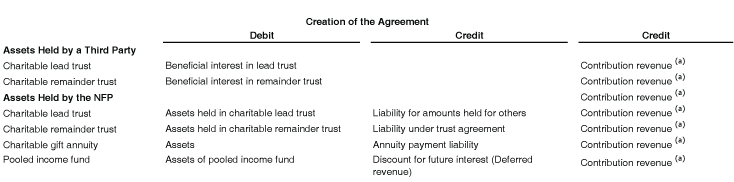
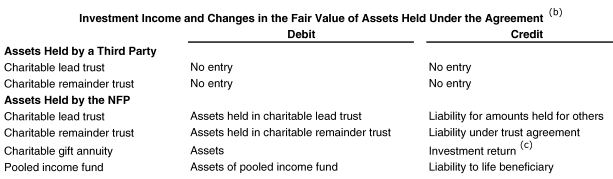
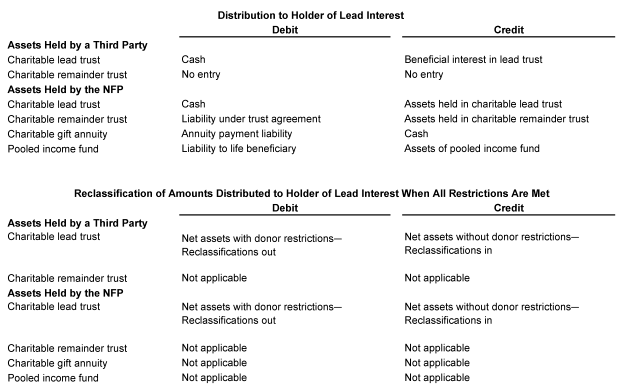
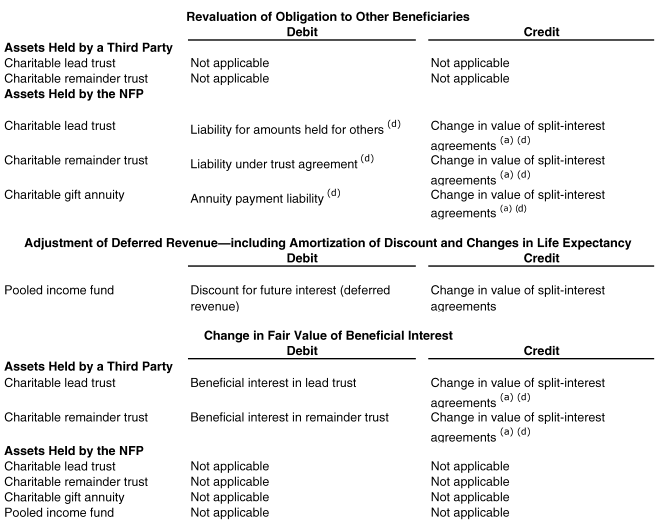
This Example provides the following journal entries related to the guidance in Sections 958-30-25, 958-30-35, and 958-30-40.
  • Creation of the Agreement Debit Credit Credit Assets Held by a Third Party Charitable lead trust Beneficial interest in lead trust Contribution revenue (a) Charitable remainder trust Beneficial interest in remainder trust Contribution revenue (a) Assets Held by the NFP Contribution revenue (a) Charitable lead trust Assets held in charitable lead trust Liability for amounts held for others Contribution revenue (a) Charitable remainder trust Assets held in charitable remainder trust Liability under trust agreement Contribution revenue (a) Charitable gift annuity Assets Annuity payment liability Contribution revenue (a) Pooled income fund Assets of pooled income fund Discount for future interest (Deferred revenue) Contribution revenue (a)
  • Investment Income and Changes in the Fair Value of Assets Held Under the Agreement (b) Debit Credit Assets Held by a Third Party Charitable lead trust No entry No entry Charitable remainder trust No entry No entry Assets Held by the NFP Charitable lead trust Assets held in charitable lead trust Liability for amounts held for others Charitable remainder trust Assets held in charitable remainder trust Liability under trust agreement Charitable gift annuity Assets Investment return (c) Pooled income fund Assets of pooled income fund Liability to life beneficiary
  • Distribution to Holder of Lead Interest Debit Credit Assets Held by a Third Party Charitable lead trust Cash Beneficial interest in lead trust Charitable remainder trust No entry No entry Assets Held by the NFP Charitable lead trust Cash Assets held in charitable lead trust Charitable remainder trust Liability under trust agreement Assets held in charitable remainder trust Charitable gift annuity Annuity payment liability Cash Pooled income fund Liability to life beneficiary Assets of pooled income fund Reclassification of Amounts Distributed to Holder of Lead Interest When All Restrictions Are Met Debit Credit Assets Held by a Third Party Charitable lead trust Net assets with donor restrictions— Reclassifications out "Net assets without donor restrictions— Reclassifications in" Charitable remainder trust Not applicable Not applicable Assets Held by the NFP Charitable lead trust Net assets with donor restrictions— Reclassifications out "Net assets without donor restrictions— Reclassifications in" Charitable remainder trust Not applicable Not applicable Charitable gift annuity Not applicable Not applicable Pooled income fund Not applicable Not applicable
  • Revaluation of Obligation to Other Beneficiaries Debit Credit Assets Held by a Third Party Charitable lead trust Not applicable Not applicable Charitable remainder trust Not applicable Not applicable Assets Held by the NFP Charitable lead trust Liability for amounts held for others (d) "Change in value of split-interest agreements (a) (d)" Charitable remainder trust Liability under trust agreement (d) "Change in value of split-interest agreements (a) (d)" Charitable gift annuity Annuity payment liability (d) "Change in value of split-interest agreements (a) (d)" Adjustment of Deferred Revenue—including Amortization of Discount and Changes in Life Expectancy Debit Credit Pooled income fund Discount for future interest (deferred revenue) Change in value of split-interest agreements Change in Fair Value of Beneficial Interest Debit Credit Assets Held by a Third Party Charitable lead trust Beneficial interest in lead trust "Change in value of split-interest agreements (a) (d)" Charitable remainder trust Beneficial interest in remainder trust "Change in value of split-interest agreements (a) (d)" Assets Held by the NFP Charitable lead trust Not applicable Not applicable Charitable remainder trust Not applicable Not applicable Charitable gift annuity Not applicable Not applicable Pooled income fund Not applicable Not applicable
  • Termination of the Trust Debit Credit Credit Assets Held by a Third Party Charitable lead trust Change in value of split-interest agreements (a) Beneficial interest in lead trust Charitable remainder trust "Assets (for example, endowment or other investments)" Beneficial interest in remainder trust Change in value of split-interest agreements (a) (d) Assets Held by the NFP Change in value of split-interest agreements (a) (d) Charitable lead trust Liability for amounts held for others Assets held in charitable lead trust Change in value of split-interest agreements (a) (d) Charitable remainder trust Liability under trust agreement Change in value of split-interest agreements (a) Charitable remainder trust "Assets (for example, endowment or other investments)" Assets held in charitable remainder trust Charitable gift annuity Annuity payment liability Change in value of split-interest agreements (a) Pooled income fund Discount for future interest (deferred revenue) Change in value of split-interest agreements (a) Pooled income fund "Assets (for example, endowment or other investments)" Assets of pooled income fund All Agreements "Additionally, a reclassification may be necessary if net assets are no longer subject to time or purpose restrictions." (a) See Section 958-30-45 for classification of contribution revenue and change in the value of split-interest agreements. (b) Debit and credit could be reversed depending on whether the change in fair value of the assets held under the agreement is a gain or a loss. (c) "Alternatively, the annuity payment liability could be credited, resulting in the netting of investment return with other changes in the value of split-interest agreements." (d) Debit or credit could be reversed depending upon the whether the adjustment increases or decreases the liability.

Related subtopics