ASC 274-10
Overall
274 Personal Financial Statements
Source downloaded: .Record version 131ef8564b70. Effective date must be checked in the source.
ASC 274-10 governs personal financial statements prepared for an individual, a married couple, or a family. The core rule is that assets are presented at their estimated current values and liabilities at their estimated current amounts on the accrual basis (274-10-25-1; 274-10-35-1), with a provision for estimated income taxes on the difference between those amounts and the related tax bases (274-10-35-15). The required statement is a statement of financial condition ending in net worth; a statement of changes in net worth and comparative statements are optional (274-10-45-4, 45-5).
Key points (7)
- Assets and liabilities are recognized on the accrual basis and presented at estimated current values/amounts at the statement date, using methods applied consistently from period to period (274-10-25-1, 274-10-35-1, 274-10-35-3).
- Receivables are presented at the discounted amount expected to be collected, and payables/other liabilities at the discounted amount of cash to be paid using the rate implicit in the transaction (or a lower current settlement amount if the debt can be discharged for less) (274-10-35-4, 274-10-35-12).
- Marketable securities are valued at quoted market prices (closing price, or within the bid-asked range if not traded that day), with possible adjustments for large blocks, control, or transfer restrictions; life insurance is carried at cash value less policy loans (274-10-35-5 through 35-9).
- Nonforfeitable rights to receive fixed or determinable amounts not contingent on life expectancy or future service (e.g., vested pension interests, annuities, beneficial interests in trusts) are presented as assets at discounted amounts; mirror criteria apply to noncancellable commitments as liabilities (274-10-35-11, 274-10-35-13, 274-10-55-7).
- A provision for estimated income taxes is computed as if all assets had been realized and all liabilities liquidated at the statement date, and is presented between liabilities and net worth (274-10-35-15, 274-10-45-12).
- Assets and liabilities are listed by order of liquidity and maturity without current/noncurrent classification; the net investment in a business entity (not its individual assets and liabilities) is shown in one amount if marketable as a going concern (274-10-45-7, 45-9, 45-11).
- Required disclosures include the individuals covered, valuation methods and changes therein, joint ownership arrangements, concentrations in the investment portfolio, information about material closely held business investments, life insurance face amounts, and detailed tax information including carryforwards and current value/tax basis differences (274-10-50-2).
For students. Personal financial statements are the rare GAAP context where a full current-value (not historical cost) balance sheet is required, and the hypothetical tax provision sits between liabilities and net worth rather than in liabilities. A common mistake is combining a closely held business's assets and liabilities with personal items instead of showing a single net investment amount, or classifying items as current/noncurrent.
Machine-generated study aid for ASC 274-10. Check the source paragraphs below.
274-10-00Status
Source downloaded: .Record version 9940d9988ec8. Effective date must be checked in the source.
| Paragraph | Action | Accounting Standards Update | Date |
| 274-10-50-2 | Amended | Accounting Standards Update No. 2016-02 | 02/25/2016 |
| 274-10-55-11 | Amended | Accounting Standards Update No. 2015-10 | 06/12/2015 |
| 274-10-65-1 | Added | Accounting Standards Update No. 2015-10 | 06/12/2015 |
274-10-05Overview and Background
Source downloaded: .Record version 463bf95e499c. Effective date must be checked in the source.
Basis of Presentation of Personal Financial Statements
274-10-15Scope and Scope Exceptions
Source downloaded: .Record version 8d891eeee8b7. Effective date must be checked in the source.
Entities
- aAll individuals
- bAll groups of related individuals (families).
Other Considerations
274-10-25Recognition
Source downloaded: .Record version bcb49bcc5f94. Effective date must be checked in the source.
The Methods of Presentation
274-10-35Subsequent Measurement
Source downloaded: .Record version f3424db6038b. Effective date must be checked in the source.
Assets
- aThe rights are for fixed or determinable amounts.
- bThe rights are not contingent on the holder's life expectancy or the occurrence of a particular event, such as disability or death.
- cThe rights do not require future performance of service by the holder.
Liabilities
- aThe commitments are for fixed or determinable amounts.
- bThe commitments are not contingent on others' life expectancies or the occurrence of a particular event, such as disability or death.
- cThe commitments do not require future performance of service by others.
274-10-45Other Presentation Matters
Source downloaded: .Record version 3b43f9f94f02. Effective date must be checked in the source.
Reporting Entity
- aAn individual
- bA husband and wife
- cA family.
Form of Statements
- aA statement of financial condition. A statement of financial condition is the basic personal financial statement and shall present all of the following:
- 1Estimated current values of assets
- 2Estimated current amounts of liabilities
- 3Estimated income taxes on the differences between the estimated current values of assets and the estimated current amounts of liabilities and their tax bases
- 4Net worth at a specified date.
- 1
- bA statement of changes in net worth. The presentation of a statement of changes in net worth is optional.A statement of changes in net worth shall present all of the following:
- 1Major sources of increases in net worth, including any of the following:
- iIncome
- iiIncreases in the estimated current values of assets
- iiiDecreases in the estimated current amounts of liabilities
- ivDecreases in estimated income taxes on the differences between the estimated current values of assets and the estimated current amounts of liabilities and their tax bases.
- i
- 2Major sources of decreases in net worth, including any of the following:
- iExpenses
- iiDecreases in the estimated current values of assets
- iiiIncreases in the estimated current amounts of liabilities
- ivIncreases in estimated income taxes on the differences between the estimated current values of assets and the estimated current amounts of liabilities and their tax bases.
- i
- 1
Methods of Presentation
Closely Held Businesses
Certain Estimated Income Taxes
Adequate Disclosure
274-10-50Disclosure
Source downloaded: .Record version a537d8cd6766. Effective date must be checked in the source.
- a A clear indication of the individuals covered by the financial statements
- b That assets are presented at their estimated current values and liabilities are presented at their estimated current amounts
- c Either of the following:
- 1 The methods used in determining the estimated current values of major assets and the estimated current amounts of major liabilities
- 2 The methods used in determining the major categories of assets and liabilities.
- 1
- d Changes in item (c) methods from one period to the next
- e If assets held jointly by the person and by others are included in the statements, the nature of the joint ownership
- f If the person's investment portfolio is material in relation to his or her other assets and is concentrated in one or a few companies or industries, the names of the entities or industries and the estimated current values of the securities
- g If the person has a material investment in a closely held business, at least the following:
- 1 The name of the entity and the person's percentage of ownership
- 2 The nature of the business
- 3 Summarized financial information about assets, liabilities, and results of operations for the most recent year based on the financial statements of the business, including information about the basis of presentation (for example, generally accepted accounting principles, income tax basis, or cash basis) and any significant loss contingencies.
- 1
- h Descriptions of intangible assets and their estimated useful lives
- i The face amount of life insurance the individuals own
- j Nonforfeitable rights that do not have the characteristics discussed in paragraph 274-10-35-11, for example, pensions based on life expectancy
- k All of the following tax information:
- 1 The methods and assumptions used to compute the estimated income taxes on the differences between the estimated current values of assets and the estimated current amounts of liabilities and their tax bases
- 2 A statement that the provision will probably differ from the amounts of income taxes that might eventually be paid because those amounts are determined by the timing and the method of disposal, realization, or liquidation and the tax laws and regulations in effect at the time of disposal, realization, or liquidation
- 3 Unused operating loss and capital loss carryforwards
- 4 Other unused deductions and credits, with their expiration periods, if applicable
- 5 The differences between the estimated current values of major assets and the estimated current amounts of major liabilities or categories of assets and liabilities and their tax bases
- 6 The excess or deficit of the estimated current values of major assets or categories of assets over their tax bases.
- 1
- l Maturities, interest rates, collateral, and other pertinent details relating to receivables and debt
- m Noncancellable commitments that do not have the characteristics discussed in paragraph 274-10-35-13.
274-10-55Implementation Guidance and Illustrations
Source downloaded: .Record version b89d8bf861a9. Effective date must be checked in the source.
Implementation Guidance
- aThe capitalization of past or prospective earnings
- bThe use of liquidation values
- cThe adjustment of historical cost based on changes in a specific price index
- dThe use of appraisals
- eThe use of the discounted amounts of projected cash receipts and payments.
- aA multiple of earnings
- bLiquidation value
- cReproduction value
- dAppraisals
- eDiscounted amounts of projected cash receipts and payments
- fAdjustments of book value or cost of the person's share of the equity of the business.
- aSales of similar property in similar circumstances
- bThe discounted amounts of projected cash receipts and payments relating to the property or the net realizable value of the property, based on planned courses of action, including leaseholds whose current rental value exceeds the rent in the lease
- cAppraisals based on estimates of selling prices and selling costs obtained from independent real estate agents or brokers familiar with similar properties in similar locations
- dAppraisals used to obtain financing
- eAssessed value for property taxes, including consideration of the basis for such assessments and their relationship to market values in the area.
- aGuaranteed minimum portions of pensions
- bVested interests in pension or profit sharing plans
- cDeferred compensation contracts
- dBeneficial interests in trusts
- eRemainder interests in property subject to life estates
- fAnnuities
- gFixed amounts of alimony for a definite future period.
Illustrations
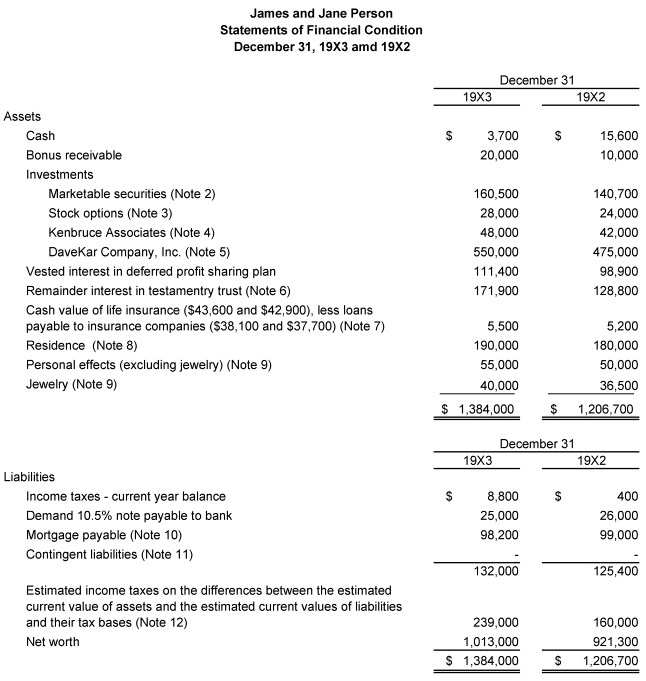 James and Jane Person Statements of Financial Condition "December 31, 19X3 amd 19X2" December 31 19X3 19X2 Assets Cash " $3,700 " " $15,600 " Bonus receivable " 20,000 " " 10,000 " Investments Marketable securities (Note 2) " 160,500 " " 140,700 " Stock options (Note 3) " 28,000 " " 24,000 " Kenbruce Associates (Note 4) " 48,000 " " 42,000 " "DaveKar Company, Inc. (Note 5)" " 550,000 " " 475,000 " Vested interest in deferred profit sharing plan " 111,400 " " 98,900 " Remainder interest in testamentry trust (Note 6) " 171,900 " " 128,800 " "Cash value of life insurance ($43,600 and $42,900), less loans payable to insurance companies ($38,100 and $37,700) (Note 7)" " 5,500 " " 5,200 " Residence (Note 8) " 190,000 " " 180,000 " Personal effects (excluding jewelry) (Note 9) " 55,000 " " 50,000 " Jewelry (Note 9) " 40,000 " " 36,500 " " $1,384,000 " " $1,206,700 " December 31 19X3 19X2 Liabilities Income taxes - current year balance " $8,800 " $400 Demand 10.5% note payable to bank " 25,000 " " 26,000 " Mortgage payable (Note 10) " 98,200 " " 99,000 " Contingent liabilities (Note 11) - - " 132,000 " " 125,400 " Estimated income taxes on the differences between the estimated current value of assets and the estimated current values of liabilities and their tax bases (Note 12) " 239,000 " " 160,000 " Net worth " 1,013,000 " " 921,300 " " $1,384,000 " " $1,206,700 "
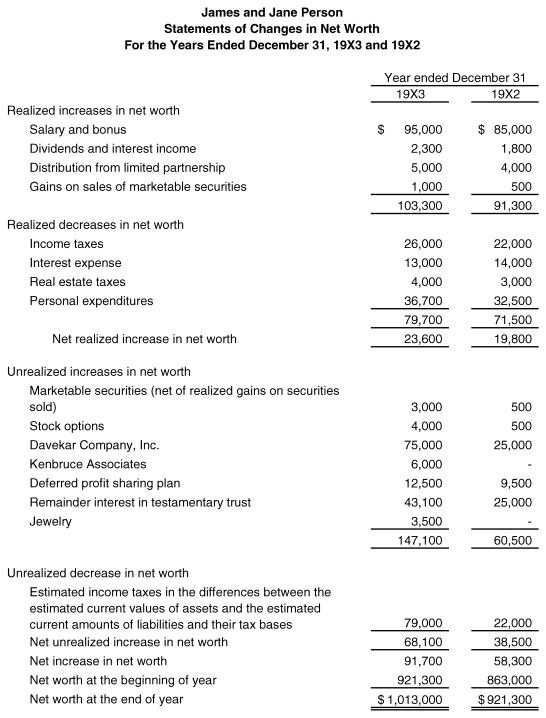 James and Jane Person Statements of Changes in Net Worth "For the Years Ended December 31, 19X3 and 19X2" Year ended December 31 19X3 19X2 Realized increases in net worth Salary and bonus " $95,000 " " $85,000 " Dividends and interest income " 2,300 " " 1,800 " Distribution from limited partnership " 5,000 " " 4,000 " Gains on sales of marketable securities " 1,000 " 500 " 103,300 " " 91,300 " Realized decreases in net worth Income taxes " 26,000 " " 22,000 " Interest expense " 13,000 " " 14,000 " Real estate taxes " 4,000 " " 3,000 " Personal expenditures " 36,700 " " 32,500 " " 79,700 " " 71,500 " Net realized increase in net worth " 23,600 " " 19,800 " Unrealized increases in net worth Marketable securities (net of realized gains on securities sold) " 3,000 " 500 Stock options " 4,000 " 500 "Davekar Company, Inc." " 75,000 " " 25,000 " Kenbruce Associates " 6,000 " - Deferred profit sharing plan " 12,500 " " 9,500 " Remainder interest in testamentary trust " 43,100 " " 25,000 " Jewelry " 3,500 " - " 147,100 " " 60,500 " Unrealized decrease in net worth Estimated income taxes in the differences between the estimated current values of assets and the estimated current amounts of liabilities and their tax bases " 79,000 " " 22,000 " Net unrealized increase in net worth " 68,100 " " 38,500 " Net increase in net worth " 91,700 " " 58,300 " Net worth at the beginning of year " 921,300 " " 863,000 " Net worth at the end of year " $1,013,000 " " $921,300 "
- James and Jane Person—Notes to Financial Statements
- NOTE 1. The accompanying financial statements include the assets and liabilities of James and Jane Person. Assets are stated at their estimated current values, and liabilities at their estimated current amounts.
- NOTE 2. The estimated current values of marketable securities are either (a) their quoted closing prices or (b) for securities not traded on the financial statement date, amounts that fall within the range of quoted bid and ask prices.
- Marketable securities consist of the following:
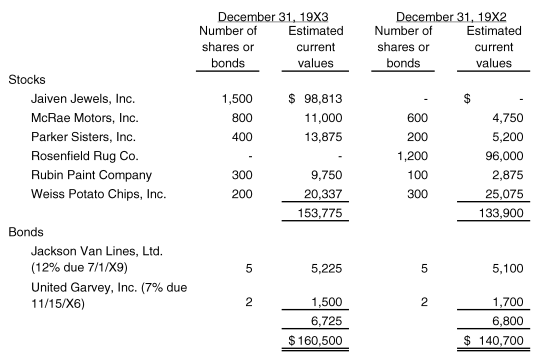 "December 31, 19X3" "December 31, 19X2" Number of shares or bonds Estimated current values Number of shares or bonds Estimated current values Stocks "Jaiven Jewels, Inc." " 1,500 " " $98,813 " - $- "McRae Motors, Inc." 800 " 11,000 " 600 " 4,750 " "Parker Sisters, Inc." 400 " 13,875 " 200 " 5,200 " Rosenfield Rug Co. - - " 1,200 " " 96,000 " Rubin Paint Company 300 " 9,750 " 100 " 2,875 " "Weiss Potato Chips, Inc." 200 " 20,337 " 300 " 25,075 " " 153,775 " " 133,900 " Bonds "Jackson Van Lines, Ltd. (12% due 7/1/X9)" 5 " 5,225 " 5 " 5,100 " "United Garvey, Inc. (7% due 11/15/X6)" 2 " 1,500 " 2 " 1,700 " " 6,725 " " 6,800 " " $160,500 " " $140,700 "
- NOTE 3. Jane Person owns options to acquire 4,000 shares of stock of Winner Corp. at an option price of $5 per share. The option expires on June 30, 19X5. The estimated current value its published selling price.
- NOTE 4. The investment in Kenbruce Associates is an 8 percent interest in a real estate limited partnership. The estimated current value is determined by the projected annual cash receipts and payments capitalized at a 12 percent rate.
- NOTE 5. James Person owns 50 percent of the common stock of Davekar Company, Inc. a retail mail order business. The estimated current value of the investment is determined by the provisions of a shareholders' agreement, which restricts the sale of the stock and, under certain conditions, requires the entity to repurchase the stock based on a price equal to the book value of the net assets plus an agreed amount for goodwill. At December 31, 19X3, the agreed amount for goodwill was $112,500, and at December 31, 19X2, it was $100,000.
- A condensed balance sheet of Davekar Company, Inc. prepared in conformity with generally accepted accounting principles, is summarized below:
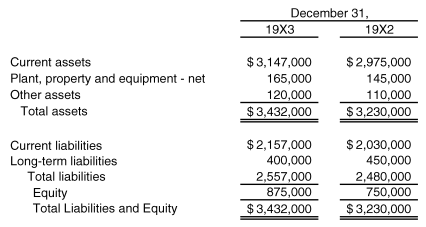 "December 31," 19X3 19X2 Current assets " $3,147,000 " " $2,975,000 " "Plant, property and equipment - net" " 165,000 " " 145,000 " Other assets " 120,000 " " 110,000 " Total assets " 3,432,000 " " 3,230,000 " Current liabilities " 2,157,000 " " 2,030,000 " Long-term liabilities " 400,000 " " 450,000 " Total liabilities " 2,557,000 " " 2,480,000 " Equity " 875,000 " " 750,000 " Total Liabilities and Equity " $3,432,000 " " $3,230,000 "
- The sales and net income for 19X3 were $10,500,000 and $125,000 and for 19X2 were $9,700,000 and $80,000.
- NOTE 6. Jane Person is the beneficiary of a remainder interest in a testamentary trust under the will of the late Joseph Jones. The amount included in the accompanying statements is her remainder interest in the estimated current value of the trust assets, discounted at 10 percent.
- NOTE 7. At December 31, 19X3 and 19X2, James Person owned a $300,000 whole life insurance policy.
- NOTE 8. The estimated current value of the residence is the appraised value based on an estimate of selling price, net of estimated selling costs obtained from an independent real estate agent familiar with similar properties in similar locations.
- NOTE 9. The estimated current values of personal effects and jewelry are the appraised values of those assets, determined by an independent appraiser for insurance purposes.
- NOTE 10. The mortgage (collateralized by the residence) is payable in monthly installments of $815 a month, including interest at 10 percent a year through 20Y8.
- NOTE 11. James Person has guaranteed the payment of loans of Davekar Company, Inc., under a $500,000 line of credit. The loan balance was $300,000 at December 31, 19X3, and $400,000 at December 31, 19X2.
- NOTE 12. The estimated current amounts of liabilities at December 31, 19X3, and December 31, 19X2, equaled their tax bases. Estimated income taxes have been provided on the excess of the estimated current values of assets over their tax bases as if the estimated current values of the assets had been realized on the statement date, using applicable tax laws and regulations. The provision will probably differ from the amounts of income taxes that eventually might be paid because those amounts are determined by the timing and the method of disposal or realization and the tax laws and regulations in effect at the time of disposal or realization.
- The estimated current values of assets exceeded their tax bases by $850,000 at December 31, 19X3, and by $770,300 at December 31, 19X2. The excess of estimated current values of major assets over their tax bases are:
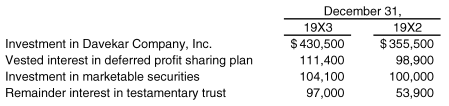 "December 31," 19X3 19X2 "Investment in Davekar Company, Inc." " $430,500 " " $355,500 " Vested interest in deferred profit sharing plan " 111,400 " " 98,900 " Investment in marketable securities " 104,100 " " 100,000 " Remainder interest in testamentary trust " 97,000 " " 53,900 "
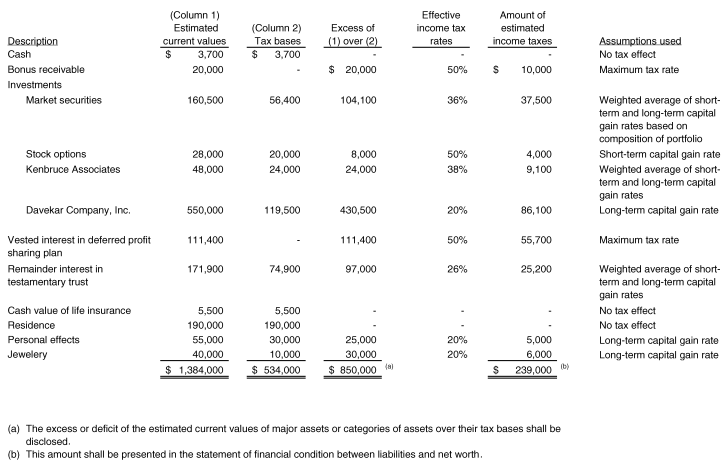 Description "(Column 1) Estimated current values" "(Column 2) Tax bases" Excess of (1) over (2) Effective income tax rates Amount of estimated income taxes Assumptions used Cash " $3,700 " " $3,700 " - - - No tax effect Bonus receivable " 20,000 " - " $20,000 " 50% " $10,000 " Maximum tax rate Investments Market securities " 160,500 " " 56,400 " " 104,100 " 36% " 37,500 " Weighted average of short-term and long-term capital gain rates based on composition of portfolio Stock options " 28,000 " " 20,000 " " 8,000 " 50% " 4,000 " Short-term capital gain rate Kenbruce Associates " 48,000 " " 24,000 " " 24,000 " 38% " 9,100 " Weighted average of short-term and long-term capital gain rates "Davekar Company, Inc." " 550,000 " " 119,500 " " 430,500 " 20% " 86,100 " Long-term capital gain rate Vested interest in deferred profit sharing plan " 111,400 " - " 111,400 " 50% " 55,700 " Maximum tax rate Remainder interest in testamentary trust " 171,900 " " 74,900 " " 97,000 " 26% " 25,200 " Weighted average of short-term and long-term capital gain rates Cash value of life insurance " 5,500 " " 5,500 " - - - No tax effect Residence " 190,000 " " 190,000 " - - - No tax effect Personal effects " 55,000 " " 30,000 " " 25,000 " 20% " 5,000 " Long-term capital gain rate Jewelery " 40,000 " " 10,000 " " 30,000 " 20% " 6,000 " Long-term capital gain rate " $1,384,000 " " $534,000 " " $850,000 " (a) " $239,000 " (b) (a) The excess or deficit of the estimated current values of major assets or categories of assets over their tax bases shall be disclosed (b) This amount shall be presented in the statement of financial condition between liabilities and net worth
274-10-65Transition and Open Effective Date Information
Source downloaded: .Record version 9cb83ea40ab2. Effective date must be checked in the source.
Related subtopics
- 205-958 Not-for-Profit EntitiesPresentation of Financial Statements
- 210-958 Not-for-Profit EntitiesBalance Sheet
- 210-946 Financial Services—Investment CompaniesBalance Sheet
- 220-946 Financial Services—Investment CompaniesIncome Statement—Reporting Comprehensive Income
- 220-10 OverallIncome Statement—Reporting Comprehensive Income
- 255-10 OverallChanging Prices