ASC

ASC 818-20

Environmental Credits

818 Environmental Credits and Environmental Credit Obligations

Source downloaded: .Record version 5c3255a93ad5. Effective date must be checked in the source.

ASC 818-20 governs the accounting for environmental credits (e.g., emissions allowances, carbon offsets, renewable energy certificates, RINs). An environmental credit is recognized as an asset only if it is probable it will be used to settle an environmental credit obligation, transferred in an exchange transaction, or used in a nonreciprocal transfer; otherwise the cost is expensed as incurred and can never later be capitalized. Credits recognized as assets are classified as compliance credits (not remeasured) or noncompliance credits (tested for impairment each reporting date, with an optional fair value policy election by class for eligible credits).

Key points (7)
  • An environmental credit is recognized as an asset only if it is probable it will be used to settle an environmental credit obligation, transferred in an exchange transaction, or used in a nonreciprocal transfer; all other credits (and nonrefundable deposits for such credits) are expensed as costs are incurred and may not be added to the carrying amount of another asset (818-20-25-1; 25-3).
  • Credits recognized as assets are classified as compliance environmental credits if probable of being used to settle an environmental credit obligation, and as noncompliance environmental credits otherwise; the probability assessment is collective and need not be made credit by credit (818-20-25-2; 25-5; 55-2; 55-4).
  • Initial measurement: internally generated credits and credits granted by a regulator or its designee are measured at transaction costs incurred, if any (zero if none); credits obtained in a transaction measured under another Topic follow that Topic; all others are measured at cost under 805-50-30-1 through 30-4 (818-20-30-1 through 30-3; 55-5).
  • Compliance environmental credits are not subsequently remeasured; noncompliance environmental credits are tested for impairment at each reporting date, with loss equal to the excess of carrying value over fair value and reversal prohibited; no credit is amortized (818-20-35-3; 35-4; 35-6).
  • Similar credits are subsequently measured using average cost, FIFO, or specific identification, applied separately to compliance and noncompliance credits (818-20-35-2).
  • An entity may elect, by class, to measure eligible noncompliance credits (obtained in an exchange transaction, a nonreciprocal transfer other than a regulator grant, or a business combination) at fair value through earnings; that measurement continues until derecognition, even if later reclassified as compliance credits, and a change to the policy is applied prospectively with a cumulative-effect adjustment to retained earnings (818-20-35-7 through 35-10; 55-7; 55-8).
  • Derecognition follows Subtopic 610-20 (or Topic 606 for contracts with customers); if it is no longer probable a credit will be used, transferred, or nonreciprocally transferred, it is derecognized through earnings and can never be re-recognized as an asset (818-20-40-1 through 40-3).

For students. This is new guidance (effective for fiscal years beginning after Dec. 16, 2027 for public entities) creating a distinct asset model for carbon credits and allowances. The classic trap: regulator-granted and internally generated credits are measured at transaction costs (often zero) and are never eligible for the fair value election, and once a credit fails the probable test it is expensed permanently — no later capitalization or impairment reversal.

Machine-generated study aid for ASC 818-20. Check the source paragraphs below.

818-20-00Status

Source downloaded: .Record version a8a2b3cd784d. Effective date must be checked in the source.

818-20-00-1
The following table identifies the changes made to this Subtopic.
ParagraphActionAccounting Standards UpdateDate
AcquireeAddedAccounting Standards Update No. 2026-0205/19/2026
AcquirerAddedAccounting Standards Update No. 2026-0205/19/2026
Acquisition by a Not-for-Profit EntityAddedAccounting Standards Update No. 2026-0205/19/2026
BusinessAddedAccounting Standards Update No. 2026-0205/19/2026
Business CombinationAddedAccounting Standards Update No. 2026-0205/19/2026
Compliance Environmental CreditAddedAccounting Standards Update No. 2026-0205/19/2026
ContractAddedAccounting Standards Update No. 2026-0205/19/2026
CustomerAddedAccounting Standards Update No. 2026-0205/19/2026
Environmental CreditAddedAccounting Standards Update No. 2026-0205/19/2026
Environmental Credit ObligationAddedAccounting Standards Update No. 2026-0205/19/2026
ExchangeAddedAccounting Standards Update No. 2026-0205/19/2026
Fair Value (2nd def.)AddedAccounting Standards Update No. 2026-0205/19/2026
Financial AssetAddedAccounting Standards Update No. 2026-0205/19/2026
Income TaxesAddedAccounting Standards Update No. 2026-0205/19/2026
Market ParticipantsAddedAccounting Standards Update No. 2026-0205/19/2026
Noncompliance Environmental CreditAddedAccounting Standards Update No. 2026-0205/19/2026
Nonreciprocal Transfer (1st def.)AddedAccounting Standards Update No. 2026-0205/19/2026
Not-for-Profit EntityAddedAccounting Standards Update No. 2026-0205/19/2026
Operating CycleAddedAccounting Standards Update No. 2026-0205/19/2026
Orderly TransactionAddedAccounting Standards Update No. 2026-0205/19/2026
ProbableAddedAccounting Standards Update No. 2026-0205/19/2026
Related PartiesAddedAccounting Standards Update No. 2026-0205/19/2026
818-20-05-1AddedAccounting Standards Update No. 2026-0205/19/2026
818-20-15-1AddedAccounting Standards Update No. 2026-0205/19/2026
AddedAccounting Standards Update No. 2026-0205/19/2026
818-20-45-1AddedAccounting Standards Update No. 2026-0205/19/2026
818-20-45-2AddedAccounting Standards Update No. 2026-0205/19/2026
AddedAccounting Standards Update No. 2026-0205/19/2026

818-20-05Overview and Background

Source downloaded: .Record version d8eac502d6b5. Effective date must be checked in the source.

818-20-05-1
Transition date:(P) December 16, 2027; (N) December 16, 2028Transition guidance:
818-10-65-1This Subtopic addresses the accounting for an environmental credit. Paragraph 818-20-55-1 provides a flowchart of the recognition and measurement requirements of this Subtopic.

818-20-15Scope and Scope Exceptions

Source downloaded: .Record version 856a6202d478. Effective date must be checked in the source.

818-20-15-1
Transition date:(P) December 16, 2027; (N) December 16, 2028Transition guidance:
818-10-65-1This Subtopic follows the same Scope and Scope Exceptions as the Overall Subtopic.

818-20-25Recognition

Source downloaded: .Record version d2d0c53f7522. Effective date must be checked in the source.

818-20-25-1
Transition date:(P) December 16, 2027; (N) December 16, 2028Transition guidance:
818-10-65-1An entity shall recognize an environmental credit as an asset if it is probable that the environmental credit will be used to settle an environmental credit obligation, transferred in an exchange transaction, or used in a nonreciprocal transfer. For all other environmental credits, an entity shall recognize an expense when costs are incurred and is prohibited from including those costs in the carrying amount of another asset accounted for in accordance with another Topic.
818-20-25-2
Transition date:(P) December 16, 2027; (N) December 16, 2028Transition guidance:
818-10-65-1An entity that recognizes an environmental credit as an asset in accordance with paragraph 818-20-25-1 shall classify an environmental credit that is probable of being used to settle an environmental credit obligation as a compliance environmental credit. All other environmental credits recognized as assets shall be classified as noncompliance environmental credits.
818-20-25-3
Transition date:(P) December 16, 2027; (N) December 16, 2028Transition guidance:
818-10-65-1An entity shall recognize an expense for a nonrefundable deposit made to obtain an environmental credit for which it is not probable that the entity will use the environmental credit:
  1. a
    To settle an environmental credit obligation
  2. b
    To transfer in an exchange transaction
  3. c
    In a nonreciprocal transfer.
818-20-25-4
Transition date:(P) December 16, 2027; (N) December 16, 2028Transition guidance:
818-10-65-1See paragraphs for implementation guidance on the application of asset recognition.
818-20-25-5
Transition date:(P) December 16, 2027; (N) December 16, 2028Transition guidance:
818-10-65-1The recognition guidance in paragraphs is not required to be applied at the individual environmental credit level. See paragraph 818-20-55-4 for implementation guidance on the application of this paragraph.

818-20-30Initial Measurement

Source downloaded: .Record version 104f17d3a88e. Effective date must be checked in the source.

818-20-30-1
Transition date:(P) December 16, 2027; (N) December 16, 2028Transition guidance:
818-10-65-1An environmental credit that is internally generated by an entity or received through a grant from a regulator or its designee(s) shall be initially measured at the transaction costs incurred, if any. See paragraph 818-20-55-5 for implementation guidance on the application of this paragraph.
818-20-30-2
Transition date:(P) December 16, 2027; (N) December 16, 2028Transition guidance:
818-10-65-1Environmental credits other than those measured in accordance with paragraph 818-20-30-1 that are obtained in a transaction initially measured in accordance with another Topic shall follow the requirements of that other Topic. See paragraph 818-20-55-6 for implementation guidance on the application of this paragraph.
818-20-30-3
Transition date:(P) December 16, 2027; (N) December 16, 2028Transition guidance:
818-10-65-1Environmental credits other than those measured in accordance with paragraph 818-20-30-1 or 818-20-30-2 shall be initially measured at cost in accordance with paragraphs .

818-20-35Subsequent Measurement

Source downloaded: .Record version 9e9902b6e56e. Effective date must be checked in the source.

818-20-35-1
Transition date:(P) December 16, 2027; (N) December 16, 2028Transition guidance:
818-10-65-1Before applying the subsequent measurement requirements of this Subtopic, an entity shall apply the asset recognition reassessment requirements in paragraph 818-20-40-2 at each reporting date.
818-20-35-2
Transition date:(P) December 16, 2027; (N) December 16, 2028Transition guidance:
818-10-65-1An entity shall subsequently measure similar environmental credits recognized as assets using one of the following costing methods:
  1. a
    Average cost
  2. b
    First-in, first-out
  3. c
    Specific identification.
An entity shall apply the costing methods in (a) through (c) separately for compliance environmental credits measured in accordance with paragraph 818-20-35-3 and noncompliance environmental credits measured in accordance with paragraph 818-20-35-4.
818-20-35-3
Transition date:(P) December 16, 2027; (N) December 16, 2028Transition guidance:
818-10-65-1An entity shall determine at each reporting date whether it is probable that an environmental credit recognized as an asset will be used to settle an environmental credit obligation. If it is probable, the environmental credit shall be classified as a compliance environmental credit and shall not be subsequently remeasured.
818-20-35-4
Transition date:(P) December 16, 2027; (N) December 16, 2028Transition guidance:
818-10-65-1All other environmental credits recognized as assets shall be classified as noncompliance environmental credits and tested for impairment at each reporting date. An entity shall recognize an impairment loss when the carrying value of the noncompliance environmental credit exceeds its fair value. The impairment loss shall be measured as the excess of the carrying value over fair value. Subsequent reversal of a previously recognized impairment loss is prohibited.
818-20-35-5
Transition date:(P) December 16, 2027; (N) December 16, 2028Transition guidance:
818-10-65-1If an environmental credit is reclassified from a compliance environmental credit to a noncompliance environmental credit or vice versa, an entity shall apply the impairment requirements in paragraph 818-20-35-4 before applying the subsequent measurement guidance related to the new classification of the environmental credit.
818-20-35-6
Transition date:(P) December 16, 2027; (N) December 16, 2028Transition guidance:
818-10-65-1An entity shall not amortize an environmental credit.

Fair Value Measurement Accounting Policy Election

818-20-35-7
Transition date:(P) December 16, 2027; (N) December 16, 2028Transition guidance:
818-10-65-1Notwithstanding the requirements of paragraphs , an entity may elect an accounting policy by class to subsequently measure a class of eligible (see paragraph 818-20-35-9) noncompliance environmental credits at fair value at each reporting date, with changes in fair value recognized in earnings. An entity should determine what constitutes a class based on its specific facts and circumstances.
818-20-35-8
Transition date:(P) December 16, 2027; (N) December 16, 2028Transition guidance:
818-10-65-1An environmental credit subsequently measured at fair value in accordance with paragraph 818-20-35-7 shall continue to be measured at fair value at each reporting date until that environmental credit is derecognized. See paragraph 818-20-55-8 for implementation guidance on the application of this paragraph.
818-20-35-9
Transition date:(P) December 16, 2027; (N) December 16, 2028Transition guidance:
818-10-65-1To be eligible for subsequent fair value measurement, a noncompliance environmental credit shall be obtained through one of the following:
  1. a
    An exchange transaction
  2. b
    A nonreciprocal transfer that is not a grant from a regulator or its designee(s)
  3. c
See paragraph 818-20-55-7 for implementation guidance on the application of this paragraph.
818-20-35-10
Transition date:(P) December 16, 2027; (N) December 16, 2028Transition guidance:
818-10-65-1A change in accounting policy to elect fair value measurement shall be subject to the guidance in Topic 250 on accounting changes and error corrections, including the requirements related to a change in accounting policy in an interim period in paragraphs . However, notwithstanding the requirements of paragraph 250-10-45-5, an entity that elects to change its accounting policy to subsequently measure a class of eligible noncompliance environmental credits at fair value shall apply that fair value measurement accounting policy prospectively, with a cumulative-effect adjustment to retained earnings as of the beginning of the annual reporting period in which the change is made. The change shall not be retrospectively applied to prior annual reporting periods. The adjustment to retained earnings shall be determined in accordance with Topic 250 and shall include the difference between the fair value and the carrying amount of all affected noncompliance environmental credits at the beginning of the annual reporting period in which the fair value measurement accounting policy change is made. The initial adoption of an accounting policy for a class of eligible noncompliance environmental credits is not a change in accounting policy subject to the guidance in Topic 250.

818-20-40Derecognition

Source downloaded: .Record version 982812eccfe0. Effective date must be checked in the source.

818-20-40-1
Transition date:(P) December 16, 2027; (N) December 16, 2028Transition guidance:
818-10-65-1An entity shall derecognize an environmental credit in accordance with Subtopic 610-20 on gains and losses from the derecognition of nonfinancial assets unless a scope exception from that Subtopic applies. For example, a nonfinancial asset in a contract with a customer shall be derecognized in accordance with Topic 606 on revenue from contracts with customers.

Asset Recognition Reassessment

818-20-40-2
Transition date:(P) December 16, 2027; (N) December 16, 2028Transition guidance:
818-10-65-1At each reporting date, an entity shall reassess whether environmental credits shall continue to be recognized as assets in accordance with paragraph 818-20-25-1. If an entity determines that it is no longer probable that an environmental credit will be used to settle an environmental credit obligation, transferred in an exchange transaction, or used in a nonreciprocal transfer, the entity shall derecognize the environmental credit through earnings.
818-20-40-3
Transition date:(P) December 16, 2027; (N) December 16, 2028Transition guidance:
818-10-65-1An entity is prohibited from recognizing an environmental credit as an asset if the entity previously determined that the environmental credit was not probable of being used to settle an environmental credit obligation, transferred in an exchange transaction, or used in a nonreciprocal transfer. Therefore, an environmental credit previously derecognized or never recognized as an asset shall not subsequently be recognized as an asset.

818-20-45Other Presentation Matters

Source downloaded: .Record version 5bfabd9335a0. Effective date must be checked in the source.

Balance Sheet

818-20-45-1
Transition date:(P) December 16, 2027; (N) December 16, 2028Transition guidance:
818-10-65-1An entity that presents a classified balance sheet shall classify environmental credits reasonably expected to be transferred in an exchange transaction, used in a nonreciprocal transfer, or remitted to a regulator within one year (or the operating cycle of the business, if longer) as current assets. All other environmental credits shall be classified as noncurrent assets.
818-20-45-2
Transition date:(P) December 16, 2027; (N) December 16, 2028Transition guidance:
818-10-65-1An entity shall present compliance environmental credits separately from any related environmental credit obligation liabilities recognized in accordance with Subtopic 818-30 on its balance sheet.

818-20-50Disclosure

Source downloaded: .Record version ca1e0068820a. Effective date must be checked in the source.

818-20-50-1
Transition date:(P) December 16, 2027; (N) December 16, 2028Transition guidance:
818-10-65-1For annual reporting periods, an entity shall disclose the types of environmental credits owned by the entity and all of the following:
  1. a
    How the entity obtained the environmental credits (acquired, granted, internally generated, or received in a nonreciprocal transfer)
  2. b
    How the entity intends to use the environmental credits (to settle environmental credit obligations, to transfer in an exchange transaction, to use in a nonreciprocal transfer, or to meet voluntary environmental initiatives)
  3. c
    The accounting policies used to account for the environmental credits in accordance with Topic 235 on notes to financial statements (for example, whether the environmental credits are subsequently measured using the average cost; first-in, first-out; or specific identification costing methods)
  4. d
    Significant estimates and judgments used in applying the guidance.
818-20-50-2
Transition date:(P) December 16, 2027; (N) December 16, 2028Transition guidance:
818-10-65-1For annual reporting periods, an entity shall disclose, if not separately presented on the entity’s balance sheet, the current and noncurrent assets portion of both of the following:
  1. a
  2. b
An entity also shall disclose the line item or items on the balance sheet that include the current asset and noncurrent assets portion of the amounts in (a) and (b).
818-20-50-3
Transition date:(P) December 16, 2027; (N) December 16, 2028Transition guidance:
818-10-65-1For annual reporting periods, an entity shall disclose all of the following:
  1. a
    Total expense recognized for environmental credits not initially recognized as an asset in accordance with paragraph 818-20-25-1 or subsequently derecognized in accordance with paragraph 818-20-40-2.
  2. b
    Total impairment expense recognized during the reporting period, the nature of the environmental credits that were impaired, and a description of the facts and circumstances giving rise to the impairment.
  3. c
    The line item or items in the income statement that include the amounts in (a) and (b).
See paragraphs for additional disclosure requirements.
818-20-50-4
Transition date:(P) December 16, 2027; (N) December 16, 2028Transition guidance:
818-10-65-1For annual reporting periods, if as a result of applying the guidance in paragraphs and paragraph 818-20-40-2 an entity changes its use or intended use of its environmental credits, it shall disclose the nature of that change as of the date that it occurs and the related effect on earnings on that date, if any.
818-20-50-5
Transition date:(P) December 16, 2027; (N) December 16, 2028Transition guidance:
818-10-65-1An entity shall apply the fair value disclosure requirements in Topic 820 for any fair value measurements made in accordance with this Subtopic.
818-20-50-6
Transition date:(P) December 16, 2027; (N) December 16, 2028Transition guidance:
818-10-65-1See paragraph 818-20-55-14 for an illustration of the quantitative disclosures required by this Subtopic.

818-20-55Implementation Guidance and Illustrations

Source downloaded: .Record version 44908961c982. Effective date must be checked in the source.

Implementation Guidance
818-20-55-1
Transition date:(P) December 16, 2027; (N) December 16, 2028Transition guidance:
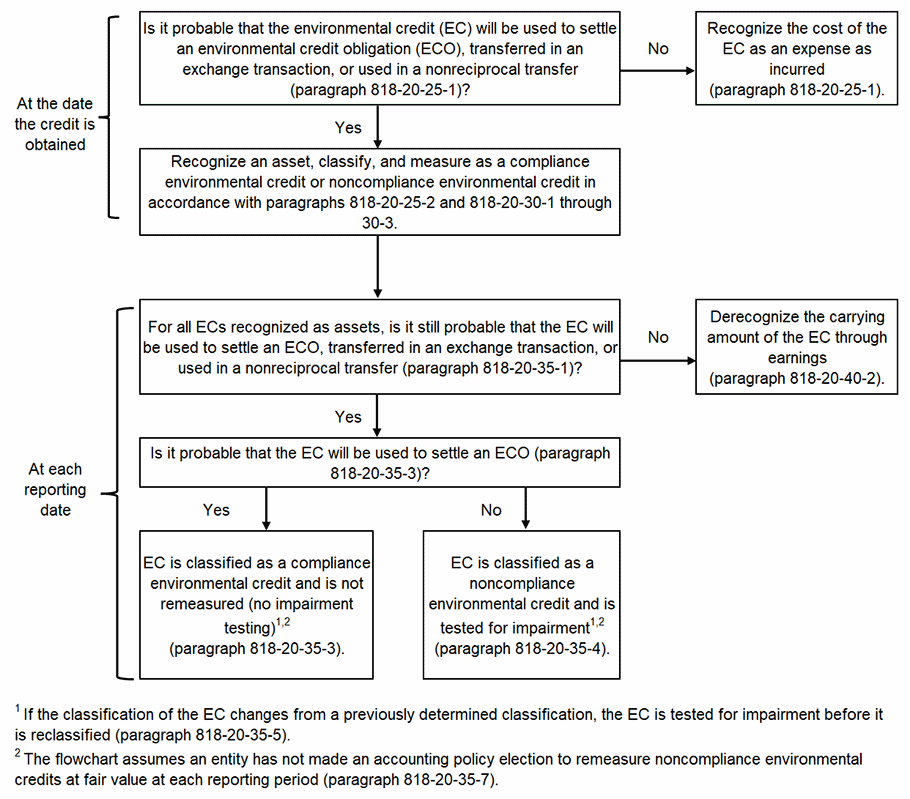
818-10-65-1The following flowchart illustrates the accounting requirements for environmental credits. The flowchart is a supplement to the guidance in this Subtopic, and it should not be interpreted to change any requirements of this Topic or be considered a substitute for those requirements.
At the date the credit is obtained Is it probable that the environmental credit (EC) will be used to settle an environmental credit obligation (ECO), transferred in an exchange transaction, or used in a nonreciprocal transfer (paragraph 818-20-25-1)? "No " "Recognize the cost of the EC as an expense as incurred (paragraph 818-20-25-1)." Yes Recognize an asset, classify, and measure as a compliance environmental credit or noncompliance environmental credit in accordance with paragraphs 818-20-25-2 and 818-20-30-1 through 30-3. At each reporting date For all ECs recognized as assets, is it still probable that the EC will be used to settle an ECO, transferred in an exchange transaction, or used in a nonreciprocal transfer (paragraph 818-20-35-1)? "No " "Derecognize the carrying amount of the EC through earnings (paragraph 818-20-40-2)." Yes Is it probable that the EC will be used to settle an ECO (paragraph 818-20-35-3)? Yes No "EC is classified as a compliance environmental credit and is not remeasured (no impairment testing)1,2 (paragraph 818-20-35-3)." "EC is classified as a noncompliance environmental credit and is tested for impairment1,2 (paragraph 818-20-35-4)." "1 If the classification of the EC changes from a previously determined classification, the EC is tested for impairment before it is reclassified (paragraph 818-20-35-5). 2 The flowchart assumes an entity has not made an accounting policy election to remeasure noncompliance environmental credits at fair value at each reporting period (paragraph 818-20-35-7)."
818-20-55-2
Transition date:(P) December 16, 2027; (N) December 16, 2028Transition guidance:
818-10-65-1Paragraph 818-20-25-1 requires that an entity recognize an environmental credit as an asset if it is probable that the environmental credit will be used to settle an environmental credit obligation, transferred in an exchange transaction, or used in a nonreciprocal transfer. That assessment of probability is a collective assessment whereby the evaluation is made on the probability of any of those events occurring. For example, an entity purchases an environmental credit that it will use to either settle an environmental credit obligation or transfer in an exchange transaction. The entity determines that there is a 50 percent likelihood that the environmental credit will be used to settle an environmental credit obligation and a 50 percent likelihood that the environmental credit will be transferred in an exchange transaction. Therefore, an asset would be recognized because collectively the likelihood of those outcomes occurring is probable.
818-20-55-3
Transition date:(P) December 16, 2027; (N) December 16, 2028Transition guidance:
818-10-65-1An entity does not need to have recognized an environmental credit obligation liability in accordance with Subtopic 818-30 to determine that it is probable that the entity will use an environmental credit to settle an environmental credit obligation because the liability may be recognized in a future period. In most instances, an entity will be able to readily determine whether it is probable that an environmental credit will be used to settle an environmental credit obligation, transferred in an exchange transaction, or used in a nonreciprocal transfer. The following factors may be helpful in determining whether it is probable that an environmental credit will be used to settle an environmental credit obligation, transferred in an exchange transaction, or used in a nonreciprocal transfer:
  1. a
    The entity’s purpose for acquiring the environmental credit
  2. b
    The quantity of environmental credits the entity owns compared with existing and expected environmental credit obligations
  3. c
    Expected events and activities that may change the entity’s need for compliance environmental credits in future periods
  4. d
    The entity’s past uses of environmental credits
  5. e
    Whether the entity would be committed to transfer in an exchange transaction any environmental credits in excess of those needed to satisfy an environmental credit obligation
  6. f
    An entity’s internal emission reduction initiatives.
818-20-55-4
Transition date:(P) December 16, 2027; (N) December 16, 2028Transition guidance:
818-10-65-1In accordance with paragraph 818-20-25-5, an entity is not required to apply the recognition requirements in paragraphs at the individual environmental credit level. For example, if an entity acquires 1,000 Class A renewable energy certificates, it evaluates whether it is probable that the renewable energy certificates will be used to settle an environmental credit obligation, transferred in an exchange transaction, or used in a nonreciprocal transfer. The entity determines that it is probable that it will use 900 of those renewable energy certificates to settle an environmental credit obligation and that it is not probable that it will use the remaining 100 renewable energy certificates to settle an environmental credit obligation, transfer the renewable energy certificates in an exchange transaction, or use the renewable energy certificates in a nonreciprocal transfer. Therefore, the entity recognizes 900 Class A renewable energy certificates as environmental credit assets, and the remaining 100 Class A renewable energy certificates are expensed as incurred.
818-20-55-5
Transition date:(P) December 16, 2027; (N) December 16, 2028Transition guidance:
818-10-65-1Paragraph 818-20-30-1 requires that an entity initially measure an internally generated environmental credit or an environmental credit received through a grant from a regulator or its designee(s) at the transaction costs incurred, if any. Transaction costs include costs such as those that are necessary to validate, register, or authenticate an environmental credit so that the environmental credit may be used to settle an environmental credit obligation, transferred in an exchange transaction, or used in a nonreciprocal transfer. If an entity does not incur transaction costs, the initial measurement of those environmental credits should be zero. That initial measurement should not affect whether an asset is recognized in accordance with paragraph 818-20-25-1 or whether the environmental credit is classified as a compliance environmental credit or a noncompliance environmental credit in accordance with paragraph 818-20-25-2. For example, a renewable energy certificate granted to an entity by a regulator that is determined to be probable of being used to settle an environmental credit obligation when received would be recognized as an asset and classified as a compliance environmental credit at initial recognition. That compliance environmental credit would be measured at zero if the entity does not incur transaction costs. Additionally, when that environmental credit is used to measure the funded portion of an environmental credit obligation liability, the liability also would be measured at zero.
818-20-55-6
Transition date:(P) December 16, 2027; (N) December 16, 2028Transition guidance:
818-10-65-1Paragraph 818-20-30-2 requires an entity that obtains an environmental credit in a transaction initially measured in accordance with another Topic to follow the initial measurement requirements of that other Topic. For example:
  1. a
    A renewable energy certificate received as consideration in a contract that is within the scope of Topic 606 on revenue from contracts with customers should be initially measured in accordance with paragraphs .
  2. b
    A carbon offset or renewable energy certificate received in a nonreciprocal transfer from an investee in a transaction that is within the scope of Topic 845 on nonmonetary transactions should be initially measured in accordance with that Topic.
  3. c
    An environmental credit received in a nonreciprocal transfer between entities under common control should initially be measured in accordance with paragraphs .
818-20-55-7
Transition date:(P) December 16, 2027; (N) December 16, 2028Transition guidance:
818-10-65-1Paragraphs permit an entity, as an accounting policy election, to subsequently measure a class of eligible noncompliance environmental credits at fair value at each reporting date, with changes recognized in earnings. An entity should determine what constitutes a class based on its facts and circumstances. Eligible noncompliance environmental credits are those obtained in an exchange transaction, received in a nonreciprocal transfer that is not a grant from a regulator or its designee(s), or acquired in a business combination. Environmental credits generated by the entity or received through a grant from a regulator (or its designee(s)) are ineligible for fair value measurement. For example, an oil refinery acquires 100 renewable identification numbers in an exchange transaction and is granted 20 similar renewable identification numbers from a regulator. The oil refinery determines that it is not probable that it will use the environmental credits to settle an environmental credit obligation because the entity intends to transfer in an exchange transaction all 120 of those noncompliance environmental credits. The 100 acquired renewable identification numbers are eligible for fair value measurement, and the 20 granted renewable identification numbers are not.
818-20-55-8
Transition date:(P) December 16, 2027; (N) December 16, 2028Transition guidance:
818-10-65-1Notwithstanding the requirements of paragraphs , an environmental credit subsequently measured at fair value in accordance with an entity’s accounting policy election should continue to be measured at fair value at each reporting date until the environmental credit is derecognized. For example, assume that an entity elects an accounting policy to subsequently measure a class of 600 eligible noncompliance renewable identification numbers at fair value at each reporting date. If the entity subsequently determines that it is probable that a portion (or all) of those 600 noncompliance renewable identification numbers will be used to settle environmental credit obligations, those renewable identification numbers would be reclassified as compliance environmental credits and would continue to be measured at fair value at each reporting date until derecognized. Therefore, measuring those compliance environmental credits at fair value would affect the measurement of the related funded portion of an entity’s environmental credit obligation liability measured in accordance with paragraph 818-30-30-2.

Illustrations

818-20-55-9
Transition date:(P) December 16, 2027; (N) December 16, 2028Transition guidance:
818-10-65-1Examples 1 through 4 illustrate the application of the recognition and measurement requirements of this Subtopic.
818-20-55-10
Transition date:(P) December 16, 2027; (N) December 16, 2028Transition guidance:
818-10-65-1An industrial manufacturing entity is subject to a cap-and-trade regulatory compliance program that mandates the remittance of emissions allowances to a regulator by March 31, 20X5, based on the amount of the entity’s emissions for a compliance year ending on December 31, 20X4. On January 1, 20X4, the entity purchases 10,000 emissions allowances at a regulator-sponsored auction for $1,000,000 ($100 per allowance) and pays $25,000 in auction fees. At initial recognition, the entity determines that it is probable that it will use those emissions allowances to settle its 20X4 cap-and-trade environmental credit obligation because it estimates that its emissions during 20X4 will require the remittance of 15,000 emissions allowances. The entity classifies the 10,000 emissions allowances as compliance environmental credits, initially measured at $1,025,000, in accordance with paragraph 818-20-30-3. Those emissions allowances are not remeasured if they continue to be classified, at each reporting date, as compliance environmental credits.
818-20-55-11
Transition date:(P) December 16, 2027; (N) December 16, 2028Transition guidance:
818-10-65-1A cloud-based software developer publicly announces its voluntary initiative to be carbon neutral for the fiscal year ending December 31, 20X4. The carbon neutral initiative of the cloud-based software developer does not represent an environmental credit obligation because it does not result from a regulatory compliance obligation under existing or enacted laws, statutes, or ordinances. Specifically, this voluntary initiative does not establish an environmental credit obligation. The entity purchases 1,000 carbon offsets for $50,000 on March 1, 20X4, to meet its voluntary initiative. Because it is not probable that the entity will use the acquired carbon offsets to settle an environmental credit obligation, transfer those carbon offsets in an exchange transaction, or use those carbon offsets in a nonreciprocal transfer, the entity recognizes the $50,000 as an expense as incurred on March 1, 20X4, in accordance with paragraph 818-20-25-1.
818-20-55-12
Transition date:(P) December 16, 2027; (N) December 16, 2028Transition guidance:
818-10-65-1An entity that owns a tree farm uses a nationally accredited third-party registry to certify the tree farm and issue carbon offsets. During January 20X4, the entity’s tree farm activities resulted in 30,000 carbon offsets issued to the entity by the registry. The entity pays $1 per carbon offset as an administrative fee to the registry. The entity determines that it is not probable that it will use the carbon offsets to settle an environmental credit obligation because it intends to sell all of the carbon offsets created as a result of its tree farm activities. The entity recognizes the carbon offsets as assets and classifies them as noncompliance environmental credits. Those noncompliance environmental credits are initially measured at $30,000, the amount of the transaction costs, in accordance with paragraph 818-20-30-1. In accordance with paragraph 818-20-35-9, an entity’s internally generated environmental credits are not eligible for the fair value measurement accounting policy election.
818-20-55-13
Transition date:(P) December 16, 2027; (N) December 16, 2028Transition guidance:
818-10-65-1A U.S. oil refinery is subject to a regulatory compliance program represented to control fuel emissions. The program requires fuel produced by the entity to include a minimum volume of fuel generated from renewable sources. The entity refines crude oil and conventional biofuel (renewable). During October 20X4, the entity refines 100,000 gallons of conventional biofuel, which results in 100,000 renewable identification numbers granted to the entity by the regulator in accordance with the program. The entity incurred no transaction costs to obtain the renewable identification numbers. The entity determines that it is probable that the renewable identification numbers will be used to settle an environmental credit obligation, transferred in an exchange transaction, or used in a nonreciprocal transfer and recognizes an asset that is initially measured at zero, in accordance with paragraph 818-20-30-1. Environmental credits received through a grant by a regulator or its designee(s) are not eligible for the fair value measurement accounting policy election in accordance with paragraph 818-20-35-9.
818-20-55-14
Transition date:(P) December 16, 2027; (N) December 16, 2028Transition guidance:
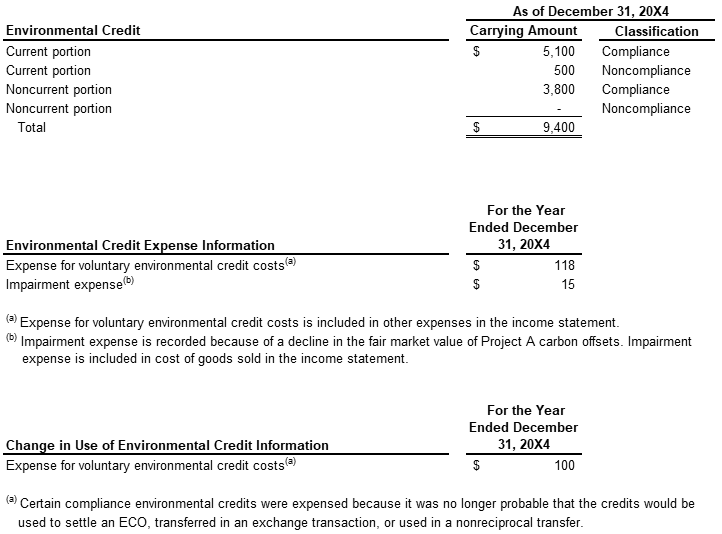
818-10-65-1The following is an illustration of the quantitative disclosures required by paragraphs for annual reporting periods. The format in the illustration is not a requirement, and the information should be formatted in the most understandable manner for an entity’s specific circumstances. This illustration does not illustrate comparative period disclosures.
As of December 31, 20X4 Environmental Credit Carrying Amount Classification Current portion $5,100 Compliance Current portion 500 Noncompliance Noncurrent portion 3,800 Compliance Noncurrent portion - Noncompliance Total $9,400 Environmental Credit Expense Information For the Year Ended December 31, 20X4 Expense for voluntary environmental credit costs(a) $118 Impairment expense(b) $15 (a) Expense for voluntary environmental credit costs is included in other expenses in the income statement. (b) Impairment expense is recorded because of a decline in the fair market value of Project A carbon offsets. Impairment expense is included in cost of goods sold in the income statement. Change in Use of Environmental Credit Information For the Year Ended December 31, 20X4 Expense for voluntary environmental credit costs(a) $100 (a) Certain compliance environmental credits were expensed because it was no longer probable that the credits would be used to settle an ECO, transferred in an exchange transaction, or used in a nonreciprocal transfer.

Related subtopics